The following notes were taken from the Tuesday, July 15th, 2025 Simulator User Group (SUG) meeting (“off week”). They form a summary of the items discussed, and are not intended to be a full transcript. The notes were taken from my chat log of the meeting – no video this week.
Meeting Overview
The Simulator User Group (also referred to by its older name of Server User Group) exists to provide an opportunity for discussion about simulator technology, bugs, and feature ideas.
These meetings are conducted (as a rule):
Every other Tuesday from July 8th, 2025, at 12:00 noon SLT.
Meetings are open to anyone with a concern / interest in the above topics, and form one of a series of regular / semi-regular User Group meetings conducted by Linden Lab.
Dates and times of all current meetings can be found on the Second Life Public Calendar, and descriptions of meetings are defined on the SL wiki.
The term “off week” is used to describe meetings held by Leviathan Linden on those weeks when a “full” Simulator User Group meeting is not scheduled to be held.
Simulator Deployments
There are no planned deployments to any channels this week, only restarts. Although the Main channel apparently had some issues on Tuesday July 22nd, leading to multi restarts for some regions.
In Brief.
Rider Linden is working on a few new script features that the moles need for an upcoming project. These mostly deal with land and being able to transfer or sell land using a script.
Pepper Linden has been working on a re-write of LL’s Conductor service, and is currently wrapping this up as it goes through QA. The Conductor service is responsible for placing regions onto servers, and the re-write is designed to allow the team responsible to more optimally place regions and prevent things like ‘hot-spots’ (e.g. one region on a host using more resources than it should and starving other regions of CPU time).
Signal Linden is working on number of projects:
Making “shovel-ready” tasks for open source contributors. This includes: bringing back legacy search; implementing drag-and-drop uploads; resizing large textures before uploading; etc.
Looking at bounty/reward platforms for compensating people for working on initiatives LL hasn’t got much traction on.
Getting budget approval for taking SLua to production and merging some “nice small fix-up PRs” on the LSL-definitions repo.
The idea in having a series of defined tasks for contributors is to have more people contributing upstream to the viewer and providing “ready to go” code and thus free the Lab’s core viewer team to focus on larger viewer projects.
Having the ability to replace mesh / prim HUDs with something more suitable was discussed. One suggestion has been the development of an HTML5/CSS/JS solution of some sort. However, this would require quite a bit of both viewer and server work; as such, a proof of concept from the community would go a long way towards getting some server attention on it.
Some concerns were raised about this leading to people having to connect to unknown external websites.
Another suggestion was for a small mobile subset of SVG within SL, although this is a potential awkward solution as it doesn’t allow thing like buttons lighting up on HUDS when moused-over.
This led to a discussion on options (HYML5, SVG, some form of modal system built-into the viewer, using MOAP / CSS, with various opinions being expressed.
glTF mech import:
As reported in my CCUG meeting notes, this is to go to “beta” with the next viewer update.
Full glTF scene import is regarded as “seriously deprioritised”, with Signal Linden expressing a preference for keeping it so until it can be implemented server-side.
There s a report that a change in the glTF uploader broke the glTF scene rendering. no further details available.
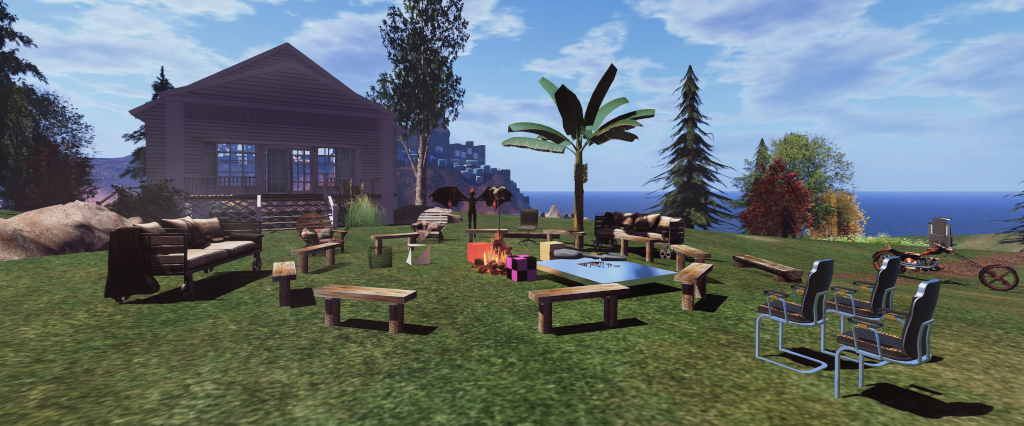
As of the next official meeting, the Simulator User Group will be at a new location (still TBC at the time of writing). What this should look like was a source of extended discussion, as was whether or not Simon Linden’s home (the meeting place until now) should be left intact or destroyed (“destroyed” won that part of the discussion).
Unofficial meeting (TBC): Tuesday, July 29th, Venue: TBC.
† The header images included in these summaries are not intended to represent anything discussed at the meetings; they are simply here to avoid a repeated image of a rooftop of people every week. They are taken from my list of region visits, with a link to the post for those interested.
Kondor Art Centre, July 2025: Angelika Corral – Seeing Without Seeing
In Japanese culture, names often convey profound meanings through kanji characters. One such concept conveyed by kanji is that of ‘hidden’, signifying mystery and secrecy, adding depth to a name. While I am no expert and am open to correction, I believe one such kanji is Inoru (“hidden”), which lends itself to a number of potential meanings in combination with other kanji, such that it might be used to form ideas such as hidden one, hidden village, hidden flower, and so on.
Another kanji is 祕, which can be taken as ‘secret’, ‘hidden’ and / or ‘conceal’, and at the Kondor Art Centre, Angelika Corral uses this Kanji as the focal point for what is a simply marvellous exhibition of black and white photography with a strong lean towards chiaroscuro, entitled Seeing Without Seeing.
Kondor Art Centre, July 2025: Angelika Corral – Seeing Without Seeing
Angelika has deep roots within the Second Life arts community as both as a curator of art and as a photographer. In the former role, she was a co-creator and operator of DaphneArts, in its time one of the foremost Second Life galleries in presenting exhibitions both ensemble and singular, which explored complex and rich themes.
As a photographer, Angelika works primarily in black-and-white, focusing on avatar studies noted for their depth and introspection, whilst carrying a richness of artistic technique and classic photography. Such is her skill, in 2022, she won Flickr/SmugMug’s World Photography Day award in the virtual photography category for I’m not just what you see, an award highlighting both her ability to craft compelling visual narratives within virtual environments and the validity of such environments as a vehicle for artistic expression.
Kondor Art Centre, July 2025: Angelika Corral – Seeing Without Seeing
The title of that winning piece actually resonates with the theme for Seeing Without Seeing, which Angelika describes thus:
This series is an invitation into the quiet … These images do not shout. They whisper. They leave space. They suggest rather than explain.
Inspired by traditional Japanese principles, these images aim to slow the act of looking. They are meant to be lingered [upon]. The subtle textures, partial forms, and quiet moments ask: what might lie just beyond the visible?
– Angelika Corral
Thus, within the images on offer, we are asked to look beyond the partial (and in places fragmented) nature of individual photographs and consider the nuances of framing, cropping, lighting and pose, and allow each piece and see what lies beyond, not what is presented in an of itself. To allow each each picture to talk to us in its own voice and listen to whatever narrative – or narratives – it might suggest.
Kondor Art Centre, July 2025: Angelika Corral – Seeing Without Seeing
Given the above, I am not going to offer my own interpretations here, but simply recommend Seeing Without Seeing to your own eyes. Just be sure to look closely and listen to what each piece might decide to whisper.
Bella’s Lullaby, July 2025 – click any image for full size
It’s been a year since I last visited Bella’s Lullaby, the homestead region design series by Bella (BellaSwan Blackheart). It is one of several of Bella’s designs I’ve always enjoyed visiting, presenting as it does various pastoral and rural setting for people to enjoy.
At the time of my last visit (see: Bella’s summer Lullaby in Second Life) it presented a varied landscape, surrounded my mountains and suggestive of somewhere in Norway (perhaps). Prior to that, in February 2024, the region lay as a windswept island setting, the location of a modest homestead and watched over by a squat lighthouse (see: A return to Bella’s Lullaby in Second Life).
Bella’s Lullaby, July 2025
Welcome to Bella’s Lullaby where the vast, rugged landscapes stretch as far as the eye can see and nature’s beauty unfolds in every direction. The wide-open spaces invite you to breathe deeply and soak in the serenity that surrounds you.
– Bella’s Lullaby About Land description
It is to this latter theme that the region has returned for summer 2025. Which is not to say the current iteration is in any way a simple rehash of the February 2024 design; whilst similar in nature, there are sufficient enough differences between the February 2024 and July 2025 designs to allow the imagination to suggest that both are separate but perhaps within the same group of islands.
Bella’s Lullaby, July 2025 – click any image for full size
Where these island might lie is a matter for you imagination. For me, the setting has always struck me as being somewhere off the coast of Scotland, perhaps among the inner islands there. Or of not, then perhaps tucked away somewhere along Europe’s Wadden or Baltic Sea coastlines. The land is low, devoid of trees, but with a soil rich enough to hold wild grass on which goats and horse might graze, and patches of wild flowers.
Wherever it might lie, this particular island is popular with birds; they are to be found throughout on rooftops, tables, fence posts, circling the lighthouse and elsewhere. Perhaps the island is along a migratory or feeding path; perhaps the bird were carried here by the wind – or perhaps they are keeping and eye on things.
Bella’s Lullaby, July 2025
Scattered across the island area number of cabins and shacks, some with strong suggestions of homeliness on the outside, but few furnished within (which is also not to say they are empty shells). Together they present the idea of a rugged settlement, the fires within offering warmth in the face of the cold winds which doubtless make their presence felt across the island.
As well as being watched over by birds, the island is home to roaming horses and goats, and someone is also raising chickens. Also spread across the setting are places to sit and pass the time.
Bella’s Lullaby, July 2025
Rugged and caught under what might be a late evening sky, or one seen just before first full light of the rising Sun, Bella’s Lullaby remains an engaging, photogenic visit.
Logos representative only and should not be seen as an endorsement / preference / recommendation
Updates from the week through to Sunday, July 20th, 2025
This summary is generally published every Monday, and is a list of SL viewer / client releases (official and TPV) made during the previous week. When reading it, please note:
It is based on my Current Viewer Releases Page, a list of all Second Life viewers and clients that are in popular use (and of which I am aware), and which are recognised as adhering to the TPV Policy.
This page includes comprehensive links to download pages, blog notes, release notes, etc., as well as links to any / all reviews of specific viewers / clients made within this blog.
By its nature, this summary presented here will always be in arrears, please refer to the Current Viewer Release Page for more up-to-date information.
Outside of the Official viewer, and as a rule, alpha / beta / nightly or release candidate viewer builds are not included; although on occasions, exceptions might be made.
Second Life Project glTF Mesh Import, version 7.1.14.15976006598 July 2 – No Change.
This is an early Alpha release with some of the rough edges and already resolved many bugs and crashes, although more are to be found, together with general feedback from the community. Please read the release notes if you intend to test this viewer.
Second Life Project Lua Editor Alpha (Aditi only), version 7.1.12.14888088240, May 13 – No Change.
Interstellar comet 3I/ATLAS seen moving against a backdrop of stars in a series of images captured by the 8.2-metre Very Large Telescope at Cerro Paranal on the night of July 4th, 2025. Credit: ESO Science Archive.
The solar system is welcoming its third (known at least – we have no idea how many may have passed through the solar system undetected down the ages) interstellar visitor. 3I/ATLAS, also known as C/2025 N1 (ATLAS), was identified on July 1st, 2025 as an interstellar comet. It is the third such object positively identified as having interstellar origins to pass through the solar system in the last eight years, the others being 1I/ʻOumuamua (discovered in October 2017) and 2I/Borisov (discovered in August 2019).
At the time of its discovery, 3I/ATLAS was some 4.5 AU (670 million km) from the Sun and moving at a relative speed of 61 km/s (38 m/s). It’s exact size is unknown, as it is behaving as an active comet and so is surrounded by a cloud of reflective gas and vapour. However, estimates put it to be somewhere between around 1 km and 24 km across – with its size likely to be at the lower end of this scale.
The object was located by the NASA-funded ATLAS survey telescope at Río Hurtado, Chile, and will reach perihelion in October 2025, when it will pass around the Sun at a distance of 1.3 AU. Following its initial discovery as a object moving through the inner solar system, there were concerns it would come close to Earth – and it was even designated a Near-Earth Object (NEO). However, checks back through the records of other observatories which may have spotted the object – such as the Zwicky Transient Facility – indicated 3I/ATLAS had been observed in mid-June 2025. These observations and those made by ATLAS confirmed the object to be of interstellar origin and on a hyperbolic path through the solar system that would not bring it close to Earth.
An animation of the hyperbolic trajectory of 3I/ATLAS (blue) through the Solar System, with orbits of planets shown. Credit: Catalina Sky Survey.
More recently, studies of the object’s track suggest that Comet 3I/ATLAS may pre-date the formation of our solar system by over three billion years, and that it appears to hail from the outer thick disk of the Milky Way, rather than the inner disk where stars like our Sun typically reside. The thick disk is where the majority of the Milky Way’s oldest stars tend to reside, and it is likely 3I/ATLAS originate in one of these ancient star systems.
Given spectrographic analysis of the object is rich in water ice, making it the oldest and most unique of our three known interstellar visitors to date. This water ice means that the comet is likely to become more active and reveal more about itself as it approaches and passes around the Sun and becomes more active. Observations will be curtailed as it passes around the Sun relative to Earth, but then resume as 3I/ATLAS starts its long journey back out of the solar system and back to interstellar space.
New Glenn to Launch EscaPADE on Second Flight
Blue Origin has confirmed that the second flight of its massive New Glenn launch vehicle will be to launch NASA’s Escape and Plasma Acceleration and Dynamics Explorer (EscaPADE) mission to Mars and the launch is scheduled for mid-to-late August 2025.
This mission had actually be scheduled to fly aboard New Glenn’s inaugural launch in late 2024; however, NASA withdrew it from the launch manifest in September 2024 when it became clear Blue Origin would be unlikely to meet the necessary launch window for the mission, so as to avoid the expense (and complications) of loading the necessary propellants aboard the EscaPADE vehicles and then having to off-load them again.
Since then, it has been unclear when the EscaPADE mission would launch – or on what vehicle. Speculation had been that the second launch of New Glenn – originally (and provisionally) scheduled for spring 2025 – could be used to send the mission on its way; However, this was not confirmed by either NASA or Blue Origin until the latter issued as formal confirmation on July 17th announcement.
The twin EscaPADE spacecraft in a clean room at Rocket Lab, the company responsible for building them on behalf of NASA, prior to being shipped to Kennedy Space Centre. Credit: Rocket Lab
Understand the processes controlling the structure of Mars’ hybrid magnetosphere and how it guides ion flows
Understand how energy and momentum are transported from the solar wind through Mars’ magnetosphere
Understand the processes controlling the flow of energy and matter into and out of the collisional atmosphere.
Each of the two satellites carries the same three science experiments to achieve these goals. Due to the relative positions of Earth and Mars at the time of launch, the craft will not be able to enter into a direct transfer orbit. Instead, they will initially target the Earth-Sun Lagrange 2 position (located on the opposite side of Earth’s orbit around the Sun relative to the latter), where they will loiter for several months carrying out solar weather observations. As a suitable transfer orbit from the L2 position opens, so the satellites will continue their journey, with a total transit time from Earth to Mars of around 24 months.
Annotated illustration of an EscaPADE satellite. Credit: NASA Scientific Visualization Studio
On initial arrival around Mars, Blue and Gold will enter a highly elliptical orbit that will be gradually lowered and circularised over a 6-month period, after which the science mission proper will begin. Both vehicles will then occupy the same nominal orbit whilst maintaining a good separation. After this, Blue will lower its apoapsis to 7,000 km and Gold will increase its own to 10,000 km, allowing simultaneous measurements of distant parts of the Mars magnetosphere for a period of some 5 months, after which the primary mission is due to end.
As well as EscaPADE, the New Glenn NG-2 launch will also fly a technology demonstration for commercial satellite company Viasat in support of NASA Space Operations Mission Directorate’s Communications Services Project, with the mission serving as the formal second certification flight to clear New Glenn to fly US national security missions. As with the first flight of the vehicle, Blue Origin will attempt to have the first stage of the booster for landing on the company’s floating landing platform Jacklyn.
AX-4 Crew Return to Earth
In my previous Space Sunday, I wrote about the Axiom Ax-4 private mission to the International Space Station (ISS). Well, two weeks have passed and the 4-person crew is back on Earth. The mission had been scheduled for a minimum of 14 days and – as I’ve reported – the mission was subjected to a series of delays prior to launch.
As such, it was perhaps somewhat fitting the crew’s return was slightly delayed, with Grace, their SpaceX Crew Dragon, departing the space station at 11:15 UTC on July 14th, to commence a gentle return to Earth over a period of almost 24 hours, splashing down off the coast of California on July 15th.
The slow return was in part to allow a Pacific splash-down, avoiding the need for the Crew Dragon to re-enter the atmosphere over the US mainland, as would be required were the vehicle to make a splash-down in the Atlantic, as has been the case with the majority of past Crew Dragon missions. The reason for this is that there have been several occasions where pieces of a Dragon “Trunk”- the service module – surviving re-entry into the atmosphere to come down close to – or within – populated areas.
An infra-red image made from video provided by SpaceX, showing the bright white dot of Crew Dragon Grace dissipating the heat of re-entry and suspended below four good main parachutes, shortly before splash-down off of the coast of California by the Axiom Ax-4 mission very early in the morning (PST) on Tuesday, July 15th, 2025. Credit: SpaceX
In all the international crew spent two and a half weeks on the ISS carrying out some 60 experiments and technology demonstrations which involving 31 different nations, and also carried out a series of public outreach events. The mission went a long way towards increasing Axiom’s experience in on-orbit operations ahead of plans for the company to start operating its own station as the ISS reaches its end-of-life.
This mission marked the first time in space for the three male members of the crew – Shubhanshu “Shux” Shukla from India; Tibor Kapu, a member of HUNOR, Hungary’s orbital astronaut programme which operates independently of Hungary’s involvement with the European Space Agency (ESA); and Sławosz “Suave” Uznański-Wiśniewski, from Poland, who is an ESA astronaut. It also marked mission Commander Peggy Whitson, a former NASA astronaut and now Axiom’s director of human spaceflight, extending her record for cumulative days spent by an American in space to 69 days across five missions.
Starliner Flight: 2026, and No Crew
As Boeing and NASA continue to work on the problems affecting the former’s CST-100 Starliner crew vehicle, the US space agency has indicated that, despites hope to slot a possible re-flight for Starliner into 2025, the next mission will almost certainly not come before 2026 – and is likely to be uncrewed.
Starliner’s last mission was the first to fly with a crew aboard, after two previous uncrewed test flights. However, despite the overall success of that first crewed flight, the Starliner vehicle had a series of issues with its thrusters systems which, whilst not critical, caused NASA to opt to instruct Boeing to return the vehicle – comprising the capsule Calypso and its service module (which mounted the problematic thrusters systems) – under automated means; leading to the inevitable (and largely inaccurate) claims that the crew – Barry “Butch” Wilmore and Sunita “Suni” Williams – were “stranded” in space and in need of “rescue”.
The core issue with the vehicle’s thrusters has been identified as a design flaw with seals within the vehicle’s fuel lines and helium purge systems, which NASA and Boeing are now working to resolve. Part of the problem here is related to the fact that the vehicle’s multiple thrusters are grouped into four close-knit sets set equidistantly around the circumference of the vehicle’s service module, in what are called “doghouses”. These units experienced unexpected temperature spikes during the 2024 Crewed Flight Test, exacerbating the issues with the seals on the thrusters failing / causing valves to stick.
A CST-100 Starliner service module showing one of the four problematic thruster assembles (bordered by blue stripes) without its “doghouse” cover. Credit: Boeing.
The doghouse system has already seen a number of improvements since the Crew Flight Test, and the focus is now on developing seals in the thruster system valves so they can better hand the stresses and remaining heat issues. This work means that no Starliner vehicle will be ready for a 2025 launch. Further, such is the schedule for 2026 ISS missions that slotting a crewed test of Starliner in that year is liable to be difficult. NASA are therefore looking to conduct a further uncrewed flight – but rather than it be merely a flight test, the plan is to have the vehicle fly cargo to the ISS, making it an “operational” mission.
The following notes were taken from my audio recording and chat log of the Content Creation User Group (CCUG) meeting of Thursday, July 17th, 2025. Please note that this is not a full transcript, but a summary of key topics, and timestamps are to the official video, embedded at the end of this report.
The CCUG meeting is for discussion of work related to content creation in Second Life, including current and upcoming LL projects, and encompasses requests or comments from the community, together with related viewer development work.
This meeting is generally held on alternate Thursdays at Hippotropolis.
Dates and times of meetings are recorded in the SL Public Calendar, and they are conducted in a mix of Voice and text chat.
Second Life Project glTF Mesh Import, version 7.1.14.15976006598 July 2 – No Change.
This is an early Alpha release with some of the rough edges and already resolved many bugs and crashes, although more are to be found, together with general feedback from the community. Please read the release notes if you intend to test this viewer.
Second Life Project Lua Editor Alpha (Aditi only), version 7.1.12.14888088240, May 13 – No Change.
This project is moving into beta testing, and the updated viewer for beta testing is currently with QA, and should appear on the Alternate Viewers page “pretty soon”.
Again, as a reminder this project is providing the overall functionality available for uploading COLLADA .DAE files to the upload of glTF mesh files. As such all current constraints will continue to exist within this work.
Enhancements will be coming (and Feature Requests have been received for things like increased tri counts and vertex limits), but are regarded as a separate tranche of work.
[Video 4:50-6:00] A request was made for enhancements to the convex physic hull limits (e.g. number and complexity). This would require simulator-side changes, as some of the constraints are enforced server-side, and are “fundamental” to how Second Life works.
There is no work currently being planned around this.
In general it was considered something that might be better tackled if / when the Lab gets to “re-doing” SL’s internal mesh format.
Lighting Discussion
[Video 6:05-7:40] Light and particle exclusion volumes – the question was asked that as SL now has water exclusions “volumes”, how hard would it be to do the same for lighting and particles (e.g. to prevent lighting in one room bleeding into another).
In actual fact, SL does not currently support water exclusion volumes – it only supports water exclusion surfaces, which operate more-or-less in 2 dimensions to “hide” water”, rather than excluding it from a volume area.
Geenz noted that water exclusion and light / particle exclusions are “very different” in nature, with water exclusions surfaces being handled by a dedicated rendering pipe, and both light and particles requiring their own specific solutions.
He further noted that for lighting, other engines typically support linking a light source to a volume, constraining the light to it. SL does not have that capability, and while it would not be impossible to enable it, the work would be non-trivial, and is not something being looked at. His preferred approach would be to get shadows working more efficiently and at a larger scale.
[Video: 10:39-11:25] Related to the above, it was noted that non-shadow punctual lighting could help with lighting / darkness / shadow issues. These had been something Runitai Linden had started to look at prior to departing the Lab; in Geenz’s view, a means to determine which lights should / should not cast shadows might offer a partial solution.
[Video: 12:17-13:43] Geenz also noted there are been several requests on Canny for lighting improvements, and he would like to get some work on lighting prioritised. However, there is a large amount of work already identified for the viewer, and so prioritising and further work has the be done “carefully”.
He also noted issues with point lights were noted (fall-off being incorrect; the light radius tends to exceed the value set; point light penetrate objects far too much, etc), and suggested they could potentially benefit from a revisit at some point.
[Video: 24:36-25:30] Would it be possible to create a reflection probe-like if volume and assign an EEP setting to it?
There is no means to do this directly, but in theory could be done via LSL.
Rider Linden noted that by using an Experience, it is possible to trigger EEP settings for individual agents, which might achieve something similar.
Pathfinding’s future is still up in the air, with no final decision taken as yet. Currently all that is being looked at is the removal of the Havok sub-library from the viewer, which impacts Pathfinding.
This sub-library is used for two purposes:
For convex decomposition in mesh uploads.
Visualising / managing the Pathfinding Navmesh.
In terms of mesh uploads, there are alternative open-source libraries which could be used in place of Havok. Some of these alternatives are already being used by TPVs in preference to having to obtain a Havok sub-library licence from LL, and Geenz noted that a Pull Request from any viewer using such an alternative would be “welcome”.
Using Havok in the viewer purely for visualising the Navmesh is seen as overkill, again considering there are potential alternatives which could be used.
Philip Linden noted the need to reduce the amount of technical debt in the codebase, and removing Havok from the viewer would assist in this.
As far as Pathfinding as a whole is concerned, Geenz reiterated that currently, the Lab is not looking to completely deprecate it (both within the viewer and on the server-side); all that is being discussed at present is the need to remove Havok from the viewer.
An ancillary question asked by Rider linden was how many people at the meeting actually used Pathfinding characters, as opposed to NPCs using llGetStaticPath (which appears more popular, given the 15LI penalty and overall complexity of build Pathfinding characters).
In Brief
Please refer to the video as well.
[Video: 3:14-4:10] There is some work going into “beefing up some frame time metrics” – this will mean the viewer’s Statistics Floater (CTRL-SHIFT-1) will be updated with “a lot more” statistics going forward.
Some of this work will be surfaced in the next update to the glTF Mesh Upload RC viewer.
How many of the new stats are to be tracked in real-time is still TBD within the Lab.
[Video: 8:05-8:40] In terms of water exclusion volumes, this work has not yet bee prioritised and would required co-ordination between the simulator and viewer teams as it would require the passing of new object flags in order to work properly.
Improvements to Screen Space Reflections (SSR) on water are currently on hold pending the work on gathering better frame time metrics to be sent to the logs (how often is a user’s frame rate significantly dipping, for example), rather than just logging a user’s frame rate at the time they log-off.
The work that has been done on water SSR also still needs some further polish.
Overall the aim is to offer real-time reflections on any surface without it being a “gigantic frame rate killer”.
Other things that Geenz would like to bring back include shoreline fading, which had to be disabled due to alpha rendering issues – but this kind of work may have to wait for expanded EEP settings for water.
[Video: 37:04-48:24] A discussion on “lag”, and the (still common) assumption that most of it is simulator-side, and thus LL’s problem, rather than the viewer becoming overloaded thanks to people’s proclivity to jam-pack their avatar with complex meshes, multiple attachments, high-resolution textures, etc., thus impacting their own system’s performance (and potentially that of the people around them).
Geenz acknowledged that there is more LL could do to allow people to better quantify the impact they are having on themselves and others, vis à vis their avatar outside of the (inaccurate) avatar complexity system.
A problem here is that whether provided via options in the viewer, documentation, etc., people will ignore recommendations, warnings, reminders, etc.
Potential approaches to helping people understand the impact of the avatar include: indicating how much of their VRAM their Avatar is absorbing; having a meter display over their avatar’s head indicating the level of impact on general performance their avatar is having (both of which would only be visible to the user viewing them – and not to everyone else).
Technical solutions which might also help and under potential consideration for future implementation include texture streaming.
This discussion also encompassed the deficiencies with the ARC (Avatar Render Cost calculations & figures, and regulating the tension between people dressing their avatars so that they are resource-intensive to render, then going to a club or social venue and then dragging down the performance experienced by other users vs. allowing the venue owners to have the ability to set an “upper limit” on how resource-intensive avatars entering their club can be in order to preserve an experience that can be enjoyed by everyone.
The first 10 minutes of the meeting included a largely text-based discussion on the physics engine and viewer freezes. In short, there are no planes to change the physics engine, and the kind of viewer freezes experienced by SL as physics calculations are carried out are not uncommon within platforms using user-generated content (UGC), so trying to replace the current Havok engine (or even updating it) would not necessarily solve these issues.
A discussion between a user and Geenz concerning an EEP setting setting and use of an RGB cloud map, and whether this is supported. No definitive answer, other than Geenz would need to investigate.
The end of the meeting touched on SL Mobile issues and Project Zero – these are covered in other user group meetings.





 Inara Pey: Living in a Modemworld