Space Sunday: exoplanets, helicopters and telescopes

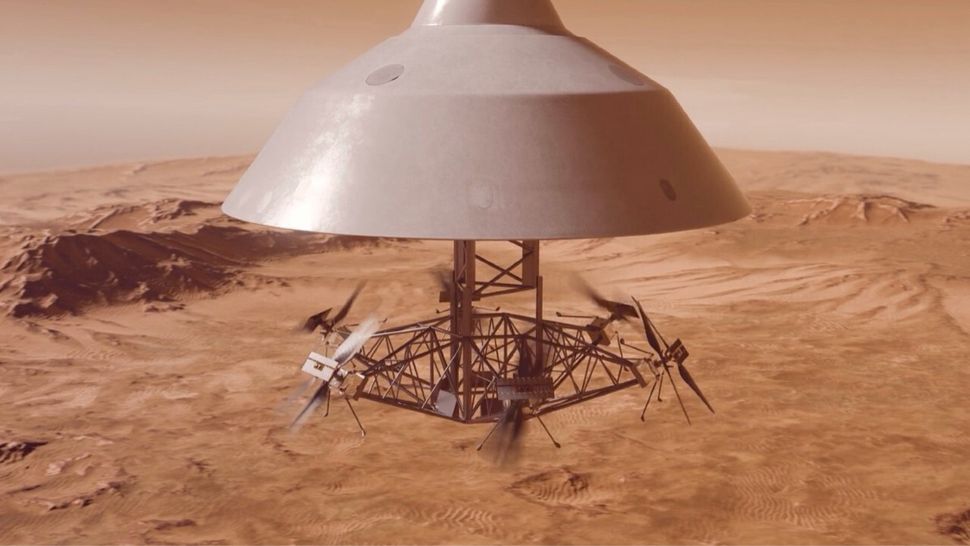
An artist’s impression of the Skyfall concept mission about to deploy its helicopters over Mars. Credit: AeroVironment – see below for details

Multi-planet star systems are of considerable interest to astronomers, as they offer opportunities for comparative study which might answer questions about the formation and development of solar systems like our own. They can also help astronomers better understand star system architectures in general, help us gain more understanding of the nature of other planetary systems and the potential for life elsewhere in the galaxy, and so on.

This is why the discovery of the seven planet TRAPPIST-1 system caused such interest in 2016 onwards (see here for more), together with the Kepler-90 system (see: Space update special: the 8-exoplanet system and AI). Now there is confirmation of a further candidate for intriguing study, the rather boringly-called L 98-59.

Located in the southern hemisphere sky, within the constellation of Volans, L 98-59 is some 34.6 light-years from our Sun. An M3 red dwarf star with around 0.3 solar masses, it measures approximately 0.31 solar radii. This week it was confirmed as being the home to a family of at least five planets. Three of these – L 98-59 b, c, and d were located by NASA’s Transiting Exoplanet Survey Satellite (TESS); then in 2021 a fourth non-transiting planet (i.e. one orbiting a star but which does not cross directly between the star and our solar system was located, with hints of a second potentially orbiting the star.

An artist’s impression of the five planets of L 98-59, seen from over the top of the outermost planet in the system. Credit: Benoit Gougeon, Université de Montréal

The fourth planet, labelled L 98-59 e was confirmed using the transit timings method and the ESO ESPRESSO system, with the fifth planet –L 98-59 f was finally confirmed this year, using the ESO HARPS system and the radical velocity method – which also suggested a sixth planet might be lurking in the system.

Given the size of their parent star, all of the planets occupy orbits very close to it. L 98-59 b orbits its parent every 2.25 terrestrial days and has an Earth-like density; but is only about 84% Earth’s mass and half its size. L 98-59 c is slightly larger than Earth, its radius being around 1.3 that of Earth, with approximately twice the mass; it orbits its star every 3.7 terrestrial days. The fourth planet, L 98-59 e is roughly the same size as L 98-59 c, but with 2.8 Earth masses and takes 12.8 terrestrial days to complete an orbit. All three of these worlds suggest they are rocky and potentially volcanic in nature, although they do not appear to have significant atmospheres.

Sitting between L 98-59 c and e, and orbiting its parent every 7.4 days, is L98-59 d, which is believed to be a hycean (water) world with around 30% of its total mass made up of water. Reports on its atmosphere vary, and it is around 1.6 Earth radii in size and has 1.6 Earth masses. The newly-confirmed planet, L 98-59 f, is in the optimistic habitable zone of the star. It has a minimum mass of about 2.80 Earth masses, about 1.4 Earth radii, and follows a 28 day orbit.
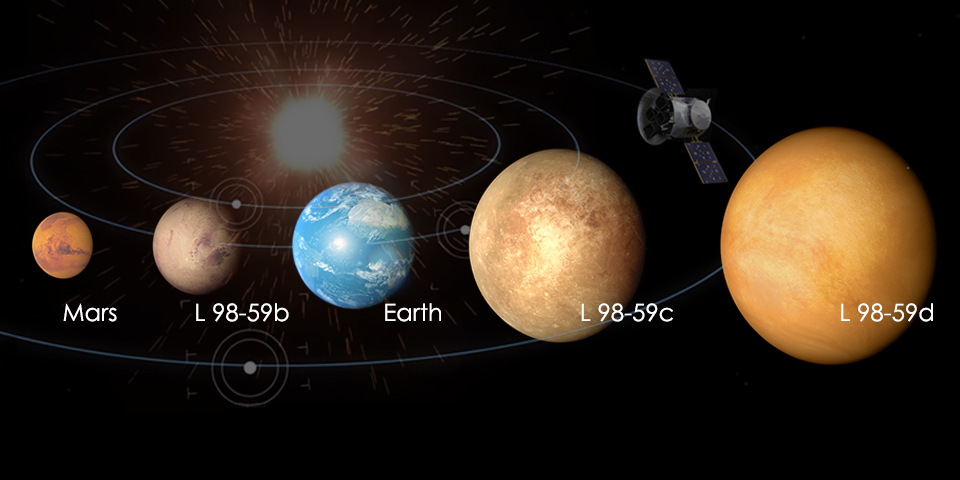
An artist’s impression of the sizes of the three planets located by NASA’s TESS orbiting L 98-59, compared to Mars and Earth.  Credit: NASA’s Goddard Space Flight Centre

One of the most interesting things about this system is that all the planets follow near circular orbits. This means they’re amenable to atmospheric spectroscopic studies by the JWST or other telescopes. Their comparative sizes also offer an opportunity to answer some key question, such as: what are super-Earths and sub-Neptunes made of? Do planets form differently around small stars? Can rocky planets around red dwarfs retain atmospheres over time? The fact that there appears to be both a hycean world and a world located within the star’s nominal habitable zone presents opportunities for studying potentially habitable worlds orbiting low-mass stars.

This latter aspect is of significance, as habitable environments within planets orbits low-mass stars like L 98-59 (and indeed, those around the likes of TRAPPIST-1) is highly contentious. Firstly, while they are long-lived and can enter into a stable maturity, red dwarf stars can also be subject to massive solar flares which, given how closely their planets orbit them, could easily rip away atmospheres make it that much harder for life to gain a toe-hold.

Additionally, because of their close proximity to their parent star, these planets are liable to be tidally locked, always keeping the same side pointing towards the star. This could play havoc with any atmosphere such a planet might have, the star super-heating the side facing it whilst the planet’s far side remains frigid and dark, potentially limited any habitable zone on the planet to the pole-to-pole terminator between the two sides of the world.

Joining a select group of relatively nearby planetary systems, L 98-59 is to become the focus of some intense study through the likes of the James Webb Space Telescope.

Skyfall: Dropping Helicopters on Mars?

Building on the success of the Ingenuity  helicopter delivered to Mars as a part of NASA’s Mars 2020 exploration programme (and covered extensively in these pages), Skyfall is a new mission concept being proposed by NASA’s Jet Propulsion Laboratory and their principal partner with Ingenuity, AeroVironment.

Were it to develop into a mission, Skyfall would see a total of six Ingenuity-class helicopter drones delivered to Mars and deployed in a manner indirectly drawing on the Skycrane system used to deliver the Mars Science Laboratory rover Curiosity and the Mars 2020 rover Perseverance to the surface of Mars.

An artist’s impression of one of Skyfall’s Ingenuity-class helicopter drones falling free of the aeroshell which help protect them on the trip to Mars and entry into the Martian atmosphere. Credit: AeroVironment

Skyfall would see the six helicopters carried to Mars within a protective aeroshell and heat shield. Once within the Martian atmosphere and descending under a parachute, the heat shield will be jettisoned and a “launch tower” extended below the aeroshell, allowing the helicopters to start their motors and fly clear of the aeroshell to start six individual but parallel missions.

By releasing the helicopters in the air, the mission avoids the need for a complex landing and deployment system, in theory reducing both mission complexity and cost – although there are obvious challenges involved in making aerial launches from under a descending platform.

The six drones would be enhanced versions of Ingenuity, charged with a variety of tasks including recording and transmitting high-resolution surface images back to Earth, using ground-penetrating radar to investigating what lies under the surface they overfly – such as potential pockets of water ice that could greatly assist future surface operations -, and identifying possible landing sites for future human missions to the Red Planet.

Like Ingenuity, the six drones would be capable of landing in order to use solar arrays to recharge their battery systems. However, exactly how far each vehicle will be able to fly between landings has not been defined, nor has their total mass, or the portion of that mass given over to science instruments and battery packs. If the concept progresses, these details will doubtless be defined and made public. As it is, AeroVironment has begun internal investments and coordination with NASA’s Jet Propulsion Laboratory to facilitate a potential 2028 launch of Skyfall.

NASA to Lose 3,900 Personnel and Gains a new Acting Administrator

For the last couple of weeks, rumours have been circulating that a large number of NASA personnel has applied to take the Trump administration’s “deferred resignation” offer, by which staff can go on paid administrative leave until such time as an actual departure date can be agreed.

The numbers had been put at somewhere between 3,500 and 4,000 personnel – many from senior management and leadership roles. Some of the rumours had been played down by the current temporary NASA senior administrator, but on July 25th, the date the offer of “deferred resignation” closed, NASA News Chief Cheryl Warner confirmed a total of around 3,900 personnel – 20% of the total workforce – have, or will be departing.

The figure might yet be subject to adjustment (up or down) as a post-offer analysis is carried out to ensure that those applying for deferred resignation do not impact the agency’s focus on safety and the Trump-demanded focus on sending humans to the Moon and Mars.

Sean Duffy, official portrait, 2025, via Wikipedia

At the same time as the rumours of the workforce cuts started circulating earlier in July, the Trump Administration further caught NASA off-guard by announcing that secretary of transportation Sean Duffy will be taking over as interim NASA Administrator until a permanent appointment can be made. The announcement came just days after Trump abruptly withdrew nominee Jared Isaacman from the running just ahead of his expected confirmation, allegedly as a result of Trump’s public spat with Elon Musk.

No-one at NASA headquarters was informed of the decision ahead of Trump’s social media announcement. It had been expected that existing acting administrator, Janet Petro, would remain in place until a suitable nominee was put forward in Isaacman’s stead. Whilst not a part of the Trump administration, Petro has tended to move in the direction the administration wants with regards to NASA – such as encouraging workforce reduction through early retirements, etc., – and had been regarded within the agency as a safe pair of hands.

A television presenter turned prosecutor turned politician, Duffy is primarily known as a vocal supporter of Donald Trump and his various policies, notably in the areas of decrying climate change, and diversity and equality in employment.

Some have attempted to paint his appointment positively, stating he could bring NASA the kind of direct access to the White House Petro lacks. However, others seen his appointment as a means of forcing through changes at NASA that are in line with Trump’s goals of reducing spending on science and R&D, and focusing only on human missions to the Moon and Mars.

Spain to the Rescue?

The Thirty Metre Telescope (TMT) has been in development since the early 2000s – and if it ever gets built, it will be the second largest optical / infrared telescope in the world, with an effective primary mirror diameter of 30 metres. Only the European-led Extremely Large Telescope – ELT – will be larger, with a primary mirror effectively 39 metres across.

A computer rendering of the Thirty Metre Telescope complex on Mauna Kea. Credit: TMT Corporation

Primarily a US-led project but with strong international involvement from Europe, Canada, Japan, India and even China, the TMT has been beset by problems. Most notably, these have involved protests over the proposed location for the observatory – on Mauna Kea, Hawaii, within the area designated the Mauna Kea Observatories Grounds, and home to 13 other astronomical facilities. However, Mauna Kea is also a sacred site and largely conservation land, and the telescope, coupled with all the environmental impact that it would bring, was seen as a step too far by many, and a battle has been waged back and forth for some 16 years, preventing any construction from proceeding.

In 2019, a proposal was made to have the TMT built in Las Palma in the Canary Islands. This was initially approved by the Spanish authorities, but has also been subject to objections. Some of these again relate to the environmental impact of such a massive construction project, but there are also astronomical objections as well; in particular, La Palma does not have the same elevation as Mauna Kea, meaning that high atmosphere water vapour could limit much of the telescope’s infrared operations (water vapour tends to absorb light in the mid-infrared spectrum).

Most recently, TMT has been under threat due to the Trump Administration’s cuts to the National Science Foundation’s budget (the NSF having the remit of oversee the construction and operation of the TMT), with the telescope directly singled-out for cancellation – and this despite the fact that China and India have agreed to meet the lion’s share of the estimated US $1 billion construction cost, and Canada offering to contribute US $24.3 million a year over ten years for the telescope’s operation.
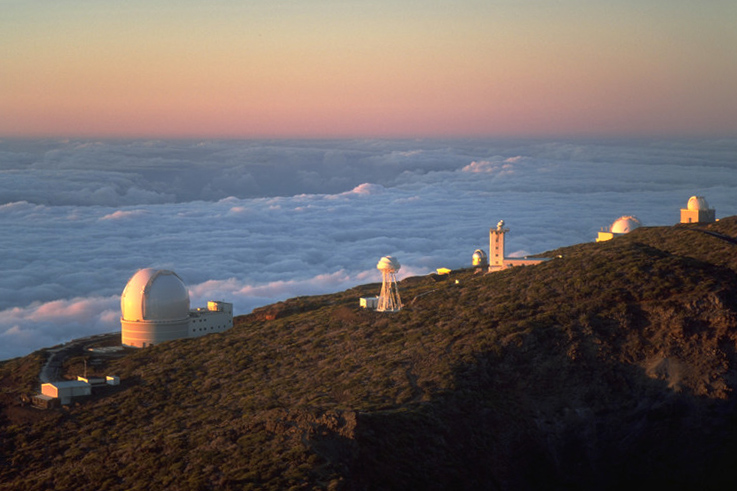
Several observatories already located at La Palma’s Roque de los Muchachos Observatory. From left: Carlsberg Meridian Telescope; William Herschel Telescope (domed); Dutch Open Telescope; Mercator Telescope (silver dome, just visible); Swedish Solar Telescope (solid tower); Isaac Newton Telescope (domed, second from right); Jacobus Kapteyn Telescope (far right). Credit: Bob Tubbs

Now the government of Spain has stepped in, offering to commit US $471 million (400 million Euros) towards the telescope’s operating costs – if the US agrees to have the facility located on La Palma. It’s not clear how the US will respond to the offer – or what can be done over the possible limitations of TMT’s infrared mission. However, TMT is also seen as critical to providing very large optical telescope coverage of the whole sky, with the TMT covering northern skies and the Giant Magellan Telescope (GMT), based in Chile to cover the southern skies, with the two intended to work in collaboration and with Europe’s ELT (also in the southern hemisphere).

GMT has a significant advantage over TMT in that its location is not controversial, allowing construction to go ahead to a point where the National Science Foundation has given the Trump administration a guarantee the project can be completed to reach operational status without the need for additional funding in 2026. Thus there have been no calls for its cancellation.

Raven’s Bay: autumn and a touch of alchemy in Second Life

Raven’s Bay, July 2025 – click any image for full size

Sam Rougefeu, curator of the destinations SL blog, pointed me toward Raven’s Bay, a homestead region held and designed by Lilly Blackwood. Open to the public, it’s and engaging location with a hint of alchemy about it.

An island of mystery and magic. Explore the trails, meet friends at the café, dance on the beach, explore the Paranormal Academy!

– Raven’s Bay About Land

Raven’s Bay, July 2025

Caught in the onset of autumn, Raven’s Bay is another of those settings that bucks the trend of aligning its design with the northern hemisphere seasons; the golds and oranges present in some of the foliage is matched by the rusty folds of hills and ridges across part of the landscape to create what is largely a tranquil setting.

The Landing Point sits just offshore within a large bay cutting into the landscape from the west, watched over by a tall lighthouse raised on the bay’s northern headland. A short walk along the boardwalk from the landing point sits the squat form of an old castle.

Raven’s Bay, July 2025

This home to the Raven’s Bay Apothecary and Paranormal Academy, the latter of which appears to offer refreshments – but perhaps these should be treated with caution, given the way the biscuits are decorated and the labelling on the tea pot!

To reach the castle, visitors must cross a ribbon of single-track road. This connects to two further hoops of road as they loop around the northern and southern side of the region, with latter connecting to a spur of track running up to the sandy headland of the bay’s southern side.

Raven’s Bay, July 2025

These roads make it easy to circumnavigate the setting using either one of the bikes or Segway-style personal transports available from the rezzers outside of the Raven’s Bay Apothecary. For those of a more magical disposition, broomsticks are available for transport as well (not you will be asked to allow the AV Sitter Experience for seamless use of the broomstick).

Following the roads will reveal both the island beauty and its points of interest. The latter include the aforementioned beach, which runs part-way along the region’s southern coast; the statues places along the roadside at various points; the local café (which likely offer more palatable beverages and treats than the arsenic tea and poison biscuits offered elsewhere 🙂 ).

Raven’s Bay, July 2025

There are also two tree-lined footpaths awaiting discovery. The first is fairly easy to find, extending as it does from the far side of the tunnel running through the castle and visible from the Land Point. It leads to a smaller bay on the east, and the gazebo built out over it. The second runs to one side of the castle (and helpfully signposted “Nowhere”! 🙂 ). It leads to an old chapel and gazebo, the former of which looks like godly worship is no longer its primary aim.

For those who are seeking something spiritual, a place to stop might be at the round ruin on the north side of the region, where Buddha awaits and cushions are set-out for meditation – or for simply passing the time.

Raven’s Bay, July 2025

With places to sit throughout, together with dancing, the hint of a coastal swamp, Raven’s Bay has a lot to offer visitors and photographers, and is finished with an appropriate sky setting and environment, as well as being rich enriched with a natural soundscape.

In all, a very worthwhile place to visit.

Raven’s Bay, July 2025

SLurl Details

2025 Week #30 Project Zero User Group Meeting

via Linden Lab
The following notes were taken from the Thursday, July 24th 2025 Project Zero User Group (PZUG) meeting.

  • They are based on the official video of the meeting (embedded below) + my chat log.
  • They should not be taken as a full transcript of the meeting.
Table of Contents

Meeting Purpose

  • The Project Zero User Group provides a platform  for open discussion about Project Zero, the cloud-streamed version of the Second Life Viewer. Topics can range from sharing the goals for Project Zero, demoing the current experience, and gathering feedback to help shape the future of cloud access for Second Life.
  • These meetings are conducted (as a rule):
    • The second and fourth Thursday of every month at 13:00 noon SLT.
    • In Voice and text.
    • At the Hippotropolis Campsite.
  • Meetings are open to anyone with a concern / interest in the above topics, and form one of a series of regular / semi-regular User Group meetings conducted by Linden Lab.
  • Dates and times of all current meetings can be found on the Second Life Public Calendar, and descriptions of meetings are defined on the SL wiki.

Resources

Recent Updates

[Video: 0:00-7:48; initially no sound on the video, as local chat is being used]

  • LL continue to experiment with sending some new users accessing SL via Project Zero to different start locations.
    • Part of July saw these users directed to the sandbox of the Welcome Hub; currently, they are being directed to Ahern.
    • LL is paying attention to what new users do when they get there and how likely they are to come back.
    • There is an intentional move to avoid traditional tutorial zones with these users, primarily because these tutorial areas are focused on the Desktop viewer, and Project Zero, within its emerging UI is starting to differ from the Desktop viewer.
      • There may in the future be a tutorial area designed specifically for Project Zero.
    • Suggestions for other locations new users could be sent to were sought.
  • Work is being carried out to move Project Zero’s Go menu to a sidebar within the browser window, so it operates in a similar manner to the Avatar Picker.
    • The number of available locations on the Go menu may also be expanded to more than three choices.
  • A focus remains on helping new users how to better understand avatar customisation and making new avatars.
  • A further focus is the development of a new web-based (presumably React / HTML5, as has been previously discussed) UI for Project Zero. This is designed to be a simplified UI specifically aimed at encouraging new users to give SL a try.

General Discussion

  • The general discussion revolved in part around further questions of a similar nature asked of users in the July Web User Group meeting. previous meeting: what was your first purchase; have you ever used a complete avatar; what originally brought you to Second Life; why did people say; were the first things you obtained in SL purchased or free; how did people obtain their first Linden Dollars (purchased, camping, etc), etc.
    • Obviously the responses were mixed, and mostly given in text chat.
    • his being the case, please refer to the video.

Date of Next Meeting

An Update from Linden Lab

On Thursday, July 24th, Linden Lab held a Zoom Call with bloggers and content creators to provide a series of updates and take questions on a number of initiatives, changes and issues that have been the subject of recent discussion through forums such as the Zoom Calls, and recent announcements made through the likes of the Meet the Lindens sessions at the SL22B. Table of Contents

The following is an attempt to summarise the discussion and questions raised. Note that the order of topics does not necessarily reflect the order in which they were discussed..

Support: Status and Ticket Backlog

  • Most support issues have a 72-hour (3 business days) SLA for turnaround, with some priority items having a 12-hour or 24-hour (1 business day) turnaround SLA.
  • This includes carrying a “balance” forward of around 1000-1500 tickets
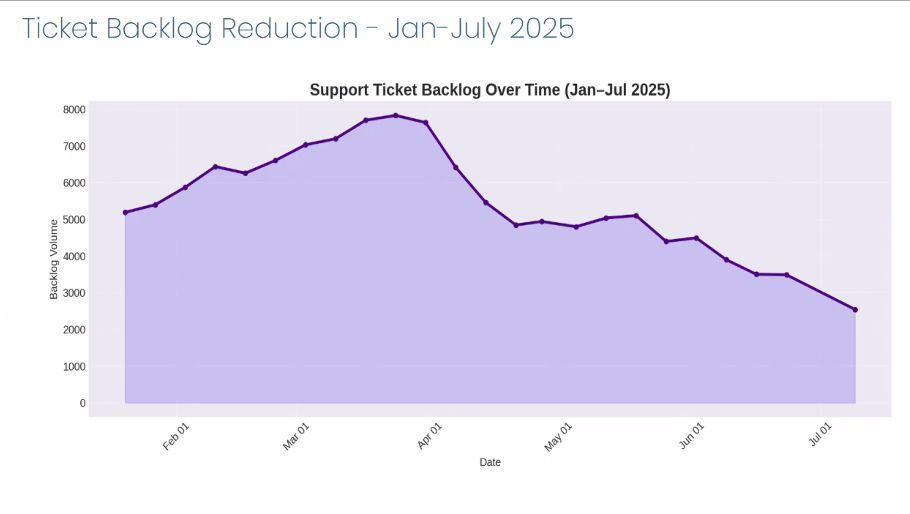
  • There has been a significant backlog of tickets due to things like the support reorganisation in late 2024, but the number of outstanding tickets is being brought down, per the graph below.
Graph supplied by Patch Linden showing the declining in the size of the support ticket backlog
  • In addition, and as Patch indicated at SL22B, weekend support hours have returned, so there is now 7-day a week support from 06:30 through 15:30 SLT.
  • In addition, new in-world support and Discord support options are in development and should be announced soon.

Tilia/Thunes and Pay-outs

  • Recap of the reason for the sale (completed in June, see: LL completes Tilia sale to Thunes: What you need to know). In short, Tilia as a Fintech operation was taking up too much time for LL to effectively manage and build.
  • As anticipated, there were some issues with pay-outs for some immediately following the completion of the sale; however, the majority of these should now be sorted out.
  • Whether the sale will potentially increase / decrease the time taken to complete pay-outs depends on a number of factors:
    • When LL moved to offering real-time pay-outs, Second Life became the target for attempts at fraud by outside forces, and the Lab wasn’t quick enough to catch all cases.
    • Ergo, before moving back towards real-time pay-out, the Lab is now focused on the issue of account security at their end of things.
    • Additionally, LL is looking to Thunes to be able to offer more pay-out options to SL creators, some of which might also reduce the times taken to receive money.
    • However, time frames for introducing the latter are a matter for Thunes, not LL.

Linden Dollar Exchange Rate and the Economy

Concerns have be raised about the recent increases in the Linden Dollar exchange rate (roughly a 5% increase thus far over the course of 2025), with questions on whether the Lab will intervene / cap the increase, and whether the increases were due to user behaviour or system tweaks.

  • The LindeX operates entirely independently of Linden Lab on an open order book basis: anyone can participate in placing buy / sell orders, with matching engine determining which orders can be fully or partially filled. There is no direct intervention by the Lab.
  • One of the negatives of the open order book mechanism is that it is subject to the laws of supply and demand: if the supply of Linden Dollars exceeds the demand for them, the LindeX is going to move.
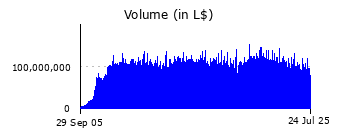
  • LindeX volumes, 2005-2025

    Whilst the 5% increase thus far over the course of 2025 is concerning:

    • It is perhaps not excessive when seen in terms of the economic disruption going on in the world at large.
    • Across 20 years of history, the LindeX has actually been remarkably stable (see: LindeX Exchange: Market Data and click on the All option beneath the graphs at the top of the page), particularly when compared to more recent crypto-currencies – or even when compared to natural inflation in the real world.
    • In this latter respect, SL might be seen as a city which, for 20 years, has seen almost zero inflation.
  • Quantitatively, the LindeX should have been moving at a rate of around 2% a year, forcing creators to periodically adjust their prices. Had this happened, it would have become the norm, and no-one would have been alarmed at the current increases.
  • That this hasn’t happened is largely down to market sinks – actions that cause Linden Dollars to “disappear” from the LindeX.
    • This tends to happen when the Lab accepts L$ as a payment for something that does not have a real-world cost associated with it (so the Lab does not make money on the L$, nor does it lose money in providing the service for which the L$ payment is made). When this happens, it can cause the supply of Linden Dollars to be reduced, boosting demand.
  • In the years prior to the COVID pandemic (i.e. 2017-2020), the number of sinks had been decreasing, causing the LindeX to rise. However, during the pandemic, demand for L$ rose exponentially, reversing the trend completely. Since COVID the trend has reversed once more, with supply again outstripping demand and leading to the current volatility.

What Can Done?

  • The Lab could directly intervene and change how the LindeX operates, either by becoming a market maker, or pegging the market rate for L$.
    • Neither option is seen as optimal for various reasons (e.g. the perception that LL is now manipulating the market to their benefit; the potential for increased fees to be charged, etc.).
    • However, the market maker is an option the Lab could possibly experiment with alongside the open order book in the future.
  • Currently, two potential actions are in development at the Lab. These are focused on the supply side of things with the aim of alleviating some of the current upward trend. Neither option was specified in the meeting, but one is liable to be launched in the near future, while the other is more medium-term.
  • Longer-term, the solution is seen as redressing the supply and demand balance in favour of the latter. There are two primary ways of doing this:
    • Find the means to introduce more sinks into the market, so that L$ can be “taken out of circulation”.
    • Stimulating demand for L$ – most particularly through bringing more active users in to SL so they engage in the economy (see below for more on this), and through short-term promotions such as the April 2025 50-hour reduction in L$ buy fees.
  • In terms of providing more sinks for L$, the Lab is open to suggestions from the user community at large on how this might be achieved – however, a sink only works if it involves no base cost to Linden Lab. For example:
    • While paying for a subscription (Plus, Premium, Premium Plus) using L$ might some like a sink, subscriptions have a base cost for LL, which is covered by the revenue LL obtains through the fiat money subscription fee. So if L$ are used instead, that revenue is removed and in order to recover it, LL must sell the L$ back into the market, keeping them in circulation and eliminating the sink.
    • The above is also true to ideas such as allowing region holders to pay for multiple regions using L$.

Platform Growth Initiatives

This was both an update on the impact of Project Zero (the viewer in a browser) and SL Mobile in bringing-in new users – and how established users can help with this.

  • Both Project Zero (viewer in a browser) and SL Mobile, together with new on-boarding initiatives and advertising has seen a month-on-month grow in the number of people trying SL over the last three months.
  • This has resulted in a tenfold increase in the number of people trying out Second Life than has historically been the case.
  • However, this is only translating to around a twofold increase in the number of retained users (those logging-in to SL repeatedly over a 30-day period) – or approximately 1 in every 100 who try SL for the first time.
  • While the Lab is trying to improve on this by directing incoming new users to meaningful locations, they are seeking help from users and creators.
  • If creators (e.g. content creators, region holders, etc) / communities can create in-world locations specifically to engage with and encourage new users to become more involved in Second Life, LL is willing to work with those creators / communities to drive incoming traffic to those locations.
  • Those interested in partnering in this way should apply to join the Creator Partnership Programme.
  • As a part of this, LL will also work closely with the creators on these new user experiences / flows to help understand what is working and what is not, where new users might be getting frustrated (and possibly leaving), how to address this, provide relevant stats on all of this, etc. The overall aim being to help iterate and build experiences and processes that result in more new users becoming more fully engaged in SL.
  • For the Lab, the focus is on trying help new users get to grips with the basics – how to dress and customise their avatars – rather than the more esoteric aspects of SL (e.g. managing land and / or Groups).
  • There are some general things existing users can do to help new users.
    • This could be as simple as engaging with them in conversation, to the likes of clubs and stores not blocking access to accounts under a certain number of days (30, 60, whatever).
    • Yes, the latter may mean having to deal with trolls / idiots, on throwaway accounts – but there are tools to help with this, and making new users feel more welcome as they hop around SL trying to find places they might enjoy (and spend L$) than making them feel utterly unwelcome.

Copyright and IP Infringements

A number of meetings with content creators earlier in 2025 raised the issues of copyright / IP infringement, content ripping, and similar (some based around the appearance of a viewer that had a focus on content ripping).

  • In response to the concerns, LL has been pro-active in trying to address the “top” problems with content theft, with those doing so receiving “more than nasty letters”, and as a result departing Second Life.
  • This was supported by the opening of a special support channel to respond directly to matters of content theft.
  • As a broad indicator of the change, the number of reports of content theft (not DCMA filings, which tend to remain constant) has fallen from around 300 per year to just 27 since the new measures were introduced earlier in 2025.
  • Content creators at the meeting largely agreed with the Lab’s point of view, confirming that some of the more notorious content thieves have not gone from SL, and the aforementioned content ripping viewer appears to now be blocked.
  • It is acknowledged that this likely does not eliminate all content ripping completely from SL, but should be taken as indicative that LL and their legal team are not prepared to be complacent on the matter.

Essence of a Man in Second Life

Gallery Björk

Just over a year ago, I wrote about Venus by the Water, a Homestead region designed by Elizabeth (ElizabethNantes) and Cecilia Nansen. It featured a captivating setting, as I described in A Venus by the Water in Second Life, one which included the Gallery Björk.

Sadly, Venus by the Water has since closed, but Gallery Björk continues within a skybox location and featuring a new, light and expansive building sitting on a sandy island offering views on all sides out over open waters. Given the building appears to have been designed as a residential structure rather than a gallery / commercial structure, it’s an interesting choice for a venue – one that works well.

Gallery Björk, July 2025 – Essence of a Man

My visit was to see Essence of a Man, an exhibition organised by Cecilia and Elizabeth and featuring an ensemble gathering of pieces by male artist-photographers, which Cecilia describes thus:

We have asked a group of 11 men to create a black and white image depicting their personal interpretation of “the essence of a man”.

The 11 invited artists, who each submitted a single image, are: “Aegean”, “A. Salvatore”, Ayden Huntsman , Creep Wolff, Klint Kord, LordDylan Ansaldo , “Pedro”, “PK”, Shad Whybrow, “The Base Of Bad Ideas”, and Titus Palmira (quotes used against some names, as the gallery only appears to reference display names, making positive identification of the artists difficult).

Gallery Björk, July 2025 – Essence of a Man

Individual pieces are to be found throughout the rooms of the lower floor of the gallery and are placed such there no more than two in a given space – hallway or room –, allowing each piece to be appreciated without distraction as one meanders through the gallery.

While each is highly individual, almost without exception, the majority of the pieces focus on “alphaness” – buffness, muscle and bare chests – as representative of the male essence. Outside of Vulnerability and Strength by Pedro (note the way the guitar is being held as if shielding its owner), there is very little display of the softer, more vulnerable, aspects of the male nature.

Gallery Björk, July 2025 – Essence of a Man

I say this not as a critique of any of the pieces or the artists, rather – and allowing for the fact that such a direction might have been implied as a part of the invite to participate – that I find it interesting. Perhaps it is a reflection of the core difference between how men and women see as defining characteristics within their respective genders. Either way, each of the pieces is fully deserving of consideration in its own right, and all of which makes Essence of a Man any engaging and provocative / evocative exhibition; one well worth viewing.

SLurl Details

Within the Elvenwood in Second Life

The Elvenwood, July 2025 – click any image for full size

Following my recent return to The Wylde to catch-up on more recent development there at the request of region holder Jazaar Silvermoon (Jazaar Heartsong) – see: Back to the Wylde and time in a Nightgarden in Second Life –, I received a further invitation from Jazaar to visit another of her Full region designs, that of The Elvenwood.

Occupying a Full private region leveraging the Land Capacity bonus, the region is a seamless blending of what might be seen as four somewhat different settings, all equally available from the Landing Point.

The Elvenwood, July 2025

To the west and north-west respectively, lay Delfai and Enoshima, both reached via the same stepping stone path and initial bridge as it spans the gorge separating Delfai from the landing Point. Comprising ruins and a large bathhouse, Delfai carries with it a Greco-Roman styling.

Delfai obviously suggests Delphi and the oracle Pythia, and the ruins appear to be the remnants of a temple in Pythia’s honour – a large statue of the oracle still standing within them, complete with offering on the dais before her. The path from the bridge meanders through a small walled garden area more suggestive of Italian / Roman heritage in order to reach the ruins. From there, steps climb up a short rise to allow the path to make its way on to the bathhouse.

The Elvenwood, July 2025

Located just above a large, open-sided pavilion possibly of ancient Greek design, and with a large terrace to one side of the main entrance, the bathhouse perhaps leans more towards a Roman design than Greek. Dancing can be enjoyed on the terrace, and steps lead down the side of the cliff to further remnants of a structure at at the water’s edge as the channel separates Delfai from Elvenwood.

Reached via a bridge spanning the channel between it and Delfai, Enoshima offers – as the name might suggest – a strong Japanese theme. It sits on an island in the north-west corner of the region, with gardens featuring water and Zen elements. Home to two large buildings, one of which offers a quiet, almost meditative retreat, Enoshima is, like Delfai, neatly self-contained and offers a lot to see in its own right, its paths and boardwalks encouraging exploration.

The Elvenwood, July 2025

The two largest elements of the setting are Elvendell and the Fairy Forest. Sitting to the south, Elvendell actually encompasses the region’s Landing Point, together with the Elvenwood.

Backed by high hills along part of the region’s southern side, Elvendell is perhaps liable to stir some thoughts of Tolkien and Imladris whilst having its own unique styling. The large house sits above the waters of what is clearly an artificial lake, its halls and rooms offering places to sit while its terraces offer open walks and dancing.

The Elvenwood, July 2025

Close by sit a council chamber and stairs providing access to a path rising to the highest point in the region rising to a temple-like structure mixing eleven and classic elements.  Guarded by miniature versions of the Gates of Argonath – the giant statues carved in the likenesses of Isildur and Anárion – this temple sits within its own plateau garden and offers another retreat.

The plateau hides a secret. To find it, look for the gates beyond the council chamber and the wooden pavilion to which they provide access. You should be able to find your way from there. The Elvenwood, meanwhile, lies below the eastern side of the hills of Elvendell, and offers its own routes of exploration. These should be followed carefully, as they also can reveal places otherwise hidden from casual view.

The Elvenwood, July 2025

Occupying the north and east of the region the Fairy Forest offers its own mix of beauty and expression, with tall towers rising into the sky, a wizard’s house, gardens and statues, and meandering paths. Again, time should be taken in exploring in order to reveal all the secrets – including how to reach the little island nestled into the south-east corner of the region between both the Fairy Forest and the Elvenwood without resorting to flying or getting your feet wet.

The beauty of this region lies not only in the way it has been built, but in the care Jazaar has taken to ensure that everything flows together naturally and fully, despite the many different (and what otherwise might be considered contradictory elements – Japanese, Greco-Roman, fantasy…) styles within it. This means that rather than being a set of four vignettes in and of themselves, Elvendell/Elvenwood, the Fairy Forest, Enoshima and Delfai very much flow together as a whole. Even the choice of bridge styles to link the different aspects of the region together simply adds to their sense of wholeness.

The Elvenwood, July 2025

Finished with both an over-arching EEP setting and the considered use of ambient sounds, Elvenwood really is a visual feast, with far more to see and appreciate than I’ve mentioned here. And if you’re interested in shopping, Jazaar’s can be reached via the teleport disk at the Landing Point.

SLurl Details