Island of Kalokairi, February 2025 – click any image for full size
Given that as I write this, February 14th is but a small handful of days away – and despite the fact I’m generally about as romantic as a cup of coffee – I thought I’d poke the Destination Guide to see what was going on by way of photogenic spots leaning towards the romantic. Among them I found Island of Kalokairi, a name that for some reason rang a bell, although I wasn’t entirely sure why, so off I hopped on what turned out to be a pleasing series of visits.
Of course, those who are fans of the film Mama Mia, the name is likely familiar as having temporarily been bestowed onto the very real Greek islands of Skopelos and Skiathos so that between them, they might represent the film’s major setting. This is probably why the region’s name rang a bell for me; I’d endured a portion of that film over Christmas (and still shudder at the thought of Pierce Brosnan’s brutal slaying of Abba’s SOS). However, for those – like me – who shudder at the thought of that film, fear not; kalokairi here is used as intended, being the Greek for “summer” (as in “island of summer”).
Island of Kalokairi, February 2025
The work of Ella.Marie (0o0EllaMarie0o0), the region is – in keeping with its name – a summertime haven and a place where romance might flow and where those already involved with one another can express themselves over champagne or by sitting by peaceful waters. For explorers and photographers, meanwhile, it is a place for wandering, taking pictures and for appreciating its natural beauty, with the hills of offshore islands and the nearby region of Prem, also held by Ella.Marie and her SL partner, Mike Chandra (MauiMike). A private setting on the ground level, this is also home to their art galleries and businesses, of which more anon.
Island of Kalokairi is itself split into two low-lying isles linked by a single bridge spanning the water channel between them. The northern isle is home the the region’s Landing Point, located within a large greenhouse-like structure. From here, a sea of flowers flows over the grasslands, encouraging visits to drift out into the open and start their explorations. This greenhouse is balanced by circular one on the southern island, the home to dancing and music. Between them, the these two greenhouses form the only enclosed structures within the region.
Island of Kalokairi, February 2025
Between these two greenhouses is a richness of pastoral and natural beauty awaiting discovery. Sheep and deer wander and graze, rabbits play and butterflies weave and fly, whilst cranes and herons keep an eye on the channel’s water, awaiting an unwary fish swimming out from under the water lilies, possibly disturbed by frogs or swans. All of this makes for peaceful wandering and well and multiple opportunities for photography.
Whilst the greenhouses are only two enclosed structures on the land, they are not alone; close to the circular greenhouse is an open-air deck dancing and event space. A further place for dancing can be found on the northern island, a short walk from the Landing Point and surrounded by the poles of a large tent. In addition, white pianos scattered around the landscape further the sense that this is a centre of music as well as romance.
Island of Kalokairi, February 2025
Four decks can be found stretching out over the the surrounding waters. Three offer places to sit and socialise, the fourth is screened by trees and offers a place of meditative retreat for those seeking peace and an sense of tranquillity. A large barge is additionally moored close to south isle’s round greenhouse; it forms a wedding venue, with details provided by the sign alongside the boarding ramp.
Kalokairi Where the sun always shines the blue sea glitters and nature blooms, capture its vibrant sunsets whilst dancing in the Ancient Ballroom or the outdoor Venue under the stars, Life is always better on the Island.
Kalokairi About Land
Island of Kalokairi, February 2025
Throughout all of this are scattered places to sit in addition to the decks noted above; from metal chairs with side tables offering pink champagne to cosy sofas and floating basket seats and benches and rocking chairs. All are just a short and pleasant walk away – or, for those with a wearable horse – a little ride away.
Earlier I mentioned the businesses over the neighbouring region. One of these is Simcaster, the couple’s streaming service – complete with plenty of advice for those wishing to stream audio and / or video in-world. A demonstration – if that’s the right word – of the streaming capabilities Mike offers can be heard within Island of Kalokairi, which has a custom audio stream very much in keeping with the ideas of love and romance for those who wish to listen.
Island of Kalokairi, February 2025
Rounded out by a natural sound scape for those who like to explore without music, Island of Kalokairi lends itself to personal EEP settings for those who prefer (I used one of my own fixed skies for the photos here) and makes for a rewarding visit. And don’t forget the neighbouring sky galleries, featuring art by both Ella and Mike.
Logos representative only and should not be seen as an endorsement / preference / recommendation
Updates from the week through to Sunday, February 9th, 2025
This summary is generally published every Monday, and is a list of SL viewer / client releases (official and TPV) made during the previous week. When reading it, please note:
It is based on my Current Viewer Releases Page, a list of all Second Life viewers and clients that are in popular use (and of which I am aware), and which are recognised as adhering to the TPV Policy. This page includes comprehensive links to download pages, blog notes, release notes, etc., as well as links to any / all reviews of specific viewers / clients made within this blog.
By its nature, this summary presented here will always be in arrears, please refer to the Current Viewer Release Page for more up-to-date information.
Note that for purposes of length, TPV test viewers, preview / beta viewers / nightly builds are generally not recorded in these summaries.
Official LL Viewers
Release viewer: version 7.1.11.12363455226. formerly the ExtraFPS RC, dated December 17, promoted December 19 – No change.
Release Candidate: Forever FPS, version 7.1.12.12999043440, February 4, 2025 – No change.
February “Membership Mania”: Linden Homes for Plus Subscribers, formal announcement of SL Mobile Streaks awards and increases to a range of limits
On Monday, February 10th, Linden Lab announced a further set of rewards and perks for Second Life subscribers / members (that is, those with a Plus, Premium or Premium Plus account).
SL Mobile Streaks Rewards
The announcement formally announced the Streaks rewards system – here defined as a “limited time” perk – which rewards subscription account holders with modest L$ payments in return for logging-in to Second Life daily.
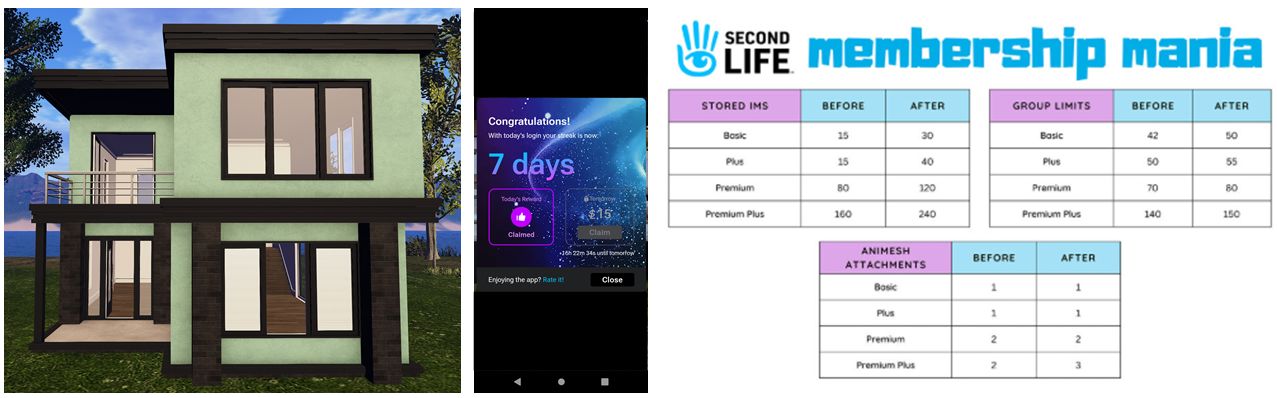
Opt-in and log into SL via the Mobile app when logging-in via it daily over a 7-day period and receive incremental L$ rewards (L$15 on the first day after opting-in the Streaks, L$20 on the second, L$25 on the third, working through to L$70 on the 7th day), which can be claimed daily.
Miss a day, and the “streak” of log-ins will reset to 0 days and the daily amount to L$15.
After 7 days of increments, the “streak” resets to L$15 and 0 days, allowing you to start claiming the next 7 days of incremental amounts (again, up to L$70 on the 7th day).
Streak rewards on the SL Mobile app are available to all subscription account holders (Plus, Premium and Premium Plus), for “a limited time”
Linden Homes for Plus Subscribers
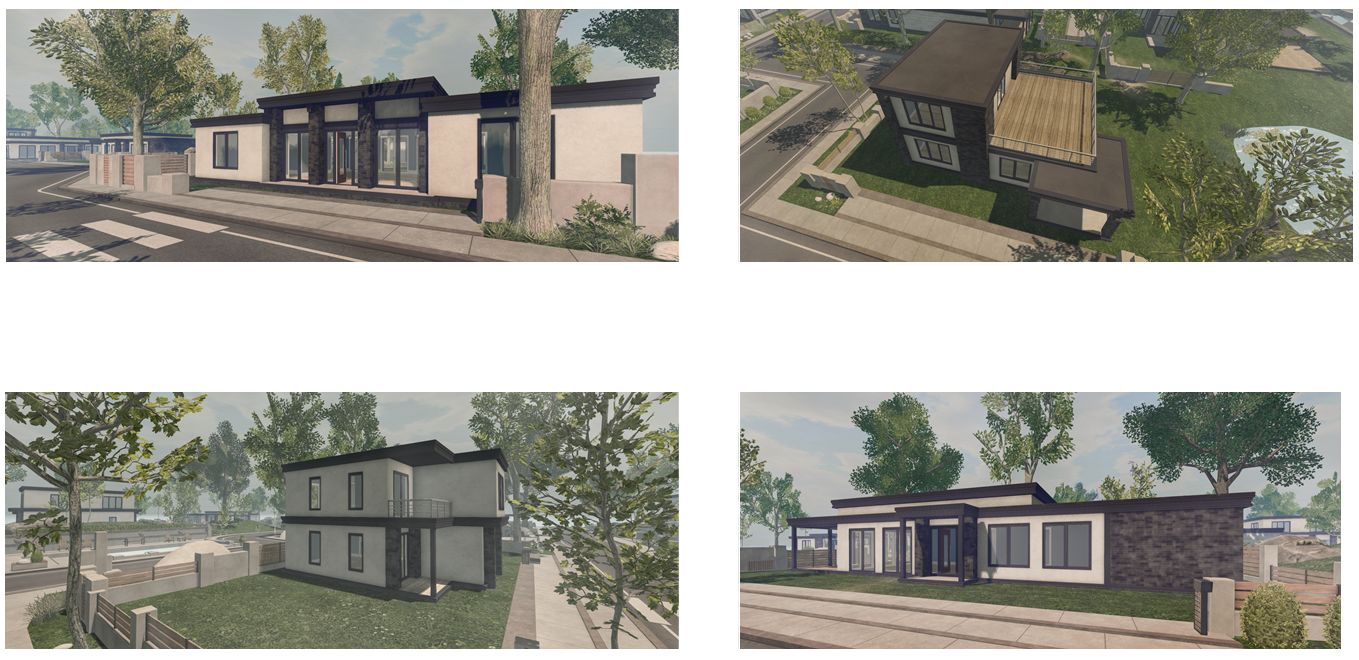
Second Life Plus subscribers can now participate in the Linden Homes benefit, with the 512 sq metre options in the following themes being available to Plus members:
Newbrooke: “modern container homes” – see here for a review – with the following styles available to Plus subscribers: Denver, Ender, Faraday and Gatewood.
The 512 sq m Newbrooke Linden homes (clockwise from top left: Faraday, Gatewood, Ender, and Denver
Sakura: Japanese themed homes – see here for a review – with the following styles available to Plus subscribers: Botan (or Benibara in open-plan form), Himawari (Haibisukasu in open-plan form), Kosumosu (Kinmokusei in open-plan form) and Tenjikubotan (Tsubaki in open plan form).
Remember: all Linden Home themes and styles – including those now available to Plus subscribers – can be viewed at the BelliHub Linden Homes demo area in-world. Availability of specific themes and styles can be found via the Linden Homes portal.
Linden homes Increased Land Capacity
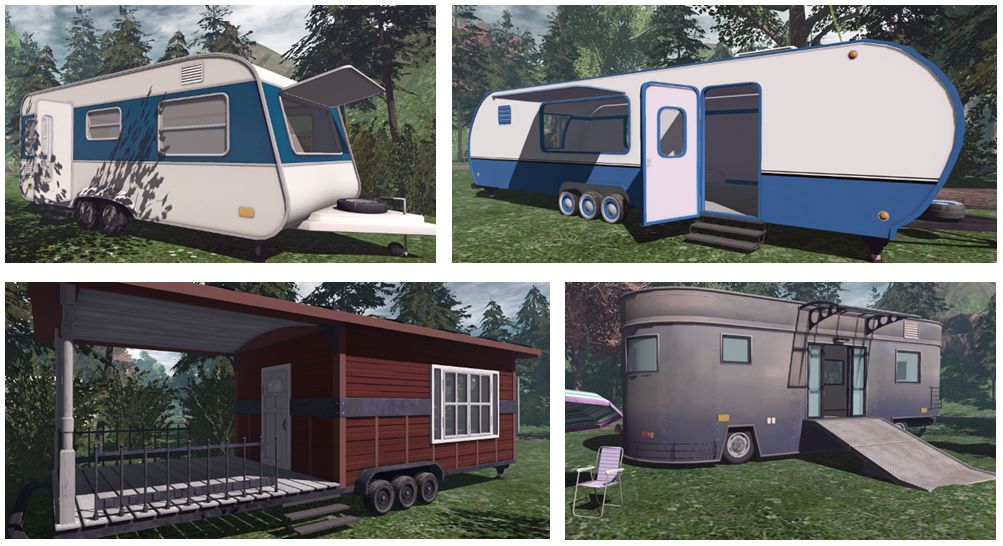
All classes of Linden home – Plus/Premium and Premium Plus now have increased parcel Land Capacity / available Land Impact, per the table below:
Land Capacity / Impact increases for Linden Homes. Credit: Linden Lab
Note that these Land Capacity updates may take time to be deployed across all Linden home parcels.
Increased Limits form IMs, Groups and Animesh Attachments
ALL account types – Basic through Premium Plus – see increases in some or all of the following: IM limits, Group limits, and allowed Animesh attachments, per the table below.
Increased limits as applied to account types. Credit: Linden Lab
Cica Ghost’s installation tend to carry with them elements of fairy tale; sometimes these elements are obvious in terms of the narrative on offer, in others the fairy tale aspect is further offered by the installations title, whilst the installation itself includes touches and turns which might cause the mind to wander further than any idea of “traditional” fairy tales. But howsoever the theme might be presented, the installation itself is always engaging.
For February 2024, Cica presents Dark Fairytale, which – for me, sits within those installations Cica offers which perhaps encourage the mind to wander further than the “traditional” idea of fairy tales. Flowing into it – in very subtle ways – are a touch of Guillermo del Toro and a tickle of cosmology. As with all of Cica’s installation, use of the Share Environment is a must.
Cica Ghost: Dark Fairytale, February 2025
Dark Fairytale presents a dark, somewhat parched landscape of lowlands watched over by peaks and hills around their edges, with two hills detached from the rest as if scouting inland. Caught under a cloud-rippled sky, this is a place with an otherworldly feel to it – a feeling that’s increased by the large face of planet (or moon?) hanging low above the westward horizon, its surface marked by the veins of a vast mountain complex spreading outward from its southern extreme.
The presence of this world / moon which does much to cast this place as much into the realm of far-away worlds in distant space as much as it does conjure thoughts of fairy tale lands. Yet at the same time, the eye of this planet might cause some to think of our own solar system; for those familiar with Mars, one of the splayed tendrils of light coloured mountains stretching across the world offers a faint suggestion of a mirrored Vallis Marineris and Noctis Labyrinthus so familiar to Mars. The effect is entirely coincidental rather than intended, but for those who see it, it gives a further twist to any backstory the imagination might choose to write for the installation.
Cica Ghost: Dark Fairytale, February 2025
This is a world inhabited by various kinds of dragon (one tucked away off-shore), all of whom appear to peacefully co-exist with the local humanoids, who in turn appear to live in exotic little homes. As with all of Cica’s characters, the creatures here carry with them a sense of innocence rather than menace, with the humanoids having some technical know-how, going by the snail car in the midst of the landscape. As one would expect, there are multiple places to sit or dance scattered through the landscape, whilst the creatures offer plenty of opportunities for photography.
Given the friendliness of the locals, the “Dark” of the installation’s title would appear to relate less to any idea of the kind of tales involving a twist of fear and / or horror, and more to the fact that this world is either dimly lit or seen at night. That said, the fantastical nature of the creatures and beings here does pump the cosmological element within Dark Fairytale, as noted. In this, the quote Cica has chosen for the installation also has a role to play, coming as it does from a longer statement by the late English cosmologist and theoretical physicist, John David Barrow.
Cica Ghost: Dark Fairytale, February 2025
All told, another marvellous setting from Cica, one able to suggest all sorts of stories to the willing imagination. And the hint of Del Torro? Take a peek inside the rotor-topped house, and you might spot it!
Space debris: defunct satellites, rocket stages, launch vehicle elements like payload fairings, complete or fragmented, has increasingly cluttered the space around Earth since the birth of the space age and now poses multiple threats. Credit: ESA
I’ve written about the issues of orbital space debris several times in these pages. It is estimated that there are 150 million pieces of space junk surrounding Earth. The vast majority of this debris is too small to be readily detected – minute pieces smaller than a centimetre; still large enough to do mischief to a satellite or other orbital vehicle, particularly if a cloud of them happen to strike – but of no significant threat to those of us on Earth or flying through the sky.
However, there are between 25,857 and 56,450 large object orbiting the Earth; of these, between 10,000 and 12,500 are operational satellites (the numbers vary based on the collective orbital regions studied), and the rest defunct satellites, rocket stages, payload fairing and other debris large enough to pose a range of issues. These present a range of problems, some of which are obvious, others perhaps less so.
For example, satellites and rocket stages in low-Earth orbit (LEO) can be directed to re-enter the atmosphere so that any parts surviving re-entry “safely” fall into the Pacific Ocean at “Point Nemo” (officially called the oceanic pole of inaccessibility), the furthest point from land in any ocean or sea, and a place 400 km from the nearest air or marine route. However, as “safe” as this is, as I recently noted – they result in an increase in high-altitude pollutants such as aluminium oxides that is on the increase (as I noted in that article, SpaceX’s Starlink is now responsible for some 40% of debris burning-up in the upper atmosphere and creating up to 5 tonnes of (mostly) aluminium oxide dumped in the mesosphere and stratosphere per day).
The Japanese ispace Hakuto-R 2 lunar lander mission, launched on January 15th, 2025, captured this image of Earth on January 31st, 2025. It is looking directly down on Point Nemo – the “spacecraft graveyard”. Credit: ispace
There are others who are less considerate in what happens to their satellites and the expended stages of their rockets. Russia, for example, has a habit of taking pot-shots at its own satellites, blowing them up (and thus increasing the amount of fast-moving debris and adding to the general confusion, whilst China just tends to leave rocket stages to make an uncontrolled re-entry which, whilst pointing in the general direction of Point Nemo, could equally result in debris striking populated areas.
Even SpaceX has been a little cavalier; three of their service modules – or “Trunks” – from Crew Dragon missions have survived re-entry to come down near populated areas. The first was largely glossed over (it fell on Australia); the next two came down in America – one within a glamping centre, the other actually striking a house in Florida (fortunately without loss of life or injury). These two were enough to persuade NASA and SpaceX to move Crew Dragon splashdowns from the Atlantic to the Pacific Ocean, so the vehicles would not be re-entering the atmosphere over the continental United States.
A piece of debris linked to the Crew-7 Dragon trunk that landed within a glamping site in North Carolina in May 2024. Credit: Future/Brett Tingley
However, this is just the tip of the iceberg. Not only is there a vast amount of debris occupying the various orbital planes – low Earth orbit (LEO), medium Earth orbit (MEO), Geostationary orbit (GEO), Sun synchronous orbit (SSO) – over the years all of the smaller debris previously mentioned has come to be spread more broadly around the Earth and across different altitudes. And the amount of potential junk we’re casually lobbing up in the form of smallsats viewed as “no bother” as even in an uncontrolled re-entry at the end of their useful life, they will completely burn up, together with the rocket stages used to get them there, is now accelerating. In 2024, for example, there were 263 launches world-wide, most of them delivering multiple satellites to various orbits and leaving upper stages in what are called “superspreader orbits” – orbit beyond those occupied by satellites, so as to minimise collision risks between them. Taken together, all of this increases the risk of collisions – and not just between a couple of objects; there is a very real risk of one or more collisions leading to an event referenced under the term Kessler syndrome.
Also called collisional cascading, the Kessler syndrome envisages a single collision between two fast-moving orbital objects generating debris which goes on to strike other orbital objects, shattering them, causing more debris, and so on through a cascading set of collisions that could destroy entire networks of satellites – and orbital facilities like space stations together with orbiting crewed space vehicles. If you’ve seen the 2013 film Gravity starring and Sandra Bullock and George Clooney, you’ll have seen a visualisation of a Kessler syndrome event.
Kessler syndrome is particularly relevant to the crowded domain of low Earth orbit which is currently getting packed out thanks to the arrival of megaconstellations such as Starlink (currently 7,000 active and inactive, with a plan for 12,000 potentially rising to 40,000 in both LEO and MEO, together with China’s planned 14,000 strong Qianfan (“Thousand Sails”). Because of these and the overall increase of commercial activities in LEO, the risk of a Kessler syndrome event occurring is seen as being on the rise – as is its potential range of impact (no pun intended).
A 2023 axonometric view of Earth showing the space debris situation in different kinds of orbits around Earth. Credit: Pablo Carlos Budassi
In particular, a study conducted by a team from the University of British Columbia (UBC) and published in Scientific Reports noted that a widespread collisional cascade could result in multiple large-scale debris elements entering the atmosphere to rain down fragments across wides areas, not only putting lives on the ground at risk but also causing potential disruptions to air travel and airspace closures, even when there is no direct threat to people on the ground.
In this latter regard, the report additionally notes that even without a Kessler syndrome event, particularly busy concentrations of air routes – like southern Europe, the Mediterranean Sea and Middle East; the Caribbean and Central America; south-east Asia through the Philippines and around the South China Sea – now have a 1 in 4 risk of suffering significant disruption as a result of orbital debris falling through them, and this could rise to 1 in 3 in the next few years (although the chances of an individual aircraft actually being struck by debris will remain around 1 in 430,000).
The report also notes that this potential for disruption is not limited to just space debris re-entering the atmosphere; the increasing number of launches around the world could see something of an increase in vehicle losses at high altitudes during ascent, also causing short-term airspace restrictions and aircraft diversions. In this, the report references the loss of the Starship vehicle during the January 16th, 2025 IFT-7 sub-orbital flight by SpaceX. The vehicle in question exploded at an attitude of 124 km, with wreckage falling over the airspace of the Caribbean and Greater Antilles, resulting in aircraft being diverted and airspace being temporary restricted to avoid the risk of aircraft passing through clouds of small debris which could be ingested by their engines with unwanted results. Also, and as a by-the-by, this mishap resulted in 85.5 tonnes of pollutants in the form of metal oxides and nitrogen oxides oxides dumped into the upper atmosphere – that’s 1/3 of the annual levels of such pollutants dumped on us from meteorites burning up in the atmosphere.
A video captured from an airliner flying over the Greater Antilles showing the break-up of the SpaceX Starship on January 16th, 2025
All of which underlines the fact that whilst space companies point towards their use of more environmentally-friendly propellants for the launch vehicles – notably with the move away from using kerosene – this is actually a very small step in tackling increasingly complex problems resulting from spaceflight.
Boeing Warn of SLS Layoffs
Following my last piece concerning NASA Project Artemis and – particularly – the Space Launch System (SLS) and Orion crew vehicle – Boeing has formally notified employees working on the SLS programme that there could be lay-offs coming.
To align with revisions to the Artemis program and cost expectations, today we informed our Space Launch Systems team of the potential for approximately 400 fewer positions by April 2025. This will require 60-day notices of involuntary layoff be issued to impacted employees in coming weeks, in accordance with the Worker Adjustment and Retraining Notification Act.
– Boeing Statement in the possible layoffs notification
SLS Core stage engine sections, 2022. Artemis 3 (l) being fitted with its four RS-25 motors; Artemis 4 (r) awaiting the same. Credit: NASA
The notification is seen as evidence that the Trump administration is moving towards an immediate cancellation of SLS – and possibly Orion. However, the wording of the Boeing statement might indicate otherwise. The company and its partners in Artemis, Lockheed-Martin and ULA have been under pressure from NASA to reduce costs, and have agreed to do so. With the SLS production line maturing the notification might by in line with that goal, Boeing having the confidence they can reduce the SLS workforce without impacting the programme. As it is, the vehicles – both SLS and Orion – due to be used in the next three Artemis missions (2 through 4) are already well advanced:
The Artemis 2 SLS is being stacked at Kennedy Space Centre, and the Orion vehicle for that mission is awaiting final testing.
Construction of the core stages for the SLS vehicles to be used with Artemis 3 and Artemis 4 have been under construction in parallel by Boeing at NASA’s Michoud Assembly Facility, and work has commenced on the Artemis 5 rocket’s core stage.
The Orion vehicles for Artemis 3 and Artemis 4 are at Kennedy space centre, undergoing assembly and integration.
The European Service Module (ESM) for Artemis 3 was shipped to Kennedy Space Centre from Germany in August / September 2024 while the ESM for Artemis 4 is currently under construction in Bremen, Germany.
However, if the Boeing notice has been issued over concerns about cancellation, then as I pointed out last time out, it would likely only serve to severely delay Artemis, because there just isn’t anything available to readily replace SLS or SLS + Orion. Also, there is an argument to be made that whilst Artemis in its current form with the fully expendable SLS is unsustainable, continuing with it for the time being might actually help move the programme towards any SLS replacement without the need to completely disrupt the entire Artemis programme.
Right now, only Artemis mission 2 through 5 are funded to any degree; 6 through 10 have yet to receive serious budget allocations – although this will have to start soon. As such, it would seem to make more sense to continue with Artemis 2 preparations and the development of the Artemis 3-5 flight hardware whilst redirecting funds that would otherwise go into the vehicles required for Artemis 6 onwards into the development of a more cost-effective architecture, such as modifications to New Glenn and the Orion launch Abort System to allow the one to launch the other, and the development of a means for Orion to dock with ULA’s Centaur upper stage whilst on-orbit (required to get Orion to cislunar space, New Glenn being unable to do so on its own).
February 2023: Artemis 2 Orion (r) during system integration work; Artemis 3 Orion (l) on a work stand and Artemis 4 Orion pressure module (c). Credit: NASA
Such an approach would both allow Artemis to meet current goals – and even provide a buffer if mission dates have to again slip – whilst the alternate hardware is modified, tested, rated, and called for flight. Thus, by the time Artemis 6 rolls around, the new architecture could be ready to make its debut in place of SLS, and no significant ground has been lost in moving Artemis forward. Additionally, the specific use of New Glenn / Centaur would both fit with the current Lunar Gateway architecture (possibly the one thing NASA really should abandon but likely won’t) and avoid the need to cancel and squander Orion.
However, this is pure conjecture. Whether the Boeing notification was issued in expectation of SLS cancellation or not, is something that is likely to become clear within the next month or two.
Atelier des Images – Gallery Gadot, February 2025: Raven Arcana: Ends and New Beginnings
Second Life photographer-artist Raven Arcana is, in my opinion, one of the most expressive artists exhibiting her work within the platform. I’ve covered her work – both individual exhibitions and as part of ensemble exhibitions – in these pages, and always appreciate the opportunity to see her work. This being the case, it was off to Atelier des Images – Gallery Gadot, operated and curated by Aurelie Gadot Costanza, to witness Raven’s latest work.
Ends and New Beginnings is a visual essay, richly expressive and poignant in the way the individual images can trigger responses and / or suggest a story in its own right whilst remaining part of the broader narrative Raven paints.
These poetic monochromatic Landscapes take you on a Journey, from the Ending to a new Beginning. Discover Landscapes that express Loss, Solitude or even Hope. You might find your own Story within them.
– Raven Arcana, Ends and New Beginnings
Atelier des Images – Gallery Gadot, February 2025: Raven Arcana: Ends and New Beginnings
As Raven notes, these are images intended to express emotions and feelings, something reflected in their evocative names as well as their depictions – Broken; Empty Places, Growth. Each has a single focus within the scene it presents, such as a fallen lighthouse or a tree, whilst bent, standing firm against the passage of time and wind as it edges towards maturity.
Combined with their monochromic nature, the titles of these pieces cause them to resonate with the observer and draw one in, encouraging both our emotions and our imaginations. Each has its own unique voice such that I’m not going to offer interpretations here; what they have to say even much depends on how we approach them: what we’re feeling; how life is affecting us at the point in time we visit; perhaps even encouraging a contemplation of things we would rather keep hidden, and in doing so offer catharsis.
Atelier des Images – Gallery Gadot, February 2025: Raven Arcana: Ends and New Beginnings
Catharsis might be a term applied to the broader story offered through the entire collection. In this, I would suggest following the exhibition from the right-side entrance as you face it. Bordered to the left by a quote on endings and beginnings by English poet Jennifer Birchall and At the End – a piece by Raven which, among a collection of expressive pieces, I found to be particularly powerful in its imagery.
From this entrance, one can progress around the exhibition from right through centre and then left, and in doing so, allow the individual voices present in the pieces work to become a choir, their voices reaching a crescendo as one arrives at Raven’s images New Beginnings and Tranquillity, together with New Beginning, a poem by American poet Colleen Courtney. This form a final verse – or chapter – of the story; one filled with the promise that, for all of us, there is the promise held within the opening quote from Birchall.
Atelier des Images – Gallery Gadot, February 2025: Raven Arcana: Ends and New Beginnings
In all, Ends and New Beginnings is a beautiful collection of work, its expressive depth certain to touch all who visit. And, should you wish to keep alive the memory of the entire exhibition, the entire collection has been put together in in-world book form by Raven, offered for sale alongside the individual prints.






 Inara Pey: Living in a Modemworld