Artsville, January 2025 – click any image for full size
A new entry in the Destination guide alerted me to the fact that Artsville – the art and entertainment hub under the joint management of Frank Atisso and Vitoria Galli – has relocated.
Now occupying roughly one third of a Full region, the “new” Artsville is a very different beast to the “old” (or previous might be a better term). Whilst it continues the design collaboration between the owners and Megan Prumier, the updated Artsville presents a tranquil, almost mystical setting of ruins, underground spaces, gardens, walks and more, all set on and within a rugged, island-like setting tucked under a curtain wall of high cliffs separating it from the rest of the region in which it sits.
Artsville, January 2025
This is a place where natural elevation is used to offer a location rich in a sense of space and freedom, with the various elements from landing point to ruins and gallery spaces to upper reaches, all flowing together harmoniously. Within it lie spaces offering both a sense of sharing, should you visit the setting in the company of others and of quiet contemplation, should you visit alone.
Presented with an east-to-west orientation, the setting can be very broadly be split into four parts: to the east there is a large, oval-shaped promontory, the flat top of which is home to the remnants of a large structure with walls of great blocks hewn from rock. To the west is the larger bulk of the setting, a tiered fortress of rock rising from the water, an into which industrious hands have bored (or perhaps laboured to convert natural tunnels and caverns), creating a marvellous series of interconnected rooms.
Artsville, January 2025
Connecting these two extremes lies a narrow neck of rock, upon which has been created one of the setting’s several garden spaces, and which forms the Artsville’s new Landing Point. Bracketing this, but separate from the rest of the setting, are two circular islands, each home to an impressive oak tree. Neither is directly accessible from the rest of Artsville (save by flying, if you must), but both serve to enhance the overall design.
The ruins, with their stone-flagged floors and roofless spaces, offer an engaging mix of public spaces: the venue for music events (second and fourth Friday of the month, between 13:00 and 14:30 SLT), together with areas to sit and pass the time with friends, and corners of quiet retreat. Those venturing up the stairs from the event terrace will also find a gorgeous bar area. There’s also a secondary art display area here as well, which at the time of my visit presented images of Artsville as captured by a quartet of SL artists.
Artsville, January 2025 – Silent Tones; artist credits as per image
The main gallery, meanwhile offer a series of chambers in which to display art. At the time of my visit, these featured Silent Tones, an ensemble exhibition brought together by Frank and Vitoria and featuring a single piece of art from each of 12 invited artists. The exhibition is defined thus:
In a world dominated by vibrant hues and vivid imagery, Silent Tones offers a quiet, contemplative pause. This exhibition … explores the delicate power of minimal colour.
Through their lens, the artists have delved into the nuances of light, shadow and texture, allowing the subtleties of form and composition to take centre stage. The absence of bold colour evokes a sense of stillness, a return to the essence of what is seen, where mood and emotion are conveyed through the slightest shifts in tone.
Artsville, January 2025
It’s an engaging exhibition, and I particularly like the fact that links to the artists’ Flickr pages have been included, allowing easy access to the greater catalogue of their work.Another aspect of the gallery’s design I like is the potential for the two main halls within it to be used for individual exhibitions, where this to be considered; each might be seen as a boutique-sized space allowing for more intimate interactions between artist and audience. Intimacy also extends to the bar tucked away between and to one side of the two gallery halls. Utilising the MINIMAL King’s Skybox by Ors Quan, it is an eye-popping display of ambience and décor.
Artsville, January 2025
To either side of the entrance to the gallery are what might be termed the lower gardens. One of these takes the form of a hedge maze. Featuring sculptures by Mistero Hifeng, it leads to a path which makes its way up the southern side of the upper tier of rock, the lower end of the path watched over by a sculpture by Fujiko Lemon (Nicoll Levee). To the south, the garden is wilder in nature but also includes a path making its way upwards, this one by guarded by a sculpture from MedievalFantasy.
This latter path direct visitors up to the upper garden and a romantic-looking hilltop conservatory commanding views out over open waters. The southern path, meanwhile, directs visitors up to walled terraces and seating, with gates also offering access to the upper garden, and thus connecting south and north together.
Artsville, January 2025
With a central firepit and a balcony standing high over the entrance to the gallery, this upper garden is perhaps the most tranquil aspect of the setting; both the firepit and the balcony offer places for sharing or for sitting in quiet retreat – with the swing watched over by deer adding to the contemplative nature of the space.
Megan has always produced region and parcel designs to capture the eye and camera, and her work at Artsville is utterly sublime, making the setting perhaps the most unique gallery space in Second Life; whether you appreciate artistic expression through the platform or whether you simply enjoy exploring SL, this iteration of Artsville is not to be missed – and make sure you keep an eye open for all the little touches scattered around, and have local sounds enabled for the fullest experience.
The following notes were taken from the Tuesday, January 14th, 2025 Simulator User Group (SUG) meeting. They form a summary of the items discussed, and are not intended to be a full transcript, and were taken from Pantera’s video of the meeting, which is embedded at the end – my thanks to her for providing it.
Meeting Overview
The Simulator User Group (also referred to by its older name of Server User Group) exists to provide an opportunity for discussion about simulator technology, bugs, and feature ideas.
Meetings are open to anyone with a concern / interest in the above topics, and form one of a series of regular / semi-regular User Group meetings conducted by Linden Lab.
Dates and times of all current meetings can be found on the Second Life Public Calendar, and descriptions of meetings are defined on the SL wiki.
Simulator Deployments
On Tuesday, January 14th, 2025, the simulators on the Main SLS channel were restarted with no update.
On Wednesday, January 15th, all remaining RC channel outside of BlueSteel should be updated with the Apple Cobbler simulator update, which includes llGetAttachedListFiltered(),llGiveAgentInventory(),llMapBeacon(),llTransferOwnership(), and a modification to llModPow, so it should work faster (however, it does not correctly handle the full range of positive 31-bit integers -and Leviathan Linden is working to define the range for which it supplies correct answers, so check the wiki page for updates).
SL Viewer Updates
Release viewer: version 7.1.11.12363455226, formerly the ExtraFPS RC (multiple performance fixes, aesthetic improvements and UI optimisations), dated December 17, promoted December 20 – No Change.
Release Candidate: none at present.
In Brief
Please refer to the video below for the following:
Rider Linden:
I have an internal change dealing with how the simulator makes outgoing HTTP calls. It’s just a proof of concept and changes how a few things at start-up are handled, residents shouldn’t see any differences. As that expands further in the future, I’ll start calling out things that people should be paying attention to.
Leviathan Linden:
Just a status update on what I’m working on: I’ve been trying to come up with a reliable repro for the “sometimes objects don’t show up upon login/teleport arrival — in order for them to show up you need to do a relog” problem. Although I don’t have a reliable repro for it I’ve verified it is a real server-side bug and have some ideas to try out. I got side-tracked on something but will get back to working on that later today.
A request was made on whether there could be a way for an Experience owner to see the data stored (e.g. as two-column spreadsheet) and without having to query the whole thing a few keys at a time. This led to a general discussion on now this might be achieved, with Monty Linden adding:
KVP things are something we have to look at again in the future – if people have wants, now is a good time to start asking … if something’s needed, can add it to the stew pot.
The above led to a broader discussion on scripting – a viewer UI for LSD / status on the Luau project for the viewer (unclear, as Signal Linden had to depart the meeting before replying); the potential for a llLinkSetData equivalent on avatars (seen as unwise because of some of the potentials it might present – such as allowing a script to put “cookies” on avatars), data storage, touched on this Canny request, and circled back to user-supplied grid-wide experiences. This discussion ran through most of the rest of the meeting.
The question was asked whether it would be possible to have llGetObjectDetails respect parcel privacy settings, whereby if an object that isn’t on the parcel you are standing on has Avatars On Other Parcels Can See and Chat with Avatars on This Parcel toggled off, it won’t be able to get a list of your attachments – notably as a form of protection against data-gathering bots. Rider Linden requested a Canny feature request on this.
Leviathan Linden suggested that a merge of 2k BOM has passed a QA review; however, as Pepper Linden was not available at the meeting to confirm overall status.
† The header images included in these summaries are not intended to represent anything discussed at the meetings; they are simply here to avoid a repeated image of a rooftop of people every week. They are taken from my list of region visits, with a link to the post for those interested.
Nitroglobus Roof Gallery, January 2025: Kitten – Nude
In modern times, nudity in art – particularly photography – tends all too often conjure images leaning towards the pornographic, or which are at least intended to titillate. Yet the history of the female nude, from art through to photography, is both ich and varied, and has been accepted differently by various cultures and societies down the ages in reflection of the social norms of each.
As well as being associated with the more risqué / erotic, female nudity in art can be linked to subjects as broad as the study of anatomy through depictions and interpretations both religious and mythological to the expression of ideal beauty and aesthetic perfection. But there is another aspect of of female nudity in art: the expression of vulnerability – even of innocence.
Nitroglobus Roof Gallery, January 2025: Kitten – Nude
This is very much the case with Nude, the opening exhibition for 2025 at Dido Haas’ Nitroglobus Roof Gallery. The work of Kitten (Joaannna), this is a stunning selection of pieces which are both highly personal – as Kitten notes – and which again demonstrates her skill in presenting images that are both marvellously artistic and highly emotive.
I’ve long admired Kitten’s work, and covered a number of her exhibitions, and have always been drawn to her use of monochrome / black-and-white, which she marries with a panoramic format which holds the eye. Here she uses both, combining them with a considered use of focus and cropping to present a series of twelve utterly captivating studies, each with a story of its own to tell, and most offered in a perfect, minimalist style.
Nitroglobus Roof Gallery, January 2025: Kitten – Nude
Over the five years seen has been involved in photography – which started in 2020, Kitten’s abilities and style has grown in leaps and bounds to the point where – to me a least – she is one of the foremost visual storytellers in Second Life arts. So much so, that alongside Scylla Rhiadra, she is one of the two Second Life artists I most admire for their ability to inhabit their work with a strength of narrative, meaning and emotion.
In this, Dido herself deserves acknowledgement; she has the ability to challenge artists to move outside of their comfort zones, to experiment, to reach into new areas of expression. Since first being challenged by Dido in 2022, Kitten has grown immeasurably in her ability to express through her art, and Nude perhaps represents her latest pinnacle, revealing not just her avatar as a nude, but her own vulnerability.
Nitroglobus Roof Gallery, January 2025: Kitten – Nude
An altogether exquisite exhibition, one which deserves time to see and consider.
Logos representative only and should not be seen as an endorsement / preference / recommendation
Updates from the week through to Sunday, January 12th, 2025
This summary is generally published every Monday, and is a list of SL viewer / client releases (official and TPV) made during the previous week. When reading it, please note:
It is based on my Current Viewer Releases Page, a list of all Second Life viewers and clients that are in popular use (and of which I am aware), and which are recognised as adhering to the TPV Policy. This page includes comprehensive links to download pages, blog notes, release notes, etc., as well as links to any / all reviews of specific viewers / clients made within this blog.
By its nature, this summary presented here will always be in arrears, please refer to the Current Viewer Release Page for more up-to-date information.
Note that for purposes of length, TPV test viewers, preview / beta viewers / nightly builds are generally not recorded in these summaries.
Official LL Viewers
Release viewer: version 7.1.11.12363455226. formerly the ExtraFPS RC, dated December 17, promoted December 19 – No change.
Malice in Wonderland, January 2025 – click any image for full size
I’ve covered a lot of regions inspired by, or in tribute to, Lewis Carroll’s Alice books. There are several reasons for this; such regions are oft highly imaginative, for example; I also particularly enjoy much of the nonsense and quirkiness with the stories, which helped end a period of literature in which it was believed all children’s stories should be didactic rather than being entertaining, and they are rich in allusions and symbolism. So, when I came across a region with intriguing name Malice in Wonderland, complete with an equally engaging description:
Not quite Wonderland, the place perhaps where Alice gave into her Malice? This destination is a fantasy, sci-fi, post-apocalyptic, wonderland. Swim with mermaids, drink at the Cantina, and avoid the rains of the run-down streets. Secrets abound to explore.
– Malice in Wonderland Destination Guide entry
Malice in Wonderland, January 2025
The work of July Foxglove, Malice in Wonderland more than lives up to the rich and enticing mix of of genres and ideas promised it the description; so much so that while there are clear references to Alice and elements of Carroll’s stories, the region contains so much more, such that a better description for the region might be found in July’s Profile:
Malice’s Wonderland 2.0.
Is it finished? never will be – it’s a work of my madness! Its my second avatar! But with many more attachment slots!
– July Foxglove
Malice in Wonderland, January 2025
What is evident as one starts to explore this world sitting under an astounding night sky is that just as it has been born freely of the imagination, so too does it require an open imagination to fully appreciate all it has to offer. Surrounded by a mountainous region surround into which it blends, Malice in Wonderland is not so much a single setting as it is a series of settings – vignettes and chapters, if you will – containing their own story or stories. Many of these are in plain view and easy to find, others are hidden away and require discovery; all of of it quite marvellous to witness and photograph.
To walk through the region in words would actually be pointless simply because it is genuinely a place that should be experienced first-hand. To help people get around, the region has a Stargate-style system of ring transporters with a list of destinations. Most can be reached on foot and by keeping eyes open for ramps, tunnels, elevators and the like; however, several can only be reached via the teleporter system (such as V’s Apartment, the Tardis, the ballroom, for example), so use of it is recommended during visits (accept the system Experience) if required.
Malice in Wonderland, January 2025
Routes (and, one might say the roots) of exploration commence from the Land Point, as one might expect. Taking the form of a subway station, this offers an obvious exit up to ground level, exiting into the rain-drenched setting of a small town which in turn anchors an interconnected archipelago of island floating overhead. However, check the tunnel mouths either side of of the portrait of Malice at the Landing Zone and you’ll discover why I reference “roots”.
A further way of getting around is using the various zip lines dotted around the settings, so its is worth keeping and eye out for them as well.
Malice in Wonderland, January 2025
Within the ground level space it is possible to find a very steampunk Tea Party, bubbling streams, a winter scene, nightclub, a stunning model of a certain spaceship for which I have a lot of affection (and had me singing about not being able to take the sky from me 🙂 ), an X-Wing whose pilot is liable to see his or her insurance premiums go up, the rain-drenched town, to mention a few of the more obvious points of interest. There’s also a tree house and a deep quarry with another series of secrets awaiting under the surface of the water – possibly best reached via the teleport rings.
Above this, the floating islands offer multiple vignettes (including an actual Stargate), reference to popular fairy tales, a floating bridge leading to a manor house where time can be spent – and where two of the zip lines can be found, one leading down into the quarry while another provides an alternate route to the manor house from the other end of the floating islands.
Malice in Wonderland, January 2025
When exploring, keep an eye out for the smaller vignettes, the use of art (2D and 3D) and the rich mix of genres and ideas. As noted I don’t want to go too much into specifics here, as exploring and encountering really is the best way to fully appreciate all this region has to offer, underground, on the ground and above the ground (can you find Mjölnir, for example? Or Cthulhu? How about Little Red Riding Hood?). However, there is a slight spawn issue with the mini subs, when you find them, which means they may not allow you to sit &require resetting to Guest mode. Keep an eye out as well for the Stargates (upright and laid flat); touching one will offer URL listing regions – enter a destination using local chat as “/d [region name]” – without the quotes – to teleport to the region.
I do recommend using the local environment setting when visit Malice in Wonderland, and also in setting aside as much time as possible to explore – even if you split it over several visits, because it really is the kind of place where just as you think you’ve discovered everything, you find something else.
Artist’s concept of the Rocket Lab Mars Ascent Vehicle lifting-off from its lander vehicle, carrying samples collected by the NASA Perseverance rover. Credit: Rocket Lab
Returning samples from Mars is proving difficult for NASA to get sorted – which, considering plans of various forms have been under consideration since before Apollo 11 landing on the Moon, might sound confusing. However, early proposals for such a mission were hampered by the fact that the density of Mars’ atmosphere was unknown, making the analysis of preferable vehicle masses and trajectory options to achieve a successful atmospheric entry somewhat difficult.
Things became easier in this regard following the successful Viking mission landings in the mid-1970s, but there were still significant technical issues to overcome – such as the number and type of vehicles required to reach Mars, land safely, obtain samples get them safely back to orbit and from there back to Earth.
A 1993 concept for a Mars Sample Return mission using ISU – the use of the Martian atmosphere to produce the propellant the sample capsule (top of the vehicle) required to achieve orbit – in order to try to reduce mission complexity and mass. Credit: NASA
Such were the complications involved that even as relatively recently as 2002, some at NASA felt that skimming a vehicle through the upper reaches of the Martian atmosphere and which used an aerogel to collect samples that would include high-altitude dust would be a easier proposition than trying to gather samples from the planet’s surface.
Also since the early 2000s, efforts have focused on the potential for international / joint efforts to recover samples from Mars, perhaps the most notable being the proposal NASA-ESA sample recovery mission, intended to recover sample tubes deposited on Mars by NASA’s Mars 2020 Perseverance mission.
However, even this has suffered from spiralling costs – in part due to an increasing reliance on complex technologies. By 2022, the mission required no fewer than five vehicles (not including Perseverance): a sample retriever lander + ascent vehicle (NASA); a sample return vehicle (ESA); and a sample collection lander and rover combination (ESA) – later replaced by two Ingenuity-class helicopters to – gather sample tubes deposited by Perseverance. This complexity and cleverness resulted in the cost estimates for the mission surpassing US $11 billion by April 2024, with the return of any samples collected by the Mars 2020 mission unlikely to occur before 2040.
A concept rendering of the original NASA/ESA Mars Sample Return mission showing the ESA Mars return vehicle (top right), the ESA sample recovery rover (centre) and the NASA sample lander / MAV combination (right). The Perseverance rover is show on the left as the collector of the samples. Note that Earth is shown for reference only, and is not to scale. Credit: NASAAs a result, NASA sought alternate architectures to complete such a sample return mission possible, turning to external expertise as well as looking to its own capabilities. The idea here would be to reduce costs and return samples gathered by Perseverance in a more reasonable time frame than 2040.
On January 7th, 2025, NASA announced it intended to spend a further 18 months studying two alternate architectures by which to recover sample caches created on Mars by Perseverance. One leverages technologies developed by NASA, whilst the other involved commercially-developed technologies, with both utilising the existing proposal for the European-built Earth Return Orbiter (ERO) from the mission architecture outlined above to return the gathered samples to Earth.
The principle difference between the two options is that the NASA option proposes using the “skcrane” system sued to which both the Curiosity and Perseverance rovers to deliver the same recovery lander / ascent vehicle onto the surface of Mars, whilst the second would utilise a commercial “heavy lander”. Exactly what form this would take is unclear from the NASA statement – however, both Blue Origin and SpaceX have tried to muscle-in on the mission, suggesting the use of variants of their Blue Moon and Starship lunar landers. In both mission outlines, Perseverance would be used to deliver sample tubes to the sample return craft.
A comparison of the size of the existing design for the MSR lander (right) with a smaller concept proposed by JPL that can use the proven “sky crane” landing system. Credit: NASA/JPL
Exactly how much of an improvement / cost reduction these two methodologies will bring over current plans is very debatable; NASA’s own estimates put the two options at a cost of between US $7 and $8 billion – which is about the same as original estimates for the NASA-ESA proposal at the time when it was already causing concerns, having risen to US $7 billion from an intended cost of US $4 billion. Further, NASA suggests that while either approach might achieve a sample return by 2035 – a more likely timeframe is 2035-2039; hardly any improvement at all over the current 2040 timeframe.
Hence why, perhaps, Peter Beck’s Rocket Lab has placed a formal request with the incoming Trump administration to re-examine sample return mission options rather than green-lighting the updated NASA approach. This is because Rocket Lab – at NASA’s request – has developed a completely alternate sample-return architecture designed to fit NASA’s requested mission cap of US $4 billion, whilst potentially returning the sample to Earth by 2031/32.
The Rocket Lab Mars Sample Return mission concept. Credit: Rocket Lab
Whilst on the surface as complex as NASA’s joint approach with ESA, the Rocket Lab mission is actually far more direct and lightweight, comprising a total of three launches from Earth, and six vehicle elements. These comprise:
The Mars Telecommunications Orbiter (MRO): this would offer an orbital communications relay for the rest of the mission – and other Mars surface missions.
The Mars Entry and Descent System (EDS): an aeroshell vehicle carrying within it the Mars Lander and the Mars Ascent Vehicle (MAV).
The Earth Return Orbiter (ERO), which includes the Earth Entry System (EES).
Rocket Lab’s mission would proceed as follows: a Rocket Lab Neutron launcher is used to send the MRO to Mars. This is followed by to further Neutron launches, one for the EDS and one for the ERO. On arrival at Mars, the MRO arrives first, entering an orbit where it can act as communications relay. The EDS then makes a direct atmosphere entry, protecting the lander / MAV through the heat of atmospheric entry prior to the lander making a parachute descent and propulsive landing.
A photo montage of ten sample tubes set on the surface of Mars by the Mars 2020 rover Perseverance as a cache for possible return to Earth by a sample return mission. Credit: NASA
The latter will be made close to one of the sample caches created by Perseverance, allowing it to collect up to 20 sample tubes (depending on the size of the cache) – although how this will be done is not fully defined in the rocket Lab proposal. The sample tubes are delivered to the MAV on the top of the lander, the MAV using the lander as its launch pad to return to orbit.
Once in orbit, the MAV rendezvous with the ERO, transferring the sample container to the ERO, which sterilises it using onboard systems as it returns the container to Earth and uses the EES to deliver the sample container back to Earth’s surface.
While Rocket Lab might seem an unlikely candidate for a Mars Sample Return mission when compared to the likes of SpaceX, the company arguably has a lot more experience with the technologies required for such a mission. The company has supplied elements used within several Mars missions from the Mars Science Laboratory onwards – including developing solar arrays for power, support systems to maintain vehicles while en-route to Mars, and build the EscaPADE Mars orbiters and their support bus, and re-entry technologies being utilised by other companies.
The six vehicle elements of the Rocket Lab MSR proposal, forming three distinct launch vehicle payloads. Credit: Rocket Lab
It’s not clear how the incoming NASA Administrator (whether it be Jared Isaacman or someone else) will respond to Rocket Lab’s request; a lot, in this regard, might be dependent upon how much influence Elon Musk – whose SpaceX, like it or not, still very much depends upon NASA and government contracts for its survival – welds over NASA’s decision-making in the coming months.
Big Birds Set to Fly
Two significant launches are due to take place in the coming week, one of which could mark the entry of a significant new player in the space launch market.
Blue Origin’s massive New Glenn vehicle, of carrying up to 45 tonnes of payload to orbit – although for the most part it will likely carry far less than that – is due to lift off from Space Launch Complex 36 at Canaveral Space Force Station at 06:00 on Monday, January 13th. It’s a mission I’ve written about extensively already, but there is a lot riding on the broad success of the mission in delivering its upper stage and payload to orbit.
New Glenn on the SLC-36 launch pad at Cape Canaveral Space Force Station in Florida, in December 2024. The flight is now targeting a January 13th launch. Credit: Blue Origin
New Glenn has, from the outset, been designed to fulfil a wide variety of roles, from delivering individual and multiple satellite payloads to orbit and to places like the Moon, through to playing a crucial role in helping Blue Origin and its partners establish their planned Orbital Reef space station, to even carrying out human-rated launches. As a payload launcher, it will – subject to a second qualifying flight after this one – be used for US government launches as well carrying out commercial launch operations.
This first flight will carry a prototype of Blue Origin’s Blue Ring orbital vehicle as the payload – although it will not separate from the vehicle’s upper stage – and will attempt a recovery of the core booster on the landing recovery ship Jacklyn, some 1,000 km off the Florida coast.
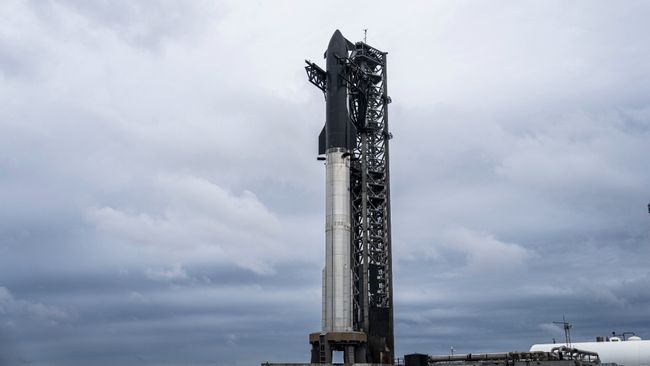
Some will likely point to Wednesday, January 15th as being more important, as it is on that day at 22:00 SpaceX is due to carry out the seventh integrated flight test of their Starship / Super Heavy behemoth, featuring the first flight of their Block 2 version of the Starship vehicle. This features revised forward aerodynamic flaps (used to control the vehicle during its fall through the atmosphere), a 25% increase in propellant load, a 3.1 metres increase in length and an updated thermal protection system.
SpaceX Starship 33 stacked on top of Booster 14, ahead of the seventh orbital flight test, currently targeting a January 15th launch. Credit: SpaceX
Overall, the flight should follow a similar format to Flight 6 – attempting a recovery of the booster at the launch site and the Starship vehicle splashing down in the Indian Ocean. However, a test of the thermal protection system and the deliberate exposure of parts of the vehicle to the heat of re-entry might result in its complete loss. This flight will also see the first attempt to deploy Starlink communication satellite “simulators” from the payload bay.
Starship, with its stated payload capability of up to 100 tonnes far outclasses New Glenn in lifting capabilities – but contrary to SpaceX fans, this actually does not guarantee the vehicle is destined for commercial success once it reaches any form of operational status beyond being a Starlink delivery mechanism. A lot in this regard depends on the price-point for launches with the system, and the continuing downwards trend in the size and mass of many classes of satellite which make smaller, low-cost launchers potentially far more attractive for such launches (I’m deliberately ignoring the claims that Starship is about opening Mars to colonisation, as that had a world of issues in its own right).
I’ve have a report on the flights – assuming they go ahead – in the next Space Sunday.





 Inara Pey: Living in a Modemworld