
Returning samples from Mars is proving difficult for NASA to get sorted – which, considering plans of various forms have been under consideration since before Apollo 11 landing on the Moon, might sound confusing. However, early proposals for such a mission were hampered by the fact that the density of Mars’ atmosphere was unknown, making the analysis of preferable vehicle masses and trajectory options to achieve a successful atmospheric entry somewhat difficult.
Things became easier in this regard following the successful Viking mission landings in the mid-1970s, but there were still significant technical issues to overcome – such as the number and type of vehicles required to reach Mars, land safely, obtain samples get them safely back to orbit and from there back to Earth.

Such were the complications involved that even as relatively recently as 2002, some at NASA felt that skimming a vehicle through the upper reaches of the Martian atmosphere and which used an aerogel to collect samples that would include high-altitude dust would be a easier proposition than trying to gather samples from the planet’s surface.
Also since the early 2000s, efforts have focused on the potential for international / joint efforts to recover samples from Mars, perhaps the most notable being the proposal NASA-ESA sample recovery mission, intended to recover sample tubes deposited on Mars by NASA’s Mars 2020 Perseverance mission.
However, even this has suffered from spiralling costs – in part due to an increasing reliance on complex technologies. By 2022, the mission required no fewer than five vehicles (not including Perseverance): a sample retriever lander + ascent vehicle (NASA); a sample return vehicle (ESA); and a sample collection lander and rover combination (ESA) – later replaced by two Ingenuity-class helicopters to – gather sample tubes deposited by Perseverance. This complexity and cleverness resulted in the cost estimates for the mission surpassing US $11 billion by April 2024, with the return of any samples collected by the Mars 2020 mission unlikely to occur before 2040.

On January 7th, 2025, NASA announced it intended to spend a further 18 months studying two alternate architectures by which to recover sample caches created on Mars by Perseverance. One leverages technologies developed by NASA, whilst the other involved commercially-developed technologies, with both utilising the existing proposal for the European-built Earth Return Orbiter (ERO) from the mission architecture outlined above to return the gathered samples to Earth.
The principle difference between the two options is that the NASA option proposes using the “skcrane” system sued to which both the Curiosity and Perseverance rovers to deliver the same recovery lander / ascent vehicle onto the surface of Mars, whilst the second would utilise a commercial “heavy lander”. Exactly what form this would take is unclear from the NASA statement – however, both Blue Origin and SpaceX have tried to muscle-in on the mission, suggesting the use of variants of their Blue Moon and Starship lunar landers. In both mission outlines, Perseverance would be used to deliver sample tubes to the sample return craft.

Exactly how much of an improvement / cost reduction these two methodologies will bring over current plans is very debatable; NASA’s own estimates put the two options at a cost of between US $7 and $8 billion – which is about the same as original estimates for the NASA-ESA proposal at the time when it was already causing concerns, having risen to US $7 billion from an intended cost of US $4 billion. Further, NASA suggests that while either approach might achieve a sample return by 2035 – a more likely timeframe is 2035-2039; hardly any improvement at all over the current 2040 timeframe.
Hence why, perhaps, Peter Beck’s Rocket Lab has placed a formal request with the incoming Trump administration to re-examine sample return mission options rather than green-lighting the updated NASA approach. This is because Rocket Lab – at NASA’s request – has developed a completely alternate sample-return architecture designed to fit NASA’s requested mission cap of US $4 billion, whilst potentially returning the sample to Earth by 2031/32.

Whilst on the surface as complex as NASA’s joint approach with ESA, the Rocket Lab mission is actually far more direct and lightweight, comprising a total of three launches from Earth, and six vehicle elements. These comprise:
- The Mars Telecommunications Orbiter (MRO): this would offer an orbital communications relay for the rest of the mission – and other Mars surface missions.
- The Mars Entry and Descent System (EDS): an aeroshell vehicle carrying within it the Mars Lander and the Mars Ascent Vehicle (MAV).
- The Earth Return Orbiter (ERO), which includes the Earth Entry System (EES).
Rocket Lab’s mission would proceed as follows: a Rocket Lab Neutron launcher is used to send the MRO to Mars. This is followed by to further Neutron launches, one for the EDS and one for the ERO. On arrival at Mars, the MRO arrives first, entering an orbit where it can act as communications relay. The EDS then makes a direct atmosphere entry, protecting the lander / MAV through the heat of atmospheric entry prior to the lander making a parachute descent and propulsive landing.

The latter will be made close to one of the sample caches created by Perseverance, allowing it to collect up to 20 sample tubes (depending on the size of the cache) – although how this will be done is not fully defined in the rocket Lab proposal. The sample tubes are delivered to the MAV on the top of the lander, the MAV using the lander as its launch pad to return to orbit.
Once in orbit, the MAV rendezvous with the ERO, transferring the sample container to the ERO, which sterilises it using onboard systems as it returns the container to Earth and uses the EES to deliver the sample container back to Earth’s surface.
While Rocket Lab might seem an unlikely candidate for a Mars Sample Return mission when compared to the likes of SpaceX, the company arguably has a lot more experience with the technologies required for such a mission. The company has supplied elements used within several Mars missions from the Mars Science Laboratory onwards – including developing solar arrays for power, support systems to maintain vehicles while en-route to Mars, and build the EscaPADE Mars orbiters and their support bus, and re-entry technologies being utilised by other companies.

It’s not clear how the incoming NASA Administrator (whether it be Jared Isaacman or someone else) will respond to Rocket Lab’s request; a lot, in this regard, might be dependent upon how much influence Elon Musk – whose SpaceX, like it or not, still very much depends upon NASA and government contracts for its survival – welds over NASA’s decision-making in the coming months.
Big Birds Set to Fly
Two significant launches are due to take place in the coming week, one of which could mark the entry of a significant new player in the space launch market.
Blue Origin’s massive New Glenn vehicle, of carrying up to 45 tonnes of payload to orbit – although for the most part it will likely carry far less than that – is due to lift off from Space Launch Complex 36 at Canaveral Space Force Station at 06:00 on Monday, January 13th. It’s a mission I’ve written about extensively already, but there is a lot riding on the broad success of the mission in delivering its upper stage and payload to orbit.

New Glenn has, from the outset, been designed to fulfil a wide variety of roles, from delivering individual and multiple satellite payloads to orbit and to places like the Moon, through to playing a crucial role in helping Blue Origin and its partners establish their planned Orbital Reef space station, to even carrying out human-rated launches. As a payload launcher, it will – subject to a second qualifying flight after this one – be used for US government launches as well carrying out commercial launch operations.
This first flight will carry a prototype of Blue Origin’s Blue Ring orbital vehicle as the payload – although it will not separate from the vehicle’s upper stage – and will attempt a recovery of the core booster on the landing recovery ship Jacklyn, some 1,000 km off the Florida coast.
Some will likely point to Wednesday, January 15th as being more important, as it is on that day at 22:00 SpaceX is due to carry out the seventh integrated flight test of their Starship / Super Heavy behemoth, featuring the first flight of their Block 2 version of the Starship vehicle. This features revised forward aerodynamic flaps (used to control the vehicle during its fall through the atmosphere), a 25% increase in propellant load, a 3.1 metres increase in length and an updated thermal protection system.
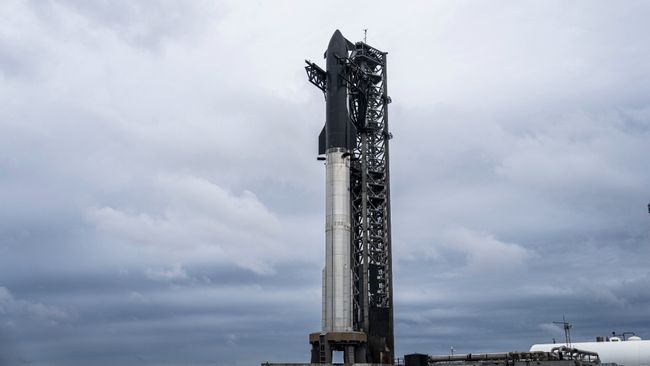
Overall, the flight should follow a similar format to Flight 6 – attempting a recovery of the booster at the launch site and the Starship vehicle splashing down in the Indian Ocean. However, a test of the thermal protection system and the deliberate exposure of parts of the vehicle to the heat of re-entry might result in its complete loss. This flight will also see the first attempt to deploy Starlink communication satellite “simulators” from the payload bay.
Starship, with its stated payload capability of up to 100 tonnes far outclasses New Glenn in lifting capabilities – but contrary to SpaceX fans, this actually does not guarantee the vehicle is destined for commercial success once it reaches any form of operational status beyond being a Starlink delivery mechanism. A lot in this regard depends on the price-point for launches with the system, and the continuing downwards trend in the size and mass of many classes of satellite which make smaller, low-cost launchers potentially far more attractive for such launches (I’m deliberately ignoring the claims that Starship is about opening Mars to colonisation, as that had a world of issues in its own right).
I’ve have a report on the flights – assuming they go ahead – in the next Space Sunday.


 Inara Pey: Living in a Modemworld