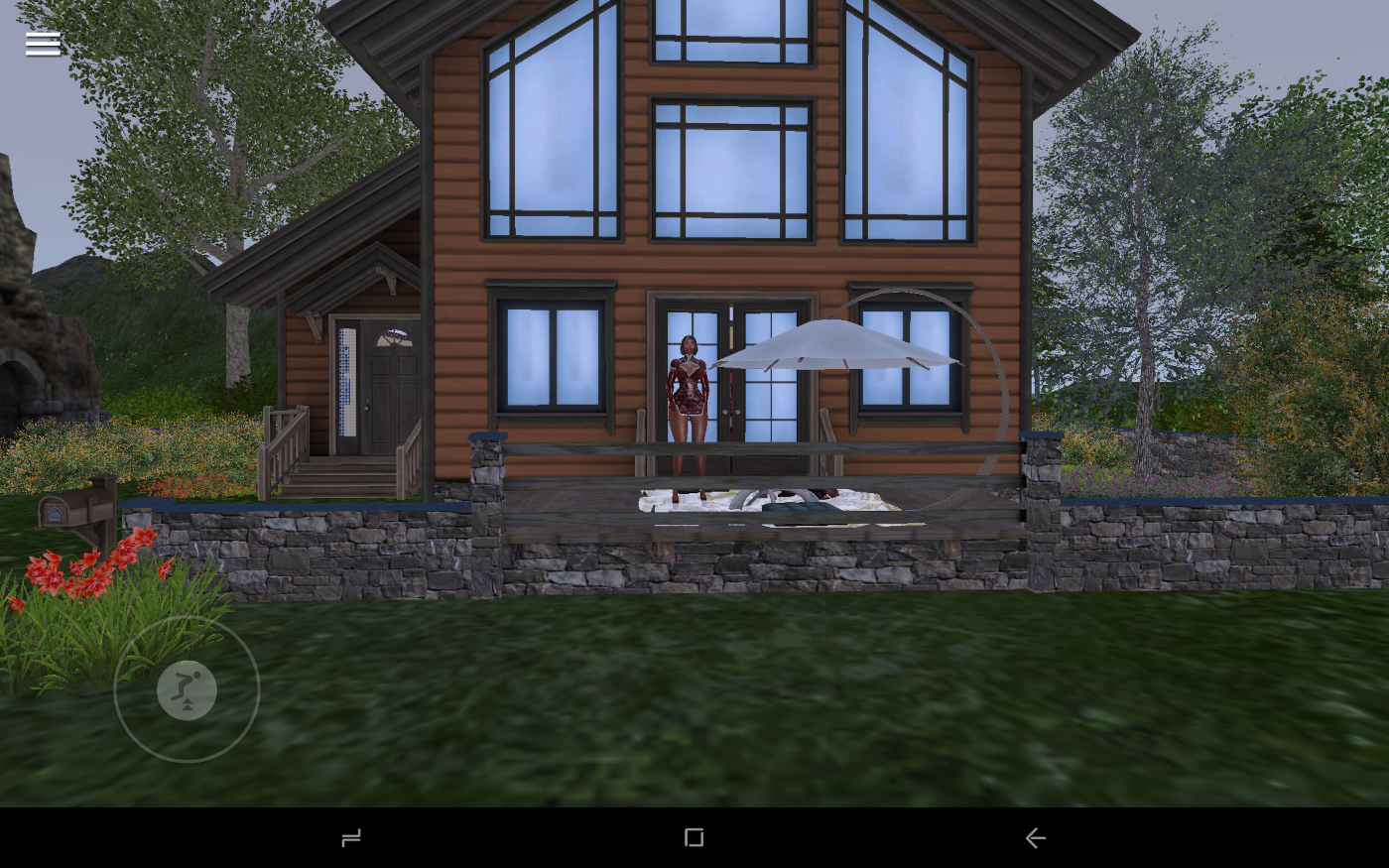
Outside my Linden Home on the SL Mobile App, November 14th, 2024 (unedited / retouched)
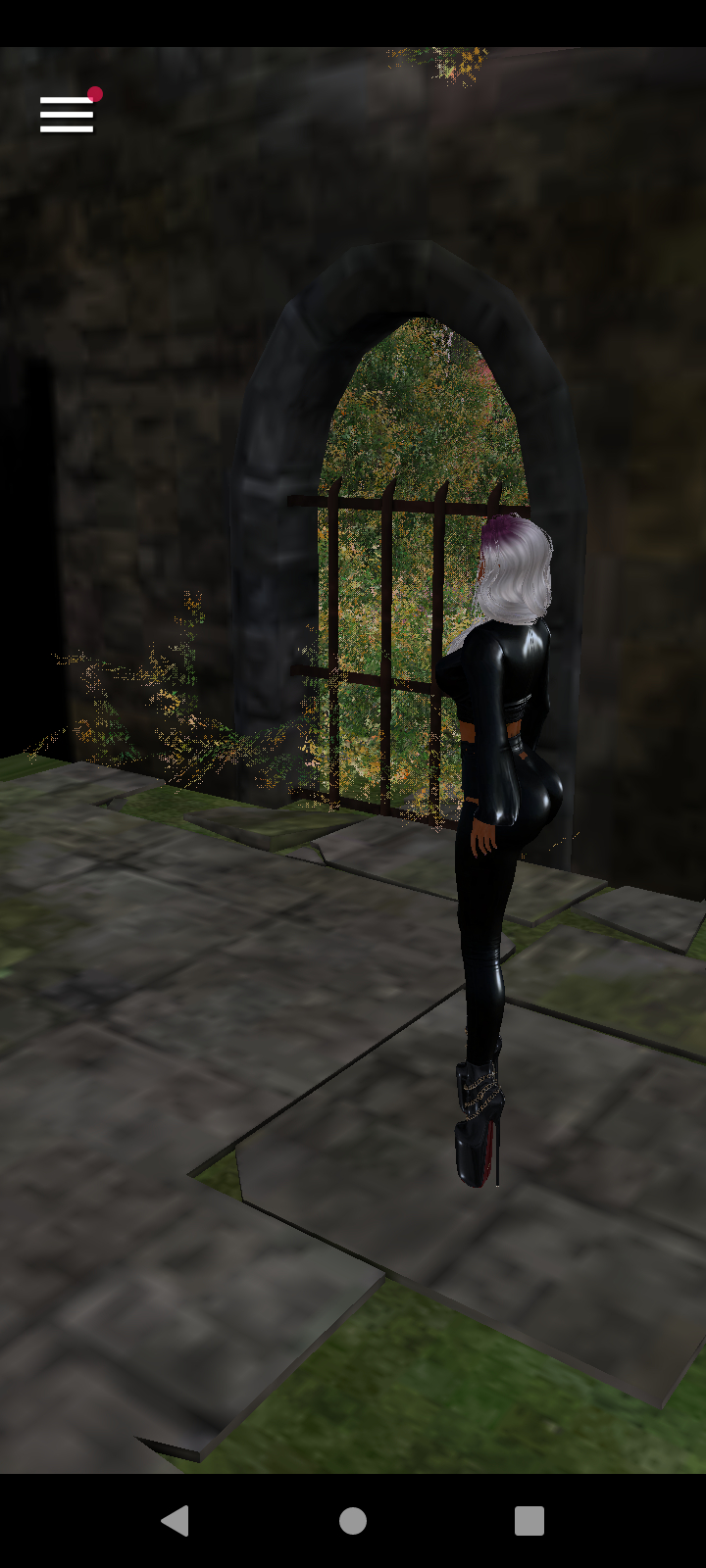
A little over a week since quietly making it available to all Second Life accounts types, on Thursday November 21st Linden Lab officially blogged that all Second Life users can now download and make use of the SL Mobile App (available on both Android and iOS) – see Second Life Mobile is here!
The original November 14th move to make SL Mobile available to all was followed by a special Zoom telecon with a number of Second Life bloggers, during which – and among other things – the Lab specifically discussed Mobile and its development and their hopes for it.
Engaged in that call were Executive Chairman Brad Oberwager, CTO Philip Rosedale, VP of Engineering and Product, Grumpity Linden, and chief Mobile developer Adam Frisby – who some may know for his former involvement in Second Life and his role in creating the Sine Space virtual world (or as it was once known, sinewave.space), whilst being hosted by Brett Linden.
Currently, the product is still officially regarded a “Beta” – it is still being improved based on feedback, and new features are being developed for future integration.
Capabilities are being added in terms of user “journeys” – that is, if someone wants to do X in SL, what capabilities / functionality / abilities do they require? The first such “journey” focused on going something in-world – such as a club or venue, etc., – and doing something, and what that would entail (being able to see the scene, move, chat, IM, view profiles, tip performers etc).
The App is not – and most likely will not – ever be seen as a “replacement” for access Second Life via a desktop / laptop; not is it ever likely to be as feature-capable as the desktop viewer.
Broadly speaking, SL Mobile has been developed with two primary audience in mind:
Existing users – as a means for them to enhance their SL experience by continuing engage with the platform and their friends during those times of the say when it might not be practical to utilise the desktop viewer in order to do so.
“Lapsed” users who have left SL, many of whom have responded to the Lab reaching out to them by saying Second Life doesn’t address their preference for using mobile to access the things they want to do, rather than being reliant on a desktop environment.
Linden Lab is seeking feedback on the App, particularly if issues are encountered / persistent. However, when reviewing the App on Google Play or the Apple Store, LL do ask that users keep in mind that SL Mobile is not feature complete, and is being built iteratively, and so not all desired functionality may be there when using it.
Alongside the announcement, the Lab promoted a short video first seen with the “soft” opening of the App’s availability on November 14th, and which is presented below.
Personal Notes
I’ve been using the SL Mobile App since it was first made available for Premium account holders, and as such have watching its development since then. While my own experience with the App has been problematic – and potentially the result of a range of factors outside of SL and the Lab’s control (quality of wi-fi, for example), I’ve been impressed with what I’ve seen in terms of development and progress. However, given I personally have little use for the App (I work from home and so my PC is always within easy reach when I have time for SL), and given its (until recently) limited availability, I’ve not covered it to a great degree going forward.
That said, I will continue to cover the App in my Viewer Release page and weekly viewer release summaries, and as as result of the App now being available to all, I will attempt to report on significant updates going forward, for those interested.
Lights in White Satin, November 2024 – click any image for full size
Light in white satin, frosted trees on the hill Cakes for the eating, ’til you’ve had your own fill. Beauty in gentle mist with soft whimsy before Fun for its own sake is here to adore.
OK, so that’s not precisely what Justin Hayward wrote at the tender age of 19 whilst penning Nights in White Satin (which coincidentally reached No. 19 in the UK charts when first release as a single in 1967), but given the title of the region design I’m featuring here and its nature, can you really blame me?
Lights in White Satin, November 2024
Lights in White Satin is the work of ChimKami and Leica Arado as a whimsical winter setting that is intended to be enjoyed for its light-heartedness and sense of joy. Folding within it charm, memories of childhood, holidays in the sunshine and on beaches lapped with surf and crisp winter’s nights when the snow crunches underfoot and the silver crescent of the Moon hangs amongst scattered jewels of stars.
This is a place where logic and detailed descriptions can, frankly, be thrown out the window – it is whimsy and delight should be experience first-hand. From Chocolate tumbling down the sides of tall peaks and turning some of the satiny snow brown, through trees growing like Magnum® ice cream, and paths formed by icing-tops biscuits and chocolate blocks broken from some giant’s bar, this homestead region offers vignettes and settings where time might be spent.
Lights in White Satin, November 2024
The latter are spread all around the region, far enough apart to offer a little privacy where seating is available. The seating comes in a wide variety of forms, from chairs cut from pieces of fruit to those of a more regular variety. Some are watched over by Disney-esque characters, others are home to unicorns or penguins, elephants or deer; but this alone is an insufficient description.
This is a place where lollipops and gum crops form the trees alongside ice creams and ice cream cones, wish fish and sea creatures swim underwater and under dome; where lanterns float and mushroom drip icing like stalactites, ladders climb trees and little worlds and puffs of little clouds hover in the sky, possibly ignoring all that passes below.
Lights in White Satin, November 2024
To put it another way and partially repeat myself, this is a place to put away grown-up thoughts and let your inner child free and simply enjoy the whimsy, the contradictions, the little wonders. Of course, if you want, you can hop around via the teleport near the Landing Point and thus find the horses waiting to be ridden or the little RHIB waiting for you to putter (or zip) around the island or the rowing bow moored for you to relax upon – but where’s the fun in that? Better to roam and find.
Also waiting to be found are a host of references similar to the touches of Disney mentioned above. From a certain ogre and his sidekick to Hergé’s heroes or broomsticks hinting at games of Quidditch, all might be found here, together with opportunities for ice-skating, dancing and those simple opportunities to relax and have fun.
Lights in White Satin
As already noted, Lights in White Satin isn’t a place to be written about – it is a place to visited, explored and experienced – be sure to mouse-over things carefully or you might miss a few smile-raising things. So instead, rather than banging on about it here, I’ll just invite you to pay a visit. And, before closing, express my thanks to Sam Rougefeu for his blog post that led me to visit.
The following notes were taken from the Tuesday, November 19th, 2024 Simulator User Group (SUG) meeting. They form a summary of the items discussed, and are not intended to be a full transcript, and were taken from the chat log and Pantera’s video of the meeting, which is embedded at the end – my thanks to her for providing it.
Meeting Overview
The Simulator User Group (also referred to by its older name of Server User Group) exists to provide an opportunity for discussion about simulator technology, bugs, and feature ideas.
Meetings are open to anyone with a concern / interest in the above topics, and form one of a series of regular / semi-regular User Group meetings conducted by Linden Lab.
Dates and times of all current meetings can be found on the Second Life Public Calendar, and descriptions of meetings are defined on the SL wiki.
Simulator Deployments
On Tuesday, November 19th, 2024, the simulators on the Main SLS channel were restarted without no updates.
On Wednesday, November 20th the Barbecue simulator update will be deployed to all remaining simulator RC channels. This update includes:
Support for “alpha-gamma” which will allow an object owner to adjust some of the PBR alpha values that were impacting legacy things like hair.
A new warning on receiving direct IMs from Scripted Agents (“registered” bots). Rider describes this as “Bot confessions”: with IM sessions with bots there will be a warning sent to the receiver that they are having a conversation with a bot. Also, for viewer developers, there will be a bit of metadata attached to the IM_NOTHING_SPECIAL that indicates the sender is a bot.
The remaining RC channel will be restarted.
Apple Cobbler Update
This will follow the Barbecue deployment in the coming week, and should include:
llTransferOwnership which enables a prim give itself to a new user (subject to owner permissions already set).
An extended llGiveInventory to allow for a destination folder (system folders + RLV/a) to be specified as well (+ the use of a parameter list, so further options can be added in the future).
llMapBeacon – like llMapDestination, but a) does not necessarily open the map window; b) can optionally open the map, with or without focus. This will also require a viewer update.
A new function for detecting attachments. If it is running with an experience it will be able to detect HUDs that also have scripts with the same experience (e.g. to ensure the correct HUDs are being used – this will not allow anyone to script to find out all the HUDs someone is using).
A preview of Apple Cobbler is available on the Aditi (Beta Grid) regions of Mauve and Jigglypuff for those wishing to test, with the testing carried out thus far having uncovered a range of cases relating to llTransferOwnership.
SL Viewer Updates
No updates with the current official viewers:
Release viewer: version 7.1.10.10800445603, formerly the DeltaFPS RC (multiple performance fixes, etc), dated September 11, promoted September 17 – No change.
The above included thought on No Copy permissions, and a potential issue with DFS rezzers.
Release Candidate: ExtraFPS RC, version 7.1.11.11750364439, November 12.
Performance improvements: enhanced texture memory tracking, broader hardware compatibility and higher FPS gain; additional code to improve texture streaming on rigged attachments (e.g. if an earring is made with 2K textures, the viewer will correctly calculate the required resolution for the textures and download them, rather than downloading the full 2K textures), etc.
Aesthetics improvements: new Antialiasing setting – SMAA; Contrast Adaptive Sharpening; Khronos Neutral Tone Mapping (can be changed to ACES via the RenderTonemapType Debug setting).
UI Optimisations.
In Brief
Please refer to the video below for the following:
A discussion about this issue with llrezobjectwithparams() (or possible feature, depending on one’s viewpoint) changes properties of no mod objects. The resulted in a wide discussion on permissions and llROWP.
The above became wrapped into a discussion on No Copy permissions. and llROWP extensions, rezzing system ranges.
A conversation on object and agent inventory, touching on some of the differences between the two, and where data is relating to objects is stored, with Rider commenting he has ideas for expanding inventory data to obtain things like the length of an animation.
† The header images included in these summaries are not intended to represent anything discussed at the meetings; they are simply here to avoid a repeated image of a rooftop of people every week. They are taken from my list of region visits, with a link to the post for those interested.
Logos representative only and should not be seen as an endorsement / preference / recommendation
Updates from the week through to Sunday, November 17th, 2024
This summary is generally published every Monday, and is a list of SL viewer / client releases (official and TPV) made during the previous week. When reading it, please note:
It is based on my Current Viewer Releases Page, a list of all Second Life viewers and clients that are in popular use (and of which I am aware), and which are recognised as adhering to the TPV Policy. This page includes comprehensive links to download pages, blog notes, release notes, etc., as well as links to any / all reviews of specific viewers / clients made within this blog.
By its nature, this summary presented here will always be in arrears, please refer to the Current Viewer Release Page for more up-to-date information.
Note that for purposes of length, TPV test viewers, preview / beta viewers / nightly builds are generally not recorded in these summaries.
Official LL Viewers
Release viewer: version 7.1.10.10800445603, formerly the DeltaFPS RC, dated September 11, promoted September 17 – NO CHANGE.
Release Candidate: ExtraFPS RC, version 7.1.11.11750364439, November 12 – New.
La Côte Sauvage, November 2024 – click any image for full size
In September 2024, I visitedLa Côte Sauvage (The Wild Coast), a natural location held and designed by Second Life artist-photographer Caly Applewhyte (Calypso Applewhyte). Taking its inspiration from the Breton Coast, France, it was at that time located within half of a Homestead region.
And while people might say a year is a long time in politics, just a matter of a couple of months or so can be an age in Second Life! Because that’s all it has taken for La Côte Sauvage to change location and expand, offering a setting both familiar and new to explore.
La Côte Sauvage, November 2024
Whilst still occupying one half of a region, the region in question is now a Full region held by Caly, with La Côte Sauvage running north-to-south along its western half, the Landing Point sitting roughly between the northern and southern extremes. I’m not sure when the move was made, but at the time of my visit, it did appear as if one or two things were still in the process of being placed / awaiting placement, with the little puppy happy in his sleep from the previous iteration still resting, but at the time I dropped in, floating serenely above and behind one of the setting’s little cabins, together with floating hovering overhead not too far away.
The cabin in question is one half of the Trompe Loeil Yara Treehouse, as carried forward from the previous build, with its remaining half (also sans supporting trees) has been transplanted to the southern end of the landscape. They are not alone in being carried over, as those who visited La Côte Sauvage in its “old” home will realise as they wander; there is much here that is familiar – and rightly so – within the expanded landscape. But this is not to say the setting is the same; there is also much that is new.
La Côte Sauvage, November 2024
Take, for example, the the henge-like standing stones and the ruined chapel on the headland beyond them; both echo the presence of the ruins that occupied the former Côte Sauvage, complete with the henge stones speaking to an ancient past; but the manner in which henge and chapel ruins speak of age is very different to the ruins which had resided in the former build. Similarly, while the Romanesque pavilion and its refreshments appears here, it now sits within a more shelter location, complete with a new view over the land as it sits at the edge of the setting’s rich woodland.
These woods occupy most of the eastern side of the land, set back and above stream and sandy coast as if ready to rebuff any harsh winds that might otherwise seek to make their way inland; and the winds and the sea here can indeed be hard and cruel, as evidence by the wreck of a ship driven on to rocks to the north. However, shelter from the harshness of the sea is offered by a headland, an island and a causeway of rock, all of which conspire to guard an inlet cutting into the land before the Landing Point. It is here that a stream bursts froth from rocks below the treeline and bubbles and rushes the short distance to the waters of the inlet, passing under one of several bridges aiding walkers in their explorations as it does so.
La Côte Sauvage, November 2024
It is within the trees that a meandering path might be found, offering another route of exploration running roughly north-to-south. It can be reached from several points, although probably the easiest is to take the steps winding up between the rocks at the north end of the setting, close to the cabin there, or by climbing the stone steps to the Romanesque pavilion and then making your way through the trees until you reach it.
This path actually straddles the parcel boundary between the two halves of the region, the woodlands doing to as well. This given the impression that the two halves of the region might be somewhat contiguous – although the different EEP settings used in each also belies this. I frankly have no idea if the two halves, even if thematically different, are supposed to run together and be open to all who visit; at the time of my visit, the east side was very much under development, so I kept my nose out as far as possible so as not to interfere.
La Côte Sauvage, November 2024
Several places to sit can be found along the woodland trail, together with a mystical altar. Quite what rituals the latter might be for, I have no idea, but its presence added a shade of misty to the woods.
In terms of mystery, the altar might be matched by the mysterious building on the island protecting the inlet mentioned earlier. Built into the island’s peak and at first resembling an old bunker, it is in fact the entrance to Caly’s gallery space: take the teleporter inside to reach it. Built around a central lobby, the gallery offers four halls in which past exhibitions presented by Caly across Second Life continue to be celebrated. Just click the tree stump to return to ground level, either at the bunker or the landing point.
La Côte Sauvage, November 2024
As with its former location and design, La Côte Sauvage remains a very visual and engaging place to explore and visit, so if you missed it the first time around, now’s your opportunity to catch up!
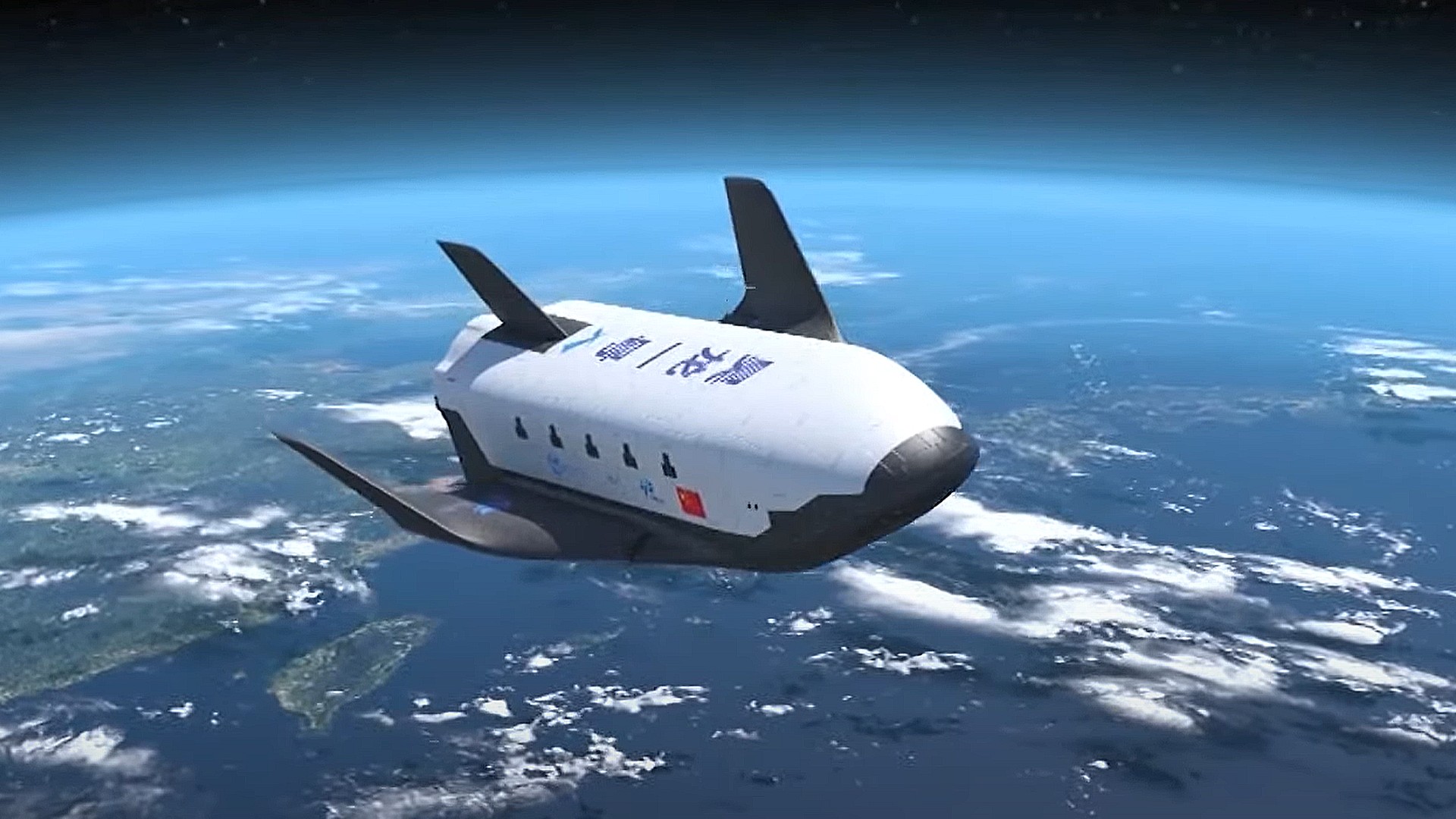
An artist’s impression of the Haolong automated resupply vehicle, intended to support China’s Tiangong space station. Credit: CCTV
China’s space programme is perhaps the most aggressive in the world in terms of ambitions and speed of development. In the last two decades, the country has been embarked on one of the most forward-thinking human spaceflight programmes, quickly moving from two small orbital laboratories to a fully-fledged space station whilst setting its eyes firmly on the Moon. At the same time, it has shown itself to be the equal of both the United States and Europe in the field of robotic exploration of the Moon and Mars, whilst also seeking to match the United States in pioneering the use of uncrewed reusable vehicles.
Most notably in this latter regard has been the Shenlong orbital vehicle, which I first wrote about in 2023, and which completed its second 200+ day orbital mission September 2024. Whilst not as long in duration as those of America’s X-37B, which it matches in terms of size and secrecy, Shenlong could be broadly as capable. And it will soon be joined by a second Chinese automated spaceplane, one with a similar purpose to America’s upcoming Dream Chaser vehicle.
Called Haolong, this new vehicle is one of two finalists in an 18-month selection process initiated by the China Manned Space Engineering Office (CMSEO) to determine the next generation of resupply vehicles intended to support the country’s Tiangong space station. In May 2023, CMSEO sought proposals from government agencies and China’s growing private sector space industry for vehicles capable of delivering a minimum of 1.8 tonnes of materiel to the Tiangong space station at a cost of no more than US$172 million per tonne. From the 10, in September 2023 four were selected to move forward to a more intensive design and review phase lasting just over a year, with the potential for two of them to be picked for full vehicle development.
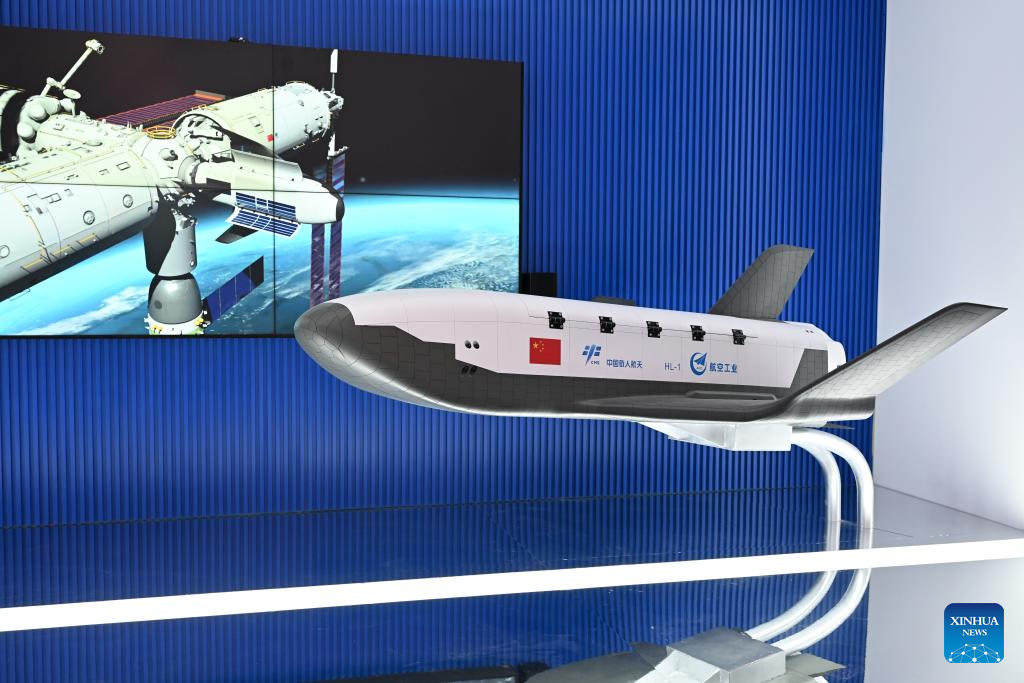
A model of the Haolong automated cargo vehicle displayed at the Zhuhai Air Show, November 2024. Credit: China News Agency
On October 29th, 2024, the winning proposals were announced, with the Haolong spaceplane immediately gaining the the most interest due to its nature and the fact it was heavily promoted at China’s annual Zhuhai Air Show, complete with videos showing it in operation and images showing the full-size proof-of-concept development model.
Haolong’s development is being undertaken by an unlikely source: the Chengdu Aircraft Design and Research Institute, operated by the state-owned Aviation Industry Corporation of China (AVIC). Neither Chengdu, which is largely responsible for military aircraft development, nor AVIC has been involved in space vehicle development until now. At a length of 10 metres and a span of 8 metres with its wings deployed, Haolong is very slightly longer and wider than America’s Dream Chaser (9 metres long with a 7-metre span). Like the American vehicle, Haolong is designed to be vertically launched via a rocket, its wings folded to fit within a payload fairing, ready to be deployed once it reaches orbit and separates from its carrier rocket.
Haolong docked at Tiangong, note the open doors with the solar arrays and thermal radiators. Credit: CCTV
Exactly what to overall payload capability for the vehicle might be is unclear; Chengdu have only confirmed it will be able to lift the required 1.8 tonnes to orbit. This is less than one-third the total load carried by the current automated (and completely expendable) Tianzhou resupply vehicle, which can carry up to 6 tonnes to orbit – a capacity Dream Chaser can match.
However, given Haolong’s size and pressurised cargo space – coupled with the fact that the CMSEO requirement included a provision the new resupply vehicles can dispose of / return to Earth up to 2 tonnes of waste / materiel – it would seem likely Haolong’s all-up payload capability is liable to be above the 1.8 tonne minimum should it ever be required to fly heavier loads.
A rendering of the Tianzhou automated resupply vehicle used to support China’s Tiangong space station. Fully expendable, the 14-tonne Tianzhou is itself based on China’s first two orbital laboratories, also confusingly called Tiangong (1 and 2). Credit: Shujianyang
But even if this isn’t the case, Haolong still scores over Tianzhou, as it’s all-up mass is expected to be less than half that of the older vehicle, potentially enabling it to be launched by a selection of Chinese rockets rather than being restricted to the expensive Long March 7. It could, for example even come to be launched atop the semi-reusable Long March 2F (if this enters production), or the rumoured semi-reusable variants of either the Long March 8 or long March 12B, as well as the expendable versions of Long March 2.
Details of the second vehicle to be selected, the Qingzhou cargo spacecraft, are somewhat scant, including its overall reusability. However, it will be launched via the upcoming Lijian-2 rocket being developed by CAS Space. The latter is commercial off-shoot of the Chinese Academy of Sciences, so technically its use as the launch vehicle for a space station resupply craft marks the first time a commercial entity will participate directly in China’s national space programme.
Long March 9: China’s Answer to Starship / Super Heavy?
Also present at the Zhuhai Air Show were further models of China’s in-development super heavy launch vehicle, the Long March 9 (Changzheng 9 or CZ-9) booster, together with the first models of China’s answer to (or near-clone of, if you prefer) the SpaceX Starship vehicle.
First announced in 2011, Long March 9 has been through a number of iterations and design overhauls. As first envisaged, the vehicle would comprise a 10-metre diameter core stage supported by up to four 5-metre diameter liquid-fuelled boosters (essentially Long March 10 first stages), giving it the ability to lift an upper stage with a payload capacity up to 140 tonnes to low-Earth orbit (LEO). With minor variations, this remained pretty much the baseline design until around 2019.
The Long March 9 super heavy launch vehicle as originally envisioned in 2016, to scale with other launch system, notable the SpaceX BFR, the precursor to Starship / Super Heavy. Credit: Wikipedia (2018)
A substantial redesign then appeared in 2021. This saw the elimination of the strap-on boosters and the first stage diameter increased 10.6 metres. To compensate for the loss of the strap-on boosters, the first stage of the vehicle had its original four engines replaced by 16 kerosene / liquid oxygen (LOX) motors, each one generating some 300 tonnes of thrust at sea level, allowing it to haul up to 160 tonnes of payload up to LEO.
Then in 2022, the decision was made to make the first stage of the rocket reusable. The LOX / kerosene motors were swapped for 26 of the more efficient YF-135 methane / LOX motors, the exact number compensating for the reduction in overall thrust. However, as 26 main engines required an 11-metre diameter first stage to fit them and their additional propellants, the design was then scaled back to keep the 10.6 metre diameter, and the number of motors reduced to 24 first stage engines. A further change at this point small the vehicle’s optional third stage increased in diameter from 7.5 metres to 10.6 metre as well, unifying all three stages.
This design carried over to 2023, where it was displayed at that year’s Zhuhai Air Show. However, the engine configuration had again changed for the first stage, with 30 of the more compact YF-215 motors now being used. In this configuration, Long March 9 was touted as being capable of delivering somewhere over 100 tonnes but less than 160 tonnes of payload to LEO in a two-stage variant and between 35 and 50 tonnes of payload to the Moon in a 3-stage version.
A drawing of the 2023 version of Long March 9 from the 2023 Zhuhai Air Show, showing the 30-stage variant, said to be capable of delivering up to 53 tonne to the surface of the Moon; the 2- stage version with 100-160 lift capability and the proposed “Starship” variant with a 100-tonne capability to LEO and full reusability. Credit: CALT / CCTV
Also revealed at the 2023 Air Show were drawings of CALT’s take on the SpaceX Starship. At the time, the idea was defined as a “possible” iteration of the Long March 9 design, and unlikely to be ready for use – if pursued – until the 2040s. However, at the 2024 Air Show held in early November, it was clear CALT is invested in making a fully reusable Long March 9 launch system; on display were a set of models, one showing the Long March reusable first stage with the “starship” vehicle sitting on top of it, with two smaller models showing the “starship” vehicle on the lunar surface and a Long March 9 first stage resting on its “catch gantry” at the end of a flight.
According to CALT representatives at the show, work has now commenced on fabricating the first Long March 9 test vehicle, indicating the core design for the rocket’s first stage is now largely finalised, and the focus will initially be on developing this and the expendable second and third stages, with the first launch of an integrated rocket targeted for 2030. However, the representatives also indicated that the development of the reusable upper stage vehicle is seen as more integral to China’s lunar aspirations, and that they are looking to introduce it possibly as soon as the mid-to-late 2030s.
Scale models of the proposed “starship” upper stage of the Long March 9 sitting on the Moon (l) and the first stage booster resting on its landing gantry’s movable arms. Note how the deployable grid fins are used to support the mass of the booster on the gantry arms. Credit: CCTV
While making no secret of the fact they are directly emulating SpaceX with their design, CALT noted their vehicle would be more flexible in its application. As well as being able to deliver 100 tonnes to LEO, it was suggested it will be able to deliver smaller payloads to other orbits – such as MEO, GEO, GTO and SSO, and deliver as much as 50 tonnes to TLI, all apparently without the need for on-orbit refuelling (which Starship currently requires in all these cases).
If the lack of refuelling is accurate, then it suggests CALT are considering different internal layouts for their “starship”, such as utilising payload space for additional propellant tanks to enable their vehicle a wider range of operational capabilities; however, until CALT are more forthcoming on exactly how they envisage vehicle operations to work, this is purely speculative.
Reaction Engines in Administration
Reaching orbit using rockets – even reusable ones – is a costly business. Rockets require complex, high-performance (and costly) motors, have to carry a lot of propellants to feed them, and require a lot of specialised infrastructure to operate them. Because of this, one of the holy grails of access to space has been the SSTO – single stage to orbit – vehicle; a craft capable of taking off in a manner akin to that of an aircraft, reaching orbit and then returning to Earth and again landing like a conventional aircraft.
In the 1980s, Britain in particular worked on an SSTO concept called HOTOL (Horizontal Take-Off and Landing), an uncrewed vehicle roughly the size of an MD-80 airliner. It would have utilised a unique air-breathing engine underdevelopment by Rolls Royce (the RB-545) to carry up to 8 tonnes of payload to orbit , using the air around it as an oxidiser for its rocket motors, mixing it with on-board supplies of liquid hydrogen until the atmosphere became too rarefied for this, and the engines would switch to using on-board LOX with the liquid hydrogen. But despite initial government backing, interest from the European Space Agency and the United States, HOTOL floundered and ultimately died in 1989, and Rolls Royce shelved development of the RB-545.
A cutaway diagram of REL’s Skylon vehicle. Credit: Reaction Engines Ltd
Undeterred by this, one of HOTOL’s originators, Alan Bond, co-founded Reaction Engines Ltd (REL), a company dedicated to developing both a new air-breathing engine to supersede the RB545 and a new SSTO spaceplane to use it. The motor, called SABRE (Synergetic Air Breathing Rocket Engine) and the vehicle, called Skylon, have been in development ever since, with SABRE in particular seeing much progress and both national and international interest. In fact, as recently as 2019, things looked remarkably rosy for SABRE and Reaction Engines.
This is why the announcement that REL had entered administration, with all staff laid-off, is deeply saddening. An eight-week process has commenced to either restructure or sell the company; if neither proves viable, it will enter liquidation and all assets sold-off. No formal reason for the company’s failure to continue to gain funding has been given; however, it has been suggested that the fact SABRE and Skylon would only be able to operate from specially reinforced runways, rather than any suitably-equipped airport facility, may have been a contributing factor.
The SABRE engine. Credit: Reaction engines Ltd
NASA and Roscosmos at Loggerheads over ISS Leak
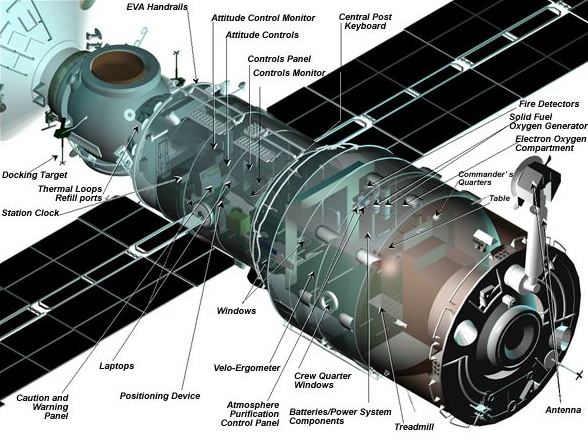
For the last five years the International Space Station (ISS) has been suffering from an atmospheric leak within one of its oldest modules, the Russian Zvezda Service Module. Launched in 2000 as the third major element of the space station, Zvezda is actually approaching its 40th birthday, the core frame and structure having been completed in 1985 when Russia was still engaged in its Mir space station programme.
As such, the unit is well beyond its operational warranty period, and since 2019, the short airlock tunnel connecting the Zvezda’s primary working space with the aft docking port has been suffering an increasing number of microscopic cracks that have allowed the station’s atmosphere to constantly leak out. Whilst the overall volume of atmosphere lost is small, by April 2024 it had reached a point where attempts to patch some of the cracks were made. While this did reduce the amount of air being lost for a short time, the volume has once again be rising of late.
The Russian Zvezda Module (also called the PrK module), seen from its aft end, with the Progress dock post visible. The airlock tunnel where the leaks are occurring is the cream-white cylinder just inside the module’s main structure, surrounding the docking port. Credit: NASA
Whilst the leaks are still far short of being any risk to the station’s crew, NASA and Roscosmos cannot reach an agreement on either their root cause or their potential to become a significant hazard. Roscosmos remains of the opinion that the cracks are purely down to thermal contraction as the module expands and contracts as it passes in and out of the Sun’s light and heat, and therefore no different to the thermal wear on all other parts of the station.
However, while agreeing agreeing thermal expansion and contraction has a role to play in the leaks, NASA does not agree that it is the only cause. Instead, they see the continued use of the aft docking port – primarily used to receive Progress resupply vehicles – as putting additional stress on the tunnel’s walls, and this, couple with the aging of the module in general and the thermal expansion / contraction is causing the cracks. What’s more, NASA is concerned that if use of the after docking port continues, it is elevating the risk of a high-rick failure within the tunnel which could seriously compromise station operations.
A Progress resupply vehicle docked at the rear end of the Zvezda Module. NASA believes the cracks causing the atmospheric leaks inside the module are in part the result of stresses induced on the module by Progress docking / undocking operations. This image was captured during a station “flyaround” by the shuttle Discovery during STS-102, March 2001. Credit: NASA
Given this, NASA would like to see Roscosmos discontinue the use of the docking port – which Roscosmos argues is not necessary. While both agree the issue is unlikely to result in a complete and catastrophic failure within the tunnel culminating in a lost of the station as a whole; NASA engineers and mission controllers are concerned that any failure within the tunnel could impact operations throughout the station. As such, they have ordered the hatch between the Russian elements of the ISS and the US / international modules to be kept closed other than during crew passage between the two sections of the station.
 The original November 14th move to make SL Mobile available to all was followed by a special Zoom telecon with a number of Second Life bloggers, during which – and among other things – the Lab specifically discussed Mobile and its development and their hopes for it.









 Inara Pey: Living in a Modemworld