Witchcraft & Voodoo in New Orleans: The End, October 2024 – click any image for full size
In August, I wrote about New Deer Isle and the touch of America’s New England that Kaiden Glocke Tray (KaidenTray) had brought to Second Norway (see: Second Norway’s touch of New England in Second Life). Kaiden is a gifted Second Life landscaper and his work can be seen across the grid places large and small, some of which I’ve also covered in these pages over the years.
For Halloween 2024, Kaiden presents Witchcraft & Voodoo in New Orleans: The End, a region-wide build presented on a Full private region leveraging the Land Capacity bonus. It’s a setting with a lot packed into it, both in terms of what to see and what is happening there throughout the month of October.
Witchcraft & Voodoo in New Orleans: The End, October 2024
Welcome to the most haunted and realistic location of New Orleans. It is a post-apocalyptic and dystopian environment, which was left bare after the flooding of Hurricane Katrina, There is an abandoned but interactive theme park with rides that still work, but ride them at your own risk! Release your competitive side with bumper cars, become lost in the mystical swamp, challenge your courage in the haunted house, create some amazing memories with photos, or get a real life reading from tarot readers!
– Witchcraft & Voodoo in New Orleans: greeter message
Unless you are there simply to pose for very specific photos of yourself, this is a place best experienced as it is designed to be seen – using the Shared Environment (World → Environment → Use Shared Environment). As there is a lot in the region that is going to keep the viewer business, I’d suggest that having Shadows enabled is not vital to the overall experience, and some might find they will need to adjust draw distance if they have it to the upper end of the scale. Do make sure that if you’re running a pre-PBR viewer, that you have enabled Advanced Lighting Model (ALM: Preferences → Graphics make sure the appropriate check box is ticked, but not you do not also need to enable shadows), and enable local sounds if you have them off.
Witchcraft & Voodoo in New Orleans: The End, October 2024
So, with all that said, and in the words spoken by Benedict Cummerbatch, “Now, shall we begin?”†
The Landing Point sits towards the western side of the region, along the main street of a Section of New Orleans as it runs north-to-south cross the region, and which is in places flooded (with the tide being held at bay at one end by a wall thrown across the road). The town forms the greater part of the setting, and at its southern end, merges into swamplands crossed by wooden board walks, the waters around them heavy with crocodiles. Among the mangroves and the cabins scattered around are various ritualistic goings on, whilst on the far side of the swamp, what appears to have been an outburst of murderous mayhem has struck the little village there.
Witchcraft & Voodoo in New Orleans: The End, October 2024
Both the bayou/ wetlands and the town also connect with the abandoned theme park as it occupies the north-east portion of the region. Partially flooded, this is fast turning into a wilding of a place – although the rides are still working (if some of them manned by ghoulish characters!), so be ready to try them out. The Landing Point is not enforced, so it is possible to hop around, but explorations on foot are really the only way to go lest you risk missing out on some of the frights.
When arriving at the main Landing Point, a greeter will provide an invite to the local Group, and information on both tours and a special show being staged in the region. Visitors are also offered a flashlight, and ADDing it helps with explorations.
Exactly which path you choose to take when exploring is entirely up to you, and I do not want to give too much away here and possibly spoil things. I will say that the theatre for the stage production is neatly tucked away (if apparently still under construction at the time of my visit, going by the raw prims), so it can sit within the setting without interrupting the overall flow of exploration or seeming to break with the overall region design.
Not all of the buildings have interiors, but those that do should be entered and appreciated / explored. Surprises may await and objects may require touching. I particularly liked the Black Cat Inn offers a cosy and relatively spooky-free place in which to relax. I will admit to being a little confused by the reference to a haunted house; not sure if I simply missed it (or maybe a teleport to it…) due to a case of the Stupids on my part, or whether you have to join one of the tours in order to visit it.
The performances I referred to above feature Theatre 6 in The Witches of New Orleans, with shows at 12:00 noon SLT on Sunday, October 13th, 2024 and 13:00 SLT on Saturday, October 26th, 2024. Dates and times of tours, meanwhile, are per the poster, above right.
Witchcraft & Voodoo in New Orleans: The End, October 2024
I’m not a great fan of Halloween as we treat it in modern times – haunted houses, trick-or-treating as it is now, etc., – although the tapestry of Gaelic influences and the link to Gothic fiction which are tied to Halloween are a different matter. As such, I tend to be a stick-in-the-mud when it comes to the plethora of Halloween themed events and regions and so on which pop-up between late September and early October in Second Life.
However, there are exceptions to this – and Witchcraft & Voodoo in New Orleans: The End is one of them. The region is well-crafted, and explorations offer surprises and things to poke at or ride or enjoy. It offers fun and engagement over simply trying to shock or excite, offering plenty of opportunities for photography as well as offering something just that little bit different by way of events within its boundaries (and some nice (and occasionally lewd!) touches of humour present in some of the signs around the place). So why not head over an have a look?
October brings with it all things spooky in the run-up to Halloween. Within Second Life, this means a plethora of region designs focused on ghostly goings-on, spookiness, haunting, monsters, vampires and the like, many with associated events and activities.
One such Halloween-ish event combining exploration, activities and entertainment in a more nuanced manner, and making a return to Second Life for its second season, is Seanchai Library’s The Bradbury Project. As it’s name implies, the month-long event is a celebration of the life and work of American author Ray Bradbury (August 22, 1920 – June 5, 2012), with a focus on some of his more spooky writing.
Bradbury is perhaps best known as a science-fiction and futurist/speculative fiction author responsible for titles such as Fahrenheit 451 (a book perhaps of special relevance currently), and his short-story collections The Martian Chronicles, and The Illustrated Man. However, he cast his writing net far wider, dipping into coming-of-age stories, screenplays, television scripts, poetry and both fantasy and dark fantasy. In the latter categories we have (the semi-autobiographical) Something Wicked This Way Comes, and The Halloween Tree.
The Halloween Tree
The latter is the story of eight boys as they attempt to rescue their friend on Halloween night. Under the guidance of the mysterious Carapace Clavicle Moundshroud, they travel through time and space, learning about different cultures, and the role that the fear of death, ghosts and hauntings has played in shaping civilisations down the ages, and how it has all contributed to much that is encompassed in modern-day Halloween activities. It’s is also one of the focal elements of The Bradbury Project.
In 2023, the project took place on sky builds within Seanchai Library’s home region of Nowhereville. For 2024, and thanks to the support of Linden Lab, the event expands into a dedicated Full region, allowing for more space for activities. However, like 2023, all donations / tips received while the Project is open through until Sunday, November 3rd, will be donated to Reading is Fundamental.
A major feature of Bradbury’s writing is Green Town, a fictionalised version of his place of birth, Waukegan, Illinois. It is a place of safety and home, featuring in a number Bradbury’s darker tales and in his short stories, and which has a result is depicted at several different points in the 20th century. Green Town is also the starting point for The Bradbury Project, which offers aspects of Green Town as it might have appeared in the 1950s.
Visitor arriving within the Project will find themselves within the garage of one of the houses lining Green Town’s main street. This offers information boards about the Project and the planned events, as well as information on the two Second Life Experiences operating within the region – both of these should be accepted in order to enjoy the Project to the fullest; however, if you an unsettled by the idea of using Experiences, a box of landmarks can also be obtained from the landing point to ferry you around.
Seanchai Library: The Bradbury Project 2024
A wander around the town will reveal its charm and also some points of interest – information boards that provide more insight into Bradbury’s life and work, and other interactive pieces (such as a television presenting the short film The House I Live In, which whilst not in any way focused on Halloween or the like, nevertheless carries a message of relevance).
Cutting through the region from east to west is the Ravine from Dandelion Wine, a collection sf short stories, and which is considered to be Bradbury’s most personal work. The Ravine can be accessed from the town at its eastern end , beyond the railway tracks, were a path slopes down into it. looping back under the railway bridge, the path will take visitors through the Ravine and up the far side to the residence of Carapace Clavicle Moundshroud, esq., and the Halloween Tree. Here again, indoors and out, is more to explore.
Seanchai Library: The Bradbury Project 2024
Events at The Bradbury Project
Story Tours of “The Halloween Tree” (presented in three episodes):
13:30 SLT, Sundays (October 13th, 20th, and 27th).
19:00 SLT, Tuesdays (October 15th, 22nd, and 29th).
Other Seanchai Library events will take place in The Project, and some additional readings from Bradbury may take place. Check out the Seanchai Library Special Projects Calendar.
Note: not all events presented by the Library this October are associated directly with this project.
eClipse Club & Resort Presents at The Bradbury Project:
Monday, October 21st, 21-23:00 SLT: DJ JAdmiral Maelstrom.
Friday, October 25th, 19:00-21:00 SLT: DJ Momma Hoi.
Saturday, October 26th, 19:00-21:00 SLT: DJ Iniry Vaher.
Sunday, October 27th, 19:00-22:00 SLT: DJs Caledonia Skytower & Tiger Pawz present Dr Frankenstein’s Halloween Boogie – music, dancing, and prizes!
In addition, those crossing the railway bridge spanning the Ravine can step through the tunnel to reach a Trick or Treat surprise. So when not pop over and have a look around / join in the events?
The Bradbury Project was created for Seanchai Library by David Abbot, Dawn Greymyst, Dagmar Kohime, Gloriana Maertens, Stevie Morane Basevi, Iniry Vaher, and Caledonia Skytower.
Nitroglobus Roof Gallery, October 2024: The Faces We Have LostIn March 2014, Dido Haas hosted a joint exhibition by Sina Souza and Sabbian Paine entitled The Masks We Wear, at Nitroglobus Gallery. It formed an exploration of the fact that whether we are aware of it or not, we all wear masks / adopt personas on a daily basis throughout our lives in respect of the people with whom we interact and the places in which we engage with them.
To be honest, I thought I had covered that exhibition in these pages, but alas, my memory is playing tricks on me and it appears not; matters of self, identify and the pressure of society are subjects I find fascinating. Fortunately, that exhibition was celebrated in film and can be found on You Tube.
Nitroglobus Roof Gallery, October 2024: The Faces We Have Lost (Sabbian Paine)
Also fortunately, and a decade on from The Masks We Wear, Sina and Sabbian have again returned to Nitroglobus Roof Gallery to present a continuance to their original exhibition; one that can be explored and appreciated regardless as to whether or not we saw or remember The Masks We Wear. This is because the new exhibition, which runs through October 2024 and is entitled The Faces We Have Lost, looks at the subject matter through a slightly different lens, as Sina and Sabbian explain in their introduction:
While people still wear masks every day to protect themselves, to hide, to achieve advantages or to slip into another form of existence [as explored through The Masks we Wear], they also lose parts of their real face in the form of innocence, happiness or the freedom, to be the person, who they really are. At a certain point in life we may be more the mask than the real face or the mask has become a face. The question which [then] arises is ‘what is the mask and what is the face?’
– Sina Souza and Sabbian Paine, The Faces We Have Lost
Nitroglobus Roof Gallery, October 2024: The Faces We Have Lost (Sina Souza)
Thus, across the two halls of the gallery, Sina and Sabbian individually and jointly explore the concept of the blurring of true self and projected self (“masks”) and, to my eyes at least, on how society has sought to constrict us through the expectation that is is the mask and not the true self we are expected to wear at all times. In this they are both uniquely and jointly gifted through their ability to use metaphor, surrealism, abstraction and colour to present images that resonate in meaning.
These are pieces which beautifully encapsulate how the use of masks to hide ourselves can be as harmful as it can be – as Wilde observed in The Critic as Artist; A dialogue Part 2 – liberating, largely thanks to the demands of society. So it is that within this exhibition might be found reflections of having to hide personal feelings – hurt, sorrow, loneliness – behind a smile, a quip, and assumed jollity to the point when even when we are in a position to take of the mask, we no longer can; the clown persists, the tears lost, the body as faded and blackened as the moods that grip us.
Nitroglobus Roof Gallery, October 2024: The Faces We Have Lost (Sabbian Paine)
These are very visual essays on matters with which the vast majority of us will recognise; that no matter what our fears and anxieties must be, society demands we always look and appear “normal”, and that giving vent to those fears – by they of flying or simply another day at the office – is “wrong” and “unnatural”, thus leading us to a point where even when alone, it is the anxieties that replace the mask, becoming us, suppressing who we might once have been – and thus we become numbed to the needs of others, our masks of indifference between defining aspects of who we are, rather than what lies behind them.
And if this sounds dark, perhaps it is; but The Faces We Have Lost is also positive in its message: by shining a light and encouraging us to ask questions about who he are and how we behave and that those around us might be feeling exactly what we are feeling, it might well encourage to be more empathic with ourselves and others.
Nitroglobus Roof Gallery, October 2024: The Faces We Have Lost (Sina Souza)
Logos representative only and should not be seen as an endorsement / preference / recommendation
Updates from the week through to Sunday, October 6th, 2024
This summary is generally published every Monday, and is a list of SL viewer / client releases (official and TPV) made during the previous week. When reading it, please note:
It is based on my Current Viewer Releases Page, a list of all Second Life viewers and clients that are in popular use (and of which I am aware), and which are recognised as adhering to the TPV Policy. This page includes comprehensive links to download pages, blog notes, release notes, etc., as well as links to any / all reviews of specific viewers / clients made within this blog.
By its nature, this summary presented here will always be in arrears, please refer to the Current Viewer Release Page for more up-to-date information.
Note that for purposes of length, TPV test viewers, preview / beta viewers / nightly builds are generally not recorded in these summaries.
Official LL Viewers
Release viewer: version 7.1.10.10800445603, formerly the DeltaFPS RC, dated September 11, promoted September 17promoted August 26 – NO CHANGE.
Release Candidate: ExtraFPS RC, version 7.1.11.11074622243, September 30.
Aesthetics improvements: new Antialiasing setting – SMAA; Contrast Adaptive Sharpening; Khronos Neutral Tone Mapping (can be changed to ACES via the RenderTonemapType Debug setting).
Calas Galadhon Shadowfell – click any image for full size
Every year, Tymus Tenk, Truck Meredith and the Calas team bring us worlds of wonder to explore in the form of their Halloween and Christmas wonderland builds as an adjunct to Calas Galadahon Park, and each year we are gifted with regions of mystical / seasonal delight. Mixing an atmospheric setting rich in places to explore, scenes to uncover, rides to enjoy and events to attend, all knitted together by the weave of environment settings, soundscape and supporting music, these builds are always and genuinely a highlight of Second Life.
For October / Halloween 2024, the Calas team once again present Shadowfell, a three region journey journey through a realm which although probably not modelled specifically after any element of Tolkien’s mythology, carries with it something of a sense of Middle Earth during the Second and Third Ages, mixed with hints of other franchises to offer an engaging potpourri of elements deserving of careful exploration. First presented in 2022 as The Gardens of Shadowfell, the setting was updated and expanded in 2023 (see: A journey through Shadowfell in Second Life), and it is this iteration – with some little tweaks and updates (including the use of PBR materials) – which opened at the start of October 2024 for people to enjoy.
The Shadowfell Pavilion schedule of entertainment for October 2024
As with all of the Calas themed builds, this is one in which it is very important visitors note at least some of the guidelines regarding a visit, all of which can be found at the landing point – with the most important perhaps being:
Make sure you Used Shared Environment (via World → Environment).
If you are not a PBR viewer, make sure Advanced Lighting Model is active via Preferences → Graphics).
Enable local sounds.
Make sure you have particles visible.
It also is suggested that those who can, should also enable Shadows via Preferences → Graphics. This is worthwhile if you can – and with the roll-out of the performance improvements within the viewer, this should be easier than it might have once been for a fair number of Second Life users – and I’d at least recommend it for photography.
This year, rather than blathering on and talking the four legs off a donkey describing the setting, I thought I’d offer a video instead – hope you enjoy it (best viewed in You Tube!)!
Vulcan Centaur rises from Cape Canaveral Space Force Station, Florida, October 4th, 2024 during Certification Flight 2. Story below. Credit: John Kraus, via X, and captured at 5,000ft in a Cessna light aircraft
Update: October 6th: Two hours after this article was published, NASA announced launch operations for the Europa Clipper mission are standing down, and the launch postponed due to Hurricane Milton. A new target launch data will be announced once the hurricane has cleared the Florida Space Coast and any damage to facilities at Cape Canaveral Space Force Station’s SLC-41 launch pad assessed.
If all goes according to plan, October 10th should see the launch of the second of NASA’s Large Strategic Science Missions of the 21st century (formerly called Flagship missions, and the first having been the James Webb Space Telescope): Europa Clipper.
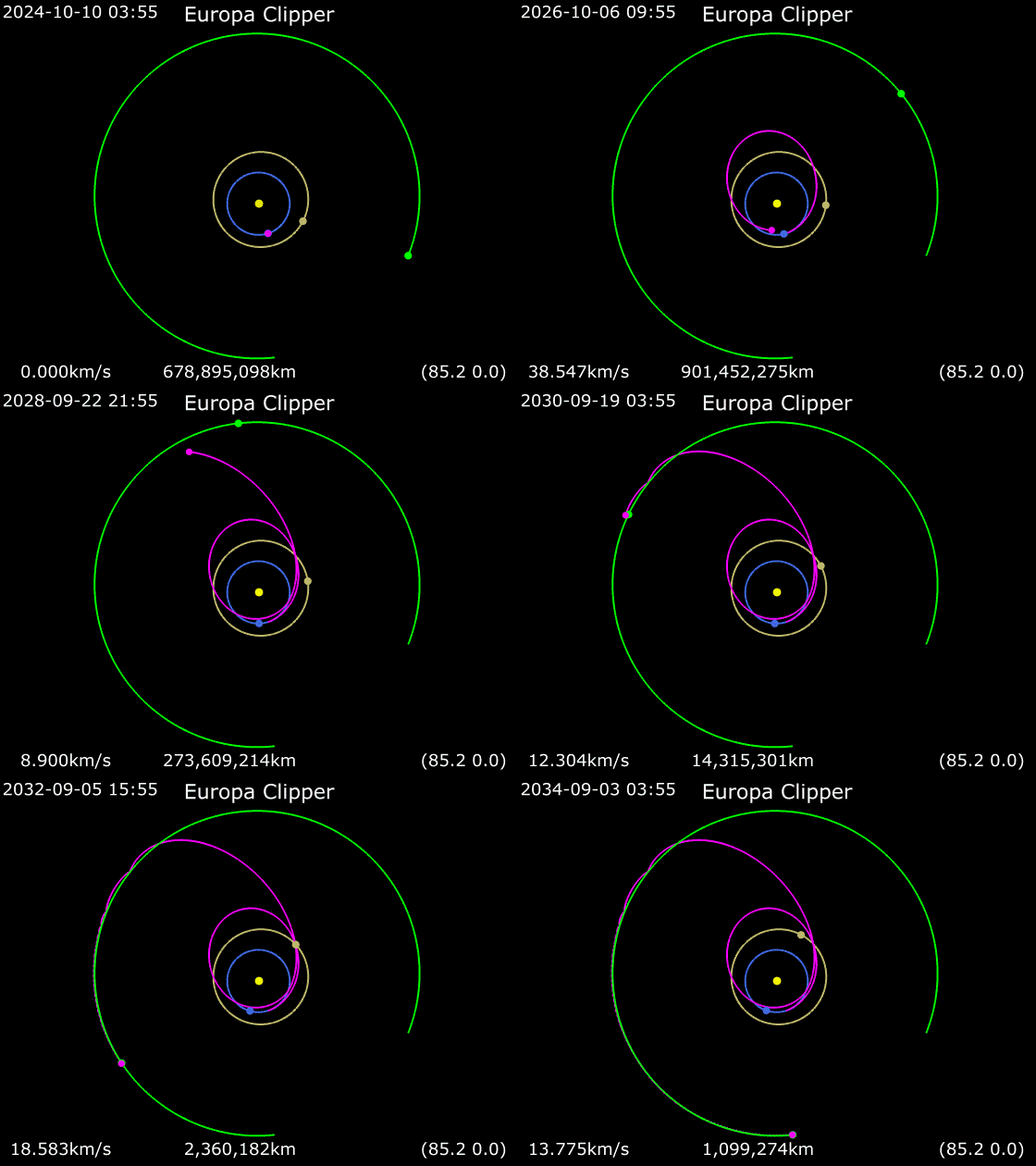
The launch will see a SpaceX Falcon Heavy carry a NASA space probe bearing the same name as the mission on the first leg of a 5.5 year journey to Jupiter to study the Galilean moon of Europa. In order to achieve this goal, the spacecraft will be directed towards Mars, which it will reach in February 2025. Using the Martian gravity as a brake, the spacecraft will fall back toward the Sun and encounter Earth again in December 2026, using our planet’s gravity to fling it out on a trajectory to reach Jupiter in April 2030.
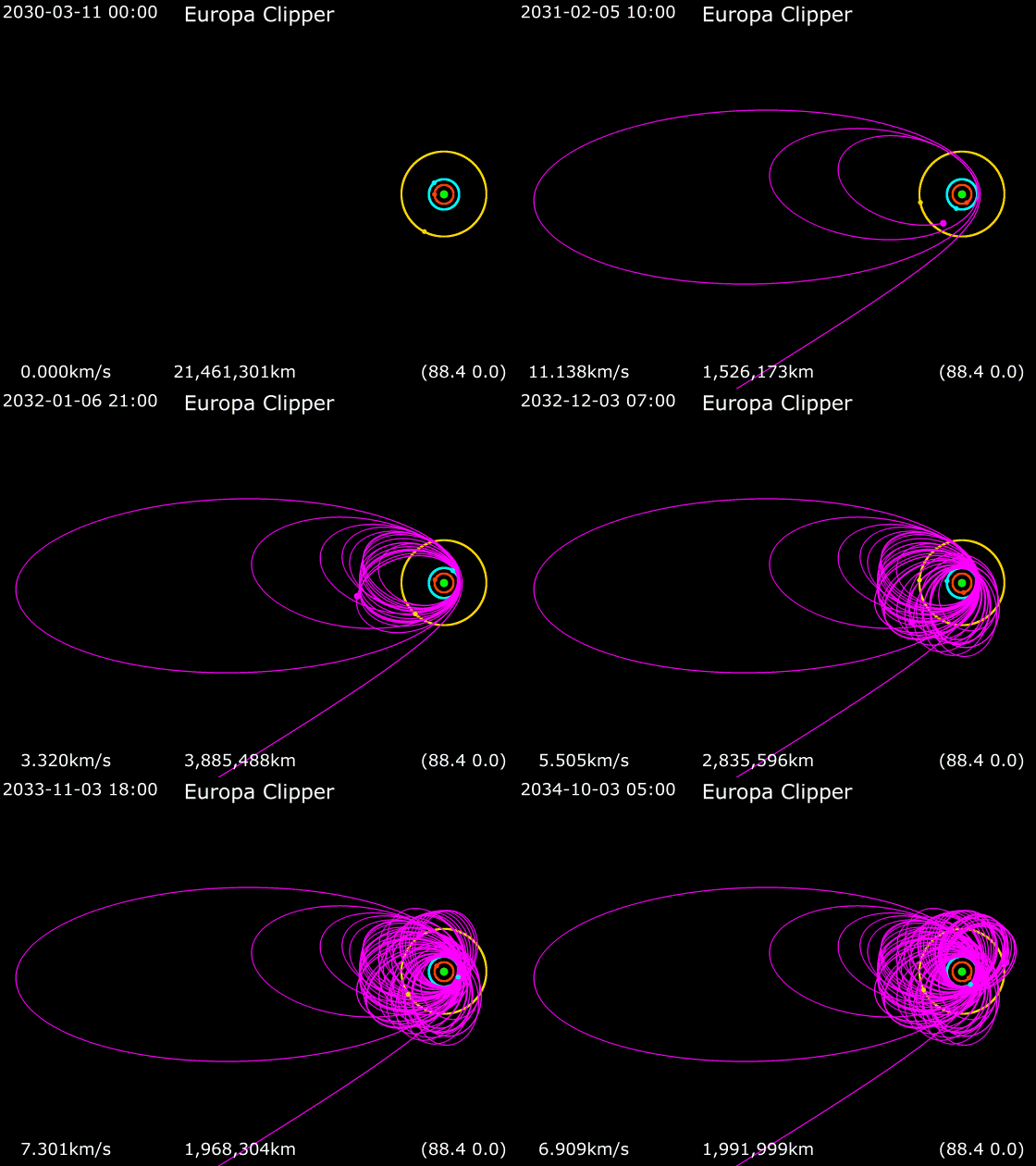
On arrival at Jupiter, the vehicle will enter an initial orbit that will then be refined, allowing it to make some 44 fly-bys of Europa varying between just 25 km above the surface and 2,700 km. The reason fly-bys will be made rather than the craft entering orbit around Europa directly is large due to radiation. Europa lies well within Jupiter’s extreme and intense radiation belts, an environment so harsh that it would fry the spacecraft’s electronics and electrical component – notably the huge solar arrays which generate its power – in just a few months after its arrival.
An artist’s rendering of the Europa Mission Spacecraft. With the deployed solar arrays measuring 22 metres in total span, the 6-tonne probe is the largest robotic interplanetary mission NASA will have flown to date. Credit: NASA/JPL
In addition, the spacecraft is carrying a significant science payload which can gather data much faster than the communications system can transmit it to Earth; were it to be placed in orbit around Europa, the opportunities to transmit the data its has would be subject to a a range of limitations (such a when Jupiter is between the probe and Earth), risking data loss due to existing data being overwritten before it could be transmitted.
By taking up an orbit around Jupiter and simply swinging by Europa, the space craft may lose opportunities for gathering data, but it increases the time available for the successful transmission of the data it does collect safely. Rather than having mere minutes or hours in which to send information, the probe will have between 7 and 10 days at a time. Further, by orbiting Jupiter rather than Europa, the spacecraft “dips” in and out of the harshest radiation, rather than being subjected to it all the time, thus preserving its electronics for much longer, and allowing it a primary science mission of an initial 3.5 years.
Generating model of Europa Clipper’s transit from launch to Jupiter. Credit: Phoenix777, via Wikipedia
To assist it whilst orbiting Jupiter, Europa Clipper will use 24 thrusters connected to a hypergolic propulsion system with 2.7 tonnes of propellants. Up to 60% of this mass will be used during the initial orbital insertion phase around Jupiter in April 2030, with the rest used in stabilising the spacecraft and orienting it during Europa fly-bys and communication periods with Earth to maximise data gathering and transmission.
The suite of nine instruments on the vehicle will be used to study Europa’s interior and ocean, geology, chemistry, and habitability. The science payload accounts for some 82 kg of the vehicle’s mass and includes a pair of imaging cameras operating in visible light wavelengths, and both a thermal imaging system and a near-infrared imaging system which will search for the likes of dynamic activity on the icy-covered surface of Europa (e.g. vents venting water and sub-surface material into space) and the distribution of organic material across the moon’s surface.
The vehicle also carries an instrument called REASON – the Radar for Europa Assessment and Sounding: Ocean to Near-surface (NASA still reign supreme in the acronym stakes!) – an ice-penetrating radar designed to characterise the 10-30 km (estimated) thick ice crust of the moon, seeking information on its composition and any indications of water pockets within it, any exosphere existing just above it as a result of venting, and – hopefully – reveal something of the nature of the upper limits of the liquid water ocean sitting under the lowest extent of the ice, between it and Europa’s rocky mantle.
Artist’s impression of Europa’s interior. The REASON instrument on NASA’s Europa Clipper will attempt to characterise the moon’s icy crust, including any water pockets in it, down to a depth of some 30km, possibly reaching the upper reaches of any liquid water ocean which might exist under the ice. Credit: Kelvinsong, via Wikipedia
Whilst it has launched some 18 months after ESA’s JuICE (Jupiter Icy Moons Explorer – see: Space Sunday: a bit of JUICE, a flight test & celebrating 50) mission, Europa Clipper will arrive in Jupiter orbit more than a year ahead of it by virtue of being launched atop a more powerful launch vehicle. In doing so, it will take over from the Juno mission as NASA’s lone research spacecraft orbiting Jupiter (the Juno mission is expected to come to an end in September 2025, the vehicle having exhausted the vast majority of its propellants, leaving only sufficient for it to make a controlled entry into Jupiter’s upper atmosphere and burn-up).
During its fly-bys of Jupiter, the Juno spacecraft has also been able to study the Galilean moons as well, and while the mission’s overall science goals have been very different to those of the Europa Clipper and JuICE missions, they are nevertheless somewhat foundational, helping both NASA and ESA better understand the environment in preparation for JuICE and Europa Clipper. Once both craft are in orbit around Jupiter, the respective science teams will work closely together, JuICE being tasked with studying Europa as well as the other two potentially water-bearing moons of Jupiter, Ganymede and Callisto.
Animation showing Europa Clipper’s arrival at Jupiter and subsequent orbits of the planet in order to fly-by Europa (coloured blue; with Callisto, the outermost of the Galilean moon in yellow, Io, the innermost in red and Jupiter in green). Credit: Phoenix777, via Wikipedia
In all, should the October 10th launch opportunity be missed (e.g. due to weather), the Europa Clipper launch window will remain open for a further 20 days.
Vulcan Triumphs despite SRB Anomaly
United Launch Alliance (ULA) completed the second launch of its new Vulcan Centaur rocket on Friday, October 4th, and despite a significant issue with one of its Northrop Grumman GEM-63XL solid rocket boosters (SRBs), the vehicle went on to ace the flight.
Vulcan Centaur is a ULA’s replacement for both the veritable Atlas and Delta families of launchers, and like them it is currently fully expendable. I covered its successful maiden flight for the vehicle, sending the ill-fated private lunar lander Peregrine One by in January 2024 (see: Space Sunday: lunar losses and delays; strings and rings). Following that flight, ULA had hoped to launch Vulcan again in April 2024, carrying aloft Tenacity the first of the Dream Chaser cargo space planes being developed by Sierra Space; however, delays with Tenacity’s final preparations now means this launch has been pushed back until at least March 2025. Instead, ULA decided to go ahead with flight designed to certify it for DoD launches, using a payload mass simulator in place of an actual payload.
Launch came at 11:25 UTC on October 4th, the vehicle lifting-off from Launch Complex 41 (SLC-41) at Cape Canaveral Space Force Station in after around a 30-minute delay. After clearing the tower, it became obvious that the right-side GEM-63XL booster was suffering an anomaly: the exhaust plume was broader than it should have been and it appeared that ignited propellants might have been escaping the SRB just above the engine bell. Then, roughly 37 seconds into the launch as the vehicle was about to commence its roll programme to pitch itself out over the Atlantic, and just before passing through clouds, the base of the right-side SRB disintegrated.
21 seconds from the pad, and the off-nominal burn of the right-side GEM-63XL SRB (indicated by large red arrow) can be seen in the form of an exhaust plume angling away from the lower side of the SRB (thin red arrow), opposed to the booster’s desired direction of thrust (short black arrow). Credit: I. Pey, using screen capture from ULA launch livestream. October 4th, 2024
On emerging from the cloud, cameras revealed the damaged SRB now had a very “off-nominal” exhaust plume, with pieces falling away as the launch vehicle continued its ascent. And here is where the overall robustness of the GEM-63XL came into play and the superb flight avionics and capabilities of the Vulcan Centaur were demonstrated. Rather than simply unzipping and exploding, taking out the entire rocket, as might reasonably be expected with the rocket was entering and passing through “max Q”, the period when it faces the maximum dynamic stresses imposed on its structure during ascent, the GEM-63XL held together and continued to provide at least some semblance of thrust all the way up to the engine cut-off point.
Meanwhile, the Vulcan Centaur sense the asymmetric thrust pushing it off of its flight trajectory and commenced compensating for it by gimballing the two Blue Origin BE-4 engines of the first stage and adjusting their thrust. At the same time, the vehicle started looking downrange and recalculating flight parameters in order to achieve a successful orbital insertion for its upper stage and payload. This entirely automated response also included calculating the likely drop-zone for the two SRBs following separation as a result of the off-nominal performance of the right side SRB.
Launch plus 44 seconds, the extreme exhaust plume from the right-side SRB now clearly visible, some 5 seconds after the base of the SRB apparently disintegrated. Credit: screen capture via ULA launch livestream, October 4th, 2024
This actually resulted in the rocket “holding on” to the two SRBs for 20 seconds beyond their expected release time. In doing so, this pretty much ensured both SRBs had sufficient upward momentum to complete their ballistic trajectory and then fall back to the Atlantic Ocean without exceeding any downrange parameters. Similarly, the rocket performed a recalculation of the required burn time on its main engines, and for the same reason.
Thus, the two BE-2 motors ran for an additional 6-7 seconds beyond their designated cut-off time. This was enough to ensure the Centaur upper stage received the kick it needed and the first stage to also remain within the parameters of its specified descent trajectory into its targeted (and shipping-free) splashdown area. Once separated, the Centaur stage was able to light its motor and go on to deliver its mass simulator almost exactly in the centre of the “bull’s-eye” of its intended orbital track.
A graphic released by Tony Bruno, ULA CEO following the launch of Vulcan Centaur on its second certification flight, showing that despite the issues with the GEM-63XL SRB, the rocket was able to successfully deliver its simulated payload mass onto its track for a heliocentric orbit pretty much perfectly. Credit: Tony Bruno, via X.com
And that is a remarkable success, all things considered. Sadly it did not stop some SpaceX cultists proclaiming FAA “bias” against SpaceX because a) Vulcan has not been “grounded” following the “failure” and b) the FAA signalled no requirement for a Mishap investigation on the grounds that, despite the SRB issue, the vehicle performed precisely as called for within its flight plan, and at no time exceeded the limits of it launch license.
Obviously, the GM-63XL failure needs to be thoroughly investigated by Northrop Grumman (potentially with FAA oversight) and the causes understood together with any significant issues – if found – rectified. However, this in itself require a “grounding” of Vulcan Centaur nor does it illustrate any kind of “bias” towards SpaceX on the part of the FAA. Why? Firstly, because the conflict between SpaceX and the FAA relate pretty much to the later exceeding the limitations imposed in the launch licenses issued to it by the latter. That’s not the case with the Vulcan Centaur flight.
More to the point, Vulcan Centaur’s launch cadence is fairly relaxed; the next launch will not occur until mid-November, for example. Ergo, there is more than enough time for the SRB issue to be investigated and a decision taken as to whether there is any kind of fault endemic to the GEM-63XL which precludes further Vulcan Centaur launches until such time as the problem has been rectified, and without the need for the FAA weigh-in on the matter pre-emptively.
Voyager 2 Loses Further Science Instrument
The two Voyager mission spacecraft have been hurling themselves away from Earth since their launches in 1977. In doing so, they are the first human-made craft to reach interstellar space, and are truly voyaging into the unknown. But even though both are powered by three radioisotope thermoelectric generators (RTGs) – essentially “nuclear batteries” generating electricity through the decay of plutonium 238 – their ability to produce the electricity they need to operate is constantly declining.
At launch the three RTGs on each of the Voyager vehicles generated some 470 watts of electrical power on a continuous basis. However, by 2011, that had been reduced to just 268 watts per vehicle. To combat the loss of electricity production NASA has, since 1998, been gradually turning off systems and instruments that are no longer essential to either vehicle’s mission.
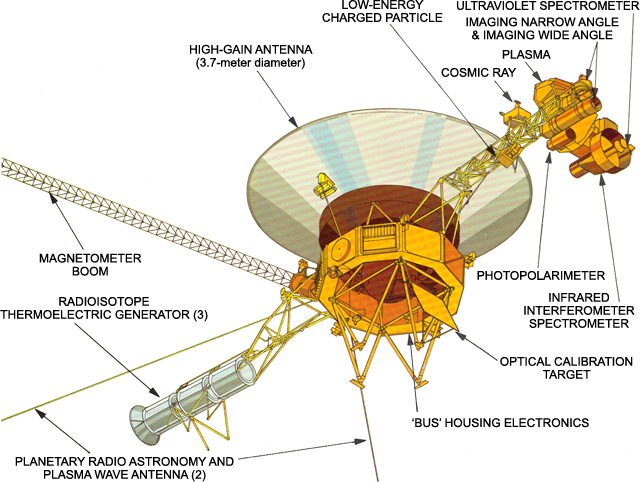
Diagram showing a Voyager spacecraft and its major elements, including the RTG boom and, opposite it so the bulk of the spacecraft bus helps shield it, the main scientific instrument arm. Credit: NASA/JPL
For example, in 1998, NASA turned off the imaging system on the two spacecraft because the amount of light reaching them was insufficient for them to be able to produce meaningful images. Over time, this policy has continued to the point were, at the start of October 2024, of the 11 instruments aboard each of the vehicles, Voyager 1 had just four operating and Voyager 2 had just five, all dedicated to examining the interstellar space through which both vehicles are travelling.
However, on October 2nd, 2024, NASA announced that a further instrument on Voyager 2, the Plasma Spectrometer, has now been turned off, again to meet the dwindling amount of energy the RTGs are producing. This means that both craft are now operating the same four instruments each, allowing for solid comparative science to be carried out as they continue to move out into interstellar space. These instrument comprise a magnetometer gathering data on the interplanetary magnetic field; a low energy charged particle instrument for measuring the distributions of ions and electrons in the interstellar medium; a cosmic ray system that determines the origin of interstellar cosmic rays; and a plasma wave detector.
Unfortunately, overall power issues mean that the rate at which instruments must be turned off is likely to accelerate over the next few years, and that by 2030 it is likely the last science instrument on both Voyagers will be turned off, although there may be sufficient power for the communications systems to continue to transmit system reports beyond that, if NASA opt to allow them. But even if this is the case, by 2036, the signals from the two spacecraft will be so weak, they will not be heard by facilities on Earth.
A 2013 diagram showing Voyager 2’s relative position as it entered interstellar space. In another 300 years, it should reach the Oort cloud, crossing in in roughly 30,000 years. Providing it suffers no mishap or deviation in its trajectory, it should pass within 1.7 light-years of Ross 248 some 40,000 years from now. The numbers along the line refer to astronomical units (AU); 1 AU being the average distance between the Earth and the Sun. Credit: NASA/JPL
But the loss of communications, when it eventually comes, will not be the end of the voyage for either of the spacecraft: in 300 years they should reach the “inner edge” of the theorised Oort cloud. It will take each of them some 30,000 years to cross it and arrive at the cosmographic boundary of the solar system. Ten thousand years after that, Voyager 2 will pass “just” 1.7 light-years away from the first star relatively close to its trajectory since departing the Sun: Ross 248. At roughly the same time, Voyager 1 will pass within 1.6 light-years of the star Gliese 445.
If you want to keep abreast of the Voyager mission status then check the official “where are they now” page for the mission.


 When arriving at the main Landing Point, a greeter will provide an invite to the local Group, and information on both tours and a special show being staged in the region. Visitors are also offered a flashlight, and ADDing it helps with explorations.












 Inara Pey: Living in a Modemworld