
Hera: Return to Didymos
On November 24th, 2021, NASA launched the Double Asteroid Redirection Test (DART) mission, a vehicle aimed at testing a method of planetary defence against near-Earth objects (NEOs) that pose a real risk of impact, by smashing an object into them and using kinetic energy to deflect them from their existing trajectory.
To achieve this, the spacecraft was both a science probe and impact device, and it was launched to rendezvous with the binary asteroid 65803 Didymos (Greek for “twin”), comprising a primary asteroid approximately 780 metres across, and a smaller companion called Dimorphos (Greek: “two forms”). These sit within a heliocentric orbit which periodically cross that of Earth whilst also reaching out beyond Mars , which occupy a heliocentric orbit that periodically crosses that of Earth. On reaching the pair, DART smashed into Dimorphos, successfully altering its orbit around Didymos.
I covered the launch of the mission in Space Sunday: a DART plus JWST and TRAPPIST-1 updates, and the aftermath of the impact two years ago in Space Sunday: collisions, gamma bursts and rockets. Since then there has been much reported on what has happened to Dimorphos in the wake of the impact, but scientists have been awaiting a planned follow-up mission to the Didymos pairing which could survey the outcome up close. And that mission is now underway, courtesy of the European Space Agency (ESA).
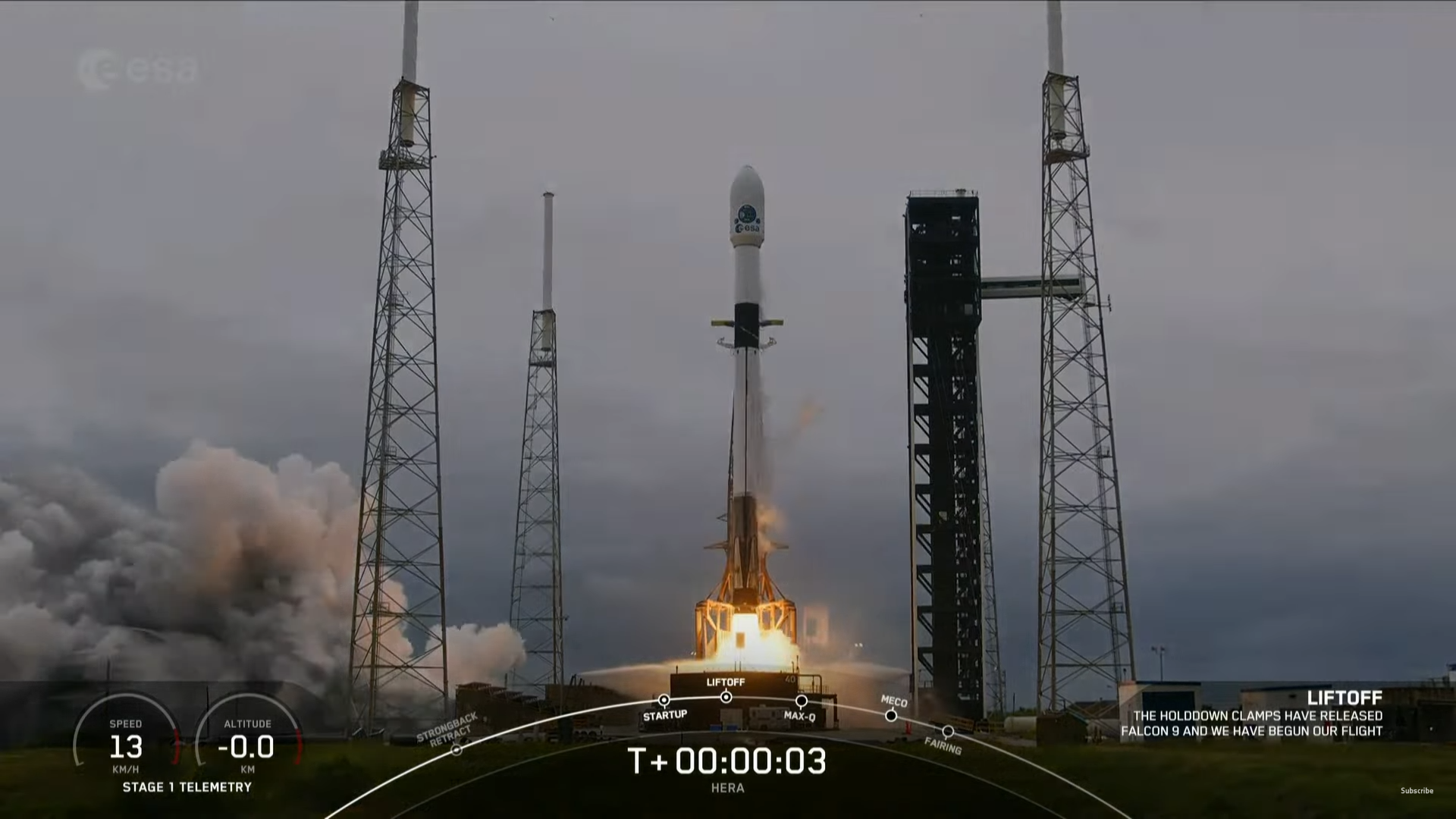
Launched at 14:52:11 UTC on Monday, October 7th from Canaveral Space Force Station, Florida atop a SpaceX Falcon 9 rocket, ESA’s Hera mission made it away from Earth just ahead of the arrival of Hurricane Milton. Lift-off marked the start of a two-year journey for the 1.1 tonne solar-powered spacecraft – also called Hera, after the mythological Greek goddess, rather than the name being an acronym –, as it heads first for Mars, which it will pass in March 2025 at a distance of between 5,000 and 8,000km. Taking the opportunity to test its science instruments in studying the tiny outermost Martian moon, Deimos as it does so, Hera will use the Martian gravity well to swing itself onto a trajectory so it can rendezvous with Didymos in December 2026.

The cube-shaped vehicle will have a primary mission of six months orbiting the Didymos pair, split into 5 phases:
- Initial characterisation (6 weeks): determine the global shape and mass/gravity together with the thermal and dynamical properties of both asteroids.
- Payload deployment (4 weeks): release two small cubesats, Juventas and Milani. The former will attempt to land on Didymos to conduct direct surface and sub-surface science, the latter will gather spectral data on the two asteroids and the surrounding dust cloud resulting from the DART impact.
- Detailed characterisation (6 weeks): metre-scale mapping of the asteroids and determination of thermal, spectral, and interior properties.
- Dimorphos observations (6 weeks): High-resolution investigations of a large fraction of the surface area of Dimorphos, including the DART impact crater.
- Experimental (6 weeks): study the morphological, spectral, and thermal properties of Dimorphos.
Overall, the mission is designed to accuracy access the overall success of the DART mission if deflecting Dimorphos in its orbit around Didymos (and thus the effectiveness of using kinetic impact to deflect NEOs threatening Earth with an impact) and to characterise both asteroids to help us better understand the composition, etc., of typical NEOs, so that the data obtained might help further refine plans for potential future asteroid redirect missions.
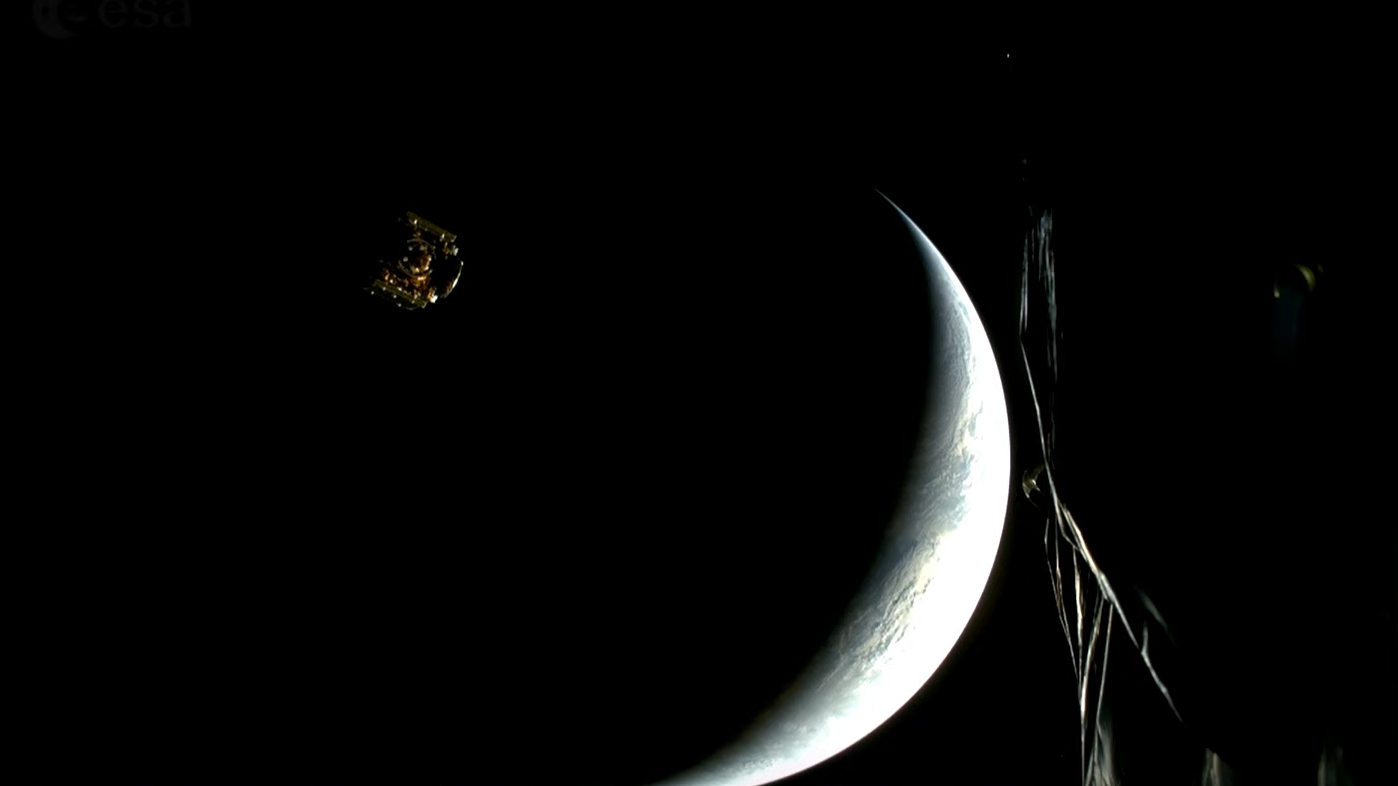
One of the major elements of the mission has been the development of sophisticated guidance and mapping software which will allow Hera, using a series of compact sensor systems, to autonomously construct a map of the Didymos system and the space around it. It will then use this map to determine for itself the safest orbital trajectories around the asteroids to avoid impacts with any remaining rock and dust debris remaining in orbit around both bodies from the DART impact, and of a sufficient size to damage it in a collision.
Following launch, Hera successfully separated from the upper stage of the Falcon 9 launch vehicle and called ESA’s mission control to confirm it was operating correctly and ready to start crucial operations such as deploying its solar panels. In November 2024, the vehicle will perform a “mid-flight” adjustment to better align its trajectory to Mars.
Starship Flight 5
October 13th saw the launch of the fifth Starship / Super Heavy combination from the SpaceX facilities at Boca Chica – and the first attempt to bring a booster back to the launch pad and catch it using the “chopsticks” of the Mechazilla mechanism on the launch tower.
A lot of people – myself included – severely doubt(ed) the ability of both the long-term viability of the idea of catching boosters and launch vehicles out of the air, or whether this flight could prove the concept. Credit falls where due, and for this flight we were proven wrong.

The launch came at 13:25 UTC, with the ignition of the 33 Raptor 2 motors lifting the roughly 5,000 tonne mass of the combined Ship 30 and Booster 12 into the morning skies above south Texas. All 33 motors had a good clean burn, and the stack quickly gained altitude. At 2m 40s after launch, and approximately 50km altitude, the majority of the engines on the booster shut down and the six motors on Ship 30 ignited in the “hot staging” burn ahead of separation. Following separation, the booster immediately commenced a manoeuvre to steer away from the starship, in readiness to commence a flight back towards the launch pad.
This started the critical phase of Booster 12’s flight. Initially it continued to gain height ballistically, reaching an altitude of approximately 100 km whilst performing a “boost back” engine burn to slow its ascent and then start a fall back towards the launch site. The manoeuvre was completed with a level of accuracy such that SpaceX confirmed they would proceed with the “return to base” and attempted booster capture. Had the boost-back been off, the capture phase would have been abandoned and the booster allow to make a controlled splashdown in the Gulf of Mexico.

There followed a series of visible pulses from the booster as it purged excess vapour from this primary propellant tanks while the three central motors gimballed to direct their thrust and steer it away from the jettisoned hot staging ring falling below it. Canting over to being close to horizontal, the booster descended to some 10 km altitude, racing back towards the launch facilities with a speed of 2,860 km/h, before the inner ring of 10 motors fired committing it to an initial braking manoeuvre.
At this point, and abort and splashdown was still possible, but the guidance system on the launch tower was working perfectly, allowing the booster to home into it. At 5km and still travelling at over 1750 km/h the 13 motors that have been firing all shut down, the booster gradually righting itself and decelerating through 1200 km/h before all thirteen re-fired in a final deceleration move before the inner ring of ten engines shut down and the three centre engines took over at at 1 km altitude to steer the booster in for capture.

The final part of the descent witnessed flames rising along two sides of the booster. The first, and larger of the two appeared to originate at the Quick Disconnect ports at the bottom of the booster (the connectors for loading propellants into the booster). The second appears part-way up the booster, possibly at vent ports for the main propellant tanks. This may have been ignited by flames from the lower fire reaching around the vehicle and setting vapours from the vents alight. Neither fire affected the vehicle’s performance as it slowed rapidly and descend precisely between the Mechazilla “chopsticks”, although it did actually come quite close to striking the tower in the process.
At precisely the same time, the “chopsticks” started to close on either side of the booster such that once it was vertical, the arms were close enough for it to gently lower itself onto them using four hard points around its hull (called “pins”, and specifically designed to allow the “chopsticks” take the booster’s unladen weight when raising / lowering it), which came to rest precisely on “shock absorbers” running along the length of the arms, designed to dissipate the weight of the booster as it dropped onto them. At this point, the Raptor engines shut down, and because of the fire, the onboard fire suppression system appeared to activate.
Even so, the fire rocket continued for several minutes, giving rise to fears of a possible post-capture explosion, but vent valves at the top of the booster were opened, allowing any remaining propellant vapours in the header tanks (smaller propellant tanks used for the final decent and capture) to be released away from the vehicle, greatly reducing the rick of explosion, and the vehicle remained intact on the launch tower.
In all, a remarkable achievement for a first attempt. Kudos to SpaceX.
However, the booster’s successful capture just under 8 minutes after launch wasn’t the end of the flight. As Booster was making its return, Ship 30 continued on its way to orbit, reaching a peak altitude of some 211 km as it cruised half-way around the world.
As it passed across Africa, the vehicle started a slow decent back into the atmosphere, passing over the tip of southern Madagascar as it gently dropped from 119 km to 115km. At around 100m altitude, it started to show the first indications of plasma built-up due the frictions created as it pushed the air molecules around it against their neighbours in the increasing atmospheric density, signs which quickly grew in intensity.

At around 75 km altitude, the vehicle entered the period of peak heating – the roughly 10 minute period when the plasma generated around the vehicle reaches its highest temperatures. It was during the period during IFT-4 in June 24, that the starship started to suffer significant burn-through issues and structure loss with one it its aft aerodynamic flaps, and which continued through its decent, destroying pretty much all of the flap in the process. Not of this was evident at this point with Ship 30.
As re-entry progressed, propellant from the header tanks in the vehicle started to be pumped through the three motors that would be used during the final phase of the flight in a “chill down” process to get them down to the desired temperature for full ignition.

It was after the period of peak re-entry heating, as the vehicle entered the period of maximum dynamic stress on its structure that the first hints of plasma burn-through began to make their presence visible on one of the two aft flaps (at roughly 48 km altitude), although there was no visible sign of large pieces of the flaps disintegrating, as had been the case in June. Transmissions did break up at this point, resuming as the vehicle entered aerodynamic fee-fall (the “bellyflop”), which showed all four flaps functioning despite the burn-through damage to one.
With less than a kilometre to fall, the three Raptors ignited, and the vehicle tipped upright, and 1 hour 5 minutes after launch, it splashed-down at night, precisely on target in the Indian Ocean. There was around a 20-second period where the vehicle appeared to settle in the water prior to it exploding, the event caught via a remote camera on a buoy positioned a short distance from the target splashdown zone.

The cause of the explosion has yet to be determined – but given that Starship isn’t actually designed to land on water, and the mix of super-heated engine elements and cold sea water isn’t a particularly good one, the explosion shouldn’t be surprising, and doesn’t negate the overall success of the flight.
There is still much more to do in testing this system – such as demonstrating these kinds of “return to base” flights and captures can be achieved consistently. There is also much that is questionable about the starship / super heavy launch system as a whole, particularly in terms of crewed missions to Mars and even in supporting NASA’s Project Artemis lunar aspirations. However, none of this negates what is a remarkable first time achievement for SpaceX with IFT-5.
And here’s another view of the Booster 12 capture – from a camera mounted on the launch tower:
Europa Clipper Update
Previewed in my previous Space Sunday update (see: Space Sunday: Europa Clipper, Vulcan Centaur and Voyager 2), Europa Clipper, NASA’s mission to study the Jovian moon Europa, which had been due to lift-off on Thursday, October 10th, suffered a launch postponement courtesy of Hurricane Milton. The launch is now targeted for 16:06 UTC on Monday, October 14th for launch from Launch Complex 39A at Kennedy Space Centre, Florida.

 Inara Pey: Living in a Modemworld