Serene Retreat, February 2024 – click any image for full size
In September 2023 I dropped into Shades of Autumn, a homestead region design by Flower Caerndow which she offered for people to visit and photograph. I found it an engaging and autumnal visit, with plenty to appreciate within in (see: Appreciating the Shades of Autumn in Second Life). Earlier in February 2024, Flower opened up her latest region design, Serene Retreat, occupying a Full private region, and given my enjoyment of Shades, I trundled over recently to have a look.
Welcome to a beautiful peaceful retreat and experience the magical beauty of nature. All are welcome to wander and take pictures and find the hidden cuddle spots.
– Serene Retreat About Land Description
Serene Retreat, February 2024
This is a place which very much carries on in the spirit of Shades, whilst presenting an entirely new landscape to explore and photograph.
The landing point sits towards the northern tip of the island, close to where a small gallery of Flower’s own SL photography might be found. Whilst picturesque, the pictures serve a dual purpose: as well as offering views of the region, each is a teleporter which will carry a visit to the location it frames. However, given the overall nature of the island, unless you’re in a hurry to get to someone or somewhere, it’s much better to explore using your pedal extremities.
Serene Retreat, February 2024
A short walk downhill from the landing is one of the island’s sandy beaches and (if it is your first port of call on arrival) the first of the region’s little places to sit and / or cuddle. For those who prefer, steps leading up from the cobbles surrounding the gallery in its ruined tower provide a way up the neighbouring hill, where a small tea house sits within a Zen garden watched over by a figure of Buddha.
From here, other paths wind their way over the island, notably to the south and east, passing by a ring of standing stones to reach the highest point within the setting as is sits above steep rocky inclines falling away to the sea. Other paths wend their way through a nearby copse, where crystals, hints of exotic plants and some of the local wildlife might be found, together with further places to sit and pass the time in solitude or with others.
Serene Retreat, February 2024
Also to be found on the edge of the Zen garden is a pool of crystal-clear water, home to swans and koi carp, and the birthplace of a stream that runs out to a rocky lip before cascading down to be caught by a rocky pool. From here and tumbling over the coastal rocks, it makes its way out to open waters. A mossy / grassy path slips down the hill alongside this stream and its falls, passing a romantic little snuggle point and what appears to be the last remnants of a building. Below these an old track passes, looking like it might have once passed around a good ideal of the island, but which the sea has been gradually reclaiming in places.
Just below the stone flooring of whatever might have once stood here, whilst also running back from the cart track, is a narrow hollow slumped within the arms of the hill. More crystal and exotic flowers are to be found here, together with the open mouth of a tunnel slipping back under the hill and inviting exploration. However, I’ll leave it to you to find out what lies within its caverns.
Serene Retreat, February 2024
The eastern side of the island also offers a second beach reached via two stone-stepped paths running down to it. From here, and past the tepee-like sitting area and a swing, you can scramble up on to the island’s rocky feet and make your way around to the south side. It’s not possible to get all the way around the island at close to sea level, but for those who do follow the hill’s lip, a way down to a southern shingle beach and its little sitting spot can be found. This also allows visitors to continue their walk on around the island close to its edge, and thus come to the stream and hollow mentioned above.
Tranquil, photogenic and sitting under a sky mindful of Stevie Davros’s work (which is not to say it is – just that it reminds me of his work – which is to say it has a sense of realism about it which is attractive), Serene Retreat build on the foundations Flower laid with Shades of Autumn whilst offer its own unique and engaging setting for exploration.
The following notes were taken from the Tuesday, February 27th, 2024 Simulator User Group (SUG) meeting. They form a summary of the items discussed, and are not intended to be a full transcript. No video this week, I’m afraid.
Meeting Overview
The Simulator User Group (also referred to by its older name of Server User Group) exists to provide an opportunity for discussion about simulator technology, bugs, and feature ideas.
They are open to anyone with a concern / interest in the above topics, and form one of a series of regular / semi-regular User Group meetings conducted by Linden Lab.
Dates and times of all current meetings can be found on the Second Life Public Calendar, and descriptions of meetings are defined on the SL wiki.
Simulator Deployments
No SLS Main channel deployment on Tuesday, February 27th, but the simhosts were restarted.
Wednesday, February 28th will see the Gingerbread RC update (containing llComputeHash(), llGetCameraAspect(), llGetCameraFOV(), llGetNotecardLineSync() and llWorldPosToHUD() ) re-deployed to the Bluesteel RC, together with Ferrari and Preflight. It includes a fix for the issue of scripts being prevented from restarting when crossing into regions running on the update.
Upcoming Simulator Release
The simulator update to follow Gingerbread remains Hearts & Flowers, which will likely be deployed in the next couple of weeks. This mostly comprises internal (non-user visible) updates, together with two notably user-visible additions:
llSetLinkSitFlags/llGetLinkSitFlags – allow you to adjust the sit flags for a prim. It supports the existing two SIT_FLAG_ALLOW_UNSIT and SCRIPT_ONLY.
At some future point, SIT_FLAG_HIDE_AVATAR should also be added, so you don’t need to play an animation that squishes the avatar so they aren’t visible in something like a very small vehicle.
A feature for estate managers that will allow them to schedule automatic region restarts.
A new constant in llSPP PRIM_SIT_FLAGS it will contain all the sit flag information, (including ALLOW_UNSIT and SCRIPTED_ONLY (the two older constants will still be available).
A new capability to load item inventory lists via HTTP (so items with large contents will load faster when accessed, although this will require a viewer update as well).
The next update after that will likely be called Spring Break. This might include notecard searches.
Viewer Updates
No changes at the start of the week:
Release viewer: version 7.1.2.7215179142, formerly the glTF PBR Materials Maintenance RC, issued December 15, promoted January 8, 2024 – numerous bug fixes and improvements – No Change.
Release channel cohorts:
Maintenance-W RC (bug and crash fixes), version 7.1.3.7983616888, February 22, 2024.
glTF PBR Materials Maintenance-2 RC viewer, version 7.1.3.7821226606, February 20, 2024.
Maintenance X RC (usability improvements), version 7.1.3.7721015131 , February 14, 2024.
Maintenance Y RC ( My Outfits folder improvements; ability to remove entries from landmark history), version 7.1.3.7790341084, February 9, 2024.
Project viewers:
Puppetry project viewer, version 6.6.12.579958, May 11.
Game Controller Update
Leviathan Linden is still working on trying to get the viewer’s Flycam capability (SpaceNavigator) with the new GameControl logic rather than old system.
Region Crossings
Monty Linden is working on the region crossings code (both physical region crossings and all that goes into them when vehicles, etc., are included, and teleports).
There has also been independent and on-going investigations by users into crossings. Some of the more recent has been around the issue of the EstablishAgentCommunication (EAC) event between the simulator and viewer (see this forum post for specifics).
As it turns out, the server engineering team have been working on an entire simulator to address EAC, which is seen as both problematic and potentially hiding other bugs in the code – and potentially causing issues for the SL Mobile app.
In Brief
The Sever Team has a new member – Pepper Linden.
There is an upcoming fix to go into a simulator maintenance release for the detach bug stopping all animations started by other attachments or sit objects – see github issue BUG-225288.
A further confirmation that the client-side scripting environment will be Luau, a Lua VM implementation developed by Roblox.
Note that this project does not encompass delivering client side scripts from inside SL simulator; it is purely viewer-side. Any such capability is seen as being so far down the line as to not be on the roadmap, although the use-cases for such interaction were noted.
Rider Linden is looking at llCloseDialog, allowing a script close a dialog that it had previously opened.
A general discussion on Experiences – extending the scope of possible controls (not on the immediate roadmap) and making the Join Experience dialogue lees frightening / off-putting to users.
† The header images included in these summaries are not intended to represent anything discussed at the meetings; they are simply here to avoid a repeated image of a rooftop of people every week. They are taken from my list of region visits, with a link to the post for those interested.
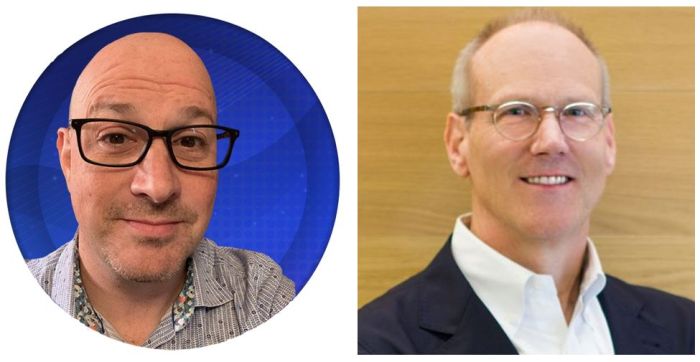
Andrew Kertesz (l) and Steven Feuling (r) – formerly Mojo and Styfy Linden, both of whom departed Linden Lab earlier in 2024.
Update: March 10th, 2024: The management team list is back up on the corporate About page.
In 2021 and 2022, Linden Lab made two fairly high-profile – in terms of the company’s management team – hirings; both of whom recently departed the company within the same time frame.
To take them in order of joining the company, Andrew Kertesz, a 20-year veteran of the gaming industry, arrived at the Lab as the new VP of Engineering in July 2021 to replace Scott Lawrence (Oz Linden). In doing so, he took the name Mojo Linden.
It is not unreasonable to say his impact was immediate and positive. Openly engaging with user through the various user groups – notably the Content Creation User Group (CCUG) and Third Party Viewer Developer (TPVD) meetings, as well as popping up from time-to-time at Simulator User Groups.
Three of his major user-facing contributions to the platform comprised a push to overhaul and improve the viewer’s performance; encouraging the adoption of industry-recognised standards (the Khronos glTF 2.0 specification); and pausing the development of the Lab’s efforts to develop an initially limited (“chat centric”) mobile app, in order to determine if a more comprehensive mobile solution might be developed (what we now know as SL Mobile). He was also keen to eliminate much of the platform’s technical debt – such as moving the simulator code to 64-bit architecture and to try to leverage technical options that hadn’t actually been around when SL first opened its doors.
The other hiring was that of Steven Feuling, who joined the company in May 2022 as Linden Lab’s first ever Chief Marketing Officer (CMO), alongside of Peter Capraro, who became the company’s first Chief Information Security Officer (CISO).
Taking the name Styfy Linden, a major part of Mr. Fueling’s focus was, according to Business Insider, to help Second Life to start to expand its user-base once more. In this he worked closely with Brett Linden, the Lab’s VP of Marketing. He also saw his role not only in marketing and promoting Second Life within market sectors relevant to the platform (e.g. the content creation sector) to b ring new users in, but also in trying to both enhance the events-driven appeal of SL through partnerships with external organisations and through direct engagement with existing users to encourage their ongoing retention.
Styfy certainly wasn’t as much a “public” figure as Mojo in terms of user visibility – he did appear in a Lab Gab session for 2022’s SL20B celebrations (which I summarised here); however, his influence – alongside of that from Brett – would seem to have been key in the formulation of projects such as the Motown Experience and Welcome Hub.
While the Lab may have something of a bumpy reputation as an employer in some quarters, it is true that a lot of the staff there – particularly among the management team and who are directly responsible for the platform’s operation and services – tend to be with the company for years at a stretch. As such, I was particularly surprised to find Mojo Linden was no longer listed as part of the company’s management team, and nor was Styfy.
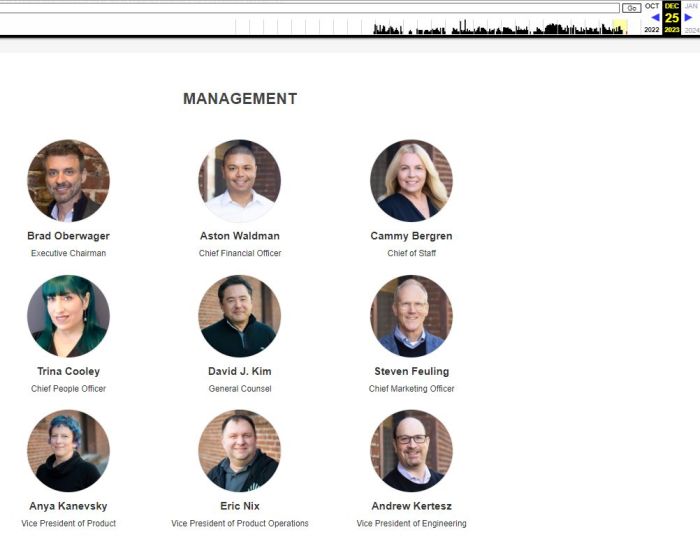
Linden Lab Management Team, as listed on the company’s About page in December 2023 (via the Wayback Machine)
Admittedly, it took a big of digging to find this out; some time between January 15th, 2024 and now, information on the Lab’s board and management team has been removed from the company’s About page (or at least, that’s been the case while I’ve been poking at things over the last couple of days; maybe there’s just been a bit of a SNAFU and said information will reappear).
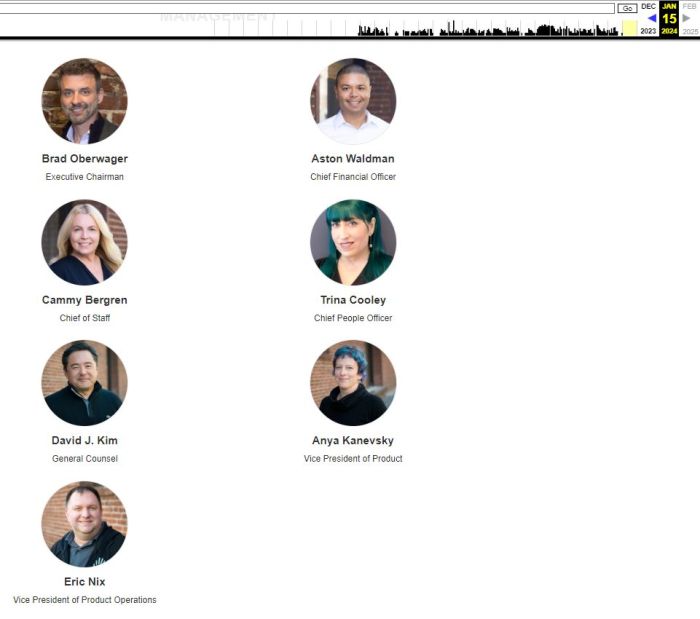
Anyway, using the Wayback Machine, I was able to confirm that both Mr. Kertesz and Mr. Feuling were listed as a part of the management team on December 25th, 2023, but by January 15th, 2024 their names had been removed. On discovering this, I ran a check on their in-world Linden accounts, and both have been deactivated (as is the company’s policy when personnel depart).
If I’m honest, I had wondered as to Mojo’s whereabouts a couple of times of late; his absence from the CCUG meetings had become sufficient enough for me to notice (he was by no means at every meeting, but had a habit of dropping in perhaps once and month – or close to that). However, I just assumed he was focused on other projects, and its not as if his departure has caused the wheels he helped set in motion seize up.
Linden Lab Management Team, as listed on the company’s About page, January 15th, 2024 (via the Wayback Machine)
Obviously, people and roles do not always work out; the CMO role at the Lab was brand new to the company, and it is possible that given LL’s size, it became recognised as a square peg / round hole situation. Similarly, leading figures within organisations can be poached away / become tempted by opportunities they spot elsewhere. As such, the departure of two senior staff from the Lab in what appears to be fairly close order might be coincidence more than a sign of Something Going On, even if finding out did cause an eyebrow to do a Spock.
Certainly, I’m not going to speculate on the ins and outs because I don’t want to feed into any conspiracy theories that might be doing the rounds (in relation to this or anything else). It will be interesting to see – if possible, assuming the management team info doesn’t reappear on the corporate website – if either post (particularly that of VP of Engineering) gains a new face (again, assuming there has not been any internal promotion to the position in the interim).
Instead, I’ll simply wish both gentlemen well in their respective futures, and also thank Mojo (should he ever read this!) for taking the time to engage with users and in responding to nagging enquiries from the likes of myself.
Logos representative only and should not be seen as an endorsement / preference / recommendation
Updates from the week through to Sunday, Febuary 25th, 2024
This summary is generally published every Monday, and is a list of SL viewer / client releases (official and TPV) made during the previous week. When reading it, please note:
It is based on my Current Viewer Releases Page, a list of all Second Life viewers and clients that are in popular use (and of which I am aware), and which are recognised as adhering to the TPV Policy. This page includes comprehensive links to download pages, blog notes, release notes, etc., as well as links to any / all reviews of specific viewers / clients made within this blog.
By its nature, this summary presented here will always be in arrears, please refer to the Current Viewer Release Page for more up-to-date information.
Note that for purposes of length, TPV test viewers, preview / beta viewers / nightly builds are generally not recorded in these summaries.
Official LL Viewers
Release viewer: version 7.1.2.7215179142, formerly the glTF PBR Materials Maintenance RC, issued December 15, promoted January 8th, 2024 – numerous bug fixes and improvements – NEW.
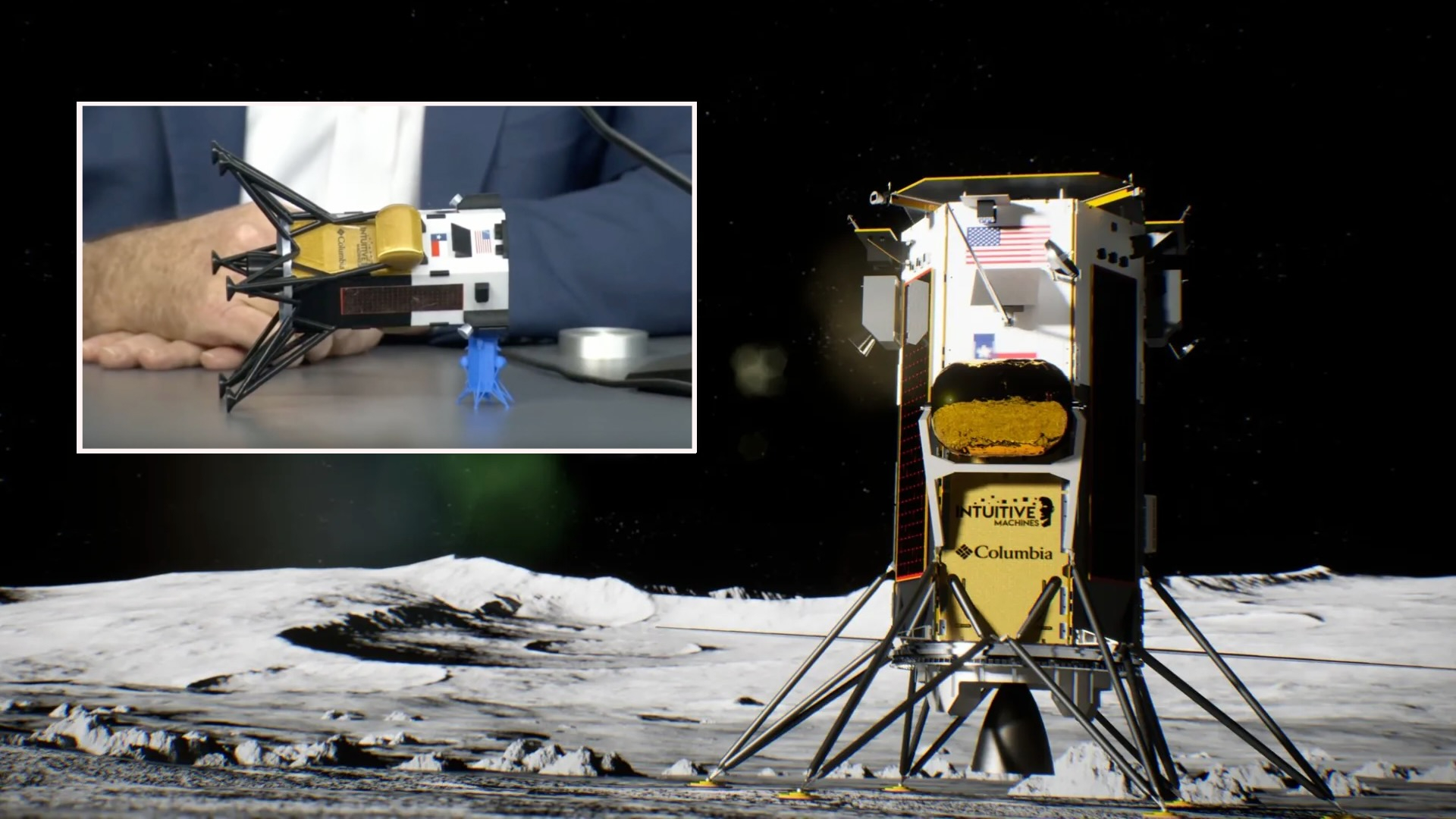
As it should have looked: an artist’s impression of the Intuitive Machine IM-1 Odysseus Nova-C lander on the surface of the Moon. Credit: Intuitive Machines / Columbia Sportswear
The second private mission to fly to the Moon under NASA’s Commercial Lunar Payload Services (CLPS) programme, and launched on February 15th, arrived on the lunar surface on February 22nd.
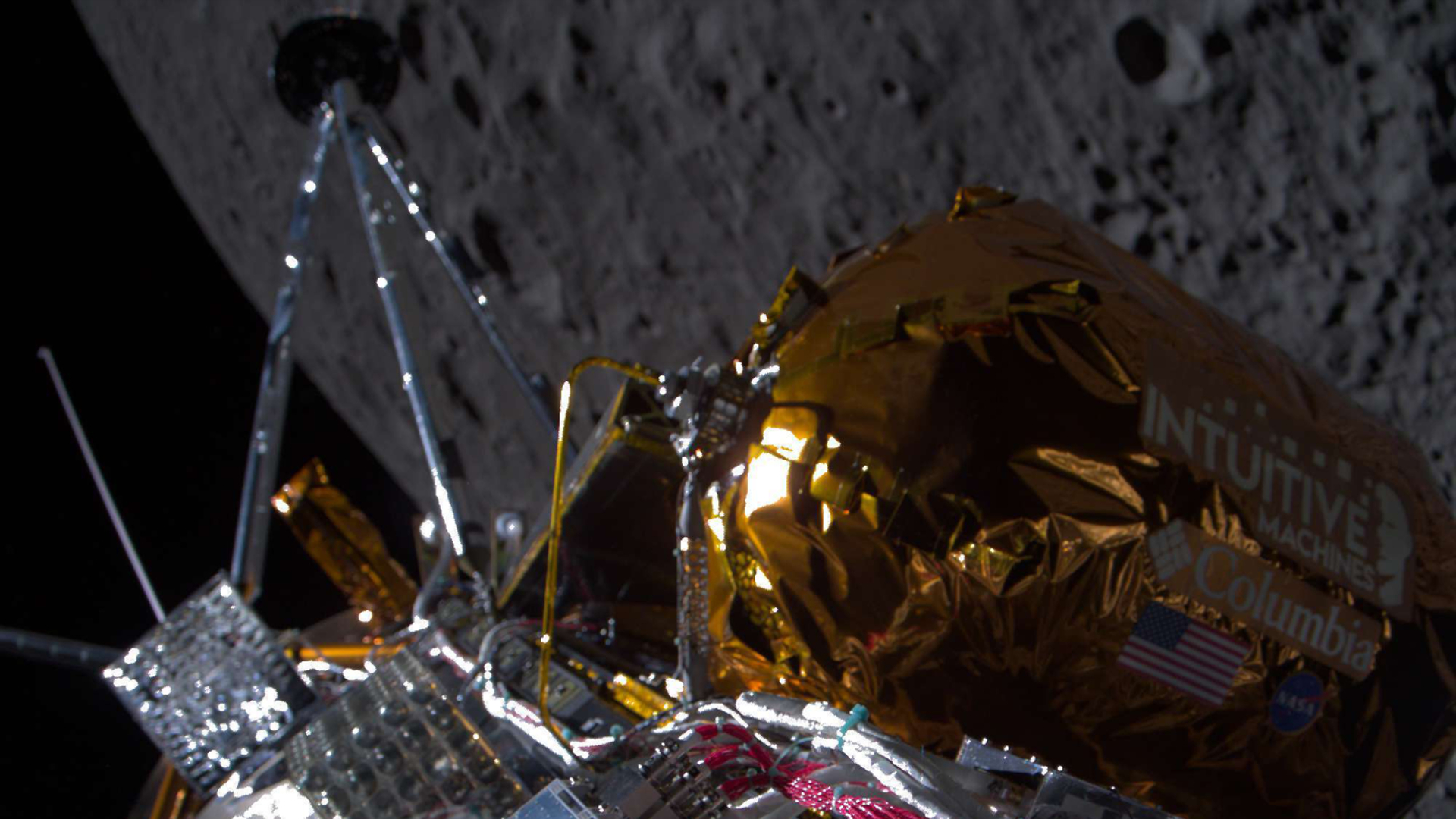
Following a successful launch, the mission – referred to as IM-1, for Intuitive Machines (the company that built the vehicle) mission 1, and the Nova-C lander itself christened Odysseus, had a slight wobbly start to its time in space after successfully being delivered into Earth orbit by a SpaceX Falcon 9 rocket.
Following its separation from the launch vehicle’s upper stage, the 675 kg Odysseus had been due to carry a “commissioning burn” of its main liquid methane / liquid oxygen (“methlox”) engine, firing it, then stopping it and then restarting it, a critical requirement of the motor if the lander was to enter lunar orbit and land. However, issues with the lander’s navigational star tracker and then with the liquid oxygen tank’s cooling lines meant the test had to be delayed until February 16th, when it was completed successfully, marking the first time a methlox propulsion system had ever been successfully re-started in space.
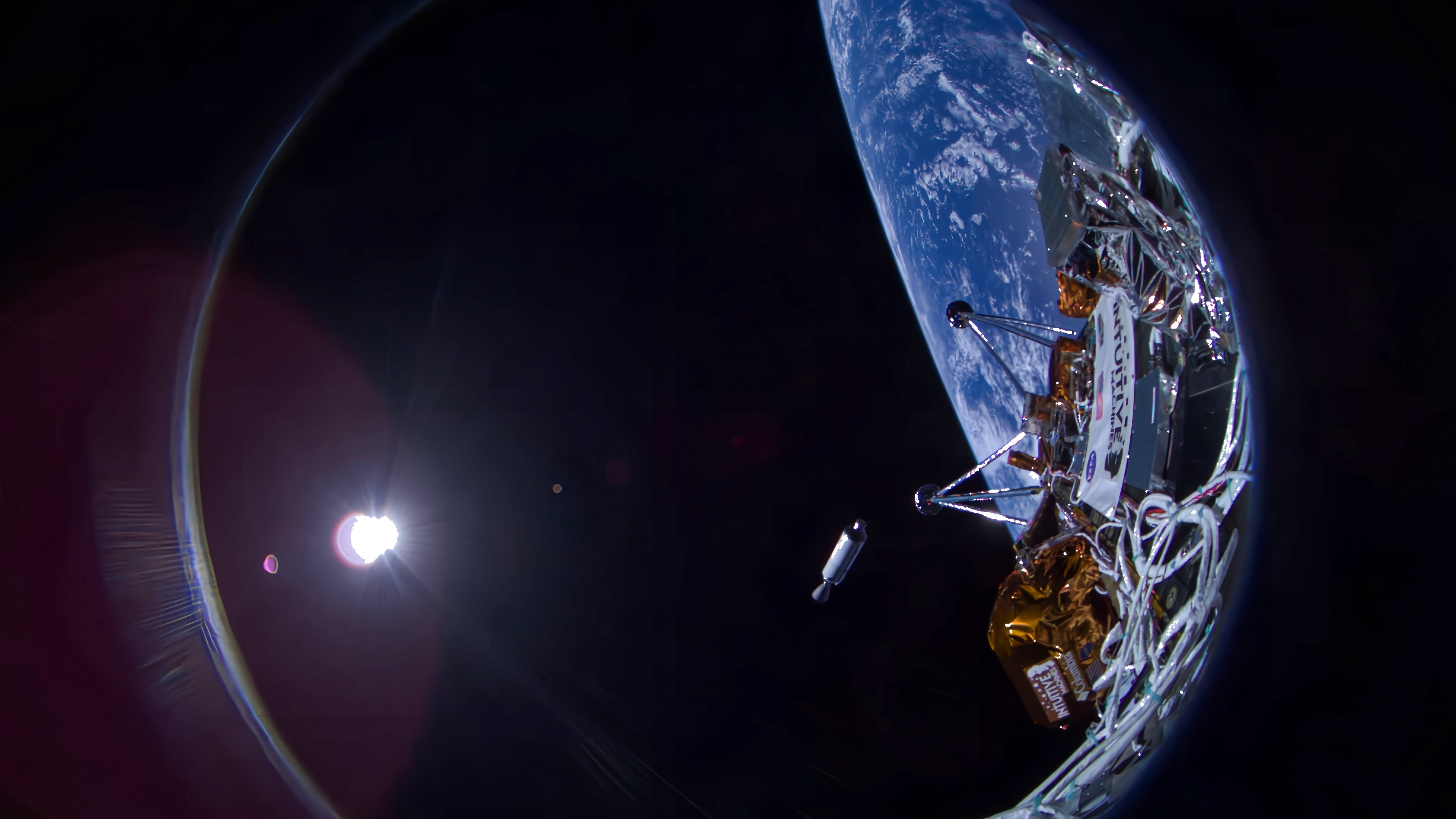
Intuitive Machines’ Nova-C lander Odysseus returned this selfie on Feb. 16th, 2024 as it orbited Earth in preparation for the commissioning test of its main motor. Credit: Intuitive Machines
Following its departure from Earth, the craft had been scheduled to make three trajectory adjustment manoeuvres whilst en route to the Moon, but only required the first two, such was the accuracy with which it matched its flight plan. On February 21st, the lander performed a Lunar Orbit Insert (LOI) manoeuvre, firing the main engine for 408 seconds to slow its velocity by 88 metres per second and place it in a 92 km orbit around the Moon.
After 24 hours in orbit, returning high-resolution images of the lunar surface to Earth, the vehicle was prepared to start its decent – and the mission hit another slight hiccup: a safety switch on the primary descent laser rangefinder had not been correctly set prior to launch, leaving the lander unable to accurately determine its distance from the Moon’s surface.
To compensate, the IM team worked with NASA to allow the latter’s experimental Navigation Doppler Lidar for Precise Velocity and Range Sensing system (called simply NDL to avoid a mouthful of an acronym) carried by the lander to take over the role of the laser rangefinder (and thereby also proving the NDL’s ability to guide a vehicle to a precise landing on another celestial body). This allowed the lander to commence its descent; unfortunately, it also meant that one of the other payloads on the lander had to be powered down.
Gazing at the Moon: Intuitive Machines’ Nova-C lander Odysseus catches a look at the Moon after entering lunar orbit, February 21st, 2024. Credit: Intuitive Machines
This was EagleCam, a small box of cameras developed by students and designed to be ejected from the lander when it was some 30 metres above the Moon in the hope that it would land ahead of Odysseus and provide the first-ever images of a space vehicle landing on the Moon. But the need to re-route power to NDL meant the ejection system for the camera had to be turned off.
Everything else with the descent seemed to go exactly as planned, and at 23:53 UTC on February 22nd, the lander settled on the Moon close to the crater Malapert A, about 300 km from the lunar south pole, only for another issue to occur: the mission team could not fully acquire the lander’s transmissions. After 15 minutes, it became apparent that whilst the vehicle was safely on the Moon, something was preventing it from sending a full-strength signal, leaving the mission team unable to lock-on to it. During the next several hours, the team worked to establish a firm contact with the lander – which they managed, to a degree – and obtain data on its approach and landing on the Moon, and general condition. The data received allowed them to reach a conclusion as to what had happened.
It had been thought that the 4.3 metre tall craft had made a proper vertical descent, slowing its horizontal speed to zero before lowering itself onto the Moon vertically at a rate of 3.6 km/h. But the telemetry finally obtained by the mission team revealed that at touchdown, the vehicle was vertically descending at close to 10 km/h, and moving horizontally at 3.2 km/h.
As it should have been compared to how it is believed to be (inset), as demonstrated by Intuitive Machines’ CEO Steve Altemus during a February 23rd media briefing. The small blue model of the lander represents the rock the lander is believed to be leaning against. Credit: NASA TV
This has led Intuitive Machines to conclude the lander was crabbbing sideways immediately before landing, rather than hovering in place, and one of the landing legs snagged on a rock or lip of a crevice, causing the vehicle to gently topple onto its side. Further data suggested that in toppling, Odysseus had ended-up leaning against a rock, allowing it to communicate, but with its antenna mis-aligned.
While communications had been stabilised, as of the time of writing the piece, it was unclear how many of the lander’s science packages would be able to function successfully. Even so, the landing is both a success – the first time an operational lunar lander built and operated by the private sector has landed on another celestial body, and the first time America has returned to the surface of the Moon since Gene Cernan and Harrison Schmitt departed on Apollo 17 in 1972 – and a warning.
Like the planned SpaceX Starship Human Landing System vehicle (HLS) intended to return humans to the lunar surface as a part of the Artemis Project, Odysseus is a tall, slim vehicle in terms of its overall proportions. Even with two extra landing legs compared to the SpaceX HLS (a altogether taller vehicle with a higher centre of mass), The IM-1 mission demonstrates how just a slight horizontal drift can be sufficient for such a vehicle to topple itself where a squatter, broader vehicle probably would not have done so.
Currently, IM-1 has sufficient sunlight to remain in operation through until the latter part of the coming week, after which the sun will set relative to its location on the Moon, depriving it of energy to power its battery systems.
Wooden Wonder
Want to have more eco-friendly satellites? Then why not make them out of … wood.
No, I’m not being sarcastic nor have I gone space happy. The above proposition was first put forward in 2019/2020 by a team of Japanese researchers at Kyoto University. It was born out of concern about the on-going practice of allowing / causing expired satellites to re-enter the upper atmosphere to burn up as a result of the frictional heat created by their passage through the atmosphere.
Whilst this generally results in the destruction of the greater portion of a lump of debris entering the atmosphere and helps reduce the dangerous clutter of junk whipping around the Earth, it is not entirely “clean”: every satellite or piece of rocket that burns up in this way leaves behind a trail of alumina particles which remain suspended in the atmosphere for decades. With the explosion of the private space sector and the growing use of “constellations” of thousands of low-orbiting, expendable satellites such as the (as of January 2024) 5,289 SpaceX Starlink network, these trails or clouds of alumina particles are set to increase exponentially, potentially having an undesirable impact on the upper reaches of the denser atmosphere and the environment as a whole.
So the researchers set out to find an alternative material for making satellites – and came to the conclusion that wood might be the best. Thus, the LignoStella Space Wood Project was born.
When you use wood on Earth, you have the problems of burning, rotting and deformation, but in space, you don’t have those problems: There is no oxygen in space, so it doesn’t burn, and no living creatures live in them, so they don’t rot. Some woods are extremely durable, so we set out to see if wood could be practically applied for use in small satellite systems.
– Koji Murata, LignoStella Space Wood Project
To test their ideas, the team examined various types of wood and determined three – Erman’s birch, Japanese cherry and magnolia bovate – had the precise properties required of a satellite body: they are lightweight, strong and durable. Just how durable was demonstrated when samples of the woods were flown to the International S[ace Station (ISS) in 2022 and exposed to the vacuum of space and the unfettered blasting of solar radiation for 290 days, being returned to Earth in mid 2023.
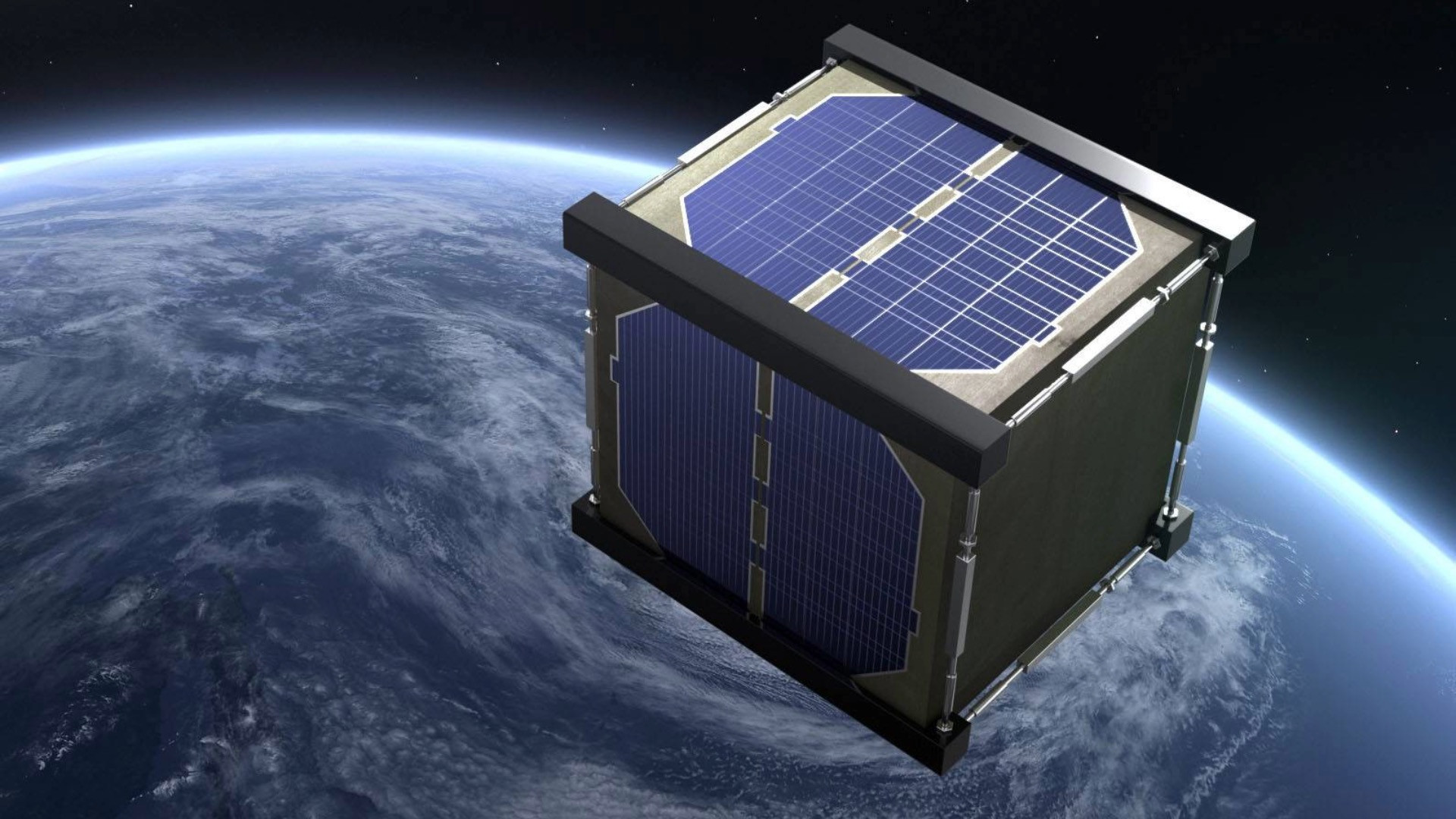
An artist’s depiction of LignoSat wooden satellite in orbit, with mini solar arrays mounted on its wooden surface. Credit: Kyoto University.
Analysis for the samples revealed that despite the harsh conditions to which they had been exposed, they had no measurable changes in mass and showed no signs of decomposition or damage. Meanwhile, tests of the woods on Earth indicated that of the three flown on the ISS, the magnolia wood – Hoonoki in Japanese – offers the best choice in terms of “workability, dimensional stability and overall strength” for use in a satellite design.
Now, and with the involvement of the Japanese Aerospace Exploration Agency (JAXA) and America’s NASA, the researcher are aiming to launch their first wooden satellite this coming summer. Currently, the plan is to carry it to orbit aboard an Orbital Sciences Cygnus automated resupply vehicle delivering supplies and equipment to the ISS. If all goes according to plan, the Cygnus vehicle will release the little satellite into its own orbit, where it will remain for 6 months.
LignoStella Space Wood Project’s Koji Murata with mock-ups of the LignoSat-2 satellite. Credit: Kyoto University
Called LignoSat-2, the vehicle is roughly the size of a cubesat – no more than 10cm on a side. Its primary purpose will be to test a number of factors in the use of wood which could dramatically change the design of such small satellites, which are growing increasingly popular in a growing number of roles. For example, wood can be penetrated by electromagnetic waves, so delicate and awkward elements of a satellite – sensors and antennae – could be mounted inside the satellite’s overall structure, helping to protect them whilst simplifying the overall design of the vehicle.
The overall durability of wood will also be monitored, as will be the eventual destruction of the satellite, the majority of which should burn-up “cleanly” in the atmosphere at the end of the mission, leaving only minute amounts of trace particulates.
One of the missions of the satellite is to measure the deformation of the wooden structure in space. Wood is durable and stable in one direction but may be prone to dimensional changes and cracking in the other direction.
– Koji Murata, LignoStella Space Wood Project
The LignoSat project is not the only team to consider the use of wood in satellites. Working entirely independently to them, a consortium of researchers and businesses out of Finland, supported by the European Space Agency (ESA) and Rocket Lab were developed a similar project with a cubesat built primarily out of plywood and called WISA Woodsat.
Heavily promoted and slated to fly in 2022, the project as (and still is) billed as the “world’s first wooden satellite”. However, since mid-2022 the project has been stalled, with no website updates or further information from ESA since April of that year.
Medical Crystals Grown in Space
One of the major promises of near-Earth space operations has long been that of leveraging the micro-gravity environment in the manufacture of ultra-pure drugs and the components used within them. Multiple experiments in this regard have been carried out over the decades, using facilities on space stations such as Mir and the ISS, or aboard the space shttle when it flew the European Spacelab, and so on.
Now a US company is looking to take matters a stage further – and have just successfully recovered their first attempt.
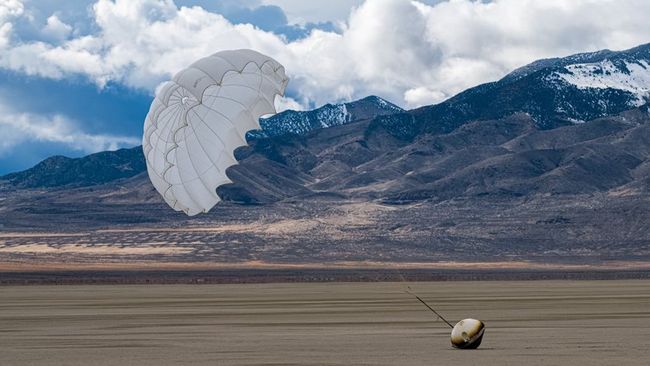
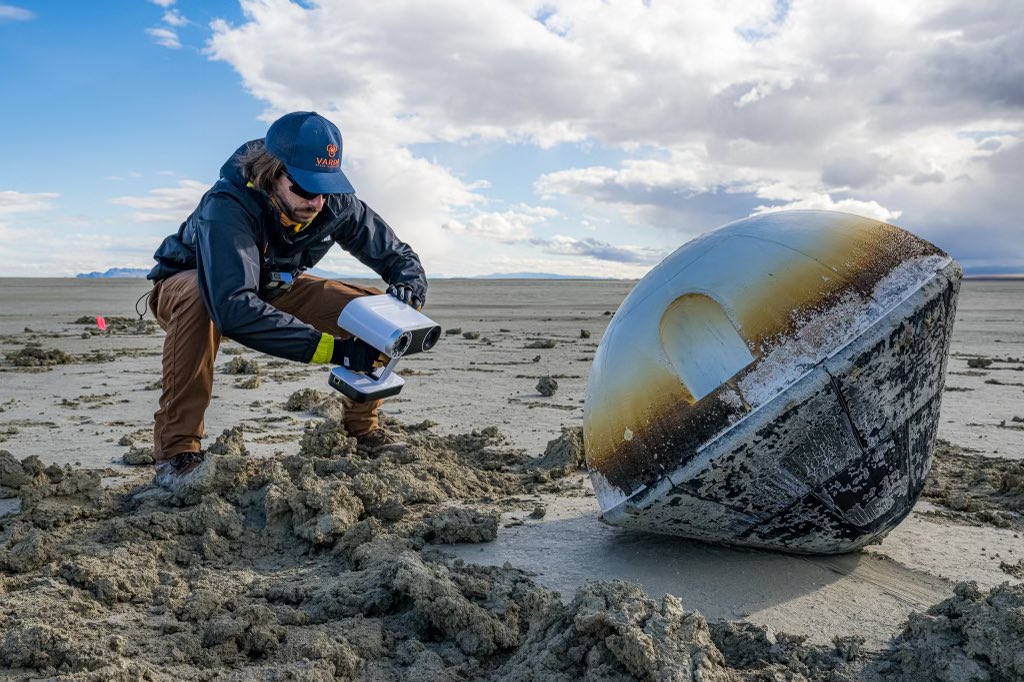
Touchdown: Varda Space’s off-Earth manufacturing capsule on the desert floor of the Utah Test and Training Range (UTTR) on Feb. 21st, 2024. Credit: Varda Space/John Kraus
Varda Space Industries is a relative new US start-up which has grand designs on microgravity manufacturing involving pharmaceuticals, fibre optics and computer chips. And they’ve moved fast. In 2021 the company purchased three Photon satellite buses from Rocket Lab to provide power, propulsion and navigation capabilities for the company’s “Winnebago” automated production satellites, the first of which – Winnebago-1 (W-1) – launched in June 2023, as a payload within a SpaceX Falcon 9 Transporter rideshare launch.
Originally, the craft was supposed to spend three months in orbit, growing exceptionally pure, “near-perfect” crystals used in an anti-viral medication called Ritonavir, a highly active antiretroviral therapy (HAART). The selection of a pharmaceutical product for the first Winnebago mission as this is seen as the largest market which might benefit from the benefits of microgravity production techniques. However, the capsule remained in orbit far longer than intended, thanks to the US Department of Defense (DOD), having originally agreed in principle to allowing Varda to use its Utah Test and Training Range (UTTR) as their landing site, withdrew that permission after the mission had been launched.
Thus began a multi-month series of negotiations involving the DOD, the Federal Aviation Administration (FAA), Varda and Rocket Lab to try and reach an agreement on the use of UTTR to recover the capsule. So protracted did this became that Varda, rather than lose their product, actually started looking at overseas recovery options such as the Koonnibba Test Range in Australia.
A Varda technician evaluated the company’s off-Earth manufacturing capsule prior to it being taken by helicopter to a receiving facility. Credit: Varda Space/John Kraus
On February 14th, however, the required agreement to use UTTR was reached and the FAA expedited granting Varda a licence to carry out a controlled re-entry into, and descent through, Earth’s atmosphere. As a result, on February 21st, 2024, Varda were finally able to bring their W-1 mission home on February 21st, 2024.
After the Photon buss had been used in a de-orbit manoeuvre, the capsule containing the automated manufacturing plant successfully re-entered the atmosphere and deployed its main parachute, touching down within the UTTR at 21:40 UTC in February 21st, marking the second time the range has been used for the recovery of space science capsules – the first being NASA’s OSIRIS-REx capsule, bringing samples from asteroid Bennu back to Earth for analysis.
Following touchdown, the capsule was subject to analysis and cooling prior to being harnessed to a helicopter for transfer to a Varda receiving station where it could be opened in suitable lab conditions, and the crystals produced initially assessed.
From there, the Ritonavir vials onboard the spacecraft will be shipped to our collaborators Improved Pharma for post-flight characterisation. Additionally, data collected throughout the entirety of the capsule’s flight — including a portion where we reached hypersonic speeds — will be shared with the Air Force and NASA under a contract Varda has with those agencies.
– Varda statement
No information has been given on the next Varda mission, called Winnebago-2, or its likely payload.
The following notes were taken from the Thursday, February 22nd, 2024 Combat User Group meeting (also referred to as the Combat Committee User Group or CCUG, an abbreviation also used by the Content Creation User Group, and which I’ll not be using in these summaries to reduce the risk of confusion between the two). They form a summary of the items discussed, and are not intended to be a full transcript.
Meeting Overview
The Combat User Group exists as a forum to discuss improvements to the Linden Lab Combat System or LLCS to better support combat in Second Life.
The core idea is to provide additional events and capabilities which sit on top of LLCS to provide combat creators with better tools with which to create better combat systems for their specific scenarios.
The meetings are the result of a proposal document on improving the native damage system in SL, written by Rider Linden, and which is the focus for both the meeting and any work arising from them.
These meetings are conducted (as a rule):
By Rider Linden, with the support of Kyle Linden.
On alternating Thursdays (rotating with the Content Creation User Group) at 13:00 SLT. Meeting dates are recorded in the Second Life Public Calendar.
Initially in text, although voice might be included in the future depending on feedback from those attending.
Feedback from the previous meeting has been written-up in the form of Github / Canny items by Rider Linden. However, they are not open to public viewing, due to being part of the server repo.
However, general feedback on Combat 2.0 can be found in this Canny board. This is seen as the place to raise any issues or suggestions as we go on, as Rider can monitor it pretty.
Rider proposes setting up two combat-specific region on Aditi (the Beta grid), specifically for testing output from this work / project.
Names are TBC, but will likely be something along the lines of “Waterloo”.
These will hopefully be up and running in about a week.
In terms of initial work, Rider is looking to “knock off” the low-hanging fruit:
First will be llGetHealth.
Second will be damage transfer across regions (e.g. damage transfer is not going to 100% when you cross a region boundary).
The above will be followed by work on the on_damage() event, key to much of the rest of the work.
New documentation accompanying the events and capabilities will be posted the to LSL Wiki.
Comments and Requests
A request was made on whether combat capabilities could be made so unobtrusive, they could be “always on” unless specifically disabled through region / parcel setting.
This was seen as a non-starter on a grid-wide basis, due to the diversity of uses to which SL is put, and the need for combat to be opt-in, not opt out as a result.
In terms of Mainland, any such arrangement would be under the remit of the Product Operations group under Patch Linden.
A user proposal has also bee submitted to the Combat 2.0 section of Canny to address damage caused by physical collisions, for review.
It was suggested that there should be some permanent regions set up to demonstrate combat in SL, as these could be useful for demonstrating to new users what sort of experiences are out there, as well as showing off how the combat features can work.
An adjunct to this was a suggestion the the SL Combat Communit(y/ies) get(s) totgether and promotes activities via the Second Life Community Exhibition at the Welcome / Motown Experience gateway.
There was a general discussion about having the ability to parcel region vertically (e.g. by altitude). However, this is not a part of this project – or something the Lab has on its roadmap, as it raises a lot of complications.
More discussion on teleporting on death / respawning and allowing defined re-spawns by group or similar, along much the same lines as the previous meeting.
Rider indicated that he is not going to tie spawning (or combat capabilities) to the SL Experience system, BUT existing experience functionality can be used to extend them.




:focal(400x267:401x268)/https://tf-cmsv2-smithsonianmag-media.s3.amazonaws.com/filer_public/6a/53/6a53ca5e-436e-4aae-91fc-2ffdb3bd420d/img_interview_murata_03_1.jpg)

 Inara Pey: Living in a Modemworld