The new addition – called the Second Life Community Exhibition (SLCE) – is designed to occupy north-west corner region of the nine-region Lab-managed estate, replacing what had been the laser tag area. However, at the time of writing it was limited to a smaller area extending outward from the main Welcome Hub region, between the Motown and and shopping regions. In terms of it’s purpose, it is intended to do exactly what the name suggests: provide active communities within Second Life with the opportunity to promote themselves to both established users visiting the Welcome Hub and its associated regions as well as to incoming new users arriving at the Hub.
Following the design design aesthetic of the Welcome Hub, the Community Exhibition area currently has room for some 32 community displays, with eleven occupied for the opening. According to the official blog post on the Exhibition, the displays will be cycled between communities as time goes on, in accordance with the response of new users to the various displays when visiting the exhibition – a statement which tickles my curiosity as to how such “resonating” will be measured (purely on the basis of the number of teleports from any supplied portal? If so, what about those displays providing access by giving landmarks or HUDs?).
Second Life Community Exhibition, January 2024
The ten communities initially presented comprise: Boystown (LGBTQ+ friendly), Drivers of SL (hosts of the famous Grid Drive events, as well as helping to represent sailing and flying in SL), Virtual Ability Inc., Non-Profit Commons, Club Furzona (Furry community focused on music, writing, animation and 3D modelling amongst much more), BURN2 (the unofficial virtual celebrations marking the physical world Burning Man traditions), plus four well established communities offering people both a sense of community and a place to live: Bay City, the Caledon community and estate, the Confederation of Democratic Simulators (CDS) and (my “home town” of) Second Norway.
Linden Realms is also represented, although it’s hard to consider it a “community” in the traditional sense. However, of all the Linden games introduced into Second Life, it does seem to be the one with the most enduring popularity, and it certainly offers the potential for new users to make friends whilst racing around and collecting gems, so its inclusion shouldn’t be sneered at.
Second Life Community Exhibition, January 2024 – expansion area for further community displays
Nor are these merely static informational areas – the aim is to both promote communities to Second Life residents and bring residents into the communities. As such, and as indicated earlier in this piece, each participating community is expected to provide some form of access into their community / experience, be it via teleport portal or HUD landmark giver, etc. In addition, communities can provide links to other resources they might have – websites, Discord channels, etc., – and displays / exhibits can utilise multi-media, etc.
Communities wishing to join the Exhibition can do so via the SLCE application form, which includes general guidelines on requirements / expectations. As to the rest, I’ll leave it to Strawberry and Patch Linden to discuss, via the Lab Gab recording below.
Overall, this would appear to be a good initiative – outreach to new users (and even existing users) is something communities and groups within Second Life can find difficult, so providing what is very much a “doorstep” opportunity to reach people through a physical resource like this is something a broad cross-section of communities and groups could find beneficial, allowing for acceptance and length of time(s) featured within the Exhibition space.
The following notes were taken from the Tuesday, January 30th, 2024 Simulator User Group (SUG) meeting. They form a summary of the items discussed, and are not intended to be a full transcript. A video of the meeting is embedded at the end of this summary, my thanks as always to Pantera for recording the meeting and providing it.
Meeting Overview
The Simulator User Group (also referred to by its older name of Server User Group) exists to provide an opportunity for discussion about simulator technology, bugs, and feature ideas.
They are open to anyone with a concern / interest in the above topics, and form one of a series of regular / semi-regular User Group meetings conducted by Linden Lab.
Dates and times of all current meetings can be found on the Second Life Public Calendar, and descriptions of meetings are defined on the SL wiki.
Wednesday, January 31st would have seen the Gingerbread RC update deployed to the BlueSteel channel. However, a late-breaking bug has seen this deployment postponed for a week, so the RC channels will likely be restarted without any simulator version change.
No changes at the start of the week, leaving the list of official viewers as:
Release viewer: version 7.1.2.7215179142, formerly the glTF PBR Materials Maintenance RC, issued December 15, promoted January 8, 2024 – numerous bug fixes and improvements – No Change.
glTF PBR Materials Maintenance-2 RC viewer, version 7.1.3.7467259489, issued January 12, 2024.
Maintenance-W RC viewer, version 7.1.3.7453541295, January 9, 2024 – bug and crash fixes.
Maintenance X RC, version 7.1.1.7088410646, December 7 – usability improvements.
Maintenance Y RC, version 6.6.17.6935642049, issued November 21 – My Outfits folder improvements; ability to remove entries from landmark history.
Project viewers:
Puppetry project viewer, version 6.6.12.579958, May 11.
Jira End-of-Road – Reminder
Linden Lab is ending its use of Atlassian Jira for the filing of bug reports and feature request, and is instead moving to Github / Canny. For specifics, please refer to the following:
The new means of filing bug reports / feature requests is via the Canny feedback portal.
Combat Committee User Group
The first meeting of the Combat Committee User Group will be held on Thursday, February 8th, at 13:00 SLT, and so will be alternating with the Content Creation User Group.
I have pointed out to Rider Linden that having two meetings abbreviated to “CCUG” (Combat Committee and Content Creation user groups), which are held at the same time on alternating Thursdays could lead to some confusion among attendees of either, even allowing for some cross-over between the two, so the Combat Committee may yet see a change in name.
In Brief
A general discussion on the upcoming llGetNotecardLineSync(), including caching (both when and length of time).
Further (often negative) feedback on CANNY as the bug / feature release front-end, including news from Signal Linden that the Canny devs are working to take onboard issues raised with them by LL to help improved the system, some of which (such as providing a wider text input field on tickets) will be deployed in the very near future.
A general discussion on a “HUDs/dialogue box 2.0 feature” to replace / improve upon the current dialogue box system and scripted HUDs. Suggestions included enabling / allowing dialogue boxes to be generated with radio buttons, dropdown boxes, and checkboxes; offering a client-side scripting capability to provide HUDs (and idea also being tossed around at recent Content Creation User Group meetings), although this got largely derailed by the hoary old (and highly subjective) “Pie Menu is better than Context Menus” debate.
Details of all above in the video, below.
† The header images included in these summaries are not intended to represent anything discussed at the meetings; they are simply here to avoid a repeated image of a rooftop of people every week. They are taken from my list of region visits, with a link to the post for those interested.
Oblivion, January 2024 – click any image for full size
There are many beautiful regions in Second Life presenting all manner of settings and environments and put together with care and love for the enjoyment and appreciate those who visit them. It has been my privilege and joy to visit many of them over the years, and to write about them. Some have faded away with the passage of time, but remain in photos and memory; others are reinvented periodically to offer something new and enchanting or mysterious or fun to visit, and some – and their designers – have become established in a growing catalogue of places I regard as personal favourites; places I will happily revisit time and again.
One such region was that of Winter Moon, a place I visited on several occasions between 2013 and 2020 and wrote about on three of them. A Homestead region held and designed by Dream Shadowcry, it was always a place of serene beauty and opportunities to decompress and renew. However, and for reasons unclear to me – or perhaps because the region was retired at some point; I genuinely have no idea – I lost track of Winter Moon in late 2020; so when a little bird whispered in my ear that Dream was back with a new setting (and with a new name for herself – Dream Softpaw), this time occupying a Full region, I knew I’d have to play a little catch-up.
Oblivion, January 2024
Oblivion – for that is the name of the setting – offers all that I found so attractive in Winter Moon, but with a richness of detail which can only come within a Full region’s additional Land Capacity. A veritable tour de force of design, it is – without hyperbole – simply magnificent in presenting a place that is rich in celebrating nature’s beauty; a veritable tapestry of ideas and themes deftly woven together into an engaging whole.
The “official” landing point (not actually enforced, so people can teleport out and back in anywhere within the region) sits at the southern end of a suspension bridge which appears to have been modelled after Liberty Bridge connecting Buda and Pest across the Danube. However, rather than spanning a river, here the bridge links a large sandbar occupying the south-east portion of the region with the main landmass. Also unlike its namesake, this bridge has only one suspension span, and is not a walkway in the traditional sense; rather, it is a garden space reaching out over the water to the rocky northern tip of the sandbar, where it drops down by way of steps to ain unsurfaced path leading to a grove of fir trees crowning the highest point above the surrounding sands.
Oblivion, January 2024As well as suggesting the region enjoys a temperature rather than tropical climate, the trees lay gathered around and on the sandy hill in a manner which suggests the surrounding beaches – despite the deckchair and parasol placed close to the current water’s edge – might well be subject to periodic submergence by the tide; a suggestion additionally made by the fact the sandbar’s lone wooden deck extends out over the sands whilst raised well above them on stout timbers.
Both ends of the bridge are marked by boxwood hedge arches, with the northern end also having steps descending from it to a small headland of sand dunes matted by wild grasses, together with a beach where a large deck has been constructed, complete with a walled garden area and upon which comfortable chairs, braziers and parasols have been set out to allow visitors to relax and enjoy a cocktail or glass of wine, together with selections of fresh fruits, – just don’t sit on the furry occupants of one of the chaise lounge!
Oblivion, January 2024
Westward, and beyond another boxwood arch, the path climbs the slopes of the main island, meandering through and between grasses, ferns and wildflowers and beneath the tall fingers of high fir trees and redwoods as they form a not-too-dense woodland. Branching mid-climb, a part of the path wriggles its way to stone steps as they slip down to a further deck, this one raised over the rocks and cliffs sitting at the landward end of the setting’s sheltered bay. Meanwhile, the rest of the trail continues upwards to run along the spine of the island, skirting the edge of a wash of lavender as it adds a splash of deep colour to the greens and browns – and even the pinks and reds of the blossoming trees sitting amongst the fir trees.
Bursting clear of the trees, the path provides access to a huge glass-and-iron greenhouse, now converted into a chandelier-hung bar, a further place to sit and relax. Beyond it, on the high headland, an eye-catching floating stage reached by wooden steps and held aloft by three large balloons as it overlooks and small and slightly overgrown dance floor to outside and the cliffs that drop away to a further beach on the other. The latter is marked by a massive rock arch which itself sits close to a final sentinel at this end of the island: a stone pavilion raised at the end of a slender finger of sand – although how you reach it is a matter for you to determine 😉 .
Oblivion, January 2024
Across the endite setting are hints of fantasy and romance gently woven into the setting to add to its beauty: a gentle voice might in places be heard singing on the breeze; an empty mausoleum has been converted to a quiet retreat; the beacon-like braziers point blades of light towards the sky; an armchair surrounded by (mostly!) quiet cattle content to simply observer whoever uses it, awaits those in a contemplative mood; a clockwork owl keeps a careful pair of eyes on the comings and goings of visitors…
Oblivion is without a doubt one of the most visually engaging, soul warming settings it has been my pleasure to explore; the depths of detail Dream has provided are wonderful to find – hence why in some cases above I’ve given hints, not directions, on what you might witness! – and the sheer natural flow form location to location is utterly sublime, while the many places to sit and share or rest in solitude further add to region’s welcome – and increase the desire to spend time within it.
Logos representative only and should not be seen as an endorsement / preference / recommendation
Updates from the week through to Sunday, January 28th, 2024
This summary is generally published every Monday, and is a list of SL viewer / client releases (official and TPV) made during the previous week. When reading it, please note:
It is based on my Current Viewer Releases Page, a list of all Second Life viewers and clients that are in popular use (and of which I am aware), and which are recognised as adhering to the TPV Policy. This page includes comprehensive links to download pages, blog notes, release notes, etc., as well as links to any / all reviews of specific viewers / clients made within this blog.
By its nature, this summary presented here will always be in arrears, please refer to the Current Viewer Release Page for more up-to-date information.
Note that for purposes of length, TPV test viewers, preview / beta viewers / nightly builds are generally not recorded in these summaries.
Official LL Viewers
Release viewer: version 7.1.2.7215179142, formerly the glTF PBR Materials Maintenance RC, issued December 15, promoted January 8th, 2024 – numerous bug fixes and improvements – NEW.
A NASA promotional image showing Ingenuity flying as the Mars 2020 rover Perseverance looks on. Credit: NASA
Ingenuity, the remarkable helicopter drone which forms a part of NASA’s Mars 2020 mission, has made its last flight and is now officially “retired” – and with full honours. Whilst very much an experimental vehicle, the craft achieved far more than the teams responsible for developing and building it and for operating it could ever have hoped for – and in doing to, the helicopter caught the imaginations of people around the world.
The vehicle’s remarkable history started in 2012 when the then director of NASA’s Jet Propulsion Laboratory (JPL) , Charles Elachi, met with members of the Autonomous Systems Division (ASD). They persuaded him that a concept study for aerial rover vehicles in support of surface missions on Mars had merit to the point where although NASA senior management had no interest in such a project, he used his influence to get the team sufficient funding for an initial design to be produced.
This demonstrator proved so impressive to NASA management that it was agreed the project should receive further funding to allow several engineering models to be built – even though there was still no mission on which any developed aircraft could join. It was not until March 2018, with the engineering models showing genuine promise for real flight capabilities on Mars that it was agreed that the helicopter project should go ahead – and should be flown as a part of the up-coming Mars 2020 rover mission, which was itself already at an advanced stage of development.
The imaging system mounted on Perseverance’s robot arm observes a partially-deployed Ingenuity as it sits under the rover. Two of the helicopter’s legs can be seen deployed, with the remaining tow still folded in their stow position until the helicopter is swung down from the rover’s belly. Above Ingenuity’s boxy fuselage can be seen the two sets of contra-rotating blades, with the helicopter’s solar array above them. Credit: NASA/JPL
This resulted in a crash course of design and development – from engineering demonstrator to full-blown, mission-ready vehicle in just two years, including a deployment system which would allow the helicopter to be stowed against the rover’s belly and deployed from there once on the surface of Mars.
Originally called the Mars Helicopter Scout, the inclusion of the helicopter in the Mars 2020 mission angered some in the NASA hierarchy – and within the rover team itself. Jennifer Trosper, Perseverance’s mission systems development manager and project manager stated her belief that such were the capabilities of the rover’s autonomous driving system, it would simply outpace the helicopter, rendering any idea of the latter being a useful scout moot.
To help counter such opposition, the scope of the helicopter’s mission was intentionally limited. Named Ingenuity, as suggested by (then) schoolgirl Vaneeza Rupani as a name for the rover, it was related to the role of technology demonstrator and its mission initially limited to a 30-day period at the start of Perseverance’s time on Mars in order to limit any impact on the rover’s mission in having to sit by and observe what was expected to be a maximum of five flights. Even so, opponents of the helicopter’s inclusion in the mission remained vocal in their objections.
I have personally been opposed to it because we are working very hard for efficiencies and spending 30 days working on a technology demonstration does not further those goals directly from the science point of view [this] helicopter is a distraction from the priority scientific tasks, unacceptable even for a short time.
Ingenuity on the surface of Jezero Crater, post-deployment by Perseverance. This image was taken using the Hazcam (HAZard avoidance CAMera) system on Perseverance on Sol 43 of the mission (April 4th, 2021), at a local mean solar time of 15:14:28. It has not been white balanced for typical Earth lighting conditions. Credit: NASA/JPL
This opposition is why Ingenuity’s project lead, MiMi Aung and her little team – who initially were not even awarded space in the Mars 2020 mission control room, but had to operate out of a meeting room they converted into their own operations centre – were so determined to see Ingenuity not only fulfil its initial primary mission but to exceed all expectations, even if it meant aggressively pursuing goals and extending flight parameters to a point of putting their little craft at risk.
The first opportunity for the team to prove their vehicle came on April 19th, 2021, almost two months after the mission had arrived within Jezero Crater, and almost two weeks after Ingenuity had successfully deployed onto the planet’s surface. In the intervening period, the helicopter’s electrical system had been charged and tested, the twin sets of contra-rotating blades unlocked for their stowed position and run through a series of ground tests – some of which didn’t quite go to plan –, with a finally high-speed test of the rotors being carried out 2 days prior to the first flight, confirming the motors could safely power the blades to their required 2400 rpm.
The first flight was brief: a simple lift-off to 3 metres above ground, then an axial rotation of around 90º prior to a descent and landing – simple, that is, until you consider that Ingenuity was attempting to take flight at within an atmosphere with a density equivalent to that of Earth’s at 34,000 metres (112,000 ft) – well above the capabilities of any Earth-based rotary craft.
The remaining four test flights came rapidly thereafter, initially testing the craft’s ability to transition from a hover to horizontal flight (covering 4 metres in its second flight, then just 3 cm shy of 100 metres in its third, before smashing its planned maximum horizontal flight capability (160 m) by covering 270 metres in its fourth flight prior to a more modest 130m in the final test flight). By this time, opposition to the helicopter’s presence on the mission was rapidly thawing, and continued operations were given the green light – providing they did not impeded on Perseverance starting into it primary mission of investigation and exploration.
This mission extension period saw the helicopter move from being a technology demonstrator to being more of a general testbed aircraft which could also gradually take up the mantle of its intended role as a scout for the rover. In this capacity it gradually flew flights of both longer duration (the longest being 169.5 seconds in August 201), and greater distance (peaking at 709 metres in a single flight on April 8th, 2022). But the end of 2022, Ingenuity was largely operating in support of Perseverance, not only keeping up with the rover in defiance of Trosper’s prediction, but also actually increasing the effectiveness of the rover’s autonomous driving capabilities by providing the mission team with data which allowed them to more efficiency plan routes wherein the rover could more easily navigate for itself, reducing the punctuation of drive, stop, survey and allow the drive team to plan and upload new instructions then drive, stop, survey and allow the drive team to plan and upload new instructions, common to a lot of the rover’s initial explorations.
Whilst there were some problems encountered with flight software and concerns over motor and rotor performance in the face of slowly decline electrical power generation, overall, Ingenuity proved remarkably robust and capable of exceeding many of the parameters originally set to safeguard it. On October 2023, for example, it achieved an altitude of 24 metres (79 ft) above the ground – over double the 10-metre maximum originally envisioned as its operational ceiling – and this during a time when several flights exceeded that limit. It also withstood the ravages of Martian winter with its harsh cold weather, as well as the challenge of seasonal dust storms.
Map of the total flight path of Ingenuity (yellow), together with the ground track of the Perseverance rover (grey), between landing on Mars in 2021 (the right end of the tracks) and the helicopter’s final flight on 18 January 2024, as the pair explored the ancient river delta within Jezero Crater, Mars. Credit: NASA/JPL
Nevertheless, it was acknowledged that the longer the mission went on, the greater the risk of something happening that could unexpectedly curtail flights. And at the start of 2024, these risks were made manifest.
By this time Ingenuity was operating over what the flight team called “difficult” terrain. To explain: Ingenuity’s flights are entirely autonomous. They are planned on Earth in terms of timings, direction, altitudes, etc., together with waypoints – static ground features and rocks the helicopter can be told to identify using its navigation cameras, and use to make changes in direction or its orientation and as reference points for landing.
However, since its 68th flight, Ingenuity has been flying over terrain where such definable waypoints are few and far between. On the helicopter’s 71st flight – which took place on January 6th, 2024 – this sparseness of waypoints resulted in Ingenuity becoming confused as to where it was and where it was going, triggering automatic a landing. Unfortunately, it seems one of the rotors suffered a very slight deformation on touch-down, as revealed in post-flight images the helicopter took of its own shadow – a trick the flight team had long used to help assess Ingenuity’s status after each flight when Perseverance was too far away to provide suitable images.
As a result, it was decided that prior to continuing in its scouting mission, Ingenuity should complete a straight up-and-down hop to test the rotor systems. This took place on January 18th, 2024 and initially looked to be successful: the rotors spun up to speed, and the helicopter rose to 10 metres and then descended for a landing. However, as I reported in my previous Space Sunday update, communications abruptly cut-off when it was still around a metre off the ground, and took a little while to restore.
Once communications had been recovered, the helicopter was ordered to again image its own shadow to help in the assessment of its overall condition as the flight team went back through the flight data to try to determine what caused the communications drop-out. In one of the the returned photos, the shadow of a rotor blades clearly shows its end has suffered damage, appearing broken and buckled.
An image returned by Ingenuity after its 72nd flight included a shadow of one of its rotors, showing damage to the blade sustained on the flight. Credit: NASA/JPL
This image suggests that at some point Ingenuity ended up at an angle as it descended at the end of flight 72. Whether this was the result of the deformation in a blade seen at the end of flight 71 or has some other cause, is unknown. However, it is clear than whatever happened, it was sufficient to bring at least one blade tip in contact with the ground, even if for a fraction of a second, causing it noticeable damage.
Whether it was the sudden jolt which likely accompanied the impact which caused the drop in communications or whether there may have been a general electrical glitch which caused both the communications drop and the blade impact is currently the subject of JPL assessments of the flight data. But whatever the cause, and even if the damage is to the one blade-tip, it has put paid to Ingenuity’s ability to fly: the damaged blade will simply cause too much turbulence and vibration for the little helicopter to remain stable. Thus, the mission has been declared over and Ingenuity retired from active duty, an event marked with the release of a short video by NASA, celebrating the mission and its achievements.
And celebration is the right word. During its 32-month operational period, Ingenuity conclusively proved the viability and value of rotary drones on Mars operating in support of other missions. In doing so, it not only itself covered a horizontal distance of 17.242 km (reaching a maximum speed of 36 km/h during some flights) and clocking up a total of 2 hours 8 minutes and 55 seconds in the Martian air, it has successfully laid for foundation for future generations of automated and – come human missions to Mars – teleoperated drones on the Red Planet.
In additional to the “official” video, NASA JPL release a more personal video from some of the members of the Ingenuity team, allowing them to say some final words about the Little Helicopter That Could – And Did.
SLIM Landed… On Its “Head”
In my previous Space Sunday, as well as commenting on Ingenuity’s 72nd flight (which at the time had not been identified as terminating its flying career) I reported on Japan’s SLIM mission to the surface of the Moon, which had met with some mixed results.
As I noted in that report, SLIM – Smart Lander for Investigating Moon – had apparently successfully landed right on target to make Japan the fifth nation to have successfully landed on the Moon, but potentially incorrectly oriented for its solar array to capture sunlight and convert it into usable energy.
At the time of that article, it was unclear precisely what had happened to the lander. The telemetry received and broadcast during the livestream seemed to suggest it was upside down – which many saw as unlikely, particularly as the lander’s systems and science instruments did appear to be working. However, in the hours between touchdown and the lander being placed in a dormant mode as battery levels dropped to a critical level, some of the images returned by the lander seemed to back-up the livestream graphics portrayal that the lander was inverted.
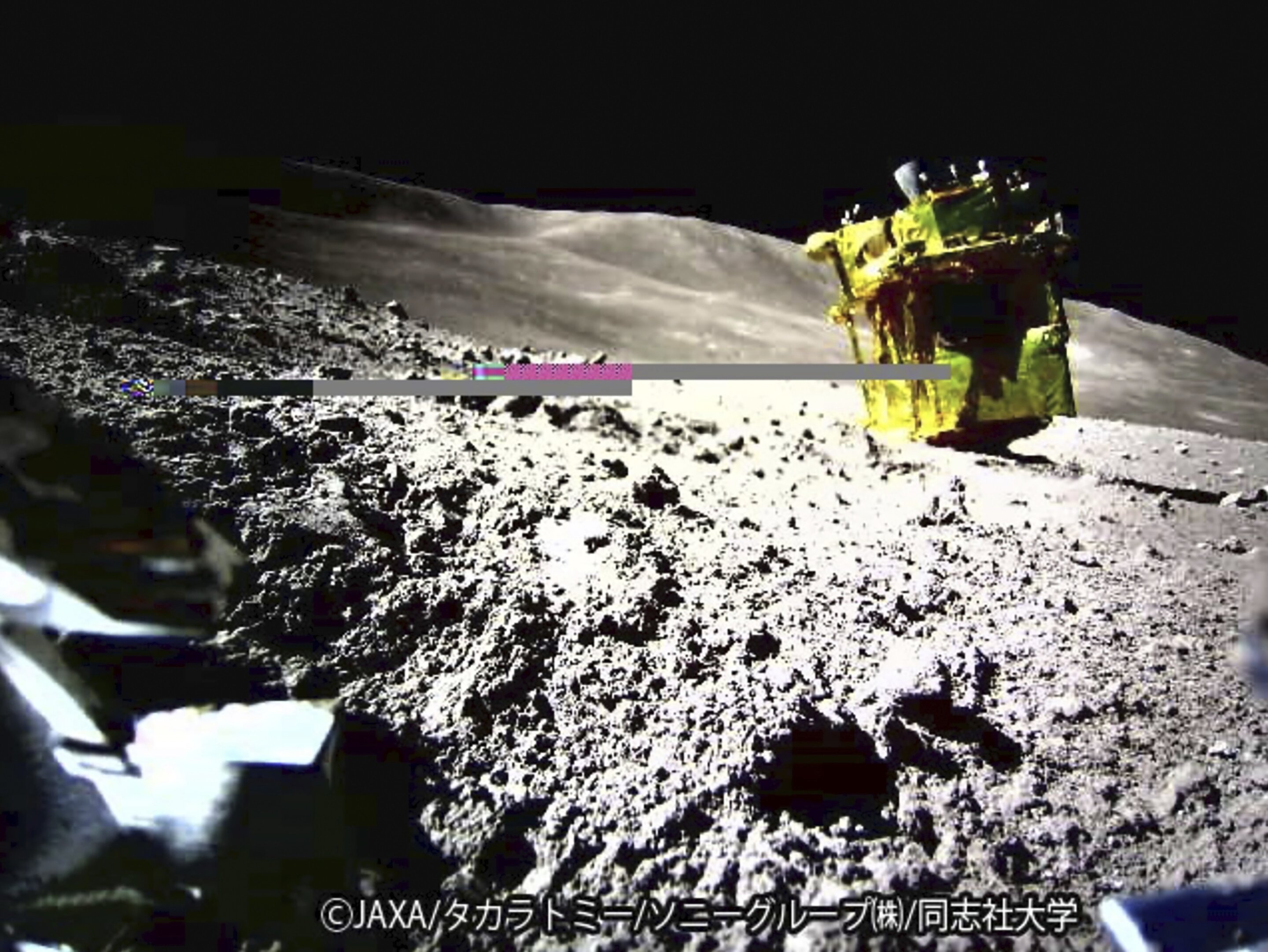
Even so, it was not until the two tiny rovers – LEV-1 (for “lunar excursion vehicle”) and LEV-2, released by the lander shortly before touch down – reported in that the status of the lander could be confirmed. After establishing contact with Earth with LEV-1 acting as a relay for LEV-2 (also called “Sora-Q”), the rovers returned images of their immediate surroundings before being tasked with making their way over to the lander and imaging it; and both return some remarkable shots of the lander sitting on its head, one of its descent engine nozzles pointing up into the lunar sky.
Japan Aerospace Exploration Agency (JAXA) released this image, captured by the LEV-2 mini-rover, of their SLIM lander upside down on the Moon. Credit: JAXA
It’s not clear exactly what occurred, but JAXA – the Japan Aerospace Exploration Agency – believes one of the lander’s decent engines failed during landing, causing it to touch-down harder than intended and then toppling over as a result of landing on a slope, or possibly the off-axis thrust from the remaining descent engine cause it to flip over following initial ground contact.
As I previously noted, mission operators had hoped that as the lunar day progressed, the Sun would move into a position where light would strike SLIM’s solar array and perhaps furnish it with power. The images from the LEV rovers have confirmed this is indeed possible – the array is facing west, and so will encounter sunlight the the Sun moves towards the local horizon. However, given that nightfall commences of February 1st/2nd, and the lander is not equipped to withstand the harsh night-time lunar temperatures, SLIM may only have a couple of days in which to resume gathering data, even if it can be revived. Even so, the fact that the lander has gathered and returned images and data post-landing, and its two little rovers are operational means this mission can still be counted a success.
Lalie Sorbet invited me to visit her latest collaborative piece – working with Chrix (chrixbed) – entitled Bloom:Flowers of Evil, and which is currently open to visitors at the Second Life Endowment for the Arts. A dynamic installation built around what I understand to be a scripted particle system of their own design (and called, appropriately, Bloom), mixed with 2-dimensional elements also under scripted management.
The result is a hard-to-define but infinitely beautiful series of collages-in-motion, centred on a 3D element of standing stones and a “starfish” which looks to be an elegant star-like piece of lava. Close by is an upright piano atop which a female form reclines and with an arc of benches with singles and couples poses ranged before it, allowing people to sit and appreciate the particle display.
SLEA6: Bloom: Flowers of Evil, January 2024
The artists state that the installation is inspired by the works of French art critic, poet and essayist, Charles Baudelaire – the title being the English translation of what is regarded as his most famous volume of work, Fleur du Mal, first published in 1857. The original volume, with its focus on decadence, eroticism, sexuality, original sin and death, caused a considerable stir when it first appeared, with six of its poems leading to Baudelaire and his publisher being prosecuted for “creating an offense against public morals”, resulting in both being fined and the six “offending” poems being suppressed for several years, only appearing in volumes of their own published outside of France (as with Épaves – The Wrecks – published in 1866 in Belgium).
However, both despite and because of the outrage it caused, Fleur de Mal not only remained in publication – less “offensive” works by Baudelaire were substituted in place of those which caused some to try and suppress the volume entirely – it became synonymous with all his works, with the title being used for successive collections which both incorporated the original poems and other works, including an edition printed in 1868 following the poet’s death at just 48 and which includes 14 of his previously unpublished poems.
SLEA6: Bloom: Flowers of Evil, January 2024
It is in this wider guise, and as a source of inspiration / reflection that Lalie and Chrix appear to utilise the title, rather than offering a more direct visual interpretation of poems from the volume (although there are what appear to be small nods towards some of the themes, here and there, for those familiar with the various sections of the volume). Baudelaire is regarded as a master of rhyme and rhythm within his prose-poetry – demonstrated by the fact that his style and work not only influenced poets down the years, but also artists and musicians, with some of the latter utilising Flowers of Evil or Fleur du Mal – and it is this aspect of his work which appears to be celebrated most directly through the ebb and flow of the piece, where particle patterns and images might be seen as poems and the stanzas therein, caught in a delicate dance of imagery.
Within Bloom: Flowers of Evil, the artists capture the essence of Baudelaire’s rhythm through the particles and images offered, whilst also reflecting the romanticism which also lay at the heart of his work. It also (possibly in part coincidentally) offers echoes of other ways in which Baudelaire’s influence has been felt; within the audio stream accompanying the installation is Sahalé’s Fleur du Mal, a piece with takes the iconic title and mixes it with the rhyme-like rhythm of Eastern and African music, whilst the presence of the piano put me in mind of Susanna Wallumrød’s Baudelaire and Piano (2019), which set several of Baudelaire’s works to music.
SLEA6: Bloom: Flowers of Evil, January 2024
Whether or not you are a follower of Baudelaire or feel compelled to seek out his works (I admit to finding some of his work “florid” (for want of a better term), although Tableaux Parisians is a captivating read, presenting both a contemporary walk through Georges-Eugène Haussmann’s renovation of Paris at the behest of Napoleon III and a critical response to its modernity, thus combining Baudelaire’s gift as a poet with his work as a critic), Bloom:Flowers of Evil stands in its own right as a visually engaging installation; just be sure to try sitting and viewing it in Mouselook, rather than purely through a 3rd-person view!







 Inara Pey: Living in a Modemworld