Space Sunday: 1,000 sols and counting

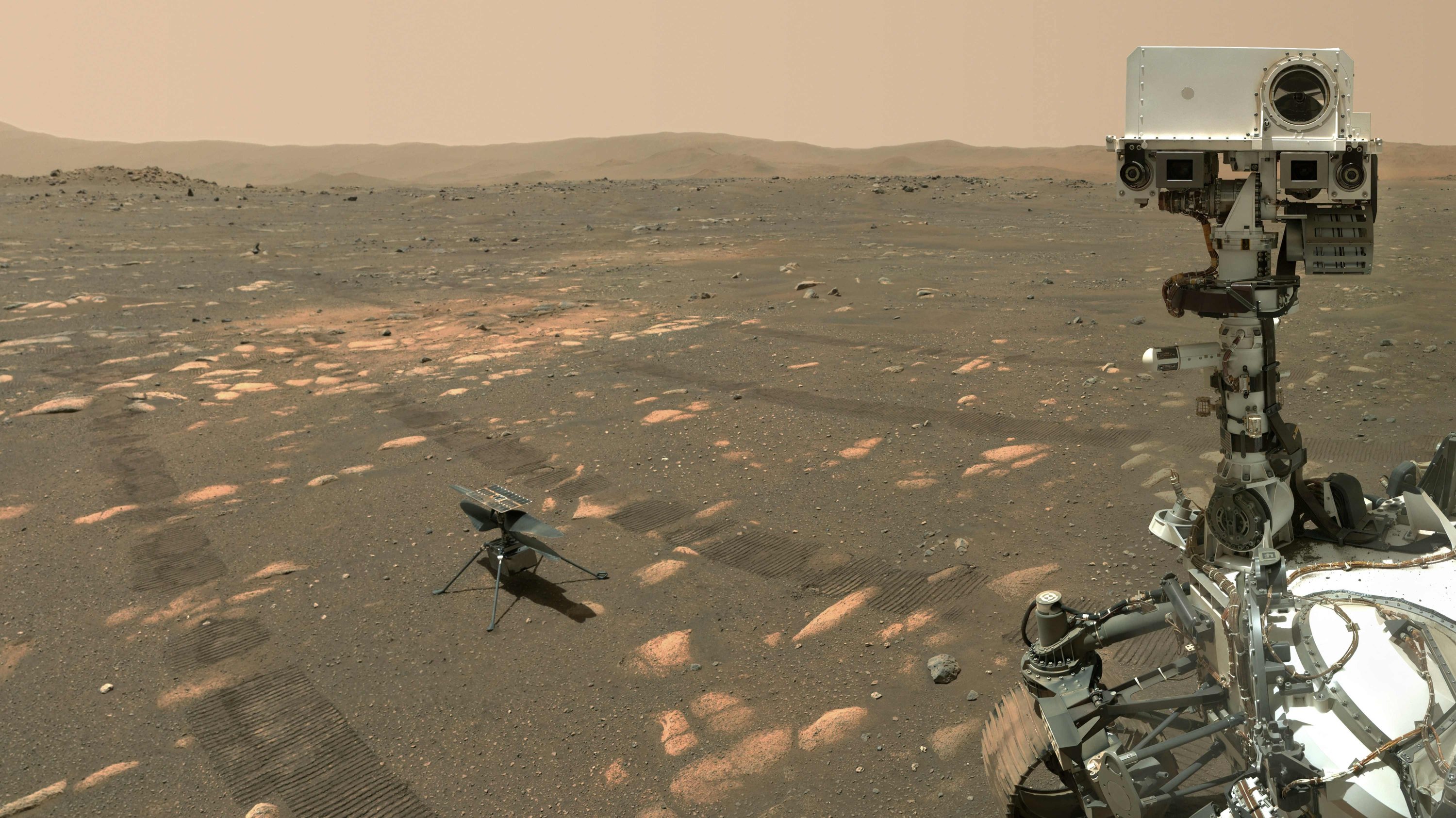
NASA’s Perseverance Mars rover using the WATSON camera mounted on its robot arm to take this “selfie” showing the rover’s camera mast looking at WATSON and the Ingenuity helicopter sitting on the surface of Mars after being dropped there by the rover. This image was r=taken on the 46th sol of the mission (April 6th, 2021). Credit: NASA/JPL/ASU/MSSS

1,000 Martian sols ago, two further ambassadors from Earth arrived on the Red Planet, winched safely down onto the floor of Jezero Crater by a hovering “skycrane”. Since then, both have performed their work near-flawlessly over a period of almost 3 terrestrial years – one doing do for far, far longer than its designers and operators had ever hoped. They are, of course, the Mars 2020 mission rover Perseverance and its companion “Mars Helicopter” Ingenuity.

The mission actually arrived on Mars on February 18th 2021, but the passing of 1,000 sols (as the local Martian day is called) is an excellent opportunity to review the Mars 2020 mission as a whole, and look to the future.

Ingenuity had a planned mission duration of 90 terrestrial days during which it was expected to be able to make up to five flights; no-one really knew how well the craft’s batteries, electronics and mechanical systems would stand up to the hostile conditions on Mars once operations got underway. But as of December 2nd, 2023, the 1.8 kg drone has complete 64 flight and clocked up just over 2 hours of airborne time. In doing so, it has proven that entirely automated flight on other planets without direct human control is possible, and that a small, camera-equipped aerial vehicle can work in tandem with ground units to help reconnoitre potential routes of exploration and identify potential points of scientific interest.

Perseverance, meanwhile, has spent the intervening time studying an ancient river delta within the crater, believed to have formed as water poured down from the plains above early in Mars’ history, depositing clays and other minerals as they gradually flowed outwards and eventually gave rise to a lake within Jezero. The primary mission for the rover has thus far been to explore the delta and seek both evidence of past habitability and search for actual biosignatures indicative of past life. In doing so, Perseverance has gathered 23 air and soil samples, some of which may be returned to Earth in a future (if controversial, in terms of NASA funding) sample-return mission.
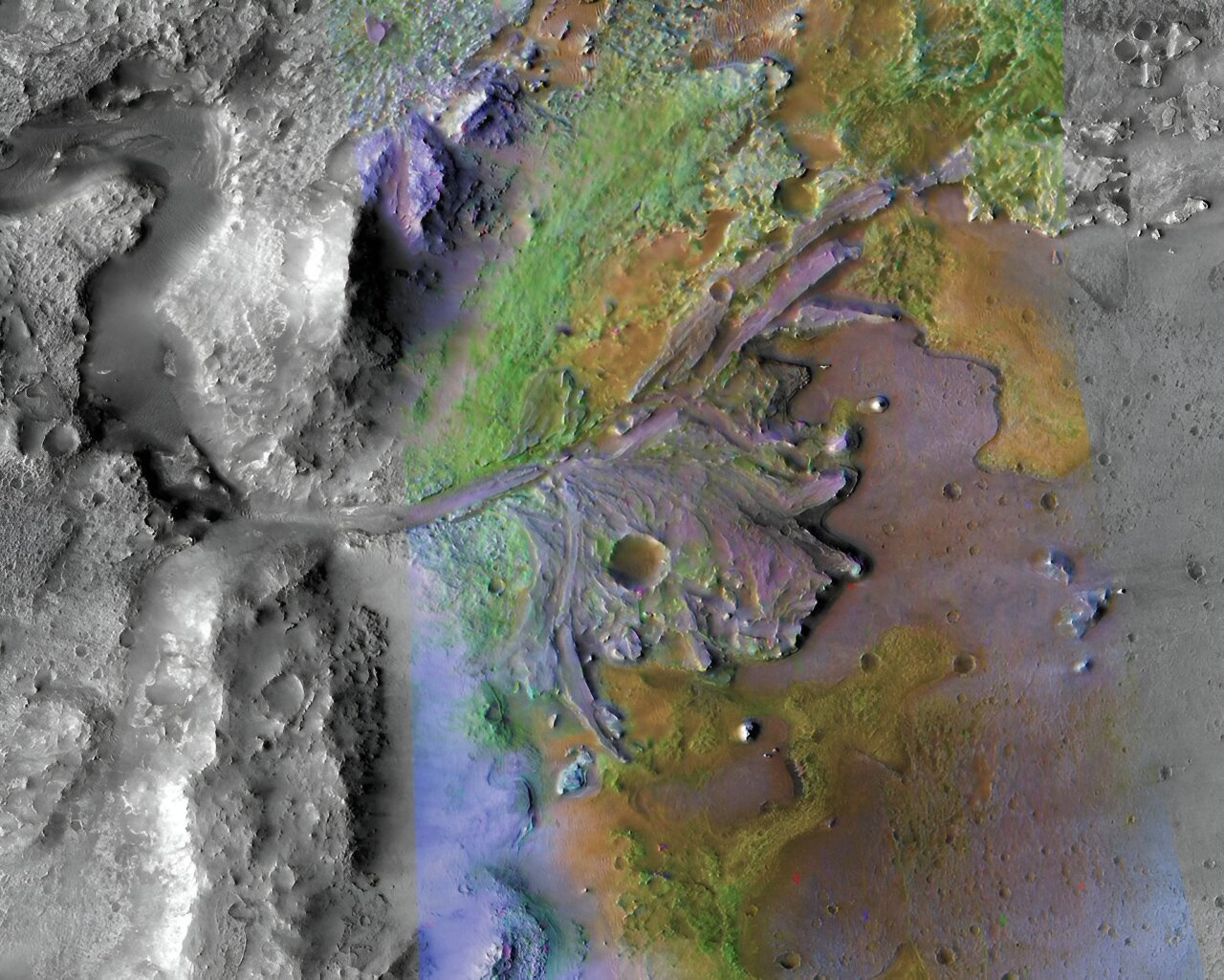
In this false-colour image of Jezero Crater, the river that once broached the crater walls and carried water into its basin to form a shallow lake can be seen on the left, with the river’s delta clearly visible on the crater floor. The colours are intended to highlight different mineral deposits within the delta, with green representing the widespread carbonates. Most recently, Perseverance has been exploring the green-tinted area above the main river channel. Credit: NASA/JPL/ASU/MSSS

The data gathered by the rover confirms that Jezero Crater – originally formed some 4 billion years ago via an asteroid impact – was subject to multiple periods of flooding which took place over an extended period commencing several hundred million years after the crater was formed. These periods of flooding initially gave rise to the deposition of sandstone and mudstone in the crater, suggesting a modest lake was created. Later, this lake underwent a more sustained period of cyclic flooding and evaporation, giving rise to the deposition of salt-rich mudstones as the waters expanded and contracted.

At its peak, it is believed the lake was perhaps 35 kilometres in diameter and 30 metres deep. Later, as Mars’ climate became more erratic, the crater was subjected to sudden, violent bursts of flooding from above, with large rocks and boulders from outside of the crater being deposited within it by repeated flash floods before the lake – and all surface water on Mars – slowly vanished, being lost to space through evaporation as the atmosphere was lost, or ras a result of it retreating underground, where it froze.

Of the samples gathered and studies by the rover’s on-board science lab, many carried tantalising markers which might be associated with the formation of basic forms of life. These include carbonates, minerals that form in watery environments often favourable to the development of organic molecules (although the molecules themselves could be the result of either organic or inorganic reactions within the water). The rover has also found quantities of fine-grained silica and deposits of phosphate, both of which have been rich in carbonates, and which are respectively known to both preserve fossilised microbes and help microbes kick-start their life processes here on Earth – although evidence of them doing the same on Mars remains elusive.  Some of the carbonate-carrying phosphates have been found to contain iron, something again associated with life here on Earth.

December 2023 is a key month for Perseverance, as it brings to a close the rover’s fourth science campaign within Jezero Crater and the start of a new endeavour. Commencing in 2024, Perseverance will follow the course of the river bed back towards the crater wall – a distance of around 4 km – to where mission personnel believe they have located an “easy” climb up the crater walls and which intersects the river’s channel at its lower end.
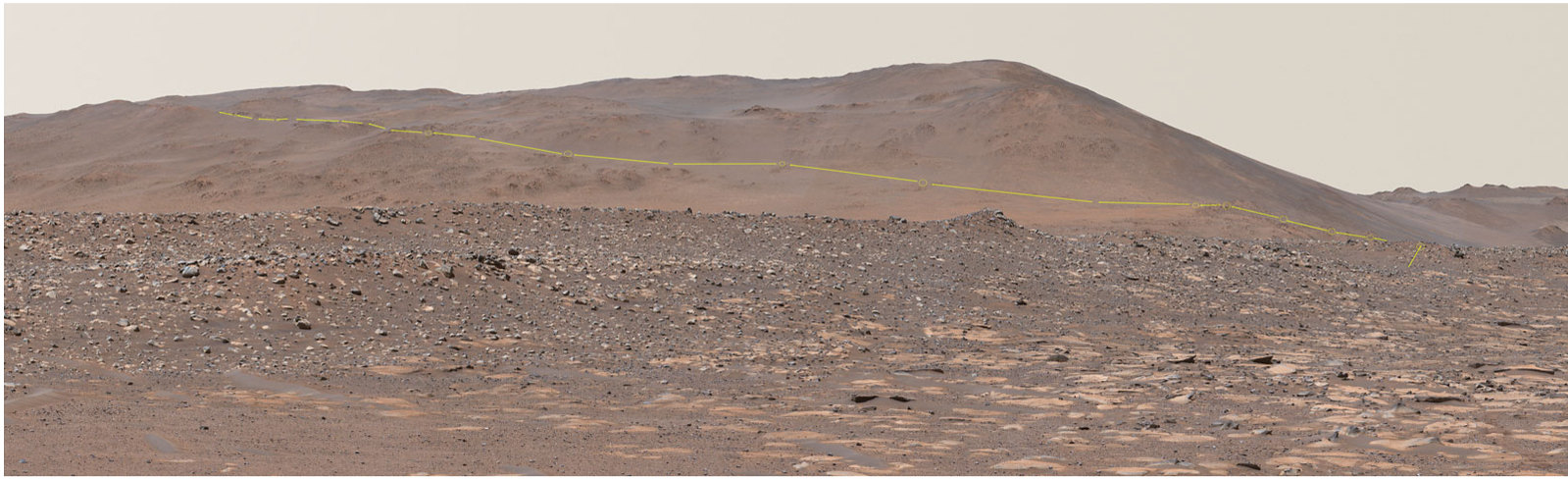
This image of Jezero Crater, captured by NASA’s Perseverance rover, shows the potential route (yellow line) that the robot may take to the crater’s rim. Credit: NASA/JPL/ASU/MSSS

Climbing the crater up to the plains above will expose Perseverance’s science instruments to bedrock and material even older then the outflow plain it has thus far studied, allowing it to reach back to the time the crater was formed. Along the way it will be able to both study the changing rocks and any atmospheric changes as it climbs upwards. As well as analysing the rock samples it gathers, the rover will also store some in the remaining 13 sample tubes contained in its belly, allowing them to be cached together with some of the remaining tubes of material gathered from the crater floor so that an alternate collection of samples can await the arrival of the still-to-be-fully-defined sample return mission, should landing within Jezero itself prove too difficult for the proposed lander part of the mission, and the samples cached there are abandoned.

 Video Promotes Rosalind Franklin

If fortune favours the unfortunate, the next rover to trundle across the surface of Mars will be Europe’s long-awaited Rosalind Franklin. Originally called the ExoMars rover, this vehicle has suffered a number of setbacks during its 20 years in development and pre-flight hell. However, (and touching large amounts of wood, given I have something of a loose association with the mission), things are currently on course for an October 2028 launch, that the European Space Agency felt confident enough to release a new promotional video showcasing the mission.

Some 60% heavier and slightly larger than NASA’s Mars Exploration Rovers Opportunity and Spirit, the European rover is, like them, solar-powered. It also shares a similar mission arc as both of the MER rovers and the nuclear-powered Curiosity and Perseverance: to locate evidence for water on Mars and seek out evidence for past signs of life. However, in one respect its mission does differ, as Rosalind Franklin will also focus seeking evidence for current microbial life on Mars.

To assist with the latter, the rover will be equipped with a drilling mechanism capable of reaching up to two metres beneath the planet’s surface – far beyond depths so far plumbed in the search for evidence of Martian microbial life – with the samples gathered then put through extensive study and analysis by the rover’s multiple science systems.

The landing site for the mission is Oxia Planum, a region located between two outflow channel systems: Mawrth Vallis to the northeast and Ares Vallis to the southwest. Scientists believe this region will contain remnants of the planet’s wetter past, increasing the potential for finding evidence for past or even current microbial life on the planet. Once there – the flight to Mars will take almost exactly 2 years, courtesy of the capabilities of its launch vehicle – Rosalind Franklin will travel up to 70 metres a day when on the move, with an overall primary mission expected to last some 7 months.

Voyager 1 Hits Problems

Humanity’s first interstellar ambassador, Voyager 1, is now just over 47 years into its voyage and more than 162 AU (or 24 billion kilometres) from Earth – and like all of us as we grow older, it is increasingly showing signs of its age. Already, the more energy-intensive science instruments on the lonely spacecraft have been shut down, and engineers have had to repeatedly work their way gingerly around assorted problems the craft has encountered; such is the distance separating vehicle and home planet that even the tiniest errors risks breaking all communications.

An artist’s impression of a voyager probe in deep space. Credit: NASA

Most recently, Voyager 1 has started having issues with two key systems: the Flight Data System (FDS) and the Telemetry Modulation Unit (TMU). The latter is responsible for transmitting to Earth data on the spacecraft’s condition, orientation, etc., together with information from its operational science instruments, and receiving and managing communications from Earth. The data it sends is gathered by the three computers of the FDS, which combine everything obtained from the other instruments and sub-systems into a single package for the TMU to send. Except recently, all the TMU has been sending is a repeating pattern of meaningless binary, although it has continued to act on messages from Earth.

It had been thought the problem lies with the TMU itself, but after careful and painfully slow diagnoses (round-trip communications between Voyager 1 and Earth are on the order of 45 hours); the problem was found to be within the FDS. Over the weekend of December 9th/10th, mission engineers ordered the FDS to perform a sequential restart, which it was hoped would kick-start the system into once again passing meaningful data to the TMU. It didn’t.
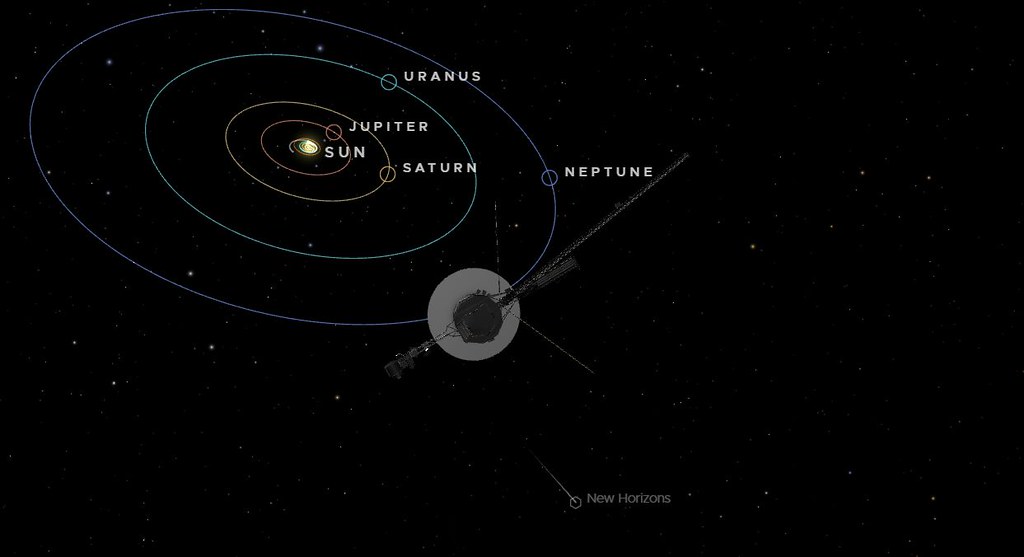
Created using NASA’s Eyes on the Solar System, this image shows what it might be like to look back at our solar system from 162 AU

So currently, Voyager 1 remains capable of receiving commands from Earth, but it cannot provide any understandable feedback on whether anything succeeded, or what systems are trying to report back through the FDS. As such, the Voyager mission team have indicated it will take several weeks to formulate a new plan of action in order to try to resolve the problem.

Spaceplanes, Spaceplanes

Both the United States and China were due to launch their highly secretive, automated “spaceplanes” this past week – although as it turned out, only one of them actually did so.

The United States X-37B programme had been due to commence its seventh mission – and the fourth flight of the 2nd of the two X-37B craft the US Space Force and US Air Force jointly operate – on December 14th. It was to be the first flight of the craft atop a SpaceX Falcon Heavy, seen as offering the craft the ability to fly missions at much higher orbits than can be achieved using its over launch vehicles – the ULA Atlas V 501and the Falcon 9 Block 4 -, potentially allowing for more flexible and even longer-duration on-orbit operations.
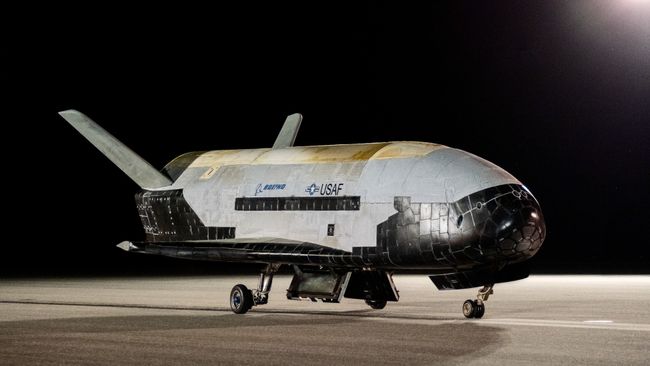
The USSF / USAF X-37B (vehicle 1), shortly after its return to Earth on November 22nd, 2022, following a 908-day orbital mission. Credit: US DoD

The cause of the delay has not been stated, but appears to have been called by SpaceX rather than the US DoD, and following the postponement, the Falcon Heavy was removed from Pad 39A at Kennedy Space Centre. At the time of writing, no revised launch target has been announced.

China, however, so no such delays in the third flight of its Shenlong “Divine Dragon” spaceplane, which lifted-off from the Jiuquan Satellite Launch Centre on December 14th, as planned, using a Long March 2F booster.

Little is actually known about the Chinese vehicle – although there is an emerging consensus that it is potentially similar in overall size and form to the US X-37B. The craft first flew the craft in September 2020 and then was launched a second time in August 2022 – this mission lasting for 276 days, which is still a small fraction of the time the US craft tends to spend in orbit (908 days on its last mission). That said, the second Shenlong mission did cause surprise and concern in the west when it apparently launch / placed / jettisoned something into space  – China has remained tight-lipped as to what it was.
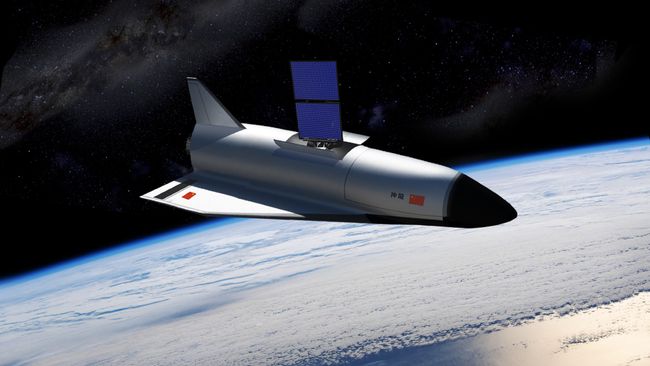
An artist’s rendering of what the Chinese automated space plane might look like. Credit: Erik Simonsen / Getty

No information on the flight or its potential duration has been given by the Chinese authorities, with the official statement post-launch something of a laconic repetition of the announcements which followed the first two flights of the vehicle.

The test spacecraft will be in orbit for a period of time before returning to the domestic scheduled landing site. During this period, it will carry out reusable technology verification as planned to provide technical support for the peaceful use of space.

– Official and bland Chinese statement following the latest Shenlong launch

That both vehicles were originally intended to launch so close together is not a coincidence. The USSC/USAF has been very open in its desire to learn more about the Chinese vehicle’s purpose and capabilities – and the China probably likewise want to know more about the American vehicle. Thus, having them in space at the same time allows the two nations to observe one another’s craft via Earth-based means and – perhaps – mimic the manoeuvrings of one another’s vehicles.

NANA Land’s many faces in Second Life

NANA Land, December 2023 – click any image for full size

Occupying a Full private region leveraging the land capacity bonus available to such regions, NANA Land is the work of Frie Frie (Freecheck) and Nika Snowpaw. The About Land description describes the region as a romantic setting offering the opportunity for meeting friends, exploring, dancing, photography and shopping; whilst this is largely accurate, it also understates all that NASA Land has to offer.

At ground level, where the landing point is to be found, sits a rugged island into which water has cut it way, either inland from the surrounding seas or outwards from the falls and streams which drop or flow from the highlands which make up a part of the island’s sub-tropical form. Flat-topped, these highlands form a pair of broad plateaux, the larger of which is home to the region’s main landing point. This sits within and open-air  café with tables sitting amidst a little sea of grass and flowers which are themselves constrained (for the most part) from flowing down over the cliffs in mimicry of the local waterfalls, by the presence of fences and shrubs.

NANA Land, December 2023

A slender finger of rock extends out from one side of this plateau to point north and form one half of an arc of rock which cups a beach of golden sand within it steep-sided arms. The remaining half of this curve of rock is formed by the side of the second plateau. This is not quite as tall as the first, but is as equally flat-topped at its far end, allowing it to play host to an architecturally impressive, green-topped building offering views out over the sea on three sides.

Whilst they are connected by a knobbly, forested wrist of rock, the easiest means by which to pass from one plateau to the other is via a long rope bridge paralleling the cliffs as they march along the back of beach below. The café end of this bridge lay close to the one path leading down from the landing point. The latter turns by way mossy paths and wooden walkways to meander down from the café and along one side of a large pool of water fed from falls which also tumble from the rocks above, to reach a humpbacked bridge which allows the route to pass over a narrowed neck of the pool.

NANA Land, December 2023

From here lay various paths of exploration passing around and through the island. These form tracks and trails of various kinds, winding their way under trees and rocky archways or over bridges and stone slabs are they cross streams and channels flowing through or cutting into the island’s lower reaches. to reaches various points of interest.

The latter range from the aforementioned beach, through a swampy bay to beach houses, cottages and huts which squat within the swamp, cling the the region’s costal areas or sit serenely in fenced grounds on hilltops. There’s also an open-air cinema (where a horse might be taken by those wishing to ride around the island rather than walk), a cave system cutting through the jumble of rock linking the two plateaux, multiple places to sit and spend time, dance machines, camp sites – and a lot more, all of which I will leave to you to discover and enjoy.

NANA Land, December 2023

Also to be found scattered throughout the region are teleport points. These are generally in the form of standing stones holding living flames within them, although their look can change depending on where you are within the region (as is the case with the wishing well and cat teleport at the landing point). Theses are all networked, providing a quick means to jump between them and to areas of the region which cannot be reached directly on foot.

The latter take the form of a set of sky platforms, three of which  – at the time of my visit, at least – offer settings appropriate for the season. They are “Christmas”, “Winter” and “Winter Shop”. Both “Christmas” and “Winter” sit on that same sky platform, so presenting a contiguous landscape visitors can explore and which encompasses cottages blanketed by snow and with cosy, warm interiors, and a Christmas setting complete with two musical Santas, places to sit and even a miniature golf area with tiny winter themes.

NANA Land, December 2023

The remaining winter setting is where visitors might find gifts left for them by Nika and Frie, and wander through another snowy landscape. A separate teleport from here provides access to gallery spaces and a little autumnal setting, whilst a further destination on the main teleport network directs visitors to the the rentals platform. Here, sitting with a very tropical setting, might be found beach houses of various sizes, some of which may be available for rent – just be aware that others may well be rented and thus off-limits to the meanderings of visitors.

There are a couple of rough patches awaiting visitors when exploring the ground-level islands, where physics need a little adjustment to present colliding with plants whilst trying to cross bridges or follow trails down into caves, but with a little careful navigation these can be bypassed. Outside of these, NANA Land offers a lot to see and appreciate, the use of sky platforms adding to the richness of exploration.

NANA Land, December 2023

SLurl Details

Traci’s Fragments (of Life?) In Second Life

Traci Ultsch – Fragments – December 2023

Fragments, the latest collection of digital art by Traci Ultsch now on display (into the early New Year, I believe) at Inspire Space Park / Art Planet, is a slightly unusual exhibition. Not because it is out-of-the-ordinary when placed alongside Traci’s overall portfolio – far from it; Fragments is as visually layered and abstracted as much of Traci’s other work. No, what makes it unusual – or perhaps curious might be a better term – is that it has not one, but three introductions, allowing visitors to take their pick as to which they find resonates the most.

Two of the three might be taken as reflections on life – or more particularly, how life is not something we can plan or necessarily control; at least, not beyond the most basic needs and routines. Rather, when all is said and done, it is really a fragmentary passage of time and events; actions and reactions within the greater planning which can so often become confused and oddly juxtaposed one to the next as we look back and try to recall  cause and effect.

Traci Ultsch – Fragments – December 2023

Thus, within this exhibition – which must be viewed with Advanced Lighting Model (ALM) enabled via Preferences → Graphics for those using a non-PBR enabled viewer, Traci offers a series of panoramic (in terms of their image ratio) pictures, each one carrying within it the sense of a theme – buildings, nature, walls, plants. However, each image is fragmented into a series of elements, often presenting a different view of the same central object, each element within the complete picture carrying a beat of not-quite repetition which is almost musical in form.

Words flow through each image collage, words which Traci declares them as extracted lines from songs; however, they have about them a similar beat, one suggestive of thoughts of the past and half-reminded reflections, so matching the manner in which the images suggest juxtaposed remembrances a a half-forgotten memory. Also present within each canvas are what might been seen as reflections of other images, small and distant – or might they be reflections of the same image?  – further enhancing the idea of fragmented memories (or desires, perhaps?), confused and overlaying one another.

Traci Ultsch – Fragments – December 2023

So it is that -perhaps –  within these images we might see personified the idea that far from being a cohesive set of steps, life really is a string of interconnected events of happenstance; some of which might well appear to be repeated (and thus give rise to our desire to understand there is a purpose to it all), when in truth there is nothing of the kind; no preordination; just random collisions of planned and unplanned events which push us onwards whilst leaving us to look back and reflect and try to make sense of it all.Or, perhaps as Traci disarmingly suggests in her third introduction to Fragments, these are images reflective of a random desire to create, trapped between hangovers and called into being by a lucid turn behind the camera lens and when hand and eye work in unison to tweak pixels on a screen. But even if the latter is true (which I somehow doubt); does this actually negate the underpinning theme offered through the first two introductions?

SLurl Details

Firestorm 6.6.17: Getting back on track

On Wednesday, December 13th, 2023 (SLT), the Firestorm team released version 6.6.17.70368 of their viewer.

It should be noted that this is not a new release of the viewer, but rather a hotfix for issues found with the client-side animation overrider which caused the withdrawal of the Firestorm 6.6.16 release (November 29th) – see here for more. In addition, the release includes a number of additional updates and fixes.

Table of Contents

Given this, the following is not a complete review of the 6.6.17 update, but focuses on the changes within it which were not a part of 6.6.16, together with the important lead-in notes – for a complete list of major and minor updates and credits for those responsible, please refer to the Firestorm 6.6.17 release notes.

Therefore, if you did not update to Firestorm 6.6.16, please release to my overview of that release as well as reading the notes below.

General Notes

Installation

  • Only download Firestorm from the Firestorm website. Do not utilise and other third-party site purporting to offer the Firestorm viewer, and remember Firestorm will never ask for log-in credentials in order to download a release version of their viewer.
  • There is no need to perform a clean install with this release if you do not wish to.
  • Do, however, make sure you back-up all your settings safely so you can restore them after installing 6.6.17.

Version Blocking

As per the Firestorm’s teams standard practice of only supporting 3 active versions of the viewer at any time, note that version 6.6.3 will be blocked from accessing Second Life three weeks from the date of version 6.6.17’s release, as will version 6.6.16.

Important Additional Notes

End of 32-Bit Windows Support
  • Linden Lab has recently moved their automated viewer build process to Github Actions (GHA) – see here for more. This will allow Firestorm to produce more timely updates, more in line with LL’s major updates.
  • However, as the Lab’s new build process does not include the third-party libraries required to build a 32-bit Windows version of the viewer, and Firestorm is not in a position to continue to directly maintain those libraries, Firestorm 6.6.17 will be the last version of Firestorm to provide a 32-bit Windows version.
PBR Materials Support
A Note on Inventory Updates
  • Both Firestorm 6.6.16 and Firestorm 6.6.17 include numerous Inventory updates. some of these see changes in inventory service communications with the viewer, designed to correct a long-standing bug wherein some deleted items became orphaned from the inventory folders and thus invisible.
  • However, with the fix these “orphaned” items may now be randomly restored to your Lost and Found folder – which may require checking and clearing as a result.
  • This issue is waiting a fix from Linden Lab – see BUG-234508.

Core Updates in Firestorm 6.6.17

Animation Overrider

Following the release of Firestorm 6.6.16, it was found that the viewer’s client-side Animation Overrider was suffering issues which were affecting a large numbers of users, prompting that version to be withdrawn. Specific fixes to address these problems in this release are:

  • FIRE-33414 – “Built-in AO destroyed after installing the Firestorm 6.6.16 (70339) Nov 23 2023 19:40:32 (64bit / SSE2)”.
  • FIRE-33300 – “FS AO doesn’t load animations on login”.

Inventory

  • FIRE-33322 – “Inventory window randomly jumps to the top”.
  • FIRE-33337 – “[BUG-234770] [SL-20682] Misbehaving Folders – can’t rename.
  • Inventory Preview Images:
    • Inventory Thumbnail Images should not be displayed uniformly.
    • An option has been added to disable inventory thumbnail preview images (see: FIRE-33356).
    • A further option has been added to control the delay before showing the inventory thumbnail preview images (see: FIRE-33285).
New Preferences option for Inventory Preview Images
  • The issue of Inventory folder names failing to correct update after a rename should now be fixed (see: FIRE-33337 “[BUG-234770] [SL-20682] Misbehaving Folders – can’t rename”.
  • The issue of tooltips always showing in inventory even though not needed, has been addressed. They should now only show for inventory items with a thumbnail or if it exceeds the width of the window.

Log-in Hang Fix

Firestorm could hang at log-in. The issue was triggered by having the statistics window open from a previous session, causing a cascade of problems, resulting in the viewer hanging.

Sakura Cranes in Second Life

Sakura Cranes, December 2023 – click any image for full size

Occupying just under an eighth of a full region (which itself leverages the additional land capacity bonus available to private regions) sits Sakura Cranes, as attractive, Japanese / oriental themed setting created by Brian Ravenhurst, and which I recently visited by way of the Second Life Destination Guide. It is actually one of three parcels within the region Brian has designed, but will be the focus of this article – the other two can be reached via the raised walkway which wends its way through a part of Sakura Cranes.

The setting has – according to its About Land description – been inspired by the Takedera Temple, which I believe is a reference / alternate name for the Hôkoku-ji Temple (although the date given in the About Land description differs to that for Hôkoku-ji) – and additionally known as the Bamboo Temple, on account of its position deep within a bamboo garden. Like Hôkoku-ji, Sakura Cranes has its own bamboo feature – a curtain of tall trees which act as a curtain of green running west-to-east between the rocks and walls forming the north-south borders of the parcel.

Sakura Cranes, December 2023

South of this curtain and sitting high on the cliffs, sits an ancient pavilion guarded by two kitsune foxes as steps climb gracefully down along the instep of the long foot of rock extending northwards from the pavilion’s perch. Torii gates mark the stairway as reaches a raised wooden walkway set over mist-shrouded ground, the mist broken in several places by fingers of rock pointing to the sky. The bell towers of a shine sit either side of the walkway as it reaches another pavilion, this one set between the arms of the bamboo curtain, offering a view over a large body of water fed by dragon fountains and partially shaded by Sakura blossoms.

A second walkway winds through the bamboo trees, this one splitting so that one arm forms the connection to the neighbouring parcels, and the other to span – by way of a slightly off-centre bridge – the water and descend to the lowlands bordering the water on the far side. This northern half of the region presents a rich, calming garden. Gravel and cobble paths wind their way over the grass and down over the rocks and under the boughs of bamboo, Sakura and other trees as then pass between an assortment of buildings.

Sakura Cranes, December 2023

The garden is reached by another walkway and wooden steps descending from the bridge, a pair of open gates to one side provide access to a small market area, a further gateway providing the means to loop back along the path paralleling the fountain-fed waters, passing under the bridge as it does so.  At the far end of the this path is a shaded place in which to spend time, whilst mid-way along the path stepping-stones pass over the water to reach another place to pass the time playing a Chinese gu zheng within an open-sided pagoda rising from the rippling waters.

Mirroring the stepping stones crossing the water is a second set, these passing over the grass of the gardens to reach a teahouse where another gu zheng sits, together with the opportunity to enjoy some tea and appreciate the artist’s studio on the upper floor.

Sakura Cranes, December 2023

The tea-house is one of four structures within the low gardens, excluding the little market. Of the remaining three, one is a small shrine sitting next to the teahouse, around which a gravel path loops on its way north. The remaining two, located at the northern extreme of the setting and separated by another curtain of bamboo and a further body of water, are two rental homes. Both were available at the time of my visit, but this might not always be the case, so do please be careful about trespassing on people’s privacy. The waters between these two houses forms a home for a small boat, open to the public and offering another place to pass the time – possibly in contemplation of Buddha as he watches over the water.

Sakura Cranes, December 2023

With lanterns together with kites floating overhead, Japanese cranes dancing and nesting in or near the waters, and with enough paths winding through the landscape, Sakura Cranes offers a lot to appreciate within its comfortable, small space – and does so without ever feeling overcrowded for its size or in any way enclosed. In other words, it makes for a perfect and relaxing visit.

Recommended!

Sakura Cranes, December 2023

SLurl Details

Second Life Mobile App enters “private” Alpha testing for Premium Plus users

SL Mobile, December 2023 – screen cap via Linden Lab

Update, December 13th: – the Lab now has an official blog post on the Alpha.

Linden Lab have announced – by way of a You Tube video (at the time of writing, I’ve not seen any official blog or forum post commentary  to accompany it) – the launch of a Second Life Mobile “Private Alpha” allowing Premium Plus subscribers to sign-up for the opportunity to take the app for a test drive and provide feedback to help with development.

Narrated by – I believe – user Boston Blaisdale, the short video (just over a minute in length) introduces the features and capabilities those accepted into the alpha will be able to try. These include:

  • See your avatar & edit appearance / change outfits.
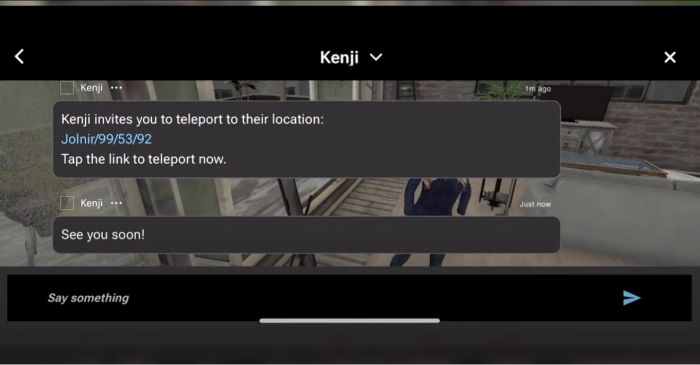
  • Explore the world via the Destination Guide, mobile showcase, teleport, deep links, TP offers.
  • Interact with the world through a limited set of movements (walk, run, fly, sit, stand) and object interactions (touch, sit) – or park your avatar and explore via flycam.
  • Socialise and stay connected (nearby chat, group chat, IM, group notices, find contacts, inspect profiles).
  • Create and log in with a new account.

The app is currently available on the following platforms:

  •  iOS (minimum: iPhone X running iOS 16.6.1).
  • Android: mid-to-high-end Android device (comparable to Google Pixel 6 or higher) running Android OS 13 or higher.

Those participating on iOS will also require the TestFlight app for testing and feedback, whilst Android users will need to provide feedback through Google Play.

Premium Plus subscribers can find out more by following this Support Page link and (I believe) submitting a support ticket. There is also a link on this page to a FAQ  on the Mobile app. It is not clear if this testing is subject to any form of NDA.

SL Mobile, December 2023 – screen cap via Linden Lab

Commenting on more general availability for the app, Linden Lab state:

It’s still early days for our mobile app. Our mobile team has been hard at work building a mobile-centred design and foundational features so that we can all enjoy Second Life anywhere we want. We’re ready to share what we’ve built so far with our most dedicated residents and we ask for your help as we continue to develop this project through this early Alpha stage, but we do not have a date for the next phase of testing or full release at this time.

Using Premium Plus members for initial feedback is an interesting choice. On the one hand, it would appear to greatly limit the potential resource pool of people willing to work on the app and give objective feedback; on the other it does allow Linden Lab to manage the size of the pool of likely applications at this point in time. Whilst some might feel snubbed at the restrictive nature of this initial Alpha, it is probably worthwhile noting that the SL Mobile app has already had input from users and will continue to do so; so will hopefully include more broad-based Alpha and Beta testing using an expanded pool of users in 2024, as LL continue to develop the app.

In the meantime, here’s the video.