Logos representative only and should not be seen as an endorsement / preference / recommendation
Updates from the week through to Sunday, October 15th, 2023
This summary is generally published every Monday, and is a list of SL viewer / client releases (official and TPV) made during the previous week. When reading it, please note:
It is based on my Current Viewer Releases Page, a list of all Second Life viewers and clients that are in popular use (and of which I am aware), and which are recognised as adhering to the TPV Policy. This page includes comprehensive links to download pages, blog notes, release notes, etc., as well as links to any / all reviews of specific viewers / clients made within this blog.
By its nature, this summary presented here will always be in arrears, please refer to the Current Viewer Release Page for more up-to-date information.
Note that for purposes of length, TPV test viewers, preview / beta viewers / nightly builds are generally not recorded in these summaries.
Official LL Viewers
Release viewer, version 6.6.15.581961 (formerly the Inventory Extensions Viewer), promoted October 2 – No Change.
Release channel cohorts:
glTF / PBR Materials viewer updated to version 7.0.0.581886 on October 12.
Maintenance V RC viewer, version 6.6.16.582075, October 5.
Moochie All Hallows, October 2023 – click any image for full size
If you are looking for a low-key, engaging setting for Halloween, a place where you can share spooky stories, explore, take photos, have a dance with someone close to you or just sit before a blazing log fire and relax without being overloaded by spooks, goblins, ghost, monsters and scary noises and the other accoutrements often poured into Halloween-themed settings, then you could do no better than to visit Maia Macabre’s Moochie All Hallows 2023.
Through the witching season, visit All Hallows for haunted meanderings, autumnal hoodoo, darkly roaming, and Halloween encapsulated. Be strange, but don’t be a stranger…
– From the Moochie All Hallows introduction
Moochie All Hallows, October 2023
Now in its eighth year, Moochie All Hallows retains the familiar central clearing and focal point for Maia’s seasonal designs, ready for dancing and surrounded by various little vignettes (one of which appears to be an invitation to dance at the end of a rope after a spot of bobbing for apples, just to keep up with the more macabre feel of the season!). It sits under a dark night’s sky (be sure to Use Shared Environment (World → Environment) which is also suitably atmospheric, while the ring of paths and trails winding outwards from the clearing. Some of these paths might only lead a short distance while others might wind onwards under the trees, occasionally branching to offer various routes of exploration, all of them beckon explorers to follow them.
One of these paths actually descends into the clearing, sloping gently down as it does from the Landing Point. The latter is located alongside familiar railcars, where might also be found notes on how best to appreciate the setting, a couple’s HUD rezzer for those wishing to walk together whilst exploring, and a HUD book outlining some of the history of some of the traditions associated with Halloween. Whilst predominantly focused on those traditions for the season hailing from Ireland (I’d have liked to have seen some inclusion the Scottish form of guising, given it has something of a direct line to modern trick-or-treating), the book makes for a good read and offers a solid introduction to the Gaelic festival of Samhain, which very much encompasses activities (mumming, guising, the use of bonfires, etc.), carried down into modern populist forms of celebrating Halloween and the season it represents.
Moochie All Hallows, October 2023
Walking the various paths spreading outwards will bring visitors to the likes of storytelling circles deep in the woods, seating arranged around a warm fire just awaiting a storyteller or two and an audience, or to ruins and a chapel, the inevitable pumpkin patch (this one nicely laid out as a means of bordering a meandering path, rather than the perhaps more familiar fenced-in square or rectangular patch), a romantic wishing well (the smoochie Moochie well? 🙂 ), and more.
Follow some of the paths far enough and you’ll come to boardwalks running alongside the waters surrounding the region, or reaching out to decks sitting over the the dark waters. These offer a mix of places to sit, treats to enjoy and even a game or two to play. Tents, either on the boardwalks or under the eves of the trees, offer further snuggle-points for couples and / or places to sit and tell stories or simply think and pass the time.
Moochie All Hallows, October 2023
A nice touch throughout is that just about everything has been set to Phantom (outside of things like the boardwalks). This means that when trying to navigate paths marked by pumpkins, torches, chairs, and so on, you are not constantly bombarded with the annoying thunk-thunk-thunk of object collisions; thus, the local ambient sounds can be appreciated without distraction. Add to this the use of burning torches, pumpkin lanterns and strings of lights hanging from tree boughs, and the setting is provided with enough suitable illumination so that navigation is easy without the lighting spoiling the sense of night-time mystery.
Maia is rightly well-know for her seasonal settings at Moochie and I’ve frequently enjoy visiting the region in its winter guises. However, this my first time there with Moochie dressed for Halloween, and as someone not particularly into all the modern (i.e. 20th century onwards) aspects of the season, I really appreciated exploring the very relaxed manner in which it captures the ideas and fun of Halloween without being in-you-face with heavy-handed references or getting bogged down in belabouring spookiness.
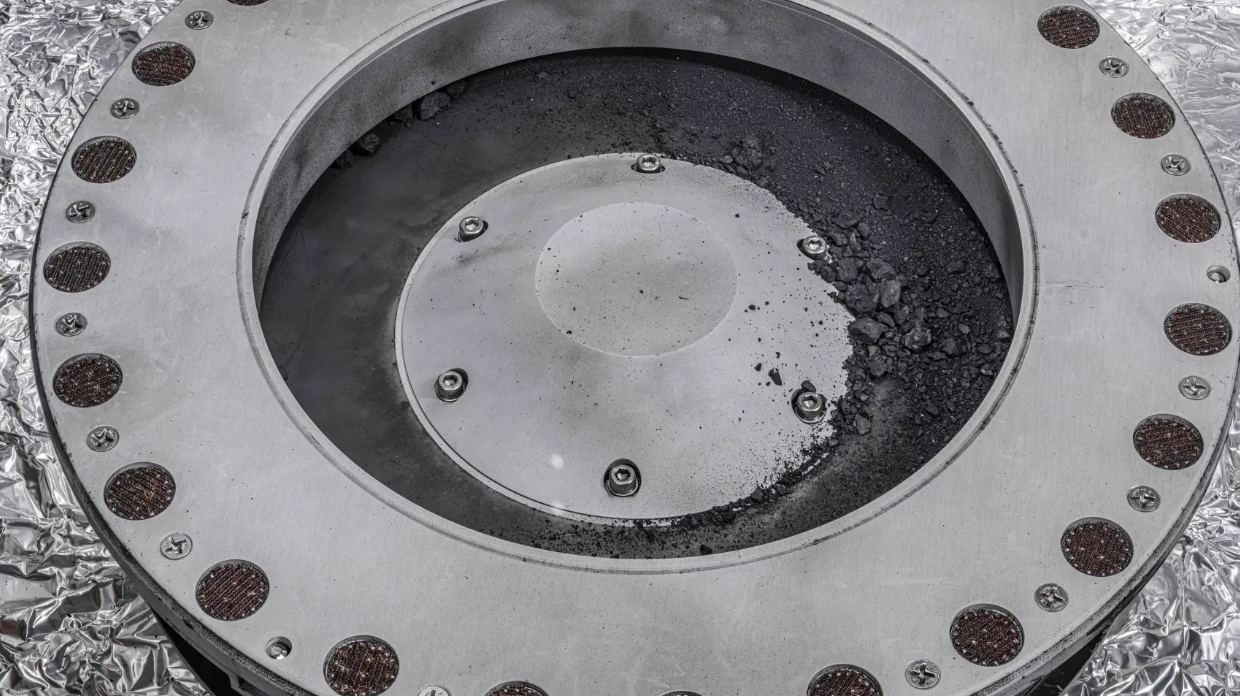
The outside of the sample container from OSIRIS-REx showing material from asteroid 101955 Bennu scattered outside of the container proper, testament to the amounts contained within. Credit: NASA / Erika Blumenfeld & Joseph Aebersold
On October 11th, 2023, NASA revealed details of their first look at samples returned from asteroid 101955 Bennu, returned to Earth on September 24th by the OSIRIS-REx mission.
As I reported in Space Sunday: the return of OSIRIS-REx, the sample return capsule carried with it up to 250 grams of material from the carbonaceous asteroid – a lot more than had been anticipated, thanks to Bennu proving to be so brittle the sample mechanism smashed through its outer surface, clogging itself with material, rather than lightly “tapping, grabbing and departing”.
The sample container now open (left), with more materials coating the inner surfaces (right). This material was used in the initial analysis of the sample. Credit: NASA
Following its recovery after landing in Utah, the capsule and containing the sample gathering head from the spacecraft was transferred to Johnson Space Centre and the Astromaterials Research and Exploration Science (ARES) centre (as I reported here), where for the last couple of weeks the sample container has been accessed and its contents subject to initial analysis.
It has still not been confirmed how much material has been obtained from Bennu; the opening of the sample canister revealed a fair amount of material was trapped between the lid of the canister and the membrane protecting the main bulk of the sample. This was painstakingly collected and formed the materials used for the initial analysis of the sample dust.
This initial analysis as revealed that – as expected, given it is a carbonaceous asteroid – the sample has within it evidence of both carbon and water, with the latter have a similar isotopic levels similar to those of Earth’s oceans. This was expected as it has long been the theory – supported by the examination of other asteroid samples returned to Earth by Japan’s Hayabusha and Hayabusha-2 missions – that C(arbonaceous)-type asteroids were responsible for bringing water and carbon to Earth early in its history.
Mari Montoya (left) and Curtis Calva at NASA’s Astromaterials Research and Exploration Science (ARES) centre carefully collect all the overspill from the OSIRIS-REx sample container, carefully clearing it all so it can be used in the initial analysis of the material returned from 101955 Bennu. Credit: NASA
Which is not to say that the samples do not offer a lot to learn; there is much that scientists do not know for certain about the Earth’s earliest history and its formation; much of what we do know is basis on hypotheses and scientific assumptions. The study of samples like those from Bennu samples could therefore allow many of those hypotheses to to more fully tested and the knowledge we lack or assume to be correct properly framed and understood.
Following extraction, the material from inside the sample container will be distributed to research centres in museums and universities around the world to enable a more extensive and as broad-ranging spectrum of independent analysis as possible over the coming months / years.
Psyche Launched
Following on from my previous Space Sunday article, and after being delayed almost 24 hours due to inclement weather, NASA’s mission to asteroid 16 Psyche got underway at 14:19 UTC on October 19th, 2023 when a Falcon Heavy lifted-off from Pad 39A at Kennedy Space Centre, Florida.
The SpaceX Falcon Heavy which launched the spacecraft Pysche at the start of its mission at Pad-39A, Kennedy Space Centre. Note the sooty exteriors of the side boosters, marking the fact both were about to make their fourth ascent each from a launch pad. Credit: NASA
After a flawless launch the rocket – comprising a core Falcon 9 booster with two additional first stages of the same rocket acting as strap-on boosters – rose into a cloudy sky over Florida. Just over two minutes into the flight, the side boosters separated to complete a “burn back” manoeuvre allowing them to return to Florida to land at Cape Canaveral Space Force Base adjacent to Kennedy Space Centre a few seconds apart, the landings marking the 4th successful flight for both units.
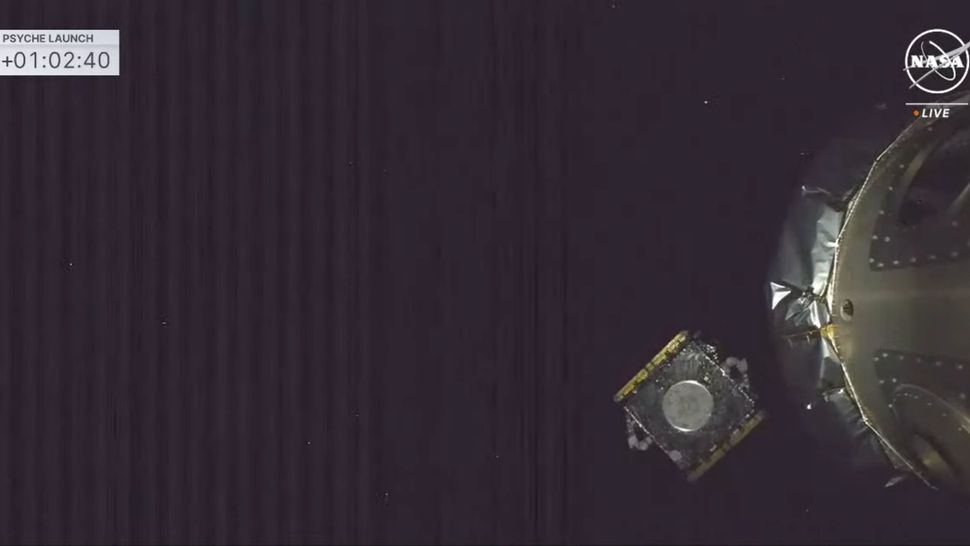
The spacecraft separated from the upper stage of the booster around an hour after launch, having been delivered to an extended orbit around Earth. There then followed a further 30 minute period of silence as the vehicle powered-up and oriented its communications system to call home with its first batch of data, indicating all was well and establishing a firm link with mission control.
The next 100 days will see the spacecraft comprehensively checked-out in terms of its flight systems – notably the four Hall-effect SPT-140 ion thrusters. This will be used serially throughout the flight to propel the vehicle to its rendezvous with 16 Pysche and enable it to slow down for an orbital rendezvous.
This checkout will be completed over the next week or so, and prior the vehicle being ordered to use the thrusters to start pushing itself away from Earth and into a heliocentric orbit around the Sun to reach Mays in 2026. Once there, it will use the planet’s gravity to help swing itself onto an intercept with 16 Psyche, where it will arrive in the latter part of 2029 to commence its science operations over an initial 21-month period.
A view from the forward end of the Falcon Heavy upper stage showing the departing Psyche spacecraft, the 24-metre span of its solar arrays still stowed. Credit: SpaceX / NASA TV
As I noted last time around, the journey to Mars will see NASA carry out a test of their Deep Space Optical Communications (DSOC) laser communications system, which could greatly increase the data rate and bandwidth of communications used with deep-space missions. The first test for DSOC should come in about three weeks from launch, when the vehicle will be 7.5 million kilometres from Earth. They will then be periodically repeated and extended as the spacecraft reaches a distance of to 2.5 AU from Earth.
The launch marked the eighth for what is now the world’s second most powerful launch vehicle currently regarded as operational (the most powerful title having been taken by NASA’s Space Launch System), and the 4th for 2023. However, it was particularly noteworthy for SpaceX, as it marks the first time NASA has used the rocket, and several concessions had to be made in order for this to go ahead.
The booster is also set to become a mainstay for several major NASA missions over the next few years. These comprise the launch of the 2.8 tonne GOES-U weather satellite and Europa Clipper mission to the Jovian system (both in 2024), the Nancy Grace Roman Space Telescope in 2026/7 and – perhaps critically for NASA’s human spaceflight operations, the joint launch of the first two sections of the Lunar Gateway Station in the form of the Power and Propulsion Element (PPE) and the Habitat And Logistics Outpost (HALO), a launch currently targeted for November 2025.
In this, and in difference to the hype and questionable capabilities of the SpaceX Starship / Super Heavy system, Falcon Heavy is proving itself as reliable a launch vehicle as the rocket from which it has been formed.
IMAGOLand Art Galleries: Carelyna – Phantasmagoria
Having opened at the start of October and occupying a skybox gallery at Mareea Farrasco’s IMAGOLand galleries, Phantasmagoria is the latest exhibition by Carelyna.
Whilst the title might well evoke thoughts of ghosts and spectres, this is a collection which takes the term in a different direction to ideas of ghosts and demons, being far more subtle in intent – as I’ll get to in a moment.
The term phantasmagoria is said to have originated in the last decade of the 18th Century as a French concatenation of the Ancient Greek phántasma (“ghost”) with either agorá, (“assembly” or “gathering”) or (agoreúō, “to speak publicly”). Exactly who coined it is subject to debate, but Paul Philidor, a magician and showman, is perhaps most widely recognised as having popularised it in the late 1790s and early 1800s, using the terms to promote his shows featuring ghostly apparitions and the shades of departed famous people – although such shows, utilising everything from concave mirrors to magic lanterns and camera obscura to create / project such ghostly phantoms, reach back into at least the 17th century. Others who started using the term around the same time as Philidor include French dramatist and proto-science fiction writer Louis-Sébastien Mercier, and Belgian showman Étienne-Gaspard Robert – who is also credited with coining the term fantascope to describe the equipment he, Philidor and others used to create their spectres.
IMAGOLand Art Galleries: Carelyna – Phantasmagoria
For her show, Carelyna has created a collection of sepia-rich, ghost-like images of individuals. It overall tone, they are suggestive of the flickering images witnessed by those sitting through one of Philidor’s shows. Some are clearer than others, presenting an well-defined study; others are caught in a halo of light and brightness which both adds to the suggestion they have perhaps caught the spirit of a person who may not have been there – or that the image was taken a long time ago, and time and light have not been kind to it.
However, while they have that faded, ghostly sense about them, as noted above, these images are not intended to portray the spirits of the departed or suggest we’re within a magic lantern show; rather they and intended to evoke ideas of mood and emotion. From celebrations of life and expressions of love, to studies of strength and introspection and of potential loss or aloneness, the emotional depth found within these 12 pieces is both intense and also entirely open to interpretation: while Carelyna offers a suggestion or theme within the title of each. it is very much down to how we individually respond to each of them in its own right.
IMAGOLand Art Galleries: Carelyna – Phantasmagoria
Scare Me Silly 2023, in support of the American Diabetes Association (ADA), opened its doors on Friday, October 13th, 2023 for its 8th season in Second Life, and will remain open through until October 31st. As with previous years, the event is organised by Team Diabetes of Second Life, with Scare Me Silly featuring live performances, parties, a hunt and an art show and – of course – shopping!
All participating merchants this year can be found comprise: Adore Amore, @AdReNaLiZeD@, Angel Fae Boutique, Art & Fashion, Be Bold, Closer to the Heart Creations, Cosmos Boutique, Country Crafter, Couture Chapeau, Creepy Midget Designs, Darymple Designs, DINKIEWEAR, Dreadfully Dark, DUST, Fae Fantasy Creations, Fashiowl Poses, Fire Within, FIRELIGHT, Grumble, HJM Designs, House of papillon, IKR, Kittycat’s Creations, LC Fashion, Le Moon, Llama Inc./Little Llama, Manikin, MG Designs, Nocturne Skies, PAJAMARAMA, PEEPS Dinkies, Pendragon Designs, Pixel Box, Pixelancer, POTOMAC, QUE RICO, Redangel Clothing Co, Shy’s Creations, Starlight Apparel, Techicolor dolls, Telsiope’s Couture, TRS Designs, & The Undiscovered Jewel. In addition, items listed in the Scare Me Silly Shopping Guide.
The artists participating in the art event are: Hadiya Draper, Jamee Sandalwood, HarlowJamison Resident, Llola Lane, maggiemagenta, aquarius27, Eucalyptus Carroll, Jessamine2108 Resident and SNOW KELLEY.
For details of the entertainment and activities going on throughout Scare Me Silly, please see the entertainment schedule.
This year the Evil Pumpkin Hunt offers a number of exclusive prizes available from several of this year’s merchants. The prizes cost L$10, with 100% of proceeds going to Team Diabetes.
In addition to Scare Me Silly, and events organised directly by Team Diabetes of Second Life, individuals, businesses and organisations are encouraged to hold fundraising events in support of Team Diabetes of Second Life. The official fundraising season toolkit is available at Team Diabetes’ offices within the Nonprofit Commons region in Second Life.
About the American Diabetes Association
Established in 1940, the American Diabetes Association is working to both prevent and cure diabetes in all it forms, and to help improve the lives of all those affected by diabetes. It does this by providing objective and credible information and resources about diabetes to communities, and funding research into ways and means of both managing and curing the illness. In addition, the Association gives voice to those denied their rights as a consequence of being affected by diabetes.
About Team Diabetes of Second life
Team Diabetes of Second Life is an official and authorised fund-raiser for the American Diabetes Association in Second Life. Established with the aim of raising funds in support of diabetes treatment and to raise awareness of the disease in SL, Team Diabetes of Second Life was founded by Jessi2009 Warrhol and John Brianna (Johannes1977 Resident), who serve on the Advisory Board along with Eleseren Brianna, Veruca Tammas, Rob Fenwitch, and Dawnbeam Dreamscape.
Th No Cottage Bizar combined: foreground: the version used to create the house; Centre Background: the version containing the swimming pool / home gym
Back in January 2023, I wibbled on about the NO Cottage Bizar by Marcthur Goosson (see: The NO Cottage Bizarin Second Life). Despite its unusual name, this is a sublime mesh model of a ruin dating back to medieval times and which has seen more recent attempts to revitalise it through the construction of newer brick walls and installation of modern windows, frames and doors.
As I noted in my previous article, the model is particularly well suited to kitbashing and / or modding, something which back in January saw me convert it into a pool house with hot tub and (after that article was written) a personal exercise space, and which has remained a part of the home island since then. However, having recently got my periodic itch to change things up, home-wise, I started wondering how it might be turned into a comfortable home and perhaps combined with the existing pool house. The answer turned out to be a combination of “surprisingly easily” – further demonstrating the potential for this building design.
The original build – it is delivered as a complete 99 LI build, without a rezzing box, and the Copy-Mod version includes a set of shadow maps to help with the production of custom textures. There is also a full permissions version.
To give a recap on the basic model, it comes in 2 versions, both at 99 LI. One is supplied at Copy / Mod / No Transfer and priced at L$1,499; the second is supplied Full permission, at a price of L$11,500. Both include shademaps, and the Full permissions version includes all diffuse, normal and specular maps. I opted for the Copy / Mod version, but have recently come to rue not getting the Full permission version. The building is supplied boxes but without a rezzer; after unpacking it’s just a case of pulling it from inventory, placing it and you are good to go.
By default, the building has 5 rooms, three on the ground floor, with one extending out to one side so its roof forms a terrace / broad balcony, and two on the upper. There’s also a small courtyard formed by the addition of brick walls at some point in its recent history, seen on the left of the image below. The textures and material maps used give a good degree of depth to the build, with enough variation in style to give the impression of a building extend over time using different stonework.
The rooms themselves are of mixed size, with two on the ground floor linked by an impressive stone arch into which modern doors have been set, guarded by heavy wooden doors on one side. The two upstairs rooms can be accessed separately, one by a pair of wrought iron stairs leading up from the innermost of the ground floor rooms, and the other via original stone stairs within the building’s single tower (which also provides access to the rooftop terrace / balcony mentioned above).
Four of the rooms of the No Cottage (out of the box”: two on the lower floor, linked by the large arch and two sets of doors and the paired stairways to the upper level (top), and the two upper floor rooms (bottom).
Now admittedly, the default interior texture do give the building a drab, dank look – entirely intentionally and no critique of Marcthur as they fit the broad theme of the building “as is”; however, for a comfortable sense of home, some of them probably need brightening up. Fortunately, Marcthur has considered this and provided sufficient mesh elements / mesh faces in the build to make this relatively easy for the most part. Thus, with some suitable wall, ceiling and floor textures it is very easy to brighten the place up, whilst leaving the original stone untouched as a contrast.
For my part, I opted to use the room off to one side of the build as a new kitchen, retexturing the wall in a mix of “wallpaper” and (for their exteriors) stucco. Running the full width of the No Cottage, the room is ideal for this kind of use. Meanwhile, the rooms linked by the archway became, respective, the dining area (complete with sofa for enjoying pre- and after dinner drinks!) (also replacing the cement on the outer wall with a white stucco to enhance the look), whilst the first of the rooms linked by the archway and double doors became an ideal dining area with an additional sofa for enjoying pre- and after inner drinks and the living room.
Another view of the two copies of the No Bizar combined. Left and lower, the version forming the house; right and elevated, the version with the pool and home gym, the brick-fronted courtyard of which (centre) forms the link between the two.
In its default form, with huge fireplace, double wrought iron stairways and heavy concrete pillars supporting one side of the arch, this latter room can at first seem too cramped to become a comfortable living space. However, it is very easy to open it out – such as by the removal of one of the stairways and replacement of the huge fireplace (I used the LISP Mid-Century fireplace by Pandora Popstar), and perhaps the removal of the concrete columns supporting the archway in the room (I also disguised the archway’s broken stonework with an arch of my own).
Removing one of the wrought iron stairways also allows the floor above to be remodelled to give more space, which I opted to use to fell the room become a comfortable bedroom, retaining the door connecting it with the other upper floor room, which became the bathroom (as well as serving a second purpose, of which more anon).
The four rooms after modding, in the same order an shown earlier. Top: the top lower floor rooms, now forming the dining area and lounge. Note the absence of a stairway and the revised arch in the lounge top help open it out. Top: the bedroom, making use of the added floorspace provided by the removal of a stairway, and the bathroom with access at the far end to reach the pool, etc.
If you want even more space, the walled courtyard can be easily converted into a room: just add ceiling/roof, floor and glazing (with the removal of the wrought iron element from the original). How the new room is then used is a matter of personal choice; I opted to install a new “front door” and make it an entrance-come-music room, increasing the sense of space in it by removing the doors separating it from the rest of the house.
One of the things I decided I wanted to achieve early-on in converting a copy of the No Cottage into a house was to combine it with the pool house version I’d created in a manner which suggests they are a single structure. Given the No Cottage essentially has a single mesh forming most of its shell, this might sound a hard-to-achieve goal; but with a little imagination it needn’t be.
Looking down on the “new” room formed out of the original courtyard (shown in the inset image, lower right), complete with glazed windows and a new “front door”.
Cutting a long story short, I managed it through the simple expedient of turning the house through 90º to the existing pool house and then placing it on a lower elevation. This allowed me to align the lower level of the pool house – notably its courtyard with is two stone arches – with the the house version. By aligning ne of the arches from the pool house courtyard with an upper floor window of the house, which could then become a connecting door linking the two (via the bathroom). By removing the wrought iron from the wall of the courtyard, I was also able to provide a second means of access the pool house from the garden (working alongside the double doors off to one side of the building.
To help blend this arrangement with the rest of the land, and to add to the sense this was once a very large structure, I availed myself of the various sets of ruined walls Marcthur also offers, and which are themselves based on elements of the No Cottage build. These were used to construct a ruined gatehouse and tower a short distance from the house, together with the remnants of a curtain wall and a wall to help with the split in elevation between the two versions of the No Cottage.
Looking across the pool house courtyard to where the two versions of the No Cottage have been aligned to give the impression they are a single building. Note the new door within the left-hand archway providing access to the house. The opening in the brick wall behind the sculpture provides access to the pool house from the garden.
As these kits are textured in a manner to suggest they have been ravaged by fire, to don’t entirely blend with the lighter stonework of the No Cottage (hence leaving me rueing the fact I didn’t but the Full permissions version!), but the gap between them and the house hopefully gives the impression the latter avoided the fire experienced by the former.
For those looking for the opportunity to obtain a building design offering some good potential for modding and which can fulfil a variety of roles from house to club venue or bar to deserted ruin – or even to house a swimming pool! – then it is really hard to fault the No Cottage Bizar, as I hope this piece again shows.
The long room to the right of the No Cottage is ideal for conversion for a number of uses. I opted to make a a rather spacious kitchen (partially visible).











 Inara Pey: Living in a Modemworld