Melu’s Horizons and AI ladies in Second Life

Melusina Parkin, September 2023: Horizons

Melusina Parkin has been expanding both her main gallery spaces and her exhibitions of late, with the former now presenting two individual gallery spaces above her main store, which she is using to host a total of four new collections of her work, three of which see Melusina dip her fingers into the world of AI art.

Both of the gallery spaces can be reached via Melu’s landing point, which also provides access to her art deco store and annex, or can be reached via the individual SLurls provided below, with galleries and store locations also being linked via teleport disks as well.

As an entirely arbitrary decision on my part, I’m starting with the Black Gallery. This is in fact split into two independent levels, also linked by the teleport disks, allowing it  to host two separate exhibitions. The first is Horizons, located in the Black Gallery 2. Taken from within Second Life, it presents a collection of 20 images captured in Melu’s familiar minimalist style.

Melusina Parkin, September 2023: Horizons

As the title of the collection suggests, each of these 20 images offers a unique view out towards a horizon. From deserts to views out over open waters, from fields of ripening crops stretching out into the far distance to looking across coastal sands to where the water takes over (or conversely from the shallows of the water back across the costal sands, these are all expressive pieces suggestive of a vast openness – even the one showing the sand/grass dappled flatness of a region awaiting the touch of terraforming tools.

True, some include evidence of life – a fence separating land from sea; a bench awaiting tired legs to lighten their load for a while; a train line cutting a horizontal divide beteen observer and distant horizon. But these only serve to heighten the sense of vastness inherent within these images. But “vastness” does not necessarily equate to “emptiness” – and to think otherwise would be a mistake.

With her photography, Melu is a storyteller. Or perhaps a better term might be story prompter; within all of her photography it is what isn’t seen that captivates; the suggestions of stories hovering just at the edge of the frame as each picture prods us to see beyond the literal. For example:  what might come thundering down that train track, shattering the peace, and who or what might it be carrying a to where? What is the promise of the far side of the sea, or what new adventure await beyond the broken horizon presented by the approaching foreshore? What might yet be raised from the flat evenness of an untouched region, and who might one day explore its wonders? The opportunities to create stories and tales is as vast as the spaces Melu presents within these 20 pieces.

Melusina Parkin, September 2023: 100 Retro Ladies

On the level below, is the first of the three AI related collections Melusina is currently presenting. Entitled 100 Retro Ladies, it comprises four sets of 25 images apiece. Each set is framed by a colour, and all are built around a theme of fashion at the height of the Art Deco era in Europe (early 1920s through early 1930s) – a time when women started to embody a new boldness and drive towards self-recognition, greater expression and more social freedom.

Each set of images – each named for the tint which largely defines them: Red, Teal, Black and Ivory – presents itself five pictures as a time around the gallery walls (so a total of only 20 images is displayed at any given time. To see the remaining images within each colour set, click on the white panels on which each group of pictures is mounted.

Sitting between the Black Gallery and Melu’s shop is the Minimum Gallery, home to two further exhibitions of AI-based art: Broken Mirrors and Kisses. both again present women who, in terms of look and style, might be seen as being draw from the 1920s.

Melusina Parkin, September 2023: Kisses

As noted above, and thanks to movements such as the drive for emancipation in the early 20th century, coupled with (in Europe at least) the need for women to take up functions and work normally the preserve of men as a result of the Great War, the 1920s was a period where women in the western world were starting to spread their wings and seek greater and more open freedoms from the strictures imposed by society. Kisses is a direct reflection of this, depicting and reflecting a period when a part of that greater expressiveness took the former of more open displays of affection / love / sexuality, be it in the form of a simple chaste kiss on the lips through to something deeper and indicative of desires beyond friendship / affection.

On the upper level of the gallery, Melu presents the most  – for me – compelling of the three AI-related collections, Broken Mirrors. I say this not to diminish Kisses or 100 Retro Ladies is any way, but because within this collect is a rich narrative depth which naturally attracts  whilst also giving out something of a challenge. Within them, we are encouraged not not to just see images of women before broken mirrors, but to contemplate how we might better understand the myriad facets of personality and self, and how we might find a more integrated life by doing so, as Melu notes in the introduction to this collection:

Mirrors are fragile and it’s very easy that they get broken. Nonetheless, even a broken mirror can be helpful. Try to look at your image on a broken mirror. You could be frightened or intrigued:  you can think that the fragmented image you see says that you are overwhelmed, destroyed, cut in pieces by your problems, trauma issues. Or you can see those fragments as different parts of yourself, and seeing them can be helpful in knowing each of them better, and trying to make them live and interact together successfully.

– Melusina Parkin, Broken Mirrors

Melusina Parkin, September 2023: Broken Mirrors

All individually engaging, the AI collections presented within Broken MirrorsKisses  and 100 Retro Ladies are a new an interesting extension to Melusina’s art, one which offers something of a unique approach in using AI toolsets compared to some other artists experimenting with the medium. Meanwhile, and for those who prefer, Horizons demonstrates Melu is not abandoning her flair for presenting equally engaging Second Life focused photographic art.

 SLurl Details

2023 SL SUG meetings week #36 summary

Grauvik, July 2023 – blog post

The following notes were taken from the Tuesday,  September 5th Simulator User Group (SUG) meeting. They form a summary of the items discussed and is not intended to be a full transcript. A video of the entire meeting is embedded at the end of the article for those wishing to review the meeting in full – my thanks to Pantera for recording it.

Meeting Overview

  • The Simulator User Group (also referred to by its older name of Server User Group) exists to provide an opportunity for discussion about simulator technology, bugs, and feature ideas.
  • These meetings are conducted (as a rule):
  • They are open to anyone with a concern / interest in the above topics, and form one of a series of regular / semi-regular User Group meetings conducted by Linden Lab.
  • Dates and times of all current meetings can be found on the Second Life Public Calendar, and descriptions of meetings are defined on the SL wiki.

Server Deployments

  • There was no deployment to the SLS Main channel on Tuesday September 5th, leaving all simhosts on that channel running on release 581251, although the hosts were all restarted.
  • On Wednesday, September 6th:
    • The “Bugsmash” simulator update 581292 will be extended across the majority of RC channels.
    • The “Dog Days” update may go to a limited RC deployment – possibly Ferrari. This update includes:
      • The unbinding of the Experience KVP database read / write functions from land (users will still require an Experience to access the KVP database).
      • A scripted ability to set CLICK_ACTION_IGNORE, allowing an object to be clicked-through to reach an object behind it – a flag supporting this is included in the Maintenance U RC viewer promoted to Release status in week #34.
      • PRIM_CLICK_ACTION is added to llSet/GetPrimParams so you can set the click action on prims in a linkset.

Viewer Updates

No updates to the official SL viewers at the start of the week, leaving the current list as:

  • Release viewer,  version 6.6.14.581101, promoted August 23.
  • Release channel cohorts:
    • glTF / PBR Materials viewer, version 7.0.0.581368, August 22.
    • Maintenance V(ersatility) RC viewer, version 6.6.14.581315, August 15.
    • Inventory Extensions RC viewer, version 6.6.14.581357, August 14.
  • Project viewers:

Note: the alternate viewer page also lists “Win32+MacOS<10.13 – 6.6.12.579987” as an RC viewer. However, the Win 32 + pre-Mac OS 10.13 was promoted to release status on July 5th, and viewer version 6.6.12.579987 points to the Maintenance S viewer, promoted to release status on May 16th.

Potential for Improving Vehicle Control Options

Further to the last meeting, Leviathan Linden gave the following update.

 I acquired a SpaceNavigator to make sure I don’t break that functionality [but] the SpaceNavigator is not detected by the alternate game controller detection lib I was thinking about using (libstem_gamepad, available on github). So, I’m going to implement a different detection system and not try to modify or recycle the NdofDevice system currently used to detect the SpaceNavigator. However the NdofDevice system does detect a regular XBox controller… well most of the input axes, not all of them, so, I think I’ll first just expose the controller input to LSL and not change how it is currently used for controlling the avatar. Overhaul of that stuff would be a separate delivery later.

This work may also include feature request BUG-234354 “Virtual control device as intermediate layer between the scripts and the controller”, with Leviathan further noting:

I would like to support multiple controllers at once, and I don’t want to paint myself into a corner where I can’t; but will first make sure just one controller works. I believe we’ll need a way for the various buttons/axes of the controllers to be re-mapped via some viewer User Interface, as part of the initial delivery, but not sure how that will work out just yet. I’m going to try to get my hands on some other controllers to test: a flight stick and a few other odd hardware with extra buttons.

In Brief

Please refer to the video for:

  • A general discussion on llVolumeDetect.
  • A general discussion on Experiences.
  • Monty Linden is continuing to look into issues of the simulator / viewer freezing during avatar arrival, although this work may be suspended whilst Monty is out-of-office for a while.
  • A discussion on options to use scripted function to gain information on the inventory contents of rezzed objects, per feature requests BUG-7395, BUG-34184, and BUG-202886.

† The header images included in these summaries are not intended to represent anything discussed at the meetings; they are simply here to avoid a repeated image of a rooftop of people every week. They are taken from my list of region visits, with a link to the post for those interested.

Appreciating the Shades of Autumn in Second Life

Shades of Autumn, September 2023 – click any image for full size

The year is turning and, for those of us in the northern hemisphere autumn is once more starting to show its face. With it comes the popular redressing of many regions in Second Life to provide autumnal (or Fall, if you prefer) colours. One of these is the Homestead region held by Flower Caerndow, which she offers as a public space for people to explore, enjoy and photograph.

Presented as Shades of Autumn, a name which precisely describes the setting, this is a landscape rich in the greens, browns, and golds, and so on associated with the season. However, there is so much more to appreciate here than a single season.

Shades of Autumn, September 2023

This is a landscape dominated by ruins, the largest of which being a Norman-style keep sitting astride the region’s northern highlands – as one might reasonable expect. With the curtain walls of the inner ward largely intact, the keep carries with it a sense of romance inside and out. Close by, and overlooking the water’s edge, is a single tower, perhaps one a part of larger fortifications which once formed a ring out outer defences for the main castle but now offers a point from which to appreciate it as it now stands – and imagine how it might once have looked.

Away to the south and occupying what is effectively a broad headland, sit the ruins of a chapel. It is far enough away from the castle so as to suggest it always stood outside of the Castle’s walls – not an uncommon state of place for the medieval period – but close enough that it could be protected by the presence of whoever occupied the castle. Together, the castle, tower and chapel are not the only ruins to be found within the region, but they are the most visible for those arriving in the setting.

Shades of Autumn, September 2023

While it is not enforced, the landing point sits towards the east side of the region, close to the tower ruins and the shallow bay it overlooks. It’s a vantage point offering a good view of the keep as it sits upslope, whilst also close by is a broad pool of water which forms the region’s most unusual natural feature.

Clearly sitting over a natural spring, this pool is open on two sides, allowing the water from it to tumble outwards, dropping by means of little falls and two narrow streams to reach the surrounding sea, thus effectively cutting the land in two. Fortunately, visitors are spared any wet feet thanks to the three bridges spanning the streams, even if two of them are slightly makeshift in nature.

Shades of Autumn, September 2023

Although the ruins clearly point to the island being occupied during medieval times, they do not mean the Normans were the first to inhabit it; also occupying the slope leading up the keep is a ring of Neolithic standing stones. They indicate there is a much older tale to be told about the island and its past. A further sense of mystery (and fantasy) is added through the presence of crystals and otherworldly-seeming plants (particularly in the keep’s inner ward) and the presence of statues here and there, all of which further add to the sense of romance found within the the keep.

And romance is very much the focus here, alongside that of photography, with any backstory we might care to create while visiting purely a matter for our imaginations. This focus on romance can further be found throughout the setting in the form of the many places visitors can find to side, cuddle and simply pass the time. Some of these are easy to find, others might require a little more in the way of exploration.

Shades of Autumn, September 2023

This is also an island with a secret; one which is not that hard to find, admittedly. It takes the form of an Experience-based teleport portal, and delivers visitors to a sky island which not only continues the theme it also – in Flower’s own words, offers a memory of the region’s previous iteration, thus connecting the two. Follow the path there to the portal leading back to ground level.

With a richness of beauty and nature, Shades of Nature is an engaging setting to visit, one which is – quite obviously – highly photogenic.  The attention to detail is superb, and the way in which Flower has brought everything together is pretty much perfect. Definitely not one to miss.

Shades of Autumn, September 2023

SLurl Details

2023 SL viewer release summaries week #35

Logos representative only and should not be seen as an endorsement / preference / recommendation

Updates from the week through to Sunday, September 3rd, 2023

This summary is generally published every Monday, and is a list of SL viewer / client releases (official and TPV) made during the previous week. When reading it, please note:

  • It is based on my Current Viewer Releases Page, a list of all Second Life viewers and clients that are in popular use (and of which I am aware), and which are recognised as adhering to the TPV Policy. This page includes comprehensive links to download pages, blog notes, release notes, etc., as well as links to any / all reviews of specific viewers / clients made within this blog.
  • By its nature, this summary presented here will always be in arrears, please refer to the Current Viewer Release Page for more up-to-date information.
  • Note that for purposes of length, TPV test viewers, preview / beta viewers / nightly builds are generally not recorded in these summaries.

Official LL Viewers

  • Release viewer,  version 6.6.13.580918, formerly the Maintenance U(pdate) RC viewer, version 6.6.14.581101, promoted August 23.
  • Release channel cohorts:
  • Project viewers:
    • No updates.

Note: The Alternative Viewers page appears to have suffered a hiccup, listing version 6.6.12.579987 as the “Win32+MacOS<10.13” RC viewer.  However, the Win 32  + Pre-MAC OS 10.3 viewer was actually version 6.6.13.580794, promoted to release status on July 5; 6.6.12.579987  was the version number assigned to the Maintenance S RC viewer promoted to release status on May 16th.

LL Viewer Resources

Third-party Viewers

V6-style

  • No updates.

V1-style

  • Cool Viewer Stable release updated to version 1.30.2.26 and Experimental Branch updated to version 1.31.0.4, both on September 2 – release notes.

Mobile / Other Clients

  • No updates.

Additional TPV Resources

Related Links

Invisible Cities: an Essay In Desire in Second Life

Nitroglobus Roof Gallery, September 2023: Debora Kaz – Invisible Cities: Essay on Desire

September 2023 sees Debora Kaz make a return to what is – in my personal opinion – consistently the finest gallery in Second Life for the presentation of engaging, provocative and evocative art: the Nitroglobus Roof Gallery operated and curated by Dido Haas. She brings with her a further chapter in her Invisible Cities series; this one entitled Essay in Desire.

I’ve covered two previous chapters of Invisible Cities, one of which was also displayed at Nitroglobus – see Invisible Cities: Fighting Women at Nitroglobus in Second Life – and also one hosted at Artsville Galleries – see: Invisible Cities: The Future in the Present Overflows in Second Life. While I would not necessarily call Essay In Desire a “sequel” per se to those earlier exhibitions, I would perhaps refer to it as a further chapter in Debora’s exploration and presentation of themes of womanhood in the modern era.

Nitroglobus Roof Gallery, September 2023: Debora Kaz – Invisible Cities: Essay on Desire

Within Fighting Women, Debora explored the manner where – for much of history – women have had to survive within a – dare I say largely patriarchal – framework as objects of desire (and objects in general); a situation which often gives rise to physical, mental and psychological violence towards us, which can be both direct and also indirect (such as with the current onslaught against a woman’s right to bodily autonomy being very publicly played out in the United States, courtesy of a largely misogynistic right-wing pseudo-religious political movement). Within The Future in the Present Overflows, the focus shifted to a more individual viewpoint on how such visible/invisible / physical/mental/”moral” violence and restrictive practices can have on a single life.

For Essay on Desire, Debora combines the approach of focusing on the individual and the sense of self seen in The Future in the Present Overflows, and of offering a wider study of the concept of desire as found within Fighting Women. However, rather than focusing on the more destructive constatations of desire as framed by that exhibition, here Debora focuses on the more personal exploration of the precepts of desire – notably those of sensuality, sexuality, and eroticism – and how they play a vital role within the process of self-discovery and understanding of oneself.

Nitroglobus Roof Gallery, September 2023: Debora Kaz – Invisible Cities: Essay on Desire

This exploration comes primarily through images and words. The the latter come in the form of an essay which both sits as an introduction to the exhibition and as a treatise for thought and introspection. It is a powerful piece; one which should be read with care and consideration (perhaps most particularly if you are a male wishing to gain a better insight to the female psyche as seen from the female perspective)v, as it is rich with insight and honesty.

The images all follow a particular form and flow. Offered in muted tones, they comprise twelve oriented in a narrow portrait form and a further six in the more usual (for Nitroglobus) large-format landscape style. All of them present images of a woman at ease with herself and her sexuality, her poses suggestive of her awareness of self and a willingness to further explore her innate beauty and eroticism without the need to conform its display through outright nudity or through directly sexual poses as might otherwise be demanded.

Nitroglobus Roof Gallery, September 2023: Debora Kaz – Invisible Cities: Essay on Desire

Each image is carefully bordered to either side (and in place directly flowing into the image)1 by mix of hand-written text, formulae, flowery etchings and hints of formal geometry, all of which presents a clear, if subtle, symbolism.

For example, the use of hand-written text reminds us that – whilst it might not be so common now for whatever reason – for a long time the closest confidant a woman might have had to bestow her secrets and desires upon was her diary. Through its pages, she could give vent to desires, wishes, hopes, and thoughts which otherwise could never be delivered in public, the diary thus becoming both a small measure of release and a reminder of imprisonment and denial enforced by society.

These constraints are further emphasised by the use of formulae and geometry. Both symbolise control, order, logic and the reductive manner of society to define everything to the simplest of terms wherein everything – including the nature of woman – has a strictly defined place. This imposition of constraint and order extends into the 3D elements to be found within of Essay, where the upright and slanting poles are ranged around female figures as if to fence them in and confine their ability to express.

Finally, there are the figurines and the use of flowers within them images. Together, these present a gentle, visual underlying of a central truth within Debora’s essay:

This process of self-discovery is an intimate dance with oneself, where each step is a journey of self-unveiling. Like petals delicately unfurling to the sun, she reveals her deepest passions and fantasies, allowing her mind and body to be in harmony. The pursuit of pleasure becomes a celebration of life itself, an ode to her essence.

– Debora Kaz, Essay on Desire

Nitroglobus Roof Gallery, September 2023: Debora Kaz – Invisible Cities: Essay on Desire

However, to suggest Essay is a complex exhibition requiring deep thought would perhaps be unfair. Yes, there is a rich layering of ideas and thought. But at the same time, the central message is also self-evident through the beauty and honesty contained within the words and the images. It is a message that is inescapable and true: freedom of expression and self-discovery is an inalienable right, which should be available to all of us. For as Debora concludes quite perfectly in the case of contemporary woman:

The need for self-knowledge, in this context, transcends the physical and delves into the deepest layers of the soul … This self-understanding is the key that unlocks the door to intimate and genuine relationships, where eroticism flows naturally.
In a world that is in constant evolution, the contemporary woman embraces the journey of self-knowledge as an act of self-love and empowerment. She understands that her sensuality and eroticism are intrinsic parts of who she is, and by exploring them with sincerity, she inspires not only herself but also those around her to embrace the quest for their own truth with curiosity and gratitude.

– Debora Kaz, Essay on Desire

SLurl Details

Space Sunday: China’s space station, data and a rover

A China State Television (CCTV) animation showing Tiangong with the new module and docking adapter (foreground), and the crewed vehicle replacement for the Soyuz-based Shenzhou crew vehicle about to dock at the central hub. Note the Wentian and Mengtian science modules to either side are shown with additional solar arrays extending away from them. Credit: CCTV

With orbital operations well underway, China is considering a further further expansion to its Tiangong space station as well as opening the station to both the nascent Chinese commercial space sector and international participation.

In particular, the latest 5-year plan produced by the China Manned Space Agency (CMSA) and the China Academy of Space Technology (CAST) for the period 2026-2030, appears to confirm statements made in December 2022 and February 2023 that China is considering expanding the station with the addition of a fourth module.

Exactly what form the new module will take has been open to debate for several months, with initial reports suggesting it would be physically and functionally similar to the existing three modules – the Tianhe-1 core module and the Mengtian and Wentian science modules – with a mass of around 21-22 tonnes, and up to 51 cubic metres of internal habitable space.

Drawn from images captured by multiple satellites in orbit, this annotated animation provided by Australia’s HEO Robotics, a company specialising in “non-Earth imaging” (i.e. capturing images of object in space using other satellites) showcases the assembly of the Chinese Space Station from September 2021 through until the arrival of the Shenzhou-14 mission in June 2022. Credit: HEO Robotics

However, more recently, it has been suggested that the additional module would be of an entirely new design, providing as much interior space as Tianhe-1, together with a new 6-way multi-function docking adapter and support scientific payloads being mounted on its exterior.

It now appears China is leaning towards this second option, with Wang Xiang, the director of space station systems at CAST indicating the increased docking capability and internal space will achieve a three-fold design function:

  • It would allow more vehicles to dock with the station together with more research space and – Wang has suggested – room for space tourists to visit the station as well.
  • It would allow the station to act as a hub for the testing and development of vehicles and technologies intended to help expand China’s lunar and deep space ambitions.
  • It could potentially encourage greater international participation in the Chinese space programme as well as encouraging the Chinese commercial space sector.
Two renderings of the proposed expansion to the core Tiangong space station. Left: using a Tianhe-1 / Wengtian/Mengtian-derived module (Green). Right: using a smaller (but roomier) module of a new design (green), equipped with a 6-way docking adapter, which would also enable further modular expansion (yellow). Credit: Wang Xiang, Zhang Qiao, Wang Wei, CAST

With regards to the latter point, Ji Qiming, an assistant director at CMSA has indicated that CMSA will be accepting proposals from the Chinese commercial space sector for vehicles capable of resupplying the station with consumables. Additionally, he indicated that China has repeated its offer to the international community to join with it in research opportunities on the station. This has been offered in two ways: cooperation in research through the provision of experiments, and the direct participation of astronauts to join Chinese tiakonauts in training for, and participating in. flights to and from the station from China.

The move towards greater international cooperation is seen by some as a significant game-changer for the Chinese space programme, further opening the door to build on agreements with a number of European nations, together with Mexico, Japan and Peru and with the UN to fly experiments on Tiangong and an agreement with Italy which includes flying astronauts to the station. In particular, China may be looking to court partnerships with India and Pacific Rim nations such as Australia and New Zealand, both of whom are looking to expand their involvement in space exploration and development.

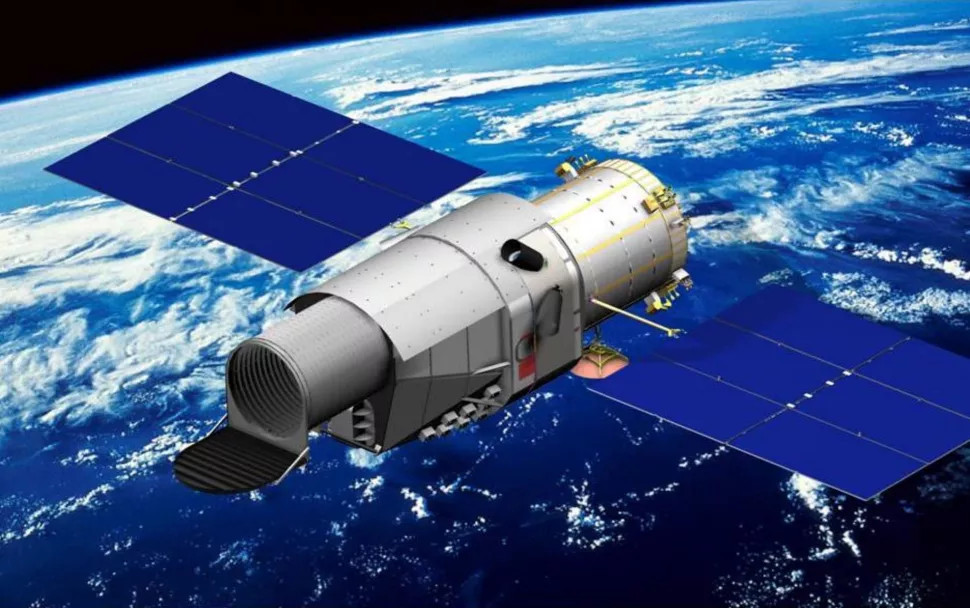
A rendering of the Xuntian Chinese Survey Space Telescope (CSST), due to be launched towards the end of 2024 and operate in cooperation with Tiangong. Credit: Jaimito130805

No launch date for the module has been given, although if it is to be of an entirely new design, it would be unlikely to be ready for launch before the early 2030s.

In the meantime, and as soon as the end of 2024, Tiangong will be indirectly expanded with the launch of the Xuntian Chinese Survey Space Telescope. This is a free-flying observatory which will be placed in a co-orbit with Tiangong, allowing it to operate both independently but also periodically dock with the station for servicing.

NASA’s DSN at Risk of Collapse?

One of the most critical elements of NASA’s infrastructure is, oddly enough, one that tends to be the most taken for granted. It’s not a launch centre or mission control facility or a research centre or astronaut training facility. It’s most obvious elements are three huge communication centres located in California, Australia and Spain. It is known by the simple acronym DSN, meaning Deep Space Network – and without it, NASA would be unable to maintain contact with any of its missions beyond Earth orbit.

More than 50 years old, the core of DSN has been in service since before Apollo. While its primary function is data communications and relay, the DSN also carries out science of its own when capacity allows, in the form of radar and radio astronomy. However, while the intervening years the broader supporting infrastructure for DSN communications between its various centres has been updated, the facilities at the centres – the primary centres have been under increasing strain, whilst at the same time, the budget allocated for both DSN operations and systems development / enhancement – has been steadily decreasing year-on-year. In 2010, for example, the DSN budget was US $250 million. Ten years later, it was down to US $200 million. As a result of this, DSN’s core capabilities have been steadily degrading.

This came to a head during the 25-day Artemis 1 mission in November / December 2022. This required dedicated DSN activity across 1774 hours – 903 hours for tracking the Artemis 1 mission, and the rest in monitoring the 8 cubesats launched as secondary payloads with the mission – the majority of which saw the DSN operating in a “search and rescue” mode, simply monitoring the cubesats in case any of them ran into problems. As a result, NASA science missions such as those operating around Mars or at the outer edge of the solar system or beyond, and so on, were almost completely denied any data communications through the DSN.

NASA’s Deep Space Network facilities near Canberra, Australia. Credit: Ryan Wick

Warnings that the DSN is over-subscribed have been available for some time. As recently as July 2023, NASA’s own Office of Inspector General (OIG) issued a report saying budget reductions mean that the network will remain over-extended throughout the rest of the 2020s and into the 2030s, even if work on updating it is prioritised.

Whilst attempts have been made to ease some of the load – a cloud-based data communications and data handling system was introduced to support the Goldstone, California DSN site, even these have struggled to keep pace with emerging technologies such as cubesats. This was again demonstrated during Artemis 1 when a system designed to handle some of the cubesat data load itself suffered a 33-hour outage, belatedly forcing NASA to realise that over-extending data communication through multiple additional rideshare payloads during a major undertaking such as an Artemis flight perhaps isn’t a good idea.

Even so, the demands of Artemis remains a major concern to those responsible for DSN, because it has the potential to cripple other missions; something which has led to the formation of a committee to outline a 4-point plan to help combat the issue.

When Artemis comes online, everybody else moves out of the way, and it’s an impact to all the science missions We either have to clear everybody off the network or we struggle — and our experience with Artemis 1 was struggling with trying to move everybody around.

– Suzanne Dodd, director of NASA’s interplanetary network directorate

The DSN antennae at NASA Goldstone, California. Credit: NASA/JPL

Some of the recommendations under consideration include implementing a new suite of six 18-metre antennae called LEGS at the DSN Goldstone centre which will be used solely for use by the Artemis programme, and also the implementation of a network of relay satellites  in orbit around the Earth and Moon to handle more of the data load required by Artemis.

However, these solutions require a budget expenditure which NASA currently doesn’t have, nor is it likely to receive in the foreseeable future, and time to implement. And even then, programmes like LEGS fall short of the overall data capabilities NASA will require for long-term human operations on the Moon.

We have reached a really critical point with the DSN’s aging infrastructure. This scares us very much.  We’ve clearly gotten a five-alarm fire bell.

– Sandra Cauffman, deputy director of NASA’s astrophysics division

Both Cauffman and Dodd are members of the committee responsible for making recommendations like LEGS to NASA, so that the agency can consider options and request funding.  However, before even this can be done, the committee can do even this, the recommendations they make must be reviewed and approved by the NASA Advisory Council, which is not scheduled to meet again before November, which means NASA will likely be unable to make any formal requests for increasing DSN’s budget until fiscal year 2025.

Continue reading “Space Sunday: China’s space station, data and a rover”