
On September 8th, 2016 at 23:05 UTC, an Atlas V 411 rocket lifted-off from Space Launch Complex (SLC) 41, Cape Canaveral Air Force Station (now Space Force Station). Launched by United Launch Alliance (ULA), the rocket carried aloft NASA’s Origins, Spectral Interpretation, Resource Identification, Security, Regolith Explorer (OSIRIS-REx), an ambitious mission to study a carbonaceous near-Earth asteroid and obtain as large a sample of material as possible for a return to Earth.
More recently, on September 24th, 2023, the mission achieved its goal, returning an estimated 250 grams of material – four times the minimum amount scientists hoped to obtain at the start of the mission – from the 500m diameter asteroid 101955 Bennu. It is not the first mission to return a sample of material from an asteroid; Japan holds that record with its Hayabusa and Hayabusa-2 missions. The first rendezvoused with asteroid 25143 Itokawa in 2005, the second with asteroid 162173 Ryugu in 2018; however, given both these missions returns a total sample cache of under 6 grams, OSIRIS-REx is the most successful to date.

Over the intervening seven years since its launch and return, OSIRIS-REx completed a round-trip journey of some 6.4 billion kilometres. Along the way it performed a fly-by of Earth some 12 months after launch, allowing it to enter an orbit around the Sun from which it could intercept Bennu. This passage around the Sun allowed OSIRIS-REx to past through the Earth-Sun Lagrange L4 position, where it performed a search for a class of near-Earth objects known as Earth-Trojan asteroids. Whilst no previously unknown asteroids were located during the 11-day survey in February 2018, the exercise yielded valuable data on vehicle manoeuvring for the kind of precise imaging required on reaching Bennu.
As it approached OSIRIS-REx Bennu in late 2018, OSIRIS-REx was able to observe Jupiter, adding to his science mission, prior to entering an initial orbit at the start of December 2018. It then spent most of the month generally characterising the asteroid, detecting hydrated minerals in the form of clay across the asteroid’s surface, suggesting it was once a part of a larger object rich with frozen water, offering a further pointer to how life-forming minerals and water may have been carried to Earth and the inner planets.
On December 31st, 2018 OSIRIS REx closed to just 1.75 km above Bennu’s surface, allowing it commence an extensive remote mapping and sensing mission which allowed the science team to identify potential areas which might be suitable for gathering one or more samples. In reaching that altitude, OSIRIS-REx set a new record for the closest distance any spacecraft has orbited a celestial object, beating ESA’s Rosetta mission’s orbit of 7 km around the comet 67P/Churyumov–Gerasimenko.
In all, 14 months were spent carefully surveying Bennu, allowing for potential sample-gathering sites to be identified, with the spacecraft closing to just 1 km above the asteroid, breaking its own record and allowing a final survey of the four preliminary landing sites so a final selection could be made. In the end, a site dubbed “Nightingale”, a fairly open shallow depression on the asteroid’s surface, was selected, and the mission moved to the rehearsal phase.

In order to collect samples, OSIRIS-REx had to make physical contact with the asteroid in a “touch and go” (TAG) manoeuvre. This would see the spacecraft deploy a robot arm underneath itself. Called the Touch-And-Go Sample Arm Mechanism or TAGSAM, this spring-loaded arm carried a camera system and, on its end, a sample gathering system. The craft would then use its thrusters to gently push itself down towards Bennu, bringing the sample head into contact with the asteroid’s surface.
At this point, several things would happen in rapid succession: the springs in the arm would absorb the spacecraft’s motion, allowing it to maintain contact for a second or two as a jet of inert nitrogen would be directed at the surface under the sample head in order to blast material up into it while Velcro-like rings on the end of the head would snag dust particles and the like. Then, as the springs in the arm recoiled under the mass of the spacecraft and very gently push it back away from the asteroid, allowing a Mylar cap to close over the sample head, trapping whatever had been captured inside the head. Finally, once the spacecraft was sufficiently clear of the asteroid – 40m or so -, OSIRIS-REx would fire its thrusters an position itself back in orbit a few hundred metres above the asteroid, where the sample gathering operation could be assessed for success and from which, if required, a further attempt made to grab material.

All of this was obviously quite complex – and due to the the delay in communications between vehicle and Earth, had to be carried out entirely autonomously. Hence the rehearsal phase of the mission. These were carried out in April and August 2020, with the first bringing the craft to within 65 metres of the sample site and the second stopping just 40 metres above it. Both saw the craft go through all phases of the TAG operation, sans actually touching the asteroid, with a small burst from the thrusters substituting from the recoil of the TAGSAM springs to push it away from the asteroid once more. Both rehearsals were flawless and paved the way for the first – and only, as it turned out – sample gathering attempt.
This occurred on October 20th, 2020 and took around 4.5 hours to complete from the start of decent towards Bennu through to a return to an orbit 770 metres above its surface. Telemetry (lagging some 18.5 minutes behind actual operations due to the transmission distance) suggested everything had gone as planned, including the TAGSAM camera recording the entire event. However, when the video footage was transmitted several hours later and then reviewed, it contained a surprise for the mission team.
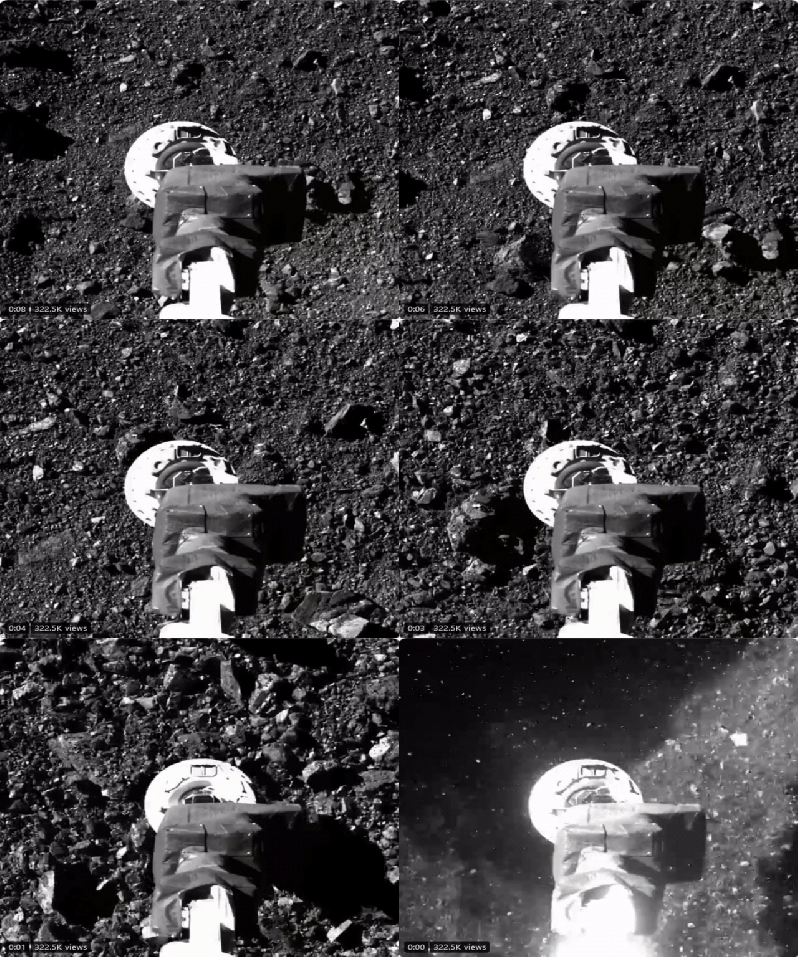
Rather than making light contact with Bennu as planned, the video showed that such was the brittleness of the asteroid’s surface material, the TAGSAM arm smashed its way into it, pulverising a rock in the process and sinking to a depth of about 50 centimetres before the spring recoil pushed the craft backwards. Concerns were immediately raised as to whether any material had been gathered and – more particularly – if the sample mechanism had been damaged.
To ascertain this, one of the star tracker cameras used for navigation was tasked to capture an image of the sample head. This revealed a second surprise: the sample head was “leaking” material. This was determined to be due to the Mylar cap having failed to rotate fully into position, resulting in a small, but growing cloud of material around the sample head. However, it was also determined that rather than only collecting a small amount of material from Bennu, the force of the sample head passing through the surface shell of the asteroid may have filled it to near-capacity, preventing the cap from operating correctly.
As a result, on October 27th, with all analysis of the situation completed, the order was given for OSIRIS-REx to forego any additional sample gathering procedures and transfer the sample head and its precious cargo into the Sample-Return Capsule (SAC), preventing further loss of what had been collected. This operation took several days to complete, after which OSIRIS-REx resumed studying Bennu until the window for its return opened in May 2021 and it started on its way back to Earth.
By September 16th, 2023, OSIRIS-REx was 4.66 million kilometres from Earth, close enough for the European Space Agency’s 1-metre Optical Ground Station (OGS) telescope on Tenerife island to catch the first – and only – telescope image of its approach. Either side of this – on September 10th and again on September 17th, the spacecraft completed two manoeuvres designed to put it on a course to allow it to deliver the sample capsule to the USAF’s Utah Test and Training Range (UTTR).

On September 24th, 2023 and at 10:42 UTC, with the spacecraft around 100,000 km from Earth, OSIRIS REx set the sample return capsule gently spinning to maintain its stability and detached it, pushing it directly towards Earth. Twenty minutes after separation, the spacecraft fired its thrusters to place itself on a fly-by trajectory which allowed it to slip past Earth, using our gravity to swing it onto the first leg of its new mission.
Meanwhile and after coasting Earthwards for four hours, the sample capsule slammed into the upper reaches of our atmosphere at a velocity of around 44,500 km/h, starting the riskiest part of the mission for the sample it contained. Such was the friction generated that the capsule was quickly enveloped in a visible fireball, and concerns had been expressed that if the thermal protection within the capsule failed to work as intended, even if it survived re-entry thanks to its external shielding, the sample material itself might be cooked and rendered usualness to study. This is something which will not be known for a while, although it appears the capsule completely its re-entry and landing pretty much precisely as planned.
Two minutes after atmospheric entry, and with the capsule cooling from the 2,990ºC temperatures of re-entry, and having survived a 32G deceleration, the supersonic drogue parachute deployed to bring the capsule’s speed down to subsonic levels in preparation for landing.
The main parachute should have opened at 8 minutes after atmospheric entry, with the capsule at an altitude of 1.6 km. However, it appears something happened to cause the main parachute to deploy at nearly 4 times that altitude, with the capsule travelling faster than the planned deployment speed. However, the ‘chute withstood the additional strain and brought the capsule into to its expected “soft” landing speed of 18 km/h, touching down at around 14:52 UTC – just three minutes outside of its ETA. Not bad after a seven year journey.
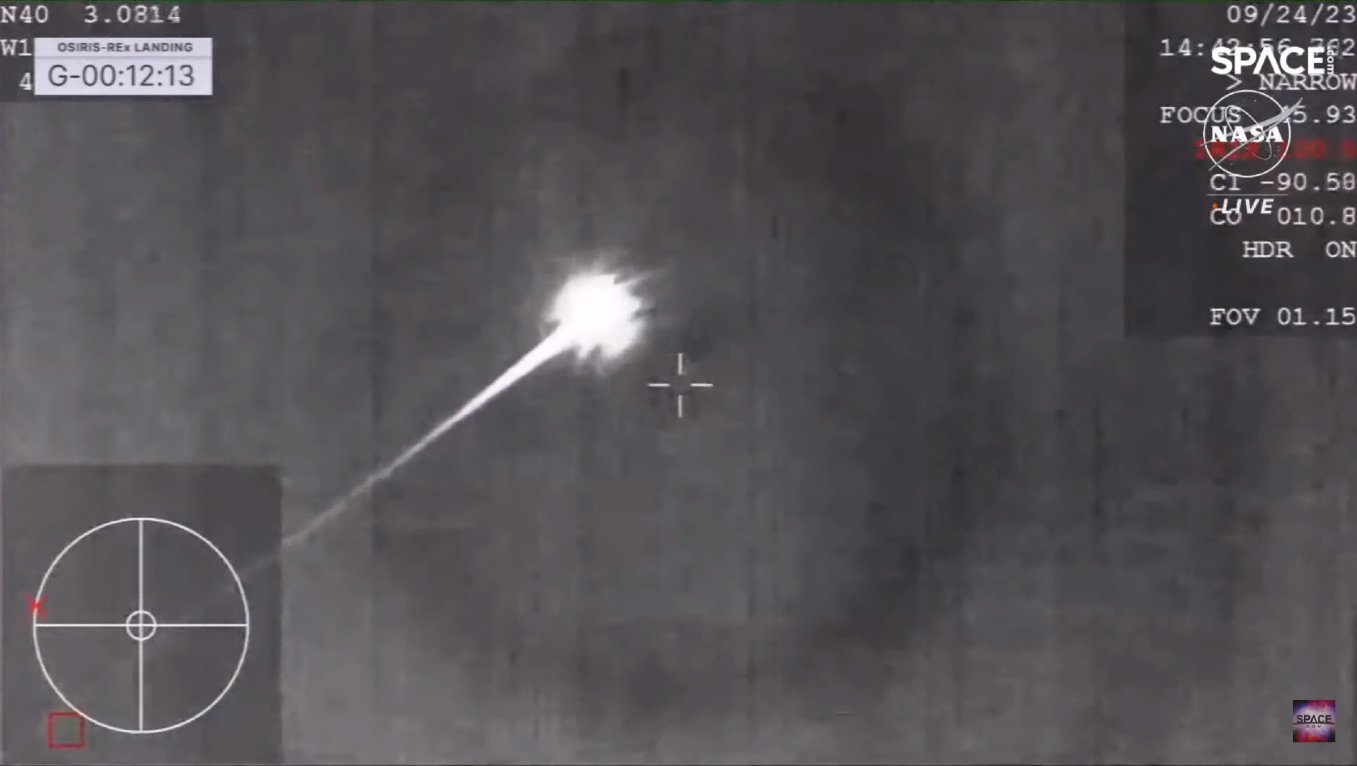
Following landing, the capsule was allowed to continue to cool over the course of an hour or so, with the recovery team surveying it from a distance. Once the all-clear was given at around 16:00 UTC, the team approached the capsule and confirmed it was intact and externally undamaged from the approach and landing and after “safing” it, they enclosed it in a protective bag and cargo net so that it could be lifted via helicopter to the US Army Dugway Proving Ground some 21 km from the UTTR.
On arrival at Dugway, the capsule was examined in detail prior to being transferred to a specially prepared clean room where it will be stowed pending unsealing and the removal of the sample canister. This in turn will be transferred to a special receiving and examination facility at Johnson Space Centre, Texas, on Monday, September 25th. Once there, it will remain stored until at least October 11th partially as a result of uncertainty about a potential US government shutdown coming into effect at the end of September and which may impact work on assessing the sample.
Once it has been extracted and assessed, portions of it will be sent to institutions around the world for analysis in an attempt to learn more about the formation and evolution of the solar system, its initial stages of planet formation, and the source of organic compounds that led to the formation of life on Earth.

It is also hoped that material from Bennu will help us better understand the composition and make-up of near-Earth asteroids and what might be done should one prove to be on a collision course with Earth (in fact, there is a 1 in 1,750 chance Bennu itself might strike Earth during any September between 2178 and 2290, with the greatest risk falling on September 24th, 2182). Thus knowing more about the likely composition and density, etc., of such asteroids helps scientists determine how better to mitigate the threat of a collision.
To this end (in part, at least), OSIRIS-REx is now officially OSIRIS-APEX (APophis EXplorer), as it departs Earth for a rendezvous with another potentially hazardous object, the near-Earth asteroid 99942 Apophis. This is an object – like OSIRIS-REx – I’ve covered in the past. Slightly smaller than Bennu, it caused a stir a couple of years ago when tabloids picked up on a nonsense story it would strike Earth in 2029; in fact it won’t com close enough to impact Earth for a minimum of 100 years – and even beyond that, the chances of a collision are unlikely.
Instead, Apophis will pass by Earth on April 13th, 2029 at a distance of just 31,600 km. Just after that, on April 21st, 2029, OSIRIS-APEX will rendezvous with Apophis and spend 18 months studying it in detail. During this time it will perform a TAG manoeuvre similar to that completed on Bennu; however, as the craft no longer has a means to return samples to Earth, it will instead use its thrusters in an attempt blast away surface materials and expose the asteroid’s subsurface for study and analysis, allow for it to be compared with the likes of Bennu, Ryugu and Itokawa.


Kudos to NASA for doing two missions with the same spacecraft! That’s quite unusual (even taking into account that the missions are “similar”) but at a considerable reduction of overall costs, a problem that space agencies constantly fight against. It also shows how maneuverable the OSIRIS spacecraft is! I mean, it’s able to do both the long-range overhauling of instrumentation half-way across the solar system (well, the planetary area of it), as well as the delicate and precise surface-contact operation, with minute adjustments all made fully automatically (it couldn’t be otherwise, considering the distance), then return back to Earth, deliver its payload, switch orbits (a feat by itself!) and continue towards the next scientific mission — while simultaneously having all instrumentation ceaselessly gathering data, of course.
In a sense, the financial constraints placed upon NASA forces their engineers to cram a lot of equipment — and missions! — in the same spacecraft, because, well, they never know if they’ll have funds to accomplish something similar again in the near future.
On the other hand, it’s so ironic that they have to put everything on hold due to the imminent government shutdown 🙂 Maybe someone at ESA could lend them a hand — after all, once everything is properly catalogued and prepared, your article mentions that the contents will be distributed to several labs across the world anyway.
I’m sure that when Bennu finally crashes upon Earth, our descendants will read their history with amusement, learning how we already had a fantastic space programme with lots of very clever gadgets, which, however, were constantly being delayed due to lack of funding and/or obsolete forms of government that made the bureaucratic aspect of dealing with such a space programme insanely difficult — for no real reason, except for power struggles among politicians, who, arguably, couldn’t care less about either those who voted for them, or the governmental institutions that depend on their agreement to fund them…
As Plato said, the perfect utopia would be managed and run by king-philosophers — that would be the only ‘perfect’ way. In contemporary terms, it means that politicians should be scientists, and vice-versa, so that they can drop all irrelevant nonsense from politics and focus on the essentials. But I digress: congratulations on your work, NASA, you did your job well, in spite of everything else — which is hardly related to NASA’s scientific & engineering skills.
LikeLike
It’s the sample cataloguing that’s the issue. JSC has prepared a special clean room for that purpose, designed to eliminate as far as possible any risk of sample contamination during the initial analysis and cataloguing of the material. Setting up a similar facility in so short a time-frame elsewhere in the world isn’t going to be that easily achieved.
In terms of manoeuvring spacecraft around the solar system and multi-taking them, we’re getting pretty good at it. Look at ESA Rosetta mission and NASA’s Dawn missions (to cite two of the more recent). The former was primarily designed to study comet 67P/Churyumov–Gerasimenko (67P), but along the way it was able to observe Earth (3 fly-bys), and Mars (1 flyby) and study a couple of asteroids along the way. Dawn, meanwhile was designed to study Vesta and Ceres, two (potentially quite different) asteroids out between Mars and Jupiter, requiring a complex flight plan which also allowed it to study Mars during an outward flyby and the ability to manoeuvre itself from Vesta tod Ceres with minimal propellant expenditure. Granted, neither craft was tasked with a return to Earth, but their missions and capabilities were still impressive.
LikeLiked by 1 person