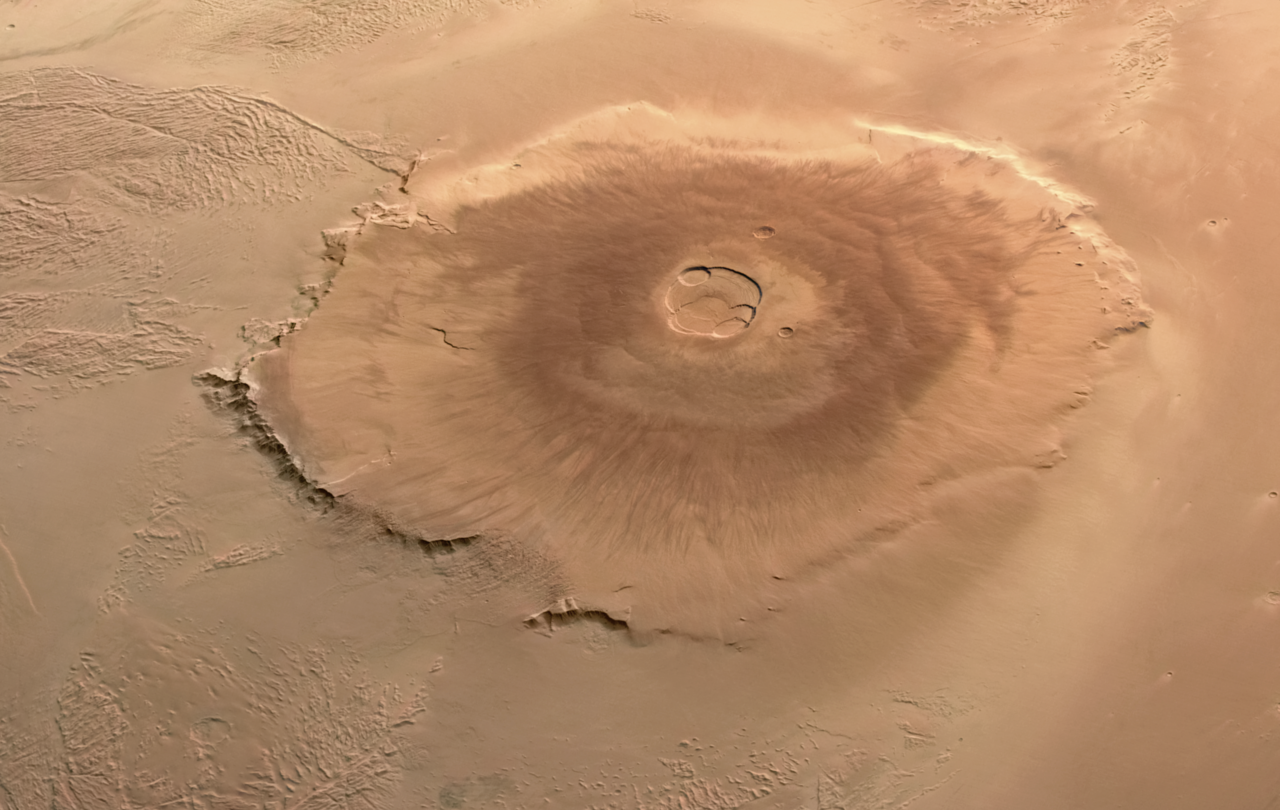
Olympus Mons is one of the many reasons I have an abiding fascination with Mars. Located to the northwest of the Tharsis Montes (Tharsis Mountains), a chain of super volcanoes marching across the planet’s northern hemisphere, Olympus Mons is the largest of all the volcanoes so far discovered in the solar system and boasts some incredible statistics.
For example, it rises a huge 26 km above the surrounding plains, or 21.9 km above datum for the planet, marking it as being around twice the height on Hawaii’s Mauna Kea as it rises from the sea bed. It is over 600km, covering an area almost the size of Poland. The volcano’s peak comprises a series of nested caldera craters which all speak to a violent volcanic past, and which at their widest measure some 60 km x 80 km and are up to 3.2 km deep.
So broad is the volcano that its slopes would not be at all mountain-like, but rather a continuous incline rising for the most part at an angle of just 5% from the horizontal; outside of the base escarpment that is. The latter, running around the volcano forms a near-continuous set of cliffs rising up to 8 km from the plains on which it sits.

Precisely how Olympus Mons formed has been open to some debate. While it and the three volcanoes of the Tharsis Montes – Arsia Mons, Pavonis Mons, and Ascraeus Mons (all of which are as impressive as Olympus Mons, if each somewhat smaller) – formed in the same period of Mars’ early history some 3.7 to 3 billion years ago, Olympus Mons is potentially the eldest. Now a team led by Anthony Hildenbrand of Université Paris-Saclay in France believe they can show that a major contributing factor in the formation of Olympus Mons was water.
Using data from a range of missions in orbit around Mars, the team has carried out an extensive comparative study between Olympus Mons and volcanic island chains such as the Azores, the Canary Islands and the Hawaiian islands. In doing so, they have found evidence which strongly supports the idea of the escarpment around Olympus Mons were laid over thousands of years through the interaction of lava from the volcano and a surround ocean.
That an ocean once existing in the northern lowland of Mars – called the Vastitas Borealis – has long been known. However, given the elevation at which Olympus Mons sits, it had long been assumed it was above this ancient ocean. However, in their work, Hildenbrand’s team suggest Olympus Mons actually grew out of the ocean, rising through successive eruptions in much the same way as, say, Mauna Kea, until it broke the surface of the sea, and the interaction of the hot lava and cold water giving rise to the escarpment as the volcano contained to rise.
In support of this, the team found evidence that the flanks of Alba Mons, another huge, but much flatter – a mere 6.8 km in elevation – volcano further north along the edge of Vastitas Borealis and much older than Olympus Mons, suffered a series of violent tsunamis. These were likely the result of the violence of the eruptions which raised Olympus Mons.

If Hildenbrand’s team are correct in piecing their evidence together, it could help explain one of the many mysterious of Mars. The edge of Vastitas Borealis has two shorelines differing substantially in elevation. Until this study, it had been widely accepted that the two shorelines were the result of two different oceans having once occupied the lowlands. The first, much higher (and older) shoreline marked a time very early on in Mars’ history when Vastitas Borealis was home to a broad, deep ocean which, due to climatic changes was almost completely lost.
Then, as volcanism again took hold, warming the planet again a few hundred million years later, a new, much shallower sea formed within Vastitas Borealis, evening rise to the younger shoreline at the lower elevation. However, this idea has always had its problems; in particular, it seems unlikely a vast, globe-circling ocean would form, and then almost complete recede, only to return again, even during Mars’ somewhat cyclical warm, wet period of history.

Instead, Hildenbrand’s work suggests that both shorelines belonged to the same ocean, one which was continuously present on Mars for perhaps close to a billion years. What changes was that in that period, the massive volcanic activity that gave rise to first Alba Mons and then to Olympus Mons and the Tharsis Montes and Tharsis Bulge, pushed up the overall elevation of the northwest quadrant of the planet to a far greater extent than thought.
Again, if this theory is correct, and Mars likely had a single, continuous northern ocean directly interacting with the volcanic activity in the region, it would have had a significant impact on the development of the planet’s climate and environment, including the development of any life which may have also developed.
The volcanic shorelines proposed in our paper may be an unambiguous witness for past sea level, where research for traces of early life (organic matter) could be targeted. More generally speaking, knowing where and when past Martian oceans may have been has significant implications for climatic models, because this would give decisive constraints on the initial amount of stable liquid water, the physical conditions for the persistence of a stable atmosphere, until when magmatic degassing associated with major planet activity may have occurred.
– Anthony Hildenbrand
Starship Update
On Friday, July 28th, 2023 SpaceX carried out a “full power” test of the new water deluge system recently installed at the launch facilities for their massive Starship / Super Heavy booster combination.
The system was installed as a result of the failed attempt at an orbital launch of a Starship / Super Heavy on April 20th (see here for more), during which the lack of any such system or any flame deflection mechanism to protect both launch facilities and rocket doomed the attempt to failure from the outset.
The use of a water deluge system, coupled with flame deflection, is a critical element in any rocket launch facility used around the world since the 1960s. The deluge system – also referred to as a sound suppression system – delivers millions of litres of water to the launch pad and its immediate infrastructure in order to absorb the waves of sound generated by the rocket engines (between 170 and 200 decibels for a Super Heavy) to stop them being deflected back up against the vehicle to cause it potentially crippling damage. The flame deflection element – usually part of the launch pad infrastructure – is designed to deflect the resultant steam, engine exhaust gases and remain flame and heat away from the vehicle and pad to similarly avoid damage.
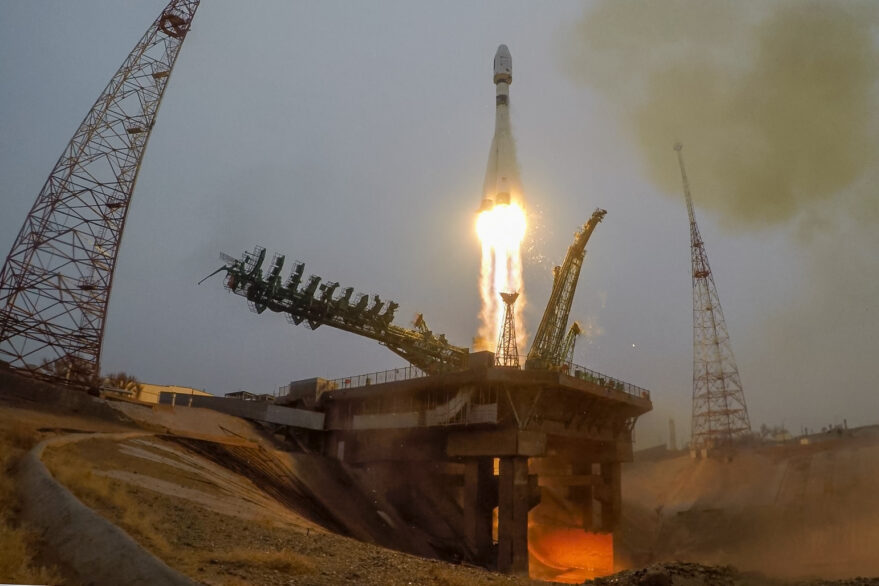
In his infinite wisdom, SpaceX CEO Elon Musk determined the Super Heavy, despite being the most powerful rocket built to date, didn’t need such protective systems, because building them and their associated infrastructure would be difficult in the confines of the land available at the launch facilities, and would be both time consuming and costly. Hence the massive damage caused during the April 20th launch, and – in the last two months the hasty repairs and the installation of the new – and somewhat novel – deluge system.
This essentially comprises a sandwich of multiple steel plates and water hoses under the launch mount which resemble a huge inverted showerhead. It is designed so that water pumped through the system at massive pressure is delivered to the space under the launch mount as a giant spray supposed to absorb the sound and heats of the rocket engines through flash vaporisation as it make contact with the engine exhausts.
The result certainly looks impressive in videos of the July 28th test, with many Starship fans commenting at the way its raw power directed water over the top of the Earth berm intended to protect the propellant loading tank farm some 80 metres away as if that was the focus of the test.
However, looking impressive doesn’t actually mean “being fit for purpose”, as some have already started pointing out. For example, as the video demonstrates, in order to avoid giving each of the 33 engine bells of the Super Heavy a personal enema, the majority of the water is directed out and away from the launch platform, and the centre of the area directly below the booster’s central cluster of 13 engines reveals little more than a thin covering of water. Whether this will be enough to absorb the raw heat of those engines without the metal plates of the deluge system being exposed to the heat and fury of the engines is questionable.
Additionally, NASA delivers some 1.8 million litres of water to their launch facilities to counter the approx. 4 thousand tonnes of thrust generated by their Space Launch System at launch. By comparison, the SpaceX system is apparently limited to delivering 1.4 million litres of water to counter 7.5 tonnes of thrust generated by Super Heavy – which would seem to be something of an imbalance, even given NASA’s predilection to be massively over-cautious and potentially go over-the-top with their use of water.

Finally, there is the question of run-off. The Federal Aviation Administration (FAA) has apparently signed-off on a “limited” water deluge system without any collection pools for used (and possibly contaminated) water. It is clear from broader films of the July 28th test that SpaceX has given no through to containing any such run-off, allowing the spent water to simply flow off the launch facilities and down into the protected wetlands.
Given the FAA is already being sued by a number of conservation and environment groups for its failure to properly enforce its own Programmatic Environment Assessment (PEA) at the SpaceX site, this continued cavalier disregard for the surrounding environment by SpaceX could result in a strengthening of that case. In particular, it might result in a finding in favour of the plaintiff’s joint demand that the FAA withdraw the Boca Chica launch license until a proper and full Environmental Impact Assessment (EIS) – which could take multiple years – is completed.
In this latter regard, attorneys for the plaintiffs have already produced documentation which indicates the FAA had originally intended to carry out an EIS starting in the mid-2020, but “subsequently deferred to Elon Musk and SpaceX” and only performed the less rigorous PEA. This, they argue, meant the FAA violated the US National Environmental Policy Act.
Currently, and despite on-going work and testing, all launches at Boca Chica are remain suspended whilst the FAA complete an investigation into the April 20th launch failure – an investigation which itself may not be closed until after the court case has been resolved.

 Inara Pey: Living in a Modemworld