Logos representative only and should not be seen as an endorsement / preference / recommendation
Updates from the week through to Sunday, March 19th, 2023
This summary is generally published every Monday, and is a list of SL viewer / client releases (official and TPV) made during the previous week. When reading it, please note:
It is based on my Current Viewer Releases Page, a list of all Second Life viewers and clients that are in popular use (and of which I am aware), and which are recognised as adhering to the TPV Policy. This page includes comprehensive links to download pages, blog notes, release notes, etc., as well as links to any / all reviews of specific viewers / clients made within this blog.
By its nature, this summary presented here will always be in arrears, please refer to the Current Viewer Release Page for more up-to-date information.
Note that for purposes of length, TPV test viewers, preview / beta viewers / nightly builds are generally not recorded in these summaries.
Official LL Viewers
Release viewer: Maintenance Q(uality) viewer, version 6.6.9.577968, promoted Thursday, February 2, 2023- no change.
Release channel cohorts:
No updates.
Project viewers:
glTF / PBR Materials project viewer, version 7.0.0.578792, March 15 – This viewer will only function on the following Aditi (beta grid) regions: Materials1; Materials Adult and Rumpus Room 1 through 4.
Forgotten Hope, March 2023 – click any image for full size
I received an invitation from Clifton Howlett to attend the opening of his latest Homestead region build, and while I was unable to make the event on Saturday, March 18th, I did manage to hop over a couple of times over the weekend and take a look around. Working with Coralile Resident, Clifton is a region designer who puts together imaginative settings which offer places in which to retreat, relax, explore and have fun, each one a little different to the last.
With Forgotten Hope, Clifton and Coralile have come up with a most unusual setting. Hidden from much of the light of day yet still rich with natural growth, it takes a new turn in presenting both a place of mystery for those who like to create stories about the location they visit in-world, and a place where personal time and a little fun can be has for those just seeking to unwind.
A veil of darkness cloaks its mysterious depths, enticing explorers and spelunkers from far and wide to uncover the dark secrets it harbours. Amidst abandoned huts and a submerged ‘plane [you can] embark on an adventure like no other and immerse yourself in the eerie atmosphere of this enchanting location.
– From the Forgotten Hope description and opening invitation card
Forgotten Hope, March 2023
A journey through this underground location – quite where it might be is up to you to decide, but for reasons I’ll come to, I thought of it as perhaps a little twist on the Lost style of mystery – commences within a fairly nondescript cavern. Here, smoke from a slightly out-of-control wood fire pit is slowly – and doubtless suffocatingly – filling the space, encouraging people to seek escape through the arch of a tunnel to one side of the dome-like cavern.
Lit by a smaller fire held in check by a rock of stones, the tunnel floor is wreathed in creeping mist as it descends down roughly hewn steps and doglegs its way into a second chamber. This appears to have been long-used; chests of hand written scrolls sit against the round walls, together with barrels of who-knows what – dried food? water? both? – and stacks of candles and other signs of human occupancy. It is a place suggestive of age and darkness – if anything is to be gleaned from the scrolls at least.
Forgotten Hope, March 2023
An arch leads to a further small cavern where more oddments can be found – including, somewhat incongruously, an upright piano complete with stool and sheet music which all look in remarkably good condition. Both form a strange combination – the chests of scrolls contrasting with the piano and the heap of mouldering mattresses; however, the mystery of these caves is liable to fade into the background after passing through the wood door tucked to one side of this little dome of rock.
Beyond the door is a split in the rock, a narrow defile, a cave taller and somewhat brighter in natural light than those on the other side of the door, perhaps suggesting that daylight is not that far away – a feeling added to by the presence of vines on the walls. Someone has gone to great lengths to lay a path of carefully cut and placed logs to ease passage over the floor of this defile, complete with a hand-made ladder to help people over a rocky lip to reach the cave mouth beyond. This sits high up on a cliff face, the ground and surface of a body of water fed by water plummeting from further around the high cliffs and visible above the tops of trees. However, its is not open land, but rather a vast and high cavern.
Forgotten Hope, March 2023
Mist rises from the waters below the cave mouth to fold itself around the trees, and thin strands of cloud float around the cavern’s high roof, the sunlight which dapples the water falling through a jagged hole in the cavern’s dome, the stray clouds around the hole acting as a prism to break the light into finger-like beams of illumination pointing down into this netherworld of a place. In doing so they fall upon the element which gives this place a Lost-like feel: a partial carcass of an airliner broken and semi-submerged in the water and, perhaps the cause of the rend in the cavern’s roof.
Here is where more mystery grows: was it the people who survived the ‘plane crash who built the path lading back to the entry caverns – and the platforms with their ladders providing the way up to (or down from!) the high cave? Or were they merely the latest inhabitants of this strange world? The evidence of long-term habitation is intriguing: at “ground” level, there is a ramshackle cabin built into the remnants of a once massive tree; there are remnants of cut-stone walls suggesting ancient buildings; board walks and decks pass out over the shallow waters to connect with the the rest of this huge cavern space. Trees grow throughout, whilst a range of wildlife sitting beneath their boughs and amidst the wild grass.
Forgotten Hope, March 2023
If the cabin and other structures located here were built before the nose of the airliner arrived – then who built them? Who was responsible from shipping the large boiler system sitting within the corrugated sides of a ramshackle shed in the second large cavern? Is this a retreat from the world, or a place where people can end up apparently stranded by misfortune – or some form of strange experiment in the human condition? Maybe the weird hooded figure lurking within the setting has some of the answers; or perhaps you don’t find them important.
If you don’t, there’s more than enough to keep you occupied here – the large deck sitting over the water of the first of the big caverns is home to DJ events and dancing, whilst scattered throughout the caverns (and up in their rocky walls) are places to sit and cuddle or read a book, with sofa and wine available by the bottle whilst the local wolves, snakes and alligator are content to let people freely come and go without being in anyway bothersome.
Forgotten Hope, March 2023
A strange but engaging world, Forgotten Hope makes for an engaging visit and serves as a spark for the willing imagination.
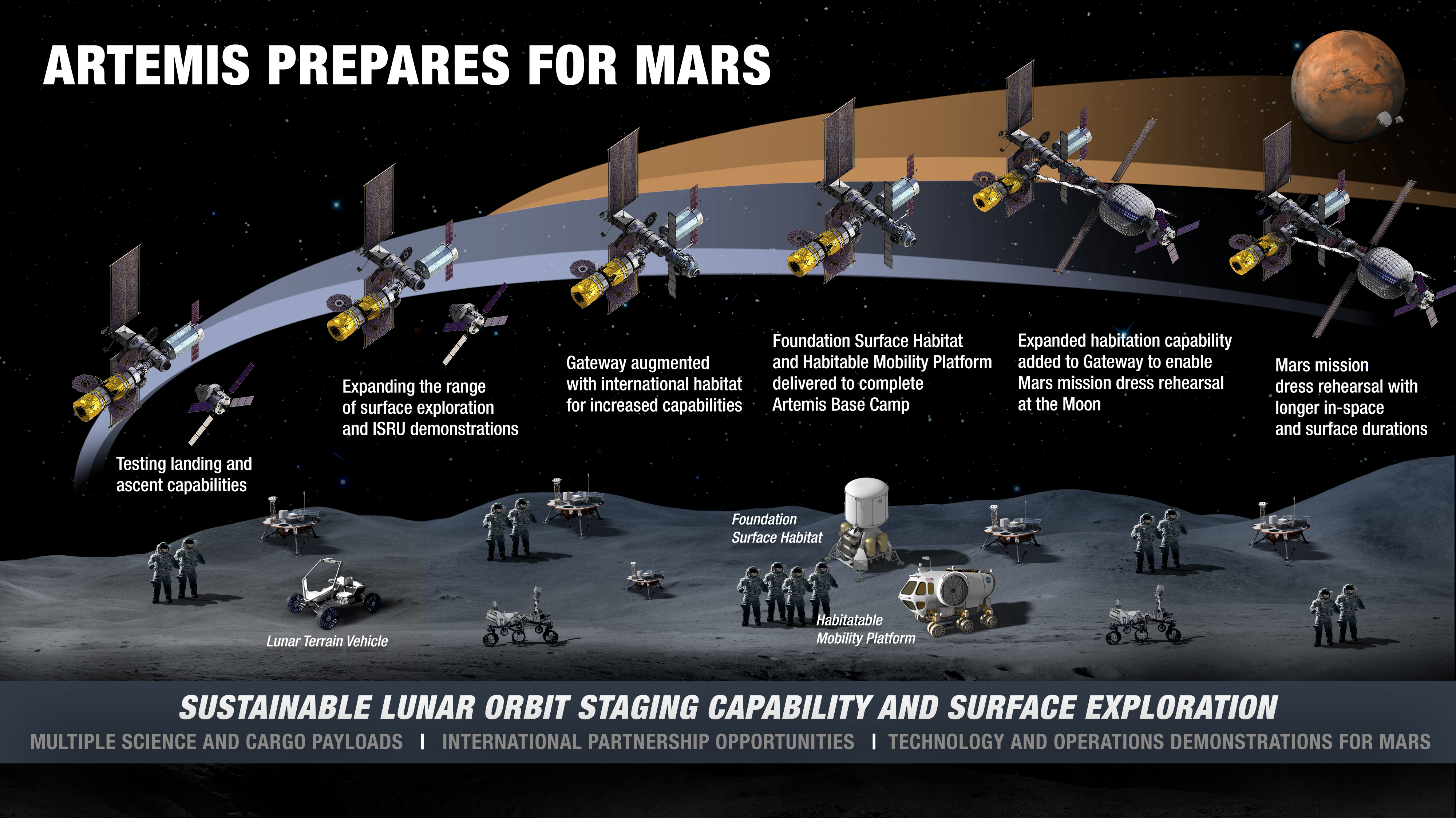
The Biden Administration has published further details on it 2024 budget proposal in support of NASA in which further details of the agency’s “Moon to Mars Manifest were revealed. Key points on the latter include:
The crewed Artemis 2 mission, intended to fly a crew around the Moon in an extended mission similar to that of the successful Artemis 1, confirmed for November 2024.
Artemis 3, the first mission to return humans to the surface of the Moon by the United States, is scheduled for 2025.
Artemis 4, the second crewed landing on the Moon now pushed back to 2028, with annual landings from there on through to the end of 2031.
Both Artemis 3 and Artemis 4 will utilise the SpaceX Starship-based Human Landing System (HLS) for carrying crews to / from the lunar surface and lunar orbit, after which crew activities will switch to the (still to be contracted) “sustainable human landing system”.
2024 will also – in theory – see a demo flight of the SpaceX HLS, whilst the end of 2025/start of 2026 will see work commence on the Lunar Gateway station with the launch of the power module and habitation module to their extended lunar orbit.
2028-2031 will also see work continue on the Gateway station alongside of the lunar landings.
Automated mission to the Moon in 2027 will demonstrate lunar construction techniques for developing a base, extracting usable commodities from the lunar surface, and testing power systems. Further demonstrations of these will take place in 2030.
The NASA Moon to Mars infographic, which formed a part of the White House NASA 2024 budget proposal. Crew NASA – click for full size
In support of the above will be a series of demonstrator missions in Earth orbit, as well as development work on Earth for longer-term goals. These include:
In-space propellant replenishment and storage for reusable lunar landers and deep space transportation vehicles under a programme referenced as CFM: Cryogenic Fluid Management, involving SpaceX (optimistically in 2023), Lockheed Martin (2025) and United Launch Alliance (2025).
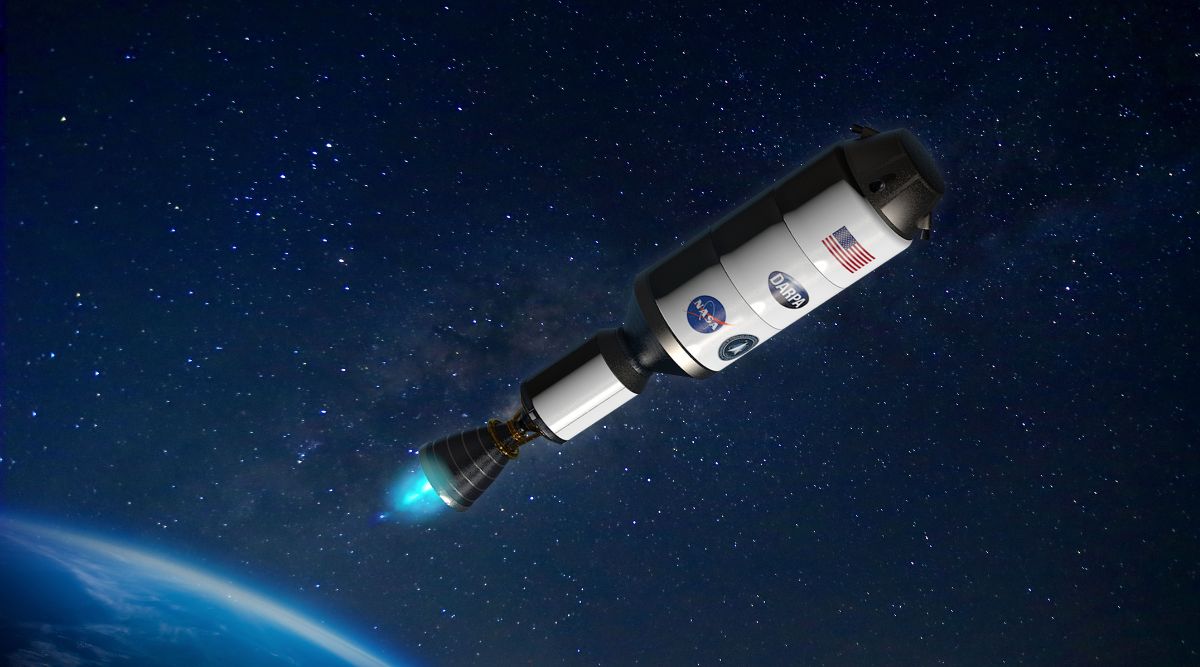
Development and delivery of a nuclear fission power unit demonstrator for use on the Moon or Mars, to the surface of the Moon in 2030.
An artist’s impression of the NASA/DARPA DRACO NTP demonstrator, included in the NASA 2024 budget proposal. Credit: NASA
The budget proposal includes an immediate request for US $180 million for the agency to start seeking proposals for a “deorbit tug” for the International Space Station (ISS). This would be a vehicle developed over multiple years and at a total cost of around US $1 billion specifically designed to dock with the ISS in 2030 and the proceed to gently push it back into Earth’s atmosphere along s pre-planned course so that it burns-up and the large element splashdown at Point Nemo.
Also within the 2024 allocation is US $30 million in support of Europe’s ExoMars rover, and an increased request for NASA’s side of the proposed NASA / ESA Mars Sample Return Mission.
ExoMars Back on Track / Sample Return on Track for Budget Overrun
The US $30 million requested in NASA’s 2024 budget is in part to provide ESA with a launch service for Rosalind Franklin, ESA’s ExoMars rover vehicle, together with various technology support activities for a lander vehicle.
This project has had its share of issues over the past two decades, and up until 2022, the plan had been for a joint mission with Russia, the latter providing the launch vehicle and a lander to deliver the rover to the surface of Mars. However, Russia’s invasion of Ukraine ended all ESA / Roscosmos cooperation.
Since then, ESA has remained relatively close-lipped about the rover’s future, but in a recently update, mission personnel confirmed 2028 is now being targeted for the mission’s launch. In addition they indicated that the agency will now build a dedicated lander for the rover which will leverage NASA’s expertise in propulsion, power and heat shield development. In addition, ESA has resumed testing of Amalia, the rover’s test bed vehicle.
The video below provides an inside look at Rosalind Franklin, and what marked the ExoMars rover mission unique among Mars missions.
In the meantime, the ambitious NASA / ESA Mars Sample Return (MSR) mission is threatening to overwhelm other elements of NASA’s science programme.
For the 2024 budget proposal, the White House has requested US $949.3 million for MSR – 19% more than the budget projection. It also notes that expenditure on the project will increase over projections through to the planned launch in 2028.
Working in concert with NASA’s Perseverance rover, which has been collecting samples from its travels across Jezero Crater and has recently started caching them for collection by MSR, the sample mission is designed as a two-part mission using a ESA-developed Mars orbiter to return the Perseverance samples to Earth, after they have been collected from the surface by a lander / recovery / ascent vehicle, primarily built by NASA.
An artist’s impression of the NASA / ESA Mars Sample Return mission. Credit NASA / ESA
NASA has already delayed the Venus Emissivity, Radio Science, InSAR, Topography, and Spectroscopy (VERITAS) mission, which had been due for launch in 2028 prior to being put on hold in November 2022 over concerns about MSR costs, and will now not launch before 2031 – if at all. Now, the Geospace Dynamics Constellation (GDC) mission, a 2013 heliophysics decadal survey recommendation, will now also be suspended. MSR itself was expected to exceed US $7 billion prior to it being revised in an attempted to lower costs – however, it was approved for continuance in 2022 under the Planetary Science Decadal Survey, on the understanding total costs would not exceed US 5.2 billion – which it still might.
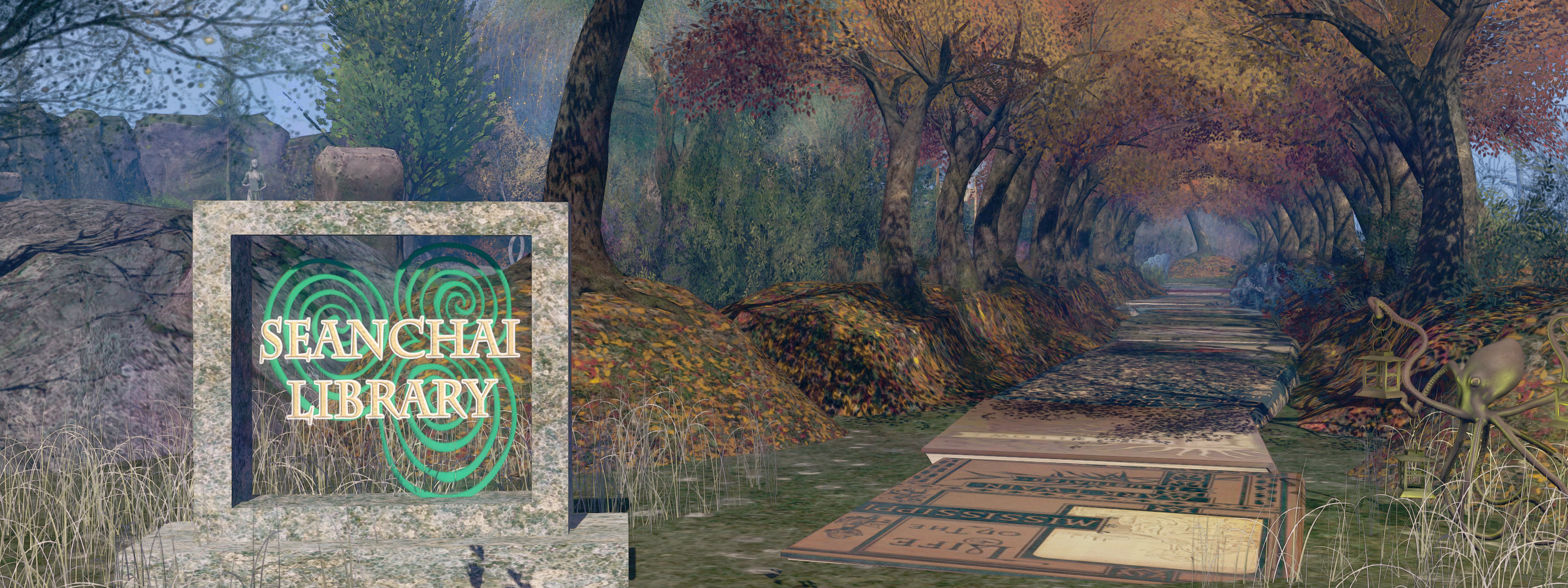
It’s time to highlight another week of storytelling in Voice by the staff and volunteers at the Seanchai Library – and this week previews the launch of a very special event.
As always, all times SLT, and events are held at the Library’s home in Nowhereville, unless otherwise indicated. Note that the schedule below may be subject to change during the week, please refer to the Seanchai Library website for the latest information through the week.
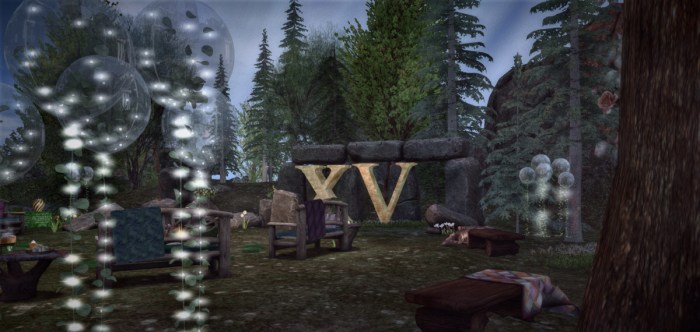
Sunday, March 19th, VOLUME XV: Seanchai Library Celebrates 15 Years!
Celebrate Seanchai Library’s 15th anniversary at Ceiliuradh Glen.
13:30: Corwyn Allen, Live!
14:00-16:00: Stories and Poetry.
Seanchai Library at 15
Monday, March 20th, 19:00: The Golden Compass (aka Northern Lights)
Originally published in 1995 as Northern Lights, The Golden Compass forms the first volume in Philip Pullman’s multiverse-spanning trilogy His Dark Materials.
In a world resembling Edwardian England, where magic is commonplace, young Lyra Belqcqua slip into the Retiring Room at the collage where he uncle is about to give a lecture – only to witness the Master of the college add poison to the wine intended for her uncle, Lord Asriel, prior to his arrival in the room. Warning him, she is rewarded by being allowed to remain and witness her uncle’s presentation, in which he discusses something called “Dust”, shows images of the northern lights in which there appears to be a city, and something else called the “panserbjørne”.
At the same time, children within Oxford are vanishing, kidnapped by a sect called the Gobblers, for a nefarious purpose – and Lyra is determined to find out why. In doing so, she is brought back into contact with the Master – who surprisingly gives her an alethiometer, a truth-telling device – and is offered the opportunity to live with the glamorous Mrs. Coulter, which comes as a thrill.
But as the mystery of the missing children deepens and Lyra determines to follow their trail north, so she discovers that Mrs. Coulter is not all she appears to be – and nor is her Dust-obsessed uncle, Lord Asriel.
Born into a time shortly after the Romans have departed Britain, now once again divided into a series of kingdoms, Myrddin Emrys, also known as Merlin, is the illegitimate son of a Welsh princess, who refuses to name his father. Small for his age and often abused or neglected, Merlin occasionally has clairvoyant visions which, together with his unknown parentage cause him to be referred to as “the son of a devil” and “bastard child”.
After being taught to harness his abilities by the hermit, Galapas, Merlin eventually find his way to Brittany, who teaches him to use his psychic powers as well as his earthly gifts, Merlin eventually finds his way to Brittany and the court of Ambrosius Aurelianus, where he joins the war leader’s plans to invade Britain and defeat Vortigern and his Saxon allies, and unify the nation as its High King.
Discovering he is Ambrosius’s son, Merlin returns to Britain and is captured by Vortigern, who believes the only way his new fortress can remain standing is through the sacrifice of the “child with no father” – Merlin. The latter, however, discerns the real reason the walls of Vortigern’s fortress keep collapsing and plays into the king’s superstitious nature, and commences his life as a king’s advisor, even whilst seeking to support Ambrosius in his goal. Thus begins the adventures of a young boy who will eventually become the advisor to Britain’s Once And Future King.
The Great Library of Eruanna, January 2023 – blog post
The following notes were taken from m y audio recording and chat log transcript of the TPV Developer (TPVD) meeting held on Friday, March 17th 2023 at 13:00 SLT.
These meetings are chaired by Vir Linden, and their dates and times can be obtained from the SL Public Calendar; also note that the following is a summary of the key topics discussed in the meeting and is not intended to be a full transcript of all points raised.
Official Viewers Status
Release viewer: Maintenance Q(uality) viewer, version 6.6.9.577968 Thursday, February 2.
Maintenance S RC viewer, version 6.6.10.578270, issued February 24.
Performance Floater / Auto FPS RC viewer updated to version 6.6.10.578172, February 21, 2023.
Project viewers:
PBR Materials project viewer, version 7.0.0.578792, March 15 – This viewer will only function on the following Aditi (beta grid) regions: Materials1; Materials Adult and Rumpus Room 1 through 4.
Puppetry project viewer, version 6.6.8.576972, December 8, 2022.
General Viewer Notes
The Performance Floater / Auto FPS viewer is still being worked on in the hope that performance can be further improved on lower-end systems.
Work is also being carried out to have the viewer work with a broader cross-section of translation tools.
Inventory Enhancement Project
The work to provide thumbnail images of folders and items in Inventory is progressing on the viewer-side, but deployment will be dependent on both viewer availability (project / RC to release) and assorted back-end service and simulator updates to handle the new data.
Once the thumbnail preview work has been completed, it is possible the Lab will look to further enhancements to inventory management. One future enhancement under consideration is support for folders to be included in the Contents inventory of individual objects.
In Brief
See also my CCUG meeting summary, as this meeting crosses topics with that.
Estate Level Scripted Agent Controls (aka “Ban the Bots”): per my SUG meeting notes, there is a new simulator release due to be deployed which will provide estate / region holders and their managers limit access to their regions by scripted agents (bots).
This work will initially be console-based in the viewer until UI updates can be made and a viewer update with them deployed.
However, a bug has been found in the simulator code, which is currently being worked upon. The hope is this will be fixed without any delay to the code being rolled-out.
It was re-iterated that the next major new graphics project following glTF materials is likely to be support for Vulkan / MotenVK as the graphics API of preference (Windows / Mac). No time frame on when this work will commence, tho.
As I reported in November 2022, Atlassian has announced it will be restructuring how it licenses the Jira bug reporting product from 2024 onwards.
No decision on the direction LL will take as this change in made has as yet been taken, but there are ongoing internal discussions on options.
However, at this point it appears as if whatever route LL decides to take, they will need to review how public issues are raised and passed to them, etc.
Dragonfly, March 2023 – click any image for full size
Dragonfly is a Full private region designed by the Mad Ninjaz, offering a fascinating setting built along vertical lines and which – on first arrival – can appear deceptive to the eye.
The landing point sits within what at first appears to be a rocky landscape, close to a Japanese style of house built over an artificial pool of water. It looks for all the world like an ordinary setting – until one starts to look around, and the floating islands with water falling free to reach nearby pools come into view. A further indication of the strangeness to the land comes in the form of the large hole in the ground behind the landing point (be careful if stepping back too far on landing!) which reveals another world; one which I’ll come to.
Dragonfly, March 2023
A Torii gate marks the entrance to the house, and more march away to the east, following the water flowing away from the pool over which the house has been built. Crossing a small bridge over the water, the gates turn south, marking the way where large basalt blocks sit as oversized stepping stones across mist-covered waters to large to stone steps curving up a hill.
The hill top is marked by more basalt rock forms and patterns of pools fed by waterfalls dropping from more floating islands. Torii gates continue to mark a path over around and between all of these to lead visitors to where a path winds its way up a naked table of rock to where more pools of water – these made by humans – can be found, forming hot baths for relaxing, with little hideaways sitting with them.
Dragonfly, March 2023
Down below, sheltered under the table of rock supporting the gardens is a waterlogged town, a place of many focal points. How you get down is something I’ll leave to your to discover – although jumping down through the hole in the land is perhaps the quickest!
Here, along flooded streets can be found a curious mix of shops, event spaces, industrial units, giant pipes, elevated tramways, all mixed together in a strange mix that is both vibrant and filled with neon, but also edged with a sense of dystopia and the alien in the form of the basalt/crystal rock formations.
Dragonfly, March 2023
The tram keeps itself busy trundling back and forth along the short length of elevated track, stairs from the shallow waters leading up to two little platforms where people can board it for the short ride if they wish. A further Torii gate sits close to one of the tram stations, marking the maw of what might be a cave, neon-lit steps rising into the darkness. Step through them into the cave’s mouth and visitors arrive in a huge cavern and a strange mix of shopping mall and suggestions of clubs and hidden spots.
There is more to be found at or near water level awaiting cameras and explorers, perhaps the more obvious of which is the glowing tree of a large pagoda again lit and limned in neon. Called the Jewel Box, it is a strange mix of old, modern and futuristic, water again forming a central feature – together with a Chinese dragon. Stairs climb between the various floors, allowing the building to be thoroughly explored.
Dragonfly, March 2023
A second pagoda sits across the region from the Jewel Box, but while it is watched over by a guardian of its own – one perhaps a little more frightening in visage than the dragon at the Jewel Box, it is a shell without interior, offered as a potential focal point for photographs. Some of the other buildings rising from the water are also shells in form, but equally, other have interiors, some of which are again diverse in form – such as a winter garden sitting between apartments. As such, time should be taken with wanderings and looking.
Very much a place of two halves, Dragonfly is richly diverse and wee-presented with a lot of small details waiting to be found. The local sounds can be a little intrusive in places, but overall a very different style of place to explore in Second Life.





 Originally published in 1995 as Northern Lights, The Golden Compass forms the first volume in Philip Pullman’s multiverse-spanning trilogy His Dark Materials.
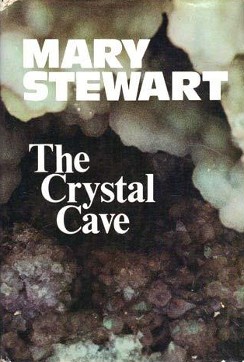 Born into a time shortly after the Romans have departed Britain, now once again divided into a series of kingdoms, Myrddin Emrys, also known as Merlin, is the illegitimate son of a Welsh princess, who refuses to name his father. Small for his age and often abused or neglected, Merlin occasionally has clairvoyant visions which, together with his unknown parentage cause him to be referred to as “the son of a devil” and “bastard child”.


 Inara Pey: Living in a Modemworld