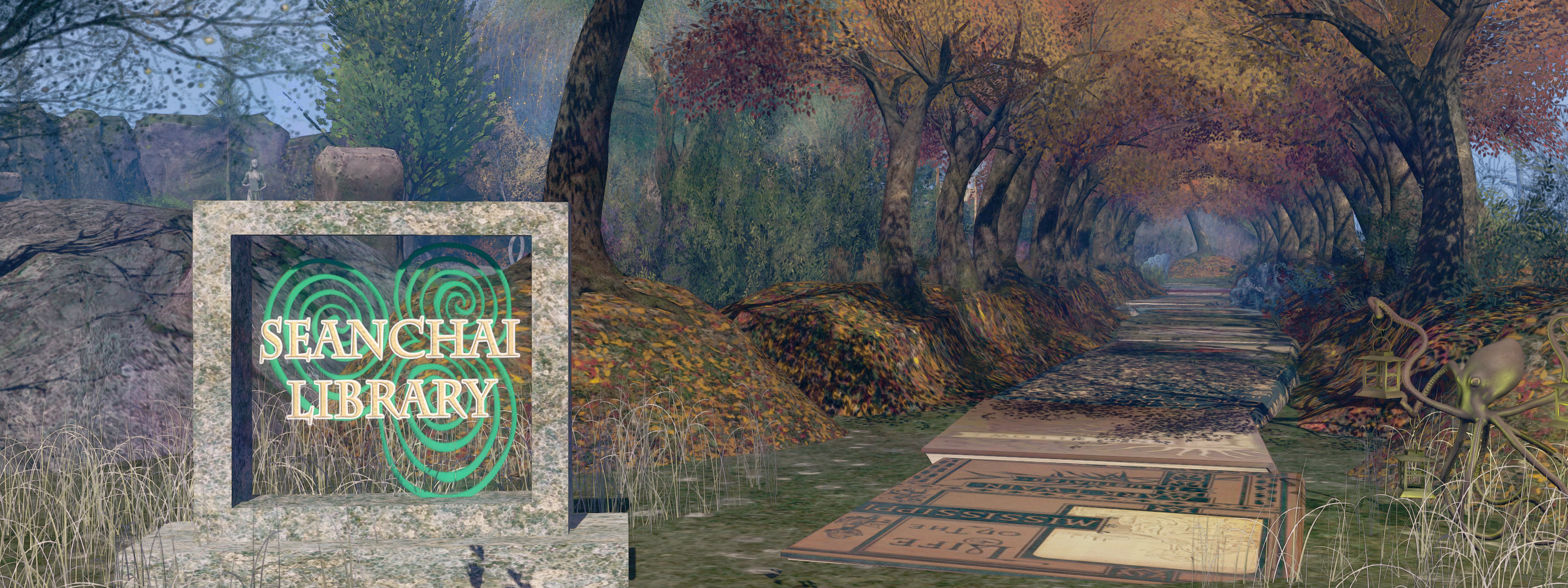
It’s time to highlight another week of storytelling in Voice by the staff and volunteers at the Seanchai Library. As always, all times SLT, and events are held at the Library’s home in Nowhereville, unless otherwise indicated. Note that the schedule below may be subject to change during the week, please refer to the Seanchai Library website for the latest information through the week.
Monday, June 13th, 19:00 Dandelion Wine
The inventor who almost took the pleasure out of life by building a Happiness Machine; the young reporter who fell in love with an alluring lady of ninety; the old gentleman whose last act was listening to the clang of a green trolley car going round a corner, two thousand miles away.
These are just a few of strange and vivid people who entered the secret world of a twelve-year-old boy during one enchanted summer when he discovered the fact that he really was alive…
“The summer of ’28 was a vintage season for a growing boy. A summer of green apple trees, mowed lawns, and new sneakers. Of half-burnt firecrackers, of gathering dandelions, of Grandma’s belly-busting dinner. It was a summer of sorrows and marvels and gold-fuzzed bees. A magical, timeless summer in the life of a twelve-year-old boy named Douglas Spaulding—remembered forever by the incomparable Ray Bradbury.”
The Kingdom of Galaway has a law – The Test of Kings – that every heir to the throne must work a year and a day as a commoner in order to prove they are worthy of being ruler. Not a great law when you are as lazy and indulgent as Prince Larry.
He find that on his day, he must become servant to a former slave, Brishee, as she is conscripted to find the lost artefact, The Shield of Many Uses. However, the evil Percy has other ideas. Via murder and conspiracy, he intends to usurp the throne of King Willy.
Will Larry survive in his role as servant to Brishee? Will she succeed in her quest – and Larry, by extension, succeed in The Test of Kings, or will he be the first to fail, and Percy thus succeed?
The King, meanwhile, has problems of his own: why does Cruith the Crone keep stealing his chickens? Why is she always the first in line to bend his ear on Beggar’s Day?
Caledonia Skytower reads M.J. McGalliard’s first volume in the Beggar’s Day series.
Wednesday, June 15th: Seanchai Flicks
A special for Star Wars month as the Seanchai cinema space plays host to videos and throw popcorn around!
Thursday, June 16th: Thursday Night Science Fiction
Logos representative only and should not be seen as an endorsement / preference / recommendation
Updates from the week ending Sunday, June 12th, 2022
This summary is generally published every Monday, and is a list of SL viewer / client releases (official and TPV) made during the previous week. When reading it, please note:
It is based on my Current Viewer Releases Page, a list of all Second Life viewers and clients that are in popular use (and of which I am aware), and which are recognised as adhering to the TPV Policy. This page includes comprehensive links to download pages, blog notes, release notes, etc., as well as links to any / all reviews of specific viewers / clients made within this blog.
By its nature, this summary presented here will always be in arrears, please refer to the Current Viewer Release Page for more up-to-date information.
Note that for purposes of length, TPV test viewers, preview / beta viewers / nightly builds are generally not recorded in these summaries.
Official LL Viewers
Release viewer: version 6.6.0.571939 – formerly the Performance Improvements viewer, dated May 25th – No change.
Release channel cohorts:
Nomayo Maintenance RC (Maintenance N) viewer, version 6.6.1.572179, June 1.
Golden Hair, June 2022 – click any image for full size
Golden Hair is a Homestead region held by BruiserBest and open to the public to visit and appreciate. Defined as a being a place “in defence of quiet places”, it is an engaging, very natural setting that reflects Bruiser’s love of nature and animals. It is also a demonstration of what can be achieved within a region to offer a rewarding visit to those who drop in without being in any way top-heavy in either mesh objects or textures.
Sculpted into a curving island which occupies roughly a third of the region’s total land area, Golden Hair gently undulates outwards from a rocky upland flowing into the main island from a northern headland, the slope rising gently until it meets west-facing cliffs, and then dropping away gently on its way to the south.
Golden Hair, June 2022
The top of this hill provides a superb vantage point from which to observe the island’s western and southern aspects. More particularly, tucked into the hill behind its cliff-edge is a small cave which forms the region’s landing-point. This ensures those arriving do not interrupt those already in the region and who may be taking photos, by avoiding avatars suddenly popping-up into the frame.
Both the cave and the rugged ground outside of it reveal Bruiser’s love of animals – a bear stand quietly inside the cave, while outside can be found deer apparently informally guarding the cave’s entrance.
Golden Hair, June 2022
A steam bubbles its way past the cliffs, running from the southern side of the main hill to pass by the cliffs and a small hill on its far bank. Tumbling over rocks and a fallen tree, the stream is a haven for animals seeking a drink, with its lower extent patrolled by a beaver.
The wildlife here is to be found throughout the setting, together with some more domesticated animals. In the case of the latter can be found cats, dogs, goats, horses, sheep, chickens, and a cow; with the former there are birds, the deer, wild boar, wolves, a snake, lizards, hares, and rabbits. However, none of the islands inhabitants have been randomly placed; gathered in groups at various points around the island, they offer little vignettes that are ideal for photography, either in their own right or with avatars suitably posed (rezzing rights can be obtained by joining the local group, 2 hour rez time).
Golden Hair, June 2022
This is a setting refreshingly free from the trappings of civilisation. There are no houses or other significant structures; the paths are – with one small exception where kerbs have clearly been laid to allow the ground to be pounded into a series of broad steps – all entirely natural, either following the line of flat rocks exposed over the years by the passage of the wind, or dusty trails most likely laid down by the passage of the animals to be found here.
The open nature of the region means that exploration is entirely on the whim of the visitor, while the nature elegance of its design presents opportunity after opportunity for photography. Those who look carefully may also spot the island’s more exotic animals, drawn from the world of fantasy.
Golden Hair, June 2022
Finished with an encompassing soundscape in which the heart of nature quite literally beats, Golden Hair might lack places to sit / cuddle, etc., but this is to its advantage as it is very much a setting to be appreciated through exploration and not for plonking oneself down and chatting.
All told, a genuinely engaging setting well worth visiting. My thanks to Shawn Shakespeare for the landmark to Golden Hair.
Artemis 1 SLS on the Mobile Launcher 1 inside the Vehicle Assembly Building. Credit: NASA
Artemis 1, the planned first flight of NASA’s huge Space Launch System (SLS), is back on Pad 39B at Kennedy Space Centre and being prepared for another try at a full Wet Dress Rehearsal in what many are framing as a make-or-break for the new launch system. At the same time, the SLS programme has come under further critique by NASA’s own Office of Inspector General (OIG).
As I’ve noted in the past, the Wet Dress Rehearsal (WDR) is the final critical test for the SLS system, putting absolutely everything involved in a launch through its paces right up to just nine second before the rocket’s core RD-25 engines would light-off. The test is to ensure everything – the pad systems, the propellant loading systems, the rocket’s computers and avionics, the launch control systems, etc., are commissioned and ready for operational launch, with the data gathered from this first rocket going on to provide a baseline for checking future SLS vehicles as they go through pad preparations and launch in the future.
A graphic showing the tank filling which forms a core element of the WDR, currently scheduled for or around June 17yh, 2022. Credit: NASA
The first attempt at a WDR, back in April started with fanfare a high-profile roll-out of the pad by the first SLS, where it successfully completed a battery of tests prior to the WDR commencing, only to be followed by a series of issues that forced rocket and Mobile Launcher (ML-1) tower to be ignominiously rolled back to the Vehicle Assembly Building (VAB).
The June 6th roll-out was far more low-key, the rocket and ML own leaving the VAB atop the veritable crawler-transporter just after midnight and arriving at the pad in the morning sunlight. Since then, the vehicle and launcher have been going through check-out and connection to all the ground support systems, and a second WDR attempt is provisionally set for on or around June 17th, 2022.
In the meantime, NASA’s OIG has issued a report critical of another aspect of the programme: Mobile Launcher 2 (ML-2).
ML 1 was originally built for launching Saturn 1B and Saturn V rockets in the 1960s. It was then modified for space shuttle launches and again to handle SLS Block 1 launches. However, it is incapable of supporting launches of the bigger and more powerful SLS Block 1B and Block 2 vehicles (assuming the latter are built). So in 2018/19, NAS awarded a US $383 million contract to engineering firm Bechtel to supply a new Launcher – ML-2 – capable of supporting SLS Block 1B and beyond launches, with delivery slated for 2024, ahead of the then planned launch of Artemis 4, the first SLS Block 1B vehicle.
However, the OIG report reveals that ML-2 is spiralling out of control, with costs already exceeding US $440 million, and set to hit at least US $960 million, with doubt cast on Bechtel’s ability to deliver the Launcher in time for Artemis 4, even though that mission is unlikely to fly before later 2027 or early 2028.
Comparing ML-1 and ML-2. Credit: NASA
The report is primarily critical of Bechtel for multiple failures and lapses, but also points out NASA’s own folly in playing “yes man” to an accelerated Artemis programme. Originally, the US return to the Moon was to commence in 2028, but the Trump administration pulled that date forward to 2024; while that was clearly unachievable, NASA attempted to meet the goal. As a result, the ML-2 contract was awarded as “cost plus”, meaning that overruns would be met out of NASA’s pocket, rather than fixed price, which would leave Bechtel holding the purse for errors and delays on their part. NASA further compounded the issue by awarding the contract for the ML-2 design before the SLS Block 1B design had been finalised. As a result, the space agency immediately became liable for continued changes to the ML-2 design as the SLS Block 1B design evolved.
Currently, NASA is attempting to move the contract to a fixed price basis; unsurprisingly, Bechtel appear somewhat resistant to doing so.
FRBs: Far, Far Away – or a Lot Closer to Home?
First discovered in 2007, FRBs are intense, brief flashes of radio-frequency emissions, lasting on the order of milliseconds, thought to emit as much energy in a millisecond as our Sun does over three days – although such are the vast distances they must cover, by the time they reach us their signal strength is around 1,000 times less powerful than a mobile ‘phone signal being received from the Moon.
What causes FRBs is unknown. Most have been thought to originate outside our galaxy – although some have clearly originated within it. Many are heard only once; others appear to repeat on a highly random basis. By listening for and measuring some of the latter, it has been possible to localise their likely point of origin to an area of space. Then, using their dispersion measurement (DM) and overall red-shift, it has been possible to calculate their approximate distance.
ive hundred-metre Aperture Spherical radio Telescope (FAST. Credit:
The DM a measurement of the period between the high-frequency range of a radio burst reaching us and the lower frequencies, which tend to get more dispersed more the first they travel, and so take longer to reach us. It’s a small, but measurable amount. As the composition of interstellar space is known, this difference can be used to calculate signal attenuation over distance, and thus the approximate distance of the originating object from Earth.
This measurement can then be combined with the overall red shift exhibited by the signal to yield a similar distance result, thus allowing reasonable certainty as to how far away the originating object is. But that’s not the case with FRB 20190520B.
What is particularly interesting about this FRB is that taken on its own, its DM suggests it originates in a small galaxy beyond our own. However, when the DM / red-shift relationship is extrapolated, the result suggests the originating point is a lot closer to Earth – as in possibly within our own galaxy.
This might make 20190520B some weird outlier among FRBs – but as some have pointed out, it might also indicate to our entire assumptions about extra-galactic FRBs and the use of dispersion measurements as a kind of “cosmic yardstick” as being totally wrong; that we could actually be mistaking events occurring within our own galaxy that result in FRBs for something far more distant and exotic.
Right now, it’s too early to tell either way, but 20190520B has caused a considerable stir among astronomers, with many looking to step-up the search for more of these strange events.
The following notes were taken from the video recording by Pantera (embedded at the end of this piece, my thanks to her as always for recording the meetings) of the Third-Party Viewer Developer (TPVD) meeting on Friday, June 10th, 2022 at 13:00 SLT. These meetings are chaired by Vir Linden, and dates for them can be obtained from the SL Public Calendar.
Important: as from this meeting, the TPV Developer meeting has moved to a four-week schedule.
Please note that this is a summary of the key topics discussed during the meeting and is not intended to be a full transcript of either. However, the video does provide a complete recording of the TPVD meeting, and timestamps to the relevant points within it are included in the notes below.
Nomayo Maintenance RC (Maintenance N) viewer, version 6.6.1.572179, June 1.
Makgeolli Maintenance RC viewer (Maintenance M) viewer, version 6.5.6.571575, May 12.
Project viewers:
Performance Floater project viewer, version 6.5.4.571296, May 10.
Mesh Optimizer project viewer, version 6.5.2.566858, dated January 5, issued after January 10.
Legacy Profiles viewer, version 6.4.11.550519, dated October 26, 2020.
Copy / Paste viewer, version 6.3.5.533365, dated December 9, 2019.
General Viewer Notes
The Performance Improvements viewer has had a couple of “significant issues” raised against it, which are being pulled into the Maintenance RC channels for resolution. One of these might be BUG-232200 (extreme mouse sensitivity based on DPI), although no specifics provided at the meeting.
The Legacy Profile project viewer (finally) looks like it may be getting some attention in the near future, in the hope it can move forward to RC status at some point.
This work is currently focused on implementing a new materials asset type that will allow materials surfaces created utilising the PBR workflow to be imported to SL and then applied to their desired object face(s).
A parallel piece of work is adding sport to SL for reflection probes to update the generation of the environment maps (because the current cube mapping used by SL is limited and would not work will with PBR).
Current Progress
Simulator-side support for reflection probes is being added, together with updates to the EEP system in support of the changes. This work is being implemented so that (hopefully) viewers without the necessary rendering updates will not see any “breakages” to the environment as the simulator work progresses through Aditi to Agni.
These updates are currently on Aditi on the DRTSIM542 channel (Materials 1, Rumpus Room, Rumpus Room 2, Materials Adult).
LSL support for this work still TBD.
There is now a test version of the viewer for the materials work available through the SL Discord server #content-features channel.
A glTF importer will “hopefully be ready in the next week or so”, although it will be a work-in-progress,
There is a texture streaming overhaul in progress. This changes the number of threads used in texture decoding and how the decoding on the background threads is handled, and should see a noticeable improvement in texture rendering when available & incorporated into viewers.
This work will likely be available ahead of the materials work mentioned above, but it has not been determined if it will form a dedicated project / RC viewer or be folded into a Maintenance RC.
TPV developers who may have been working recently on the texture threads, may want to take note of this and listen to this portion of the video, given that a number of threads have been removed o eliminate conflicts.
Part of this work is focused on trying to get a “good honest answer” from the operating system running the viewer as to how much video memory is actually free for the viewer to use.
In general (and despite the VRAM slider) the official viewer typically uses between 512 MB and 2GB of video memory (when available on a system), but runs into trouble trying to balance using anything over 512 MB with the 512 MB “limit”, thus causing issues of texture thrashing.
This work will likely see the removal of said slider as well.
Once completed, these changes should see the viewer work more “cooperatively” with other applications running on a client system:
As video memory is required by other programs, to the viewer will relinquish it; as video memory becomes available, so the viewer will attempt to use it.
As video memory is relinquished, the viewer will attempt to “intelligently” unload textures – such as those in the background/occluded, those far away, etc., to reduce the amount of visible texture blurring / unblurring as textures are unloaded /reloaded.
This work will hopefully benefit the viewer across all operating systems, although there are issues around getting Mac OS to report the amount of free video memory, and AMD GPUs are also proving a little difficult in their reporting of memory use.
The structure being used for the Windows enquiries can be found here.
In Brief
[Video 22:50-27:52] Discussion on alpha masking on avatars / rigged mesh, including reports on some content with transparent rigged meshes appearing broken as a result of changes to the draw order.
A lot of the reported breakage appears to be the result of creators “cranking the handle” to achieve results, without actually fully understanding either what they are doing or how the viewer’s rendering system works.
The changes being made now are part of trying to make the draw order more logically consistent with a view “maybe someday” being able to explicitly set the ordering priority for the draw order.
[Video 28:11-36:00] Advanced Lighting Model (ALM) vs. non-ALM (aka “forward rendering”). LL are strongly leaning towards getting rid of the non-ALM rendering path, providing it can be shown that this does not adversely impact performance (e.g. ALM runs roughly as well as non-ALM for those using the latter) on the broad cross-section of hardware most commonly operated by SL users.
This may raise concerns among the minority on metered connections (as it will increase the amount of data crossing their network in handling materials, etc.), so consideration is being given to including a “data saving mode” into ALM that will prevent the sending for materials data.
Another problem is that of general education. A lot of people still think that enabling ALM means they “must” run with shadows enabled (which does cause a significant performance hit), without realising they can disable shadows from Preferences → Graphics the Shadows drop down. De-coupling automatic shadows enabling from ALM may help rectify this.
Similarly, local lights can be a performance hit with ALM as the number can be unlimited, as opposed to the cap of six rendered lights under non-ALM rendering), so the suggestion is to have a slider to allow the user define how many local lights are rendered in their view under ALM.
[Video: 38:22-39:48] removing the non-ALM rendering path would also mean the removal of the Atmospheric Shaders checkbox, the avatar cloth checkbox (which user generated content cannot access anyway), the Bump Mapping and Shiny (low, medium high) drop-downs,
[Video: 36:10-40:04] The Performance Improvements Floater viewer (still at Project viewer status at the time of writing, and not to be confused with the Performance Improvements viewer now at release status) makes some changes to graphics pre-sets:
The object mesh detail is not always set to Low (as per some TPVs already).
Changes to max no of non-impostor avatars is based on the graphics quality slider.
The core benchmarking for setting all pre-sets has been revised.
This work is all part of the “auto-FPS” improvements that for a part of the Performance Improvements Floater viewer.
Now open through until Sunday, July 31st, 2022 is the most captivating exhibition of mixed media art it has been my delight to visit. Hosted within the Sky Gallery at NovaOwl, operated by Uli Jansma, Ceakay Ballyhoo & Owl Dragonash, the exhibition features the work of Melina Sue (MelinaSue1).
Set across two levels within the skybox is a selection of art that spans the digital divide, offering images, drawings and paintings from the physical world, together with avatar studies and wildlife pictures captured from within Second Life that is collectively utterly engaging in its richness and diversity.
A long-time resident of Second Life (having originally joined in 2009), Melina Sue describes herself as “a multi-discipline, mixed media artist”, a description that fall far short of her creativity, her eye for composition, colour, narrative, pose and lighting, and her innate ability to capture the very essence of life within her work.
NovaOwl Sky Gallery: Melina Sue, June 2022
Enter the main level of the gallery and you enter a place where Africa touches upon India’s rain forests, where gazelle, lion, elephant – and tiger – roam under a night-time sky (make sure you use the gallery’s Shared Environment settings). On the rock walls bounding three sides of this grass hollow are arranged images from Second Life: three large format avatar studies of equally enormous richness and that depth of life mentioned above, and three wildlife pictures.
Touching on elements of fantasy, all three portraits contain within them their own narrative that extends well beyond their frames, but which still as individual pieces that can be appreciated for their own beauty – with Inside Me offering a powerful resonance as to the strength of a woman. Between two of them, the wildlife pictures do more that offer images of the animals within them – but carry us to the Serengeti itself; placing us on the grasslands to witness first-hand the movement of gazelle, giraffe and elephant.
NovaOwl Sky Gallery: Melina Sue, June 2022
On the upper floor, reached by way of a ramp passing two further avatar studies, is another display of Melina’s art, which brings together paintings from the physical world, mixed media pieces from Second Life, and the most engaging drawings containing beloved pets and true life studies. These latter pieces are a continuation of a display of art on the lower floor, arranged around Melina’s signature. Click this and – if you have media enabled – you can witness her bringing a painting to life.
More than this, this selection of studies offer an introduction to Melina’s art in a manner we can all share: as a working artist, she offers both the opportunity for us to purchase her work to hang in our physical world, and will accept – subject to discussion – commissions to produce portraits of humans and our pets. For those who would like a professional photographic portrait of their avatar – or a painting of same – the info board alongside the display provides her rates, whilst more of her work can be viewed on her website.
NovaOwl Sky Gallery: Melina Sue, June 2022
A truly gifted artist, and a genuinely engaging exhibition.
 The inventor who almost took the pleasure out of life by building a Happiness Machine; the young reporter who fell in love with an alluring lady of ninety; the old gentleman whose last act was listening to the clang of a green trolley car going round a corner, two thousand miles away.
 The Kingdom of Galaway has a law – The Test of Kings – that every heir to the throne must work a year and a day as a commoner in order to prove they are worthy of being ruler. Not a great law when you are as lazy and indulgent as Prince Larry.


 Inara Pey: Living in a Modemworld