It’s time to highlight another week of storytelling in Voice by the staff and volunteers at the Seanchai Library. As always, all times SLT, and events are held at the Library’s home unless otherwise indicated. Note that the schedule below may be subject to change during the week, please refer to the Seanchai Library website for the latest information through the week.
Monday, April 20th 19:00: The Higher Space
Gyro Muggins reads Jamil Nasir’s 1996 novella that mixes science and magic.
Bob Wilson is a lawyer with a house in the suburbs, a beautiful wife, and a predictable life. Then he agrees to represent a neighbourhood couple in what looks like an open-and-shut custody case.
But no sooner do the Wilsons take in fourteen-year-old Diana Esterbrook than Bob must ask himself some troubling questions. Is Diana a computer genius or a dangerously disturbed adolescent? Why is his house being bugged? Who is the mysterious man in black? And what about Diana’s birth mother, a convicted kidnapper just released from prison?
Wilson’s quest for answers will lead him to an enigmatic private detective, a meek professor with dreams of immortality, and finally to the secrets of a discipline called Thaumatomathematics a strange blend of magic and science where death becomes the key to beatific ecstasy.
Tuesday, April 21st:
12:00 Noon: Russell Eponym, Live in the Glen
Music, poetry, and stories in a popular weekly session at Ceiluradh Glen.
19:00: The Dancing Mice & The Giant Of Flanders by Laura E. Goodin
A young mouse, Elisabeth, prepares her mask for a coming of age dance in which the young mice hope to choose their mates. A crooked old mouse uses magic to assist her, with dire consequences. with Corwyn Allen.
Wednesday, April 22nd, 19:00: A Nun in the Closet
What do two Benedictine nuns, a secretive man-on-the-run, a Tibetan monk, three hippies, members of the Mafia and children of migrant workers have in common? Why, A Nun in the Closet, of course.
When a cloistered monastic community of nuns inherit an old house with 150 acres in up-state New York courtesy of a mysterious benefactor, they are at a loss as to what to do. Sister John and Sister Hyacinthe are therefore dispatched to give the property the once-over and report back. A simple enough assignment, except neither Sister is entirely prepared to deal with all that they find.
From hippies on the lawn to suitcase stuffed with money sitting at the bottom of a well, disguised cocaine and a wounded man who has hidden himself in a closet to avoid Mafia hitmen, not to mention strange apparitions in the night, It might have been better had Sister John and Sister Hyacinthe remained cloistered in the abbey.
But it is amazing what two nuns can achieve armed only with their faith and boundless energy – up to and including a shocking revelation or two about ghosts, gangsters – and murder.
Join Caledonia Skytower as she reads Dorothy Gilman’s 1986 mystery.
Thursday, April 23rd
19:00: Legions in Time
Shandon Loring reads Michael Swanwick’s short story. Also in Kitely – grid.kitely.com:8002:SEANCHAI).
21:00: Seanchai Late Night
Contemporary sci-fi fantasy from such on-line sources as Escape Pod, Light Speed, and Clarkeworld magazines. With Finn Zeddmore.
An artist’s impression of Kepler-1649c (foreground) – an Earth-type world that might be Earth-like in some respects, and its parent star, Kepler-1649, with it’s companion planet, Kepler-1649-b visible beyond the star. Credit: NASA/Ames Research Centre/Daniel Rutter
The Kepler Space Telescope might be shut down, but the work of analysing the data it gathered on possible exoplanets continues, and an international team of scientists reviewing some of the earliest data from the mission have confiemd what had been thought of as a “false positive” is in fact an Earth-size exoplanet orbiting within its star’s habitable zone, the area around a star where a rocky planet could support liquid water.
The planet, Kepler-1649c orbits its small red dwarf star some 300 light years from Earth. It is so close to its parent, that its year is the equivalent to 19.5 Earth days. It is actually the second planet to have been found orbiting the star, hence the “c” designation in its name, and the system as a whole contains a series of points of interest for astronomers that make it particularly intriguing.
The first is that the data Kepler gathered on the planet suggest it is one of the closest in terms of size to Earth so far discovered, being just 1.06 times larger. The second is that its parent, Kepler-1649, is a class-M red dwarf with relatively low luminosity, so that despite it’s close proximity, that planet receives around 75% of the sunlight Earth receives from Sol. so it is entirely possible that if it has an atmosphere, conditions on it surface might be somewhat similar to our own in terms of average temperatures and with regards to surface water.
However, whether the planet does have an atmosphere has yet to be determined. As I’ve previously noted in this column, red dwarf stars are so small they rely on convection as the main form of energy transport to the surface, and this can give rise to violent solar outbursts which over time can rip away a nearby planet’s atmosphere. There’s also the question of how stable any atmosphere might be. Again, its close proximity to its parent means it is liable to be tidally locked, always keeping the same face towards its star. This is liable to make any atmosphere the planet does have could be exceptionally turbulent and prone to storms along the terminator dividing the light and dark halves.
An Artist’s impression of Kepler-1649c compared to Earth. Credit: NASA/Ames Research Centre/Daniel Rutter
However, Kepler-1649 has thus far shown itself to be one of the more stable M-class stars that has been observed over the years from Earth – which means it may well still possess a temperate atmosphere. If this is so, the combination of size and atmosphere then of all the red dwarf orbiting exoplanets thus far discovered, Kepler-1649c could be closer to Earth than most so far discovered.
An additional intrigue with the Kepler-1649 system is that the two planets share an unusual orbit resonance: for every nine times Kepler-1649c orbits its parent, the inner planet, Kepler-16949b, orbits almost exactly four times, giving a 9:4 ratio. This indicates the system is extremely stable, likely to survive for a long time.
9:4 is also something of a unique ratio; usually resonances take the form of ratios like 2:1 or 3:2. As such, it is thought that the Kepler’s system’s resonance might be indicative of a third planet between Keplert-1649b and Kelper-1649c, which would give the system a more regular pairing of 3:2 resonances between the middle and inner planets and the middle and outer planets. However, the existence of any third planet has yet to be confirmed.
An artist’s impression of the view of the surface of Kepler-1649c, should t have a water-rich atmosphere, with the crescent Kepler-1649b also in the sky. NASA/Ames Research Centre/Daniel Rutter
In the meantime, the discovery of Kepler-1649c adds significantly to our understanding on exoplanets around M-class stars.
The more data we get, the more signs we see pointing to the notion that potentially habitable and Earth-size exoplanets are common around these kinds of stars. With red dwarfs almost everywhere around our galaxy, and these small, potentially habitable and rocky planets around them, the chance one of them isn’t too different than our Earth looks a bit brighter.
– Andrew Vanderburg, co-author of a paper on Kepler-1649c exoplanet
Curiosity: A New Level of Remote Working
As the SARS-CoV-2 virus continues to prevent us from working normally, members of NASA’s Mars Science Laboratory Curiosity team have revealed how they’ve been continuing with normal operations since the Jet Propulsion Laboratory (JPL) shut down operations in February 2020.
Of course, in some respects the rover team has always been working remotely from their “office”, the rover never being at least 56 million km from Earth. However, the shut-down of NASA facilities ordered by Administrator Jim Bridenstine brought additional challenges to operating a rover so far away – and I’m not talking about distractions caused by the need to feed the cats or take the dog for a walk, being reliant on e-mail and video conferencing, etc.
Curiosity: a “selfie” taken in late 2016. Credit: NASA/JPL
Take driving the rover, for example. This requires a complex process of scanning the rover’s surroundings to build up a complete view of the rover’s environment, having the means to view this in 3D and to compare it to high-resolution images of the rover’s surroundings captured from orbit, then mapping a potential route that avoids any aspects of the landscape that present a risk to the rover whilst also encompassing points of interest, converting the commands into software code, testing it, and finally transmitting it to the rover for execution. Similarly, manoeuvring and using the rover’s robot arm requires precision and care, rehearsal and coding.
Much of this work requires high-powered computers. Analysing potential route from images, for example, requires not only high-resolution image processing, but also high-end gaming PCs and 3D headsets to give a greater depth of field and better visualisation of contours of the landscape and rocks. A similar approach is used to manoeuvring and manipulating the robot arm. The problem is, not all of the systems required to achieve all of this could easily be transitioned from JPL’s facilities to home use. Teams are, for example, restricted to using laptops, rather than gaming PCs; they’ve therefore had to swap from using specialised 3D headsets that rapidly shift between left- and right-eye views to better reveal the contours of the landscape, and instead rely ordinary anaglyph glasses to achieve the same ends.
Members of the Curiosity drive team recorded images of themselves of March 20th, 2020 the day they successfully completed transmitting their first remotely-generated set of commands to the rover. Credit: NASA/JPL
Johannes Huntsman may not be a familiar name to patrons of art in Second Life when reading it here – but if I mention that he’s actually the founder of Kultivate Magazine and the Windlight Gallery, then recognition will immediately drawn, the new moniker he carries being the result of SL’s Name Changes capability.
As a Second Life resident, Johannes’ support of the arts over the years has been indefatigable, from the magazine and gallery through to supporting multiple charity events to co-founding has own fund-raising organisation, Team Diabetes of Second Life, he is a veritable powerhouse. He is also an exceptional gifted photographer and artist – a fact that can be attested to with a visit at the Kiku Gallery curated by Suzanne Logan during April / early May, for that gallery is currently hosting a stunning portfolio of pieces by Johannes that are – without any exaggeration – quite breath-taking.
Kiku Art Gallery: Johannes Huntsman
Encapsulated in what is itself a charming boutique gallery space are 15 large-format image images, with a supporting collection of 8 smaller pieces, Naturescapes is an honest tour de force for Johannes’ ever-evolving breadth of styles with his art, offering as it does pieces that appear to enfold both second Life and the physical world. As the name suggests, this is a series of images focused on nature’s beauty, with three pieces offering painted coastal views that may have started life as photographs.
The collection is mostly presented in colour, but with five monochrome pieces, two of which have a marvellous quality of having been etched. Other pieces have the clarity of pencil drawings or the gentle tones of watercolours or the richness of oil paintings. Each individual item has a natural beauty, but I confess to being particularly drawn to the studies of a puffin and a dog – with a bias towards the former, if only because like many people, I have a peculiar fascination for those little alcids.
Kiku Art Gallery: Johannes Huntsman
Whether painted directly or the result of post-processing, these are all pieces that carry a depth of life that instantly draws the observer into each one. Meanwhile, the eight smaller pieces are in fact three collections of pre-sized, pre-framed pieces that would grace any Second Life home; one contains three miniatures of the coastal sail scapes, the second the trio of flower paintings and the third an exquisite pair of monochrome photographs of birds.
A genuinely engaging exhibition, well worth visiting.
The following notes are taken from the TPV Developer meeting held on Friday, April 17th, 2020. These meetings are generally held every other week, unless otherwise noted in any given summary. The embedded video is provided to Pantera – my thanks to her for recording and providing it. Time stamps are included with the notes will open the video at the point(s) where a specific topic is discussed.
The latter part of this meeting as largely general text chat related to group chat issues – please refer to the video, if required.
As per my week #16 CCUG meeting notes, the EEP RC viewer updated to version 6.4.0.540188 on Wednesday, April 15th.
If no issues are found with this version of the viewer, it will likely be promoted to de facto release status in week #17 (commencing Monday, April 20th).
The remainder of the official views currently in progress remained unchanged through the week as:
Current Release version version 6.3.8.538264, dated March 12, promoted March 18th. Formerly the Premium RC viewer – No change.
Release channel cohorts:
Camera Presets RC viewer, version 6.3.9.538729 March 25.
Love Me Render (LMR) RC viewer, version 6.3.9.538760, March 25.
Zirbenz Maintenance RC viewer, version 6.3.9.538719, issued March 19.
Project viewers:
Copy / Paste viewer, version 6.3.5.533365, December 9, 2019.
Project Muscadine (Animesh follow-on) project viewer, version 6.4.0.532999, November 22, 2019.
Legacy Profiles viewer, version 6.3.2.530836, September 17, 2019. Covers the re-integration of Viewer Profiles.
360 Snapshot project viewer, version 6.2.4.529111, July 16, 2019.
General Viewer Notes
EEP is expected to be promoted “early” in week #17. By close of business Friday, the viewer had around 1/3 of the preferred number of users hours LL look to have before determining on a viewer’s promotion.
This viewer should allow personal environment settings applied to an avatar to persist across log-ins. However, if this is used with custom settings, there is a risk the viewer will crash on logging-in; a fix for this will follow the viewer’s release.
The order of promotion for the remaining RC viewers still TBD.
It had been indicated that the LMR RC would not follow behind EEP in the order of promotions, as the Lab did not want to have two sets of rendering updates going out almost back-to-back to one another (allowing for the 2-week gap between release promotions). However, from comments made at the CCUG and the TPVD meetings, LMR may be the next to be promoted after EEP.
However, all of the current RC viewers appear to be in good shape and ready for promotion over the next 1-2 months.
The Camera Presets RC viewer is currently suffering from around an issue a week cropping up that is preventing it being declared as fit for promotion.
The mesh upload updates viewer is expected to appear in project viewer form soon, but could rapidly move to RC status once available.
Another viewer due to appear is the build tools viewer (using the updated tool chain with VS 2017 / a more recent version of Xcode). This currently has a couple of significant crash issues that are to be resolved, but once available might also go through a short cycle to achieve release status.
Once the build tools viewer is out, there are plans to upload the viewer’s Chrome Embedded Framework (CEF) for media handling, that should result in improvements to handling more (and more recent) video codecs.
Currently causes a breakage in the viewer’s ability to handle chat logs and settings (e.g. if you have a log of “user XY” who changes their name to “user XZ”, the viewer cannot reconcile the two names and give you the complete chat history using both names). There is currently no viewer-side change being implemented to auto-update chat logs should someone change their user name. But if this becomes an issues, LL will consider doing so – although a contributed patch would be most welcome.
Despite the US $40 fee, name changes have proven popular, as has been noted by the Lab and by Firestorm (who have received a lot of support calls over it). Oz noted in particularly that the initial demand has gone higher than the more optimistic forecasts by LL.
Scripted support for finding and listing the past names of and avatar will not be supported.
It was suggested by user Anastasia Horngold that Premium members should be able to pay the fee to change the name of the alt accounts without having to upgrade said accounts to Premium as well – and it has been suggested that the idea be submitted as a feature request.
[18:23-20:03] Could the viewer have a separate rendering distance for shadows (e.g. so a user can have draw distance set to 200m, but can set the maximum distance for rendering shadows to (say) 20m), to reduce the processing load on their system?
Would need to be tested for potential performance boost, but could be worth considering. Again, a feature request has been requested.
An ancillary suggestion to this would be to tie shadow rendering to an object’s LOD settings so shadows are only rendered on the high and medium models.
It was also suggested a simple general cap on the distance from the camera at which shadows are rendered might also help with performance.
[30:50-33:05] Could terrain drawing be decoupled from object drawing, so aviators, etc., have a “long” terrain draw set so they can see the land ahead, but without the load of object data transmission / rendering? LL is not well-disposed to setting relatively “long” drawing ranges (e.g. 512m or greater), as this ends up putting extra update load on all the simulators on which an avatar could have a child agent.
[36:57-39:24 + beyond in text chat] Chat lag: the increase in user concurrency has resulted in some strain on the group chat services, particularly those handling very large groups – however, the issue is not a common across-the-board issue with all groups.
It is believed the issues of failing group chat message delivery is down to an issue with a single group chat server that has a couple of “spectacularly large” groups running on it, which at present cannot be relocated (efforts focused on cloud uplift). LL is investigating to see if something else can be done to alleviate the problem.
It is hoped that transitioning group chat services to the cloud will help improve general performance, but it is likely that specific issues such as group loads will require algorithmic changes to the code itself.
Dya’s Scent of the Caribbean, April 2020 – click any image for full size
I arrived in-world on April 17th, 2020, to a message from Dya OHare inviting me to hop over to her latest region design, Dya’s Scent of the Caribbean, which now supersedes her Abandoned Vacation Spot design I blogged back in February (see: An abandoned vacation spot in Second Life).
The new setting, as might be gathered from the name, presents Dya’s take on a Caribbean setting, and is with her previous build, she packs a lot of detail into the region, offering a real taste of the tropics with nicely placed touches that add authenticity to the setting while the overall layout once again suggests a place much larger than a single region.
Dya’s Scent of the Caribbean, April 2020
This is one of the smaller, cosier Caribbean islands, surrounded by clear blue waters that gently shoal to a sandy apron that encloses the island on three side – and gives the impression it might completely surround it at low tide. The island raises its sapphire back from surrounding sea and sand, presenting a roughly diamond shape with an south-eat to north-west orientation. The landing point lies towards the former, located in a little commercial hamlet that sits on the top of the island, its single pedestrian street flanked on either side by a number of small businesses, including what might best be described as a boutique hotel, together with a bar and local small diner.
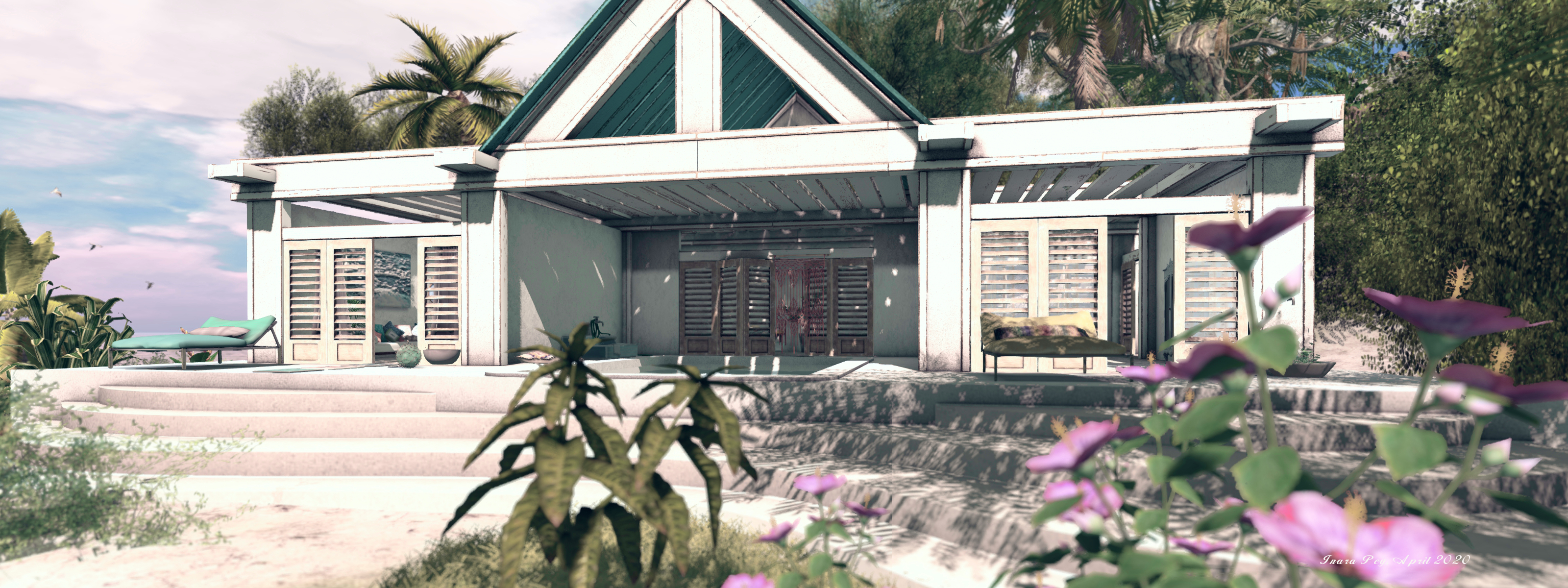
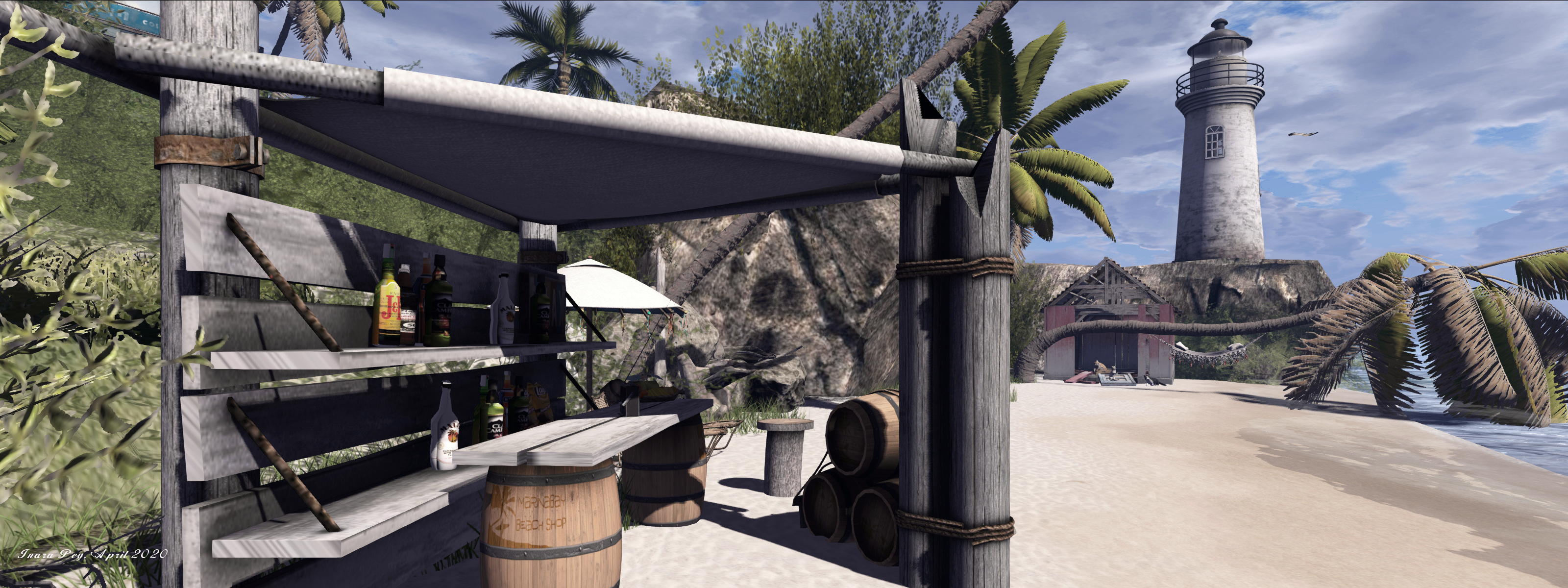
Looping around this tiny slice of urban life is is dusty track of a road that offers the primary means of exploring on foot as it curls and branches its way between uplands and beaches and rocks. Follow it south and behind the bulk of the taller commercial properties, and it’ll take you to a dead end and a tongue of sand that licks its way up over the grass with an invitation to walk across it. Doing so brings you to a stretch of golden sand that is watched over at one end by a whitewashed lighthouse, and at the other by beach house that offers shade from the Sun’s heat and glare and a cooling freshwater pool. Just offshore, the point at which the sandy shelf surrounding the island gives way to deeper waters is marked by a ring of anchored buoys (actually denoting the region’s edge).
Dya’s Scent of the Caribbean, April 2020
Take the road the other way from the landing point and it’ll offer a looping walk around the northern aspect of the island, rising and falling in response the land’s own undulations. A modest motel sits on the western side of this road, offering a view (partially obscured by trees) of the ocean, which here meets the unyielding rock of the isle, as the tide appears to be in.
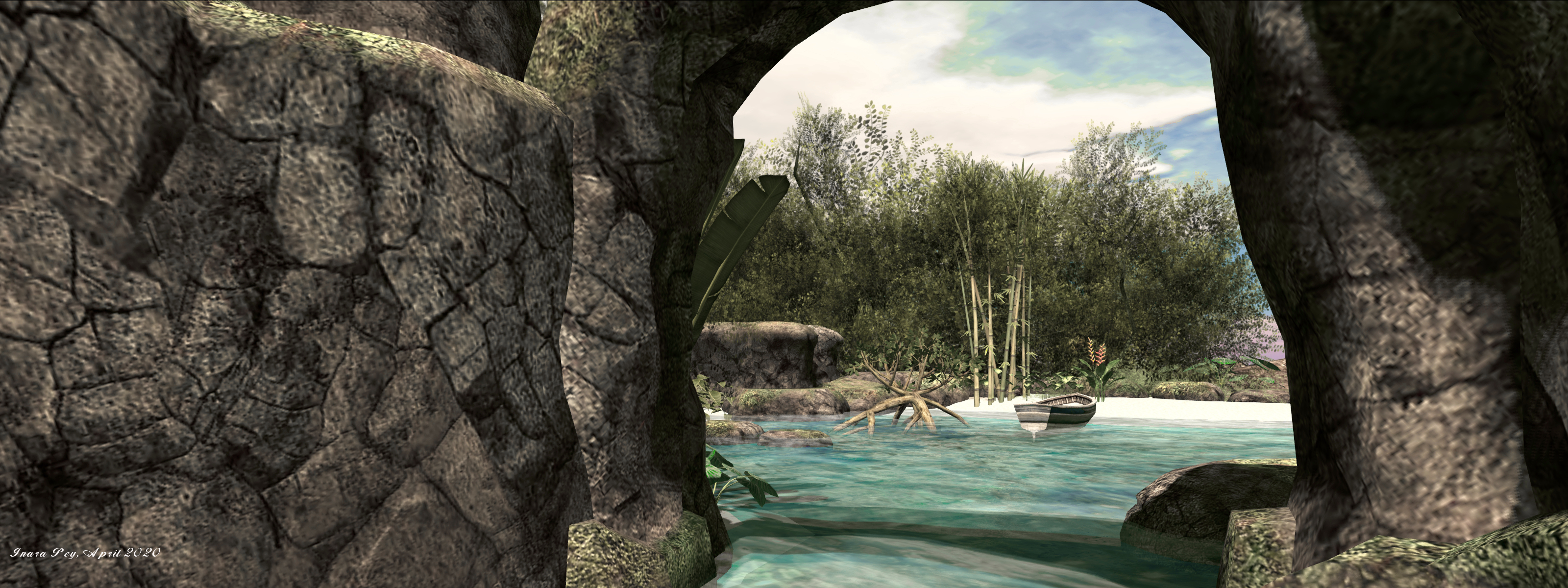
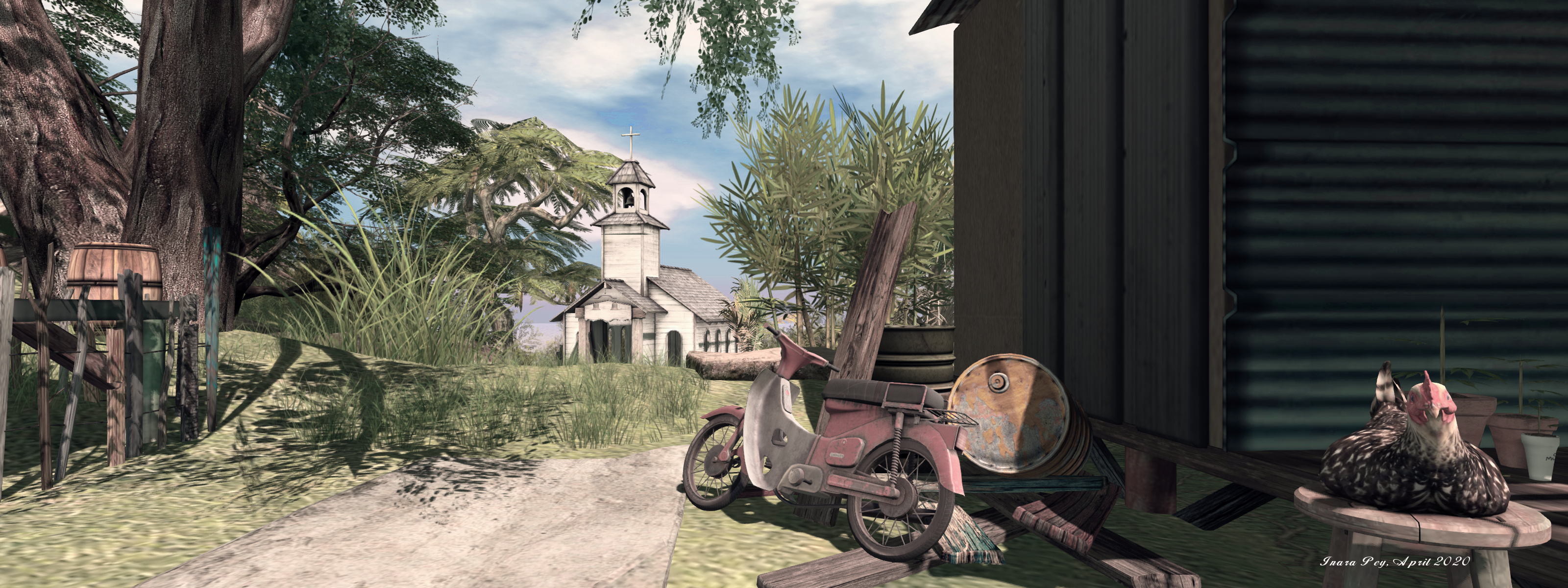
Further along the road sits a little chapel facing steps that climb up to a little shanty village of corrugated tin huts straddling the island’s backbone, the road again looping around it below. Just past the chapel and the step up to the shanty, the road offers a glimpse down into one of the island’s secrets: a landlocked cover of clear water that tumbles from a waterfall and sheltered by rocky walls and the verdant greenery of the island. Cut off from the open sea by a further beach, this cove is an attractive hideaway, perhaps now filled by freshwater given the sea apparently can no longer reach it.
Dya’s Scent of the Caribbean, April 2020
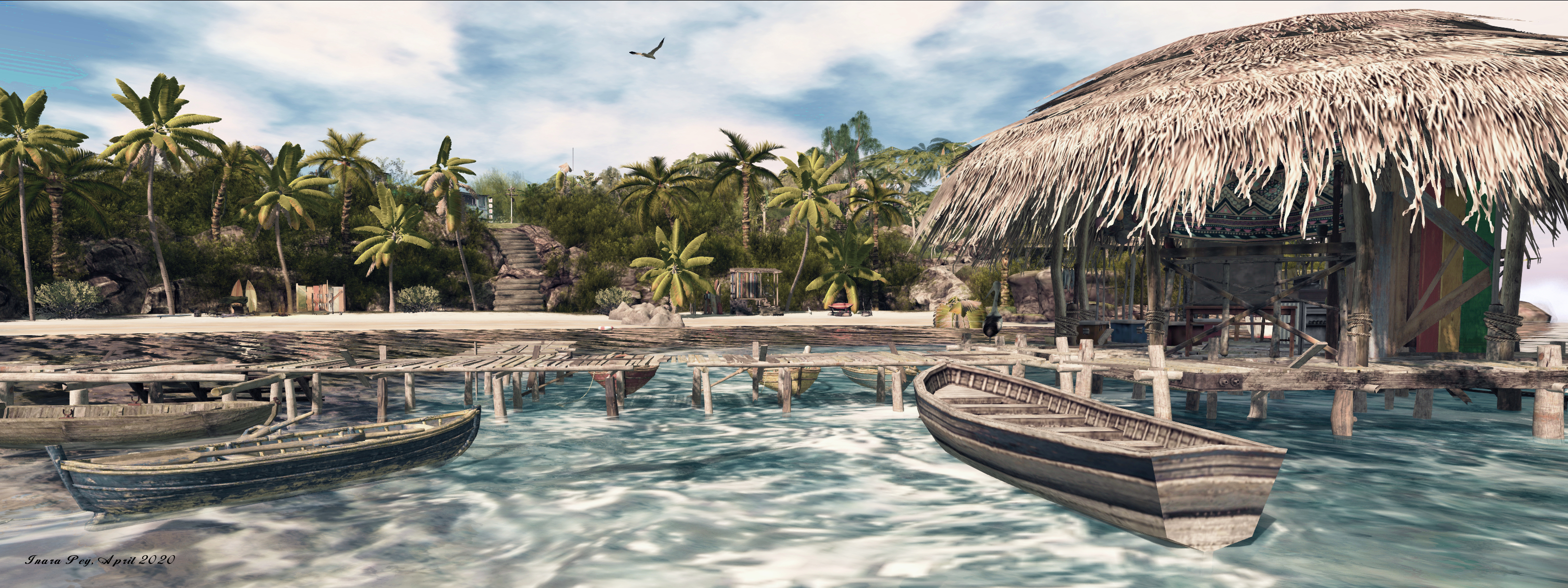
After curling around the north-western headland, the road loops back towards the landing point once more, passing as it does so a set of stone steps that offer the way down to what would appear to be – at low tide at least – the island’s largest expanse of sand. With the tide in, most of this is covered covered by water – if only moderately so – meaning a walk out to the tiki bar that marks where the depths significantly increase is actually going to be something of a wade / swim. For those not feeling so energetic, there is shade to be found under an awning set out over the ruin of an old boat further along the beach.
Like her previous build, Dya offers something of a story with this setting. Little clues are scattered about that suggest this island perhaps sits not in the present, but in the last of 20-30 years ago: the style of car parked here, the only Honda mopeds scattered around, and so on. Certainly, it would appear to be a place that is showing signs of age: paintwork on buildings, rowing boats and elsewhere is all well sun-bleached, while board walks out on the water are in a sorry state of repair – even the plumage on one of the island’s parrots is looking a little careworn!
Dya’s Scent of the Caribbean, April 2020
All of this suggests this isn’t one of the Caribbean’s more popular tourist stop-off points, but at the same time, all of the little touches waiting to be found – like a glimpse of a Bob Marley photo through an open door here, the roadside fish stall there, the fading beat of reggae music to be heard drifting through the air as one explores, clearly indicate the island is very much home to those who live on it.
Dya tells me this design will likely remain in place for at least six weeks, although she will continue to add to it / tweak it (a hurricane may apparently be on the way!), so there is plenty of time yet to visit. For now, and given the weather in my part of the physical world has gain turned cold and damp, I’m off back to Dya’s beach house with its shade, pool and – hopefully – a glass of chilled white wine as should be used to counter the Sun’s heat!
The following notes were taken from my audio recording and chat log of the Content Creation User Group (CCUG) meeting held on Thursday, April 16th 2020 at 13:00 SLT. These meetings are chaired by Vir Linden, and agenda notes, meeting SLurl, etc, are are available on the Content Creation User Group wiki page.
Environment Enhancement Project
Project Summary
A set of environmental enhancements (e.g. the sky, sun, moon, clouds, and water settings) to be set region or parcel level, with support for up to 7 days per cycle and sky environments set by altitude. It uses a new set of inventory assets (Sky, Water, Day), and includes the ability to use custom Sun, Moon and cloud textures. The assets can be stored in inventory and traded through the Marketplace / exchanged with others, and can additionally be used in experiences.
The (possibly last) RC version of the viewer – version 6.4.0.540188 was issued on Wednesday, April 15th.
If all goes well with this RC viewer, then EEP will likely be promoted at week #17 (commencing Monday, April 20th).
Once EEP has been promoted, the flow of RCs in the coming weeks also being promoted – allowing for the Lab preferring to keep to one promotion per every 2 weeks – should increase.
ARCTan
Project Summary
An attempt to re-evaluate object and avatar rendering costs to make them more reflective of the actual impact of rendering both. The overall aim is to try to correct some inherent negative incentives for creating optimised content (e.g. with regards to generating LOD models with mesh), and to update the calculations to reflect current resource constraints, rather than basing them on outdated constraints (e.g. graphics systems, network capabilities, etc).
As of January 2020 ARCTan has effectively been split:
Immediate viewer-side changes, primarily focused on revising the Avatar Rendering Cost (ARC) calculations and providing additional viewer UI so that people can better visibility and control to seeing complexity. This work can essentially be broken down as:
Collect data.
Update ARC function.
Design and provide tool within the viewer UI (i.e. not a pop-up) that presents ARC information in a usable manner and lets users make decisions about rendering / performance.
Work on providing in-world object rendering costs (LOD models, etc.) which might affect Land Impact will be handled as a later tranche of project work, after the avatar work.
The belief is that “good” avatar ARC values can likely be used as a computational base for these rendering calculations.
Current Status
Vir is looking at the avatar visibility controls – jelly dolls (which are not optimised for avatars with a lot of attachments) and imposters.
He’s been particularly looking at getting better performance from jelly dolls (e.g. avoiding any drawing of rigged attachments for jelly dolled avatars, reducing the memory required to handle them).
There are places in the code where jelly dolled avatars are handled inconsistently (e.g. setting an avatar to never render should see it treated the same as jelly doll, but this in not the case – it can actually be more expensive to render as shadows are still turned on for it, etc).
Improvements arising from this work could be issued within a maintenance RC viewer, rather than awaiting a specific ARCTan viewer to fix them.
Another thing Vir has looked at briefly with a view to possibly looking at in more detail in the future, is the time taken to compute a mesh preview when right-clicking an avatar, which can impact the time it takes for the corresponding menu to be displayed. How big an effort it might be to improve this is unclear, but it “would be nice” to see it improved.
More on Jelly Dolls
One of the things Vir has been experimenting with vis jelly dolls, is displaying them as monochrome system avatars, so the system avatar mesh is used, and so rigged mesh it is wearing is ignored (as per notes above). A disadvantage here is that non-human avatar forms that are jelly dolled then look “a little weird”.
This could be avoided by ignoring all scripted transforms contained in any mesh the avatar is wearing, as these most directly deform the avatar, and so ignoring them would prevent the monochrome system avatar “looking weird”.
The question was asked if having non-human avatars appear in a humanoid shape if jelly dolled would be a problem, with the opinion broadly being that would be up to the person using the jelly doll option.
Some alternatives to jelly dolling discussed at the meeting included:
Simply render jelly dolled avatars as elliptical capsules.
Follow Firestorm’s lead and provide an option to only render avatars on a user’s Friend list (all others are ignored and not rendered).
Offer improved lower LOD options for avatars that could be automatically swapped (or used when jelly dolled).
One of the issues with jelly dolls is whether or not the capability is widely used – people tend to complain more about seeing mono-coloured avatars in their view than worrying about having their performance hit by fully rendering all the avatars around them; it’s not clear if alternative options would change this.
In brief
Mesh Uploader project viewer:
Not available as yet, but getting close to a project viewer release.
Incorporates Beq Janus’ contributions, as see in Firestorm.
Also adds additional information about joint offsets and provides better logging.
 Gyro Muggins reads Jamil Nasir’s 1996 novella that mixes science and magic.
 What do two Benedictine nuns, a secretive man-on-the-run, a Tibetan monk, three hippies, members of the Mafia and children of migrant workers have in common? Why, A Nun in the Closet, of course.




 Inara Pey: Living in a Modemworld