
Studies of Ceres, the largest dwarf planet within the orbit of Neptune, and the focus of the joint NASA / ESA Dawn mission for the last 30 months, are beginning to be published at a high rate of knots. In my previous Space Sunday I covered the report that the water ice discovered around Ernutet crater was likely of local origin. Now, two further studies point to Ceres once having a liquid water ocean.
The first study used gravity measurements to characterise Ceres’ interior, the second sought to determine its interior structure by studying its topography. Both came to similar conclusions.
The NASA team conducting the gravity measurements used data gathered by the spacecraft, together with an analysis of gravity-induced variations in the vehicle’s orbit around the dwarf planet as tracked by NASA’s Deep Space Network (DSN) and an analysis of the gravity anomalies associated with four of Ceres’ most notable surface features: the craters Occator (famous for having bright deposits in its basin which caused excitement in the early months of the spacecraft’s time at Ceres), Kerwan and Yalode, and Ceres one significant mountain, Ahuna Mons. This allowed them to draw a number of conclusions, the most notable being Ceres was once very geologically active, and that its surface crust has an overall density closer to that of ice than rock.
The second study focused on investigating the strength and composition of Ceres’ crust and deeper interior by studying the dwarf planet’s topography. By modelling Ceres’ crustal flow, the researchers determined that it is a mixture of ice, salts, rock, and clathrate hydrates, crystalline water-based solids resembling water ice but with up to 1,000 time its strength.

The researchers further determined this high-strength crust probably rests on a softer layer that contains some liquid, allowing Ceres’ topography to deform over time, smoothing down features that were once more pronounced and producing the surface environment we see today.
Taken together, these studies suggest that Ceres once had a sub-surface ocean, likely kept liquid by internal heating (which has been suggested by other studies). This ocean may have been similar to the liquid water oceans thought to exist under the surfaces of Europa and Enceladus today. However, in the case of Ceres, much of it has long since frozen out into the dwarf planet’s crust. Most, but not all. The studies, together with the visual evidence of cryovolcanism on Ceres suggest that beneath the frozen crust there is a “soft” layer, possibly a slushy, semi-frozen layer of liquid.
It’s not clear how liquid this residual ocean might be, but as Julie Castillo-Rogez, the Dawn project scientist at JPL and a co-author on both studies, explained, “More and more, we are learning that Ceres is a complex, dynamic world that may have hosted a lot of liquid water in the past, and may still have some underground.” It is also further evidence that many of the smaller bodies in the solar system from Pluto to the asteroid belt, have histories every bit as complex as the major planets in the solar system.
Have We Just Witnessed an Extra-Solar Visitor?
We’re familiar with the concept of comets. They generally originate from one of two points in the outer solar system. The Kuiper Belt, extending from the orbit of Neptune (at 30 AU) to approximately 50 AU from the Sun, gives rise to what we call “short period” comets which follow a predictable orbit that swings them past the Sun on a regular basis. Halley’s Comet, with its 76-year period, is perhaps the most famous of these.
Then there is the Oort Cloud, predominantly comprising icy planetesimals believed to surround the Sun to as far as somewhere between 50,000 and 200,000 AU (0.8 and 3.2 light years), and thought to be the origin for “long period” comets with orbits around the Sun measured in the hundreds of years.
However, some astronomers believe the solar system might currently be being visited by an altogether rarer type of comet: one that originated in another star system.
A fast-moving object, designated A/2017 U1, was initially spotted on October 18th in Hawaii by the Pan-STARRS 1 telescope. Since then it has been closely tracked by astronomer around the world. What is particularly interesting about it is that Sun-orbiting eccentricity of between 0 (a circular orbit), and 1 (a parabolic orbit). Anything above 1 would tend to point to an object being entirely extra-solar in origin. A/2017 U1 has an orbital eccentricity of 1.2.
Because of this high eccentricity, the Minor Planets Centre put out a call for more observations on the object in attempts to confirm it is likely extra-solar in nature. It passed around the Sun on September 9th, and was detected as it crossed back over Earth’s orbit on its way back out into space. At the time it was spotted, the comet was about 30 million km (19 million mi) from Earth, and travelling at a velocity of 26 km/s (16 mi/s) – much faster than the velocity required to escape the Sun, but within ~5 km/s of other stars within the Sun’s stellar neighbourhood, further indicating an interstellar origin.
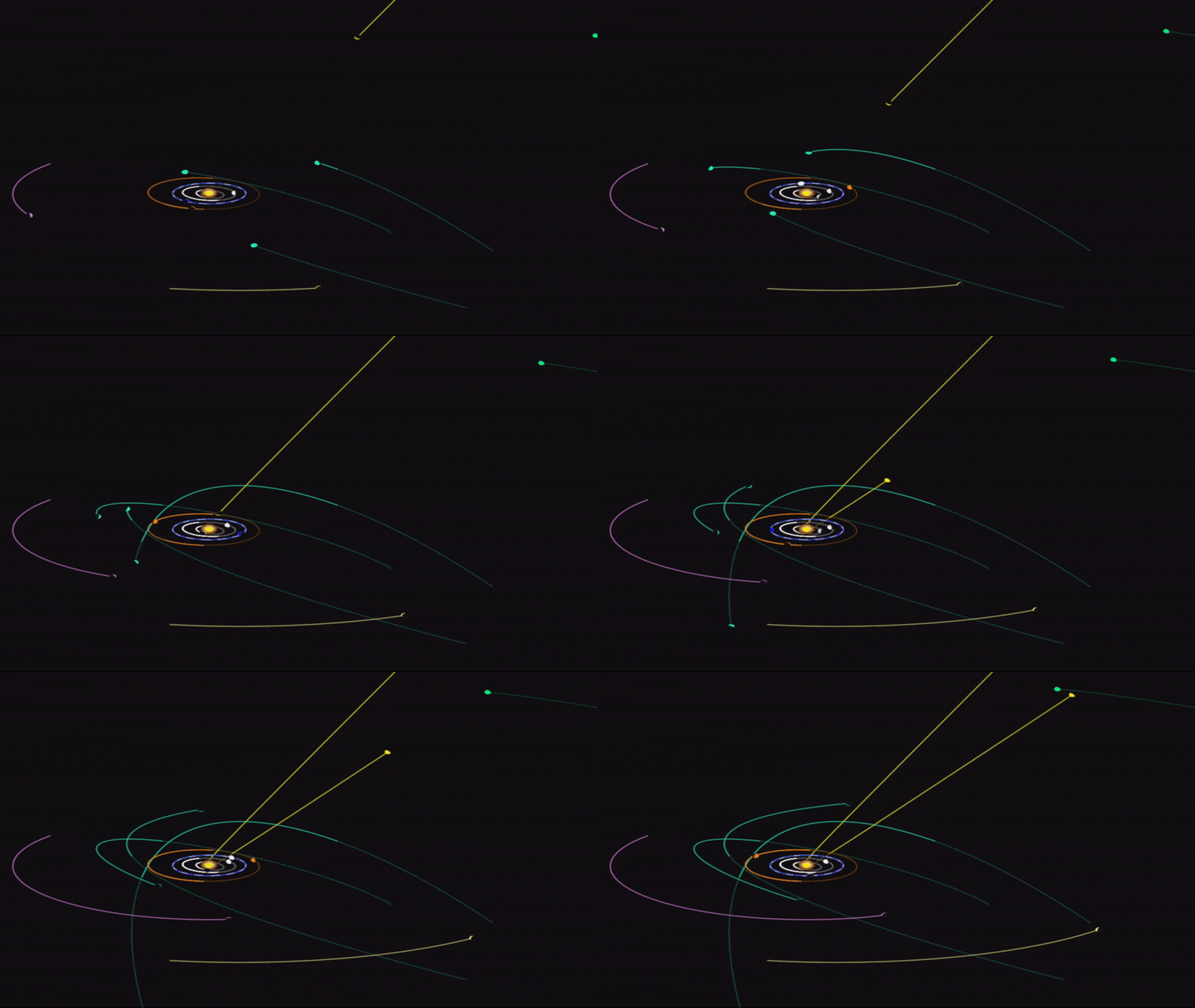
The object’s trajectory is also unusual, approaching the Sun from high above the plane of the ecliptic, and observations made from the Pan-STARRS 1 telescope in Hawaii, the William Herschel Telescope in the Canary Islands and the Very Large Telescope in Chile suggest the comet is a rocky / ice object roughly 160 metres along at least one of its axes.
Tony Dunn, an undergraduate physics and astronomy teacher at San Francisco State University has been running a series of computer simulations using tracking data on the comet, which he has been publishing on his Twitter feed. These suggest the comet may have originated as a body orbiting the star Vega, some 25 light years from the Sun; however, the likely point of origin is still being hotly debated and may never be accurately known.

If the object did originate in another star system, then it would suggest the other stars have rings or clouds or material surrounding them at great distances in a manner similar to the Oort cloud. It would also be confirmation of the idea that other stars passing within a few light-years of the Sun disturb the Oort cloud, causing objects there to be disrupted in their orbits, some of which fall towards the Sun and become long-period comets. Presumably, the Sun and other stars can influence rocky clouds around their neighbours in the same way – and that as well as falling towards their local star as comets, the disturbed objects can be kicked out of their local system to become interstellar wanderers.
“We have been waiting for this day for decades,” said Paul Chodas, responsible for NASA’s Centre for Near-Earth Object Studies (CNEOS), which has also been observing the object. “It’s long been theorised that such objects exist — asteroids or comets moving around between the stars and occasionally passing through our solar system — but this is the first such detection.”
“We have long suspected that these objects should exist, because during the process of planet formation a lot of material should be ejected from planetary systems,” Karen Meech, an astronomer at the Institute for Astronomy, Hawaii which operates the Pan-STARRs telescope, added. “What’s most surprising is that we’ve never seen interstellar objects pass through before.”
Continue reading “Space Sunday: ancient oceans, comets from beyond, and exoplanet hunting”





 Inara Pey: Living in a Modemworld