A Creeping Man, a wizard, pirates and a saloon

Seanchai Library, Holly Kai Park

It’s time to kick-off another week of storytelling in Voice by the staff and volunteers at the Seanchai Library. As always, all times SLT, and events are held at the Library’s home at Holly Kai Park, unless otherwise indicated.

Sunday, September 10th

13:30: Tea Time at Baker Street

Seanchai Library once again opens the pages of The Casebook of Sherlock Holmes, the final set of twelve Sherlock Holmes short stories first published in the Strand Magazine between October 1921 and April 1927.

This week: The Adventure of the Creeping Man

“MR. SHERLOCK HOLMES was always of opinion that I should publish the singular facts connected with Professor Presbury, if only to dispel once for all the ugly rumours which some twenty years ago agitated the university and were echoed in the learned societies of London …”

So it is that John Watson puts pen to paper to tell the strange tale of the professor, his secretary, who is also engaged to the professor’s daughter, a trip to Prague and the creepers growing up the side of the professor’s house.

The tale is a most peculiar one indeed, and not just for the story itself; The Adventure of the Creeping Man veers somewhat away from Conan Doyle’s usual scientific approach to the unravelling of the mysteries Holmes and Watson face; so much so that it has met with much debate among critics down the years.

To find out more, be sure to turn up on time for a spot of afternoon tea at Baker Street!

16:00 Magicland Storytime: The Black Cauldron

Join Caledonia Skytower at Magicland Park.

Monday, September 11th 19:00: A Wizard of Earthsea

Gyro Muggins reads Ursula K. Le Guin’s first Earthsea Cycle. 

The boy is born on the island of Gont in the archipelago of Earthsea. This is a world infused with magic. Not everyone can control this magic, but those who know the right words and have a wizard soul can learn to utilize the power of the Earth to manipulate objects and events. The boy’s name is Duny; I can tell you that name because the name has no power over him. His true name is something he can only reveal to those he trusts absolutely beyond question.

I know his true name, but fair reader, I’m not sure yet that I can share it with you.

His aunt knows a few things, a handful of words, that can be used to bind things or call animals to her. Duny is particularly adept at calling falcons and other birds of prey. His agile mind soon surpasses what his aunt can teach him. He burns to know more. He is assigned to a mage, Ogion, who tries to teach him about the balance of magic with the Earth. There is always a cost for using magic. Understanding the levy for sorcery is the difference between being just impulsively talented and being wise about what you know.

(Commentary by Jeffrey Keeten.)

Tuesday, September 12th 19:00: Adventure on the High Seas

Selected adventures to whet your appetite for International Talk Like A Pirate Day with Caledonia Skytower

Wednesday, September 13th 19:00: Callahan’s Crosstime Saloon

Corwyn Allen reads Spider Robinson’s 1999 anthology.

callahansThe titular saloon is a haven for lost souls; a place where the patrons come for one drink and a chance for a second – but only if they offer an unburdening toast at the fireplace. Mike Callahan, the owner, never judges but sometimes advises in as few words as possible.

The stories in the volume are:

  • “The Guy with the Eyes”
  • “The Time-Traveler”
  • “The Centipede’s Dilemma”
  • “Two Heads Are Better Than One”
  • “The Law of Conservation of Pain”
  • “Just Dessert”
  • “A Voice is Heard in Ramah…”
  • “Unnatural Causes”
  • “The Wonderful Conspiracy”

Also presented in Kitely (hop://grid.kitely.com:8002/Seanchai/108/609/1528).

Thursday, September 14th 19:00: Blueskin the Pirate

Shandon Loring  reads a short story from Howard Pyle’s Masterpieces.

Cape May and Cape Henlopen form, as it were, the upper and lower jaws of a gigantic mouth, which disgorges from its monstrous gullet the cloudy waters of the Delaware Bay into the heaving, sparkling blue-green of the Atlantic Ocean.

From Cape Henlopen as the lower jaw there juts out a long, curving fang of high, smooth-rolling sand dunes, cutting sharp and clean against the still, blue sky above-silent, naked, utterly deserted, excepting for the squat, white-walled lighthouse standing upon the crest of the highest hill.

Sunday, September 17th 13:00-16:30: The Pirates Are Coming!

A special event to mark International Talk Like A pirate Day – ARRRR! On Tuesday, September 19th. Stories from 13:00 and music and dancing from 14:30. Full details to follow on the Seanchai Library and Holly Kai Park websites.


Please check with the Seanchai Library’s blog for updates and for additions or changes to the week’s schedule.

The featured charity for August and September is Little Kids Rock, transforming lives by restoring, expanding, and innovating music education in schools.

Seven lilies, seven virtues and seven artists in Second Life

DaphneArts: Lilium

Now open at DaphneArts is Lilium, the second in a series of exhibitions focus on the mystical number seven, following on from The Endless (reviewed here).

The curators of DaphneArts, Angelika Corral and Sheldon Bergman (SheldonBR), who are also two of the seven artists participating in the exhibition, describe it in part thus:

Number seven is sacred and powerful. Pythagoras, the father of numerology, considered seven as the most spiritual of all the numbers. Seven is the number of divine perfection. Seven are the colors of the rainbow. Seven are the notes of the diatonic scale. There are seven ancient wonders of the world, seven days of the week, seven letters in the Roman numeral system, seven arts…
When Pope Gregory defined the Seven deadly sins, he also included a counter-balancing set of values, in a way to protect one against temptation from the deadly sins. The seven [heavenly] virtues … For this exhibition, seven photographers were invited to create a photo, each of them representing one of the seven virtues.
DaphneArt: Lilium – Temperance by Fenris

Lilium is itself Latin for “lily”, a symbol of virtue, as Angelika and Sheldon also note in their curator’s introduction to the exhibit, illustrating the point with the inclusion of an image The Annunciation by Paolo de Matteis.

Thus it is, with viewer correctly set, visitors to the exhibition start their journey in the chancel of a marble-like white cathedral (white obviously symbolic of virtue). A HUD is offered on arrival and should be worn, while overhead is a set of easy-to-follow steps guide people through ensuring they have their viewer correctly set-up (e.g. ensuring the required Windlight is selected and Advanced Lighting Model is enabled).

DaphneArts: Lilium – Patience by Magic Marker

From here, a walk through the nave of the cathedral to the porch brings people to the main exhibition space, progress to it marked by the lyrics – in Latin of the Elven Song, or Elfen Lied, as featured in the Japanese manga series of that name, the lyrics based on biblical passages and the hymn Ave Mundi Spes Maria. Beyond the porch is an open platform set against a uniform backdrop and on which are arranged seven gilded lilies.

Approaching any of these lilies will cause it to open, revealing the art apparently “held” inside it. At the same time, the title of the art – the virtue it represents – and the name of the artist are revealed by the HUD.

DaphneArt: Liluim

The images / virtues are, by artist: Charity – Inexorably; Chastity – Sheldon Bergman; Diligence – Harbour Galaxy; Humility – Kimeu Kamolla; Kindness – Angelika Corral; Patience – Magic Marker, and Temperance – Fenris. Each is obviously a personal representation of the virtue it depicts, however each carries a degree of symbolism which may be related to the virtue it represents, to virtue as a whole or to the mysticism of seven.

Lilium is a further nuanced ensemble exhibition built around a central theme, rich in symbolism and interpretation.

SLurl Details

Sansar product meetings 2017: week #36 – Aug/Sept release

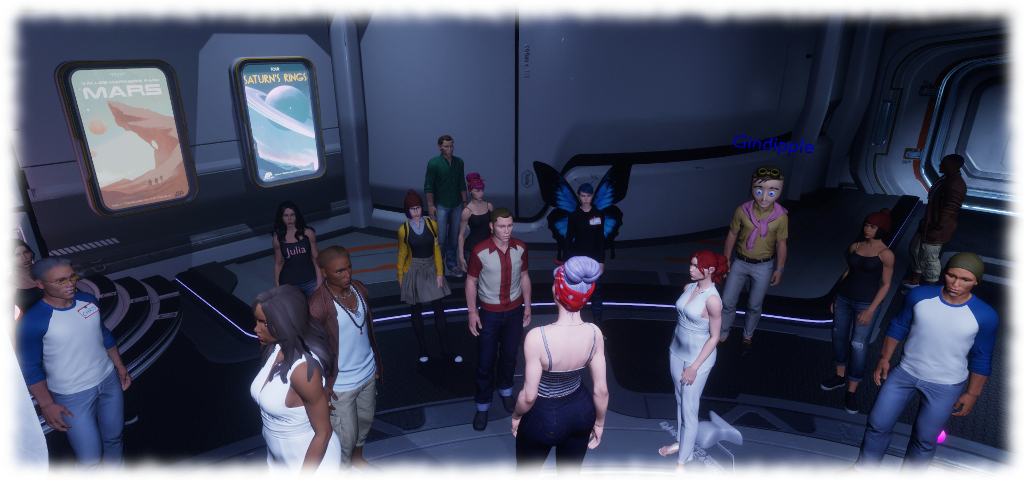
People gather at Astro Port for the first Friday September 8th 2017 Product meeting

The following notes are taken from the Sansar Product Meetings held on Friday, September 8th. These meetings are held every Friday at 9:30am PDT and 4:00pm PDT, and are open to all.

There is no set agenda (currently), and the meetings are a mix of voice and text. Venues change on a weekly basis, and are announced in the Meet-up Announcements. The September 9th meeting took place at Mold3D’s Astro Port. The official meeting notes are generally published the week following each pair of meetings.

The meetings are chaired by Jenn (aka Xiola Linden) from the Community Team, and feature various members of the Sansar teams. Cara, Carolyn and Jeremy joined the Friday, September 8th meeting.

August / September Release

The long-awaited August / September release arrived on Friday, September 8th, 2017. Highlights of the release are noted  below (please refer to the release notes for full details of this release, including known issues). Note that many of these features are still work in progress, rather than being final / polished versions.

Terrain Editor / Sculpting

Experience creators can now edit terrain objects in Sansar: create mountains and hills, create dips, craters and valleys or uneven terrain (“noise”). This is the first iteration of these tools, and features will be added over time.

Simply drag and drop a terrain plain (in one of four texture defaults) from the system objects panel, then use the sculpt tool and options to shape it. Individual plains can be placed together to create as big an area of terrain as required (within Sansar’s own limitations).

See Working with terrain in the Sansar Knowledge Base for more information.

The Terrain toolbar with the sculpt and paint master controls highlighted, and option buttons to their right
  • Terrain plains can be sculpted on in defined areas, from around 32 metres on a side up to 256 metres on a side.
  • The paint tool can be used to apply textures (from pre-set families of four) to the sculpted terrain, with automatic attempts made to blend textures with height / depth (e.g. so grass gradually gives way to rock). The brush size for painting can also be varied in size from (approximately) one metre in size upwards.
  • The textures / materials associated with the editor are currently limited to only working with one family of four textures / materials at a time, although creators can hot swap between them.
  • This is not voxel editing, and is currently restricted to height maps, so no tunnelling into terrain at present. The sculpting tool is somewhat similar in approach somewhat similar to the Second Life terraforming tool, presenting a view of the terrain and the selected tool overlaid on it at the appropriate size, although unlike SL a choice of tool shapes is offered (round or square).
A terrain plain show a raw sculpt of a hill (left), and with smoothing being applied (right). Credit: Jeremy Linden
Future Terrain Editing Capabilities

The ability to add use custom terrain textures and height maps is coming soon, together with support for mega textures. The latter will allow more textures to be blended together at a time, which are then  composited together when an experience is published.

Jason (aka Widely Linden) indicated that the roadmap for terrain editing in Sansar currently includes (exact implementation still TBD):

  • A hybrid form of terraforming, using height maps for efficiency when sculpting the terrain, then switching to a voxel element when creating tunnels / caves, etc., which is then “stitched” into the mesh height map.
  • The ability to “geo-paint” environments – use a painting technique to add boulder, rocks, vegetation, etc., onto a terrain map. This will likely start with pre-defined geo elements, before moving to allow users to define their own elements.

A suggestion from Maxwell Graf to assist in making custom height maps (once they can be imported), is to consider installing Unreal or Unity (both free) and then purchasing a terrain editing tool for the relevant engine, and using that to create terrains, then export the height maps for import into Sansar (once possible) It was also noted that Visual Studio 2017 comes with Unity support, and it is easy to add Unreal support.

.OBJ File Format, Animated & Multi-part Object Import

The Animated objects capability isn’t, at this point, fully animated mesh – there is no ability to import or use a skeleton for an object (a-la SL’s animated objects project), although this is coming.

Future Capabilities / Ideas

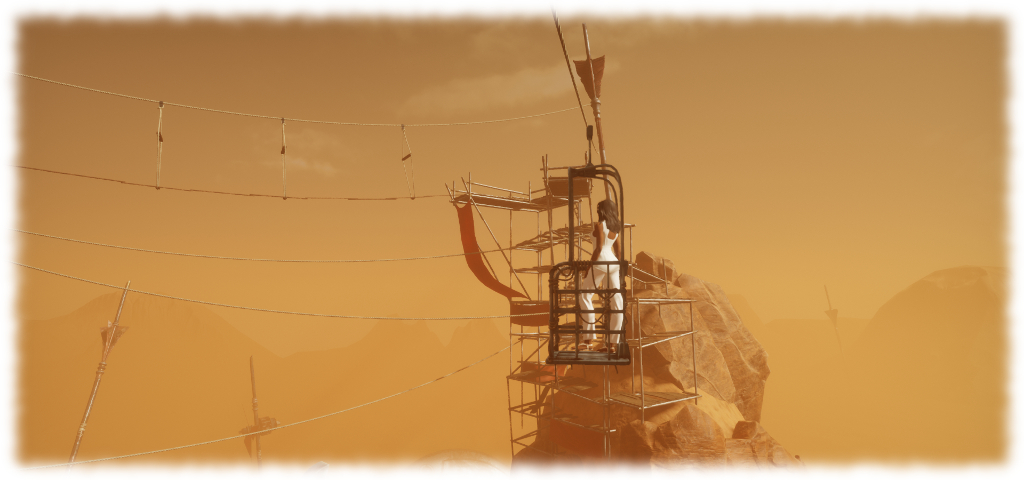
Also coming in a future release for animated / multi-part objects, are collision meshes. These will allow can be bound to rendered meshes for collision purposes. So a multi-part cable car could have collisions enabled on specific parts to allow avatars to ride it. This has already been done as a test with the gondolas in Colossus Rising.

The cable car gondolas in Colossus Rising demonstrate how collision volumes can be bound to a rendered mesh object to allow interaction (in this case riding a gondola) with an avatar. This ability will be part of a future update to the animated / multi-part objects capability forming part of the August / September Sansar release

Jason indicated that – further into the future, and via a scripted / API meachanism which the Sansar product team is considering – animated objects should allow for very dynamic things like trees which not only sway in a breeze, but which move in accordance with the (changing) wind direction / force (rather than just randomly moving) or stop swaying if there is no wind. The same scripts will also be able to trigger associated sounds of the wind in the branches when affected by a breeze.

New Stereoscopic Media & UV Animation Shaders

A series of new shaders in the materials editor:

  • Standard + Emissive + Stereographic
  • Media Surface + Stereographic
  • Standard + Emissive + UV Animation
  • Standard + Alpha Mask + UV Animation.

UV animation supports both scrolling UVs and flipbook UV, and brings the ability to animate things like water, animated lighting, etc, in Sansar. Currently, these have to be configured and applied prior to upload, but future updates will allow editing and refinement of the maps post-upload.

Trigger Volumes

Trigger volumes allow scripted events (e.g. teleporting) without the need for dynamic objects, allowing for more flexible interactions inside events.

Continue reading “Sansar product meetings 2017: week #36 – Aug/Sept release”

SL project updates week 36/2: TPV Dev meeting + SL in the cloud

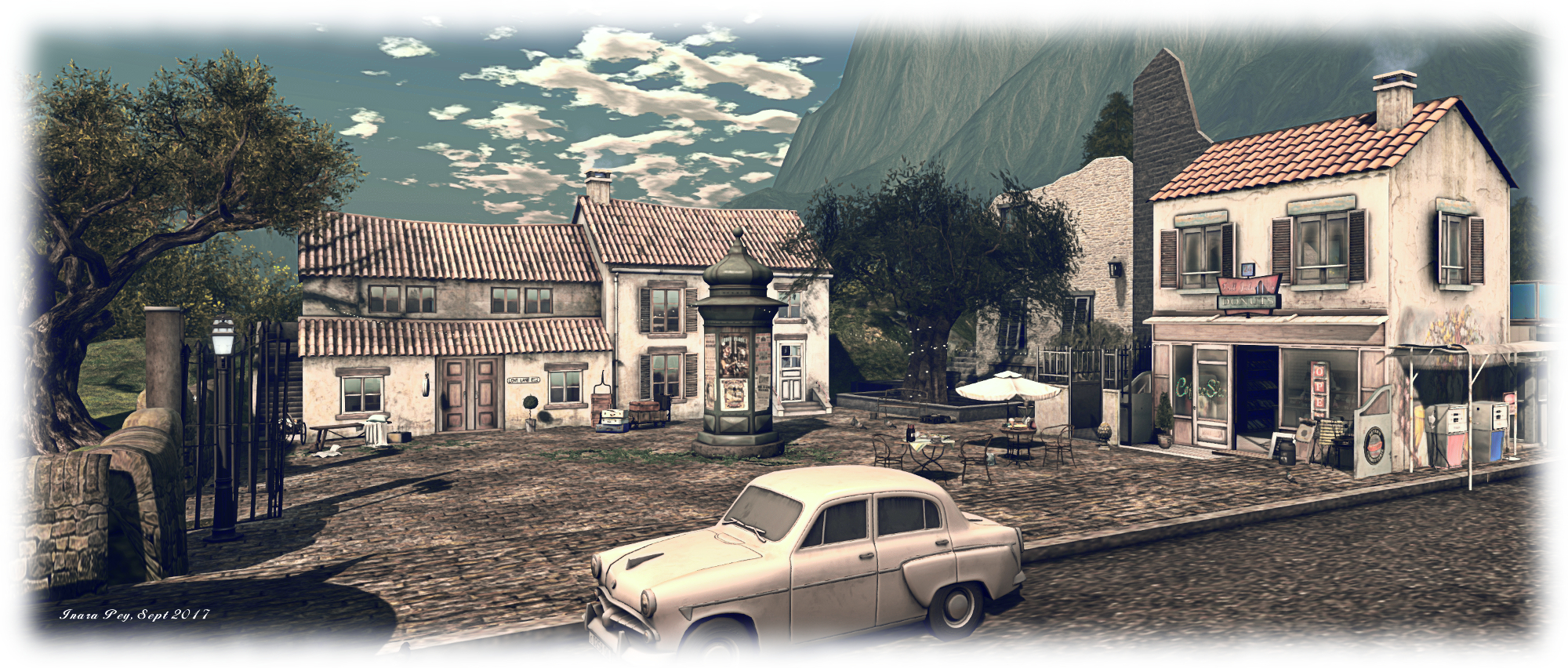
Brand New Colony; Inara Pey, September 2017, on FlickrBrand New Colonyblog post

Updated to reflect the release of the Wolfpack RC, which appeared after this article had been uploaded for publishing.

The majority of the notes in this update are taken from the TPV Developer meeting held on Friday, September 8th 2017. The video of that meeting is embedded at the end of this update, my thanks as always to North for recording and providing it. Timestamps in the text below will open the video in a separate window at the relevant point for those wishing to listen to the discussions.

Server Deployments Week #36 – Recap

Please refer to the deployment notice for the week for latest updates and news.

Region Return Issues

Whether connected to the Wednesday deployment or the grid-wide issues experienced later that day, but some regions reported significant returns of in-world objects (Mother Road, on the Main (SLS) channel, which I blogged about here, suffered the problem, as Heavenly Views (Magnum RC) also apparently did). Most of these problems seem to have been rectified by a roll-back of the affected regions.

SL Viewer

A new RC viewer, codenamed Wolfpack – version 5.0.8.328879 – was released late on September 8th. This viewer is functionally identical to the release viewer, but includes additional back-end logging to “help catch some squirrelly issues”.

[1:15-4:15] Otherwise have been no further viewer updates since the start of the week, leaving the current pipeline as follows:

  • Current Release version 5.0.7.328060, dated August 9, promoted August 23 – formerly the Maintenance RC
  • RC viewers:
    • Alex Ivy 64-bit RC viewer version 5.1.0.508209, dated September 5th
    • Voice RC viewer updated version 5.0.8.328552, dated September 1st
    • Maintenance RC viewer version 5.0.8.328812, dated August 31st
  • Project viewers:
  • Obsolete platform viewer version 3.7.28.300847, dated May 8, 2015 – provided for users on Windows XP and OS X versions below 10.7.

The Alex Ivy and Voice updates bring these RCs into parity with the current release viewer. These updates have lowered the overall crash rates for both viewers, although the Voice viewer’s crash rate is still somewhat elevated compared to the release viewer. This elevated crash rate is something the Lab has seen in the various viewers for the last few months, and are working to lower.

Alex Ivy will likely have two more RC releases before it is ready for promotion to de facto release status, as there are a couple of issues the Lab wants to clear up before any promotion of this viewer.

It is hoped work will shortly be resuming on the 360-degree snapshot viewer, part of which will also be bringing it up to parity with more recent releases.

New Viewer Splash / Log-in Screen

[4:25-8:07] The Lab is in the process of revamping the official viewer’s splash / log-in screen. This should be inherited automatically by those TPVs using the Lab’s splash screen. This will see the screen have a different look and feel, with the information arranged a little differently, with the grid status made somewhat more prominent. Some of the information widgets associated with the splash screen are also being updated as a part of this work, and will require testing by TPVs when available (RSS feeds should not be affected).

This work is being carried out by Phronimos Linden, one of the more recent (3 months ago at the time of writing) Lab staff recruited to work on Second Life.

Moving to the Cloud

[15:52-25:25] As confirmed in a recent Lab blog post, Second Life services are moving to the cloud. There are no specific details on this as yet, but in short:

  • The work will be carried out in stages.
  • It will include providing regions from the cloud (rather than the Lab’s own co-located servers).
  • As many know, the asset services has been in S3 cloud servers for several years.
  • The order of moving services hasn’t been determined as yet, but the aim will be to move services, then test for reliability and performance before opening them up / moving to the next service(s).
  • Some testing has already begun, using services only accessed indirectly by users.
  • The Lab has been working on the infrastructure for this for a while, but none of the major services have been moved.

It is unlikely this will lead to regions of a different size to those presently on the grid, or which can be varied in size (a-la the OpenSim varregions), as region size is very deeply baked into the simulator and viewer code (and probably elsewhere in the overall SL code base); although some at the Lab would love to be able to have such a region capability. However – as indicated in the Lab’s blog post – it may allow the Lab to introduce new region products, possibly ones capable of handling greater loads.

It is hoped that this work will result in lower tier over time, but whether this will be the case of not is still and open question at this time, as it is unclear as to what costs will be involved in terms of cloud instance types., etc., that will be required to support simulators.

Overall, there is a lot the Lab hopes to achieve with the move, but the precise benefits are likely to only become clear once things have been tried and found to work / over time as the work progresses and beyond. However, at this point time scales are TBD, and it is liable to be some time before user-visible aspects of the service move to the cloud (although non-visible services – such as the log-in service, for example – could be moved sooner).

A precursor to this project is the continuing work to update the servers to newer version of Linux, work which is making “good progress”.

Other Items

Asset HTTP Messaging and Asset HTTP Issues

[10:11-10:45 and 12:10-15:23] With the promotion of the Asset HTTP viewer to release status in June 2017, the majority of assets are now delivered to the viewer using HTTP via the Content Delivery Network(s) used by the Lab. This means that UDP messaging for all of the affected asset types will be turned off at the server end at some point.  Currently no date has been set for this, and it looks like it may not occur much before February 2018.

There is still an issue related to fetching assets over HTTP in general which is experienced by some users some of the time   whereby something causes the pipeline textures to get out of sync and things to go awry. As the problem happens for some and not others, the Lab is still trying to determine the root cause for the problem, but it is a matter the Lab is trying to resolve.

Catznip viewer reports issues with textures over HTTP “stalling” for between 5-10 minutes on their pre-release viewer with the latest HTTP updates, but this isn’t something the Lab is aware of as a more general issue.

Estate Tool Ban List Improvements

[10:48-11:43] The Lab did some initial work to improve ban lists at the estate / region level a while ago, but the intended work to improvement to overall layout for the lists, etc., has been delayed do to work on dealing with viewer crashes, etc. This work is apparently now “next in line” once some of the existing viewer projects are shipped.

The conversation from 26 minutes to the end is more general chat on viewer stats, speculation on the reason for the texture load stalls, and an ad for the Firestorm birthday party.

Visiting ~Neive~ in Second Life

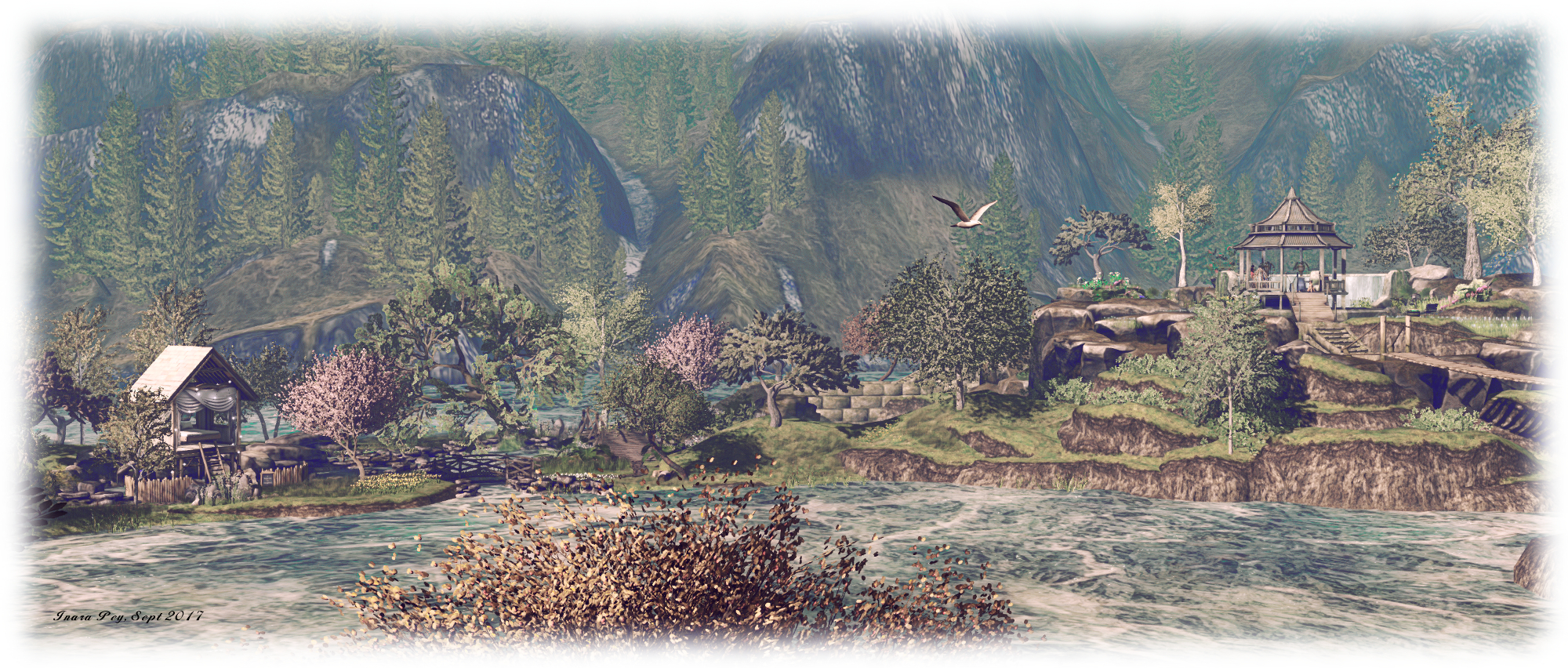
Neive; Inara Pey, September 2017, on Flickr~Neive~ – click any image for full size

Update, September 14th: Claudia has made some further changes to ~Neive~ since this article was published. The parade of shops and houses at the landing point (and seen in the image above) has been revised, and the bath house referred to in the text below has been replaced by the automotive garage which used to sit just outside of the shops and their street. To the south-west, one of the Tuscan-style farm houses has been replaced by a pavilion.

~Neive~ is a Homestead regions designed by Claudia (claudia74a Orsini) which Caitlyn and I first visited in late June 2017, when it still appeared to be under construction. We dropped back there at the start of September to see how things had developed, and found the region has grown into a quite pastoral – if slightly eclectic – setting.

A visit start towards the east side of the region, where a small parade of shops, houses and ruined buildings sit against a waterside road raised above a quay. A set of steps descend from the south side of square in front of the stores, offering the way – over a grass bank  – to a dirt track running between the waters surrounding the region and the large body of water occupying the middle of the region. A Tuscan style farmhouse sits above the track, which ends in an arch formed by two old tree trunks.

Neive; Inara Pey, September 2017, on Flickr~Neive~ – click any image for full size

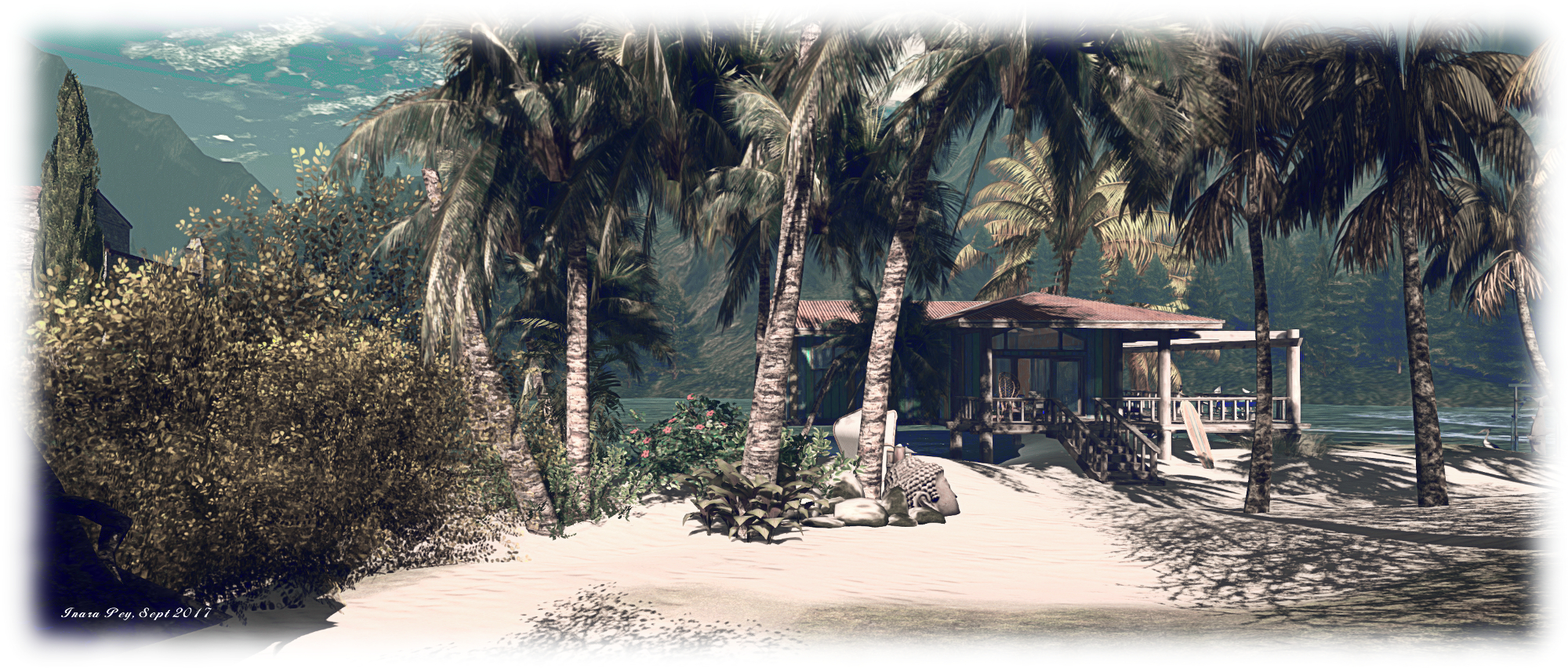
Beyond this, on the south side of the region, the land changes from temperate grasses and trees to a more tropical beach, complete with palm trees and a beach club built out over the waters. Further across the sand sits a terrace bar, also built out over the water.

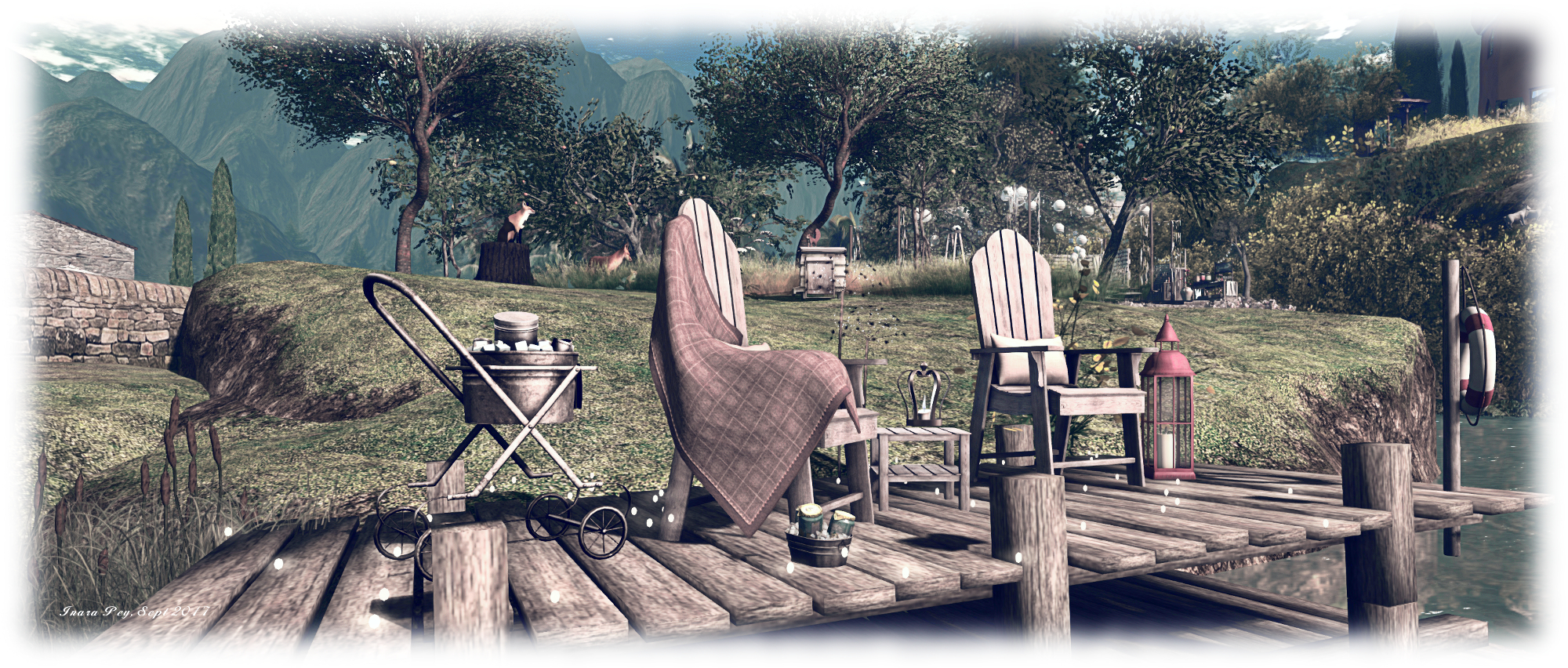
The beach curves around to the west side of the island, and a set of stairs leading up to where a terrace sits under the shadow of a windmill atop the highest peak on the land, and overlooking the central pool. A finger of water run by the foot of the terrace hill, connecting inland water with those surrounding the region. A log bridge offer the way to the far bank, where a rocky plateau rises, topped by an old Tuscan villa. Horses graze in the field below the villa, where a deck provides another vantage point looking out over the water towards the south side of the region.

Neive; Inara Pey, September 2017, on Flickr~Neive~ – click any image for full size

From here, the path circles back towards the landing point, passing an artist’s studio in a cabin surrounded by its own little garden. Another narrow neck on water is spanned by a wooden bridge, offering the way to where an ancient bath house sits, clearly still in use despite its age. With an old wooden garage sitting at the top of the slope from the bridge, the path leads the way back to the shops and the landing point.

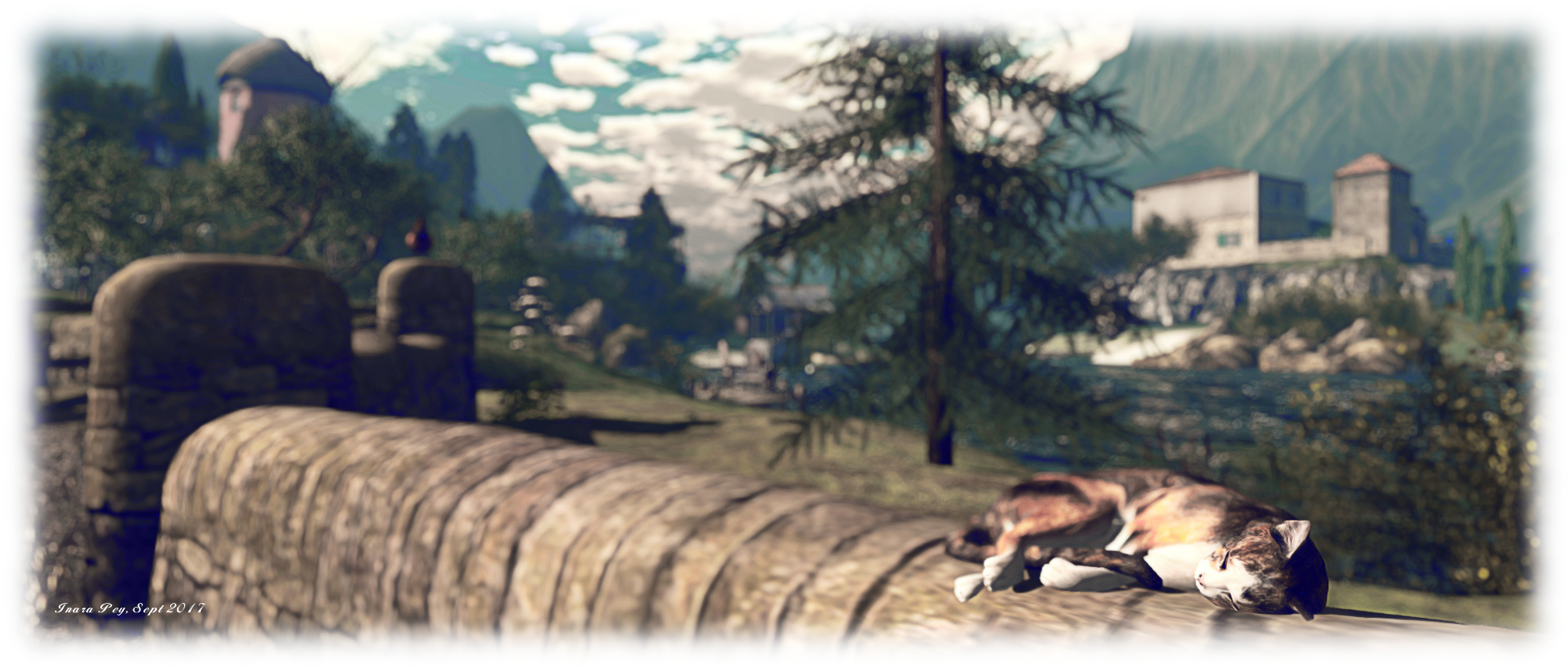
With sheep, chickens and deer grazing across the land, foxes on the prowl and cats sunning themselves, together with decks and vantage points scattered throughout, Neive offers a relaxing visit. Cuddle spots can be found as well, on land and on the water, and the sound scape and surrounding hills complete the scene. There are one or two visual issues which can bump into view when exploring: walls and rocks which don’t quite meet the terrain below them, together with one or two items floating above ground or deck, but these don’t detract from the region being a pleasant visit and photogenic in nature.

Neive; Inara Pey, September 2017, on Flickr~Neive~ – click any image for full size

SLurl Details

  • Region no longer held by Claudia

Haveit’s Elastic Garage in Second Life

UTSA: Elastic Garage

Sometimes magic is elusive. In the dark, in a large crowded storage space with one hanging light bulb: the realm of shadows and highlights, everything is sculpted of wonder. A broken down car dreams of the morning sky. An old-fashioned white porcelain bathtub with rusted scars, broken furniture, a collection of rocks in little cloth bags hanging from a beam, yellowing slides and photos from the old days stowed in a corroded file cabinet … the air tempered with repeated phrases of Prokofiev that my mother is practising on the piano in the distant living room … This was the garage of my childhood, where my visits were frequent in search of all manner of treasures to furnish the little cities I was building in the garden.

Thus Haveit Neox introduces Elastic Garage, his installation now open at the University of Texas at San Antonio’s ArtSpace. And indeed, on entering the exhibition area, visitors are confronted with the bric-a-brac which might have been gathered over time, and cherished, before being put away in the garage of the mind.

UTSA: Elastic Garage

Filing boxes lay stacked against the walls, a child’s old railway track lies on the floor, cabinets and boxes scattered around, the bath toppled on its side and the broken-down car parked to one side. Memories from childhood scattered around, spiders and their cobwebs covering some. but so is there more: memories of art builds, fragmented and scattered among the bric-a-brac.

Sitting atop some of the filing boxes, for example, is a telescope. While this may well be a childhood  memory, it might also be a reflection of Haveit’s Paper Observatory, first unveiled in 2014, and the successor to his Paper Tower. On the floor by the bodywork of the old car sits a tiny city, streams of cars rolling away from it over elevated roads; a reflection, perhaps of Haveit’s Miniature Goal and his wider concern for the environment. Inside the cabinets and upright boxes, partially hidden and awaiting discovery – just like memories in a draw or cupboard of a garage – are paintings and images, again perhaps echoing past installations Haveit has presented in-world.

UTSA: Elastic Garage

Elastic Garage is a both an expression of art and of memory; personal elements from life mixed with personal expressions of life. It makes for a fascinating visit, and will remain open through September and into October.

SLurl Details