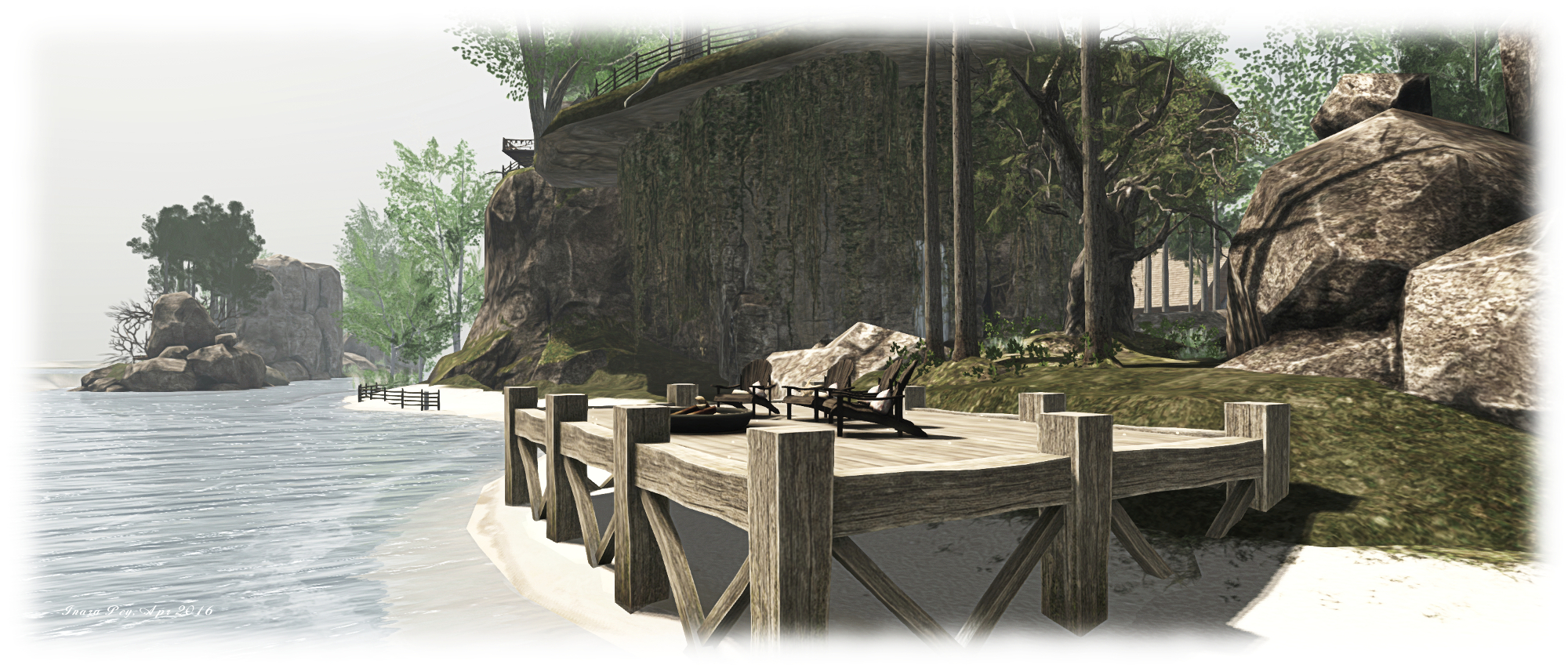
Of universities and bars, and pirates and wars

It’s time to kick-off a week of story-telling in voice, brought to our virtual lives by the staff and volunteers at the Seanchai Library. As always, all times SLT, and events are held at the Library’s Second Life home at Bradley University, unless otherwise indicated.

Sunday, May 1st

13:30 at Crazy Eights: Tea Time at Baker Street

Crazy Eights sees Caledonia, Corwyn and Kayden reading from The Return of Sherlock Holmes on Sundays from the living room of 221B Baker Street.
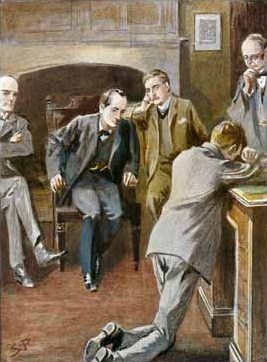
The Adventure of the Three Student, Sidney Paget

It was in the year ’95 that a combination of events, into which I need not enter, caused Mr. Sherlock Holmes and myself to spend some weeks in one of our great University towns, and it was during this time that the small but instructive adventure which I am about to relate befell us … any details which would help the reader to exactly identify the college or the criminal would be injudicious and offensive. So painful a scandal may well be allowed to die out.

So opens the Adventure of the Three Students, as related by Dr. John Watson. The scandal is that the galley proofs of a forthcoming exam have, after a most unfortunate oversight, been partially copied. The exam is for a generous scholarship, and should it ever come to light that one of the three candidates who would sit the exam earned his scholarship by cheating, it would forever blemish the college’s reputation.

Fortunately, and although only armed with the smallest of clues – a blob of clay into which is embedded some sawdust, a broken pencil lead and a cut in the top of a desk – are sufficient to inform Sherlock Holmes of the culprit’s identity.

15:00: LEA 8 Selections from Pride & Prejudice

"Jane Austen's English Countryside" at LEA 8
“Jane Austen’s English Countryside” at LEA 8

Caledonia Skytower visits Jane Austen’s English Countryside at LEA 8 to read selections from Jane Austen’s novel beloved of television networks and film companies,

Monday May 2nd, 19:00: A Trifecta of Sci-Fi

Gyro Muggins reads Spider Robinson’s The Guy with the Eyes, Hobbits and – time allowing – Arthur C. Clarke’s Take A Deep Breath.

callahansThe Guy with the Eyes was the first story Robinson had published, and went on to  be the opening chapter of Robinson’s anthology, Callahan’s Crosstime Saloon.

The titular saloon is a haven for lost souls; a place where the patrons come for one drink and a chance for a second – but only if they offer an unburdening toast at the fireplace. Mike Callahan, the owner, never judges but sometimes advises in as few words as possible.

Callahan thinks he’s heard it all until one day, The Guy With The Eyes comes in, spends an hour nursing his first drink, then steps up to the fireplace and unburdens himself with the news that he’s an alien, a harbinger of doom for Earth, who will be returning home in just a couple of hours. But when he does, his masters will destroy the planet, convinced human kind is a cancer. Only he’s no longer convinced that this is true, and no longer wants to see the world destroyed…

Tuesday May 3rd, 19:00: Dead Man’s Chest

Shandon Loring concludes reading of the second instalment of the Pirates of the Caribbean film franchise, Dead Man’s Chest.

Wednesday May 4th 19:00: Crazy Eights: The War that Saved My Life

War savedCaledonia Skytower reads Kimberly Brubaker Bradley’s children’s story.

It is the Second World War, and when nine-year-old Ada’s little brother is evacuated from London to escape the blitz, she is determined not to be left behind because her mother is too ashamed to allow her to be seen in public with her twisted foot.

So it is that Ada, experiencing her first time in the world beyond the house in which she has always lived, finds herself on an adventure, adapting to life with Susan Smith, the woman charged with caring for Ada’s little brother, and who unexpectedly finds herself with a second ward in her care.

As time passes, Ada learns to ride a pony, watches for German spies, and finds a bond forming between her and Susan smith, a bond shared with her brother, but over which hangs the shadow of what will happen when they have to return to London and the cruelty of Ada’s mother.

Thursday, May 5th

19:00: King Kong – Eighth Wonder of the World

With Shandon Loring

21:00: Seanchai Late Night

With Finn Zeddmore.

—–

Please check with the Seanchai Library SL’s blog for updates and for additions or changes to the week’s schedule.

The featured charity for March / April is Project Children, building peace in Ireland one child at a time.

Additional Links

In the Press: a voyage of discovery in Second Life

Second Life has again been getting some fair press coverage, both directly and directly, of late. I’ve already written about the platform either being the focus of, or looked at as part of, two interesting articles published in Motherboard. Also during the week, Second Life was written about on this side of the Atlantic, as first reported by Ciaran Laval.

On April 28th the on-line edition of France’s Le Monde carried an article focused on Second Life, written by  Morgane Tual.  Bearing the delightfully French title Absurde, créatif et débauché : dix ans après, « Second Life » est toujours bien vivant (Absurd, creative and debauched: ten years later, “Second Life” is still alive), it weaves a wonderful introduction to the platform which cannot fail to have those of us immersed in this digital world smiling and / or nodding in agreement.

Morgane Taul: an engaging article on Second Life
Morgane Tual: an engaging article on Second Life

This is very much a hands-on, through-the-eyes look at Second Life, good and bad, written with an unabashed honesty and wonderment. Opening with a description of her initial time in Second Life and a (first?) encounter with another resident, Ms. Tual quickly informs her readers where she is and why she is there – and hints that what she has to say might come as a surprise for who might have heard of the platform at some point:

Like me, some haggard and clumsy beginners landed on this strange beach to discover what remains of this game that occupied the headlines there about ten years. I expected to find, a decade later, a deserted world, ageing technology and a few cobwebs in the corners. It was exactly the opposite.

From this set-up we are lead on what is very much a personal voyage of discovery through Second Life. In it we encounter the realities of the platform – good and bad in equal measure,  each presented to us as they are encountered.

So it is we share in her wonder as she hops from place-to-place; her confusion (and that of others newcomers) in finding herself unceremoniously dumped at an infohub; the embarrassment that can occur simply as a result of clicking the wrong button, or in awkwardly accepting the help of another. We share in her delight in her discoveries of the music scene and in finding a place were she makes a new friend, Patti, a fellow French woman. From here we join her on a whirlwind tour of Second Life which take her to Hogwarts and thence via Star Wars, 221B Baker Street and a nightclub, to the Petit Trianon, Tatiana Dokuchic’s wonderful build in the Duché de Coeur, and a conversation with Tatiana herself.

Petit Trianon by Tatiana Dokuchic, featured in Absurde, créatif et débauché : dix ans après, « Second Life » est toujours bien vivant
Petit Trianon by Tatiana Dokuchic, featured in the Le Monde article by Morgane Tual

Interspersed with this are the assorted facts and figures from the Lab – the 900,000 monthly log-ins, the broad demographic, the economics of the platform, and so on, together with the usual potted history of the platform, all of which paints one of the clearest pictures of Second Life I’ve had the good fortune to read; one with a personal narrative free from the need to fall back on cliché or dogged by mocking observation.

Such is the narrative, we’re drawn directly into Ms. Tual’s experiences, all of which are related without judgement, but often with a real sense of joy and / or wonder. Of course, the sex is also there, but so too is the discovery that contrary to belief, Second life isn’t necessarily “all about the sex”, a point of view Ms. Tual fully embraces.

The breadth of possible engagement in Second Life is touched upon in other ways as well. Through the conversation with Tatiana, readers are introduced to the richness of opportunity for creativity in Second life. Art and entertainment are referred to – the latter supported by the inclusion of some hand-picked videos.

We also witness the tales of others, such as the guy who initially mocked the activities of SL users, regarding them as “losers”, only to himself become engrossed in the platform and all it offers. We are also – movingly – introduced to the way in which Second life bridges the physical / digital divide, very genuinely bringing people together when entire continents might otherwise separate them.

With videos and in-world images, personal tales, a frank narrative, Absurde, créatif et débauché : dix ans après, « Second Life » est toujours bien vivant is one of the most engaging pieces on second Life it has been my pleasure to read. Recommended.

Project Bento User Group update 13 with audio

Project Bento – extending the SL avatar skeleton

The following notes and audio were taken from the weekly Bento User Group meeting, held on Thursday, April 28th at 13:00 SLT on Aditi. For details on each meeting and the location, please refer to the Bento User Group wiki page.

Note that this update is not intended to offer a full transcript of the meeting, nor does it present the discussion points in chronological order. Rather, it represents the core points of discussion to Project Bento, grouped together by subject matter were relevant / possible.

Issue Fixes

Partial Joint Offsets

As noted in my last update, one issue facing Bento is in how best to handle defining partial joint offsets – a mesh that specifies the override positions for some of the joints but leaves  other joints alone, which would allow different meshes to be mixed and matched to create an avatar look. Currently, the viewer doesn’t handle  multiple root bones in a mesh with partial rigging correctly, and to help correct this, Vir Linden has published a proposal for moving forward. Essentially, this would filter out any joints which have a position unchanged from their expected default, even if the mesh claims to use an offset, with only a very small adjustment (0.1mm or greater) is required to have a joint treated as having its own offset.

Offset and Slider Conflicts

Another issue which has been discussed recently is that joints offsets (notably translation offsets) can conflict with adjustments made using the appearance sliders, resulting in adjustments made using the sliders “snapping back” to their original location on leaving edit shape or following a relog or after removing / rewearing the avatar mesh.

An adjustment has now been made so that where an offset has been set for a joint, adjustments made using the sliders which only affect the offset will be ignored, only changes to the scale of a joint (length, height) made using the sliders will work. It is thought that this fix will also address the likes of BUG-11854.

Work in progress: Aki Shichiroji demonstrates a wearable wyvern utilising Bento bones for animation.

It has also been noted that BUG-10991, “[Bento] Mesh rigged to the new joints either partly disappears, collapses or melts when viewing that avatar as an imposter” has not been fixed with the latest version of the project viewer. It will hopefully be one of the issues addressed with the next update.

Next Viewer Update

The above fixes, coupled with other work which has been carried out are regarded as being sufficient to kick-off another update to the project viewer, although there is a further piece of work Vir hopes to include. If all goes according to plan, this should see a new version of the Bento project viewer appearing in week #18 (week commencing Monday, May 2nd).

Animation File Size Limit

Currently, there is a file size limit of 120 Kb on animation files enforced by the back-end servers. With the increased number of bone available for animation. As it is now possible to animate a far large number of joints, some creators have started to find this limit a problem, and a request has been put in for it to be increased (see BUG-11836).

While there is potential for this to be done, it is currently unclear how much the file size limit should be increased. There are also other considerations to take into account, such as the intention for animation assets to be moved to the CDN for better delivery.

If there are specific examples of animation with large file sizes which could be attached to the JIRA as examples, they would be welcomed by the Lab. It has also been suggested that the Lab establish a best practices guide for animations files on the wiki.

This lead to a brief discussion on interpolation and the differences between .BVH and .ANIM animations, with Vir providing background information on how each are respectively handled.

Sliders for Remaining Bento Bones

While many Bento bones  – notably those of the face / head – have been tied-into the existing appearance sliders, there are still those which do not have slider support because they would require the development of dedicated sliders. this has been considered outside the scope of the initial Bento work, and it is far from certain it will be taken up in the near-term future, if at all.

Part of this comes down to the added complexity further sliders would thrust into the viewer UI, and also – as Vir explains – because the use of many of the Bento bones is intended to be arbitrary, therefore providing sliders to adjust them may not suit all of the uses to which they might be put, and cause further confusion / unpredictable results when used.

Continue reading “Project Bento User Group update 13 with audio”

The hidden paths of Osprey Ridge in Second Life

Osprey Ridge; Inara Pey, April 2016, on Flickr Osprey Ridge – click any image for full size

Osprey Ridge has passed into the annals of SL history. SLurls have therefor been removed.

Osprey Ridge is a homestead region within the United Sailing Sims located eastward of Blake Sea and a place we’ve often passed when our sailing or boating. Open to the public, the region has been landscaped by Markarius Viper and is cared for by Flo (SweetFloXO) and presents a pleasing environment in which to spend time.

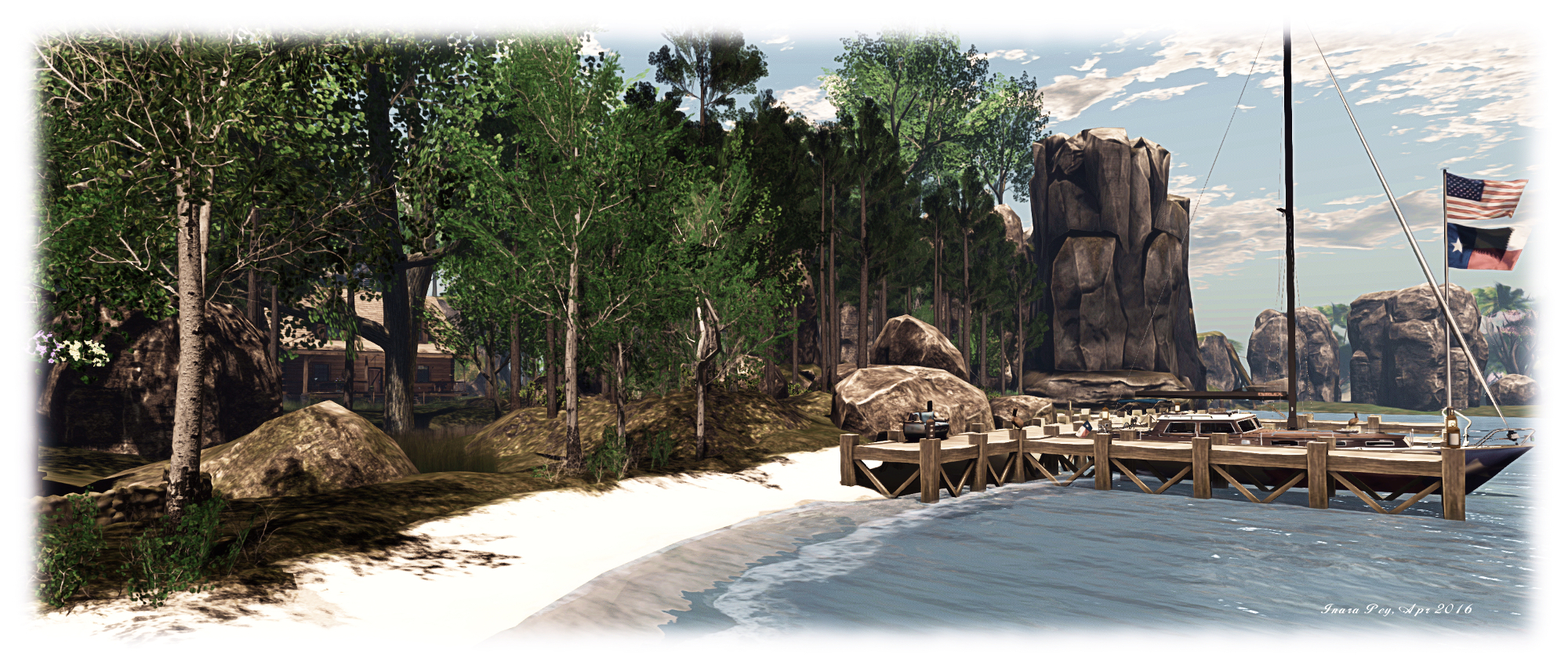
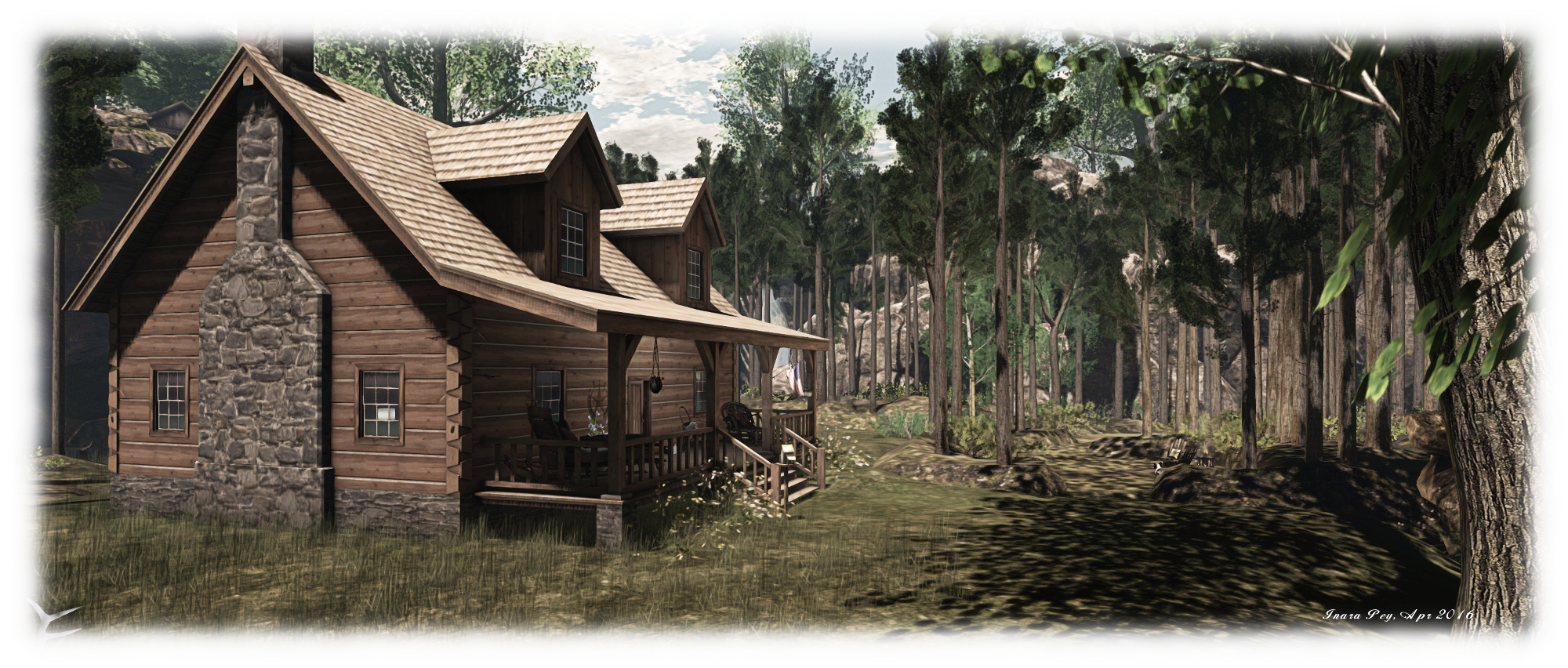
The best place to start a visit is at the moorings on the north side of the island, sheltered from the passage linking Blake Sea with Second Norway by a natural grassy breakwater. From here, visitors can walk eastwards along the moorings and the beach to come to a cosy summer gazebo sitting alongside a reedy pond, or head inland along a wooded track which winds its way to a sturdy and comfortable log cabin.

Osprey Ridge; Inara Pey, April 2016, on Flickr Osprey Ridge

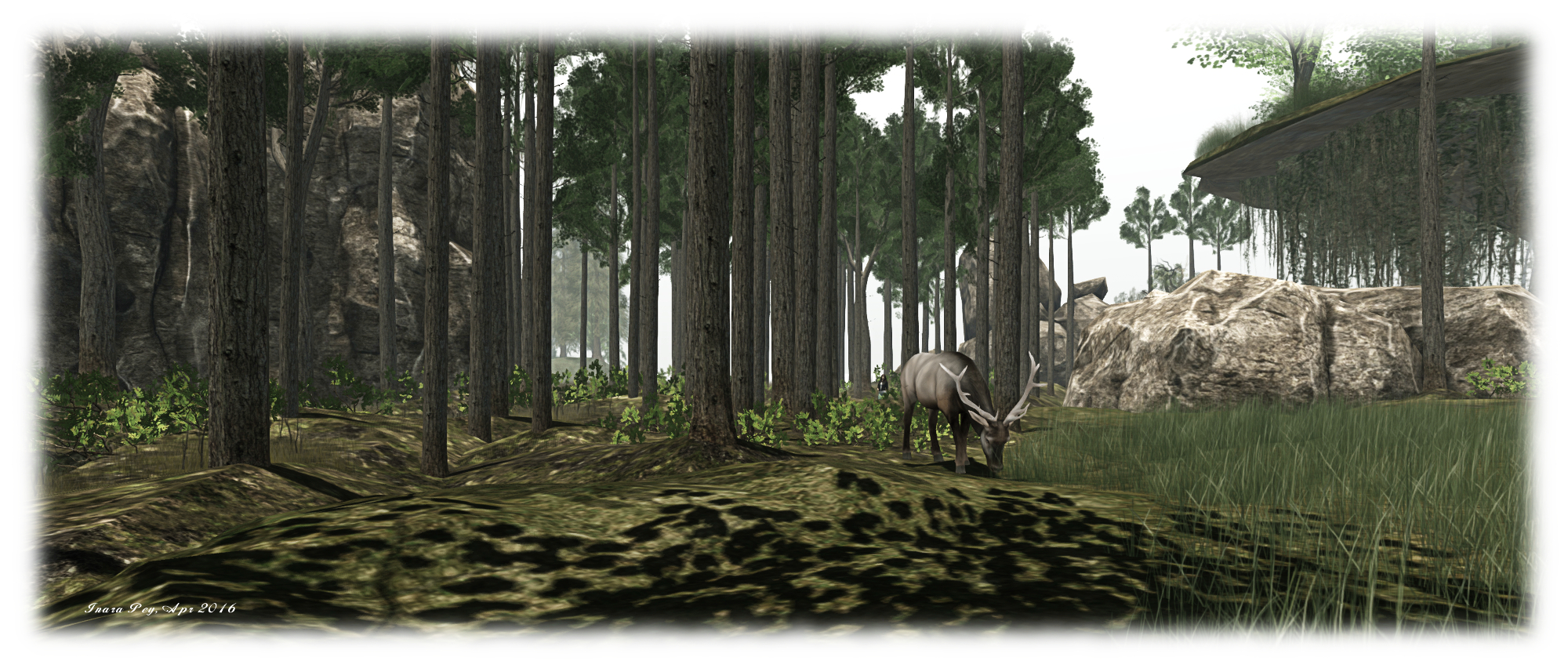
The cabin sits nestled between tall columns and plateaus rising to the south and west of it, topped by tables of grass from which tress grow. Of these more anon; for now however, take the path onwards around the front of the cabin, and it will turn southwards and lead you between more trees and under the shadow of a another mesa on the east side of the region bore your arrive at the southern shore, a deck overlooking the open waters, with another ribbon of beach pointing westwards.

If you prefer, there is a track on the west side of the cabin, just within the tree line, which leads the way to the waters at the foot of the rocky cliffs, which are in turn spanned by a bridge made from the trunk of an old, fallen tree. From here it is possible to pass between the tall mesas on either side to reach the south-western corner of the island, or scramble over the rocks and into the cavern beneath the west side plateau.

Osprey Ridge; Inara Pey, April 2016, on Flickr Osprey Ridge

The cavern is a place of peace, watched over by a fae waystone which, for those running with ALM enabled, casts patterns of light across the surrounding rock faces and over the pool of water in which it sits. A narrow opening on the north side of the carven provides a short-cut back to the moorings, which eagle-eyed visitors may have spotted as they followed the rack down towards the cabin from the north side of the island.

The broad, grassy tops of the plateaus are home to a tree house, a camp site, Greedy, Greedy and a romantic cuddle swing. A wooden bridge connects the two plateaus, but how to get up to them without flying or double-click teleporting actually defeated Caitlyn and I (we eventually went the double-click TP route).

Osprey Ridge; Inara Pey, April 2016, on Flickr Osprey Ridge

The region could perhaps benefit from having the moorings on the north side parcelled-off so that auto-return could be set to say, 60 minutes, to allow those arriving by boat to come ashore and explore without fear of their vessel poofing to Lost and Found as soon as they do so, but this is a minor point. Osprey Ridge offers a pleasing visit to those passing or who are looking for photogenic spots within Second Life, with plenty of places up high and at ground level for simply sitting and enjoying the environment or having an intimate cuddle (including a bed suspended from the trees in the woods!).

Fantasy Faire 2016: Otherworld

Otherworld
Otherworld

I’ve already written about what, for me, makes visiting the regions of Fantasy Faire special, so it may seem unfair to pick out one or two for mention beyond that post. However, as I’ve mentioned elsewhere in this blog, I am a long-time admirer of Elicio Ember’s work and designs, and so Otherworld tends to call to me strongly wherever I’m in the Fairelands.

Otherworld
Otherworld

I particularly love visiting it during the mornings (my local time, that is). It is then that the Fairelands are at their quietest and I can wander through the caves and high fields of Otherworld, climb the stairs,  descend under water or wade through the pools – and simply enjoy the tranquillity and the marvellous architecture.

At these times, My thoughts can roam, taking a short break between getting myself upright and plunging into all things physical and virtual, as demanded by the day.

Otherworld
Otherworld

Time has again conspired against me this year, preventing me from writing anywhere near what I had hope might have otherwise been the case for each of the Faireland realms; so I hope this video of Otherworld goes some way towards making up for things.

In the Press: Motherboard looks at Second Life

There have been a couple of interesting articles which have appeared in Motherboard over the last couple of days which make interesting reading.

In the first, Men Are Working Out Their Issues By Playing As Their Lovers and Exes in RPGs, published on April 28th, Cecilia D’Anastasio looks at a little researched aspect of avatar use within Second Life and MMORPGs: using their capabilities to create avatars in the likeness of a ex- or current partner or spouse.

Cecilia D'Anastasio: writing on identity in the digital age
Cecilia D’Anastasio: writing on identity in the digital age

I’ve always enjoyed reading Ms. D’Anastasio’s pieces on matter of digital identity, and have previously written about her excellent Avatar IRL, which appeared almost exactly a year ago.

This new article examines a number of ways in which people – notably, but not exclusively, young male gamers – have created representations of current or past Significant Others in the virtual environments they use.

Some of the related stories are pretty innocent. From Second Life, for example, we learn that well-known boat designer Jacqueline Trudeau  uses an avatar “minutely resembling” her husband to help promote her designs, even though he seemingly has no interest in either the platform or his wife’s ability to generate an income through it.  Similarly,  Kevin D. Kramer, a Second Life DJ in his 50s, has designed an avatar modelled on his wife which they both use, candidly admitting it offers him the opportunity to buy gowns, dresses and outfits to surprise her with in ways he cannot easily replicate in the physical world.

However, some are much more disturbing in tone, notably the examples drawn from Skyrim and XCOM-2 where the motivation for creating likenesses of ex-partners be 20-something gamers as a means to exert greater (and not entirely positive) control over them, even to the point of subjugation, or to increase their own self-image as a “protector” of the women formerly in their lives.

The piece is certainly an interesting read, going by way of Nick Yee’s research into matters  of gender-bending as covered by his Daedalus Project (you can also learn more about his work on matters of avatar identity here and via Draxtor’s excellent interview with him), and including feedback from Dr. Jamie Banks of Department of Communication Studies, West Virginia University. However, it is not without potential fault.

There is an acknowledged lack of research in why people might create avatars in the likeness of former or current partners; as such, there is perhaps a bias present in the piece, which I did find undermined it in places.

For example, while it is hard to reconcile Dr. Banks’ view of creating avatars in the image of a former partner as a means of coping with the Skrim and XCOM2 examples cited (they are far too calculated in their creation and use), it doesn’t mean the idea doesn’t have merit in other possible cases. Unfortunately, any potential credence it might have is more-or-less directly thrown under the bus in the paragraph of the article following Dr. Banks’ comments.

There are other flaws evident in the writing as well. It is noted, for example, that one of the people who created a female avatar based on his ex-girlfriend has since been banned from an unrelated game. The reason for that ban isn’t specified and could be entirely unrelated to the issues being discussed in the article. Thus, the inclusion of this statement seems to serve no other purpose than to enhance the reader’s negative view they may already have of the individual.

However, given this is an aspect of the use of avatar-driven environments and MMOs that hasn’t really been deeply researched, the article does open the door to discussions on the subject, and may encourage a greater academic study of the issue.

In Why Is Second Life Still a Thing?, which appeared on April 29th, Emanuel Maiberg poses a question I suspect might be asked by a lot of journalists who have perhaps been previously familiar with the platform and are suddenly exposed to it once more.

In asking the question, Mr. Maiberg also does a fair job in answering it as well, and in doing so, takes the reader on a no hold barred tour of the platform, commencing with what has been it’s crucial differentiator over other, “prettier” platforms and games:

A crucial difference between Second Life and MMOs like World of Warcraft is that the latter are mostly fixed worlds. Once in awhile, developer Blizzard will introduce a new continent or reconfigure an existing location, but all players are guests in the world that Blizzard created. Second Life, by contrast, allows users to not only create their own avatars, but also to shape and create the world they’re in, importing their own 3D assets and modifying the world with the Linden Scripting Language.  

Emanuel Maiberg - a frank look at Second Life
Emanuel Maiberg – a frank look at Second Life

A potted history of the platform follows, together with an examination of much of what goes on in-world being referenced: art, education, user-generated transactions, and so on, together with the highs and lows the platform has seen. Of course, sex gets a fair mention within the piece; no surprises there, as it does both act as a draw for at least some of those coming into the platform (although equally, they may find their interests moving elsewhere once they are engaged in the platform), and it does contribute fairly to the platform’s economy.

Project Sansar is also touched upon – as is one of the core reasons why the Lab is keen to emphasise it is a platform designed to run alongside, rather than replace, Second Life. The very success of the latter and the level of investment users have within the system mean that displacing them anywhere else is at best exceptionally difficult; no other platform or service as thus far managed to achieve what Second Life invented in terms of environment, capabilities, user numbers and economical viability.

Those of us familiar with Second Life may not find much that is new in Mr. Maiberg’s piece, but that’s beside the point. What he offers is a frank look at the platform, free from bias or agenda but which fairly addresses many of the reasons which have made the platform a success in and of itself.

Overall, both pieces made for interesting reading.