Updates for the week ending: Sunday, May 31st, 2015
This summary is published every Monday, and is a list of SL viewer / client releases (official and TPV) made during the previous week. When reading it, please note:
It is based on my Current Viewer Releases Page, a list of all Second Life viewers and clients that are in popular use (and of which I am aware), and which are recognised as adhering to the TPV Policy. This page includes comprehensive links to download pages, blog notes, release notes, etc., as well as links to any / all reviews of specific viewers / clients made within this blog
By its nature, this summary presented here will always be in arrears, please refer to the Current Viewer Release Page for more up-to-date information.
Official LL Viewers
Current Release version: 3.7.29.301305, May 28 (formerly the Avatar Layer Limits RC viewer allows users to wear up to 60 wearable layers (jackets, shirts, tattoo, alpha, etc.) in any combination ) download page, release notes
Attachment fixes RC viewer (Project Big Bird) updated to version 3.7.29.301943 on May 21 – core updates: a number of fixes for various attachment issues (download and release notes)
Black Dragon updated to version 2.4.2.6 on May 30th with a bug fix release 2.4.2.7 on June 1st – core updates: revised Build tools floater layouts (release notes)
UKanDo updated to version 3.7.29.28115 on May 31 – core updates: keeping pace with recent LL releases (layer limits), and RLV releases (release notes).
V1-style
Cool VL Viewer Stable branch updated to version 1.26.12.44, and the Experimental branch to version 1.26.13.13, both on May 30th (release notes).
Black Dragon 2.4.2.6 was released on Saturday, May 30th 2015, followed by a rapid-fire bug fix update with the release of 2.4.2.7 on Monday, June 1st.
Both updates focus on the Build tools floater and its associated tabs, which Niran has completely overhauled and realigned in an attempt to make it a lot less cluttered-looking and easier to read, as well as adding a degree of consistency of presentation between the tabs in the floater and the types of tool options (spinners and sliders) seen in the Build floater when compared to other tool floaters in the viewer.
My personal opinion on the changes is that is that he’s largely succeeded. There is a linear tidiness to the tabs in his revised Build floater that works naturally for those used to scanning left-to-right, and top down. everything is pretty much orderly placed, and the flow through the various tabs is logical and easy to follow.
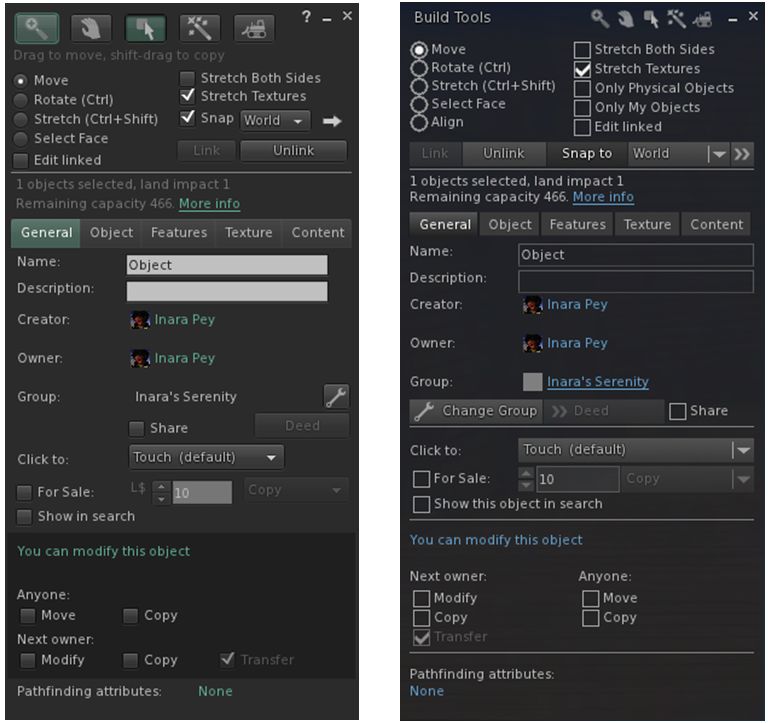
The official viewer’s Build floater Object tab (l) and Niran’s revised layout in black Dragon (r) – click any image for full size
Buttons with the Black Dragon floater are more obvious / clearer – radio buttons, for example are better defined when selected, what might be slightly confusing buttons (such as the spanner for changing the group attributes) are now clearly labelled, and buttons for pop-out options like the Grid Options are also more in keeping with the style used elsewhere in the viewer.
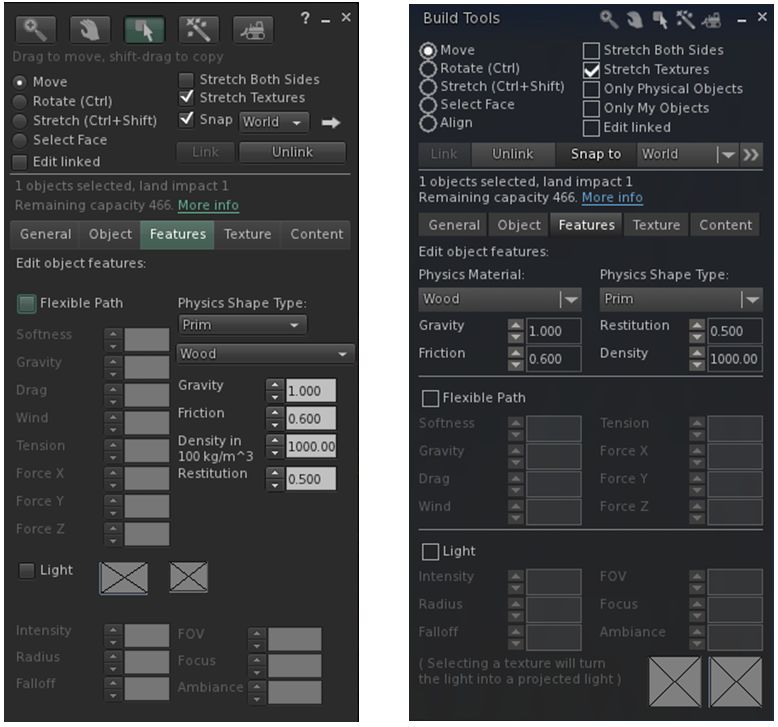
The official viewer’s Build floater Features tab (l) and Niran’s revised layout in black Dragon (r)
Some of the changes are a lot more noticeable in this regard than others – as with the General and Features tabs – both of which are compared to their official viewer equivalents in the images above – and the Texture tab. The changes to the Content and Object tabs are more subtle in nature – but given they were relatively straightforward to understand, then this is in keeping with making balanced changes.
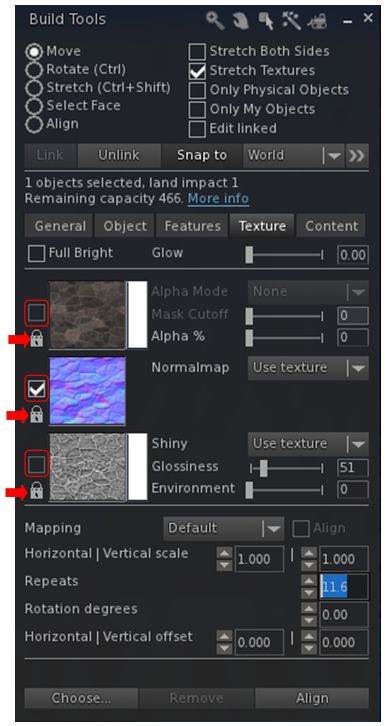
The Texture tab now has clearer map selection check boxes (outlined) and individual lock options for applying rotations, offsets, etc., via the spinners (arrowed)
In terms of the Texture tab, Niran has also revised the map selection indicator from a radio button to a check box – again adding consistency to the use of check boxes in the floater – and has also added an individual lock option to each of the three map types.
The check boxes actually do make it easier to see which of the three maps (diffuse, normal or specular) has been selected, while the three individual locks now allow greater flexibility in how changes to repeats, offsets and rotations are applied.
For example, if you want to have them applied across all three maps, regardless of which one you have selected, just click on the icons to lock them – any change make to the offsets, etc., on one map will automatically be applied to all three, regardless of which one you are working on. If you want to change the offsets to each map independently of the others, simply unlock them (the default) – any changes made the offset, etc., spinners will only apply to the selected map. And you can also obviously have one set of rotations applied to two out of the three maps and level the third to be independently set.
The Textures tab also now makes use of sliders as well as spinners for applying Glow, Transparency (Alpha %), Glossiness and Environment to faces / objects, making it easy to apply quick changes before fine-tuning them with the spinners. It was actually two of these sliders that prompted the 2.4.2.7 release. While testing the 2.4.2.6 release for this review, I noted the Glow and Alpha % sliders were not working as expected. A quick IM to Niran, and he dived in and fixed the issue. The updates to these two sliders mark the only changes between 2.4.2.6 and 2.4.2.7.
Snapshot Floater Preview Update
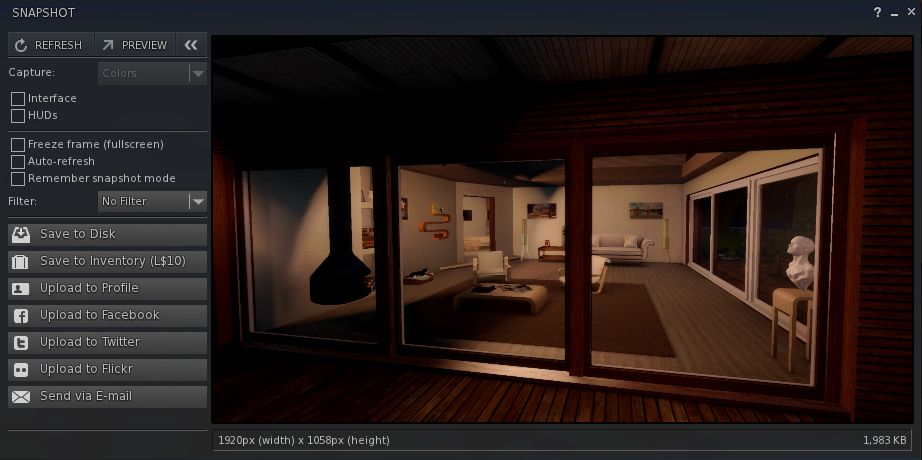
The other significant update in the 2.4.2.6/7 release lies with the Unified Snapshot floater. In the 2.4.2.5 updates (which I reviewed here), Niran introduced a separate, resizeable preview panel as an alternative to the preview pane built-in to the floater. He’s now further revised the snapshot floater so that the built-in preview pane displays a high-resolution preview image, as with the alternative preview panel.
The preview pane for the snapshot floater now displays high-resolution preview images
The new preview panel offers a much improved image, and further enhances an option a lot of people would like to see adopted by other viewers in some way.
Feedback
Overall, the core Build tools updates in these releases – to me – do much to enhance the Build floater. As noted, some of the changes are a little more subtle than others, but overall they all work to present a far tidier set of tabs within the floater, and offer a more-or-less consistent set of control options in terms of the use of spinners, sliders, etc. One might have a small niggle with the colour swatch panels for the diffuse and specular maps perhaps not being obvious, but it’s really hard to see how else they could be presented without losing the order and layout Niran has achieved within the Texture tab.
Towards the top of this post, I pointed to these releases marking the beginning of the end of Niran’s active development of the Black Dragon viewer He’s aiming to slow things down from release 2.4.5). Since releasing the 2.4.2.7 update he has explained some of his reasons for this.
The important point to note here are the word “active” – hence my emphasis above. He’s not given up on everything within the viewer; he’s allowing himself space to refocus on other things than need attention (like that irritating thing we call “real life”) and to refresh himself. He’ll still be poking and tweaking things in the viewer in the future; it just won’t be his primary focus. And after the amount of time and effort he has poured into his viewers, frankly, he should be respected for his decision, and offered kudos for all he has offered the community.
In the meantime, I’ll continue to look forward to seeing what future updates to Black Dragon bring.
In December 2014, I wrote about the Curiosity science team reporting they had detected odd “spikes” in methane levels in the Martian atmosphere as a result of analyses undertaken by the SAM (Sample Analysis at Mars) mini laboratory within the Mars rover.
Methane had first been definitively detected on Mars by the 2008 Phoenix Lander, although its presence had long been suspected and indicated. However, Curiosity’s discovery of two sudden sharp increases in the normal levels of traceable methane to some 7 part per billion – a ten time increase of the expected levels – suggested it had perhaps happened across some localised methane-producing source, possibly of organic nature (notes that “organic” in this case doesn’t actually mean “living things”).
However, the results have recently had some doubt cast upon them, and from within NASA itself. Kevin Zahnle, a scientist at NASA’s Ames Research Centre in California has been studying the data and suggested that the methane spikes could have come from a very localised source – a leaf of Earthly air previously trapped somewhere in the rover’s insides.
Could a small pocket of air carried from Earth have leaked into one of the spectrometers aboard Curiosity’s SAM instrument and caused spurious methane counts? Image: NASA / JPL
Depsite rigorous decontamination processes prior to launch, is is possible for air and gas pockets to get trapped inside a robot vehicle. This is actually what happened at the start of Curiosity’s sojourn on Mars: during its initial analysis of the atmosphere around it, the rover also detected abnormally high levels of methane, only for it to be tracked back to tiny amount of air carried aboard the rover leaking into the spectrometer carrying out the methane measurements. Zahnle suggests that a similar leak cannot yet be ruled-out as the cause of the 2013 and 2014 spikes.
Members of the Curiosity science team argue that as a result of the initial leak, they have taken every caution to prevent being misled again, and are confident that only the most exceptional of circumstances could result in SAM’s findings being the result of methane “trapped” somewhere inside the rover only get released well over a year after its arrival on Mars. However, they also admit that the potential for such a situation cannot be entirely ruled-out.
One of the arguments for the spikes being the result of contamination from within the rover is that similar readings haven’t since been recorded. A counter argument to this is that the levels SAM recorded could be the result of a yet-to-be-understood seasonal phenomena. To this end, the rover is going to be sniffing the air around it very carefully during late 2015 / early 2016 to see if it can detect any similar spikes.
Insight (in) to Mars
An artist’s impression of InSight on Mars. Image: NASA / JPL
NASA’s next mission to Mars is scheduled to launch a March 2016. In keeping with the agency’s (roughly) alternating approach to surface mission to the planet, which switch between landers craft and rovers, the InSight (Interior Exploration using Seismic Investigations, Geodesy and Heat Transport) mission is a lander mission.
As the full version of its name suggests, InSight is intended to probe the deep interior of Mars. In doing so, it is hoped the mission will not only add to our understanding of Mars, but also our understanding of the processes that shaped the rocky planets of the inner solar system (including Earth) more than four billion years ago.
Following its launch, InSight will cruise to Mars in a flight of roughly 6 months, landing on the surface in September of that year. After a check-out and calibration period, the science mission will commence in October 2016, with the overall surface mission expected to last 700 Sols (roughly 720 Earth days).
The solar arrays on NASA’s InSight lander are deployed in this test inside a clean room at Lockheed Martin Space Systems, Denver. This configuration is how the spacecraft will look on the surface of Mars.Image: NASA / JPL / Lockheed Martin
The reason Mars is being used in this way, rather than scientists simply studying the Earth to better understand the processes involved in shaping the rocky worlds of the solar system is that Mars are far less geologically active than Earth, it retains a more complete record of its history in its own basic planetary building blocks: its core, mantle and crust than does Earth.
The Lander for the mission is based on the successful design of the 2008 Phoenix mission, and will include technology and instruments that will be deployed onto the surface of Mars, including the HP3 “mole” which will burrow its way deep below the surface (see the artist’s impression under the headline to this piece) in an attempt to more accurately measure the amount of heat flowing outwards from the planet’s core.
It’s time to kick-off another week of fabulous story-telling in voice, brought to our virtual lives by the staff and volunteers at the Seanchai Library. As always, all times SLT, and all events in Second Life are held at the Seanchai Library’s home at Bradley University. Locations for events in InWorldz and Kitely are given within the write-ups for those events.
Sunday, May 31st
13:00 Tea-time at Baker Street
Caledonia Skytower, Kaydon Oconnell and Corwyn Allen continue reading The Memoirs of Sherlock Holmes, originally published in 1894, and which brings together twelve (or eleven in US editions of the volume) adventures featuring Holmes and Watson, as originally published in The Strand Magazine. This week: The Adventure of the Cardboard Box.
The Adventure of the Cardboard Box
In choosing a few typical cases which illustrate the remarkable mental qualities of my friend, Sherlock Holmes, I have endeavoured, as far as possible, to select those which presented the minimum of sensationalism, while offering a fair field for his talents. It is, however, unfortunately impossible entirely to separate the sensational from the criminal, and a chronicler is left in the dilemma that he must either sacrifice details which are essential to his statement and so give a false impression of the problem, or he must use matter which chance, and not choice, has provided him with. With this short preface I shall turn to my notes of what proved to be a strange, though a peculiarly terrible, chain of events.
So begins Dr, John Watson in re-telling one of Holmes’ more grisly cases, which was first published in The Stand Magazine in 1892, before forming a part of the Memoirs anthology in the UK, and His Last Bow in the United States.
The affair begins when Miss Susan Cushing of Croydon receives a grisly parcel of two severed human ears, packed in salt. Inspector Lestrade is convinced that the parcel is a prank on the part of three medical students Miss Cushing was forced to evict from her lodgings due to their unruly behaviour. Lestrade points to the parcel as coming from Belfast – the home of one of the former lodgers – as reason for his suspicions.
On examining the parcel, however, Holmes is certain that they are dealing with a far more serious crime, involving tormented minds and extra-marital relationships…
18:00 Magicland Storytime – Thomasina Part 1
Join Caledonia Skytower at Magicland Park as she commences reading Paul Gallico’s 1957 novel (and later a 1963 Walt Disney film starring none other that Patrick McGoohan, alongside Karen Dotrice – who also appeared in Disney’s Mary Poppins and The Gnome Mobile – and Susan Hampshire).
When Thomasina, young Mary’s cat, suffers injury, Mary’s veterinarian father and widower, is typically unsympathetic , and rather than treating the cat, has it put to sleep – earning himself the enmity of his daughter, who declares him dead to her.
Thomasina, meantime, finds herself in cat heaven, only to be returned to Earth because she has lived only one of her nine lives. Thus begins a series of adventures involving Thomasina, Mary, her father and a local woman regarded as a “witch” by the children, but who has a caring way with animals…
Monday June 1st, 19:00: Science Fiction with Gyro Muggins
This evening Gyro reads from two short stories. In Isaac Asimov’s 1956 story, Pâté de Foie Gras a goose is discovered which actually lays golden eggs. Meanwhile, in If at Faust You Don’t Succeedby Roger Zelazny, Robert Sheckley, the contest between the forces of Good and Evil for control of the universe resumes, but Mephistopheles has mistakenly signs up a medieval cutpurse named Mack the Club, thinking him the learned Dr. Faust. And that’s just the start of Mephisto’s problems…
Tuesday June 2nd, The Great Gatsby, Part 2
Caledonia Skytower, Corwyn Allen and Kaydan Oconnell continue reading of F. Scott Fitzgerald’s magnificent 1925 novel.
In 1922, Nick Carraway arrives in New York to learn about the bond business. He rents a small cottage in West Egg, home of the newly-rich, only to discover the owner of the huge Gothic mansion next door, the deeply mysterious Jay Gatsby, is prone to throwing lavish parties every weekend, to which in seems everyone comes. Everyone it seems, except Nick’s cousin Daisy, who is married to Tom Buchanan. Together they live across the bay in the more fashion East Egg, where the “old money” resides.
Following a visit with them, Nick is slowly drawn into their world, both discovering Tom Buchanan has a mistress who lives in the Valley of Ashes, an industrial area lying between the Eggs and New York city, and finding himself increasingly attracted to the Buchanan’s friend, the beautiful, if cynically minded, Jordan Baker.
Then, one Saturday, Nick finds himself invited to one of Jay Gatsby’s great parties, and is thus drawn into an increasingly deep well of infatuation, lust, and tragedy, witnessing first hand a darker side of the so-called American Dream.
Wednesday June 3rd
06:00: Forever Erma
Erma Bombeck achieved great popularity for her newspaper column that described suburban home life from the mid-1960s until the late 1990s. She also published 15 books, most of which became bestsellers. From 1965 to 1996, Erma Bombeck wrote over 4,000 newspaper columns, using broad and sometimes eloquent humour, chronicling the ordinary life of a mid-western suburban housewife. By the 1970s, her columns were read twice-weekly by 30 million readers of the 900 newspapers in the U.S. and Canada
Join Freda Frostbite and Trolly Trollop as the delve into Erma’s wit and wisdom of everyday life, joined by Caledonia Skytower.
19:00: The Night Fairy
With Faerie Maven-Pralou.
Thursday June 4th, 19:00: The Night’s Ocean
Shandon Loring reads from the 1936 short story by H.P. Lovecraft and R.H. Barlow.
—–
Please check with the Seanchai Library SL’s blog for updates and for additions or changes to the week’s schedule. The featured charity for April / May is Habitat for Humanity, with a vision of a world where everyone has a decent place to live – a safe and clean place to call home.
We’re approaching the start of June, and with the run-up to this year’s Second Life Birthday Community Celebrations. As noted in the banner above, the event will take place between June 21st and 28th, and will feature fifteen regions packed with builds, performance areas, stages, works of art and more, all celebrating the rich creative diversity within Second Life. On Monday, June 1st, eager exhibitors will gain access to the regions, ready to start construction!
As a part of the build-up to the main event, there will once again be a special Press Day – Saturday, June 20th, 2015 – when the fifteen regions will be open for bloggers, photographers, machinima makers, and so on to tour them and preview all that awaits residents in this year’s celebrations.
If you would like to participate in the Press Day for SL12BCC, please make sure you complete and submit the SL12B press application form.
The SL12B Time Capsule
The Time Capsule is a traditional part of the SL Birthday celebrations. It is used to contain items donated by SL residents, which are placed on display at future SLB celebrations. This year is no exception, and the SL12BCC organisers have issued an invitation to residents to submit designs for a time capsule that represents a significant technical enhancement for the year, or which is inspired by the year’s celebratory theme, which this year is “what dreams may come?”.
To give some examples of past time capsules, the SL4B capsule had flexible prims which that of SL5B featured glow – which were technical developments in SL in their respective years, while the SL6B time capsule was a meteorite chunk, in keeping with that year’s space theme.
I have the honour to be invited by the SL12B CC coordinator, Doc Gascoigne, to produce a series of short “preview” videos marking how things are developing on the celebration regions as building commences – and obviously without giving too much away!
As work starts in earnest for most exhibitors on Monday, June 1st, 2015, we thought we’d start the previews with… a preview! Enjoy!
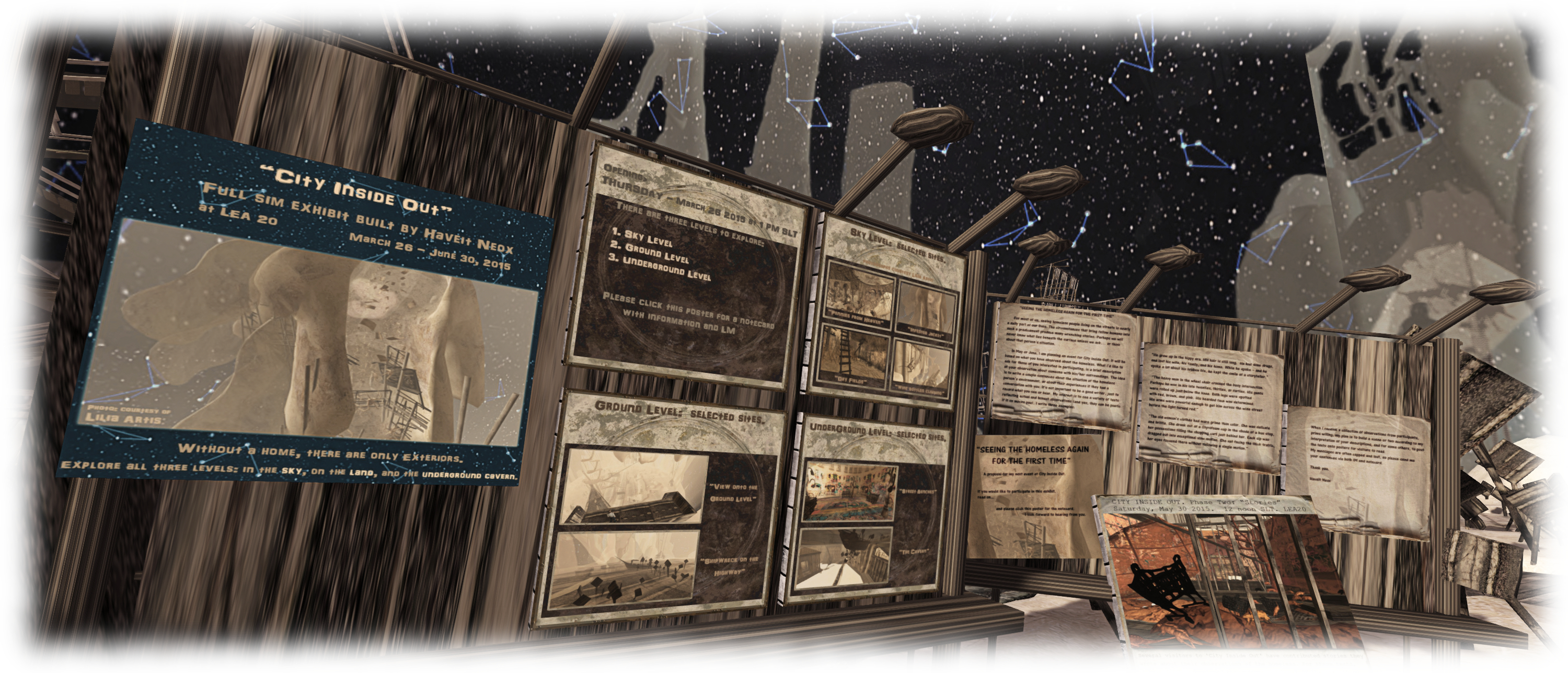
In March I wrote about Haveit Neox’s visually stunning City Inside Out, a full-region installation at LEA 20, which is displayed as a part of the 8th round of the Artist In Residence series.
On Saturday, May 30th, a new element in the installation, City Inside Out Phase II:“Stories” opened, and takes the visitor down under Haveit’s remarkable cityscape, where stories await.
To briefly recap on the original build, as per my initial post about it:
This is a city we’re asked to see through the eyes of the homeless, the dispossessed; those who have nowhere to be, nowhere to go. For these people, the city is a very different place to the one we know. It’s a place where everything is strange, alien, and threatening. A place bad enough in daylight, but as Haevit further explains, becomes much, much worse at night…
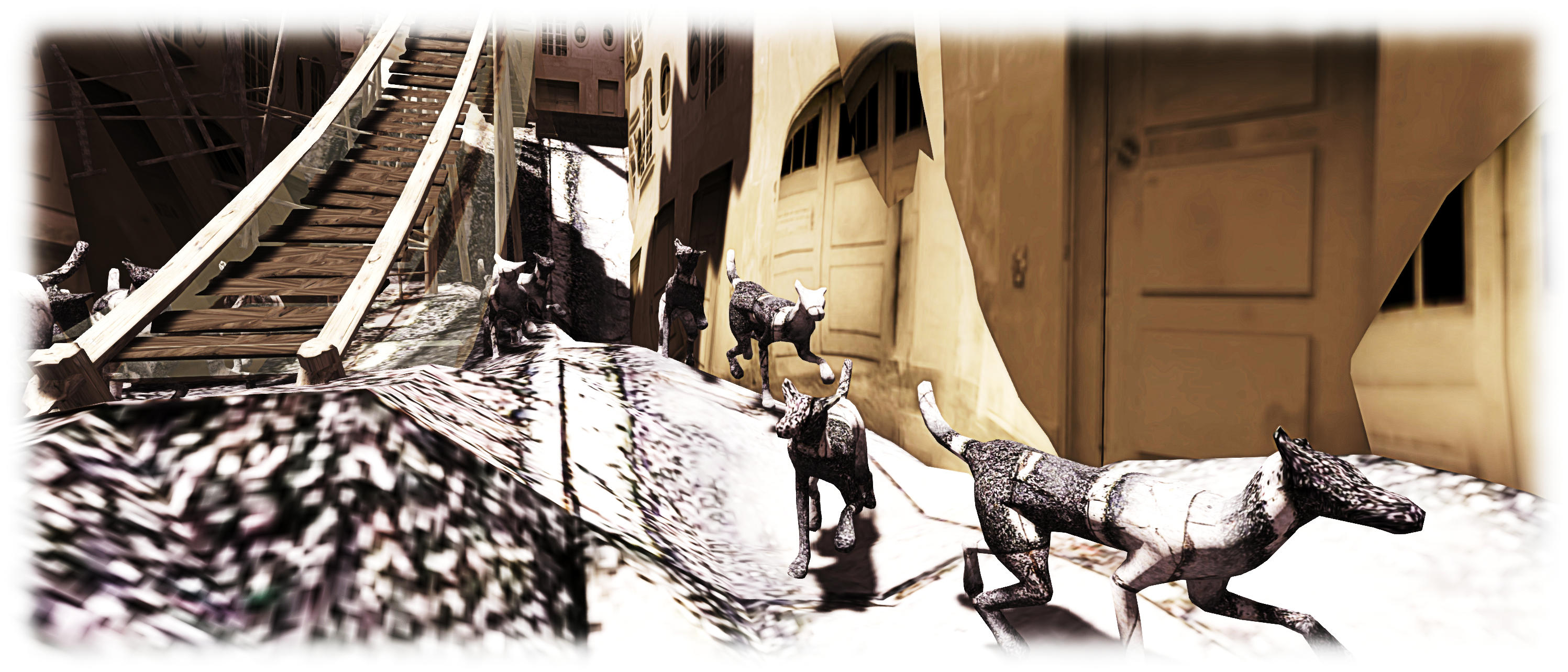
As I noted at the time, this premise of seeing a city somewhat in reverse, as a homeless person, makes for a remarkable – and is some places uncomfortable – place, where nothing is quite as it seems, be it the had offering money or the man walking his dog; threats real or imagined and spurred by fears and a sense of separation, can be found everywhere…
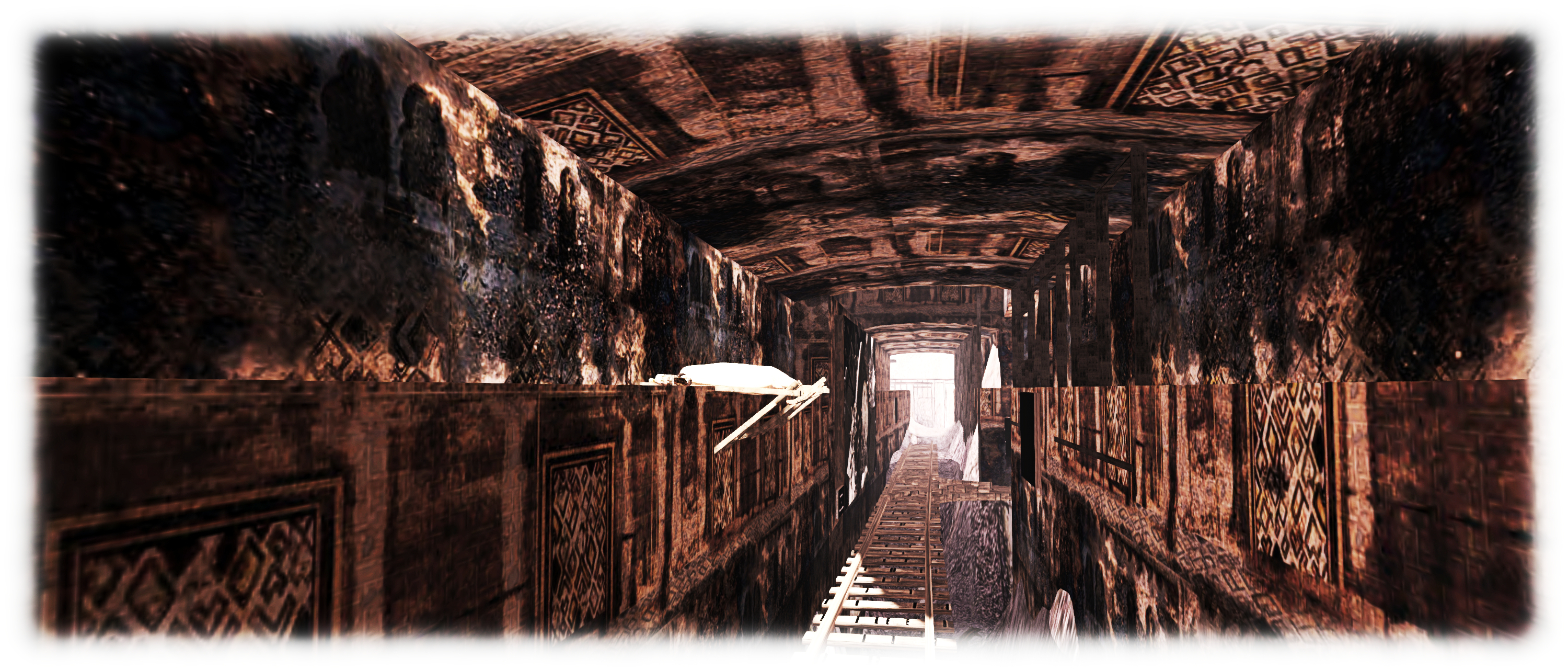
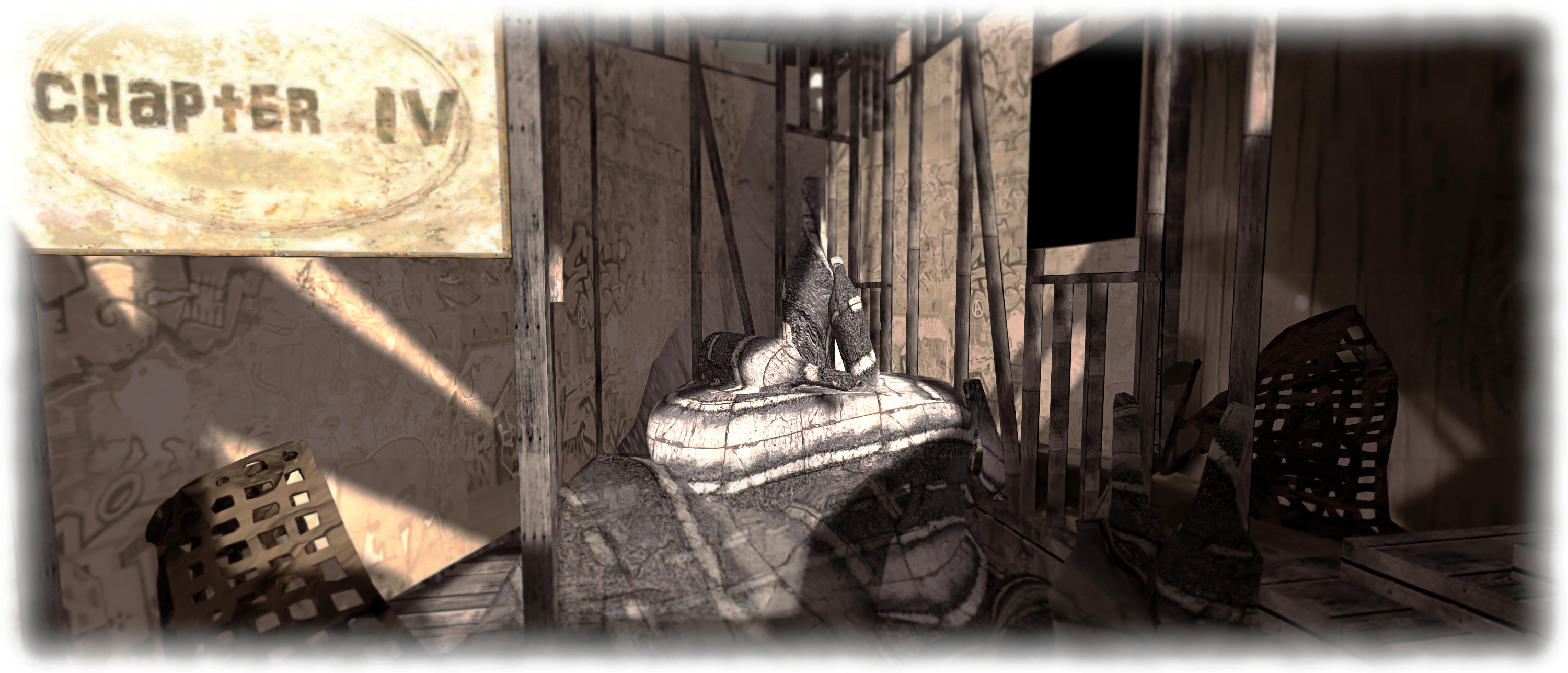
With Phase 2 of the build Haveit incorporates a series of short stories written by other Second Life residents on the subject of homelessness in the physical world as they perceive it. These are laid-out in an underground labyrinth sitting beneath the lowest level of the main build, and are arranged as a series of seven chapters reached by following subterranean paths.
There are a number of different entry points to these paths – simply walk onto one of the moving roadways and follow it, and you will drop into the underground world. However, to follow the chapters roughly in order, the best point to start is to walk to the dual carriageway that lies just behind the landing point information boards, and follow it eastwards. It ends in a slice in the ground that will lead you down to Chapter 1, which sits directly under the roads. Do note, however, that the route through the chapters from 1 to 2 to 3, etc., isn’t necessarily linear; spurs and turns can lead you through the middle chapters in different ways, depending on the route you take.
The paths also provide a hint of narrative as well the the story boards located along them. As you walk through them they change from a trench-like cutting to what could be long-abandoned mine workings or the underground vital intestines that keep a city alive, through to vast subterranean chambers suggestive of a city that has built over itself time and again, burying or hiding its past from view – just as we so easily can blot the homeless around us from our view.
This is a fascinating addition to what was already a brilliant installation, both in terms of the build and the stories it contains. It is also one in which you can play a role; Haveit is still accepting pieces on the subject of homelessness, and will add them to boards throughout the underground world as they are submitted. Simply send him your words via note card together with an IM notifying him you have sent something. Additions to the narrative will continue through until June 25th, and both phases of City Inside Out will remain open until June 30th.
If you haven’t already visited, I urge you to do so; and if you have been before, do make sure of a return visit and walk the underground paths.




 Inara Pey: Living in a Modemworld