Few people involved in VR and augmented reality are unconvinced that these emerging technologies will have a profound effect on education and teaching. As has been seen in both Second Life and Open Simulator, even without immersive VR, virtual environments offer a huge opportunity to education.
Now High Fidelity is joining in, and is doing so in a novel but enticing way: by offering up to three US$5,000 grants to teams or individuals who want to build educational content within High Fidelity.
The new of the opportunity, which the HiFi team is calling the “STEM VR Challenge” (STEM being the acronym for Science, Technology, Engineering and Mathematics in education), was made via a blog post on the High Fidelity website from Ryan Karpf. In it, Ryan says:
High Fidelity recently had the pleasure of showing off our open source virtual reality platform to educators and technical integrators at the ISTE conference in Philadelphia.
To demonstrate one way educators can use our platform, High Fidelity worked with DynamoidApps to develop an interactive model of an animal cell that can be explored on one’s own or with an entire class. The vast alien looking environment goes beyond just showing the parts of the cell, also showing some of the processes taking place. Travelling around with your classmates and teacher allows for real time question and answers and sharing of ideas.
If you want to visit this animal cell, login and go to cellscience/start, and fly towards any cell you see to begin your journey. Hitch a ride on a motor protein and jump off at one of the huge mitochondria along the way!
The interactive model of an animal cell created by High Fidelity, working with DynamoidApps (image courtesy of High Fidelity)
The model itself, in keeping with High Fidelity’s open-source approach to their platform, is being offered free to any who wishes to modify it, with the companying hoping it will become the first of a catalogue of educational units created within High Fidelity.
To further kick-start things, High Fidelity are inviting educators, be they individuals or groups, to take up the STEM VR Challenge, to submit proposals for educational content in High Fidelity which meets the criteria set-out in the Challenge website, namely that the content is:
HMD (e.g. Oculus Rift) featured
High school age appropriate
STEM focused
Social (can be experienced by >3 people together)
Proposals meeting these criteria and abiding by the rules and are eligible to enter the Challenge, should be submitted via e-mail to eduvrgrant-at-highfidelity.com. On offer are up to three grants of US$5,000 apiece to help further develop the selected ideas. In addition, awardees will have direct access to High Fidelity’s technical support, and have their content hosted by High Fidelity. To find out more, follow the links to the High Fidelity blog and the STEM VR website.
JayJay Zifanwee of the University of Western Australia (UWA) informs me that The Sci-Fi Film Festival will once again be held in Australia, hosted and sponsored by the Parramatta City Council.
Taking place over the three days of October 30th through November 1st inclusive, the Festival will once again include the Project Sci-Fi Challenge, in which film makers and machinima makers from around the world are challenged to create a short sci-fi film in just 30 days.
The UWA is once again partnering with Project Sci-Fi organisers Screen My Shorts, and will cover the Challenge entry fees for any machinima filmed in Second Life. There is a prize pool of AU $5,750 on offer, and according to JayJay, Second Life machinima makers should be eligible for the Animation and International Film categories as well as the overall prizes.
“We feel that in a SciFi category, those filming in Second Life have a huge advantage over those using conventional filming methods, and we hope that all of you machinimatogtraphers and filmmakers in Second Life use this advantage fully,” Jayjay said.
It has certainly been fertile ground for SL machinima makers in the past. In 2013, Tutsy Navarathna was the best overall winner in the machinima category of the 2013 Challenge (then sponsored by Western Digital) with his brilliant The Residents, a remarkable tale of worlds within worlds, and a clever twist involving SL (seen above), with Erythro Asimov taking the 2nd prize with Looking Around (below), as well as several other prize-winning entries.
So, if you’re interested in applying, take a read through the guidelines linked-to above, and make sure you read the Project Sci-Fi Guidelines and the official rules to fully understand the requirements of entry and the competition time line. When you enter, please consider letting Jayjay know, either via in-world contact or via e-mail (jayjayaustralia-at-hotmail.com), and good luck!
December 2014 saw me make an initial visit to Umbral Photography and Umbral, designed and curated by vlady and Coqueta Veeper on their homestead region of Hydra Isles. In that piece, I noted that the region can go through seasonal changes, and at the time of writing back then, the northern hemisphere was in deepest winter, and the region was similarly in the grip of deep snow, and the waters had a decidedly chilly look to them.
Now, half a year later, the snows have thawed, the skies are blue, and the flowers are all in bloom. Summer has come to the region, and with it have come a few changes to the landscape.
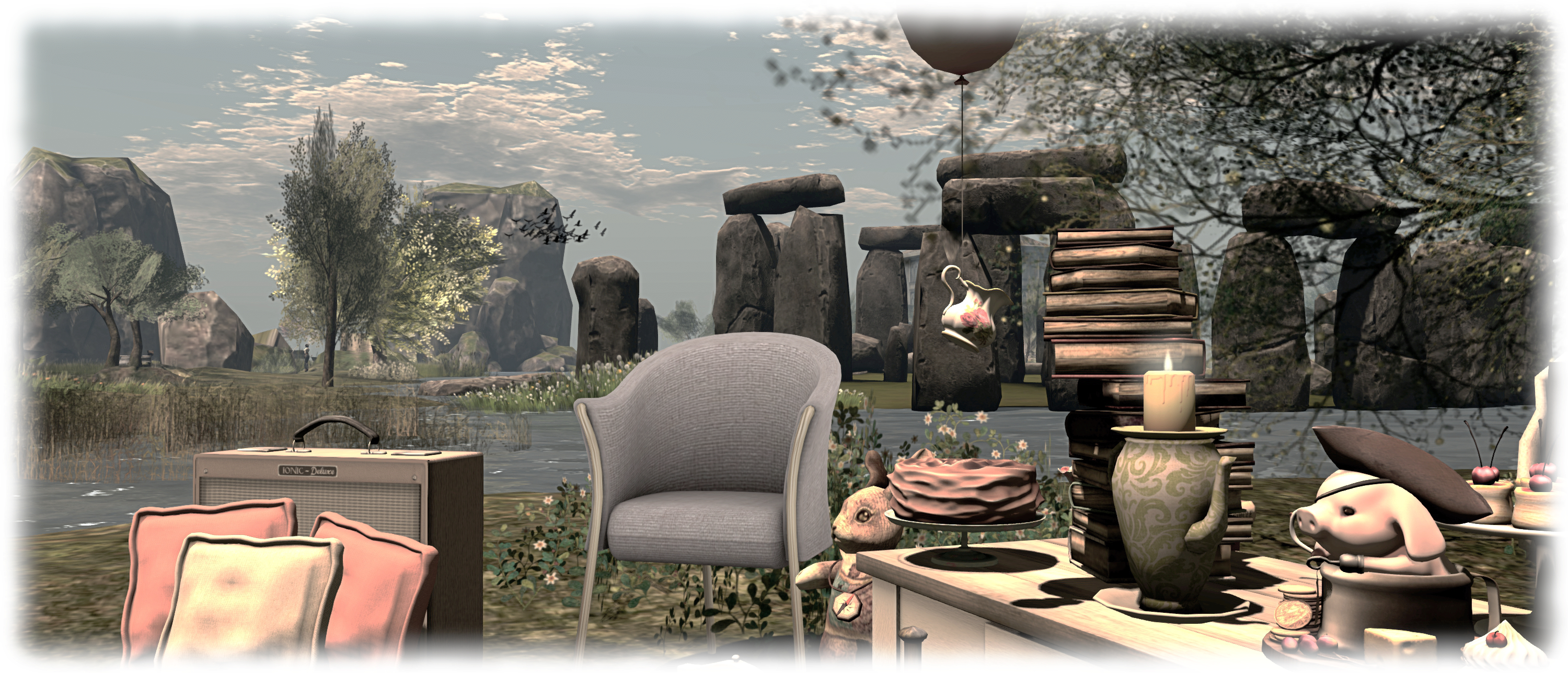
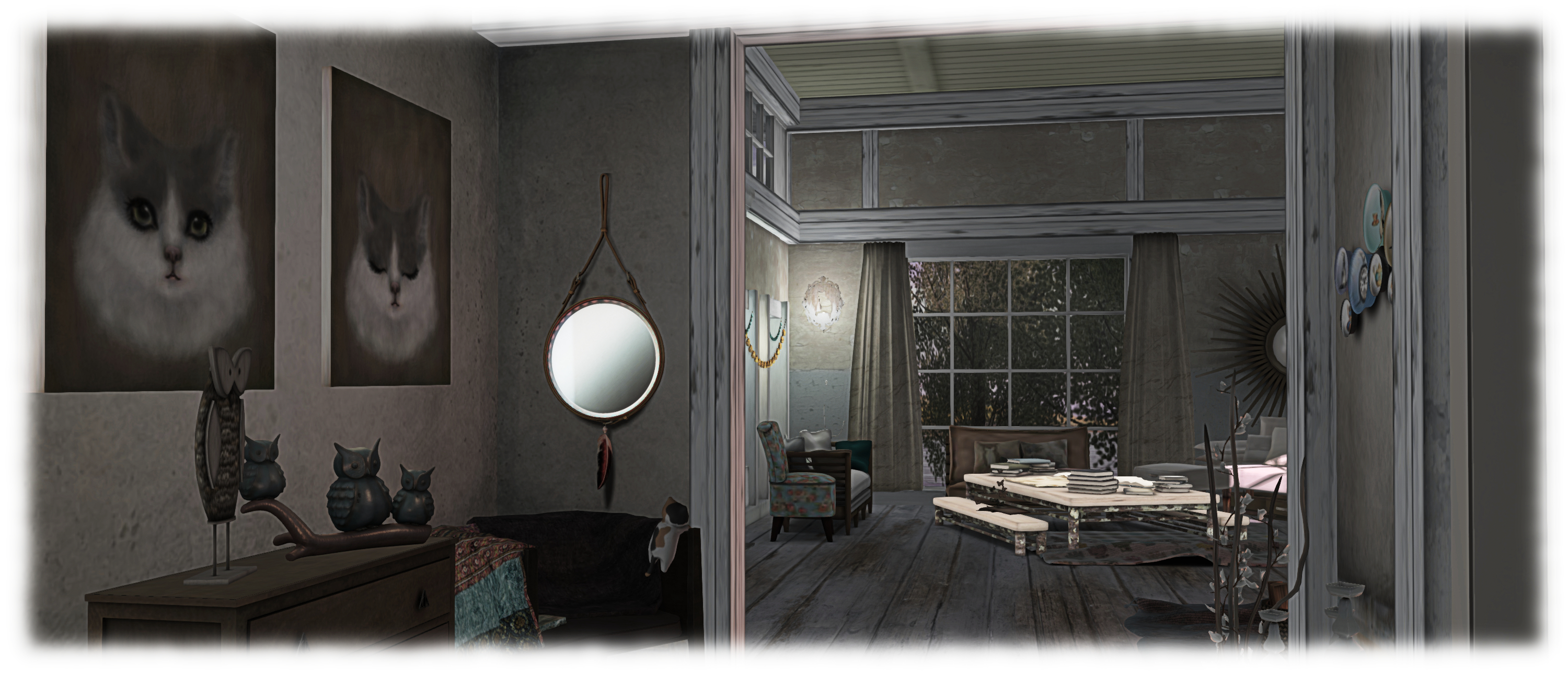
Umbral Photography still occupies the southern half of the region, a place devoted to photography (indoors and out), with open rezzing for visitors (please make sure you clean up behind you!).
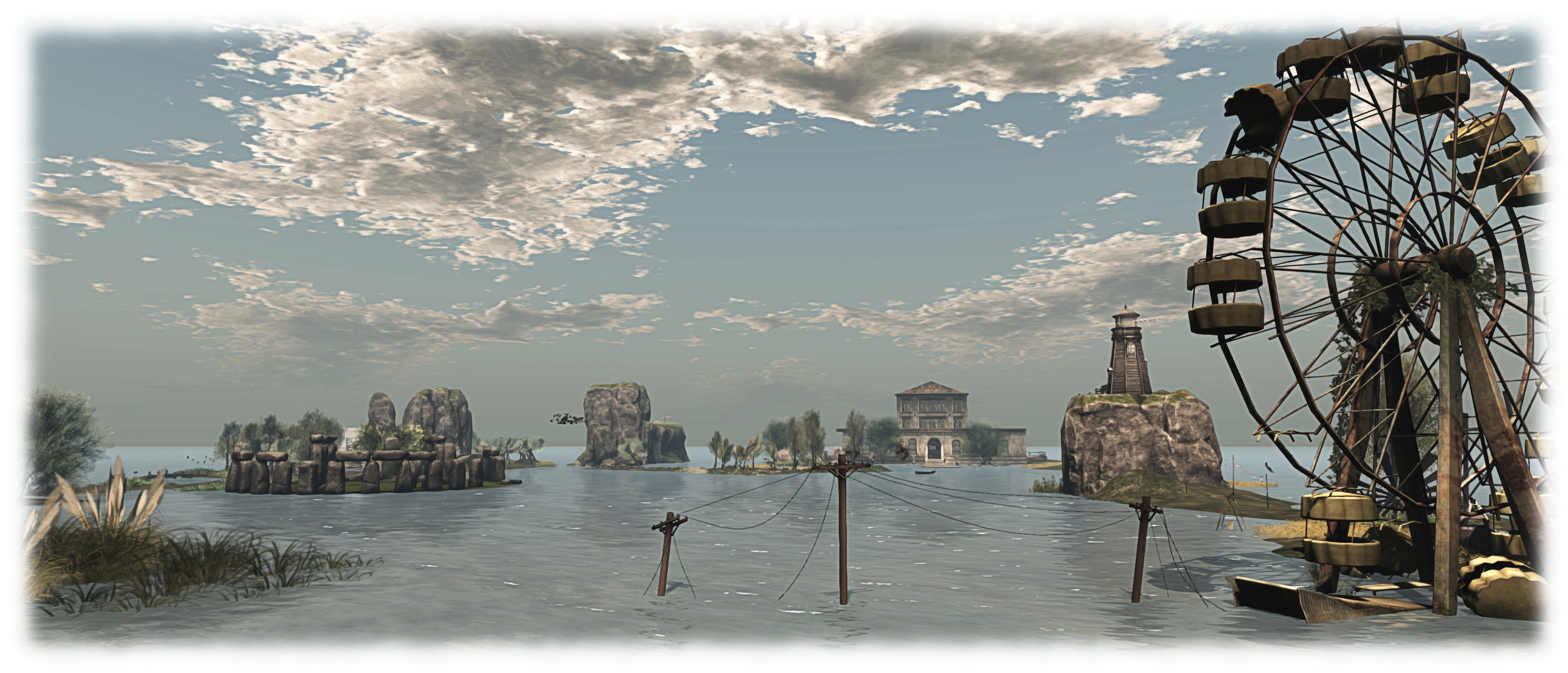
A stone henge has been added to the landscape since my last visit, standing on a small island a short walk from the landing point. A copse facing cross the main footpath is also, I think, a more recent addition. However, Cory Edo’s delightful summer-house still sits over the water, the little tea party area is still available, and the house offering indoor photo opportunities still stands in the south-west corner, while the tall grass still lines the horizon, marking more distant islets to be explored.
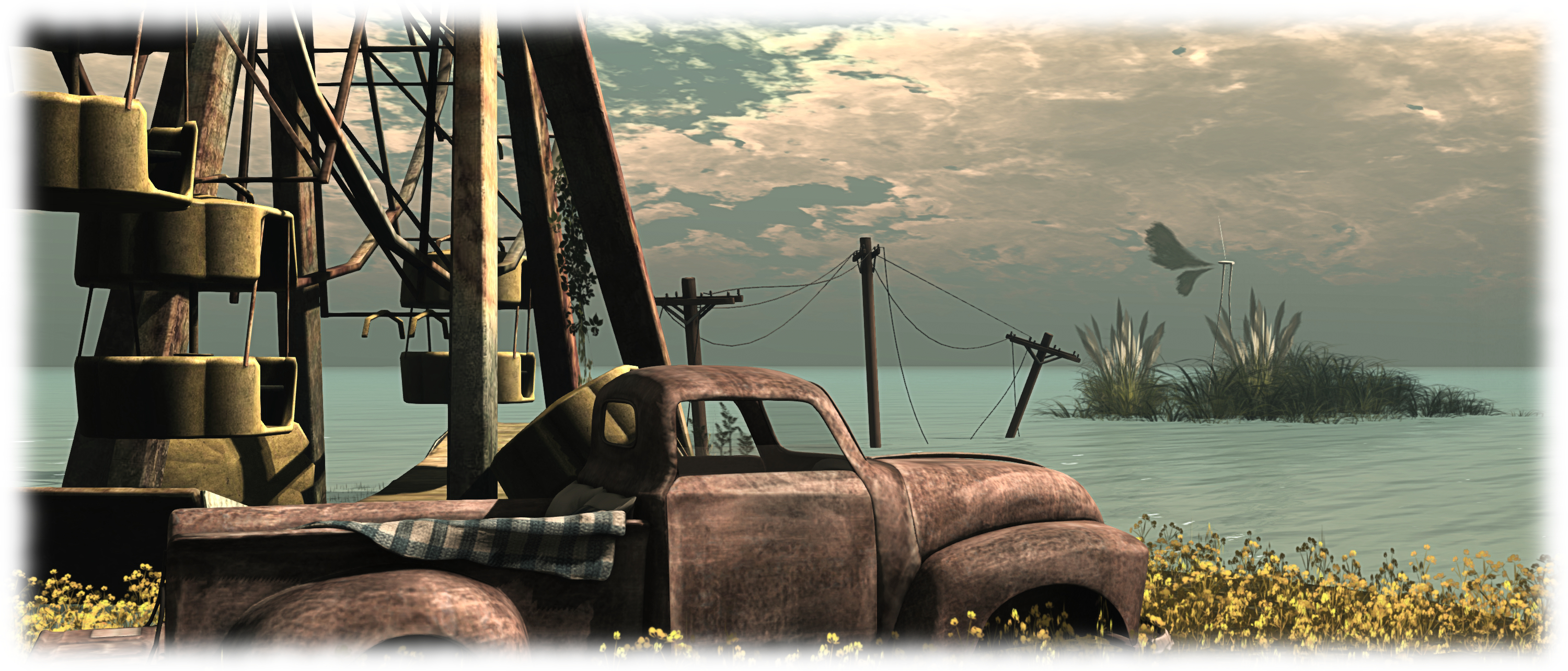
The divide between Umbral Photography and Umbral runs through the henge, but the north side of the island is as open to the public as the south, and as photogenic. There have been some changes here as well; perhaps most noticeably the arrival of a Ferris wheel on the north-east headland, and which has perhaps seen better days.
The principal difference between the north and south parcels of the region, as I noted in my original review, is that the former is home to a club given over to erotica and D/s activities. Visitors are welcome, as long as they follow the guidelines supplied upon arrival, and activities are confined to within the building. However, if this is not to your taste, you might want to focus on exploring the rest of the region.
We’re in the middle of a heat wave here in the UK right now, with temperatures exceeding those of the Mediterranean in some places. Given this, walking through the waters of Hydra Isles had me thinking that the day VR truly arrives will be the day when, while it may be scorching outside, the simple act of stepping into a suitable virtual environment and wading through ankle-deep clear waters can immediately have one cooling down nicely!
I guess that until that does happen, I can take comfort in the fact that this is England, and as such summer will likely be over by Sunday. In the meantime, I’ll keep paddling my feet in the waters of in-world locations like this in the hope of feel just that little bit cooler!
The last time I visited MetaLES, the art region run by Romy Nayar and Ux Hax, it was to visit Romy’s brilliant Sparkys, which I wrote about here.
Since then, I’ve not really had a chance to drop in and see what’s going on, so when both Honour and Ziki poked me about a new celebratory installation there that had just opened (and which will remain open until August 13th, 2015) as a celebration of MetaLES and its support group, ..O.., I knew I’d had to pop along and take a look.
Distrito Disinto – or Different Districts, if you prefer, presents a concept that’s simple enough: the visitor is taken on a journey through a series of rooms, or “districts”, as if travelling through, or with, a festival. Within each room, an artist has established a setting inspired by a song, and in which the song and art are presented together. Simple in concept maybe, but beautifully intricate and delightfully imaginative in execution.
On arrival, visitors “purchase” a ticket (they’re actually free) from the box office. This delivers a teleport HUD (just grant it permission to act on your avatar when worn), and some introductory notes. Then all that’s required is to ensure local sounds enabled, as the audio isn’t streamed, but played in-world, and the region’s windlight is being used. Then it’s a case of clicking on one of the musical notes in the HUD under each of the artists’ names. For the sake of convenience, I took the destinations in their numerical order.
Distrito Disinto, MetaLES: Bryn Oh – Keep the Streets Empty for Me
The artists who have actively contributed to the installation are Betty Tureaud (musical piece: She’s a Rainbow by the Rolling Stones); Giovanna Cerise (Innuendo by Queen); JadeYu Fhang (What Your Soul Sings by Massive Attack); Maya Paris (Oh, Bondage! Up Yours! by X-Ray Spex); Cica Ghost (Lullaby by The Cure); Rebeca Bashly (Chop Suey by System of a Down); Bryn Oh (Keep the Streets Empty for Me by Fever Ray); Romy Nayar (Nuit d’hiver (Chloé) by Mylène Farmer); Alpha Auer (Grid Factory by Alpha Auer); and Eupalinos Ugajin (Rockingchair by Estudio, Trabajo Y Fusil!).
Selavy Oh is also listed as a contributing artist, but there is no corresponding teleport option in the HUD. I assume this is because Selavy was unable to participate and the introductory note card was not updated.
To describe each of the pieces offered would be to negate the point of seeing them yourself. Suffice it to say that each offers an interesting interpretation on the subject matter of the chosen song, which ranges from the thought-provoking through to the light-hearted and witty, to some hints of pathos through to outright irreverence in the most wonderful of ways (who else could mix Oh Bondage, Up Yours!, Diana Rigg’s Mrs Emma Peel, Eartha Kitt’s Catwoman and flying saucers so brilliantly, than Maya Paris 🙂 ).
However, and while I enjoyed all the pieces on offer through the installation, and really don’t want to appear as if I’m singling any out over the others (not the least because those who collaborated represent some of my favourite artists), I have to say I was particularly drawn to Alpha Auer’s Grid Factory. There is a nuanced beauty to this piece that’s suggestive of many things, and return visits have drawn me back to it perhaps just a little more than some of the other pieces here. Be sure to pick-up your Grid Factory avatar from Alpha when you visit.
Distrito Disinto, MetaLES: Alpha Auer – Grid Factory
I also confess to enjoying Bryn’s interpretation of Keep the Streets Empty for Me, which offers an interactive piece that’s best shared – thank you to Gem, Kate and Tutsy in joining me for a little house building – or is that house clearing?
Distrito Disinto is open through until August 13th – so go, enjoy!
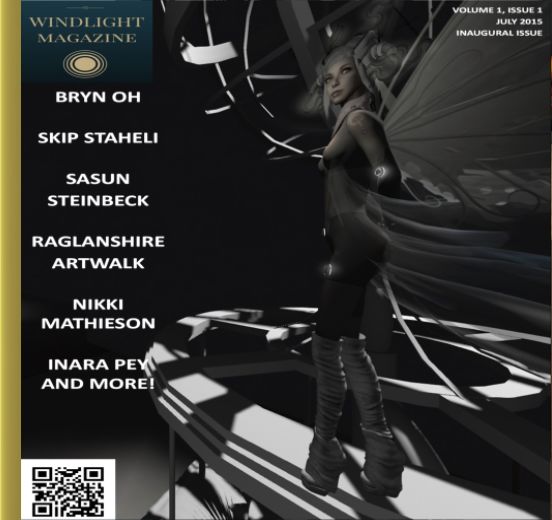
Bryn Oh is profiled by Emma Portilo in the inaugural July 2015 issue of Windlight
On June 25th, I wrote about a new magazine for the arts in Second Life that would be launching in July 2015. Well, here we are at the start of July, and the inaugural issue is now available!
Called Windlight, the magazine has been founded by John (Johannes1977 Resident), with Nikki Mathieson, owner of Avi Choice Productions, the magazine’s co-publisher. At 136 pages, the initial issue of the magazine covers a lot of territory, with interviews with Bryn Oh, Skip Staheli and Sasun Steinbeck, a piece on the Raglan shire Artwalk and a whole lot more.
Windlight Issue 1 cover
As I mentioned in my original article, the folk behind the magazine are motivated and high-powered. Since that piece was written, blogger and photographer Kara Trapdoor has also joined the team, in which I’m also honoured to play a small role.
The feature article on Bryn Oh is a must-read. In it, this fabulous artist who has done so much to enrich Second Life as well as bridge the physical / digital divide, is wonderfully profiled by Emma Portilo.
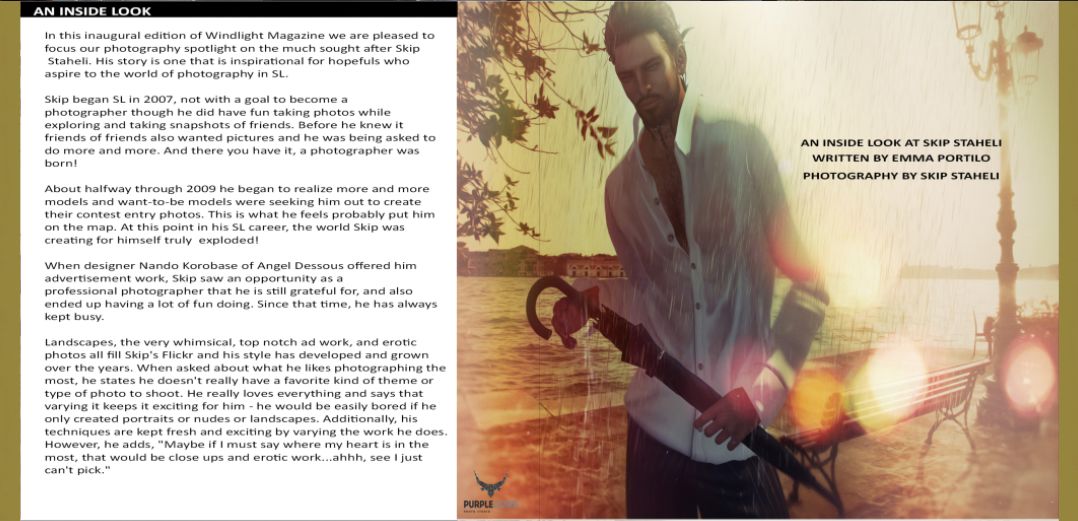
It is Emma who also interviews Skip Staheli, again providing insight into this talented photographer’s Second Life and work. John provides readers with interviews with Sasun, Nikki and, um, yours truly. I was flattered to be asked to talk about my work in blogging the art scene in Second Life, and further flattered by the use of my own photos within the piece. John also takes the helm for the article on the Raglan Shire Artwalk (something I sadly missed this year, due to having too many commitments throughout May).
Shakti Adored is someone I’ve long admired, and I’m looking forward to reading her Curator’s Corner pieces each month. Shakti currently curates some of the leading galleries in SL, including the phenomenal Rose Gallery at Kaya Angel’s magnificent Angel Manor. She also has an interest in quantum physics, which tends to tweak the armchair scientist in me 🙂 .
Skip Staheli is interviewed by Emma Portilo
This is undoubtedly a great inaugural issue for Windlight, and I’m looking forward to writing for the magazine from the August issue onwards. In the meantime, in-world kiosks for the magazine are available in many outlets across Second Life, and you’ll be able to pick up a copy from the Windlight Magazine Gallery which will be opening soon, offering space to artists under the Windlight Fellowship Programme.
Updated, July 2nd: A series of questions were asked at the Simulator User Group meeting following the release of the Experiences Tools viewer. A summary of those asked and which I’ve seen asked elsewhere has been added to the end of this article for reference.
On Tuesday, June 30th, the long-awaited Experience Tools viewer was promoted as the de factorelease viewer by Linden Lab.
An official blog post announced the move, indicating that while experiences created using the new capability will be open to all, the ability to create new experiences using the tools is available to Premium members only, who have the opportunity to create one Experience by default.
For those not previously aware of Experience Keys, I’ll simply quote from the blog post issued by the Lab back when Experience Keys reached release candidate viewer status:
Experience Keys are a powerful feature that allows creators to build more seamless and immersive experiences in Second Life. Without this feature, you need to grant individual permissions to every single scripted object included in an in-world experience, and that can mean a lot of dialogue boxes interrupting the fun! Experience Keys make it possible for creators to build experiences that ask your permission just once. In other words, you can opt-in to the entire experience, rather than having to grant individual permissions to every single scripted object included in it.
A number of Experiences are already available across the grid for people to use. The Lab’s Cornfield shooter game available through the Portal Parks, for example, utilises Experience Keys, as does Loki Eliot’s outstanding Childhood Dreams, available at SL12B through until Saturday, July 4th, 2015. There’s also a growing section of the Destination Guide devoted to Experiences.
You don’t actually have to use the Experience Tools viewer to visit and participate in any Experience. However, the viewer does provide a lot of additional information to users than viewers without the code, and is essential for those who wish to build Experiences – so expect TPVs to be updating with the code as soon as they can.
An Experience dialogue box. On the left, as it appears in an Experience Keys enabled viewer, and on the right, in a “non-Experience Tools” viewer. Both will allow users to join / refuse experiences, and indicate the levels of permissions the Experience is requesting, but the Experiences Tools viewer provides additional options
As explained in the Lab’s video, once you have accepted an invitation to join an Experience, you never need to do so again; the fact that you have accepted it and the permissions you have awarded it in respect of your avatar are remembered – so each time you re-visit, you’re not hampered by having to accept. If there are HUDs and other attachments applicable to the Experience, these are automatically applied to you on your return; if there are scores or points associated with the Experience, these are also recorded and restored on your next visit. When you leave, HUDs and other attachments belonging to the Experience are removed and any permissions you’ve granted are revoked.
If you spend time in a place that has an Experience you’d rather not join, and don’t want to be bothered by invitations to do so each time you visit that place, you can opt to block the Experience (or specific objects offering invitations to the Experience). This will prevent further invitations being sent.
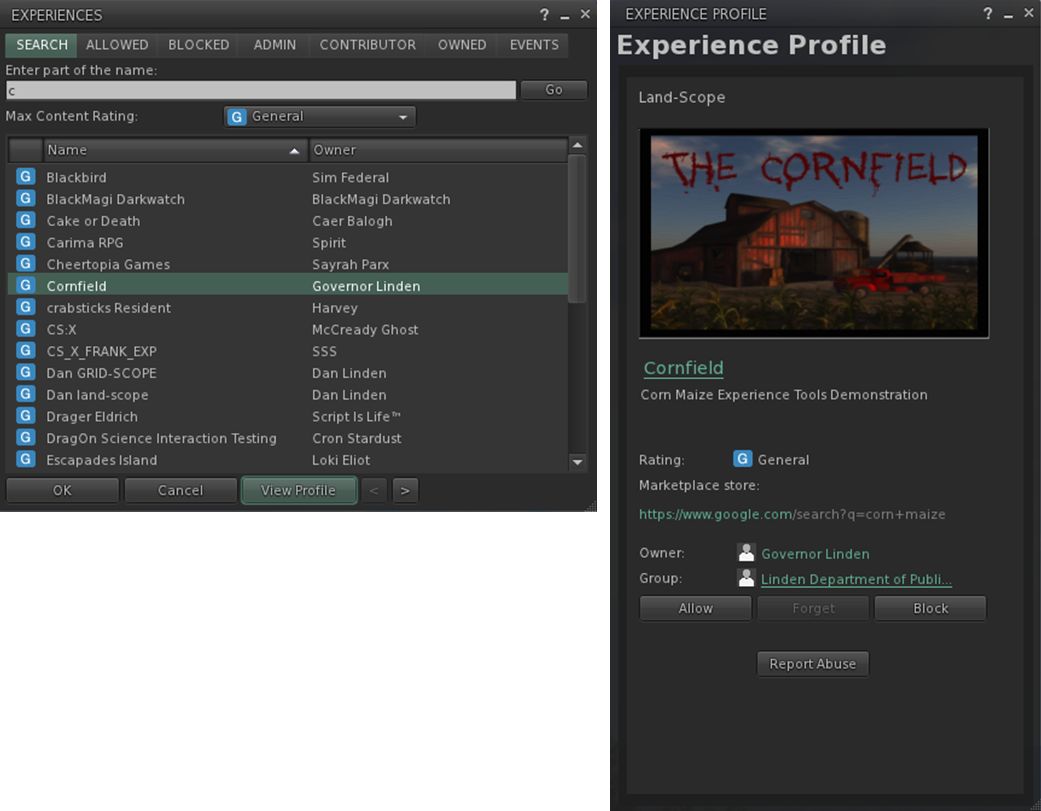
The Experience floater (left) can be used to manage your Experiences and to display more information about them through the Experience Profile (right) – click for full size
For Experience users and creators, the viewer introduces two new floaters – the Experience panel and the Experience Profile, both shown above.
The Experiences floater (Me > Experiences) helps you keep track of the Experiences you join or block, or which you are involved in as an owner or collaborator. It also allows you to search for Experiences in SL, and tracks the actions taken on your avatar by the Experiences you’ve allowed.
The Experience Profile provides additional information on a specific Experience, and can be displayed a number of ways. You can, for example, highlight an Experience in the Search tab of the Experience floater and then click the View Profile button. You can also click the Experience’s link in the Allowed / Blocked / etc., tabs to display its Profile.
The Profile allows you to Allow or Block an Experience, make an Abuse Report if it is doing something intentionally abusive (such as repeatedly orbiting you). If you wish to leave an Experience, you can use the Forget button. Note that the next time you visit, it will treat you as a new joiner. If an Experience Profile includes a SLurl, clicking on it will open the Places floater, allowing you to teleport to the Experience.
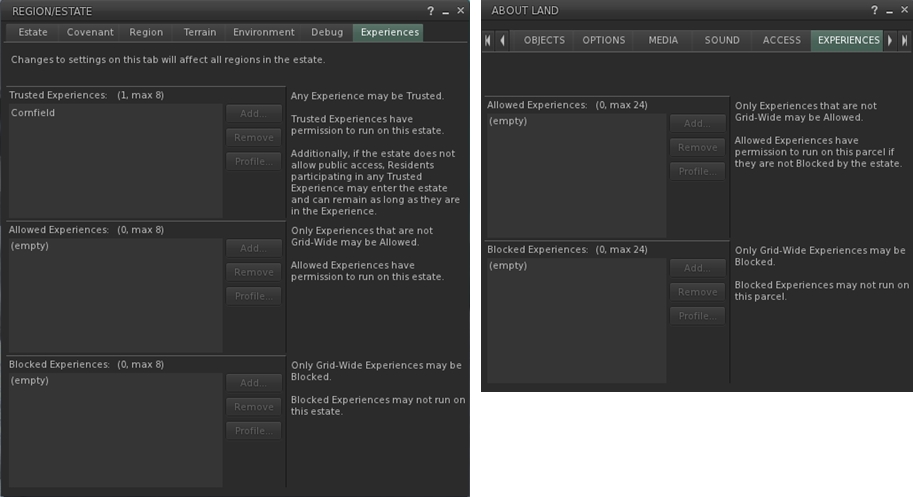
The Experience Keys viewer introduces additional Estate and Land tabs to allow management of the Experiences enabled at estate / region and parcel level.
Experience Keys – which allow Experiences to run – are currently restricted to the region / parcel level. There are currently no keys which automatically allow an Experience to run across the entire grid, although this may change in the future. To help land owners to decide which, if any, Experiences they wish to have running on their land, the Experience Keys viewer also introduces two new tabs to the Region / Estate floater and the About Land floater (shown above).
Adding an Experience to your Land should only be done if you’re actually an active collaborator / participant in providing the Experience to others, or have created it yourself. Do note as well, that a hierarchy that exists between regions and parcels; if an Experience is blocked at Estate level, it cannot be run within a parcel on that estate.
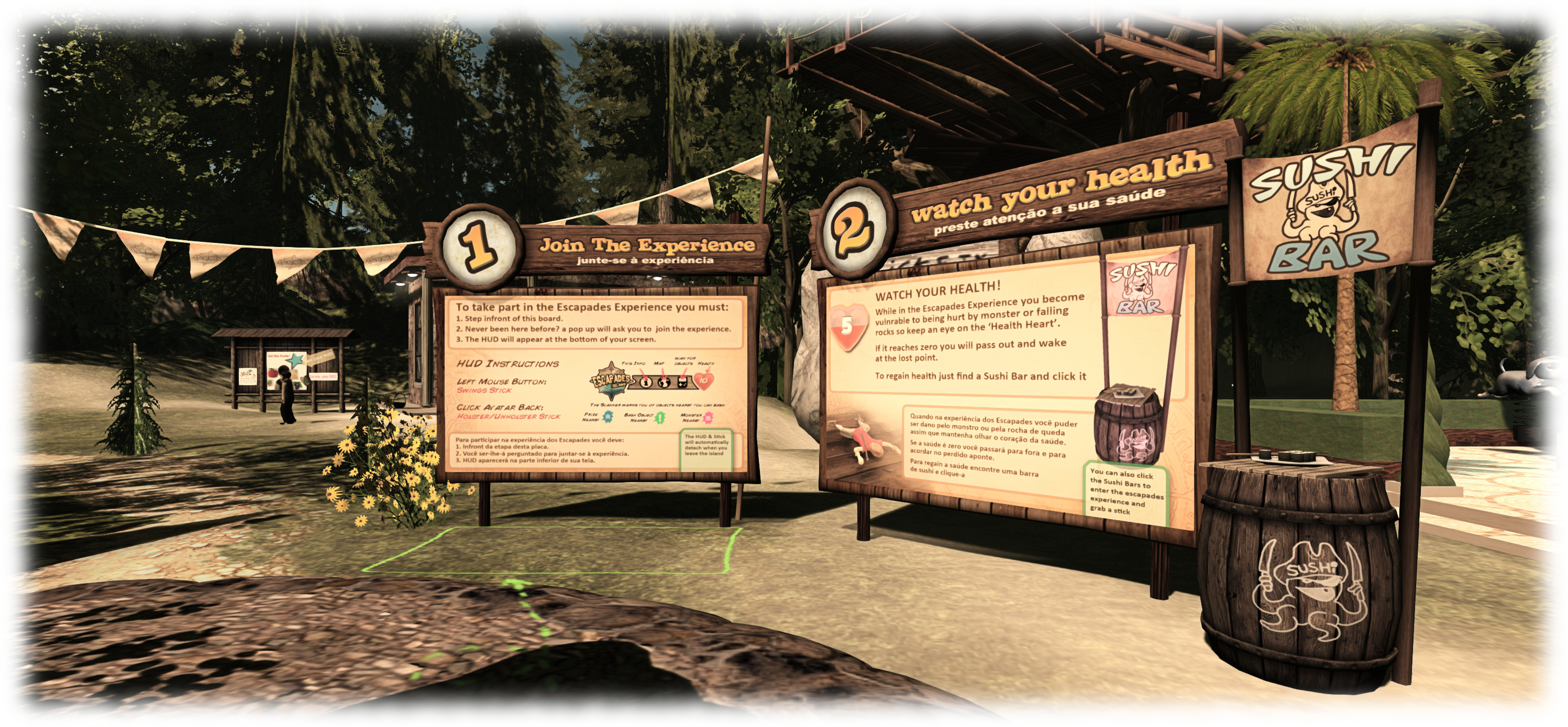
Loki Eliot also has an Experience based game available at Escapades Island
In terms of creating Experiences, and as noted above, this is limited to Premium member. There is a lot of power involved in the capabilities, and so maintaining some degree of accountability with those using them is vital; so limiting the creative element to Premium members is a good way of ensuring that accountability (providing accountability is also why there are options to report abusive Experiences in both the Experiences floater and individual Experience Profiles).
 Few people involved in VR and augmented reality are unconvinced that these emerging technologies will have a profound effect on education and teaching. As has been seen in both Second Life and Open Simulator, even without immersive VR, virtual environments offer a huge opportunity to education.





 Inara Pey: Living in a Modemworld