SL projects update 24/2: viewer, LSL materials functions

 Server Deployments Week 24 – Recap

  • There was no new deployment to the Main (SLS) channel, although it was subject to a grid-wide restart following schedule maintenance on Tuesday June 10th
  • BlueSteel returned to the Sunshine / AISv3  inventory update, which requires the use of the Sunshine RC Viewer
  • LeTigre once more had the server-side group ban project updates deployed to it. See the release notes for details
  • Magnum returned to the Experience Tools project.

The RC channel updates were essentially the same updates as deployed in week 23, but subsequently overwritten following a grid-wide security issue update.

SL Viewer

The Snowstorm code contributions viewer appeared as a project viewer on June 12th. Version 3.7.9.290788 includes some 20 code contributions to the viewer, including:

  • STORM-68 Allow setting of default permissions on creation of objects, clothing, scripts, notecards, etc.
The new floater for setting default permissions for created items as it should appear in the Snowstorm viewer
  • STORM-1831 Obtain LSL syntax table from simulator so that it is always up to date: this update allows the viewer to obtain the information required for syntax highlighting directly from the simulator the viewer is connected to, eliminating issues with using manually updated syntax files within the viewer falling out-of-synch with the simulators as new LSL syntax as new functions and parameters, etc., are added
  • STORM-1966 Block installation on old and unpatched versions of Windows: this updates causes the viewer’s Windows installer to check to see Windows XP systems have the latest patches installed (i.e. Service Pack 3 for 32-bit XP and Service Pack 2 for 64-bit XP). Any XP systems not meeting these requirements will be unable to install the viewer until such time as they are updated. Additionally, Windows Vista and Windows 7 systems  lacking a Service Pack update will receive a warning, but installation of the viewer will not be blocked

For the full list of OPEN and STORM updates, please refer to the release notes.

LSL Functions for Materials

The Server Beta Meeting on Thursday June 12th included tests to see whether the new LSL functions for materials might offer griefing opportunities. Maestro Linden had created two 256 prim linksets using default prim cubes, one of which was scripted to use PRIM_NORMAL to continuously set a unique material on each of the 6 faces of each prim, and the other was scripted to continuously set PRIM_TEXTURE on each face to a different alpha-blended diffuse texture.

Two sets of four of these objects were rezzed in turn, and meeting attendees asked to monitor their viewer performance (FPS and UDP bandwidth) while the Lab watched the simulator.

Server-wise, performance was largely unaffected by either type of object, with the load being largely controlled by the built-in LSL performance controls. Throughout both tests, and with no  objects rezzed, script spare time remained almost constant around the 14-15ms mark.

Viewer-wise, both types of object impacted FPS, with most people reporting around a 50% drop from the materials-enabled objects, compared to around 40% with the texture changing objects.

Both tests saw an increase in UDP information being sent to the viewer, with bandwidth use increasing by a factor of around 3.5 to 4 (e.g. 180-200kbps to 700-800kbps) with the materials objects and a factor of around 5 to 5.5 for the texture changing objects. As indicated by Maestro, the lower bandwidth use by the materials objects was due to the throttles already in place for how quickly the viewer will look up materials properties.

The takeaway from this (and other tests Maestro has performed) is that scripted materials controls are unlikely to be a major source of griefing. The simulator seems to handle excessive use of script materials in its stride, and impacts on the viewer’s frame rate can be mitigated by using Develop > Show Updates to Objects (CTRL-ALT-SHIIFT-U) to block the offending object.

There are still concerns over potential bandwidth impacts, such as by combining the materials LSL functions with other scripted controls, and concerns how the viewer might be affected by peculiar uses of the materials functions (such as combining them with the already laggy animated mesh tails that are available). However, it seems that for now, the Lab will continue to monitor things to see what happens and whether anything unexpected does crop-up, rather than moving immediately to apply throttles to the functions.

In the meantime, the arrival of these functions has prompted people to start putting together feature requests to be able to animate diffuse (texture), normal and specular maps on an object / object face independently to one another. The Lab has previously indicated that trying to do this via llSetTextureAnim() would be “pretty ugly to implement or would need some careful design …” and that as such they have no plans to try this at present. It’ll be interesting to see if any feature request(s) put forward persuade them otherwise.

Have a favourite SL location? share it with the Guardian, Lab suggests

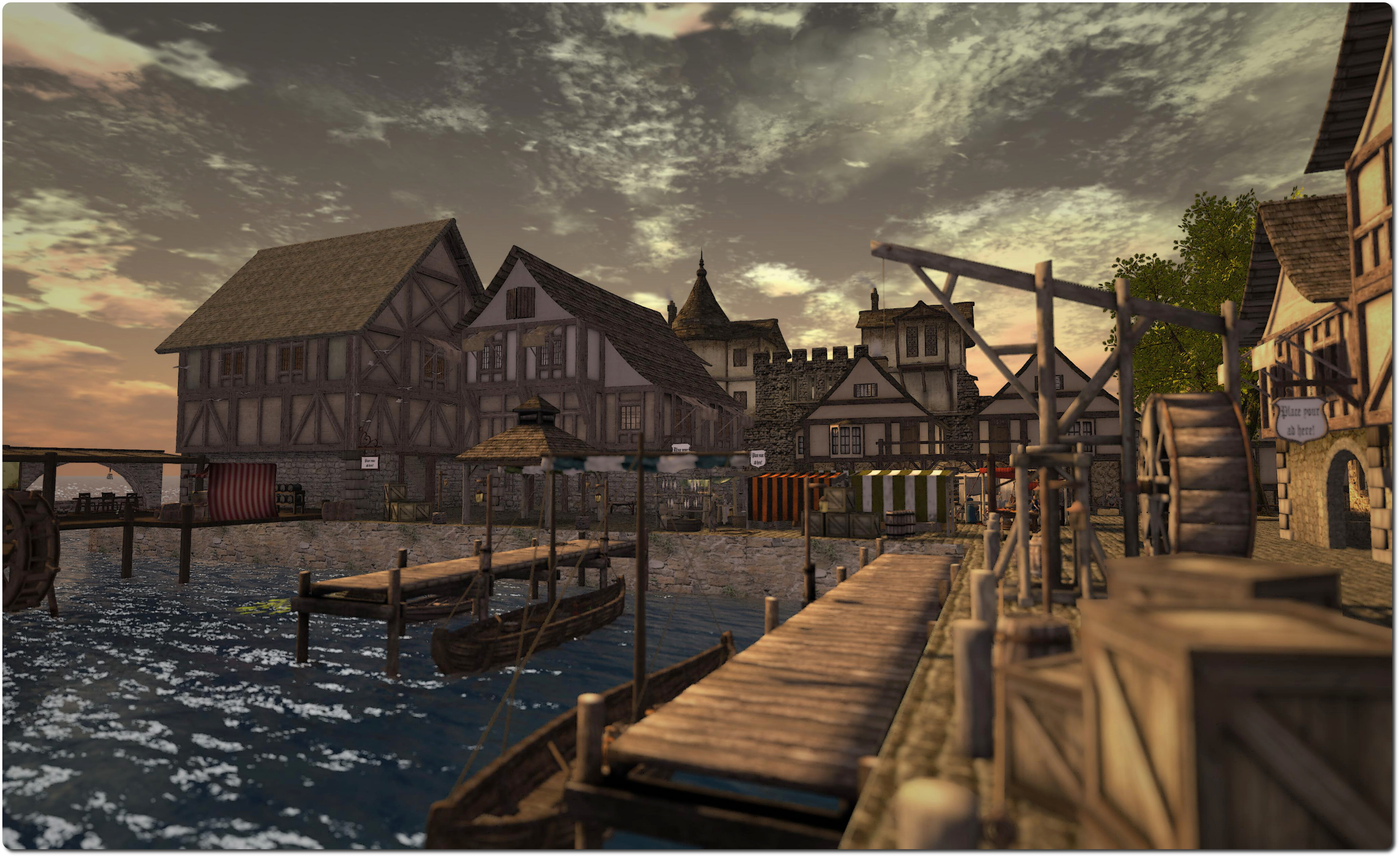
Forgotten City
Forgotten City, click for full size

On Tuesday June 10th, and spotted by Ziki Questi, the Guardian Online in the UK carried an article about how modern urban design is influencing city game design in computer games – and vice versa. As a follow-up to that piece, the Guardian has invited readers to share their favourite virtual cities, and the Lab suggest this is the perfect opportunity for Second Life users promote their favourite Second Life locations.

The Guardian asks readers to upload screen shots of their favourite urban locations via a Guardian Witness page (user-generated content pages curated by the Guardian), which explains:

We want to hear about your best-loved virtual places – from a beautiful view in GTA V to that 20-million-strong SimCity megalopolis you’ve been building (or possibly destroying). What would be the best video game cities to live in? The worst? Perhaps you’ve designed one you think would be better than your own city? Share your screen grabs and we’ll feature the best on Guardian Cities.

To contribute, readers can log-in to the page using either a Facebook or Google + account and then upload a screen shot of their own with some descriptive text, and / or recommend those uploaded by others. There are several locations from Second Life listed on the page already,

Caelestivm, Palau, March 2014 Caelestivm, Palau, March 2014, click for full size

Quick to spot a promotional opportunity, the Lab has suggested, via a Featured News blog post, that more SL users should submit their own favourite locations to the Guardian’s page, noting:

This is a great chance to share some amazing Second Life locations with The Guardian’s readers. Whether it’s a place you created personally, discovered (maybe through the Destination Guide?) and love, or just a spot you always find yourself returning to, the Second Life locations that ‘wow’ you are great ones to share to help show off Second Life to the uninitiated.

Assuming the Guardian doesn’t get overwhelmed by images from Second Life and feel a little narked as a result (and keeping in mind they’re asking for city-like images, which the lab’s blog post tends to brush over in referring for “locations”), this might be a way to shine a little light on some SL builds and get a message out about the user-generated nature of SL.

As well as the pointer to the Guardian, the Lab is inviting users to share their favourite SL locations (city or otherwise) via a forum thread, and to submit any which aren’t already listed to the Destination Guide.

Versu’s Blood & Laurels arrives in the App Store

versuFollowing the announcement that a deal had been reached which allows Versu, the interactive fiction engine, to continue after Linden Lab had discontinued it in February, comes the news that, as promised, the much-anticipated Blood & Laurels is now available.

As I noted in my report on Versu’s return, Blood & Laurels is the first title to be released under the new Versu banner, and will be followed in the near future by Bramble House by Jake T. Forbes.

New Versu titles will, for the forseeable future only be available on the iOS operating system and focused on the iPad. As the Versu team has noted, while they would like to have an Android version, resources are such that right now that it just isn’t possible.

So what is Blood and Laurels about? The slip notes provide an overview:

It’s the eight hundred and twenty-first year of the city of Rome, a year of bad omens and unrest. The Emperor is bloodthirsty and watches keenly for anyone who might be trying to overthrow him. The grain dole is running out and the people are going hungry. Romans are beginning to put their faith in foreign cults, as their old gods seem indifferent.

In this dangerous environment, Marcus is concerned with two things: his poetry, and keeping his patron Artus happy. But when Artus sends him to ask a secret question of an oracle, Marcus is forced to get involved, with conspiracies, politics, and a woman he is trying to forget.

Blood & Laurels offers dozens of outcomes for Marcus, his friends, his enemies, and Rome itself. The choices you make for him will decide not only how he ends up, but what kind of man he is when he reaches the end.

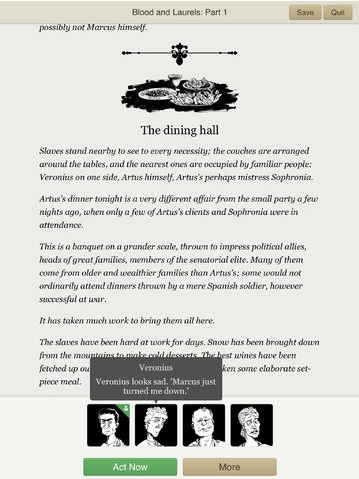
A page from Blood & Laurels (via the App Store)

Blood & Laurels might best be described as a piece of theatre; play is heavily influenced by the evolving conversations as much as by the actions of the protagonist, Marcus the Cowardly (that’s you, by the way, should play the game). As Marcus, you have to steer your way through the complex situations which develop around you, some of which are a direct result of your actions and words, while others may be the result of things you perhaps didn’t do or say earlier in the game. Your interactions with other characters (and their interactions with each other) can be reflected in the changing expressions on their little portraits. In keeping with most intrigue in life, few things go unnoticed and repercussions can be positive or negative.

The complexity of Blood & Laurels is staggering: 240,000 words of interactive content, a branched, two-part storyline and a large cast of dynamic characters. All of this adds up to a piece in which a player is only likely to encounter around 7% of the content in any given play through.

Alongside of the launch, the Versu team also issued a teaser video of movie-like quality and presence.

Blood & Laurels can be purchased from the App Store for $2.99 / £1.99.

Related Links

Note that Emily Short of the Versu team, and the creator of Blood & Laurels, will be featured in a Drax Files Radio Hour interview on Friday June 13th. Also, coverage of the “new” Versu and Versu titles in this blog can now be found under the Versu category or via the menus: Pey’s Travelogues > Other Worlds > Versu.

Kitely’s Metered Worlds become Premium Worlds

kitely-logoOn Wednesday June 11th, Kitely, the on-demand virtual world provider, announced that their “Metered World” offering has been restructured as a “Premium World” offering.

“Metered Worlds” were one of two world types offered by Kitely to customers, the other being Fixed Price Worlds (which remain unaffected by this change). Rather than being paid for through a fixed monthly fee, “Metered Worlds” were paid for through small fees charged for various actions performed on them, as specified in the Kitely Services web page.

Up until the June 11th announcement, both Premium and Regular Account holders had been able to add  new Metered Worlds to their accounts at a cost of 10 KCs per world, per day. However, as of the June 11th announcement, only Premium Account holders remain able to so; hence the product being renamed “Premium World”.

Furthermore, from July 1st onwards, any existing Premium Worlds held by Regular Account holders will only be accessible to Premium Account holders. This means that Regular Account holders must consider what they want to do with their existing Premium Worlds.

For example: to retain access to their own Premium Worlds beyond July 1st, Regular Account holders will need to either upgrade to a Premium Account, or convert their world(s) to one of Kitely’s Fixed Price World plans. Alternatively, they could allow their Premium Worlds to continue “as is”, and simply not be able to access them until such time as they do upgrade their account or convert these worlds to a Fixed Price plan. Because only Premium Account holders will be able to access these worlds, no additional charges will accrue in the interim.

As noted in the Kitely blog post, Regular Account holders can even, up until July 1st, opt to export their Premium Worlds to OAR files for use elsewhere (subject to object permissions and the normal export fee of 150 KCs per world).

Fallingwater, my region-wide build on Kitely utilises was was a Metered World. I now face a decision on what to do about its future ...
Fallingwater, my region-wide build on Kitely utilises what was a Metered World. I now face a decision on what to do about its future …

A single Premium World will continue to be provided to new users signing-up to Kitely’s Regular Account. However, only the account holder and Premium Account holders will be able to visit it during the initial 6-hour trail period supplied to Regular Accounts – the world will be closed to other Regular Accounts and Hypergrid users. At the end of the trial period, if the user wishes to continue using the world, they must either convert it to a Fixed Price world plan or upgrade to a Premium Account.

Again, please note that these changes do not affect Kitely’s Fixed Price worlds, which remain available to both Premium and Regular Account holders.

Reaction to the announcement has been mixed, with some expressing disappointment at the move, and others appearing to be somewhat confused, at least initially. Some of the disappointment has perhaps been the result of Regular Account holders feeling they are being disenfranchised from land ownership in Kitely.

However, an alternative viewpoint to this is that the move might actually help to further stimulate Kitely’s in-world economy by allowing land rental businesses to develop, particularly where Fixed Price worlds are concerned. If so, this could have a further benefit of allowing themed estates to develop, which in turn may help give in-world locations more of a “community” feel than might currently be the case.

SL11B: Lab issues limited edition avatar

Second Life’s eleventh anniversary is a fast approaching – as if you needed any reminding! And in keeping with last year, Linden Lab have entered into the spirit of things by giving away another celebratory avatar.

The SL11B celebratory robot avatar
The SL11B celebratory robot avatar (via Linden Lab)

SL10B saw the Lab offer a large, materials-enabled bear to residents. This year, it’s a robot, and it comes as a rigged mesh avatar supporting fitted mesh. Also in keeping with 2013, it appears to be the first in a series of surprises coming from the Lab during June.

The blog post announcing the offering reads in part:

This robot is sleek and ready to explore the landscapes of Second Life. Made with Fitted Mesh, you can put your own stamp on this android by playing with some of the shape sliders. Just make sure you’re upgraded to a Viewer with Fitted Mesh enabled. There are two ways to get your robot – pick it up inworld at Hairy Hippo Fun Land in Bay City or just visit the Marketplace.

I have to say the little fellow (he is around the same height as the female mesh avatars supplied by the Lab) is rather cute and, in difference to the original release of the mesh avatars (which were updated today!), he does have a modifiable base shape, so can the height and shape can be adjusted using the supported shape sliders.

While it’s always controversial, given that AOs are very much a user creation and a part of general commerce within SL, I still can’t help but feel the Lab could also provide a very basic AO system with items like this – not everyone is liable to have robot-specific AOs in their inventory, so providing one with a basic “robot-y” walk and standing pose wouldn’t go amiss. It might even encourage people to wear the avatar more and go out and purchase additional walks and poses to add to it. But that’s just a very minor point. As I said, the little fellow is rather cute.

A closer look at the robot avatar

Elsewhere in the blog post, the Lab again references the SL11B Community Celebration, and give a reminder to all who are planning SL11B celebrations of their own to make sure they  submit it for inclusion in the special SL11B category of the Destination Guide (use the “Misc” category when submitting the form and indicate the event is for SL11B in the description). For those who prefer, they can send their entries for the Destination Guide via e-mail to: editor@lindenlab.com, and using “SL11B” in the subject line on the email.

US Army targets Second Life and virtual worlds for healthcare

An interesting article published by the Official Home Page of the US Army came to light recently highlighting the use of virtual worlds as a part of studies into providing better healthcare and support to US soldiers and veterans.

For the last three years, Colonel Valerie Rice, Director of the US Army Research Laboratory’s Human Research and Engineering Directorate located at Fort Sam Houston, in San Antonio, Texas, has been spearheading a team studying the use of Mindfulness-based Stress Reduction (MBSR) as way of teaching army personnel and veterans how to manage PTSD and similar disorders which have resulted from their military service. The work is part of a broader series of research activities funded by the US Army aimed at providing suitable care and support for those afflicted by PTSD.

Colonel Vice Rice
Colonel Valerie Rice

Mindfulness –  “being in the moment” – is a means of stress and anxiety relief using age-old techniques such as meditation and yoga to help focus and clear the mind. It has become a popular means of therapy and support in many areas of life.

The studies being undertaken by Dr. Rice and her colleagues have a twofold purpose. Firstly, to determine the effectiveness of MBSR techniques in helping US Army personnel and veterans deal with PTSD and related issues. Secondly, to identify whether a programme using these methods could be reasonably and effectively adopted by the Army for widespread use.

In this latter regard, MBSR is seen as a particularly worthwhile means of assisting service personnel and veterans because not only is it a proven means of treatment in civilian life, but also because instructors do not need to be qualified healthcare professionals; they only need to have successfully completed a comprehensive training and certification programme. This significantly eases the challenges involved in leveraging it for more widespread deployment and use.

MBSR is also something ideally suited to leveraging the use of virtual worlds, notably Second Life and All These Worlds LLC, which bring with them unique opportunities and benefits which are not necessarily achieved with courses and therapy conducted in the physical world.

The Mindfulness studies take place as 2-hour weekly sessions over a period of eight weeks apiece, and involve some 66 participants at a time, 36% of whom were soldiers on active duty, and the remaining 64% veterans. Half of each batch of participants meet face-to-face in real life, the other half in a virtual world environment.

In both the physical and the virtual environments, sessions are experiential in nature; participants in the study meet, go through various exercises designed to focus the mind, ease tension, and reduce stress. Classes as cumulative, each building on and reinforcing the last, providing techniques participants can carry with them into their daily lives. There are also opportunities for discussion and feedback on individual’s experiences with the techniques, and so on.

Those participating in the virtual classes are encouraged to physically perform the exercises rather than just perform them with their avatar. There is a high degree of interaction between session leaders and participants, and courses include homework sessions – exercises participants are asked to carry out when away from the sessions.

A US Army MBSR session being held in All These Worlds (via alltheseworldsllc.com)
A typical US Army MBSR session being held in All These Worlds (via alltheseworldsllc.com)

Virtual world environments are seen as a particularly beneficial for conducting sessions due to the level of anonymity they offer. There is still something of a stigma attached to seeking help for disorders such as PTSD which can make individuals shy away from any involvement in actual behavioural health classes due to misplaced feelings of embarrassment, inadequacy or shame. The use of what is essentially an anonymous avatar in a virtual environment helps eliminate these feelings, and any associated stress or anxiety which might otherwise be experienced.

The multiple ways in which participants can provide feedback through a virtual world is also seen as beneficial. Giving voice to the feelings, responses and emotions one is experiencing when in a public forum is not always easy. But in a virtual environment, a participant can, for example, opt to give their thoughts and feedback via IM to the session leader, who can in turn relay the salient points to the class in a way that also doesn’t cause the individual any additional stress or embarrassment. Even the use of voice morphing is seen as advantageous, as it again offers participants relief from any fear that their voice might otherwise be recognised.

Participant in both the physical and virtual studies receive "homework" assignments (via alltheseworldsllc.com)
Participants in both the physical and virtual studies receive “homework” assignments (via alltheseworldsllc.com)

Additional benefits in using virtual worlds are those of accessibility and the ability to establish social networks among peers. Writing in Advanced Computational Intelligence Paradigms in Healthcare 6, Jacquelyn Ford Morie, the founder of All These Worlds, and who also one of Dr. Rice’s collaborators in the study, notes:

Today’s returning soldiers are most likely geographically dispersed, which may make it difficult to get to centres where medical help is typically aggregated. In addition, a social support structure may be lacking, leaving veterans unable to socialise with comrades in person on a regular basis … Online shared virtual worlds, however, are easily accessed from any personal computer, and can support the formation of social networks, facilitate access to care, and provide social activities between soldiers where geography is no barrier.

Jacquelyn Ford Morie. All These Worlds, her company, has also provided virtual environments for the US Army's MBSR studies
Jacquelyn Ford Morie. All These Worlds, her company, has also provided virtual environments for the US Army’s MBSR studies

She goes on to note that most service personal today are comfortable with using technology and in playing computer games, so accessing virtual worlds should not present them with significant barriers to entry or from engaging with online communities.

Dr. Rice and her team report that taken as a whole, the MBSR courses have seen positive results across both actual and virtual sessions, with participants registering lower blood pressure, reduced anger and increased calmness in their lives, as well as  exhibiting increased energy levels and faster reactions. Her team also note that anecdotal evidence suggests that those who have participated in courses are still practicing techniques six months later.

However, the team also acknowledge that further research into the overall effectiveness of MBSR with military personnel is required before any definitive findings on its overall applicability to widespread use within the US Army can be determined.

Even so, despite the fact that such formal determination has yet to be reached, the work carried out to date is encouraging, and stands as another fascinating example of how virtual worlds can be used for the betterment of our health and welfare.

Related Links

With thanks to Ziki Questi for the initial pointer to the US Army article on this research.