On Tuesday May 6th, the Lab announced the “Project Interesting” viewer has finally made it to a release status with the arrival of version 3.7.7.289461 of the viewer as the de facto release version.
Available since mid-November 2013 as a release candidate viewer, this release represents the last stage in the current work on improving interest list functionality, the code which controls how the data relating to your in-world view is handled by both the server and the viewer. This includes what is sent to the viewer, what is retained by the viewer for reuse and things like the order in which objects are rendered when you log-in to SL or teleport (so that the “interesting” objects which are closer to you or which are particularly large should render first, for example).
To mark the viewer’s formal release, the Lab has re-issued a video by Torley Linden, originally released when the viewer first made it to release candidate status, which neatly encapsulates the key updates contained within the viewer, and how they relate to server-side changes which have already been implemented.
There are no scheduled simulator deployments this week to either the Main or RC channels, and so no associated rolling restarted expected.
SL Viewer
The Interest List RC finally made it to the de facto release viewer with its promotion on Tuesday May 5th (version 3.7.7.289461). This leaves just three RC viewer in the release channel at present: SL Share 2 project viewer version 3.7.7.289497; Sunshine / AIS v3 RC version 3.7.7.289441; and the Maintenance RC viewer version 3.7.7.289405. Please refer to my Current Viewer Release page for up-to-date information on all viewer releases.
Group Chat
Simon Linden’s optimisation work for group chat was deployed across all of the back-end chat servers on Monday May 5th. while these should see some improvements in group chat (particularly in sending / receiving chat and moving between regions), Simon does warn that these optimisations are not expected to “fix” all of group chat. However, he will continue to work on further improvements as well.
Other Items
New Starter Avatars
Ebbe Altberg used one of the upcoming new starter avatars at the VWBPE conference in April (image: Strawberry Singh)
During his appearance at the VWBPE conference in mid-April, Ebbe Altberg appeared using one of the new starter avatars. At the time he did, it was hinted that the new avatars would be appearing relatively imminently. However, almost a month on and they have yet to officially appear, although there is some speculation they’ll do so in May.
these new avatars are said to take advantage of some of the latest features in SL, which is being taken to mean that some / all are full or partial mesh. This has in turn raised questions as to whether it is wise giving new starters full mesh avatars, given they may not work with freebie items often offered to or picked-up by new starters.
LSL Functions for Materials
While there is no confirmation any work is being carried out on this (except, as Simon quipped, “perhaps in a parallel universe or something”), the Lab is still sounding out how and where such calls would likely be used, and the frequency with which such calls would be made.
The option of having scripted control of materials has been debated often, and still remains a desired item among builders and scripters. However, some of the concerns still remain – notably, have such capabilities might end up causing performance issues, deliberately or otherwise. Much has already been written on how rapid map flipping on multiple objects could deliberately impact performance and potentially result in viewer crashes, plus there are already animated mesh elements available which can also have a significant impact on viewer performance (some types of animated mesh tail can reportedly overload a viewer on a 32-bit system with out-of-memory errors in a matter of seconds), so there are also concerns that were this to be combined with the ability to change textures via script, they could (even unintentionally) have further dramatic impacts on performance.
One way around this would be to throttle the rate at which material maps can be changed via scripted command. What is interesting for the moment is that the Lab appears to have not completely closed the door on scripted control of materials, but is considering options and informally seeking feedback on potential use cases.
In a wide-ranging discussion at the TechCrunch Disrupt New York event (May 5th-7th), Oculus VR CEO Brendan Iribe has spoken about why the company the Facebook acquisition was a good thing, and has described a desire expressed without both companies to make VR a social experience for a billion users, perhaps in the form of a MMO.
The discussion – described as a “fireside chat” with TechCrunch co-editor Matthew Panzarino – is available as a video in a Techcrunch article. It was followed by a backstage interview with TechCrunch’s Josh Constine.
Brendan Iribe, Oculus VR CEO, talks to Matthew Panzarino at TechCrunch Disrupt NY (image via TechCrunch)
in discussing the attractiveness of the deal for Oculus VR, Iribe indicates that one major consideration was the fact that the company was offered the opportunity to more-or-less continue to operate fairly independently of Facebook, a-la Instagram. Another was that Facebook were prepared to provide Oculus with access to their enormous technical capabilities and services, while offering Oculus the ability to practically cherry-pick which of them they’d like to leverage.
The majority of the conversation, however, focuses on the development of an immersive, VR-focused “MMO” (a term used interchangeably with “virtual worlds” and “metaverse”) with a billion users world-wide. “Metaverse” is a term which has been used by the Oculus team in the past, indicating that they’ve held aspirations in that direction and beyond the gaming market, and Iribe frankly admits that having Facebook behind them immediately means that Oculus VR has a huge network behind them – not only in terms of infrastructure and tech, but in terms of users (1.2 billion of them), which could very much help speed up adoption and acceptance of VR. Commenting at around the 4:35 mark, Iribe states:
We know with Oculus, with a virtual world, if you’re putting on this pair of glasses and you’re going to be face-to-face communicating with people, you’re gonna be jumping in and out of this new set of virtual worlds, this is gonna be the largest MMO ever made. This is going to be an MMO where we want to put a billion people in VR. And a billion person virtual world MMO is going to require a bigger network than exists today. Why not start with Facebook and their infrastructure, and their team and their talent that they’ve built up?
While this is not a short-term goal – the figure of around ten to twenty years is mentioned when discussing how this will all come about. Iribe also notes that there has to be something of a further upscaling of computing power in order to make it all happen, as well as the technology needing to become less cumbersome and intrusive and more readily acceptable and wearable. He suggests it should look more like a set of sunglasses – a direction several VR companies are already heading in.
Exactly how this billion-user environment will come about and what form it will take is unclear. Towards the end of the video, Iribe wisely points-out that VR is still in its infancy, and that it’s hard to predict precisely where it will lead or the impact it will have. However, it seems from his comments that the “MMO / Metaverse” Oculus VR are considering isn’t a single platform (although they see Facebook’s users and network as a good starting-point, as mentioned), but potentially a range of interconnected worlds / environments.
An interesting aspect of the discussion around the MMO / Metaverse concept is that Iribe in some respects echoes much of the work that is going on at High Fidelity. He mentions that one of the attractions Facebook held for Oculus was that it already operates a complex payment system (worth around $3 billion in revenue), which negates the need for Oculus to have to develop one – a problem High Fidelity is still mulling over. More particularly, at some 12 minutes into the video, he describes the working going on at Valve in terms of development avatars and projects this work into the future where he sees avatars have head tracking capabilities, can mimic facial expressions and carry people into the Uncanny Valley – a path High Fidelity are already walking, and would appear to be a good deal further along.
In the backstage interview with Josh Constine (embedded below), Iribe also talks about issues of trust and identity security, and having the confidence that as you move between apps and environments, you maintain control of what aspects of your identity are exposed. This is another issue which has very much been at the forefront of High Fidelity’s thinking with regards to a metaverse of virtual worlds.
Towards the end of the discussion, Iribe mentions the fact that Oculus VR are now starting to work more closely with the education sector in a drive to expand the whole VR ecosystem.
June 22nd-29th will mark BURN2: Conception, a time to celebrate the past, present and future. The e-mail press release announcing the event reads in part:
Sometimes it is good to look back at where we came from, so we can see how far we have come. A long, long, long, long, long time ago, where we live now looked much like our Moon. So as we look back at the start of the flame this year, let’s do it under the stars on a landscape just waiting to come to life.
The BURN2 team go on to extend an open invitation to artists and builders to apply for a place on the cratered playa, a reflection of this image of a young and new Earth, and create a vision of the past or the present or the future and help to bring the barren landscape to life.
Available craters range from 28 to 32 metres in diameter, and some overlap with one another to encourage people to develop communal builds, whether they know each other or are meeting for the first time. For those looking back, the recycling of parts of old builds seen in the playa is encouraged. Those looking to the future are encouraged to think “far out” into the future and to where we may be heading – or what may already be out there, heading our way …
Those wishing to participate in BURN2: Conception, are invited to read the Builder’s Guidelines and then, complete the application form. All applications my be submitted no later than Friday May 16th, 2014.
BURN”‘s own magnificent desolation: awaiting artists and builders
About BURN2
BURN2 is an extension of the Burning Man festival and community into the world of Second Life. It is an officially sanctioned Burning Man regional event, and the only virtual world event out of more than 100 real world Regional groups and the only regional event allowed to burn the man.
The BURN2 Team operates events year around, culminating in an annual major festival of community, art and fire in the fall – a virtual echo of Burning Man itself.
There are probably very few people in SL who have not heard of MadPea; they’ve been responsible for some of the most engaging and interactive games, hunts and gachas in Second Life. I’ve covered some of their work in these pages, notably their magnificent Room 326, (which continued through their Mad City installation on Da Vinci Isle), and their fiendishly fun Carneval. The team have also been featured in an edition of The Drax Files.
For most of the past year, the team has been focused on their next major undertaking, an immersive, interactive HUD-based game called UNIA, which is spread across two regions and is – I can say with some authority, having been taken on a guided tour of the installation by MadPea’s leader, Kiana “Queen Pea” Writer and development team member (and good friend) RAG Randt – utterly stunning and completely involving.
I don’t want to give too much away as to the plot, but suffice it to say, it is part horror story (or nightmare story, given its origins), part puzzle solving, part mystery, and more. Players will be able to engage in the game either individual or work in co-operation with others (or even both, depending upon how events unfold), and will interact with creatures, NPCs and things not normally of this world as they attempt to resolve what is going on and discover the truth.
From the moment someone arrives in the little town of Molimo, they are in for one hell of a time (literally and figuratively!), in a game which features settings designed by the likes of Bryn Oh, Rebeca Bashly, BlueSean Yiyuan and Silex Zapedzki, and Jaimy Hancroft, as well as the MadPea team themselves, with huge amounts of dedicated scripting by the team and purpose-built animations from Abranimations.
The reason the game has taken so long to develop is that it really pushing the envelope within Second Life in terms of capabilities and gaming mechanism, and even now, Kiana and the team estimate there is still around two or three months work required in order to bring UNIA to life. However, a major spanner was thrown into the works fairly early on in the scheme of things.
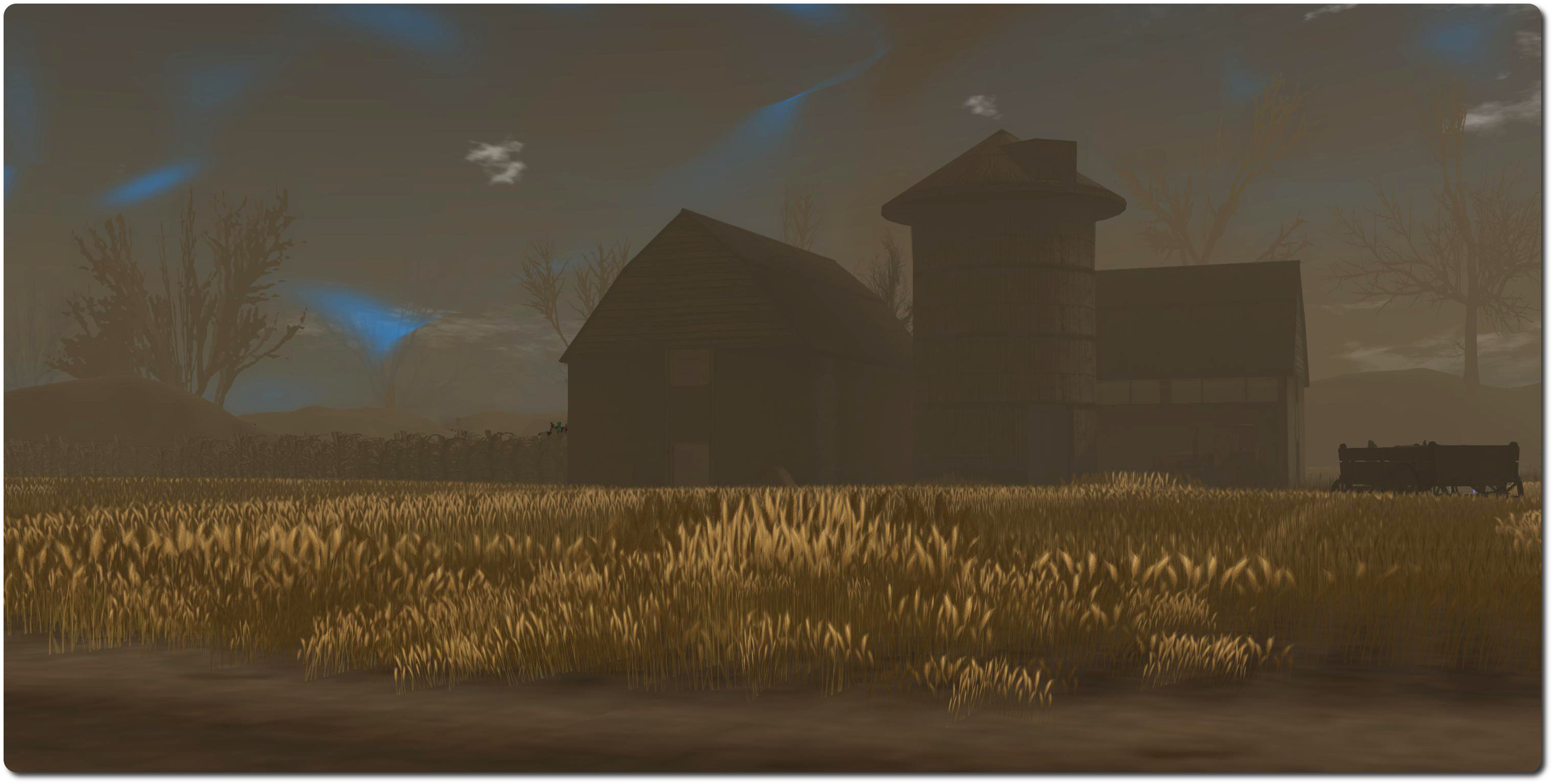
The Farm, one of the settings for UNIA
As the game was being developed, so MadPea lost their sponsor. Developing something as immersive and involving as UNIA doesn’t come cheap: the cost of the two regions on which it is set runs to $731.60 a month (incl. VAT at 24%, levied as a result of Kiana’s real-life location in Finland). The team have been able to offset some of the costs through other ventures and activities – including running additional hunts and gacha fairs, and well as via donations through Mad City. The problem here is, of course that time spent on developing hunts, etc., is time taken away from UNIA, slowing down its completion. Also, Mad City is set to close at the end of May 2014.
In order to try to keep things going, MadPea launched a fundraiser at the start of May, hoping to encourage SL users and their patrons to help contribute to bringing UNIA to life.
“I have been struggling with this for a while in my mind.. Should I do a fundraiser for UNIA or not?” Kiana says. “After several players contacted me asking where they could donate, I thought that ok, let’s go ahead with this, there’s nothing I have to lose.”
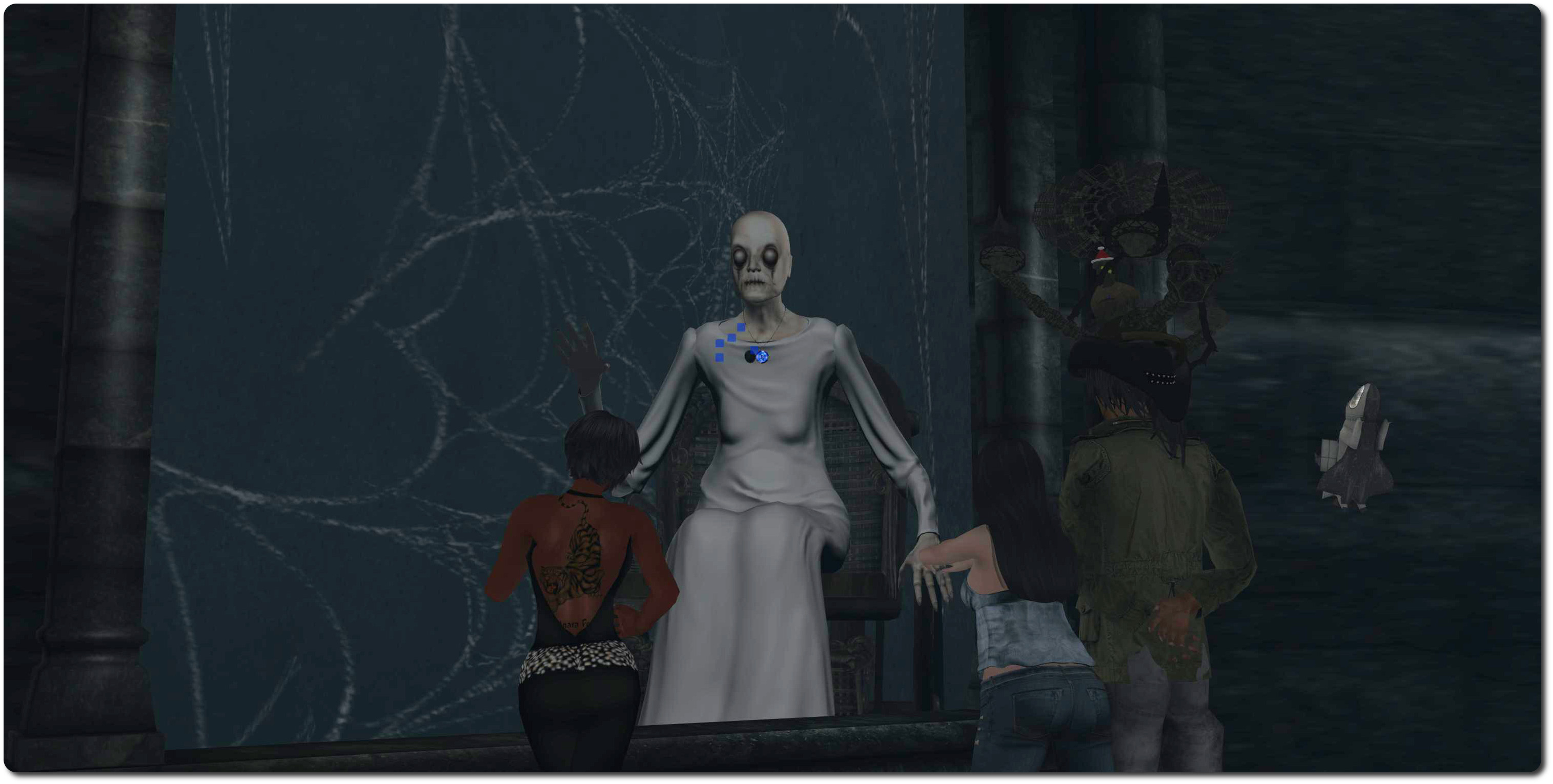
Visiting Grandma …
The funding effort is being run via GoFundMe, and aims to raise $4,389.00 for the development and upkeep of the game, with some $1,500 of that target having been achieved at the time of writing. People are free to donate whatever they are comfortable with giving, but pay $50.00 and you’ll receive an exclusive UNIA outfit for your avatar; pay $500, and you’ll receive an exclusive tour of UNIA by Kiana, early access to the game, a free HUD, weapons and outfits.
If the fundraiser is successful, and UNIA does open to the public, then there is the potential for even more, “This is only part ONE,” Kiana said during my tour, “Part two is [going to be] taking place all over the grid.”
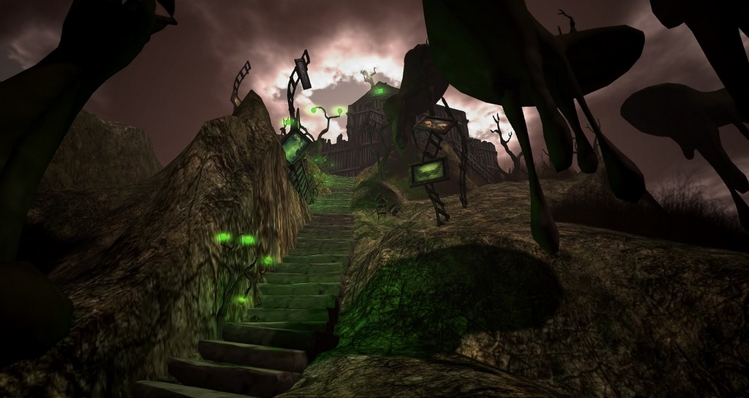
The house on the hill (by Kiana Writer)
Having spent two hours in UNIA with Kiana and RAG, I can say that this is something that could be very unique in SL, and offer an astonishing level of immersion and engagement. If you’ve experienced past MadPea activities and events, you’ll know just how inventive and imaginative they can be. So why not hop over to the funding page and offer a payment? In doing so, you’ll be helping to open the door to even more fun you can enjoy.
The 17th edition of The Drax Files Radio Hour more-or-less carries on where episode 16 left off, with more interviews and comments from Linden Lab staffers, gathered when Drax dropped-in on a group of them as they camped-out in Santa Cruz one Friday afternoon.
Prior to this, there’s another Leap Motion giveaway, and mention of forthcoming updates to OnLive’s provisioning of SL Go. there’s also usual chin-wagging about HMDs, and details of an offer for those who can attend it to get $100 off registration for the Silicon Valley Virtual Reality Conference and Expo, which takes place at the Computer History Museum, Mountain View, California on May 19th / 20th. Simply use the code “drax2014” (or indeed, “nwn2014” if you are an NWN reader) when registering, and get to hear the likes of Palmer Luckey (Oculus VR), Philip Rosedale, Ebbe Altberg, David Holtz (Leap Motion), Ben Lang (Road to VR) and others.
As well as being on the blog post and Stitcher, the show can also be found on YouTube, and I’m using that recording in the timestamps below. The recording itself is towards the end of this piece.
For those who want to cut to the quick, the core interviews commence at 20:25 into the podcast. This is an absolute “must listen” portion, although the sound quality isn’t brilliant in places, for which Drax apologies up-front (one of the pains of recording in an outdoor, windy environment). Nevertheless, sound issues shouldn’t necessarily be an issue for skipping over this part of the show, in which the likes of Baker Linden, and Hoz Linden from the development side of things (Hoz is a development team manager), and members of the finance team discuss the complexity and intricacy involved in running and maintaining an environment as complex as Second Life.
Baker Linden is well-known among those familiar with the dev side of Second Life and who attend the Simulator User Group and the Server Beta User Group, both for the work he carries out. His current major project being Group Ban lists, providing the means by which troublemakers can be banned from re-joining groups with open enrollment (think estate bans, and you’ll get the picture). He’s a popular figure among users, and known for his mischievous sense of humour. A server-side trouble-shooter, he’s also undertaken major fixes for large group loading issues.
Both Baker and Hoz note that as SL is community driven, it’s important to give those managing communities the tools with which they can manage things more efficiently. The group ban and group load work are considered major elements in this, with the former being voluntarily picked-up by Baker in 2013 after reading JIRA VWR-29337.
Group bans: provides the option to ban troublemakers from a group. It involves some significant changes to the server-side of SL, as well as updates to the viewer itself. Key among the latter is an additional sub-tab (currently called “Banned Agents”) in the Members tab of the Group floater. This displays a list of those banned from a group, and provides a means of applying individual bans (which can also be applied via other means) or multiple bans, and to unban a person.
The discussion covers some of the difficulties the Lab faces with maintaining Second Life (server and viewer – with Drax drawing an analogy through plumbing: when something major goes wrong with the plumbing in a house, it’s not exactly feasible to rip it all out and start over, so the plumber has to work through how things work, where things go and what needs to be done to fix things with minimal disruption (or additional breakage to the house) – which is pretty much how LL’s devs have to work.
This is in some ways illustrated by the comments made about fixing group chat [26:29]. There is currently a project that Simon Linden is working on to better optimise elements of group chat, which has been getting some regularly testing on the Aditi (Beta) grid by both the Lab and users. The code for this looks likely to be fully deployed to the back-end chat servers in week 19 (commencing Monday May 5th). It won’t resolve all of the issues associated with group chat, but it should see some overall improvements.
Both Baker and Hoz note that any significant overhaul of the chat system would require significant investments in time, manpower and money – and that even then, while they may end up fixing an obvious problem, the nature of the SL services are so intertwined, that it is not always possible to simply remove a block of code or a service and simply replace it with something else without running the risk of doing far more harm than good. It is this complexity, coupled to both a cost / benefit analysis of what can be achieved in a given time frame over what might be achieved, and an analysis of the potential for content breakage (itself no small concern), which generally tends to result in the Lab opting not to work on issues which users may see as being something which is an “obvious” fix, rather than any capricious refusal to do so.
Hoz passes some thoughts on perceptions about Linden staff engagement in SL, noting that he doesn’t spend much time in-world, he is nevertheless passionate about the creative processes in SL and how they’re leveraged by users. He also notes that, realistically, given the number of hours available to them, many Lab staff are focused on running the company and the grid rather than spending a lot of time in-world. Baker admits to being a Second Life user prior to joining the Lab, and quite possibly a rowdy one at that, which goes a long way to explaining his very evident enthusiasm for the platform.
The second part of this interview [31:09] sees Hoz take the opportunity to again re-iterate that while the Lab may not do everything users want, or may not appear in-world a lot of the time doesn’t mean they lack passion for, or interest in, the platform or its users. This discussion moves on through subjects such as the JIRA (and the misconceptions that surround it), and as such, is one of the richest pieces of information anyone who wants to understand what really goes on at the Lab, rather than making assumptions, should take eight minutes of their time to listen to what Hoz has to say.
From here, the conversation switches to Bacon and Saeros Linden [46:40] , both of whom work in the finance team. Bacon has the job of testing the entire transaction management / payment system by going out and purchasing SL goods, purchasing land, making tier payments, buying Linden Dollars, etc., while Saeros works on the code for this side of the platform.
Bacon Linden tests all aspects of the transaction system, whether it’s buying goods in-world or via the Marketplace, buying land, paying tier, purchasing L$, making premium membership payments, paying in L$ or via PayPal or credit card, and so on (image courtesy of Draxtor Despres)
Again, the fascinating elements of this conversation are the extent of the testing involved, which encompasses interactions with the third-party companies responsible for processing the likes of credit card payments on the Lab’s behalf, as well as all the internal mechanisms use by the Lab for user / user transactions. Again, for those with an interest in how the various aspects of SL actually work, this is another discussion where much is revealed, particularly LL’s dependence upon external service providers which may not always be understood – or readily acknowledged at times. As Bacon points out, the Lab isn’t only subject to these services where handling certain payments are concerned, they really are also subject to any issues these services may suffer as well.
The range of the discussion here is as fascinating as that with Baker and Hoz, demonstrating again that the folk managing and running the platform actually do have a greater appreciation of the platform and how it is used than we might actually credit – although that doesn’t necessarily mean that do get everything right, as the frank discussion on recent issues relating to transaction history page updates, and the step being taken to correct matters, reveals.
The show rounds-out with Da5id Abbot discussing Fantasy Faire 2014 [55:33] – which, if you haven’t visited already, please make sure you do!
Another great show, and the interviews here are simply superb and more than worth taking the time to listen to. It’s very easy to build-up preconceptions and make assumptions about the Lab and its relationship to both Second Life and its users, particularly when we distance ourselves from the Lab as much as they have in the past appeared to distance themselves from us.
As such, and as I’ve already mentioned a couple of times, the interviews presented here should help redress the balance somewhat. For my part, and while I make a point of attending as many in-world meetings with Lab staffers as I can (up to five a week), the conversations were still an eye-opener for me in several respects, and I really cannot recommend both this segment and episode #16 of The Drax Files Radio Hour enough.




 Inara Pey: Living in a Modemworld