Murders, storytellers, and the loyalty of a hell hound

It’s time to kick-off another week of fabulous story-telling in Voice, brought to Second Life and Kitely by the staff and volunteers at the Seanchai Library.

As always, all times SLT, and unless otherwise stated, events will be held on the Seanchai Library’s home on Imagination Island.

Sunday May 11th

10:00 PDT: Lighthouse Horrors at Kitely

“Storm-swept, remote light stations—and the isolated souls who man the beacons—are the perfect inspirations for tales of suspense and horror. Throughout the years, lighthouses have served as backdrops for dark, gothic tales of solitary, sea-based horror. If you like a good chilling tale and you like lighthouses and the sea, this story session is just for you.”

With Shandon Loring at Lighthouse Point in the Seanchai region on Kitely.

13:30: Tea-time at Baker Street: The Sign of Four

Sign-of-fourTea-time at Baker Street sees Caledonia Skytower, Corwyn Allen and Kayden Oconnell open the pages of the second full-length novel by Sir Arthur Conan Doyle featuring Sherlock Holmes and John Watson, which was originally published under the title The Sign of the Four.

In 1888, Mary Morston come to Sherlock Holmes seeking his assistance in two matters. The first is with regards to her father. Having returned safely from India in 1878, Captain Arthur Morston had arranged to meet his daughter at the Langham Hotel, London – but he had vanished from the hotel prior to ber arrival, and no trace of his whereabouts has ever been discovered. The second relates to a series of pearls he has received, at the rate of one a year, every year, from 1882 onwards. The pearls started arriving after she had responded to a strange newspaper query inquiring for her, and the last one had come with a letter, indicating she had somehow been wronged, and asking to meet with her.

Holmes discovers that the pearls started arriving shortly after the death of Major Sholto, a colleague of Arthur Morston’s from the army in India, and he is certain there is a connection between the two – a connection which appears to involve an Indian fortress and the names of three Sikhs and a man by the name of Jonathan Small. Then the subject of a treasure and links between it and Arthur Morston, Major Sholto and Sholto’s sons are all revealed …

Find out more by joining Cale, Kayden and Corwyn.

Monday May 12th, 19:00: The Chromium Helmet

Gyro Muggins reads Theodore Sturgeon’s 1946 classic short story.

Tuesday May 13th, 19:00: The Raven and the Storyteller

Aoife Niphrendil concludes her reading of A. Gouedard’s novel, an enchanting tale of the travels of a Raven called Wilf and Moon the Storyteller, both of whom are immortal, and of the people and events they meet on their journey. The stories told are set within the book as their journey unfolds, and in the tradition of fables and stories within a story.

Wednesday May 14th, 19:00: Flora and Ulysses

Kate DiCamillo’s second novel to win a prestigious Newbery Award (the first being The Tales of Despereaux in 2004), is at its heart, a comic superhero tale.

The squirrel never saw the vacuum cleaner coming, but self-described cynic Flora Belle Buckman, who has read every issue of the comic book Terrible Things Can Happen to You!, is the just the right person to step in and save him.

“What neither can predict is that Ulysses (the squirrel) has been born anew, with powers of strength, flight, and misspelled poetry—and that Flora will be changed too, as she discovers the possibility of hope and the promise of a capacious heart.”

Join Caladonia as she continues to chart this lighthearted tale of eccentric, endearing characters, engaging illustrated by K. G Campbell.

Thursday May 15th

16:00: TBA

Please check the Seanchai Library SL blog.

19:00: Cerebus Part 2

“Cerberus is a three-headed dog born to monstrous parents, who experiences many adventures, culminating in a tragic journey into the Underworld. It is here that Hades, ruler of that kingdom, determines to keep Cerberus as his sentinel at the Gates of Hell. The three-headed dog ventures into this perilous trap in his quest for the little girl he loves, who has been ruthlessly stolen from him by death. It is in Tartarus that Cerberus finally finds her and where he meets his greatest challenge. “Here is the stirring tale of friendship, cunning, and treachery within the turbulent world of myth occupied by heroes, gods, and monsters.”

With Shandon Loring.

—–

Please check with the Seanchai Library SL’s blog for updates and for additions or changes to the week’s schedule. The featured charity for May-June is Habitat for Humanity: envisioning a world where everyone has a decent place to live.

Related Links

Contemplating an Absence of Colour

Absence of Colour
Absence of Colour, Timamoon Arts

Art Blue recommended I make time to see a new exhibition which has just opened at the Timamoon Gallery, and which features as it subject … fractal art. Needless to say, I was immediately curious, so when an unexpected free 60 minutes popped-up I hopped over to take a look.

Absence of Colour is a joint exhibit by Milly Sharple and Ranadeep. As the name suggests, this is a presentation of monochrome and greyscale fractal art by the two artists and is, I have to say, stunning; even the setting is a continuance of the overall theme, albeit it with a slight hint of colour.

Absence of Colour, Timamoon Gallery

Spread across three levels, the exhibition space comprises 24 large cubes arranged eight to a level in a square around a communal area. Four cubes open onto this central communal area, and are linked to the remaining four cubes by short tunnels. All of the cubes has at least one element of art displayed within it. The interiors of the cube further reflect the title of the exhibition, alternating between white and black as you walk through them.

The entire arrangement means it as possible to wander between the cubes, crossing back and forth over the communal areas, or to enter one cube and then proceed through each of them in turn to see the displayed pieces before returning to your start point. Teleporters provide the means to move between the three levels.

Absence of Colour, Timamoon Arts

The central level forms the landing point. The cubes here combine pieces by Milly and Ranadeep, while the upper level is devoted to Milly’s work, and the lower to Ranadeep’s. While both artists have used similar software for their work, both employing  Apophysis (although Ranadeep also uses Ultra Fractal and Incendia), their individual styles are apparent in many of the pieces. Ranadeep’s work often features bold lines and linear forms (although not exclusively so), while Milly’s often display more cursive elements and softer lines (although again, these are not exclusive to her pieces).

That all of the pieces have been rendered in black-and-white gives them a remarkable depth; some of the images in the cubes with a black interior have a particular perspective that makes the observer feel they are looking into them, rather than at them, as if they are not pieces of two-dimensional art, but actual constructs located in front of the observer and into which one might climb – or fall. The effect is both captivating and mesmerizing. It is also, while not unexpected given the nature of the art, perhaps far more heady in impact than might be the case had the pieces been rendered in colour.

Absence of Colour, Timamoon Arts

Within each cube, as well, stand figures, male and / or female, apparently studying the pieces on display. These are as much a part of the exhibit as pieces on the walls, seeming to represent each of us as we explore and study, the subtle tones, swirls and lines on their bodies reflective of the impact the art on display has on our own thinking and perception.

This is a quite stunning exhibit, in terms of both the art on display and the manner in which it is presented. It’s not often that one encounters an exhibition where the very space in which it is presented actually forms a part of the overall work, but such appears to be the case here. Even the very subtle use of colour in some of the sofa and seats and on certain walls of the cubes, carries a meaning of their own which adds to the whole.

Absence of Colour, Timamoon Arts

Definitely not one to miss. Highly recommended.

Related Links

Lumiya 2.6.0: fine-tuning the engine for F1 performance

lumiya-logoUpdate May 13th: Lumiya 2.6.1 is now available. This includes a fix to prevent the client crashing when rendering megaprims, improved mesh download speeds and reduced lage when walking.

Alina Lyvette announced the arrival of the latest release of Lumiya on Friday May 9th.

Version 2.6.0 marks the arrival of support for Fitted Mesh and some pretty impressive under-the-hood changes which greatly enhance Lumiya’s performance in the areas of memory use, bandwidth utilisation and 3D rendering – and I found the improvements really are noticeable.

Feature Updates

Fitted Mesh Rendering

The Fitted Mesh support is perhaps the most visible update in terms of new features. I only carried out a quick series of tests, but found the FM demos I had from back when testing the SL Fitted Mesh viewer (I’m ashamed to say I’ve still not actually started using any mesh clothing myself…) worked just fine when rendered by Lumiya.

Fitted Mesh on Lumiya: renders perfectly

I did experience slight issues with mesh clothing failing to render when worn, something I don’t remember occurring back when mesh support was first released. Should this happen, a quick fix seems to be hopping out of the 3D view and back again.

Request Teleport

Another feature update with this release is the Request Teleport option. This can be accessed by:

  • Selecting the person you wish to teleport to from your Friends list, or IM
  • Tapping the MORE option
  • Tapping Request Teleport. This opens the Request Teleport message screen where you can enter your request text (or leave blank, if you prefer). Tapping OK will close the message window and send the teleport request
  • If the request is accepted, you will receive a teleport offer, as per usual; if the request is declined, you will not receive any feedback (which is how Request Teleport is handled in the viewer and not a result of Lumiya failing to receive a notification).
Request Teleport: now in Lumiya

Avatar Interaction

Lumiya 2.6.0 makes it easier to interact with nearby avatars when in 3D view by applying a long touch to the centre of an avatar. This may take a little practice, but when used, will call-up a menu allowing you to initiate an IM session with that avatar, examine them, etc.

Using a long touch on a nearby avatar will
Using a long touch or the Drag to Select option on a nearby avatar will allow you to ineract with them via the displayed menu bar

If you have problems using the long touch method when selecting an avatar, don’t forget you can also use the Drag To Select option in the top left corner of the 3D view and drag that down to point to the avatar in question.

Under-the-Hood

The under-the-hood changes in 2.6.0 range from fixes for known crash issues through to better support for transparency in the 3D world view and new notification sounds (courtesy of Lhasa Mencur) to some really quite significant performance improvements.

The latter include a reduced memory footprint together with much improved bandwidth usage, both of which see Lumiya operate a lot more smoothly (not that it was ever particularly clunky). Much has been done to the 3D rendering performance and management as well.Also these combined mean it should be much easier to run  Lumiya on lower-end system, and for those on high-end devices, to have more of the bells and whistles turned on. In my case, for example, these improvements make it a lot easier to run with High Quality Textures enabled by default on my Nexus 2013 HD.

Feedback

Lumiya has always offered tremendous value for accessing Second Life while on-the-go with a suitable Android device. Even allowing for trying to maintain compatibility with older versions of Android, Alina consistently pulls-off some impressive miracles with the client, and 2.6.0 more than demonstrates this. While the added features may seem minimal (even though mesh support represents considerable work itself), the performance improvements evident in this release are astonishing.

Obviously, with a fairly high-end Android device running Android KitKat and a quad-core Qualcomm Snapdragon™ S4 Pro, 1.5 GHz / Adreno 320, 400 MHz combination, I stand to benefit the most from the improvements in rendering, but even so, on my old Samsung Galaxy S2 with Android 4.1 Jellybean and Dual-core 1.2 GHz Cortex-A9 / Mali-400 combination, things were still noticeably faster.

For those who require access to OpenSim and are Android users with a decent CPU / GPU combination and a reason screen size, Lumiya stands head-and-shoulder above the rest. For those wanting mobile access to Second Life and have limited screen size, it also beats SL Go hands-down in terms of convenience of use, even if it lacks the full rendering capabilities of the latter.

Related Links

Fantasy Faire: tarrying in Medhir Woods and wandering Wiggenstead Mooring

Fantasy Faire 2014; Inara Pey, April 2014, on FlickrMedhir Woods: Fantasy Faire 2014 (Flickr)

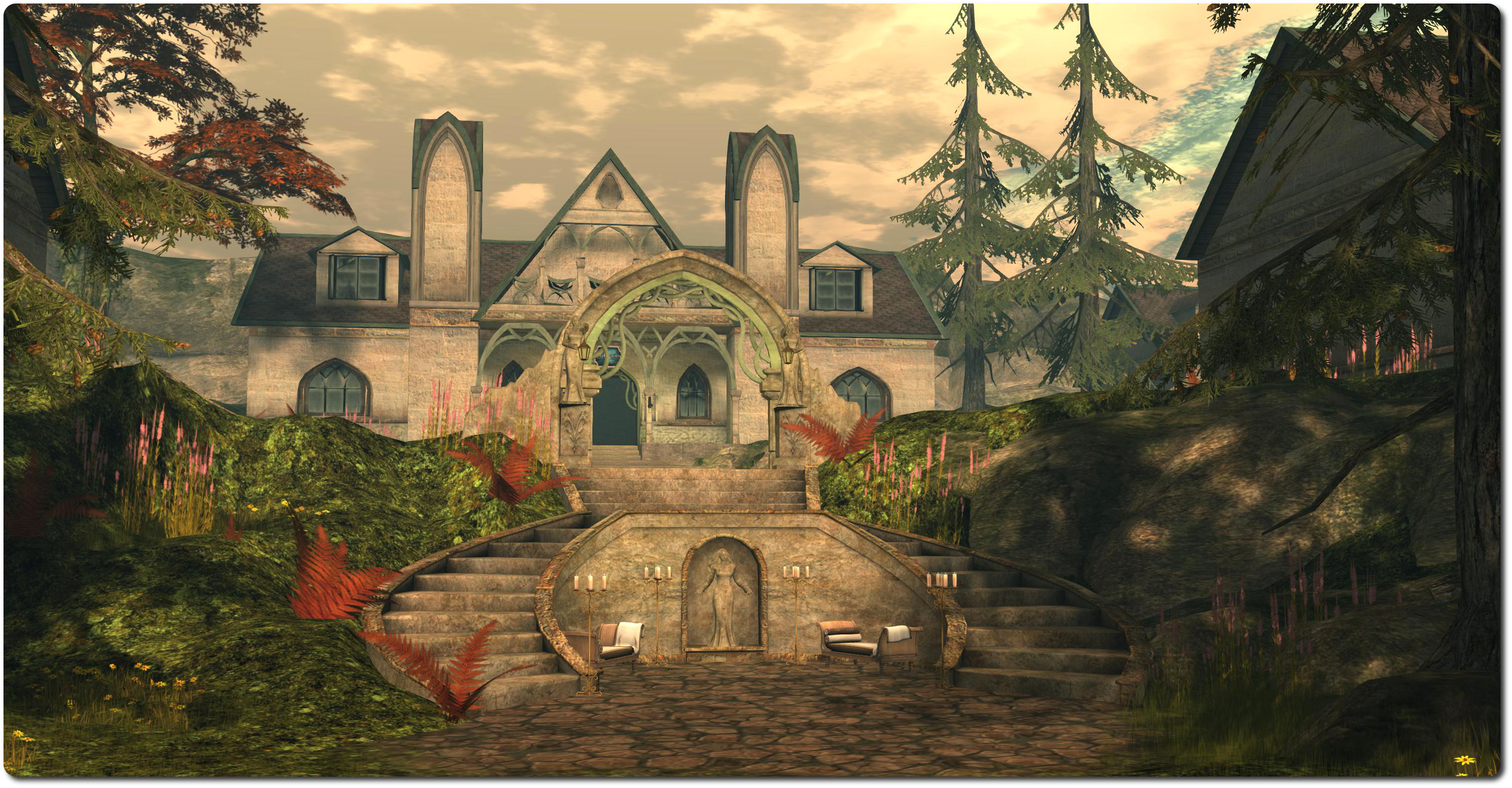
Rynn Verwood’s Medhir Woods lives up to its description of an elven outpost.

For most of us, I’m sure, the mention of elves leads to images of Tolkien’s elven races, proud and tall, surrounded by an air of mysticism and calm, offering havens of peace in a turbulent world of change. And so it is with Medhir Woods. Arriving in the region, particularly when the fairelands are busy, is akin to how it may have felt in entering the valley of Imladris after a long journey; one discovers a place of peace and welcome amidst all the bustle.

Fantasy Faire May 2014: Medhir Woods, Inara PeyMedhir Woods: Fantasy Faire May 2014: (Flickr)

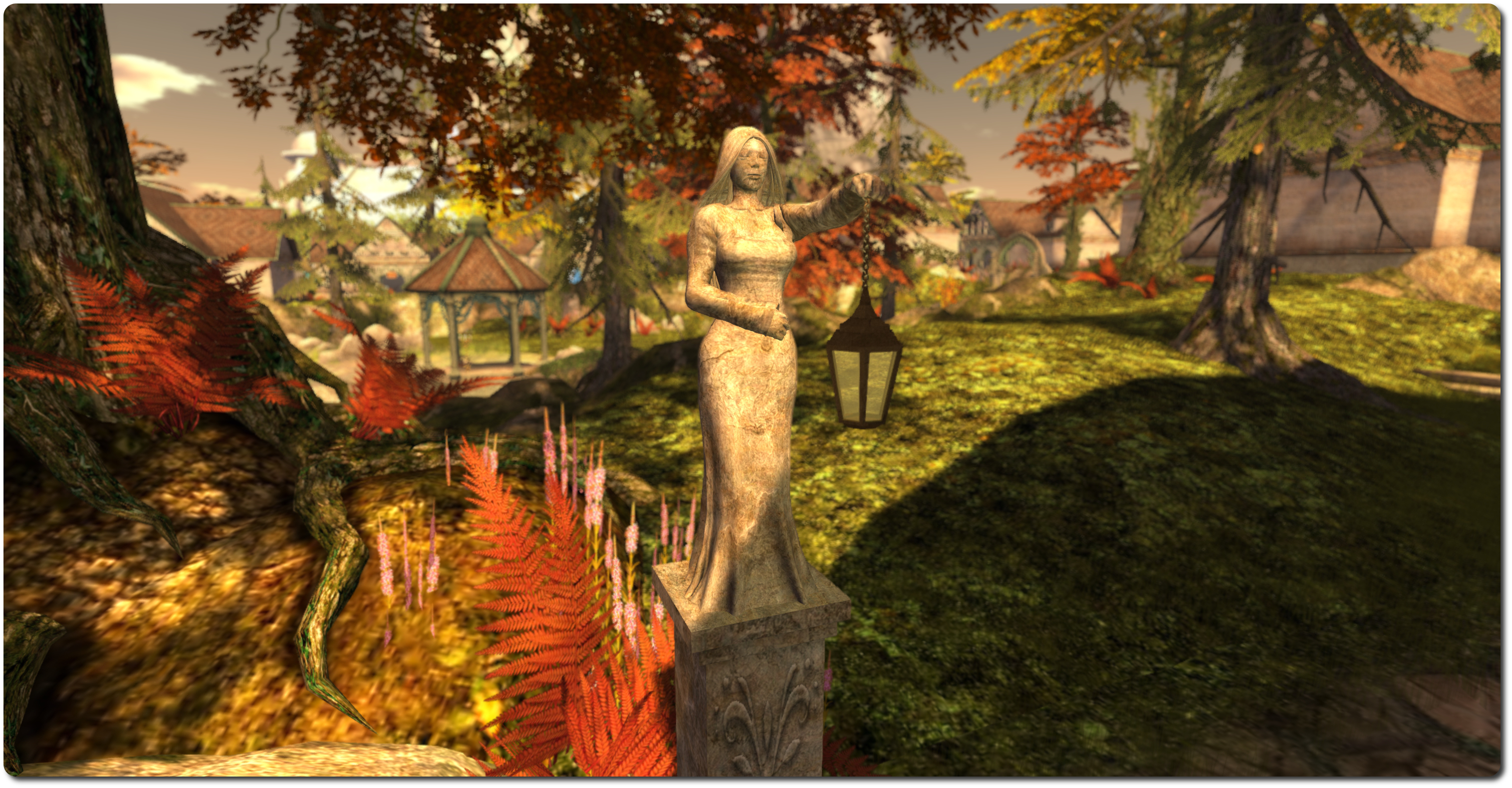
The feel of Middle Earth is unmistakable here as one wanders the streets between the houses. The latter may not be as other-worldly as the designs of elves as imagined in Peter Jackson’s films, but given this is a forested enclave, the buildings have the right elven feel about them. Chimes sound in the wind as one explores while birds call and sing from the surrounding woods, and the ways are lit by lamp-bearing statues with a decidedly elven  look.

Of course, the feeling of being deep within Middle Earth is somewhat heightened by the tall bulk of Hope’s Haven which rises to the north of Medhir Woods. But even without this, when one takes the design here, complete with a slightly misty, perpetual autumnal sun-set, it is hard not to feel as if one is within an outpost from the twilight years of age of the Elves,  when the Dominion of Men has come to the fore.

Fantasy Faire May 2014: Medhir Woods, Inara PeyMedhir Woods: Fantasy Faire May 2014: (Flickr)

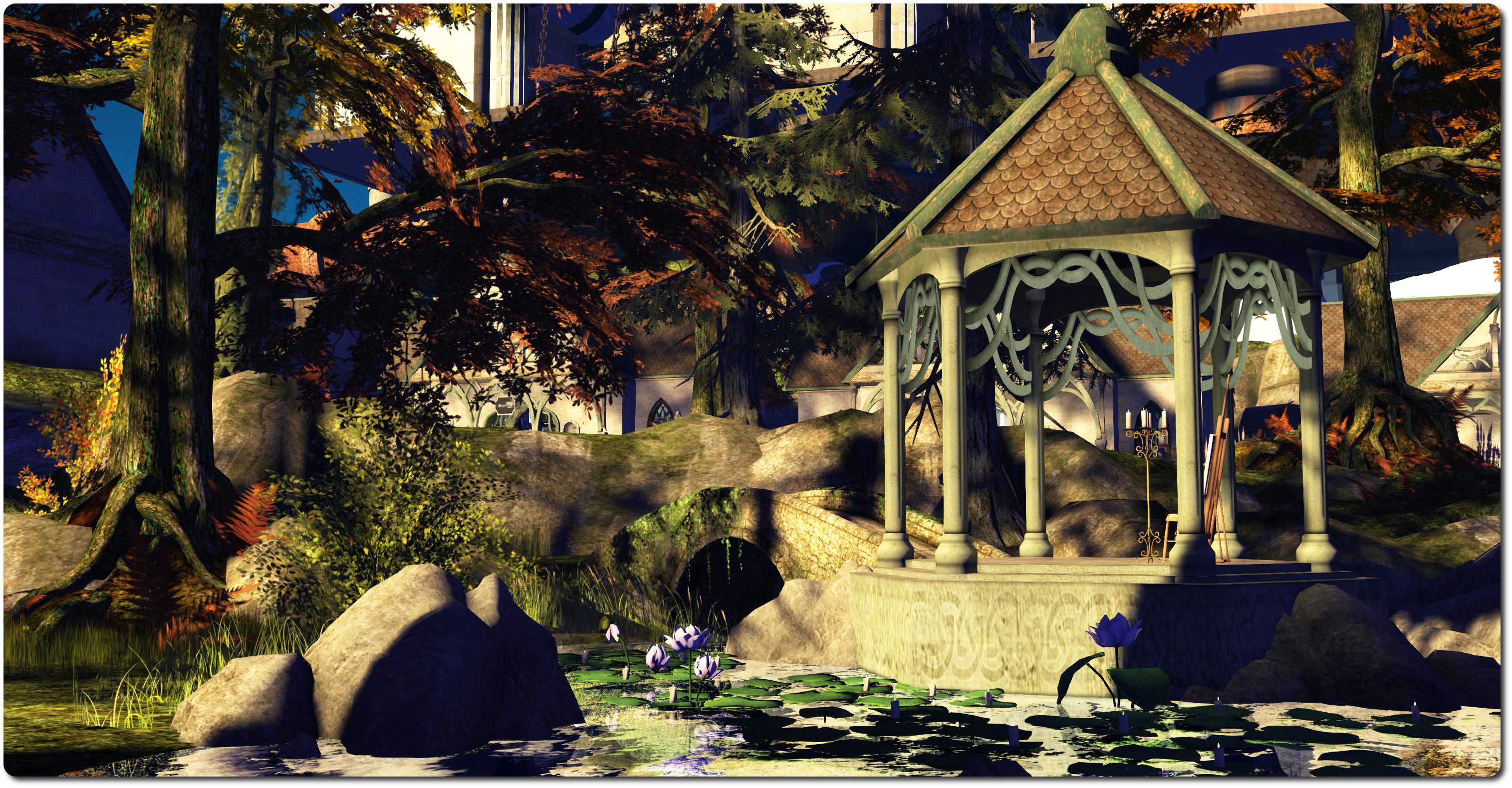
For those seeking further respite from the excitement and rush of the Faire, Medhir Woods offers a place of sanctuary (and also the scene of role-play earlier in the week) even amidst its own calm. This can be found under the arch from the landing-point and down the stone steps. Follow these as the lead to a greensward overlooking the bay around which Medhir Woods sits. Here there are benches located in the arms of the stone stairs, offering a place of rest and contemplation. A small gazebo stands close to shore at the edge of the greensward, reached by a stone bridge, and offers a view westward out over the inland sea.

A photogenic location, Medhir Woods is a delightful setting, one which, for me, stands as a favourite place in which to spend time while at the Faire.

Fantasy Faire 2014; Inara Pey, April 2014, on FlickrWiggenstead Mooring: Fantasy Faire 2014 (Flickr)

There is something delightfully playful about Kayle Matzerath’s builds for Fantasy Faire. Luminaria, his build for 2013 for example, presented a wonderful and colourful town of winding streets, broad gardens and gingerbread houses and stores. Having stepped into the breach at the eleventh hour after Nya Alchemi had to unfortunately withdraw due to health reasons, Kayle has this year created a place of heartwarming whimsy with Wiggenstead Mooring.

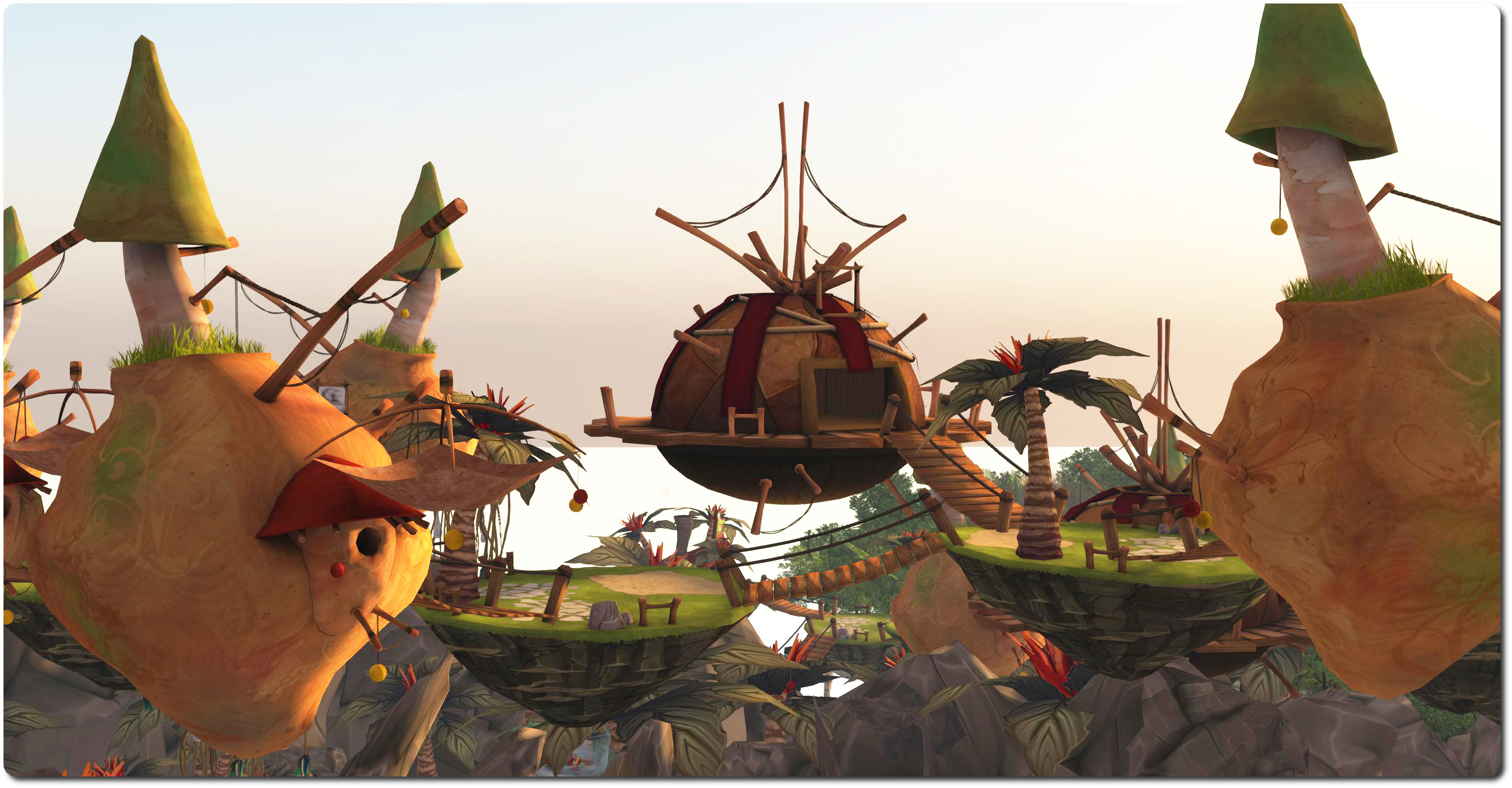
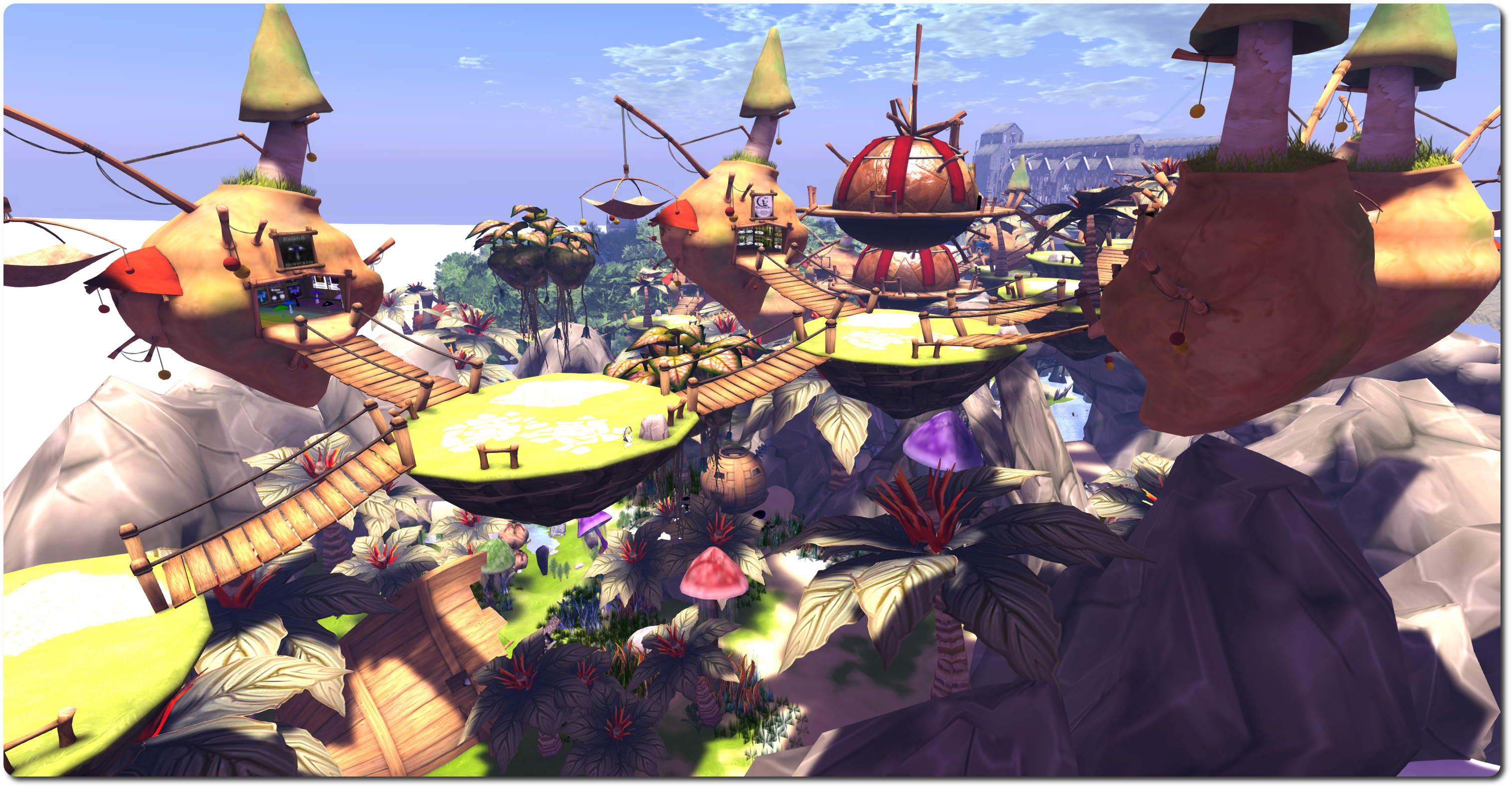
With its floating islands linked by rope bridges occupying the sky over a rocky land filled with great flowers and huddled trees, where water offers a place to bathe or paddle, it’s hardly surprising that the Rickety Weasels established their clubhouse here. One would be hard put to find a more playful environment anywhere in the Fairelands.

Fantasy Faire 2014; Inara Pey, April 2014, on FlickrWiggenstead Mooring: Fantasy Faire 2014 (Flickr)

Up on the islands, the stores are a whimsical delight, with some looking like tepees, a patchwork of hides stitched together, draped with cloths and held-up by stout poles, others looking as if they’ve been built from dried mud and with mushroom-like growths sprouting from their tops chimney-like. Linking the islands supporting the stores are smaller islands on which sit palm tree-like plants topped with brightly coloured flowers.

Such is the design here, you cannot help but smile as you walk from island to island across the bridges – something which can be as restorative as finding a quiet corner somewhere and simply sitting down. Travel to the south-west corner of the region and you’ll find the Jolly Crocodile.

Here loud-mouthed Fimbleby awaits your challenge and to get you on the road of the Fantasy Faire Hunt. Solve the puzzles here and you’re ready to participate in the second part of the hunt, which takes place in the Palace of Tears – but you’d best hurry if you’ve not already faced Fimbleby; he’ll be packing-up his things and heading home when the Jolly Crocodile closes its doors as the Faire draws to a close on Sunday May 11th (although the Palace of Tears hunt will continue for another week to give you a chance to draw breath and complete all of the hunt).

Fantasy Faire May 2014: Wiggenstead Mooring, Inara PeyFantasy Faire May 2014: Wiggenstead Mooring

Close to the Jolly Crocodile is a bridge leading down to ground level. Take this and you’ll find paths to explore through the rocks and plants. Deep among these sits the headquarters of the Fairelands Sheriff’s Association, ready to extend the long arm of the law (as they have been throughout the Faire) and ensure the peace is kept. Don’t miss, as well, the little island in the bay on the north side of the region.

If there is a word to be used to sum-up Wiggenstead Mooring I’d likely settle on “fun”; it’s fun to look at and it’s fun to visit and as such, in many respects, it is a visualisation of one of the elements which lay at the heart of Fantasy Faire for all who attend.

Fantasy Faire May 2014: Wiggenstead Mooring, Inara PeyFantasy Faire May 2014: Wiggenstead Mooring

Teleport to Wiggenstead Mooring.

Keeping up with Fantasy Faire

Related Links


SL projects updates: TPV developer meeting, Friday May 9th 2014

A TPV developer meeting took place on Friday May 9th. The core items discussed in the meeting are reported below, with timestamps in the relevant paragraphs indicating the point at they are discussed in the video embedded here. My thanks as always to North for the latter.

SL Viewer Status

[00:35] As noted in part one of this week’s updates report, the de facto viewer was updated on Tuesday May 5th with the promotion of the Interest List viewer (version 3.7.7.289461). The viewer contains what’s being referred to as a number of “non-trivial” merges, as the team responsible for the viewer took the opportunity to clean-up “a lot of old and unpleasant code”, and this “touched on a lot of things”. As such, it may be a while before this code filters into all TPVs.

[01:27] On Thursday May 8th, the SL Share-2 RC updated to version 3.7.8.289775 (download and release notes). This viewer includes the ability to upload Tweets and snapshots to Twitter and / or snapshots to Flickr, and to use pre-set filters on images being uploaded to either service and / or to Facebook, and to create your own filters.

The remaining viewers in the release channel (Sunshine / AIS and the Maintenance viewer) and the Zipper project viewer will be updated in week 20.

[02:11] There are two or three other viewers which are expected to be appearing in the near future. One of these contains a number of Snowstorm contributions (such as STORM-1831, currently awaiting two minor bug fixes), Baker Linden’s group ban work should be generating a viewer soon (see below for more), and there is a viewer which contains a series of memory leak fixes which is currently in QA.

Group Ban List

[03:40] Baker reports he has two “major” bugs and three or four “minor” bugs still to deal with; however, it doesn’t appear is if these are going to stop the viewer arriving as a project viewer. As noted in part two of this week’s report, the repository for the code has already been made public, and TPVs have been invited to pull code from the repository if they’re in a position to do so (the group ban viewer is built to LL’s 3.7.8 code base).

Obviously, and again as noted in part two of this report, the code will not be usable on the main grid until such time as the server-side changes have been deployed, and this isn’t likely to happen for a couple of weeks or so, so don’t expect it to be appearing in release versions of any viewers for a while.

The server-side code is available on a channel on Aditi (DRTSIM-234 14.05.05.289712 – which includes the Morris region where the Server Beta meeting is held and now includes the BUG-5929 fix), and there may be a grid-wide Aditi deployment of the server-side code. If this is the case, it will likely be confirmed via a Server Beta group meeting.

One aspect that has not been looked into as yet is ensuring that when someone is ejected / banned from a group, they are also ejected from group chat. Currently, due to the way the back-end services operate, if someone has the group chat window open when they are ejected from a group, they can continue to chat / spam into the group chat up until the point where they close the window. Commenting on this, and given that Simon Linden has been working on the chat service, Baker has indicated that he’ll look into things with Simon and see if this problem cannot be resolved.

Leap Motion Integration

[12:18] In November 2013, Leap Motion approached Linden Lab about integrating their gesture controller into the view.  Due to the amount of work the Lab had on its plate, the work was handed-off to TPV, with members of the Firestorm team working with Leap Motion to get things integrated.

Since that time, the work has been subject to a number of hiccups – including the need for Leap Motion to update their software. As it stands, the work is slightly stalled as the Firestorm team no longer have the resources needed for the work, so a call has gone out to TPV developers who are willing to take a lead in bringing this work to fruition.

Third-party Library Work (Webkit et al)

[26:14] Monty Linden is continuing his work in cleaning-up the third-party libraries used within the viewer build process. This work has been focused of late on Webkit, which is used for a number of tasks, such as powering the built-in web browser and to display profiles, and is used with Media on a Prim (MOAP) and many in-world televisions. However, Monty has more recently been working on the COLLADA DOM library as a means of “taking a break” from Webkit. He describes this as the “last big one” on his list.

Despite still having to finish-up with Webkit, Monty is already in a position of being able to use a windows version of the viewer which makes use of his updated and cleaned-up libraries, although he emphasises the work is not ready to enter prime-time use as yet.

Continue reading “SL projects updates: TPV developer meeting, Friday May 9th 2014”

Of dreams and memories: rare things, fine as a Beeswing

Beeswing, Banana Island, May 2014; Inara Pey, on FlickrBeeswing, Banana Island

I was drawn back to Banana Island, Bowie Zeplin’s homestead region, which I last visited in March, due to a post from Honour which indicated Bowie’s new build is now close to completion. As her work is always stunning to see, as anyone who saw Pangloss will know only too well, I knew I’d have to hop over and see for myself as soon as the opportunity presented itself.

As with her previous pieces, Beeswing is beautifully composed, striking to the eye and with a “natural” surrealism which makes it truly unique.

Beeswing, Banana Island, May 2014; Inara Pey, on FlickrBeeswing, Banana Island

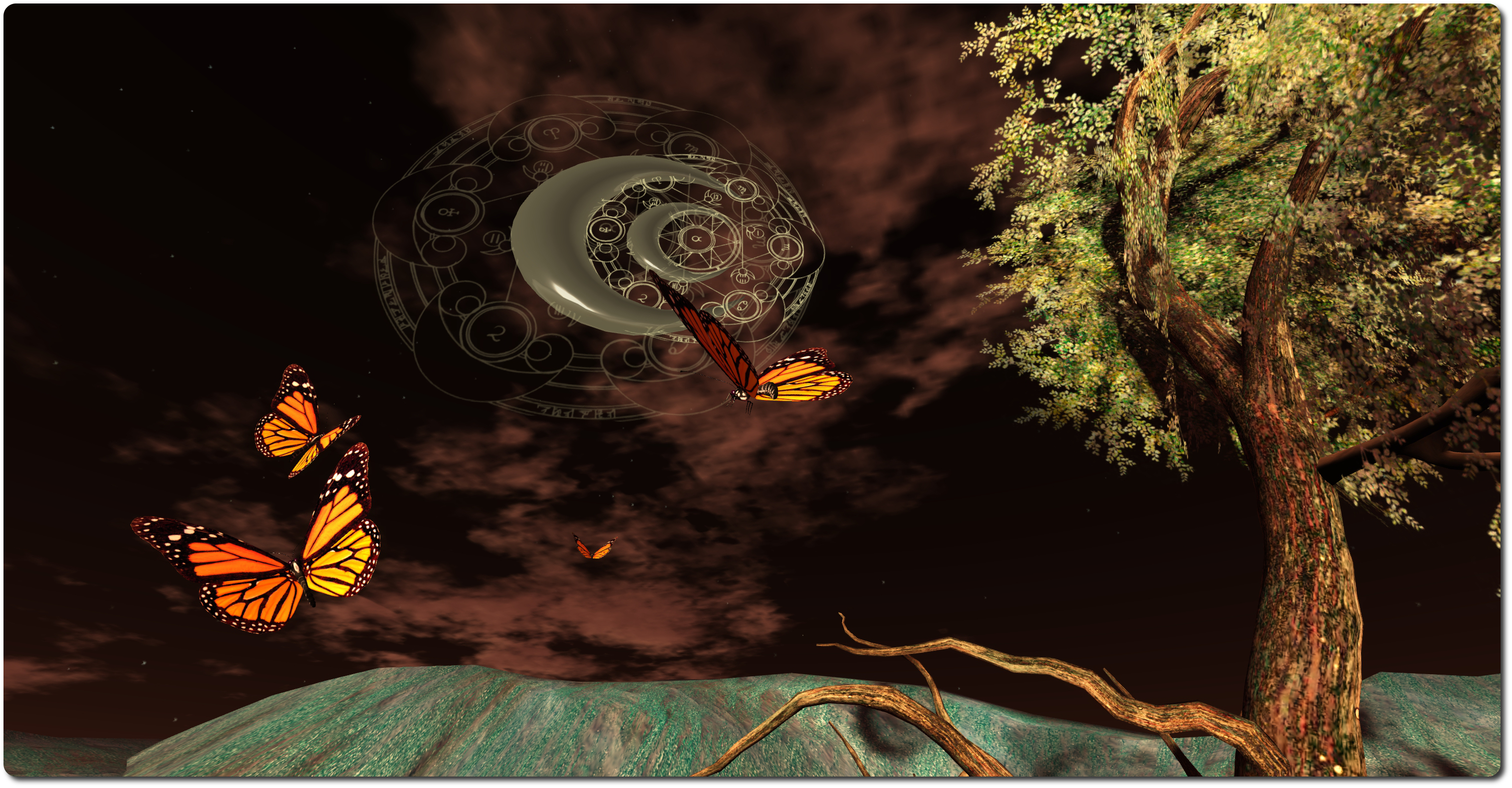
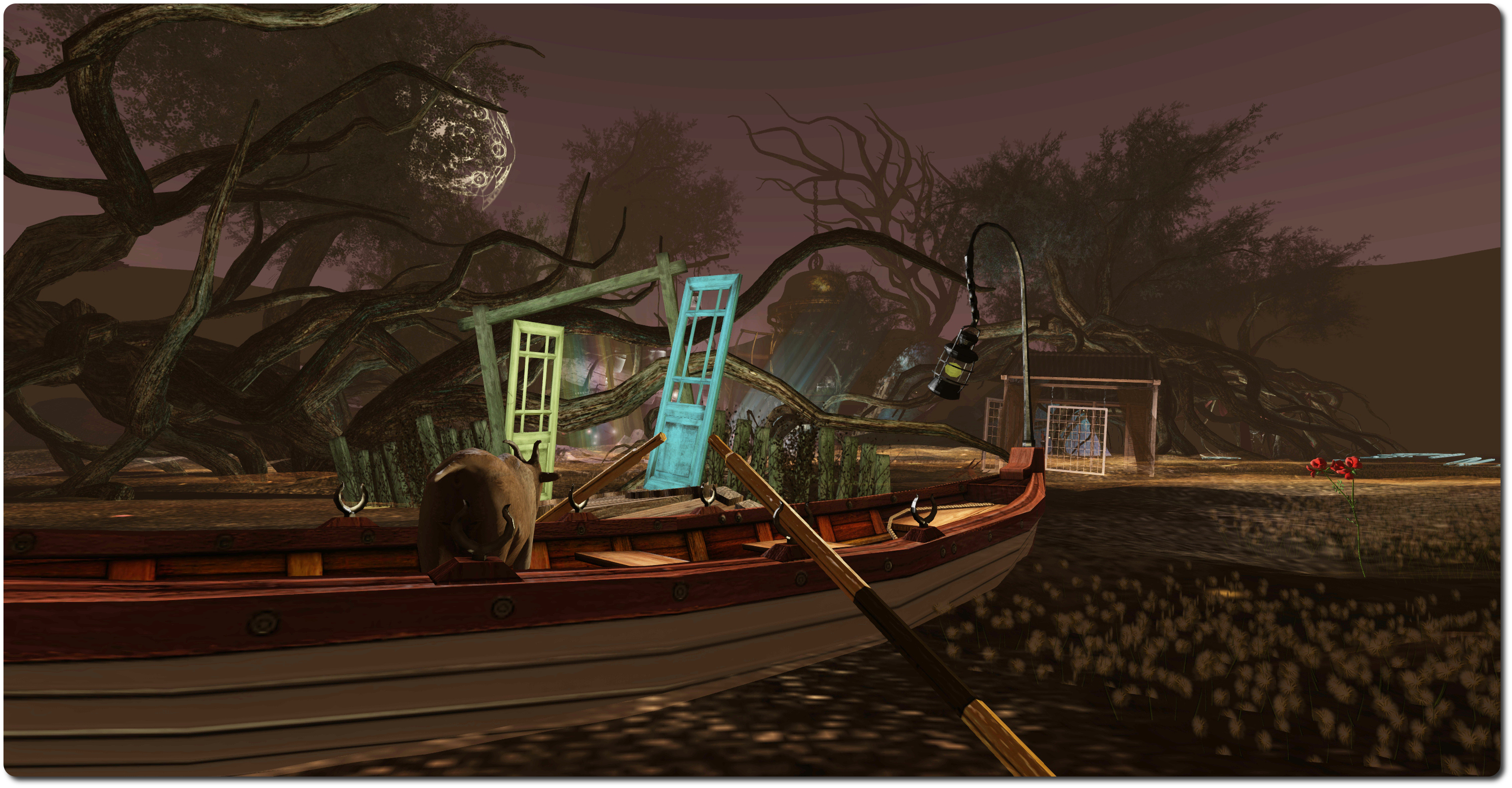
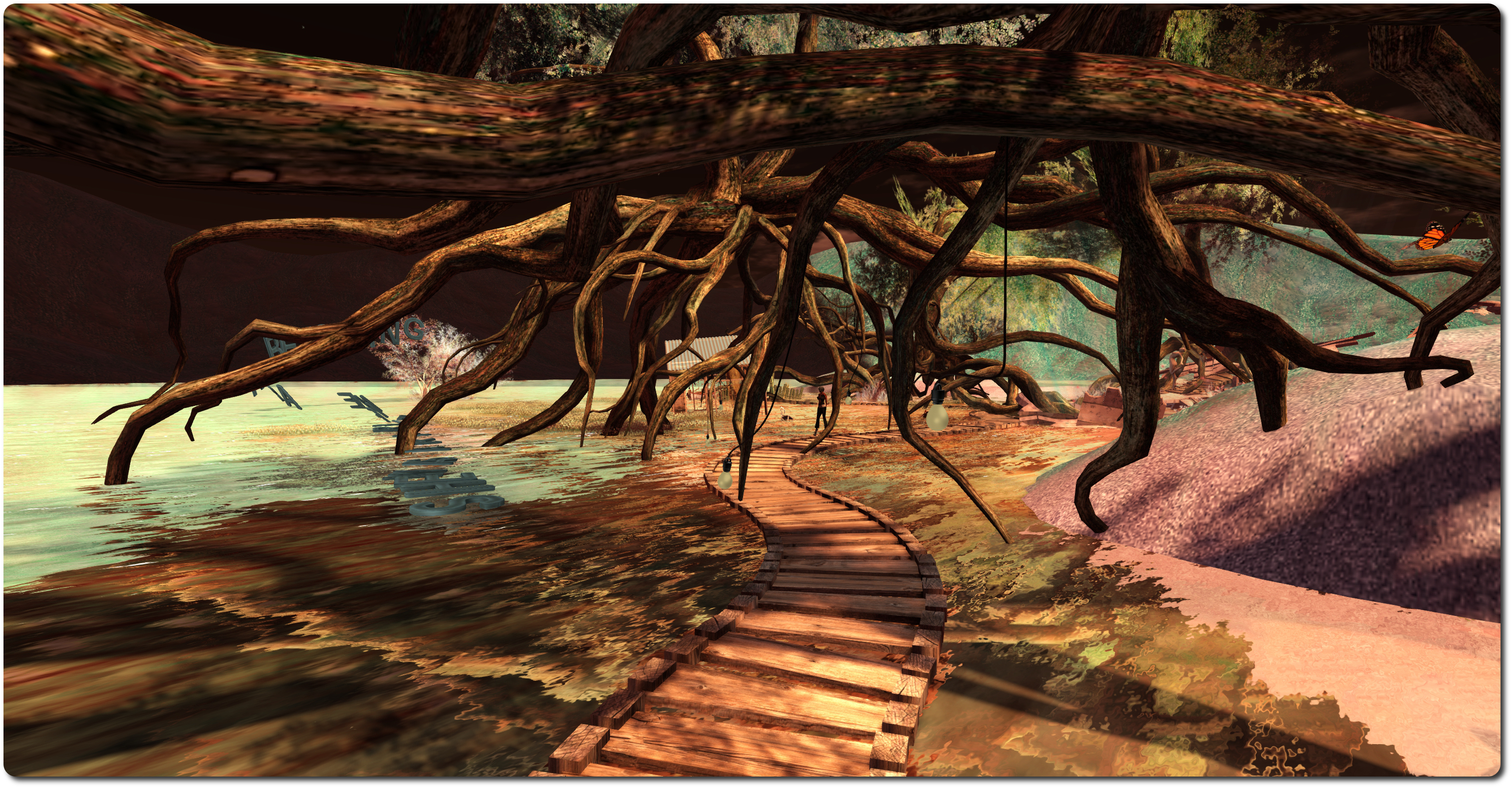
The first thing you’ll notice on arrival is the region is darkly atmospheric – I’ve taken the liberty of either toning-up my images or of using a slightly different windlight to the default. The landscape is largely given over to water surrounded by hills, and features raised wooden walkways which wind through the region and under the thick roots of trees which float serenely overhead.

Wander the walkways, and you’ll come across vignettes, large and small, many of which appear to be memories of childhood or of events from childhood. Some may be happy: an innocent game of hopscotch or a favourite book. Others appear less happy: the tiny apartment house, ripped open by an upthrust tree, perhaps an echo of a parental divorce, the shattering of a home, the tiny figure within the broken building representing a daughter standing isolated and alone as her parents go their separate ways.

Beeswing, Banana Island, May 2014; Inara Pey, on FlickrBeeswing, Banana Island

Elsewhere, the images appear to be all that remains of dreams and hopes once held, or the memories of roads not taken: the dancer under a single spotlight; the naked figure rising from water displaying ever-changing images, her hand extended towards a star above her, as if reaching for her future. Mixed with these are other little vignettes I’ll leave to you to interpret.

Toward one side of the region sits a gilded cage, doors flung wide, within which sits an idyllic image: a house sitting in a beautiful landscape, smoke rising from its chimney as water tumbles from a waterfall nearby to feed a crystal blue lake before passing under a quaint stone bridge. The kind of thing society tells us is the ideal lifestyle we all should strive to attain; yet still those gilded cage doors sit, both inviting us in and perhaps warning us of the price we may yet face should we do so …

Beeswing, Banana Island, May 2014; Inara Pey, on FlickrBeeswing, Banana Island

To determine a meaning here, if one is indeed intended, is not easy. Nor, frankly, is it required, given the captivating beauty apparent in each of these scenes. To me, if there is a theme here, then perhaps it echoes the meaning behind Richard Thompson’s song Beeswing, a refrain from which can be found in the region; that the installation is about the choices we make in life, or which are thrust upon us, and the price they carry.

If that sounds dark, then don’t be put off: Beeswing is an evocative place, stunning in composition and with a beauty as fine as a bee’s wing. More than worth the time taken to visit it.

Related Links