Dio beta launched – and it might be more than it seems

LL logoUpdate, February 19th, 2014: dio was discontinued by Linden Lab on February 19th, 2014. Links to the dio website, etc have therefore been removed from this article.

Linden Lab has officially launched dio, the latest in its new product line, in a beta release on Tuesday 29th January.

dio has been subject to much speculation since the original website was accidentally left accessible to enquiring noses back in May 2012. More recently, the site has been extensively updated, giving some clues as to what it is about.
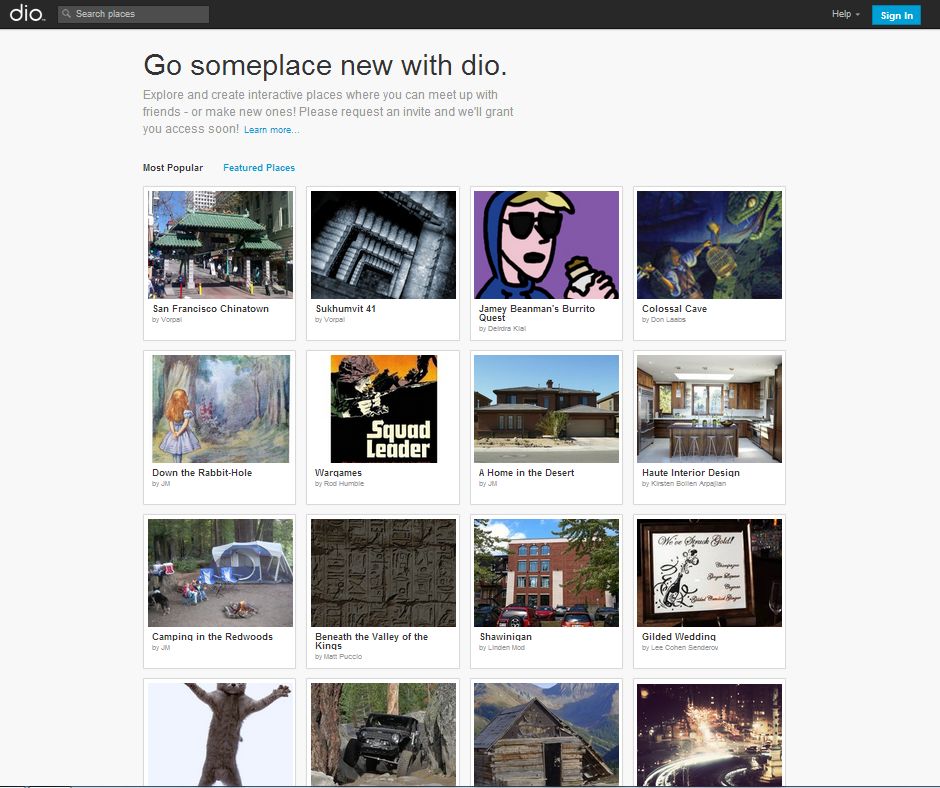
The new Dio website homepage - launched on 29th January (click to enlarge)
The dio website homepage – launched on 29th January

The press release announcing the launch reads in part:

In dio, you create places by adding text, photos, videos, and interactive objects into interconnected ‘rooms’ that give spatial context to the content you share. You can keep your places private, share them with friends and family, or allow everyone to explore and enjoy them. Live and persistent chat allows you to socialize with other users as you discover and explore dio places together and see what those who came before you had to say. In the future, dio users will be able to monetize the dio places they create, enabling them to profit from their own creativity.

The Learn More link on the site provides more information on the site, and there is an introuctory vdieo to accompany the launch.

Within dio, users can create places – such as their own homes – or recreate events in their lives, such as their wedding, or make picture-based games, and so on, and then select how to share them. All of these aspects cane be combined, as dio Producer Bo Barfield explained in an interview with Forbes Magazine to mark the launch:

You can combine these game-like experiences in places where they traditionally wouldn’t be. As an example, a hotel that’s trying to find a new way to advertise and make money can recreate their hotel in dio, and then make a short and easy game that takes a few minutes. Say Clare Danes lost her beloved emerald earrings. Find it somewhere in the hotel, and you get a free bottle of champagne with your stay. It’s using gamification in a richer way. It’s not just about getting badges or achievements: It gets customers imagining themselves in your hotel or whatever it is you’re trying to market.

Questions as to how dio will be monetised, both for the Lab and for users, are also answered – to a point – within the  Forbes article, where Barfield states:

We want to implement revenue sharing with the content creators of dio to give people an incentive to create interesting spaces. We’re going to give them a cut of the advertising revenue that they bring.

We’ve seen that work exceptionally well in Second Life, where users can monetize their own creation…. If I create a dio place that’s very compelling and is getting lots of traffic, then I’ll be able to monetize that as a share with Linden Lab.

So it would appear to be that dio is perhaps the Lab’s most ambitious product to date, aiming at a very broad cross-section of users, from individuals through to businesses.

Interestingly, the dio Terms of Service still make reference to the use of Linden Dollars. Given the website is still beta, this may be down to the fact that the ToS is still boilerplated from the Second Life ToS – a point I’ve previously made. While I’m still somewhat drawn to this being the case, it is nevertheless interesting to speculate where and how Linden Dollars might be linked to dio, and what form any cross-pollination between dio and Second Life (were there to be any) might take.

Also accompanying the launch is a set of video tutorials on You Tube.

The response from Frobes’ contributor Carol Pinchefsky is broadly positive towards the platform. Those wishing to sign-up can do so (it’s free), either by using their Facebook account or using their e-mail address.

I’ll be looking at dio in-depth in an upcoming article.

Related Links

SL project news: week 5 (1): servers, viewer, deformer

Server Deployments Week 5

There are a full set of deployments this week, Main channel and RCs.

On Tuesday 29th January, the Main channel received the threaded region crossing code deployed to BlueSteel and LeTigre in week 4. This project makes sim performance smoother when objects and avatars cross between regions. Please refer to the release notes for further information.

On Wednesday 29th January, the Release Candidate channels should receive the following deployments:

  • BlueSteel should receive the server-side materials processing code. This code will require a a project viewer in order to be used, As reported in week 4, there is no definitive timeframe as to when a viewer is liable to be available, but it would be reasonable to expect something in the next few weeks (possibly sooner) – release notes
  • LeTigre should receive the maint-server project originally deployed to Magnum in week 3. This deployment includes the bug fix for the places / search indexing issue which occurred following the original deployment of the code to Magnum – release notes
  • Magnum will receive a further update to the interest list code deployed in week 4. This update addresses high packet loss problems, leading to issues such as not seeing avatars or objects in-world, specifically:
    • A fix for bots which do not specify a valid draw distance in order to prevent them downloading huge amounts of unwanted data
    • A fix to keep ObjectUpdate packets within an ethernet MTU of 1500
    • Release notes.

Please check with the forum discussion thread for these deployments to keep abreast of updates / changes / issues.

Materials processing: server-side code to go to BluseSteel on Wednesday 30th January - but no project viewer yet
Materials processing: server-side code to go to BlueSteel on Wednesday 30th January – but no project viewer yet

SL Viewer News

Problems remain with the beta viewer code, but it is hoped a new beta will be appearing shortly. In te meantime, Kelly Linden has committed the viewer-side code for extending the maximum avatar animation length from 30 seconds to 60 seconds (MAINT-1492). This should be appearing in the 3.4.5 beta viewer, and should also be appearing in TPVs in the near future.

Mesh Deformer

Delays continue with the mesh deformer, which can be summarised as:

  • The Lab has limited internal resources for testing it – although attempts are being made to address this
  • There is concern that there is no clear way for a designer and a user to be sure that they are using the same avatar base model – and if they are not, then the deformer will very likely make things worse. While there are some provisions within the current deformer for the base model to be taken into consideration, there is apparently concern that it may not be sufficient
  • The project veiewer code is now significantly behind the current viewer release, although work is underway to merge it up (and I received a report that this has been done while preparing this update).

A further potential issue in progressing the deformer  – as Karl Stiefvater (Qarl Fizz), who wrote the original code points out – is there are a lot of expectations that the deformer will do a lot of things which were not in the original specification (or indeed, the code as originally written). Some of this scope creep has resulted in further updates to the code from other contributors. However, there appear to be concerns that if the Lab prematurely release if, there will be a risk that a) it breaks existing content, b) it is viewed as not addressing problems correctly.

This latter aspect was also commented upon by Oz Linden, when speaking Open-source Development meeting on Monday 28th January. He said, “We are often (and frequently with justification) accused of throwing things out that are not really finished enough… indeed, the lack of some solution for the problem the deformer is trying to solve is one of the more prominent recent examples, but I don’t want to make the situation even worse by putting out a ‘solution’ that turns out not to solve enough of the problem and/or creates bigger ones down the road.”

Avatar Baking (SSB)

A set of code updates for the viewer are in progress. However, an issue with the Mac build means they have not been pushed as an update to the project viewer as yet. It is hoped that the updates will reach all three versions of the viewer (Windows, Linux and Mac) once the Mac build problem has been resolved.

Kokua 3.4.4 goes CHUI

Update February 28th: Nicky has posted that the CHUI code has now been merged with the main Kokua code, and a new version of Kokua is available for testing with it.

kokua-logoNicky  Perian, working on the Kokua viewer for SL / OpenSim, issued an experimental version of the viewer on January 24th which includes the new SL Communications Hub User Interface (CHUI).

Release 3.4.4 (CHUI) has a dedicated repository, and is available for Windows and Linux.

As reported on its launch, CHUI complete overhauls the communications floater within the official viewer, and introduces a new Conversations Logs floater, allowing users to access saved chat and IM histories from within the viewer. In updating the Conversations floater, CHUI brings some functionality to it which users of several TPVs may find somewhat familiar, even if the presentation doesn’t match anything they’ve been used to in the past.

CHUI goes purple: the initial integration of the CHUI code into Kokua

A Kokua blog post accompanying the release of the experimental viewer provides additional information:

The Communication Hub UI  has Instant Messaging , Chat,  and Voice controls in one floater as was done in version 1 viewers.

Imprudence users have asked that Kokua implement the Imprudence UI for communications. I would like comments from Imprudence users about this interface .

This merge affected many parts of Kokua code. Please test and report problems using our bug tracker.

There is also a link to the Kokua wiki page on recommended practices for using Kokua experimental viewers.

The implementation appears to be a “straightforward”  merge of the code, with the familiar Kokua UI colour changes, but otherwise no additional updates. “Straightforward” is given in inverted commas because, as the Kokua blog post notes, the CHUI changes impact many areas of the viewer’s code, making integration somewhat difficult – particularly if the TPV merging the code already has modifications to how  communications within the viewer are presented to the user.

The experimental viewer also includes the default “account creation” prompt found in the beta and development versions of the SL viewer which appears to be in relation to the forthcoming SL / Steam link-up, and which is displayed on the viewer’s log-in splash screen if no account details are found on the local computer when the viewer loads. As with other viewers which have merged-up with SL viewer development code, this should be taken as a sign that the code has been included in Kokua by default rather than having any deeper meaning associated with it.

Other recent updates for Kokua (from the 3.4.4.25633 release of January 13th, 2013) include:

  • The use of Vivox as the default Voice system, as a result of the latter relaxing licencing requirements for grids
  • The addition of a draw distance slider to the top right of the menu bar
  • The ability to set a minimum draw distance of 3 metres (seen as a means of improving performance for those involved in close-quarter combat / duelling)
  • Minor UI changes (such as the “Me” menu being renamed “Avatar”).

Overall, this looks to be a clean implementation of CHUI, and one which gives OpenSim users a further opportunity to get a look ad feel for the revised  / new floaters for communications.

Related Links

Viewer release summary 2013: week 4

This summary is published every Monday and is a list of SL viewer / client releases (official and TPV) made during the previous week. When reading it, please note:

  • It is based on my Viewer Round-up Page, a list of  all Second Life viewers and clients that are in popular use (and of which I am aware) and which are recognised as adhering to the TPV Policy
  • By its nature, this summary will always be in arrears
  • The Viewer Round-up Page is updated as soon as I’m aware of any releases / changes to viewers & clients, and should be referred to for more up-to-date information as the week progresses
  • The Viewer Round-up Page also includes comprehensive links to download pages, blog notes, release notes, etc., as well as links to any / all reviews of specific viewers / clients made within this blog.  

Updates for the week ending: 27 January, 2013

The major news for the week is that the Zen viewer has officially ceased development and has been delisted from the SL Third-party viewer directory at the developer’s request and all repositories removed from public access. The reason for this is unknown at the time of going to print with this summary.

  • SL Viewer updates:
      • Development rolled to 3.4.6.269302 on January 22nd, then 3.4.6.269515 on January 25th
      • CHUI development viewer rolled to 3.4.4.269464 on January 25
  • Dolphin rolled to 3.4.11.27250 on January 24th – core updates: cursor now displays in the correct position on the input line of the Places floater; moving, animated linksets will not leave phantom prims behind (LL breakage); llLoadURL no longer includes a “?” when sending URL to a browser (VWR-17689); source up-to-date with latest LL development viewer code – release notes
  • Kokua issues an experimental CHUI viewer (3.4.4) on January 24, with dedicated repository 
  • Niran’s Viewer updated to version 2.0.8 on January 22nd – assorted UI updates (About floater and fog settings, updates to playing local sounds); revised animations speed to control speed of all animations sseen through the viewer; improvements to custom always-on mouse steering mode; XML files clean-up  – release notes
  • Cool VL updates – three versions for the time being, all updated on January 26th:
    • Stable version rolled to 1.26.6.7
    • Legacy version Legacy (v2.6 renderer) rolled to 1.26.4.50
    • Experimental version rolled to 1.26.7.7
    • Release notes
  • Phoenix officially reached end-of-line for SL on December 31st – read more here
  • Zen viewer was withdrawn from the SL TPV directory and all repositories shutdown on January 27th, 2013.

Related Links

The Arrival of a question of departure …

The Arrival
The Arrival

Rose Borchovski’s latest installation at the Linden Endowment for the Arts opened on January 11th. I missed the actual event, but popped along to visit last week, and thought it time I got around to putting words to thoughts and reactions to the piece.

The Arrival is a full sim installation which is both a standalone piece and a continuation of the saga of her Susa’s – child-like beings of a mischievous and sometimes malevolent bent. Here they have captured a fish, and celebrations of the fact turn to questions as the fish dies literally beneath them as they use it as a stage for their jubilation; are they to blame for the poor fish’s demise?

The Arrival
The Arrival

Or that’s one of four explanations Rose gives for the piece. The others include memories from childhood, the inspiration of other artists, and even the influence of religion. In introducing the piece on the LEA blog, Rowan Derryth provides thought-provoking insight into the work which includes more on the possible origins of the piece – and I’ll leave you to go read her thoughts.

Quite how you interpret the work is up to you – you can follow Rowan’s thoughts, which are themselves based on commentary from Rose herself, or you can let your own thoughts percolate as your explore. The latter, by the way, is best done by using the teleport at the arrival point to get you started.

The Arrival
The Arrival

For my part, I found the piece something of an allegory / metaphor for how we humans behave, always busy exploiting this, that or the other, congratulating ourselves on what we can achieve and how we can enjoy everything, with little thought for what might happen when things are gone and we’re left to ponder our own role in their disappearance / extinction …

The Arrival is a fully immersive installation. The level of detail is stunning and ranges from the macro to the micro, plus there is a complete sound scape to take-in (scripted sounds rather than a media feed, so you’ll need sounds active to fully appreciate the work), and all manner of things to touch and prod – and which may surprise you in return. You’ll need to take your time as you explore, not only to make sure you experience all the interactive elements, but also because the detail really is amazing – a genuine tour-de-force as to what can be achieved in SL both in terms of art and in immersive, engaging environments. Make sure, as well, that you accept the region’s windlight settings on arrival, if asked. They are as much a part of the piece as anything else.

The Arrival
The Arrival

The Susas themselves are (as ever) marvellously made and beautifully expressive, particularly when there are grouped together when their child-like innocence is dispelled by looking into the eyes of several of them and witnessing a mischief which might border on malice lurking there. There also seems to be something of a hierarchy among them, as well, which is also hinted at in their expressions.

There is a charm and a disquiet about the piece. The charm comes in part from the very evident care with which all the piece within the installation have been created created – witness the line of peguins going for a dive towards the top of this piece. It also comes from the early sections of the piece where there is much merry-making and happiness, and well as wonderful little touches which are a delight to find (a little book with swimming fish!).

The Arrival
The Arrival

Move deeper into the installation as the story progresses, and the disquiet grows. Full credit here to Caer Balogh, a long-time collaborator with Rose, and her incredible scripted sound scape, which does much to set the mood as it is realised the fish is dead and questions arise. It was towards the middle of the piece that my own conscience was pricked and my thoughts turned to the potential for the piece being a allegory / metaphor, as mentioned above. A scene with two Susas tearing at one another’s faces and biting one another did little to quieten the unease; and while it certainly gave pause for thought, it most certainly did not put me off continuing my explorations. Like many outstanding pieces of art, The Arrival seeks to challenge, not offend.

The Arrival
The Arrival

All in all, this is a fabulous piece of art for all of these reasons and more, and very definitely worth a visit to explore, consider and participate in.

So, now you’re hooked, why not go and see what tales you can land for yourself?

Related Links

The Arrival
The Arrival

LEA Full Sim Art series – next round of applications sought

The LEA Full Sim Art series has a new call for proposals for the period March 2013 – February 2014.

All artists in SL are eligible to apply to have a full region provided for them for a period of one calendar month in which they can host a show of their choosing.

As with previous Full sim art series, successful applicants will receive:

  • A full, 15,000-prim region (inclusive of the media) – not all the prims have to be used!
  • The freedom to choose when to open the show to the public
  • Coverage within the LEA and UWA blog & potentially in any other blogs confirming their continuing support of the series

Access to regions will be granted to successful applicants on the first day of each month, and must end and be cleared from the region on the last day of the month.

How to Apply

  • Send a Notecard in-world to both Jayjay Zifanwe and Bryn Oh, which includes:
    • Your name and the name of anyone who might be working with you on the project
    • A 100-word description of your plan for your show
    • Give your 1st, 2nd, and 3rd preferences for the month in which you would like to use a region (from March 2012 through to February 2013 inclusive)
  • Applications must be received no later than midnight SLT on the 10th February, 2013.

With thanks to Bryn Oh