One of my first experiences with V1 TPVs was via the Windows Cool Viewer compiled by Boy Lane, and which became the Rainbow Viewer. For a long time, this was simply my Viewer of choice. I was therefore intrigued to see that after over a year, Rainbow has been overhauled and made available once again.
Based on the 1.22 release of Viewer 1, Rainbow has a core of die-hard fans, and the new release does much to bring it up to par with the likes of Phoenix and Imprudence 1.3/1.4, given it now includes:
Client-side AO
Media filtering
TP history
Display Names
Multiple attachments (but like other V1 TPVs, no multiple wear for the same layer of clothing)
Tattoo and Alpha layers
Outfits creation
Prim alignment tool
Multiple grid support
Using Rainbow is like a blast from the past. At installation, you’re informed that you need to obtain several files from either the “official” Viewer 1 or from Snowglobe. This is something I haven’t had to do in ages, and while I can understand why Boy has gone this route (better performance where the Kakadu system is concerned), I nevertheless wonder as to how vulnerable this leaves Rainbow: Viewer 1 is no longer available and there is no guarantee LL might not at some point simply remove snowglobe access, given it is now a dead project.
Once in the Viewer – and my use of Firestorm of late notwithstanding – there was something nostalgic in using Rainbow; the interface, the Preferences options – all hark back to the “good old days” in many respects when things were indeed, “fast, fun and easy”. However, the nostalgia is actually very short-lived. There is much that Rainbow lacks that I find hard to do without: there is no vertical tabbing for IM windows, for example, and no Quick Preferences option (although granted, both may come). Even the inclusion of avatar physics is – to be honest – now dated. The Viewer 2 system (already adopted by Firestorm) is far superior for those willing to give it a go.
Where Rainbow is likely to score is in being aimed at other OS Grids. I tested it with InWorldz and Avination, both with few issues other than getting the “you have been logged out” message, complete with options to review chat / IMs each time I logged out of InWorldz, rather than getting s “clean” exit. Other than that, performance was easily as smooth at Imprudence 1.3, and a lot better than the likes of Phoenix. As such, it is a welcome addition to the list of Viewers that can access other grids.
In terms of SL, however, I do wonder about the Viewer’s longevity. As I’ve already commented, the reality is that V1-based TPVs for Second Life are likely coming to their End of Days, what with the Search issues, mesh, and so on.
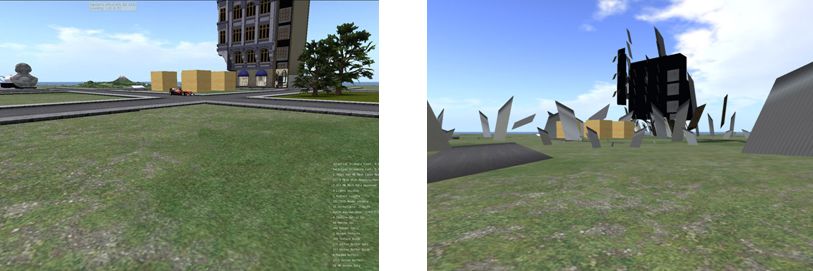
One of the problems facing Rainbow: Mesh as seen in the V2 Mesh Viewer (left) and in Viewer 1 (right) – with thanks to Linden Lab
To be fair to Boy Lane, the Viewer has been released with a clear statement of intent:
“Rainbow does not intend to be a competitor of viewer 2 or any other of the 3rd party viewers around. All of them are based on either V2 or Snowglobe code. Rainbow is based on 1.22, and playing in a league of it’s own. To support legacy hardware, and to support all my friends in Opensims.”
The last part of this statement is a worthy goal in itself – and again, full kudos to Boy for providing OS grid users with a greater choice. However, where Second Life is concerned, and even with a loyal following, given all that is coming down the road in the next few weeks and months, it’s hard to see this latest Rainbow release as having a decent shelf life.
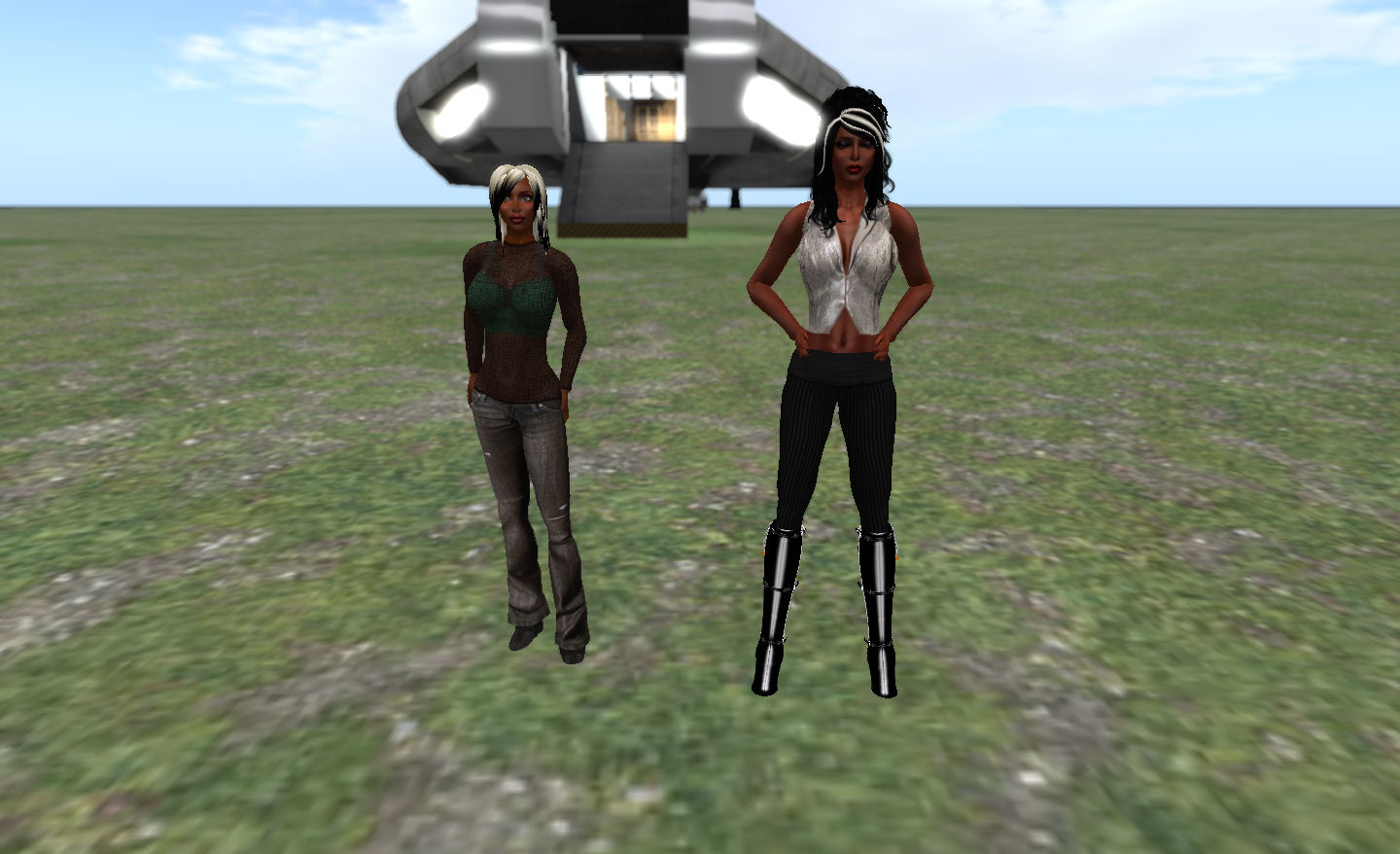
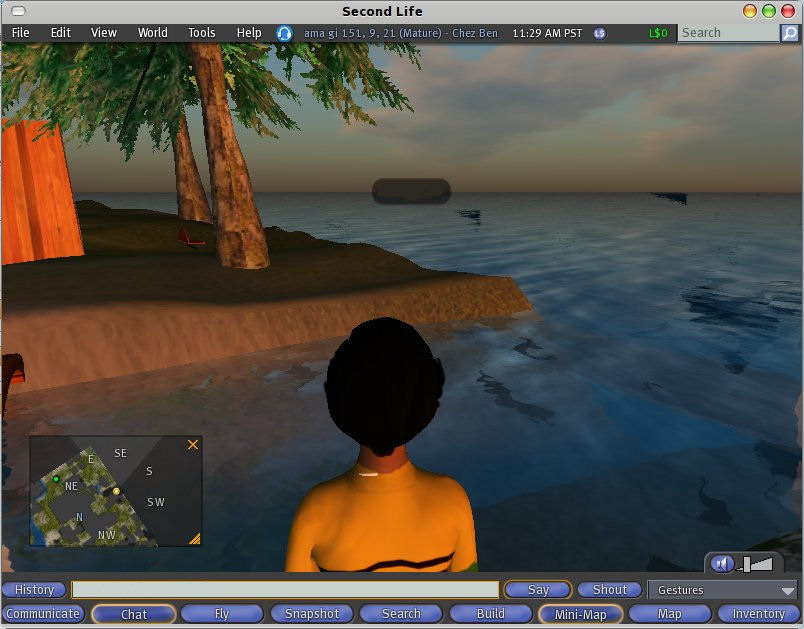
Standing outside the “Hidden Avatars Enabled” parcel
Privacy in SL is a nebulous thing.
We can employ banlines, security orbs and other systems; we can restrict parcel access to those without our own Group, or by access list; we can even resort to ban lists and systems that support them.
Whatever option we take, the fact remains that, unless we have our own private sim (Homestead or full), our privacy lasts only so long as someone who is so minded opts to step up their draw distance and use their camera to zoom-in and watch us.
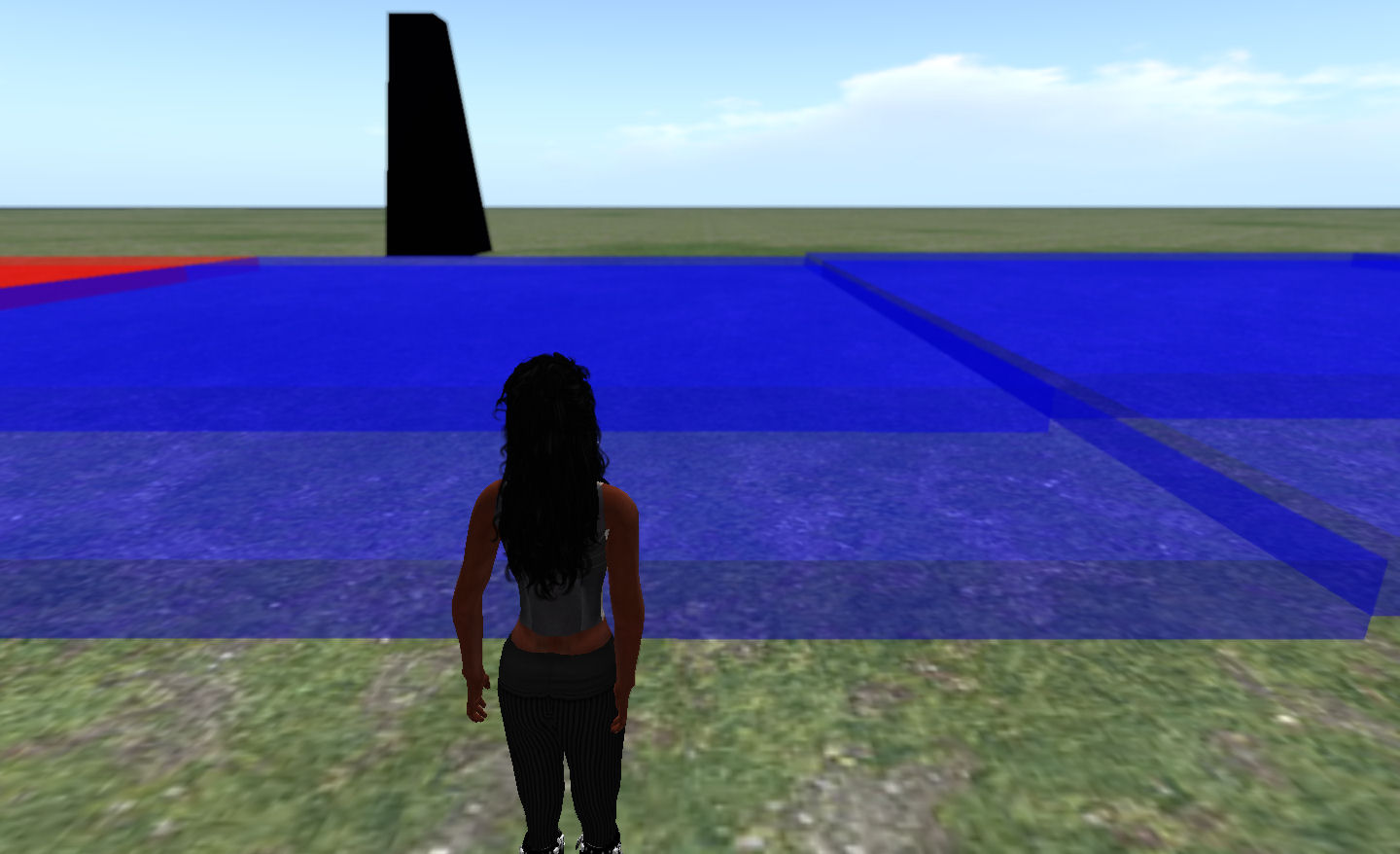
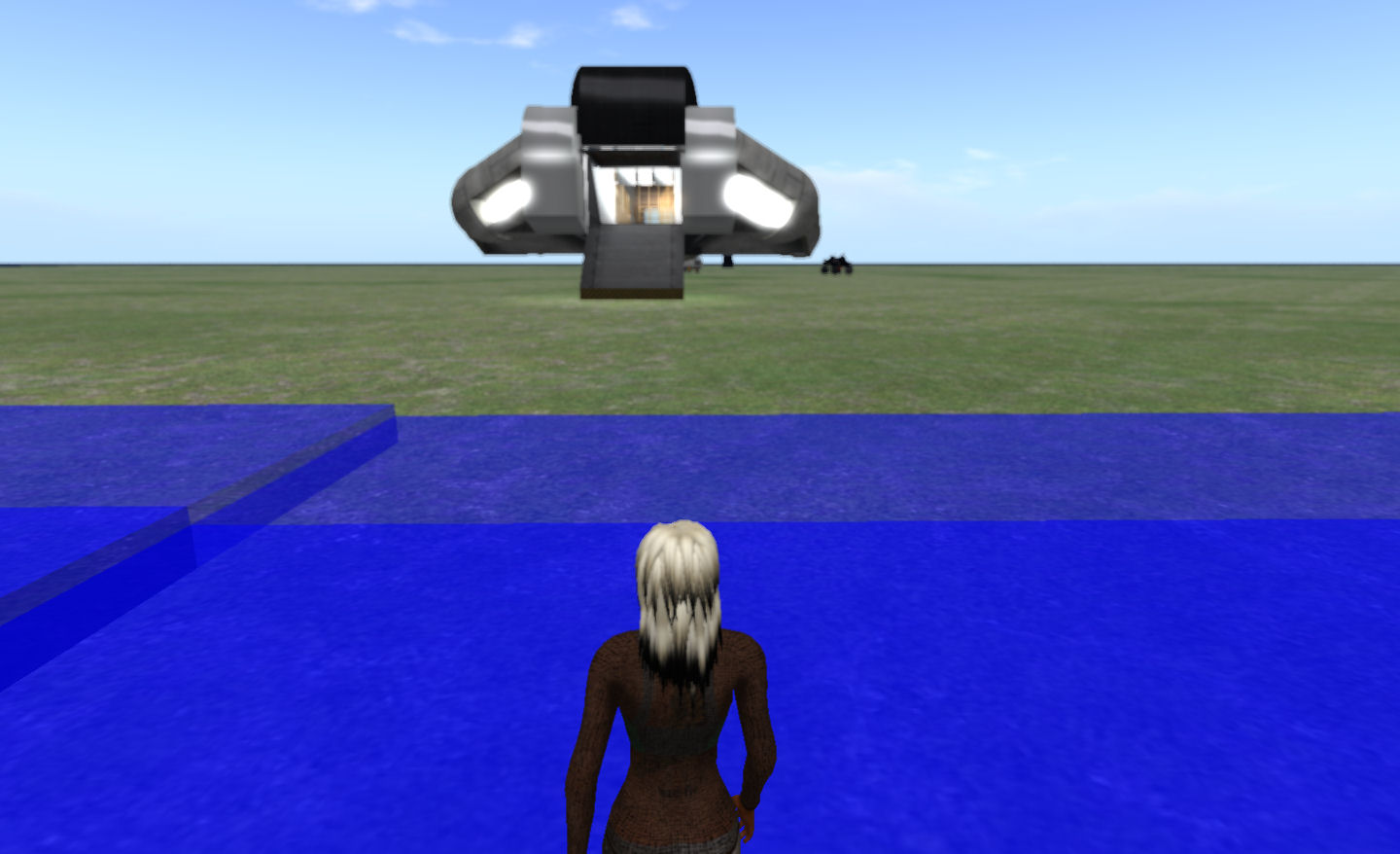
The view from outside the “Hidden Avatars” parcel when someone is occupying it
The ability to “camera-perve” has long been an issue in SL. Indeed, it was one of the worries people had when the grid merger took place: while those under 18 may well be restricted to G sims, if they are on mainland, there is nothing to stop them from camming out of a G sim and into a neighbouring M sim and seeing something they shouldn’t.
Now even that might be about to change in the near future.
Standing inside the parcel, looking out – I’ve vanished as well!
A new parcel-level permissioning flag is currently being tested on the beta Grid, and could soon be rolled out to the main grid with a number of other new parcel capabilities. This is the Hidden Avatars flag, and when set against a parcel, it will have the following impact:
All avatars inside the parcel will not be rendered in the Viewers of those outside the parcel, however avatars inside the parcel will be able to see one another
Avatars outside the parcel will not be rendered in the Viewers of those inside the parcel
In either case, avatars will still show up on the map and mini-map as dots/icons as usual.
This isn’t an ideal solution to all matters of privacy; objects within the parcel will be visible and touchable by those outside the parcel, for example, and it may even lead to confusion for some (open chat conversations apparently popping out of thin air – the SL equivalent of hearing voices). However, this is a step in the right direction when it comes to increasing people’s personal privacy when combined with other privacy features such as the aforementioned security options.
It’s not clear when (or indeed if) this new option will appear on the main Grid; not everything tested by the Lab in the beta Grid winds up as being rolled out to the main Grid, but looking at it now, and limitations notwithstanding, there doesn’t appear to be any major reason why it shouldn’t find its way onto the main Grid in the near future. Indeed, one has to wonder why LL have been resistant to implementing it in the past, given it has oft-been requested by users over the years.
If you want to test Hidden Avatars for yourself, you’ll need to log-in to the beta Grid using the SL Viewer 2 (I found things didn’t actually work that well when I was running Firestorm, which is based on the 2.4 or 2.5 Viewer 2 code). Instructions for doing this can be found in the SL wiki.
Rod Humble once again demonstrates an adept hand and tongue when dealing with the media – this time the e-zine The Mark. It’s a fascinating piece that further demonstrates Rodvik not only grasps Second Life as a platform, he understands the importance of virtual identity. Take this extract:
The Mark: Do you think people existing in virtual worlds get closer to, or further away from, their true selves?
Rod Humble: I don’t have a clear answer on that, but I do have an opinion. There have been a series of high-profile people, from the head of Facebook to the Pope, talking about how social media should be about centering the individual – that it is all about your real life and ensuring that you don’t become a fractured person. I respectfully disagree with that.
I think that one of the healthiest things that technology can do is actually help us develop the different dimensions of ourselves that we portray in different situations. For example, the “me” at church is very different from the “me” who plays an online shooter game. The “me” talking to you now is very different from the one who will be at my parent-teacher-association meeting later tonight. We’ve always had that. I actually like the idea of enabling people to say, “In this community, I’m a completely different person, and I can hold views that aren’t going to seep into this other part of my life.” It’s a slightly heretical position, but that’s the one I take.
It may be a heretical position among his peers, but Rodvik hits the nail squarely on the head. No one in the world is ever “one” individual per se. Yes we may constantly present the same physical face to the world (although for those that wish to make use of cosmetic surgery, even that isn’t a given) – but the individual we present to different social aspects of our lives vary enormously. I am simply not the same person when among my family as I am when in the office environment of a major publishing house.
Of course, the “identity purists” will argue that this is not a matter of identity but rather of behaviour and personality; that while I may behave differently according to circumstances, my identity remains constant, as demonstrated by my having the same name on my office ID (when I have one!) as I do on my driving license. And in terms of ID cards and driving licenses they’d be right.
But they’d also be missing the point entirely. Identity is not distinct from either behaviour or personality. Rather it is intimately bound up with both, and that who were are and how we present ourselves to the world goes far beyond the a photo on a piece of paper or laminated card.
Facebook and, it now seems, Google Plus, would rather narrow the definition of identity to the two-dimensional aspects of name and photo, coupled with a verifiable address, as that better suits their marketing engines and their ability to generate revenues. I say “it seems” where Google Plus is concerned, because that situation is an unholy mess right now as regards “identity”, and it’s unclear how Google’s own tools may or may not be hooked-into Plus to reap data for their own use.
In taking this approach, the likes of Facebook are trying to enforce a form of conformity on their terms while remaining blind to the potential offered by virtual identities simply because the virtual does fit with the corporate modus operandi or world-view.
The fact is, “Inara Pey” is as much me as the person I present to business or to family and friends. In some ways she’s more “me” than the “real me” I am myself. Through her, I can integrate and publicly express facets of my personality that “real world” society would still deeply frown upon. I can, for example, mix my interests with fetish, D/s, etc., with my interests in business, psychology, politics, history, sport, etc., without (for the most part) being judged solely on the one aspect (fetish / D/s) some have determined to be “objectionable”.
She’s also a part of my psyche in other ways: she is an outlet for my writing on a variety of subjects; she represents me through Twitter and the like. In fact, I find it impossible – even discomfiting – to enter other virtual worlds without her, and so she existed in Blue Mars (as was) and exists in InWorldz, OSGrid, New World Grid, and Avination.
She only really differs in looks (although I’ve tried to mod her shape to be reasonably reflective of the “meat me”): I’m Caucasian in real life, whereas she is dark-skinnned. But even this is perhaps a subconscious reflection of elements of my “real” personality.
I say this because one side of my family’s history goes back to New Zealand, which has generated a deep interest in all things Maori in my in adult life. At the same time, I’ve been fortunate to spend a fair amount of time as an adult in Sri Lanka, and have developed a deep love for that country and its people. The fascination with both New Zealand’s Maori and the Sri Lanka people (Sinhalese and Tamil) seems to have influenced how Inara herself looks.
This genuinely wasn’t a conscious act on my part when I decided to give her a virtual make-over last year. However, the look evolved somewhat subconsciously over a period of several months, and has left me feeling that her appearance is a result of these various inner voices and aspects of who I am coming together to give her form. so to me, physical and virtual self, are deeply intertwined emotionally and psychologically; and I doubt I’m alone in feeling this.
And while she may not have a credit card or a driver’s license or a passport, it’s about time that big business caught on to the fact that she can still be a consumer (and again, that’s really what a lot of the kerfuffle about “real identities” is about: the ability to connect producer with consumer). This is because advertising, promotions, and the like that are directed at her still reach me. Certainly, they do screw with FB’s (and the likes) abilities to carry out wider data-gathering and limit their ability to gain “real” influence (in their eyes) over people – but the fact is, *if* I end up purchasing something, getting involved in something (either directly, or through my digital persona, and accept the receipt of on-going communications, etc., from a service, company or group – does it really matter if it came about through contact with my digital self rather than the “real” (in their eyes) me?
Blimey, and I haven’t even started on privacy concerns and handing over my “real” identity over to the suits and shirts of FB et al is akin to handing them power over me…
But to return to the interview with Rodvik: as well as identity, he dives into the many creative facets of Second Life and the myriad ways in which it brings people together and how they interact once brought together. As such, it not only shows (again) that he gets the value of Second Life on just about all levels, it provides interesting thought for consideration, both by those of us involved in this frontier – and, dare I say, by those who would seek to limit our ability to explore it by forcing us to restrict ourselves to their interpretation of what can be classified as a “real identity”. Not that I can see it causing them to re-think their position, sadly.
If I were to take issue with Rodvik, it would in his answer to a question concerning the future of virtual worlds and how people come together, when he replies:
“Good question. I think that something big is going to happen when it comes to online associations, which are going to run headlong into conflict – probably with some totalitarian country somewhere. It’s a broader thing than just Second Life.”
My take on this – while it is slightly out-of-context to the question asked, which set commercial aspects of virtual interaction to one side – is on the one hand he is more than likely right right in his assessment vis “totalitarian countries”. However, on the other, for those of us already living on the edge of the “new digital divide”, the conflict is clearly already here, with the totalitarian drive is coming out of “big business”. How that is resolved may actually render anything else moot for us.
I would, however, end this piece on a lighter note, and wag a teasing finger. My 40th birthday is rushing towards me fast enough as it is, Rodvik, so did you really have to go and push me into my “mid-40s” in the interview?! That’s two dances you owe me! 😉
Some may count this post as premature, but given we’re now into July, and what is coming down the road, I’m getting my goodbyes in early.
Viewer 1 has been with us since Second Life opened its doors. Over the years, it has seen features added, tools moved around, the capability for API elements to be introduced (perhaps the most widely-used being Marine Kelley’s Restrained Love Viewer); the code has been open-sourced, allowing a raft of famous (and not a few infamous) Viewers to come into use: the OnRez Viewer, Cool Viewer, Rainbow Viewer, Meerkat, Imprudence, Phoenix and of course the “Devil incarnate” itself: Emerald (and that’s without mentioning the various “blackhat” Viewers).
Many changes to the Viewer were welcome (remember the introduction of the first skin option? of Windlight?), many were being decried and striking fear in the hearts of some even before they rolled out (remember the hoo-haw in some camps over the arrival of Voice?); others were met with much facepalming and LL’s apparent failure to grasp how people used their viewer (remember the consternation when the chat windows all changed and “communicate” turned up?). Some of the criticism aimed at the Viewer and LL was justified; a lot of it wasn’t. But through it all, Viewer 1.x, in all its many guises has remained a perennial favourite among Second Life users. Not even the demise of the official 1.x series of Viewer did much to put a dent in this: people simply switched over to V1-based TPVs in preference to going over the Viewer 2.
Viewer 1.18 at the Windlight launch (with thanks to Eckhard Jager)
Now all of that is about to change. In truth, the writing has been on the wall for V1-based Viewers for the last 12 months or so: ever since Linden Lab depreciated all versions of their Viewer prior to 1.23.5 and then turned off Snowglobe work in favour of Snowstorm for Viewer 2.x.
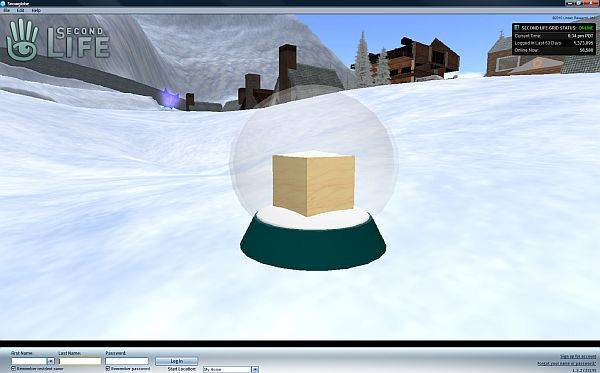
Snowglobe showing the silver skin (thanks to SamanthaS Nightfire)
From this month, however, even those using V1 TPVs are going to have to consider where they are going to move to next. As LL remind us (via retweets of this announcement, at least through @SecondLife), mesh commences its roll-out this month, starting with, I understand, the Blue Steel Release Channel prior to the remaining Release Channels & the rest of the main grid being mesh-enabled by the end of August.
Ergo, if people want to see mesh objects, they are going to have to move to a V2-based viewer. What’s more, unless the TPV developers have persuaded LL otherwise, it is possible those wanting to upload mesh imports will be forced to use Viewer 2 for this purpose, given LL were looking to ring-fence this capability (whether this is still the case is unclear – like much else around mesh).
Mesh: heralding the end of the road for Viewer 1 TPVs (model by Timmi Allen)
Nor does the bad news for Viewer 1 end there; Oz Linden is on record as saying that developers of such Viewers are facing an uphill battle: “[A]ny Viewer that isn’t being actively maintained is going to start having fairly serious problems over the next months. We’re making a lot of changes… if viewers don’t keep up, things will break.”
The fact is, it will become harder and harder for TPV devs to try and maintain Viewer 1 code. Kirstenlee Cinquetti saw the writing on the wall over a year ago, and has moved over entirely to the development of the outstanding S21 Viewer. Announcements made at the end of last year concerning the future of the Viewer 1 Search prompted Phoenix and Imprudence to start down the road to developing a V2-based Viewer each. While Imprudence are still putting effort into their V1-based 1.4 Viewer, it is evident that their longer-term aim is not merge this work into their V2 Kokua Viewer, while Phoenix already have the outstanding Firestorm available. Individual TPV developers are also transitioning: Lance Corrimal hasn’t done anything significant with his V1-based Viewer since the end of April, while his V2-based Viewer comes on in leaps and bounds.
It is going to take a while for mesh to really make its presence felt – assuming, again, that the roll-out goes smoothly and without any major updates; it’s also possible that some TPV developers will look to try and backport the Search 2 functionality into their offerings in the hope of keeping things alive. So it’s possible that some may try to cling to Viewer 1 for a little longer; but while it may be seen as an unpopular statement in some quarters, the era of Viewer 1 really is now drawing to a close.
I don’t say that with any sense of superiority (I am an unabashed V2-based Viewer convert – Firestorm and Kirstenlee’s S21); I started out with Viewer 1 (version 1.14 or 1.15), and personally have no problems with it. But, sad to say, we all come to a time where, for better or worse (depending on one’s own feelings), we must move with the tide.
And the tide is now assuredly flowing to Viewer 2’s shore.
There has been much to-do on the matter of Search. It’s perhaps the most consistently controversial element in Second Life in terms of ongoing debate, with many complaining that it has been “broken” since the birth of Viewer 2, and that Linden Lab have been slow in responding to issues and problems.
At the same time we have LL working to try to improve things, tweaking this, changing that, taking on feedback somewhere else – all of which has culminated in the arrival of the Search Viewer project and the “new” Viewer 2 Search – which people are saying actually isn’t half-bad.
I’ve been playing with the “new” Search since it was made available through the Firestorm Public Beta, and I have to say that in many respects, I like it: the opening screen is clean and clearly laid out, it recaptures some of what Search 1 had and earlier versions of Search 2 lacked, etc. In other respects I still find it a bloody annoyance.
So if I were asked, what would I like to see in Search, what would my answer be?
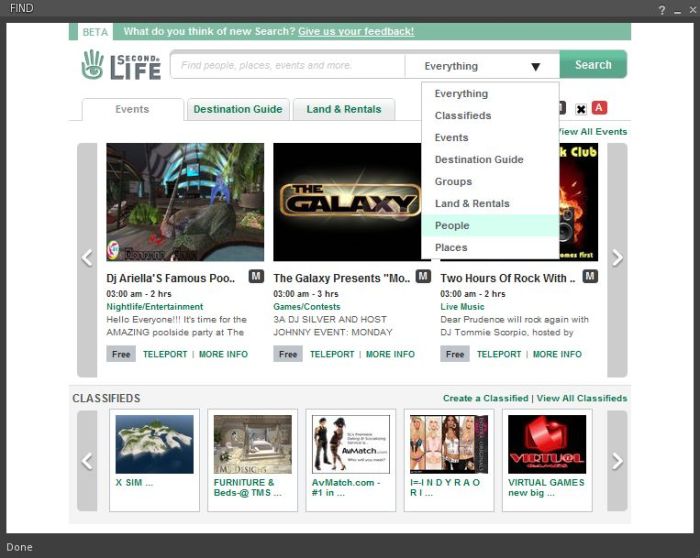
Home Page
Well, first the good – and I’m deliberately focused on the look and feel and use of the search window as it is presented to us, rather than digging into the intricacies of word lists, gaming and everything else that goes into making the wider subject for Search and Second Life such a hotbed of debate.
I’d certainly keep the new front page layout. It’s clean, it’s easy to follow, and it has all the core items required to facilitate a search. At the top of the page is the main search bar, withthe ability to define searches by category via a drop-down list.
The rest of the page layout is pretty much self-explanatory and easy to follow (although I am curious as to how ads for the “highlights” in Events, etc., tabs & in Classified are selected, and how frequently they are rotated for ads from other creators).
Wasted
After this, however, I’m less enthusiastic about how information is presented. The fact is, whatever the “under-the-hood” improvements that have been made, Search still wastes space and takes up more screen real estate than I personally feel is necessary.
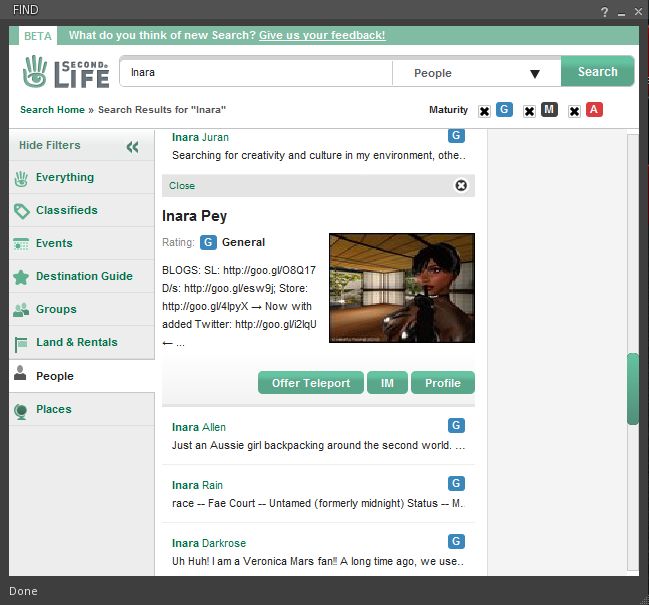
“New” Search – still wastes space
Look at the example above. There is much that is useful in it – the Filters on the left, the main results area, etc. – but the fact is it is poorly presented and wasteful. Why aren’t the filter options tabbed across the top, in keeping with the Events, Destinations and Land tabs on the home page? This is not only more logical, it frees-up the main section of the window to allow more information to potentially be displayed. Similarly, why the vertical column to the right for Classifieds? Why not use the bottom part of the window, again in keeping with the home page?
Then there is the fact that if you want to drill down to detailed information on anything, you get chucked out of the Search window and into the Sidebar. Sometimes (as with profiles) this might be useful, but given the dearth of information the Sidebar now tends to offer for things like Places, this is frequently a wasted exercise and so doubly annoying. Things are equally irritating when you’re searching through a set of results for something specific and wind up having to shuffle back and forth between Search and Sidebar, impersonating a tennis ball in the middle of a Nadal / Djonkovic rally.
Which is a shame, as it really needn’t be like this.
All it takes is a little forethought
The “powerful” aspect of the Viewer 1 Search has always been the convenience with which results are displayed. For the majority of searches, everything is focused on a single window split into two panes: on the left is a list of initial results, on the right space to display focused results.
Search 1: convenient
This is not 100% ideal, but it does tend to give maximum bang to the buck on any given search. When running a search on people, land, places and the like, this is massively convenient, allowing you to quickly flick back and forth between a list of results and the details on each one without taking up masses of screen space (so you can even keep an eye on what is happening around you in-world).
My ideal Search
My ideal search would therefore take the strengths of Viewer 1 and the “new” Search (tabs, filters, home page, etc.) and (where appropriate) the two-pane design of Viewer 1 Search and bring them together in a Search window that avoids the Sidebar and presents information in a manner that is fast and convenient to use – as in the example I’ve cobbled together rather roughly below.
All-in-one: so much more convenient (Firestorm used for Profile image, due to lack of available images for the “new” web profiles look)
Of course, some of the tabs would need to be tweaked somewhat. Events, for example, would require an ability to search by event type, data, times, etc. – but this capability is already supplied in the left-side filters on the “new” search, and should be relatively easy to incorporate them in my revised layout as a drop-down series of options.
The image above isn’t perfect – I’m not terrifically clever with graphics, but I think it gives a reasonable idea of what could have been done, and even provides room here and there for things to be tweaked.
Can it be done? Well, why not? Will it be done? Probably not. But I can dream, can’t I?
The theme for July’s Month of Machinima is “Games in SL”.
Or at least, that’s the theory; and tbh I’d been looking forward to seeing a set of films showcasing the magic of games and role play in Second Life, and perhaps even learning about elements of rp or other games in SL I’ve not previously encountered. As the very least, I was anticipating seeing glimpses of stories involving fantasy, science-fiction and the rest. Sadly, this was not to be.
Don’t get me wrong, the entries on show this month at the LEA Theatre are visually impressive, and demonstrate skill and artistry I probably couldn’t hope to master; it just that – well, almost none of the have anything to do with Games in SL.
In The Red Shoes we have a superb demonstration of Second Life as an outstanding medium for storytelling, as we do with Someone Called – but to my mind, storytelling isn’t really related to games in SL. Similarly, Travelling presents an excellent travelogue to Second Life – but travelling through SL, seeing the sights and the means of transport isn’t directly related to games in SL. I’m honestly not at all sure what to make of bRaiNwasHer, but it’s hard to frame it in the conext of games. The Wavey Sea is a great music video, but – well, you can guess where I’m going.
Dedication gets somewhat nearer the mark, insamuch as it tells a story that might be said to be framed in a role-play environment, and again, it is a fabulous piece of work in itself, but I still cannot help but feel something is missing…
To me, games in SL offers up an opportunity to highlight the deep, immersive richness of game playing within SL: role-play, steampunk, combat – dare I say, even Gorean. There are many other forms of games in SL – Tiny Empires and the like – which could, with a little imagination, form the foundations for revealing and entertaining films. Arcade Boy and When Warriors Gather go some way towards this, but there still seems to be something missing.
Again, I’m not blaming the film-makers for this lack of game-related depth: as I’ve stated, every film in this month’s entrants is skillfully executed and worth watching. I’m also not necessarily pointing the finger at the LEA judges; MoM is an excellent idea and worth pursuing; and truth be told, it’s hard to guarantee that what will work theme-wise. Even so, it’s a little disappointing that more did not rise to the challenge and present films more directly related to this month’s theme – I’ve certainly seen a fair few films on subjects such as combat games and RP in SL elsewhere, so it’s not for lack of potential content.
In the meantime, here’s Dedication, by CadenceDVE, which I really like as a story and which comes close to the ideal of the theme in a visually impressive manner. You can see all the entries above on the MOM YouTube channel.




 Inara Pey: Living in a Modemworld