What’s so bad about living on the web, eh?

I thought the idea behind the creation of time was to stop everything happening at once? If so, it’s not working for me!

This is probably old news to most of you, as Hamlet has had it over at NWN for a couple of days, but for once I failed to take a peek over there when the restructuring announcement hit the headlines. My thanks to the ever-hunky Ciaran Laval for turning my nose in the right direction…

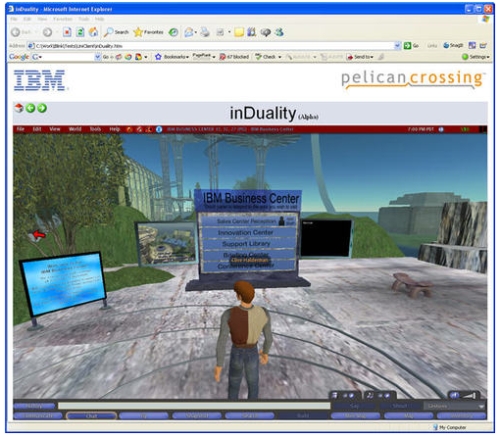
In his piece, Hamlet not only agrees with the view that LL, in their announcement, in fact mean having a web-based means of accessing SL in addition to the current browser, rather than replacing it; he also cites an example of the same – put together in 2007 by a now-definct (it would seem) UK company called Pelican Crossing.

The browser tool, initially backed by IBM, apparently offered “most of” the functionality found within the Viewer (what was missing is unclear), and therefore would suggest that browser-based access to SL could be both lightweight and workable. Which as has been previously said, shouldn’t be sneezed at.

Pelican Crossing c. 2007 (with thanks to Hamlet Au and New World Notes)

Again, other that having the world-view somewhat reduced, and facing the browser tool and navigation bars, I’m not entirely seeing why people are hating the concept of browser-based access, if it is presented like this: with the necessary functionality to do things.  To me, accessing through a browser (especially if you’ve never downloaded a Viewer) wouldn’t be an issue. And if the “viewer” element could be “popped out” of the browser, even better.

Certainly, there is mileage in offering such an access option, as I’ve already mentioned.

Pelican Crossing may well have gone (or have been sucked into the Big Blue), but if they could do it in 2007….

Restructures, ToS and licences

Gwyn Llewelyn replied to my post on the restructuring at LL, and while we differed in some views, she nevertheless raised a point that has taken a while to percolate through the grey fluff between my ears and mingle with something I posted regarding the sudden launch of the heavily revised ToS.

At the time the new Terms of Service came out, I asked if LL might not be putting the paperwork in order, suggesting that they might be moving towards a hiving-off and licencing of the server-side software.

Despite all the soft assurances from Mark Kingdon about the health and vitality of Linden Lab, as circulated in his recent e-mail, could it be that the announcement of the restructuring be a further step in that direction?

If I’m honest, Prokofy Neva spotted the parallel before me; although she takes a slightly different angle.

In the ToS, LL have pretty much redefined SL as software as a service (SAAS). This helps make the platform itself suitable for licencing – letting other companies come in a take on the task of hosting the platform, as I’ve previously mentioned. This benefits LL from the need to invest massively in additional hosting efforts elsewhere (such as in Europe) with the aim of reducing latency. It also relieves them of the burden of supplying customer support services, since this would fall under the remit of the licensees. At the ame time, LL generate income through a licence structure (based on the server count? the number of actual sims?) that also enables them to retain the IP on the software and thus control its development.

Certainly it is doubtful a purely “land sales” model is sufficient to keep LL afloat, and licensing deals have traditionally been far more lucrative to software companies, so I’d be very surprised if a shift towards such a model hasn’t been considered by some at the top of the LL tree.

They could even hive-off the operations they currently have into a holding company, as Prok suggests, which in turn could operate a number of sub-leasing deals.

Again, moving towards browser-based accessibility for the platform (or possibly offering as an option alongside the Viewer) fits this scenario, again for reasons I’ve stated: it encourages those who would otherwise fight shy of “trying” SL to do so, simply because it no longer necessarily requires them to download and maintain software.

The browser approach also increases the potential attraction business and education may have towards SL as a platform. A shiny new toy delivered direct to the desktop within an browser’s existing functionality is far more attractive than buying a “virtual world modelling tool” which requires you to install and maintain a clunky client front-end on every single desktop PC in your office / classroom environment.

Licencing the platform also offers potential benefits for LL’s business hopes: a couple of strategic “partnerships” with suitably focused hosting services could see the development of Justin Bovington’s longed-for “business oriented Mainland”: a secure environment to which companies using Second Life on the business front can meet and intermingle via “shop fronts”, as an example. Again, LL win in that they lose the overhead of running the service, but gain on the licensing of the platform and in the potential consultancy spin-offs.

Turning as well, for a moment, to Mark Kingdon’s e-mail to residents on the structuring, and risking going off-topic from the above speculation.

I’ve previously-suggested that the structuring PR may have been poorly-worded, giving people the impression that LL were going to overthrow the Viewer in favour of a purely browser-based method of access SL when in fact they may have meant the browser option might be in addition to the Viewer.

Mark Kingdon’s letter to users suggests this may well be the case, as he states: By bringing new people to Second Life, and by increasing the ways in which people can interact with the world and with the people, places, and things within it. Note the emphasis. Not “changing the way in which people can interact”, but “increasing the ways” – this really does suggest to me that the browser approach is intended to be in addition to the Viewer.

Viewer 2 – getting there?

Linden Lab have released an “Alpha” of Viewer 2.1.

They’re making progress it seems – calling the release “Alpha” rather than trumpeting it as an “almost ready Beta”. Who sez they don’t listen?!

On a serious note, the new release (which admittedly, I have yet to download and try) brings with it several much-needed improvements – such as the bane of my life, the Sidebar, now “overlaying” the world-view as an option, rather than shunting it rudely off to the left. Why anyone would want the latter option constantly shattering their experience, I’ll never understand; but at least we now have the long-overdue option to get rid of it for something altogether smoother.

They’ve also finally got the message about camera controls – recombining things into a single pane (why, oh why were they ever split-off in the first place?), and they’ve made the bottom button bar somewhat more customisable to meet the needs of experienced users.

All this is very much to the good – although again points to a broken train of thought somewhere along the development trail, as all of these features should have been there from the get-go, and thank heavens for Kirstenlee Cinquetti for demonstrating to LL that all this and more could have been done from the get-go via her (still) infinitely superior S20 viewer.

Viewer 2.1 brings us a step closer to OpenID authentication for SL-related services. About time to.

A novel feature being introduced to Viewer 2.1 is Voice Morphing. Clearly, despite claims that we’ve already clocked up 28+ billion years of chat on Voice, not enough of us are using it. There are many reasons for this – some of which I’ve pointed to in that post.

Voice Morphing is an attempt to resolve some of these issues by providing the means for people to “sound like their avatar should sound” – with a range of robotic, furry and other voices – including the option to sound like a member of the opposite sex.

I have to admit that I’ve avoided Voice in the past in part because I simply don’t want my mental image of the people / creatures I’m interacting with shattered by hearing the real voice behind the avatar. It’s not the only reason I’ve largely steered clear of Voice after some early playing (and using it at a couple of OH meetings in-world), but it is one. As such, I’m going to be curious as to how the morphing tool is viewed / taken up.

On the one hand, I can see it being a lot of fun; on the other, I can seen some trying to use it for drama purposes (anyone using a female avatar and one of the female voices in place of their own must be a guy, for example). On the third hand (yes, I occasionally have Beeblebrox moments) I can see it not making an iota of difference all ways around.

The main reason for presenting the third hand is simply because a) people are slow to change their ways, and in terms of rp, where this has the biggest potential use, if it is not adopted by the many within a particular rp environment, the few won’t bother either; and b) it is, at the end of the day, a subscription service; and while “only” about $3 a month (L$750), given LL’s recent track record, doubtless many will avoid it simply because of the pleasure they’ll have in not giving LL more of their hard-earned  pennies. Especially when the voices are pre-packaged. If you only want a female voice – then it is “only” $3 a month. But if you vary from, say a male gladiator to a sci-fi robot to a furry according to your mood, then you’re looking at $9 a month to give all your forms a voice.

Mind you…I can see the MOTD promotion for Premium Accounts now: “Upgrade and (homes, support, blah, blah)…offset the cost of your in-world Voices with weekly stipends!”

All-in-all, however, the moves being made with Viewer 2.1 are welcome.

The very short “goodbyes” as the rumour-mills churn

The names of those “let go” following yesterday’s restructuring announcement are beginning to appear. Pastebin has one of the most comprehensive lists. Whether it in complete or not is another matter. Elsewhere there is much speculation that Cyn Linden and Babbage Linden have both gone – but this remains unconfirmed, while Prok Neva points to Blue Linden is among the casualties and also mentions Cyn.

Running an in-world search, it appears that the speculation surrounding Babbage and Cyn is misplaced. I’d actually have been very surprised if Cyn was on the list of the departed, given her very recent promotion. Similarly, given the mighty work that has been done around LSL and Mono, I would also have been surprised had Babbage gone – and would certainly looked at his departure as a negative portent.

Blue, sadly, has gone; and despite what some may say about him, I personally shall miss him. Despite a rocky start to our relationship, he and I went on to have many private conversations on a range of subjects that convinced me that, while the corporate need may have forced his hand at times (and indeed stifled a desire to provide greater support to users), he had a very genuine love for the platform and the people with whom he interacted.

I have to say that, while I wouldn’t wish redundancy on anyone (I’ve been through it twice myself and I know how devastating it can be), I find myself unable to feel much in the way of remorse at the loss of Pink Linden. Her attitude from day one was autocratic, and despite knowing little about SL or the SLX/XStreet SL environment, she was very quick to unbendingly follow the corporate line where a modicum of understanding might have been more welcome – and more appropriate.

If I’m honest, part of my opinion of her was shaped by the whole XSL Content Roadmap situation – particularly her determination to stifle any and all discussion on the subject at her Office Hours meetings, while at the same time using her real life blog to decry the fact that the owners of her apartment block had opted to cut down some fourteen trees around it without consulting the residents. Pot, meet kettle and please note its colour.

I also did wonder at her potential longevity at LL after a) Jack effectively took over matters of commerce; b) the Content Roadmap was shelved.

Beyond the names, the speculation and rumour mill continues apace with tidings of woe and doom for SL, and a general consensus that the platform is heading for a Farmville type future, or that it is about to become Flash-driven. Many are claiming that Viewer 2.0 and the new user experience have been complete failures and have thus precipitated the situation.

Me? I think it is still too early to judge. Let’s face it, the New User Experience hasn’t been around that long, and there are more than enough issues with Viewer 2 to possibly prevent LL pushing it into the spotlight in terms of widespread external advertising. Indeed, it is hard to see any signs of a concerted advertising campaign across the full breadth of the media that one would assume would be needed to raise SL’s real world profile.

As I’ve previously posted, Mark Kingdon and his colleagues are not stupid.  They may not get Second Life, but that doesn’t make them stupid. They are marketers, and they know the value of advertising. At the moment, Viewer 2 and the New Viewer Experience stand in a vacuum  – few, if any, outside of Second Life have ever heard of them. So is it really any wonder than since their “launch” new numbers haven’t dramatically increased?

Unless, of course, Viewer 2 has been put together in a Costneresque view of the world wherein if you build it, they will come. If this is the case, then I’ll gladly revise my view on the levels of stupidity potentially prevalent in a certain boardroom.

No, current figures on user throughput are simply too fresh to squarely point the finger at Viewer 2, etc., and lay blame. Q2 figures might start to revise this, but even then it might be a tad premature.

So… what has happened? As I said in yesterday’s post, leaving aside the hysteria around the “Web-ising” (or possibly not) of SL and the “Facebook joining”, layoffs and retrenchment of this scale (Singapore shut, Withdrawal from Germany (SL’s 2nd largest national market), closing down the Brighton, UK office) do all tend to point to a company scrambling to save money. And I think that Gwyn Llewelyn may have hit the nail on the head a little more squarely then the theories of Viewer 2 failures, identifying one factor of the equation everyone has been overlooking:

The SL Business Enterprise “solution” isn’t working.

SL Enterprise, and what is now SL Workspaces were launched a long time ahead of either Viewer 2 or the New User Experience (last October / November). Their roots go back a lot further than that, however, and have been the cause of much angst for many of us. Throughout 2009, Linden Lab was constantly being badgered by the likes of Justin Bovington of LL’s (former?) business partner Rivers Run Red to develop huge swathes of “business only” Mainland. For a time, even the likes of Amanda Linden displayed what amounted to a hostile attitude towards residents.

Everyone seemed to be far too enamoured with the 2006/2007 situation where big business suddenly “discovered” Second Life, with the likes of Nike, IBM, Toyota, NBC, etc., all rushing in to set-up shop here…before just as quickly vanishing again.

Many theories have been cooked up to explain “what went wrong” – both within and outside of LL – with many within LL thinking they’d potentially missed a golden opportunity, albeit one hovering just outside their reach that could be recaptured if they only get things right.

Among all the theories for the 06/07 “boom/bust” business cycle, I don’t think anyone considered the most basic and simple explanation: Second Life just isn’t really very good for real world businesses.

I’ve long been a critic of the “business is all” ethos that did pervade LL for a time. The idea that what amounts to a recreational pursuit could somehow become the nexus of corporate communications and technology development always struck me as simply ludicrous.

Yet it became a major mainstay of LL’s strategic development. But beyond a few “case studies” and the dozen-or-so companies using SLW just what – as Gwyn asks – has it actually achieved?

SLE remains in beta. While there has been some take-up of it (the US Navy, for example, appears to have pulled most of it in-world studies back behind their own firewalls where they use SLE), all news relating to it has dried up. There has been no move to move it out of beta; there have been no really big corporate fish hooked by the “promise” of SLE.

Even Justin Bovington has gone quiet.

So one cannot help but wonder if this might not be the reason behind the current situation. Was someone rash enough to pin LL’s future cashflow and turnover largely on the SLE / SLW tool and environment? Where the rose-tinted business glasses worn to the degree that projections were based around the $55K-a-pop sales of SLE and the ability for LL to pull in even more revenue via business “consulting”, rather than through resident tiers, and the chicken is now home to roost?

So what of the future? Does this all point towards LL going “solely” web?

It really is hard to judge – but I do remain of the opinion that those who are condemning SL’s future are speaking prematurely. While new user numbers have not skyrocketed – they haven’t actually fallen. As a recreational platform, SL remains viable and afloat. It is also going through a series of upgrades that point – if anything – not towards a flat browser experience, but rather towards a more immersive experience: we have Havoc 7 about to be finally rolled out; later in the year full mesh capabilities are arriving. While the latter brings with it a host of other issues, it bodes well overall for SL’s ability to remain competitive and engaging.
The virtual web?

This popped its head up today – and is now being reported on in the blogrum. And it sent some familiar alarm bells clanging.

The 30% staffing reductions aren’t surprising – worrying yes, but not surprising – given the recent high degree of staff “bleed” right across all levels of the organisation, as anyone who track these things will be only too aware.

The two core elements of the announcement that have everyone a-lather are cited together: First, the company aims to create a browser-based virtual world experience, eliminating the need to download software. Secondly, Linden Lab will look to extend the Second Life experience into popular social networks.

Both statements are indeed worrying on a first read. But are they indicative of anything that traumatic? I’m actually going to remain somewhat positive on both at this point – although with the caveat that this just could finally be the tip of the iceberg breaking the surface.

First off, the company aims to create a browser-based virtual word experience, eliminating the need to download software. Note the emphasis. This is not saying that Linden Lab are eliminating downloadable viewers (such as TPVs or the new Viewer 2). Rather, it is stating they are looking to develop the means to access Second Life through means that do not require people to download dedicated software in order to access the world if they themselves do not wish to.

This is  an important distinction; one I would respectfully suggest those already rending their garments would well to consider. Far from forcing everyone to move to some kind of browser-based means of accessing Second Life, this statement suggests that LL will be developing such a mode of access to work alongside the existing Viewer iterations.

Why do this? Simply because there are doubtless many people who are put off from using Second Life simply because it does require them to download, install and maintain a local client – and like it or not, there is a huge potential audience for Second Life out there who a) are not games players; and / or b) are dubious about downloading software who might very well leap at the opportunity to at least try this wonderful “new” medium if it can be accessed directly from their favourite web browser.

Of course, this does open the debate as to exactly what their in-world experience would be, whether they’d be able to create rich content through the browser (or browser applet?), etc., – but if it can be done, and achieve a further influx of users who can at least explore and potential invest in SL monetarily – that could be a very good thing.

And if the world can be made to function as it does now, but through a browser interface, is that such a bad thing? As long as we can readily access the tools we need to interact, to build, to play, to do business, etc., without having to mentally pretzel our thinking processes or risk carpel tunnel syndrome attempting to defeat an interface better suited to someone with four tentacles and three eyes – then surely moving the interface to the web might at some point benefit us all. (I readily and freely admit that this particular *if* is a whopper, so don’t beat me up about it, as I for one am actually not holding my breath on it.)

Further, browser-based access likely equally applies to mobile devices. Again, LL haven’t exactly hidden the desire to make SL accessible from such devices in some dank cupboard under the proverbial staircase to the basement. While SLIM may have gone (and the dressing-up of its departure the butt of deserved jokes) – the fact is there were and are better tools available from TPVs to access SL via mobile devices and indeed, there is something of a demand for such tools. Ergo, it makes perfect sense for LL to start looking to develop tools for themselves – or at least in cooperation with others (Judy Wade’s Hands-On, anyone?).

Of course, there could be some madcap desire to simply do away with the Viewer completely; but when one steps back an looks at things objectively, such a move wouldn’t make sense. Not yet. LL have made a massive investment in Viewer 2. I’m not saying they got it right – but it is an investment, and I cannot see them simply throwing it over the parapet. And if rich content is not on the cards (as in all the speculation that they wish to reduce SL to a simplistic web-based “world”) – why all the effort to finally get full mesh support up and running, etc?

So, while it is true this goal needs to be looked at cautiously, I really don’t think it is indicative that LL are planning something overly “nasty”.

Which brings me to Linden Lab will look to extend the Second Life experience into popular social networks. Again, why all the wailing? This is hardly new. Linking SL to social network environments has been on the card since last year. Am I in favour? No, not entirely; not at all if it means that SL is going to be steadily sanitised and watered down to the point where it is a pale. bland shadow of its former self.

But again, I don’t think that is what is meant here. Mark Kingdon is already on record as stating (several times each) that a) social network environments again offer a potentially massive audience for SL and the means to both increase user levels and user involvement in SL. He’s also made it clear that links with social networking sites will not automatically lead to the “outing” of human identities behind avatars; nor will it require the loss of anonymity for those who do not wish it. So again, while I may not like it, so long as it doesn’t infringe on the freedoms we all take for granted within SL – I really don’t see the point of getting worked up about it. And I’ve yet to see anything from the likes of Kingdon himself that suggests any of the nightmare scenarios of avatar outing, etc., are anything more than speculation.

This move will continue to be the subject of much debate for a while to come. And while I may well be proven wrong down the road, right now I don’t feel it is the Portent of Doom some are claiming. What, to me at least, is of greater interest is whether the two stated goals of the release (browser-based option for accessing SL and links with social networks) justify the degree of change  / cutbacks that are being implied within the announcement.

As I said earlier, staff cutbacks have been going on for the last two or three months with both notables and not-so-notables vanishing, seemingly without replacement. Whether the mentioned figure of 30% includes those already gone or not is unclear (and this announcement was coupled with the departure of several more “leading Lindens” – including none other than the former head of commerce, Pink Linden). BUT…”strategic restructures” and “staffing cutbacks”, however they are dressed up, tend to be indicative of one things no matter what business one is in: the need to save money. Fast.

If fiscal issues should lie (in part) behind staff cutbacks, the closure of the Singapore office, the apparent re-trenchment away from Europe at the moment; then one has to ask is it because LL are, like everyone else, feeling the economic pinch. Or is it because of something possibly deeper within the organisation that may be in part connected to why the senior management don’t always appear to understand their own customers.

So I do indeed wonder if there is more going on here than meets the eye – although not in the way others might be questioning things.

ADDNDUM

After writing this, the official word finally popped up in the LL blog for me….

Listen to the lyrics…

Foolish Frost is well-known for his SL-related music parodies (his “Avatar: A Rockstar Parody” being perhaps the best known). His lyrics are clear, giggle-inducing and clever enough to occasionally prick us with embarrassment as we recognise ourselves in the words.

“Lindens Lament” is perhaps one of his cleverest parodies to date (and I’m no Bob Dylan fan!). Just ignore the intrusive adverts, and listen / read the lyrics!