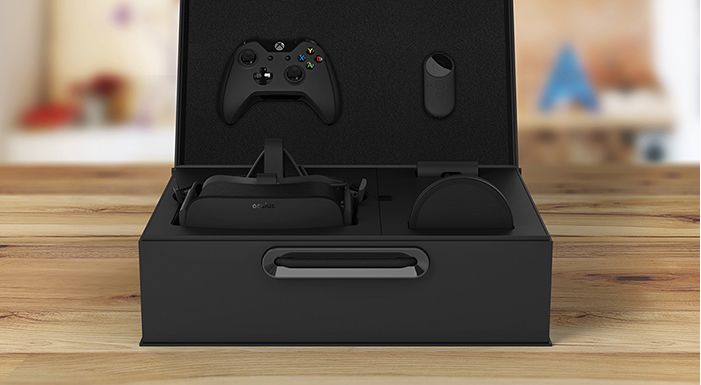
Following a pre-announcement on Tuesday, January 5th, Oculus VR have confirmed that the Oculus Rift headset is now available for pre-order (for Windows users) for shipment to the following countries: Australia, Belgium, Canada, Denmark, Finland, France, Germany, Japan, Iceland, Ireland, Italy, Netherlands, New Zealand, Norway, Poland, Spain, Sweden, Taiwan, United Kingdom, United States.
The price for the headset and accessories is a nominal US $599 (€699 in Europe and £499 in the UK), although as the announcement notes, this is exclusive of tax and shipping costs, and the price may vary for non-USD purchases.
Oculus VR indicate that pre-ordered set will start shipping on March 28th, 2016, and limited stocks will be available to retailers later in April 2016. However, Engadget report even the March 28th ship date may have slipped due to the initial volume of orders already received by Oculus VR, and that some outside of the US may have had problems in placing orders.
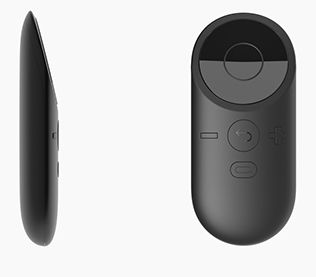
The complete package comprises the Rift headset with built-in headphones and microphone, sensor, and an Xbox One controller and the Oculus Remote.
Those pre-ordering also secure the opportunity to pre-order the Oculus Touch hand controllers when they become available later in 2016 (the release of the latter was pushed back to the second half of 2016 to allow further time for development / testing).
Also included in the package is a copy of Playful’s Lucky’s Tale, a platform game which has enjoyed much exposure and positive response as a part of Oculus Rift demonstrations, and also EVE: Valkyrie.
Those pre-ordering are reminded that a fairly hefty PC is required to obtain a suitable Rift experience, with the specifications listed as : NVIDIA GTX 970 / AMD R9 290 equivalent or greater GPU;, an Intel i5-4590 equivalent CPU or greater; at least 8Gb of RAM; compatible HDMI 1.3 video output; 3 free USB 3 ports (and 1 USB 2 port) and Windows 7 + SP1 or greater. Oculus also report that PCs supplied by manufacturers meeting this specification will start to ship with an “Oculus Ready” logo, and the company will be making suitable PCs with headset available for pre-order in February (presumably in the US only) at a starting price of US $1499.
A compatibility tool is available for download to help determine if your PC is “Oculus ready” and those wishing to pre-order can do so through the Oculus Shop.

There has already been some excitement following the announcement by those SL users who are interested in the Lab’s upcoming virtual worlds platform, “Project Sansar”, as this is being built very much with the Rift in mind (although use of a Rift headset with “Sansar” is not a requirement).
While the experience is acknowledged to be somewhat less-than-optimal, it’ll be interesting to see of the Oculus VR announcement spurs the Lab on update the Second Life Oculus Rift project viewer for those wishing to try the headset in Second Life. There have been promises that such an update is coming down the pipe, but until now it has likely been sitting at the back of the queue while the Lab pushes out updates and capabilities liable to be more widely appreciated by SL users.

As noted above, Engadget report that the initial response to the pre-order announcement has been positive. There is undoubtedly a lot of interest in HMDs from gamers around the world, and most likely from the curious and those with specific uses for the headset. However, it’ll be interesting to see how things go over the coming year. Whichever way you look at it, the Oculus Rift CR-1 and its nearest rival, the HTC / Valve Vive represent fairly hefty investments, and many might prefer to wait and see how the market develops in terms of newer, more compact headsets, lower prices, etc., before committing.
I confess to being in the latter category. To me, the potential of VR still lies down the road, and I’m more than happy to see how the hardware side of things shapes up, and what really develops in support of it in terms of practical applications which might appeal to me (games most certainly ain’t it). I also have to admit augmented reality holds far more fascination for me in terms of it potential for “every day” use than do most things so far imagined with VR.






 Inara Pey: Living in a Modemworld