Second Life machinima used in postgraduate law degree course

The University of Western Australia (UWA) in Second Life blog of how a Second Life machinima has, for the first time, been used in one of the major units for a degree programme at the university.

The film, Equity & Trusts: Estoppel Tutorial has been used within the LAWS5103 unit, Equity & Trusts, a 2nd Year compulsory postgraduate unit for the Juris Doctor (law degree), taught at the University of Western Australia. It is a collaborative effort between Metaworlds, based in Ulm, Germany, and the UWA, directed and edited by Laurina Hawks of Metaworlds and featuring a script by Professor Natalie Skead, Associate Professor – Faculty of Law at UWA.

Estoppel is a series of legal doctrines which preclude a person asserting something contrary to what has been expressed or implied by a previous statement or action by that person, or by a previous relevant judicial determination.

legal-movie
Professor Skead and students discuss the unfolding situation in the Equity & Trusts: Estoppel Tutorial movie (image courtesy of the UWA in SL blog

The film charts a situation which develops between a young student and her uncle, who initially offers to finance her tuition fees as she goes to university to study law – at his suggestion – before later withdrawing the offer.

At just under 8 minutes in length, the movie has been shown to students during tutorials designed to trigger  discussions on the Estoppel principle of law. Following the discussions, students were asked to evaluate the effectiveness of the film, and the overwhelming response was positive.

Commenting on the outcome of the presentations, Professor Skead indicated the use of the video resulted in far more rigorous and detailed assessment of the facts as presented in the movie. She added that she felt the discussion on the topic which followed the film was far more sophisticated and detailed when compared to previous exercises conducted using more conventional methods, thus marking Second Life as a valuable tool for connecting students to real life experiences.

Commenting on the approach, / said, “We are absolutely thrilled at how successful this has been, and hope to continue supporting more and more areas in the targeted use of Second Life where it adds value. We have the far have had various activities and outcomes across the School of Business, School of Education, School of Physiology, Anatomy and Human Biology aside from this newest venture with the School of Law.”

As well as this work, the UWA has also recently made a series of presentations on how they use  Virtual worlds to support teaching, research, architecture, international community development, art & film at the Digital Education Show Asia, which took place in May 2014 in Kuala Lumpur.


The Freedom Project: Thank you ceremony and exhibition

The Freedom Project FINAL 26 Aug, 2013

Launched on Sunday September 1st, 2013, the Freedom Project is a joint undertaking by the University of Western Australia,  Virtual Ability Inc., and the Centre for ME/CFS and Other Invisible Illnesses.

A 2D and 3D art and film event, the project extended an open invitation to artists suffering from a disability or chronic illness, or associated with those suffering from either, to demonstrate how virtual life has enabled them to engage in activities and interact with others in ways which may not be possible in the real world.

iSkye Speechless Freedom
The Freedom Project: iSkye Silverweb – Speechless Freedom

I reported on the project at its launch, and again as submissions came in, and the organisers have now announced the formal opening of the public exhibition part of the project. This will  commence with a special Thank You Ceremony, to be held on Sunday March 23rd, at 17:00 SLT.

The ceremony is to thank all the artists, filmmakers, and writers for contributing their works and of themselves, as well as to thank the many individuals, groups and organisations who made the project possible. An open invitation is extended to anyone wishing to attend the ceremony, and for them to visit and experience all of the submissions to the project.

Roiben Sweetwater: Alice and The Many Sodes
The Freedom Project: Roiben Sweetwater – Alice (l) and The Many Sodes

Entries to the project comprise 2D and 3D art, text, and machinima, featuring individual and collaborative pieces, all with their own stories to tell. The pieces on display provide some very powerful statements, and viewing of the complete exhibition is highly recommended.

About Virtual Ability

Many disabilities in the real world can be a barrier to entry into the digital as well. People may have difficulties in dealing with the keyboard due to illness or disability; others many be reliant upon voice recognition software, and so on. Virtual Ability, Inc. helps people with these kind of challenges get into and become successful in virtual worlds like Second Life.

From an individual skills assessment undertaken during a unique intake process, Virtual Ability inc., are able to refer clients for help with assistive hardware and software as appropriate, and provide customised training and orientation. Once clients are in-world, Virtual Ability Inc., helps them integrate into the virtual society, and provides an ongoing community of support.  The community offers members information, encouragement, training, companionship, referrals to other online resources and groups, ways to contribute back to the community, and ways to have fun.

The organisation runs a number of in-world centres, which can be read about on their website.

The Freedom Project: Xia Firethorn - My Body is a Cage
The Freedom Project: Xia Firethorn – My Body is a Cage

About the Centre for ME/CFS and Other Invisible Illnesses

The Centre for ME/CFS and Other Invisible Illnesses provides resources, support and guided relaxation sessions, for people with Myalgic Encephalomyelitis, Chronic Fatigue Syndrome, Fibromyalgia, Post Traumatic Stress Disorder, Irritable Bowel Syndrome, Gulf War Syndrome, and other invisible illnesses.  They host general and research discussions once a week on Mondays at 18:00 SLT, and guided relaxation sessions every day, twice a day, at 08:00 and 20:00 SLT, in the Centre to help people manage their illness.  This Centre is open to all, and all are welcome, including anyone with an illness, their families and carers to meet here and help each other. The Centre is located in Curtin University in Second Life.

Related Links

With thanks to Gentle Heron for the reminder, and Jayjay Zifanwe.

Project Homeless: short film challenge, L$2.28M in prizes

Jayjay Zifanwe of the University of Western Australia brings word of a new film and machinima challenge

Project Homeless 2014 is a Challenge run by Screen My Shorts Incorporated and the University of Western Australia in partnership with, and sponsored by the Parramatta City Council.

Film-makers of all ages cultures and ability are invited to submit original creative digital content (conventional film and / or machinima) and win a share of the $10,000 Aus (L$2.28 Million) cash and prizes (with at least $700 Aus  reserved for Machinima), and have their works exposed on the international stage. Films may be individual or team efforts.

HomelessEntrants are asked to indicate two themes from the 22 listed by the competition, on which they would like to base their film. The organisers will then allocate one the selected options. Entrants then have full freedom to explore and interpret the allocated theme and create a completed film within 30 days. All entrants are asked to  be as creative as possible in interpreting their nominated theme.

All registrations should be received no later than Friday April 11th, 2014, which is the date on which entrants will be informed of their allocated film theme.

Completed films must be submitted by Sunday May 11th, 2014.

How to Register

  1. The preferred method is to register via the competition website– note that entry fees for machinima style film are being sponsored by the University of Western Australia.
  2. Send an email (or a NC in-world) with the following details to jay.jay@uwa.edu.au:
        • Second Life name
        • Team name (if applicable)
        • Email address
        • City & country
        • 2 preferred themes as the subject of the entry, in order of preference.

Essential Rules

  1. Only G or PG rated films will be accepted.
  2. Entry length to be between 3 to 10 minutes.
  3. Registration is essential.
  4. All entries are to be made specifically for the Project Homeless Competition.
  5. Register before the 11th of April & must nominate two of the listed themes.
  6. $10,000 Aus in prizes available with at least $700 Aus reserved for machinima.
  7. The full official rules should also be read, together with the 10 Step Guide.

Prizes

Please refer to the UWA website for a full list of prizes.

Related Links

Freedom Project: first video submission premiered, still time to enter

The Freedom Project FINAL 26 Aug, 2013At the start of September, 2013, I covered the launch of the Freedom Project, a 2D/3D Art and Film Event. co-organised by the University of Western Australia,  Virtual Ability Inc., and the Centre for ME/CFS and Other Invisible illnesses.

The project is an opportunity for artists suffering from a disability or chronic illness, or associated with those suffering from either, to demonstrate how virtual life has enabled them to engage in activities and interact with others in ways which may not be possible in the real world.

On Saturday January 11th, the UWA premiered the first Freedom Project Film Mandala Dance by Maia Kyi’Ra (Starheart Erdhein in SL), co-founder of the Spirit Dance Company and founder of the  Light Fantastic Dancers, who perform the Mandala Dance, choreographed by Maia, and which features Now We Are Free by Lisa Gerrard and Hans Zimmer, the title of which fits the theme of the project perfectly.

As well as showcasing the film the UWA blog entry for Mandala Dance includes some of Maia’s own story, and you can read more of it on her website, New Earthstar Merkabah.

Sculptures, models and 2D art for the Freedom Project can also be seen at the UWA Virtual Gallery, and as a reminder to artists and those wishing to participate, submissions remain open until February 28th, 2014. Please refer to my original report on the Project – and more particularly, the original UWA announcement of the Project – for notes on the theme, technical requirements, considerations, rules, etc., for submitting a piece to the exhibit.

In brief, submissions should be on the theme of “freedom” and represent how the virtual world has helped the artist or those around the artist. Artwork should be no more than 200 land impact and films should be around 3-5 minutes (although no hard limits on film length will be enforced). Collaborative works are welcome, so long as the submission guidelines are adhered to. Artwork will go on display immediately at the UWA Virtual Gallery, and films will be put on the UWA Second Life Blog.

While the Project is not a competition, ten pieces will be selected by a special panel to each receive a special L$10,000 award.

A part of Cyberwings by Willothewisp

About Virtual Ability

Many disabilities in the real world can be a barrier to entry into the digital as well. People may have difficulties in dealing with the keyboard due to illness or disability; others many be reliant upon voice recognition software, and so on. Virtual Ability, Inc. helps people with these kind of challenges get into and become successful in virtual worlds like Second Life.

From an individual skills assessment undertaken during a unique intake process, Virtual Ability inc., are able to refer clients for help with assistive hardware and software as appropriate, and provide customised training and orientation. Once clients are in-world, Virtual Ability Inc., helps them integrate into the virtual society, and provides an ongoing community of support.  The community offers members information, encouragement, training, companionship, referrals to other online resources and groups, ways to contribute back to the community, and ways to have fun.

The organisation runs a number of in-world centres, which can be read about on their website.

Beauty in Darkness and Silent Night by Roman Godde

About the Centre for ME/CFS and Other Invisible Illnesses

The Centre for ME/CFS and Other Invisible Illnesses provides resources, support and guided relaxation sessions, for people with Myalgic Encephalomyelitis, Chronic Fatigue Syndrome, Fibromyalgia, Post Traumatic Stress Disorder, Irritable Bowel Syndrome, Gulf War Syndrome, and other invisible illnesses.  They host general and research discussions once a week on Mondays at 18:00 SLT, and guided relaxation sessions every day, twice a day, at 08:00 and 20:00 SLT, in the Centre to help people manage their illness.  This Centre is open to all, and all are welcome, including anyone with an illness, their families and carers to meet here and help each other. The Centre is located in Curtin University in Second Life.

Related Links

Tutsy Navarathna tops machinima section of WD’s Sci-Fi Challenge

If you had the power to choose to make a film in any time or place in the Universe – when or where would you choose? Another planet or perhaps another time or reality on Earth? Filmmakers, Animators and Machinimographers’ will have 30 days in November, to write, shoot, edit, produce and upload their creative masterpieces.

So read the opening piece for the WD Project Sci-Fi challenge, which I reported upon back in October 2013. As noted, filmmakers, animators and machinima makers were invited to spend 30 days from the 1st November 2013 through until the end of the month writing, shooting, editing and producing a sci-fi short, with a total of $10,000 Aus. in prize money for the winners.

The machinima section of the challenge was held in association with the University of Western Australia, and has $1,500 Aus. (L$230,000) on offer specifically for machinima films, with $750 Aus going to the 1st prize winner, and all machinima entrants additionally in with a chance to win any of the main prizes.

The results of the challenge were announced on December 22nd, and once again, Tutsy Navarathna tops-out the machinima winners with his piece, The Residents, a remarkable tale of worlds within worlds, and a clever twist involving SL.

Following hard on Tutsy’s heels and in 2nd place is the appropriately named (given the sci-fi theme of the challenge) Erythro Asimov, with his piece Looking Around.

The remaining winders in the machinima category comprise:

Centuries Past also won the UWA Centum Special Prize along with Misgiving by Glasz DeCuir.

All six prize-winning films can be seen on the UWA’s website, and a complete list of the challenge’s winners can be found on the Screen My Shorts Facebook site.

Congratulations to Tutsy, Erythro and all the winners.

Related Links

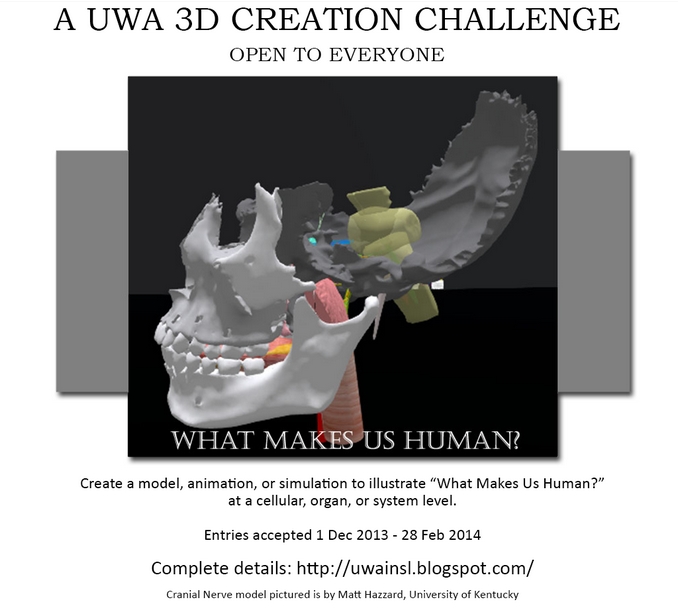
What makes us human? A UWA 3D challenge with a L$268K prize pool

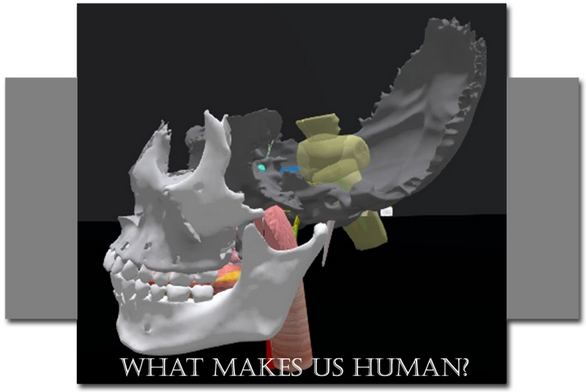
What Makes-1The University of Western Australia has launched its latest art challenge, with a total prize pool of L$268,750 on offer to prize winners.

The challenge is open to everyone, not just artists, and the challenge is to create a model, animation or simulation which reflects what make makes us human at the cellular, organ or system level.

Sponsored by the School of Anatomy, Physiology and Human Biology as well as the School of Physics at UWA, the challenge seeks to encourage entrants to create fairly accurate or representative creations or models that can be used for teaching, with the overall aim of enabling others to learn anatomical, histological, developmental and/or physiological concepts about the human body from the submitted work.

The UWA blog post announcing the challenge offers-up a few suggestions entrants might consider:

Histology (convey the microscopic structure of human tissues)

  • Nervous System: What are the various representations of different types of neurons?
  • Muscular System: Examine structural differences and/or similarities between skeletal, cardiac, and smooth muscle cells.

Anatomy (convey the gross structure of human body parts) & Histology

  • Embryology & Foetology: What are various stages of embryonic and foetal development?
  • Perhaps look at the transformation from embryo to foetus.

Anatomy

  • Skeletal System: What are the components of the human skeleton?
  • Present the anatomy of various types of joints.

Physiology (convey the processes that enable the human body and its components to function):

  • Nervous System: What are some of the neural pathways that enable us to perform day-to-day cognitive and motor functions?
  • Circulatory System: How does blood circulate through our body to meet the metabolic needs and maintain the normal function of cells/organs/and bodily systems.

Anatomy & Physiology

  • Circulatory System: How does the heart operate, and what are its different chambers and valves?

Histology, anatomy, and physiology are disciplines that go hand in hand. It is only natural that entrants may construct submissions that draw on more than one of these disciplines in order to facilitate the learning of concepts. Entrants are also encouraged to “think outside the box”, and portray/convey such aspects as the difference between normal features and functioning, and the abnormal or dysfunctional.

Other topics seen as relevant to the challenge include representations of anatomy, physiology and histology pertaining to the following systems: digestive, endocrine, exocrine, immune, lymphatic, reproductive, respiratory, urinary, and visual.

What Makes-2Prizes

There are five main prizes and three special prizes:

  • 1st prize: L$81,250
  • 2nd prize: L$62,500
  • 3rd prize: L$37,500
  • 4th prize: L$18,750
  • 5th prize: L$12,500

The three special prizes are for L$18,750 each, and will be awarded under the headings of Anatomy, Histology and Physiology Special Prizes.

How to Enter

Entries are being accepted from now through until 28th February 28th, 2014.

  • Entries should have no more than 300 prims
  • Mod / Copy entries are preferred to allow models to be displayed in temp rezzers
  • Entries must be accompanied by a Creator’s Notecard form (available from the contest entry receiver (see below), or by a note card bearing the title of the entry, a short description and the name of the creator. This may optionally include a brief biography and RL location information
  • Models  must be deposited in the contest entry receiver at the UWA Gallery – hold the CTRL key and drag the model from inventory onto the receiver’s billboard prim, which will turn red. Release the mouse button to deliver your item. Repeat for the accompanying note card.

If any problems are experienced with the receiver, please pass your model and note card to either FreeWee Ling (UWA Curator of Arts) or Jayjay Zifanwe (Jay Jay Jegathesan: UWA in Second Life Founder & Lead).

For all rules associated with the challenge and details on the judging panel and additional information, please refer to the UWA blog post.

Related Links