Metabolt, the 3rd-party text-based client appears to have ceased development, this time possibly permanently.
Rumours that development work on the client had ceased first arose in late 2013, after an extended period which had seen no updates or releases. However, in February 2014, news circulated that CasperTech were set to take over the curation of the project and continue it in the spirit in which it had been started.
The updated METAbolt log-in / splash screen from February 2014 gave the first indication that Metabolt would be continuing after several months of what appeared to be suspended development.
The announcement was followed in June 2014 with an update to the client – version 0.9.71.0. However, since then, there haven’t been any further releases, which had again left some wondering if the client was still being actively developed.
It now appears the reason for the more recent lack of releases may in part be due to a dispute between CasperTech and the original developer of Metabolt over the use of the client’s name. A dispute which has resulted CasperTech withdrawing from active development of the client, as a recent terse announcement on the Metabolt web page makes clear:
The recent CasperTech announcement
Obviously, whatever arrangement (if any) had originally been reached between CasperTech and the original developer on how the client might be continued under its original branding is a matter for the two parties concerned, and not something for idle speculation. However, given a disagreement has now arisen on the matter, then as the CasperTech announcement states, this would appear to be the end of the line for the client in its current form at this point in time.
As can be seen from the notice, CasperTech are intending to issue an alternative client in the near future, although no time frames appear to be available at the time of writing this article. I’ll of course provide a review of any new client from them once it does appear.
METAbolt is a lightweight text-based client for Second Life and OpenSim offering a range of features and capabilities. At the start of the year, there had been concerns that due to the long delay between updates (the last being August 2013), work on the client had stopped.
However, as I reported in February, this was not the case, but rather CasperTech were stepping-in to take over the project, as was announced on the METAbolt website at the time.
While it has taken a while for things to move forward since then, the initial interim updates from CasperTech have now started to appear.
The updated METAbolt log-in / splash screen highlighting the fact CasperTech are now maintaining it (Feb 2014)
The first of these was to update METAbolt from release 0.9.69.0 (Beta) to version 0.9.70.0 (release notes) on June 13th. As an interim update, this release did not bring with it new features or capabilities, but focused more on bug fixes and under-the-hood updates:
Bug fixes from CasperTech and contributed by users – for which CasperTach pass on thanks
The removal of x64 support – the viewer is now 32-bit focused and installs into C:\Program Files (x86) by default. The reason given for this is, “If METAbolt uses over 4gb of memory, it’s really not doing its job as a lightweight text client. Let’s use faster 32-bit pointers instead!”
Initial work on providing Mono support for Linux and Mac compatibility, although as the release notes state, it will be a while yet before this is complete
As this release resulted in an issue with METAbolt plugins, June 14th saw the release of version 0.9.71.0 (release notes) which, as well as fixing the plugins problem, also added a digital signature to the installer to prevent any security warnings from popping up on download.
Both of the releases present METAbolt as an installer .EXE, rather than packaging them as a ZIP file containing the installer and support files, as with previous versions. A little more work is required on cleaning-up some elements, as the installer does still refer to “METAbolt (64 bit)” and defaults to naming the installation folder “METAbolt (64 bit)” under Program Files (x86). However, this is purely a cosmetic thing, and not something that interferes with using the client.
The latest releases mostly contain under-the-hood updates and bug fixes. However a major code refactor for METAbolt is underway
Given the focus with these updates is on under-the-hood changes, the look and feel ofMETAbolt remains largely unchanged from earlier recent releases, other than the revised log-in / splash screen. Which is not to say additional work isn’t already underway.Tom Mettam, now leading the METAbolt project indicates that there is a major code refactor underway; as a part of this, CasperTech apparently plan to offer “bounties” for people willing to assist with the work. Those interested are advised to keep and eye on the Issues section of the METAbolt GitHub tracker for more information.
While I have not covered every release of METAbolt through this blog, those unfamiliar with the client may want to read my initial review, mush of which still appears to be relevant, and check the METAbolt category of this blog for those updates I do have.
Update May 13th: Lumiya 2.6.1 is now available. This includes a fix to prevent the client crashing when rendering megaprims, improved mesh download speeds and reduced lage when walking.
Alina Lyvette announced the arrival of the latest release of Lumiya on Friday May 9th.
Version 2.6.0 marks the arrival of support for Fitted Mesh and some pretty impressive under-the-hood changes which greatly enhance Lumiya’s performance in the areas of memory use, bandwidth utilisation and 3D rendering – and I found the improvements really are noticeable.
Feature Updates
Fitted Mesh Rendering
The Fitted Mesh support is perhaps the most visible update in terms of new features. I only carried out a quick series of tests, but found the FM demos I had from back when testing the SL Fitted Mesh viewer (I’m ashamed to say I’ve still not actually started using any mesh clothing myself…) worked just fine when rendered by Lumiya.
Fitted Mesh on Lumiya: renders perfectly
I did experience slight issues with mesh clothing failing to render when worn, something I don’t remember occurring back when mesh support was first released. Should this happen, a quick fix seems to be hopping out of the 3D view and back again.
Request Teleport
Another feature update with this release is the Request Teleport option. This can be accessed by:
Selecting the person you wish to teleport to from your Friends list, or IM
Tapping the MORE option
Tapping Request Teleport. This opens the Request Teleport message screen where you can enter your request text (or leave blank, if you prefer). Tapping OK will close the message window and send the teleport request
If the request is accepted, you will receive a teleport offer, as per usual; if the request is declined, you will not receive any feedback (which is how Request Teleport is handled in the viewer and not a result of Lumiya failing to receive a notification).
Request Teleport: now in Lumiya
Avatar Interaction
Lumiya 2.6.0 makes it easier to interact with nearby avatars when in 3D view by applying a long touch to the centre of an avatar. This may take a little practice, but when used, will call-up a menu allowing you to initiate an IM session with that avatar, examine them, etc.
Using a long touch or the Drag to Select option on a nearby avatar will allow you to ineract with them via the displayed menu bar
If you have problems using the long touch method when selecting an avatar, don’t forget you can also use the Drag To Select option in the top left corner of the 3D view and drag that down to point to the avatar in question.
Under-the-Hood
The under-the-hood changes in 2.6.0 range from fixes for known crash issues through to better support for transparency in the 3D world view and new notification sounds (courtesy of Lhasa Mencur) to some really quite significant performance improvements.
The latter include a reduced memory footprint together with much improved bandwidth usage, both of which see Lumiya operate a lot more smoothly (not that it was ever particularly clunky). Much has been done to the 3D rendering performance and management as well.Also these combined mean it should be much easier to run Lumiya on lower-end system, and for those on high-end devices, to have more of the bells and whistles turned on. In my case, for example, these improvements make it a lot easier to run with High Quality Textures enabled by default on my Nexus 2013 HD.
Feedback
Lumiya has always offered tremendous value for accessing Second Life while on-the-go with a suitable Android device. Even allowing for trying to maintain compatibility with older versions of Android, Alina consistently pulls-off some impressive miracles with the client, and 2.6.0 more than demonstrates this. While the added features may seem minimal (even though mesh support represents considerable work itself), the performance improvements evident in this release are astonishing.
Obviously, with a fairly high-end Android device running Android KitKat and a quad-core Qualcomm Snapdragon™ S4 Pro, 1.5 GHz / Adreno 320, 400 MHz combination, I stand to benefit the most from the improvements in rendering, but even so, on my old Samsung Galaxy S2 with Android 4.1 Jellybean and Dual-core 1.2 GHz Cortex-A9 / Mali-400 combination, things were still noticeably faster.
For those who require access to OpenSim and are Android users with a decent CPU / GPU combination and a reason screen size, Lumiya stands head-and-shoulder above the rest. For those wanting mobile access to Second Life and have limited screen size, it also beats SL Go hands-down in terms of convenience of use, even if it lacks the full rendering capabilities of the latter.
There have been concerns and rumours circulating about Metabolt, the text-based client for Second Life and OpenSim. The last update occurred in August 2013; the long delay coupled with the recent unavailability of the Metabolt website, fuelled rumours that the client was being discontinued.
However, this is not the case; CasperTech are stepping-in to take over curating the project, as an announcement on the Metabolt website reveals:
Same Viewer. New Opportunities
It was recently announced that the METAbolt project was being discontinued. We are very happy to announce that this has not happened, and instead CasperTech have stepped in to curate and maintain the project.
CasperTech is a leading provider of solutions for content creators within Second Life. We believe that METAbolt will benefit from our strong legacy and foundations.
It is not our intention to commercialise the project, and we will maintain it in the same spirit of open source community collaboration. We do intend, however, to rejuvenate the METAbolt community with active development, support and new innovation. We are very excited by this opportunity, and we hope you are, too!
Please bear with us while we complete the transitional period – we’re working on a new website and will be making our first release of METAbolt soon.
– Casper Warden, CasperTech Ltd.
While the new Metabolt site is being set-up, a link to the download page / source code for the current release of the client is included below the message.
Metabolt: set to continue thanks to CasperTech
Metabolt is popular text-based client for users of various types of bot in SL (such as the Pandora Bot), which can be used for a variety of role, such as greeters, automated assistants, etc. As such, the news that the client looks set to continue should be warmly received.
Alina Lyvette released version 2.5.6 of the Android Second Life / OpenSim Lumiya client on Sunday December 8th, with a further release of version 2.5.7 on Monday December 9th; with both came a chance to have a real play with my latest toy: a gorgeous new Asus Google Nexus 7 HD 2013!
Between them, these two updates comprise:
2.5.6:
View your own profile and your transaction history
Send and receive group invites;
Persistent mute/block list support
Improved performance when handling large chat histories and of flexible prims in 3D mode
Fixes for an issue with touching complex mesh objects and a few known crash issues.
2.5.7:
Quick fix for broken Unicode support in instant messages
Support for editing scripts, both in inventory and objects.
Note that with this review, I am using a 7-inch display screen, and so have split screens enabled. If you are using a device with a smaller screen / without spilt screen functionality enabled, your screen displays may differ from those shown in this review. All examples may not be the only means of accessing specific functions; they are based on my preferred usage of Lumiya.
Viewing Your Own Profile or Transaction History
Until now, Lumiya has only offered the opportunity to view other people’s profiles. With version 2.5.6+ you can now view your own. you can also view your transaction history, which will list any transactions made during your current log-in session.
To view your profile, display the Chat or 3D world view and tap on the More option (three vertical dots) at the top-right of the screen. This will open a menu of additional options. Tap on My Avatar.
If you have split screens enabled, your profile will be displayed on the right, with the My Avatar options on the left
If you are not using split screens, tap My Profile to display your profile.
To view your transaction history, follow the steps above to display the My Avatar options, then tap L$ Balance option. All transactions which have taken place while you’ve been logged-in will be displayed.
Send and Receive Group Invites
Lumiya 2.5.6 starts into providing more group management functions with the ability to send / group invites with those groups in which you have be granted the required ability, or to receive group invites from others.
Sending A Group Invite
Currently, you can only send an invite to join a group to people recorded on your Recent, Friends or Nearby lists, there is no name picker to allow you to search for and invite anyone.
Tap Chat to display your Chat / Group options
Tap the name of a group to which you wish to invite new members. The group’s panel will open
Tap the invite icon located at the top right of the group’s panel.
Lumiya 2.5.6+: the new invite option for inviting people to join your groups
A pop-up is displayed, allowing you to select the person you wish to invite from your Recent, Friends or Nearby Lists
Tap the name of the person you wish to extend an invite. A role picker pop-up is displayed
Tap the role you wish to assign to the person. The role is selected and an invite is automatically sent.
Receiving a Group Invite
As with any graphical viewer, when you receive an invitation to join a group, Lumiya displays the invitation in you Chat panel, with the name of the person sending the invitation, details of the group you are being invited to join and option buttons to join the group or decline the invitation.
Persistent Mute / Block
Lumiya 2.5.6 introduces the ability to mute / block IMs and group chat sessions, either for the current log-in session or persistently across all sessions until the block is lifted.
Muting an Individual or Group
There are a number of ways to mute an individual or group:
Muting via the chat list:
If the person or group you wish to mute is in your local chat list, long-touch the name.
A pop-up menu is displayed:
If you have selected an individual, it will include the option to Block them. Tap this. You will be prompted to confirm your action; doing so will add the individual to your Block list
If you have selected a group, it will include an option to Close and Mute the group chat. Tapping this will prompt whether you wish to mute the group chat for just the current log-in session or permanently (until unblocked). Tap the required option to add the group to your Block list.
You can mute / block group chat for your current log-in session or persistently across all log-in sessions, including via other viewers
Muting via the Friends, Group or Nearby lists or from within an IM or Group chat session:
You can block someone via an open IM session, or by starting an IM session and selecting the mute option
Select the individual you wish to mute / block from your Friends or Nearby lists OR tap on the name of the group you wish to mute chat from in your Group list
The IM or Group chat panel will open. Tap the More option icon (three vertical buttons) to display a further list of options. Tap Mute.
You will be prompted whether you wish to cancel, or mute the individual / group for the current session or persistently across all log-ins – tap your desired preference.
Muting an individual in group chat:
Long-touch the individual’s name within the Group chat panel
A pop-up is displayed allowing you to Copy Message Text or Block the individual
Tap Block to add the individual to your Block list.
Muting via the Block list:
From Chat or the 3D world view, click the More icon (three vertical dots) in the top right of the screen
Tap My Avatar
Tap Block List to display a list of blocked individuals, groups and objects
Tap the ADD button (top right of the list)
A pop-up is displayed for your Recent, Friends and Nearby lists. Tap the required list to display a list of names
Tap on the avatar name you wish to block, it will be added to your Block list
Repeat for any additional names you wish to block.
Blocking an Object
To block a spammy object:
Locate it in Chat and long-touch it
A pop-up is displayed which includes the option to Block it
Tap the Block option to add the object to your Block list.
Unmuting / Unblocking an Individual, Group or Object
The easiest way to unblock an individual or group is via your More menu:
From Chat (or the 3D world view, click the More icon (three vertical dots) to display further menu options
Click My Avatar
Click Block List to display a list of blocked individuals, groups and objects
Scroll through the list to the item you wish to unblock and long-touch You’ll be prompted to confirm the action
Once you have confirmed, the individual, group or object will be unblocked.
Note that you can also unmute an individual or group by tapping on the name in your Friends / Nearby / Group list to start an IM / Group chat session, then tapping the More icon and tapping the Unmute option.
Script Editing
Lumiya 2.5.7 allows users to view and edit scripts to which they have the requisite rights both from within inventory and contained within an object.
Open a Script from Inventory
Tap the Inventory icon to open the Inventory panel
Navigate to the folder containing the script to be edited
Locate the script in the folder’s contents and tap it
The script editor is displayed, together with the selected script in view mode.
Open a Script in an Object
In the 3D world view, long-touch the object containing the script you wish to edit
Tap the More button to display additional options
Tap Open Contents. A panel displaying the objects content is displayed
Locate and tap the script to be edited. The script editor is displayed, together with the selected script in view mode.
Lumiya 2.5.7+: viewing and editing your scripts
Editing a Script
Tap the Edit Script button at the bottom of the script editor
Position the cursor at the point at which you wish to start editing
Use the Save or Discard Changes buttons as required.
Lumiya on the Nexus 7 HD 2013
And now, a short aside.
Until now, I’ve been running Lumiya on a Samsung Galaxy S2. However, when updating my mobile (cell) phone recently, my new service provider offered me a bundled deal of a new ‘phone and free Nexus 7 HD 2013 (and other goodies) for the same monthly tariff rate I had been paying for just the S2. Needless to say, I took the deal.
Lumiya has always worked well on the S2 for me, although it did struggled at times and the relatively small screen tended to make some operations difficult. With the Nexus 7 HD, Lumiya is nothing short of glorious.
Not only do I now have the benefit of full split-screen functionality on a screen big enough to handle it when operating in landscape mode, I have the power of two quad-core processors to handle the application and graphics and twice the available memory to play with. As a result, the 3D view is a joy to behold and move around in, with very fast rendering (as compared to the S2), and much smoother movement – both of which go a long way towards making Lumiya even more of a desirable travel companion.
The in-world view is also given something of a boost as a result of the Nexus 7 HD’s screen resolution: 1920×1200 which is a higher resolution than I’m getting on my main monitor (1440×900) and at an amazing 323ppi. This presents a really crisp, clean in-world image when using the 3D view which is very pleasing to the eye; so much so that I don’t feel a screen cap really does it justice.
My home on Lumiya and the Nexus 7
The Nexus does still struggle when using the High Quality Textures setting, particularly at higher draw distances (48-96 metres), but given the load this is placing on the tablet in areas rich in textures, many of which will be of very high-resolution, I’m not actually surprised by this.
As I plan to use (and already have used) the Nexus to do “serious” work when moving around, I opted to invest in a bluetooth keyboard to go with it; and I have to say it is an absolute joy to have – part of this article was actually written on the Nexus using the keyboard and Kingsoft Office. The keyboard really adds to using Lumiya in that it obviously avoids the need to use the on-screen keypad, and the cursor keys / WASD keys can make moving around a lot more natural in feel if you’re used to using them on a viewer. Another benefit with a keyovard is the reduction in the amount of finger prints and smears appearing on the screen as you work.
I’m actually rather chuffed with the keyboard, which I obtained via ebay for £15.00 (around 18.00 Euros or $24.00 USD). When not in use it forms a protective cover for the screen, clipping securely around the tablet. Despite being aluminium in construction, it adds very little physical bulk to the Nexus when “closed”, and also has the benefit of solid-feeling keys which have a decent travel distance, which aids typing considerably. With Lumiya, it certainly adds a huge amount of ease to chatting and (now) to editing scripts! If you’re a Nexus user and decide to get one, just make sure you get the version which matches your Nexus model (2012 or 2013).
A suitable bluetooth keyboard can further enhance using Lumiya
Feedback
Two more outstanding updates for Lumiya which significantly enhance its capabilities, although on smaller screen the script editor may have limited appeal due to issues of trying to correctly position the cursor for editing and seeing what you’re actually doing when an on-screen keypad is open as well. On a tablet, the editor performs much better, although big fingers may still have problems positioning the cursor. As noted above, use of a suitable keyboard easily overcomes this problem (although are not always easy to use when on the move), and also makes chatting and IMs massively easier for those who aren’t keen on on-screen keypads.
The group and mute / block options are likely to be heartily welcomed by those putting Lumiya to extensive use and / or who routinely visit busy places. Both work very well using the methods I’ve indicated in these notes, and the functionality appears flawless.
All told, these are more than worthwhile updates to Lumiya further enhancing its reputation as the go-to solution for anyone on android who needs to access SL for a broad range of tasks while on the move.
Thursday October 10th saw the latest release of Lumiya, the Android client for Second Life and OpenSim arrive.
Version 2.5.5 brings with a number of updates and improvements including:
Sliding gesture toggles between contact list and chat
Share inventory
Partner information in user profiles
Option to view chat logs within the application.
Slide Gesture for Chat / IMs and Contacts
The slide gesture is a handy means of moving between your contacts list and an ongoing conversation either in open chat or IM without needing to use your device’s Back button.
To move between a conversation window and your Contacts list:
Start a conversation in chat or use Contacts to IM a friend
Place you finger on the screen and drag to the right. Your Contacts list will slide into view
Drag your finger to the left to return to the conversation
The image on the right, courtesy of Alina Lyvette, shows the function in use (the size of the image is unfortunately dictated by a limitation within WordPress.com when handling animated GIF files. Apologies if it is a little “in your face”.)
You can move between multiple IM windows by “sliding” back to Contacts and then tapping the name of the person you which to talk with and then “sliding” back and tapping the name of someone else.
Share Inventory
Version 2.5.5 allows you to share /give inventory items with / to others (subject to permissions, as usual).
To share and item:
Open you inventory and navigate to the folder containing the item you wish to share / give
Long touch the item for the context menu
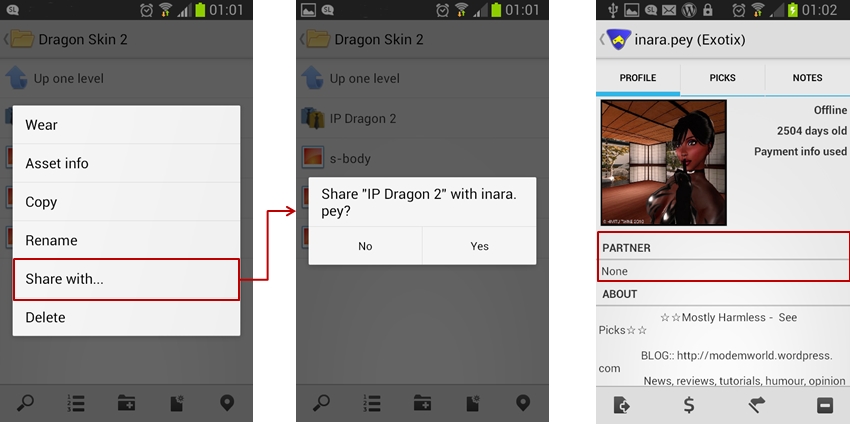
Tap the Share With… button – this will open your Contacts screen
Tap the name of the person you with whom you wish to share the item
A pop-up dialogue will be displayed asking you to confirm that to wish to proceed. Tap Yes to do so.
Note that Lumiya doesn’t display the warning notification if you are sharing a Transfer / No Copy item, nor does it display the “User is offline….” message when the recipient is offline. However, a message confirming the object has been transferred is displayed in local chat.
Lumiya 2.5.5 allows you to share / give inventory items with / to others (left and centre) and also display partner information in the Profile display (right)
Partner Information
The ability for Lumiya to display partner information has been added to the Profile display.
Viewing Chat Logs within Lumiya
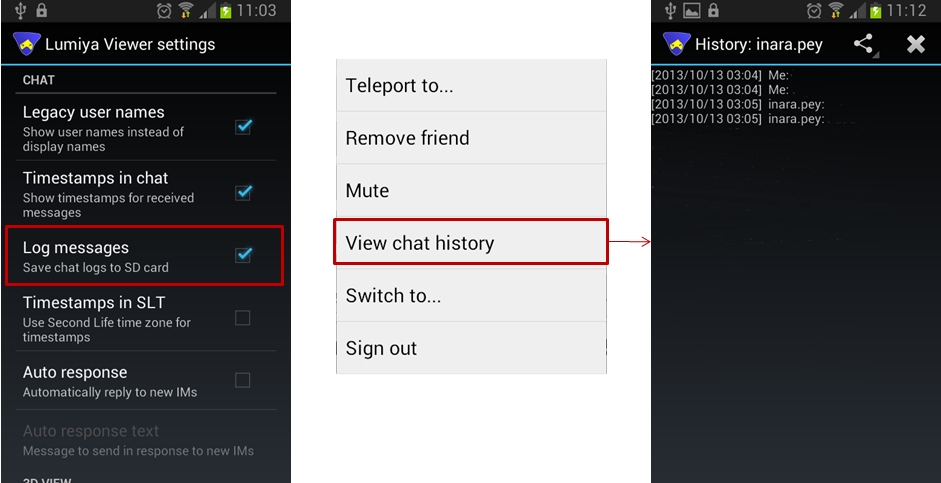
Lumiya 2.5.5 allows you to access chat logs (history) within the application. This does require that Log Messages is enabled in Settings. Also note that due to a file name format change, chat logs saved in previous versions of Lumiya may not display.
Tap the Menu key on your device from Lumiya’s main screen and then tap Settings
Scroll down the Settings page to the Chat section and make sure Log Messages is checked
Initiate a conversation with someone
To see the chat history, tap the Menu screen from within the Chat / IM window and select View Chat History – note that if there is no recorded history log, this option will not be displayed in the menu
If a chat log file exists, it will be displayed.
View chat history: make sure the Log messages option is checked (l); from the chat / IM screen, tap the Menu button on your device and select the View Chat History option (c) to open the history, if available (r). Note that if the option is not displayed, there is no history file to view
Other Items
Other updates in this release comprise:
Support for llLoadURL() – so you can now open a web page in a browser installed on your device, if a dialogue box is displayed asking if you wish to do so
Improved notifications
Bug fixes and performance improvements.
Feedback
Another very tidy update from Alina which adds some useful functions to Lumiya, with the ability to share / give items of inventory liable to be welcome among users. Kudos!





 Inara Pey: Living in a Modemworld