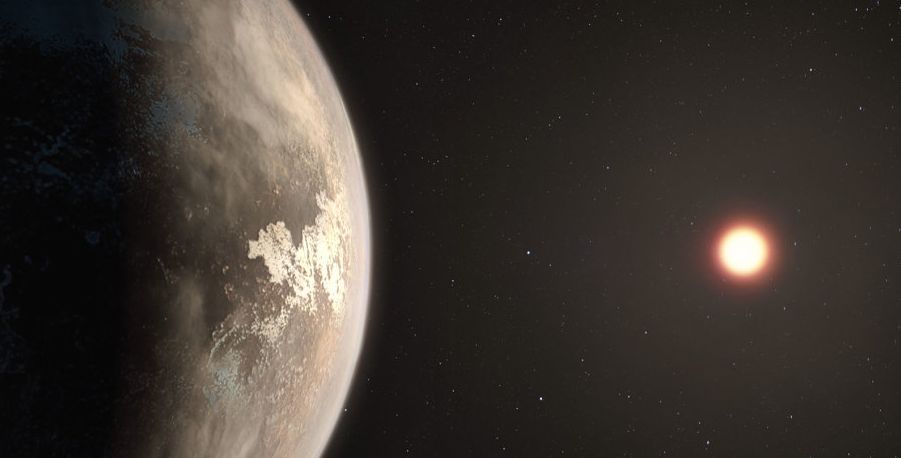
The European Southern Observatory (ESO), responsible for finding a planet orbiting the Sun’s nearest stellar neighbour, Proxima Centauri (see here for more), has now discovered another exoplanet orbiting a nearby star.
The star in question is Ross 128, a red dwarf located in the constellation of Virgo. As I’ve previously noted, red dwarf stars tend to be extremely violent in nature. Their internal action is entirely convective, making them unstable and subject to powerful solar flares, generating high levels of radiation in the ultraviolet and infra-red wavelengths which can leave planets like the one orbiting Proxima Centauri or those orbiting TRAPPIST-1 unlikely to support life.
However, Ross 128 is different. It is a “quiet” red dwarf; it experiences less in the way of flare activity, meaning any planets orbiting it will be exposed to less radiation and stellar wind. In particular, the planet discovered by ESO could potentially be habitable.
The planet, designated Ross 128 b, was discovered using the ESO’s High Accuracy Radial velocity Planet Searcher (HARPS), located at the La Silla Observatory in Chile. HARPS uses measurements of a star’s Doppler shift in order to determine if it moving back and forth, a sign that it has a system of planets. The data gathered by the instrument allowed astronomers to confirm Ross 128 b is a rocky world, with roughly 35% more mass than Earth, orbiting Ross 128 at a distance of about 0.05 AU, and with a period of 9.9 Earth days.
Measurements of Ross 128’s likely radiative output, combined with the planet’s distance from the star put it on or near the star’s habitable zone – the region around a star where a solid body planet might have both an atmosphere and liquid water on the surface. It receives around 38% more light from its star than Earth does from the Sun. This has allowed the team making the discovery to estimate that Ross 128 b’s equilibrium temperature is likely somewhere between -60 °C and 20 °C – close to what we experience here on Earth, making it a temperate planet.
That Ross 128 is a “quiet” older red dwarf, less prone to violent outbursts, means Ross 128 b may well have retained any atmosphere which may have formed around it. Whether or not Ross 128 b has an atmosphere has yet to be determined; if it does, given the planet is likely to be tidally locked, with the same same side always facing towards its star, any atmosphere the planet may have could be subject to extreme weather.
Even so, given what is currently known about Ross 128 b, were it to have an atmosphere and liquid water on the surface, it would be the closest potentially habitable exoplanet to Earth so far discovered. This alone means Ross 128 b is liable to be the subject of a lot of additional study over the coming months.
Nor is this the first time Ross 128 has been in the news this year. In July 2017, Abel Méndez, an astrobiologist at the Arecibo Radio Telescope, reported that on May 12th, 2017, during a 10-ten observation of Ross 128, the telescope received a 10-minute wide-band radio signal “almost periodic” in natures, and which decreased in frequency.
While some were quick to link this event with the November discovery of Ross 128 b, it’s worth pointing out that Arecibo, the Green Bank Telescope in West Virginia and the Allen Telescope Array (ATA) in northern California, have all spent time listening to Ross 128 without any of them hearing any repeat of the signal. Currently the most widely accepted explanation for the May 2017 signal is radio frequency interference from a satellite orbiting the Earth.
A Lava World with an Atmosphere?
And staying with exoplanets, 55 Cancri e, also named Janssen, has also been in the news this week.
One of the few exoplanets discovered prior to the Kepler mission, it is one of five planets orbiting 55 Cancri A, the G-class main sequence star which forms one half of the binary star system 55 Cancri, some 41 light years away from the Sun, in the constellation of Cancer. At 7.8 Earth masses, and with a diameter almost 50% that of Neptune, it has the distinction of being the first “super-Earth” discovered in orbit around a main sequence star similar to the Sun.

Discovered in August 20o4, the planet has been subject of extensive study. As the closest planet to its parent, it takes 2.8 days Earth days to complete one orbit, and is tidally locked, always keeping the same side facing its parent. A study of the planet using the Spitzer space telescope in 2013 led astronomers to the conclusion 55 Cencri e is likely carbon planet, dominated by lava flows on its sunward side. In 2016, observations using the Hubble Space Telescope indicated the planet may have a thin hydrogen and helium atmosphere with suggestions of hydrogen cyanide.
However, an international team led by Cambridge University in the UK, has been re-examining the data gathered by the Spitzer space telescope. Using an improved model of how energy would flow throughout the planet and radiate back into space, their findings indicate that temperatures on the “dark” side of the planet average 1,300 to 1,400 oC (2,400 to 2,600 oF), much closer to to the average 2,300 oC (4,200 oF) on the sunward side than previously thought.
These finding suggest 55 Cancri e has a far denser, more complex atmosphere than had been thought, one which acts as transfer mechanism for circulating heat around the planet. What’s more, this atmosphere may well contain nitrogen, water vapour and even oxygen—molecules found in our atmosphere, too—but with much higher temperatures throughout.
The overall conditions on the surface of the planet preclude free-flowing water or the opportunity for life to arise, but they also present a further mystery. Given its proximity to its parent star, in theory 33 Cancri 2e’s atmosphere should have been stripped away aeons ago by the solar wind. so there are still mysteries with the planet yet to be resolved.
Continue reading “Space Sunday: exoplanets and launch systems”
















 Inara Pey: Living in a Modemworld