
This is part 2 of a special Space Sunday series, celebrating the 50th anniversary of Apollo 11 landing on the Moon, and follows on directly from Part 1: “Lift-off! We Have Lift-off!” It was published on Saturday, July 20th, 2019, as a Space Sunday special to mark the actual date of that historic landing.
Part 2: “The Eagle Has landed”
Once the combined Command and Service Module (CSM) and Apollo Lunar Module (CM) were free of the Saturn V’s S-IVB stage, they were in constant sunlight, so to help better regulate their internal and external temperatures, the reaction control system on the CSM was used to set both vehicles spinning very gently along their longitudinal axis in what was called the “Apollo barbecue roll”.

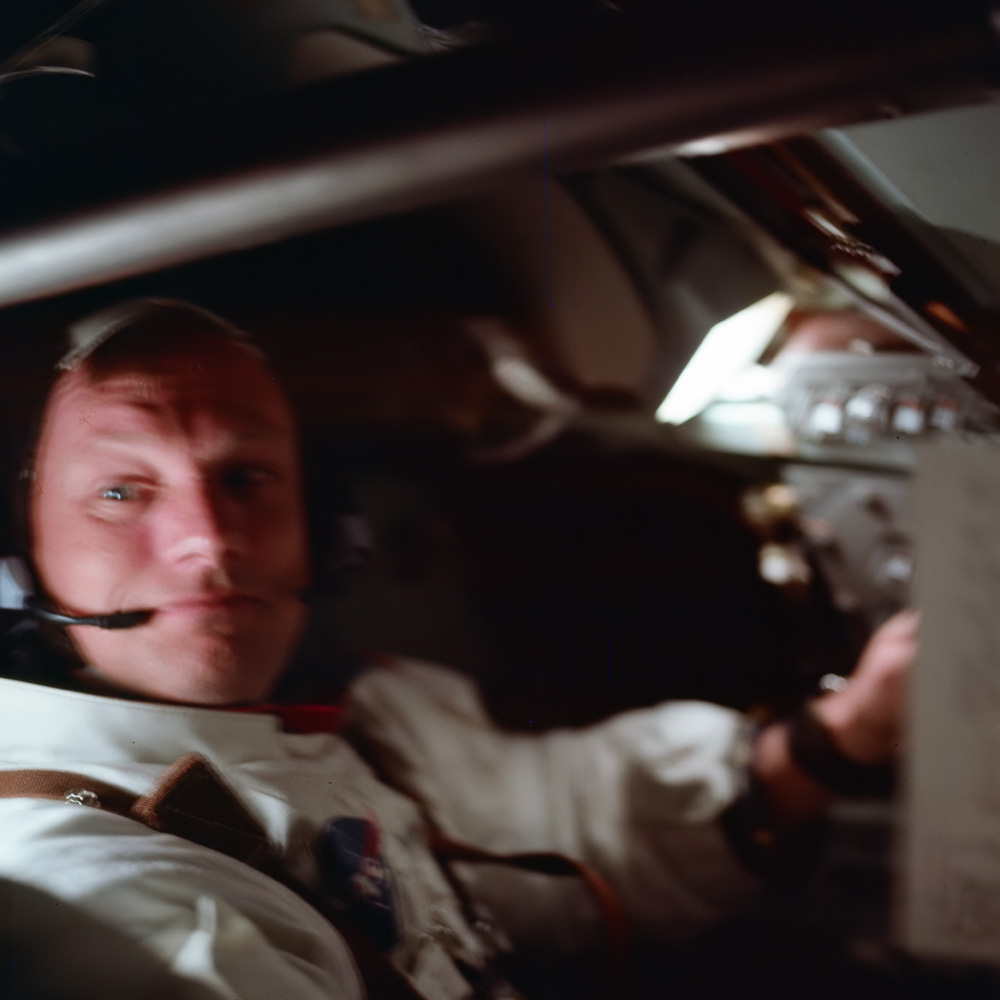
During this “cruise phase” of the flight, the three men aboard Apollo 11 – Armstrong, Collins and Aldrin – had to perform a range of activities from keeping an eye on their spacecraft through to making broadcasts back to Earth. It was here that their curious relationship came a little to the fore.
While all three men got along very well, they were observed not to bond in the manner of other crews; all three were somewhat quiet men, with Collins and Aldrin particularly coming to refer to their relationships with one to the others as that of “amiable strangers”.
Which is not to say the three men didn’t get along; almost all of the on-board conversations were recorded by NASA, even if they weren’t broadcast, and these “off-air” conversations reveal the three men shared jokes – such as Aldrin and Collins gently teasing Armstrong about his “rookie” status in having clocked the fewest number of hours in space. However, when it came to talking for the benefit of the television audience, Mission Control sometimes had to coax words out of the crew.
The first time we saw the Moon up close, it was a magnificent spectacle. It was huge. The Sun was coming around it, cascading and making a golden halo and filled out entire window. [But] as impressive as the view was of this alien Moon seen up close was, it was nothing compared to the sight of the tiny Earth. The Earth was the main show. The Earth was it.
– Michael Collins, 50th anniversary of the Moon landing
Apollo 11 reached the Moon on July 19th, 1969, after a single mid-course corrections using the single motor of the Service Module (out of 4 planned for the flight).

Now Collins again took the controls to gently pivot the vehicles around in their own length, so that single large motor was pointing forward along their line of flight. Then, at 17:21:50 UTC, as they passed around the Moon’s far side, the engine was fired in the first of two orbital insertion burns.
This first engine burn slowed the vehicles so they they were snagged by the Moon’s gravity and placed in an elliptical orbit. A second burn of the engine followed 4 hours and 22 minutes later, circularising the vehicle’s orbit in readiness for Armstrong and Aldrin to make their historic descent.
In all thirty orbits of the Moon were performed as the Lunar Module was prepared for its descent and landing. These orbits frequently passed over the Mare Tranquillitatis, a large basalt plain on the Moon selected as the location for the first manned landing by the United States as it appeared from orbital imaging as being relatively smooth, and had already seen a successful landing by the automated Surveyor 5 mission, which arrived on the Moon on September 11th, 1967.
Shortly after Apollo 11 dropped into orbit around the moon, Frank Borman got a message from the Soviet Union that said, “Congratulations on reaching lunar orbit. We have Luna 15 also in orbit around the moon and its orbital parameters are such and such. If it presents any problem, please advise and we will move it.” We didn’t need Luna 16 moved, but I thought it was a noble gesture in those days of the Cold War.
– Bruce McCandless, Capsule Communicator (CapCom),
Apollo 11 Mission Control Green Team

At 12:52:00 UTC on July 20th, Aldrin and Armstrong entered Eagle, and began the final preparations for lunar descent, Five hours later, all was set and they undocked from the Command Module Columbia. With Michael Collins in the Command Module, Armstrong gently eased Eagle away from the CSM, then used its reaction control system to perform a slow pirouette. This allowed Collins to carry out a visual inspection of the LM, confirm its legs were deployed and that it was generally looked OK to make its decent.
For the first part of the decent, Eagle was effectively “face down” giving Armstrong and Aldrin a view of the Moon. Then the descent engine fired and the vehicle slowly moved to an upright position, and Armstrong voiced a slight concern.
We’re about a minute, maybe 2 minutes, into powered descent, face-down, and Neil says to me, and the Earth, “I think we’re gonna be a little long.” I said to myself, how in the world can he really, at this point, tell that we’re gonna be a little long? But sure enough, we were. I’ve learned that whenever Neil says anything, you’d better pay attention because there’s good meaning to it.
– Buzz Aldrin commenting on the Eagle’s descent to its landing
Continue reading “Space Sunday special: Apollo 11 at 50 Part 2”










 Inara Pey: Living in a Modemworld