Space Sunday: China’s missions and a disappearing “planet”

An artist’s impression of China’s Tianwen Mars lander with the rover vehicle on its back. Credit: CNSA

China is readying for the next phases of its space ambitions.

In July, the country is due to launch its first mission to Mars. Officially referred to as the Mars Global Remote Sensing Orbiter and Small Rover mission, it comprises an orbiter, a lander vehicle and a small rover, with the orbiter and rover between them carrying the majority of the mission’s 18 scientific instruments.

The priorities for the mission include finding evidence of current or previous microbial life, and evaluating the planet’s surface and environment. In addition, solo and joint explorations of Mars, the orbiter and rover will produce maps of the Martian surface topography, and obtain data on soil characteristics, material composition, water ice, atmospheric composition, ionosphere field intensity, and other scientific data.

On April 24th, the Chinese announced the lander vehicle is to be called Tianwen, or “Quest for Heavenly Truth.” It will use a landing system comprising a parachute, retrorockets, and an airbag to achieve a soft landing. The rover will be solar powered, as with China’s Yutu family of lunar rovers.

A test article of the Mars lander undergoing retro-rocket tests in China, November 2019. Credit: CNSA

The name represents the Chinese people’s relentless pursuit of truth, the country’s cultural inheritance of its understanding of nature and universe, as well as the unending explorations in science and technology.

– China’s National Space Administration (CNSA) statement

The Chinese tend to be fairly close-lipped about their space missions (among many other things), but from what has been announced, the mission is being built along similar lines to both NASA surface missions like InSight and MSL, and Europe’s ExoMars orbiter / lander missions. Following its arrival in Mars orbit in February 2021, the combined orbiter / lander will remain there for an unspecified period while the intended landing site is confirmed.

Once on the surface, the 200 gram 6-wheeled rover is expected to operate for at least 3 months, with a selection of its science systems comprising Ground-Penetrating Radar (GPR), to image about 100 m below the Martian surface, a magnetic field detector, a Mars meteorological instrument and multiple camera instruments. The rover is expected to be given its own name in due course.

Chinese national television footage of a 53.7 m tall Long March 5B launch vehicle, carrying the first of China’s new generation of crewed launch vehicle, being rolled out to the launch pad.

At the same time, China rolled out a Long March 5B launcher in preparation for a mission to prove space station launch capabilities and to test a new spacecraft for deep space human space flight. It is expected to lift-off on, or around, May 5th 2020, carrying the first of China’s new generation of crew-capable vehicles designed to supersede the Soyuz-derived Shenzhou craft.

The new craft resembles an Apollo command and service module (CSM) combination, comprising a conical capsule vehicle protected by an atmospheric entry heat shield, and a cylindrical service module that provides the primary source of power and propulsion when operating in space. For the first flight, it will carry around 10 tonnes of fuel, intended to allow the vehicle to offer a similar mass to the core stage of the upcoming Chinese space station. The fuel will also allow the vehicle to reach a high orbit and and achieve a fast re-entry velocity.

This latter is important as the the new vehicle is intended for deep space crewed missions, including acting as the carrier for crews engaged in future missions to the Moon. Such missions will – like America’s Orion coming back from the Moon – return to Earth as a higher velocity than an orbital craft. As such, the first flight of this new Chinese vehicle will be somewhat similar in nature to the Orion’s first uncrewed flight in 2018.

The 14-tonne and 20-tonne next generation Chinese crewed vehicles. Credit: Beijing Institute of Space Mechanics and Electronics

To achieve its full envelope of uses, the new crew vehicle comes in two variants: a capsule and small service module which together weigh 14 tonnes, to be used in local orbital flights, and a version with a larger service module, giving a mass of 20 tonnes for the combined craft. This will likely be used for missions into deeper space. Either craft be able to carry up to six astronauts, or three astronauts and 500 kg of cargo to low Earth orbit.

Overall, the May launch of the vehicle has a lot hinging on it. A successful flight will clear the way for the two-month-long launch campaign required for the Mars Global Remote Sensing Orbiter and Small Rover mission mentioned above, using a Long March 5. In will also be see as opening the way for the Long March 5B vehicle to undergo a series of launches ahead of placing the 20-tonne Tianhe module, intended to be the core element of China’s new space station, due in early 2021. Weighing 20 tonnes, the module’s launch will mark the first in about a dozen that will be needed to complete the station between 2021 and 2022 /23.

When is an Exoplanet Not and Exoplanet?

As I’ve frequently remarked in these pages, we’ve so far confirmed the presence of over 4,000 exoplanets orbiting other stars. The number is such that it’s easy to think that detecting these worlds is just a matter of observing and waiting for that regular tell-tale dipping of brightness in a starts luminosity as seen from our orbiting telescopes, and which has been the more common means of detecting the worlds around other stars.

However, finding and confirming the presence of exoplanets is a complicated process, one that can be ripe with false positives. An example of this is Fomalhaut b, which has been puzzling astronomers since it was first observed in 2004. Orbiting the A-type main-sequence star Fomalhaut, some 25 light-years from Earth in the constellation of Piscis Austrinus, the planet was first observed by the Hubble Space Telescope, marking as the first to be detected in visible wavelengths (that is. the Direct Imaging Method).

Hubble images of the dust cloud around Fomalhaut. Credit: NASA/ESA/A. Gáspár and G. Rieke (University of Arizona)

Continue reading “Space Sunday: China’s missions and a disappearing “planet””

Space Sunday: an exoplanet, a star and an asteroid

An artist’s impression of Kepler-1649c (foreground) – an Earth-type world that might be Earth-like in some respects, and its parent star, Kepler-1649, with it’s companion planet, Kepler-1649-b visible beyond the star. Credit: NASA/Ames Research Centre/Daniel Rutter

The Kepler Space Telescope might be shut down, but the work of analysing the data it gathered on possible exoplanets continues, and an international team of scientists reviewing some of the earliest data from the mission have confiemd what had been thought of as a “false positive” is in fact an Earth-size exoplanet orbiting within its star’s habitable zone, the area around a star where a rocky planet could support liquid water.

The planet, Kepler-1649c orbits its small red dwarf star some 300 light years from Earth. It is so close to its parent, that its year is the equivalent to 19.5 Earth days. It is actually the second planet to have been found orbiting the star, hence the “c” designation in its name, and the system as a whole contains a series of points of interest for astronomers that make it particularly intriguing.

The first is that the data Kepler gathered on the planet suggest it is one of the closest in terms of size to Earth so far discovered, being just 1.06 times larger. The second is that its parent, Kepler-1649, is a class-M red dwarf with relatively low luminosity, so that despite it’s close proximity, that planet receives around 75% of the sunlight Earth receives from Sol. so it is entirely possible that if it has an atmosphere, conditions on it surface might be somewhat similar to our own in terms of average temperatures and with regards to surface water.

However, whether the planet does have an atmosphere has yet to be determined. As I’ve previously noted in this column, red dwarf stars are so small they rely on convection as the main form of energy transport to the surface, and this can give rise to violent solar outbursts which over time can rip away a nearby planet’s atmosphere. There’s also the question of how stable any atmosphere might be. Again, its close proximity to its parent means it is liable to be tidally locked, always keeping the same face towards its star. This is liable to make any atmosphere the planet does have could be exceptionally turbulent and prone to storms along the terminator dividing the light and dark halves.

An Artist’s impression of Kepler-1649c compared to Earth. Credit: NASA/Ames Research Centre/Daniel Rutter

However, Kepler-1649 has thus far shown itself to be one of the more stable M-class stars that has been observed over the years from Earth – which means it may well still possess a temperate atmosphere. If this is so, the combination of size and atmosphere then of all the red dwarf orbiting exoplanets thus far discovered, Kepler-1649c could be closer to Earth than most so far discovered.

An additional intrigue with the Kepler-1649 system is that the two planets share an unusual orbit resonance: for every nine times Kepler-1649c orbits its parent, the inner planet, Kepler-16949b, orbits almost exactly four times, giving a 9:4 ratio. This indicates the system is extremely stable, likely to survive for a long time.

9:4 is also something of a unique ratio; usually resonances take the form of ratios like 2:1 or 3:2. As such, it is thought that the Kepler’s system’s resonance might be indicative of a third planet between Keplert-1649b and Kelper-1649c, which would give the system a more regular pairing of 3:2 resonances between the middle and inner planets and the middle and outer planets. However, the existence of any third planet has yet to be confirmed.

An artist’s impression of the view of the surface of Kepler-1649c, should t have a water-rich atmosphere, with the crescent Kepler-1649b also in the sky. NASA/Ames Research Centre/Daniel Rutter

In the meantime, the discovery of Kepler-1649c adds significantly to our understanding on exoplanets around M-class stars.

The more data we get, the more signs we see pointing to the notion that potentially habitable and Earth-size exoplanets are common around these kinds of stars. With red dwarfs almost everywhere around our galaxy, and these small, potentially habitable and rocky planets around them, the chance one of them isn’t too different than our Earth looks a bit brighter.

– Andrew Vanderburg, co-author of a paper on Kepler-1649c exoplanet

Curiosity: A New Level of Remote Working

As the SARS-CoV-2 virus continues to prevent us from working normally, members of NASA’s Mars Science Laboratory Curiosity team have revealed how they’ve been continuing with normal operations since the Jet Propulsion Laboratory (JPL) shut down operations in February 2020.

Of course, in some respects the rover team has always been working remotely from their “office”, the rover never being at least 56 million km from Earth. However, the shut-down of NASA facilities ordered by Administrator Jim Bridenstine brought additional challenges to operating a rover so far away – and I’m not talking about distractions caused by the need to feed the cats or take the dog for a walk, being reliant on e-mail and video conferencing, etc.

Curiosity: a “selfie” taken in late 2016. Credit: NASA/JPL

Take driving the rover, for example. This requires a complex process of scanning the rover’s surroundings to build up a complete view of the rover’s environment, having the means to view this in 3D and to compare it to high-resolution images of the rover’s surroundings captured from orbit, then mapping a potential route that avoids any aspects of the landscape that present a risk to the rover whilst also encompassing points of interest, converting the commands into software code, testing it, and finally transmitting it to the rover for execution. Similarly, manoeuvring and using the rover’s robot arm requires precision and care, rehearsal and coding.

Much of this work requires high-powered computers. Analysing potential route from images, for example, requires not only high-resolution image processing, but also high-end gaming PCs and 3D headsets to give a greater depth of field and better visualisation of contours of the landscape and rocks. A similar approach is used to manoeuvring and manipulating the robot arm. The problem is, not all of the systems required to achieve all of this could easily be transitioned from JPL’s facilities to home use. Teams are, for example, restricted to using laptops, rather than gaming PCs; they’ve therefore had to swap from using specialised 3D headsets that rapidly shift between left- and right-eye views to better reveal the contours of the landscape, and instead rely ordinary anaglyph glasses to achieve the same ends.

Members of the Curiosity drive team recorded images of themselves of March 20th, 2020 the day they successfully completed transmitting their first remotely-generated set of commands to the rover. Credit: NASA/JPL

Space Sunday: Apollo 13, 50 years on

The Apollo 13 crew: Fred Haise, Jack Swigert and Jim Lovell. Credit: NASA

It is hard to believe fifty years after the fact, that with only two missions to surface of the Moon, America was ready to end its love affair with NASA by the time Apollo 13 lifted-off from Kennedy Space Centre’s Pad 39A at 19:13 UTC (14:13 EST) on Saturday, April 11th, 1970.

Already by that date, the Saturn V construction programme had been cancelled, leaving NASA with enough vehicles for seven more flights, and one of those (formerly Apollo 20) had been re-assigned to fly what would become the Skylab orbital laboratory (Apollo mission 18 and 19 would be later be cancelled completely their launch vehicles relegated to museum pieces).

Even Apollo 13 itself had something of a rocky path to the launch pad. Under the prevailing NASA crew rotation protocols, the prime crew for the mission was to have been Gordon Cooper, Edgar Mitchell, and Donn F.Eisele, but NASA’s Director of Flight Crew Operations Donald “Deke” Slayton vetoed any participation in a prime crew by Cooper, who had a lax attitude towards training, and by Eisle as a result of incidents that occurred in the Apollo 7 flight and for bringing the agency’s public image into disrepute as a result of an extramarital affair.

Up until two days before launch, Ken Mattingly had been Apollo 13’s Command Module Pilot

Instead, Slayton placed the crew due to fly Apollo 14 forward to take the prime slots for Apollo 13, with US Navy captain and veteran of three previous space flights, James Arthur “Jim” Lovell Jr., as commander and fellow test pilots Fred Haise (USAF) Thomas Kenneth “Ken” Mattingly II (USN) as the lunar module pilot (LMP) and command module pilot (CMP) respectively.  Their back-up crew were John Young, Charles Duke and John Leonard “Jack” Swigert Jr, with whom they shared time in training and simulation work for the mission.

Seven days prior to launch, Charles Duke was diagnosed with rubella, and Mattingly was the only man in the two crews not immune through prior exposure. Because of this, flight surgeons insisted he be removed from the prime crew in case he developed symptoms during the mission, and two days before launch, he was replaced by Swigert from the back-up crew (Mattingly subsequently never developed symptoms, and would eventually fly to the Moon on Apollo 16).

Even during the launch, the mission suffered what at the time appeared to be a relatively minor issue. Shortly after the separation of the Saturn V’s first stage the centre-most of the S-II second stage’s five engines was abruptly shut down automatically just 4 minutes into a planned 6.4 minute burn. The remaining four engines performed flawlessly, and no more thought was given to the issue at the time. Two and half hours later, the S-IVB upper stage motor was re-lit and Apollo 13 started its journey to the Moon.

Except for the launch, the three major TV networks showed little interest in Apollo 13. Planned broadcasts by the crew were not transmitted live, and America and the world carried on as if Apollo 13 wasn’t there.

After six successful Apollo flights, including two lunar landings, people were getting bored.

– Apollo 13 commander Jim Lovell reflecting on the lack of public
interest in the Apollo13 flight

All that changed on the night of April 13th/14th 1970, when the flight was almost 56 hours old and Apollo 13 was 330,00 km from Earth and less than a day from the Moon. The crew had just completed yet another televised transmission that had been ignored by the networks (and which included Richard Strauss’ Also Sprach Zarathustra, used as the iconic theme for Stanley Kubrick’s 2001 A Space Odyssey –  the latter being the command module’s (CM) call-sign), when mission control requested the crew carry out a number of tasks minor tasks, including one for Swigert, as CMP, to “stir” both of service module’s (SM) oxygen tanks.

The television broadcast that took place just before the Apollo 13 accident, and at least watched by mission control. Fred Haise can be seen in on the large screen while in the centre foreground, lead flight director Gene Kranz looks on. Credit: NASA

These two tanks supplied oxygen both to the CM’s cabin and to the three fuel cells alongside them that provided electrical power to the entire command and service module (CSM) combination. Due to solar heating the oxygen in the tanks would “stratify”, so each day fans in to the tanks would be turned on to normalise the temperature and pressure readings. However, an extra stir had been requested in the hope of eliminating an incorrect pressure reading.

Swigert duly turned on the fans in both tanks as requested, and 90 seconds later, Apollo 13 was rocked by a “pretty large bang” that caused the attitude control system (ACS) to automatically fire to stabilise the vehicle, and the CM’s instruments to register sudden power fluctuations within the Main Bus B, one of the two electrical power distribution systems delivering electrical power to the CM.

The bang and fluctuations prompted Swigert and Lovell to both report to Earth that the vehicle had had a problem – but as instrument readings returned to normal, astronauts and engineers were momentarily confused. Lovell actually thought Haise had opened the LM’s cabin repressurisation valve (which also caused a bang) in an attempt to startle his crew mates. But Haise’s expression as he came up through the docking tunnel from the LM indicated he was as equally confused by the noise. Then the electrical output from both the power distribution systems started falling.


“OK Houston, we’ve had a problem here…” Swigert and Lovell in turn report Apollo 13 could be in difficulties

Checking the status of the three SM fuel cells, Haise found two completely dead and the third dangerously low. Swigert, engaged in checking the slowly decreasing pressure in oxygen tank 1 flipped the displays to check tank 2, only to find it completely depleted. Moving to the CM’s windows, Lovell reported the SM appeared to be venting “a gas of some sort” and the vehicle as being surrounded by a cloud of fine debris – clearly, something was seriously wrong.

Worse, struggling to maintain power levels, the surviving cell  was drawing on oxygen from the CM’s surge tank. This was a reserve of oxygen intended to supply the crew with a breathable atmosphere at the end of a mission, between the CM detaching from the SM and splashing down on Earth. Were that supply to be depleted, the crew would face certain death.

Realising the significance of the surge tank situation, veteran flight controller and White Team leader Eugene Francis “Gene” Kranz, ordered the fuel cell immediately isolated from the surge tank’s oxygen supply. This left the crew with an estimated 2 hours of oxygen to in tank 1 to power the remaining fuel cell before it was also depleted, killing the command module – and the crew. With that realisation, Apollo 13 switched from being a lunar landing mission to a rescue mission.

My concern was increasing all the time. It went from, “I wonder what this is going to do to the landing?” To “I wonder if we can get back home again?”

– Apollo 13 commander Jim Lovell at a post-flight press conference,
May 1970.

Two options were available for bringing the crew home: a direct abort or a free return. The first involved turning the CSM / LM combination through 180° and then using the big service propulsion system (SPS) on the SM to reverse course and fly back to Earth, which would take about 2 days.

The free return option involved continuing on around the Moon and using its gravity, combined with an engine burn, to return to Earth in about 4 days. Both approaches would require the crew to power down the CM and use the LM as a lifeboat – something that NASA had actually planned for just after the first Apollo flight to the Moon (Apollo 8, which also had Jim Lovell as a member of the crew).

Gee, I think back in Apollo 9 we first started looking at the LEM [Lunar Excursion Module, NASA’s original official title for the lunar module] as more-or-less a lifeboat and fortunately, although the exact procedures do not tailor the exact case we’ve got, we looked at the utilisation of the LEM for an awfully long time. So we knew what the limitations were and we developed workaround procedures wherever it was possible. I think the LEM spacecraft is in excellent shape and it’s fully capable of getting the crew back.

– Lead Flight Director, Apollo 13, Gene Kranz during a press conference,
April 14th, 1970

A crowd Vilnius, Soviet Latvia, watch Russian coverage of Apollo 13 through a store window. Credit: delfi.lv

Space Sunday: crunches, telescopes and ambitions

Starship SN3 tank section sits as a crumpled mess after the pressurisation test failure. Credit: SpaceX

I’ve covered the development and plans SpaceX have for their mighty Starship vehicle – designed to be capable of lifting up to 100 tonnes of cargo, or 100 people to the Moon or Mars – and its equally massive reusable booster on numerous occasions. For the last 12+ months, the company has been engaged in fabricating a series of prototype / test versions of the Starship vehicle, some of which are (or were) intended for actual flight testing. But it has been far from plain sailing for the company.

The first vehicle in the series, called simply “Starship Mark 1”, and built at the company’s Boca Chica test facilities in southern Texas, underwent a series of tank pressurisation tests that were initially positive, at least up until a full pressure test – mimicking the pressure the vehicle’s tanks would be under when fully fuelled and awaiting launch – on November 20th, 2019. SpaceX CEO Elon Musk anticipated this test might end in failure – and it did, the fuel tank bulkheads suffering a catastrophic failure.

Sections of the Starship SN3 unveiled on March 26th, 2020. Note the black cylinders of the deployable landing legs on the section on the right. Credit: SpaceX

A second prototype, Starship SN1, had a series of refinements built into the tank bulkheads and was subjected to a similar test on February 28th, 2020. This time, the bulkheads survived, but a failure occurred with a “thrust puck” at the base of the tank that takes the load from the vehicle’s Raptor engines, again resulting in the loss of the vehicle. As a result, the third prototype, SN2 was modified and then stripped back just to its tanks so that a further test of the “thrust puck” weld on March 3rd – which it passed successfully.

The adjustments were then made to the next prototype: SN3, a vehicle intended to start flight tests. The sections of SN3 were revealed on March 26th, 2020, after which the main tank section was moved to a test stand where it would also undergo a series of pressurisation tests, culminating a full pressurisation using liquid nitrogen to simulate a fuel load at typical launch temperatures. This took place on April 2nd (CST) / April 3rd (UK / CET), and once again ended in failure and the loss of the tank section.

Video recorded by NASASpaceflight.com (not an official NASA site) shows the tank under pressure and venting gas (as expected) before the upper portion initially buckles before completely collapsing.

Immediately following the test, Musk indicated via Twitter the the loss of the section may have been a result of the test being incorrectly configured, rather than a failure with the vehicle itself – although analysis of the data is continuing.

A significant difference between the SN3 vehicle and the prototypes that came before it was the inclusion of deployable landing legs, included in the vehicle to allow it to undertake the system’s first, low-altitude “hops”. SpaceX had already applied to the Federal Aviation Administration (FAA) for permission to complete a static fire of the vehicle’s raptor engine – a required precursor for any test flights – and the FAA had in turn issued a notification to airmen to remain clear of the airspace around the Boca Chica test area between April 6th to 8th, a move consistent with an engine static fire test, which the failed pressurisation test was in turn something of a precursor.

Artist impressions of Starship. On the left, the crewed and cargo variants, on the right a typical large payload deployment. Credit: SpaceX Starship User Guide

It’s not clear how the incident with SN3 affects Starship testing; a further test vehicle, Starship SN4 is under construction specifically to complete higher-altitude flight tests before SN5 undertakes flights in excess of 20km altitude. Whether this SN4 will now be used for the low altitude hops and SN5 and SN6 for the higher flights, or the range of flights for SN4 is extended to cover both low and intermediate altitude tests remains to be seen. All the company has indicated is that the failures encountered so far shouldn’t deflect them too much in their aspirational goals of a lunar vicinity flight in 2022 and a Mars flight in 2024. In respect of these, in March 2020, SpaceX issued payload and crew guidelines for customer wishing to launch cargoes to orbit – a further option for the Starship / Super Heavy booster combination being cargo flights and payload deployments, replacing the company’s Falcon 9 and Falcon Heavy boosters.

James Web Unfurls its Telescope for the First Time

NASA’s next great observatory, the James Webb Space Telescope, has fully deployed its primary mirror under test conditions for the first time, marking another milestone on its journey to space.

The giant mirror, 6.5 metres across, is so large, it must be folded and stowed during launch, requiring it to be carefully deployed while on-route to its final L2 halo orbit beyond the Moon – which will take it around 14 days to initially reach, and another 14 to settle into.

Prior to the SARS-CoV-2 situation caused NASA to suspend work on the telescope, it was hooked-up to a gravity / mass compensating rig – needed to support the weight of the two deployable “sides” of the mirror as well as the mass of the central section – allowing the mirror’s deployment motors to be spun up and the entire mirror assembly put through its actual deployment routine.

JWST deployment. Credit: NASA

The test was one of the final large-scale crucial test of JWST’s key systems. Integration testing of the telescope’s systems and those of it’s “bus” that includes the sun shield were completed in early 2019, while a test deployment of the complex and delicate sun shield “sandwich” – vital to keeping the telescope cool and allowing it to “see” in the glare of the sun – was successfully in October 2019.

Even so, the project has several more hurdles to clear before its actual launch date can be confirmed without risk of further significant delays, and such confirmation will not be given until after the coronavirus situation is no longer impacting the project, and a further review of its overall status completed.

Space Sunday: Al Worden remembered

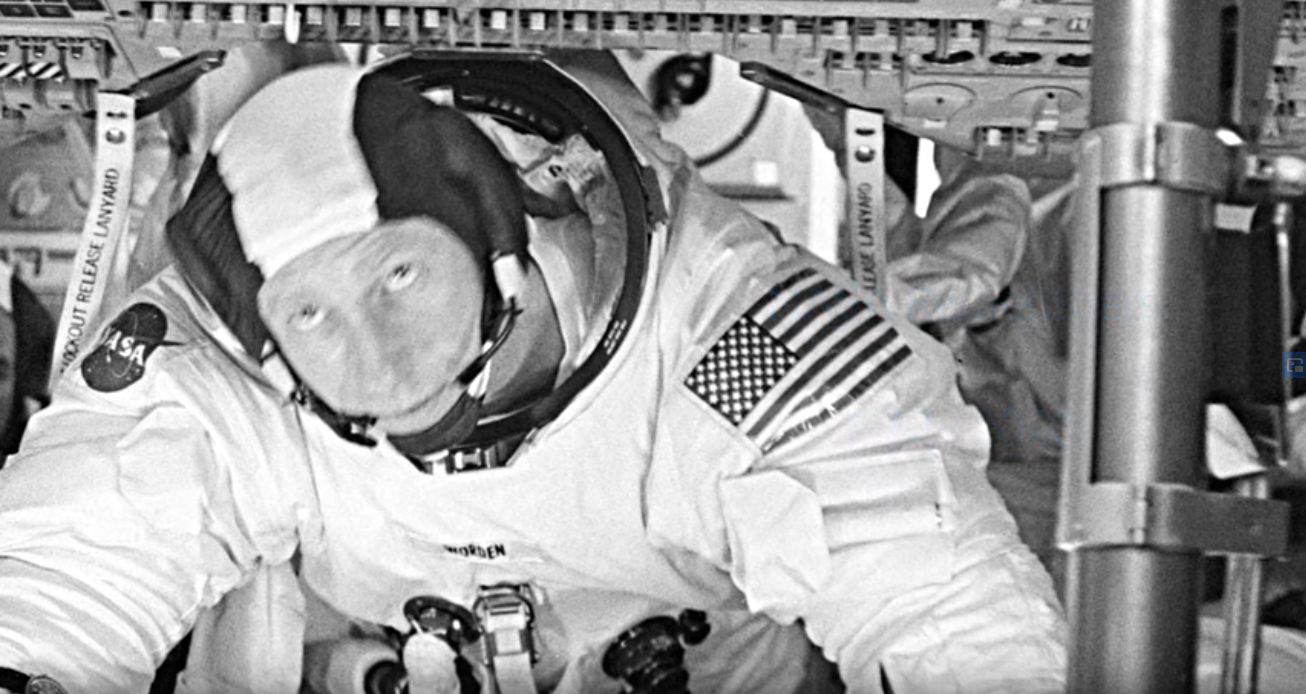
Al Worden, Apollo 15, July 1971. Credit: NASA

The years 2019 through 2022 mark the 50th anniversaries of the Apollo lunar landings of the 1960s. At a time when those ambitious, pioneering mission, undertaken at what was still the early dawn of human space flight, serve as a background against the current US Artemis endeavour, it is sad to report on the passing of another of one of the 24 men who flew to the Moon as a part of those trailblazing missions has passed away.

Alfred Merrill “Al” Worden was one of those Apollo pioneers who is perhaps less well-known than others, as he was one of Command Module Pilots. These were the mean who remained in lunar orbit piloting the Apollo Command and Service Module (CSM) whilst their fellow crew members made the actual descent and landing on the Moon, and so – with perhaps the exceptions of Michael Collins (Apollo 11) and John Leonard (“Jack”) Swigert Jr. (Apollo13) – did not garner the same degree of media attention during their missions and their surface exploring crew mates.

Worden’s lunar flight aboard Apollo 15 (July 26th, 1971 through August 7th, 1971) was his only flight into space, thanks to actions he and his fellow crew, David R. Scott and James Irwin, took before, during and after the mission which saw all three removed from active flight status for the remainder of their careers at NASA.

Born in 1932, in Jackson, Michigan, Worden was the second of six children and the oldest of the four boys born into a low-income farming family. A keen learner, he opted to try to continue his education beyond high school by obtaining an scholarship, initially to the University of Michigan. But unable to secure funding for more than a year, he turned his attention to the military in order to continue his learning. Applying to both United States Military Academy at West Point (US Army) and the United States Naval Academy at Annapolis, he found himself accepted by both, and after some deliberation, opted to go to West Point, enrolling there in 1951.

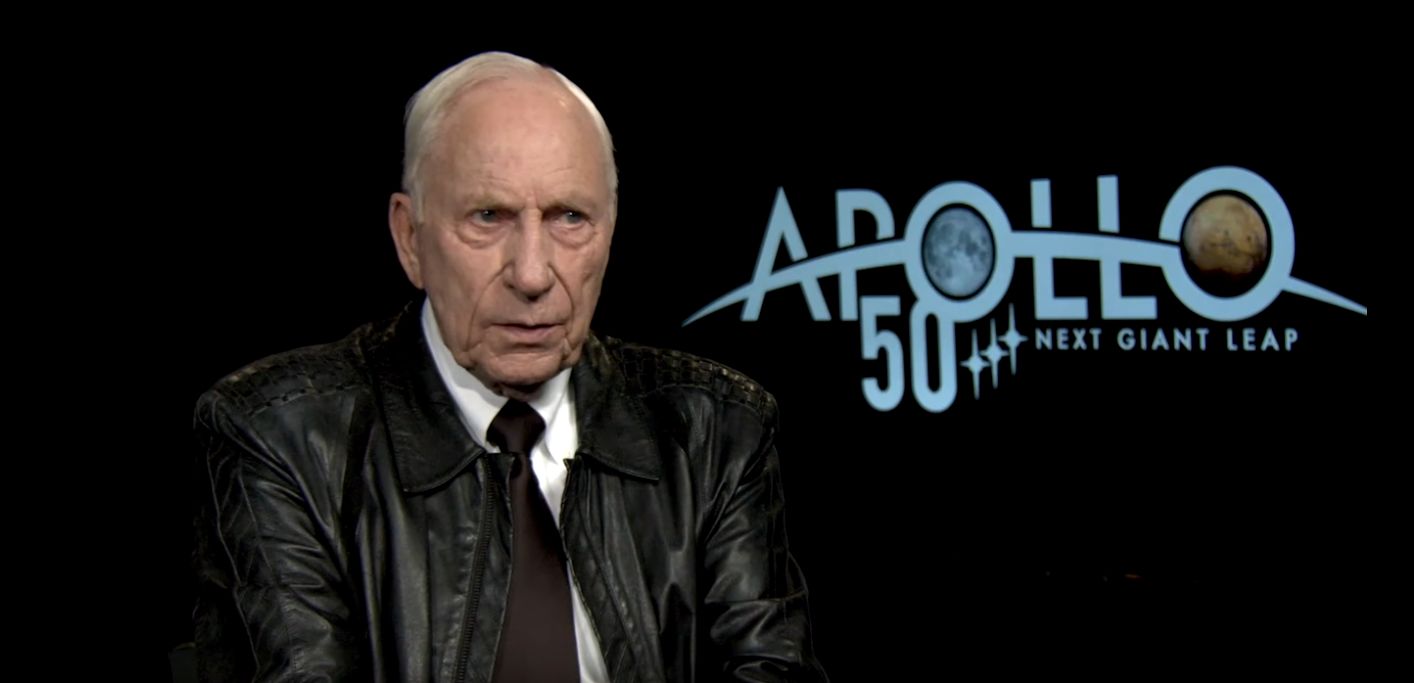
Al Worden at an Apollo 11 50th anniversary event. Credit: NASA

Whilst he enjoyed the army discipline at West Point, Worden found himself being encouraged by instructors to pursue a career in the nascent United States Air Force (formed out of the United States Army Air Force in 1947). At that time, the USAF was so young as an independent branch of the US military, it did not have its own training academy, so Worden was able to take advantage of an arrangement that allowed West Point and Annapolis graduates to transfer to the USAF for training, regardless of any possible lack of experience in flying.

As it turned out, Worden proved to be a natural flyer, moving swiftly from the propeller-driven T34 trainer to the jet-powered Lockheed T33. On completing his Air Defense Command training, he was posted to the 95th Fighter Interceptor Squadron, based at  Andrews Air Force Base near Washington D.C. , where he mostly flew the USAF’s first supersonic, swept-wing fighter, the F-102 Delta Dagger. Staying with the squadron as a pilot and armaments officer through until May 1961, Worden applied for, and received, permission to study aerospace engineering at the University of Michigan, graduating in 1963 with Master of Science degrees in astronautical/aeronautical engineering and instrumentation engineering.

Returning to flight service, Worden increased his logged flying time to over 4,000 hours, 2,500 of which was flying jets. During this time he graduated from both the Instrument Pilots Instructor School in the US, and the Empire Test Pilots’ School, UK, one of the most high-regarded test pilots schools in the world. He then served as an instructor at the Aerospace Research Pilots School, then attended the USAF’s advanced flight training school for experimental aircraft, as both a pilot and as an instructor.

In 1966, he joined NASA as a part of the 19-strong Group 5 astronaut intake, alongside of his eventual crew mate, (“Jim”) Irwin. In 1968, they were selected to be the Apollo 12 back-up under the command of veteran astronaut David R. Scott, one of the most experienced Apollo astronauts, whoo had already flown on Gemini 8 and, more particularly, Apollo 9, the proving flight for all of the Apollo hardware – Saturn V rocket, Apollo Command and Service Modules, and the Lunar Module.

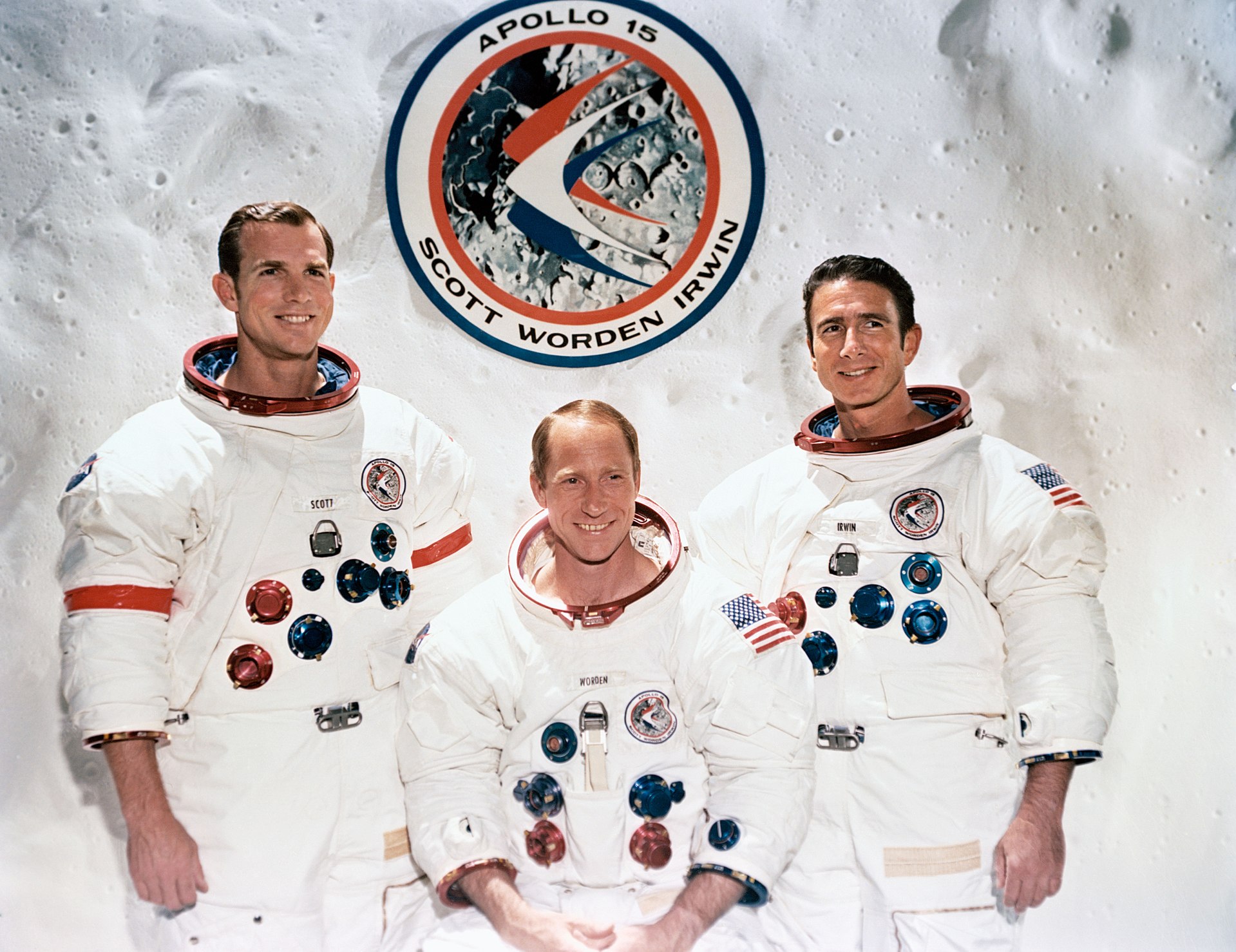
Apollo 15 crew: David Scott (l), James Irwin (r) and Al Worden (c). Credit: NASA

The crew were appointed as the prime crew for Apollo 15 at the start of 1970. From the start, Scott, as the mission commander, was determined that they would by the crew that gathered the most scientific data on and about the Moon – spurred in on part back the Apollo 15 back-up crew included Harrison Schmitt, the only actual scientist to participate in a lunar flight (Apollo 17). A first reason for wanting to be the best science crew on Apollo was that thanks to NASA cancelling two of the planned missions, Apollo 15 was raised to a “J-mission”, becoming the first such mission to feature an enhanced Lunar Module, capable of carrying more to the surface of the Moon, including the now famous lunar rover vehicle.

The J mission status of the flight also meant that Worden would have far more to do in lunar orbit than previous CM pilots, as the service module for the mission was the first to include a dedicated Scientific Instrument Module (SIM) bay. This was an equipment bay shielded by a protective panel during launch (and jettisoned once en route to the Moon), and carrying a range of science equipment – a high-resolution contained a panoramic camera, a gamma ray spectrometer, a mapping camera, a laser altimeter and mass spectrometer, all of which Worden had to manage and monitor. In addition, the bay contained a sub-satellite he was tasked with deploying before Apollo 15 left lunar orbit to return to Earth, and designed to study the plasma, particle, and magnetic field environment of the Moon and map the lunar gravity field.

A shot of the Apollo 15 Command Module Endeavour and its Service Module, as seen by from the Lunar Module Falcon, showing the exposed SIM bay and instruments, the cover having been jettisoned en route to the Moon. Credit: NASA

Worden’s sojourn about the Command Module Endeavour began after the Lunar Module carrying Scott and Irwin detached from his vehicle on July 30th, 1971 at an attitude of just 10.7 km above the lunar surface. Following separation, Worden fired the main engine on the Service Module to raise his orbit to 120.8 km x 101.5 km in order to commence his science work.

Over the next 4 days, he worked steadily on his assigned science duties, actually exceeding in some of them. Among his activities, he used the spy satellite quality camera system in the SIM bay to capture 1,529 usable high-resolution images of the lunar surface, and also carried out a regime of exercises using a bungee cord for research into muscle behaviour in micro-gravity environments. These exercises were supposed to mirror similar exercises performed by Scott and Irwin under the greater influence of lunar gravity, so that comparative data could be obtained between them. However, Worden was so enthusiastic about his work, he completed twice the amount of exercise he was required to do!

During those days on his own, Worden gained a citation from Guinness World Records as “the most isolated human being”, because as times during his flights around the Moon he would by up to 3,597 km away from the Lunar Module Falcon and Scott and Irwin – further than any human being had been from anyone else up until that point in time.

After the mission and when asked if he ever felt alone during this time, he would always reply in the negative, saying it suited his jet fighter pilot mentality, and he particularly enjoyed his times on the far side of the Moon when he’d be totally out of contact with any living soul, and would have something special to look forward to.

Every time I came around the Moon I went to a window and watched the Earth rise and that was pretty unique.

The thing that was most interesting to me was taking photographs of very faint objects with a special camera that I had on board. These objects reflect sunlight, but it’s very, very weak and you can’t see it from [Earth]. There are several places between the Earth and the moon that are stable equilibrium points. And if that’s the case, there has to be a dust cloud there. I got pictures of that.

– Al Worden discussing his time alone as the Apollo 15 Command Module Pilot

Following the rendezvous with, and recovery of, the Lunar Module ascent stage, Worden had another record-setting duty to complete: whilst en-route back to Earth, he had to perform an EVA – extra-vehiclular activity -, leaving the Apollo Command Module to make his way back to the SIM bay of the service module to collect the 25 kg cassette of images he’d captured during his time orbiting the Moon.

Worden during his historic deep space EVA, the round drum of the film cassette hanging from his harness. Credit: NASA

The space walk was completed with Jim Irwin standing in the Command Module’s hatch ready to provide assistance if needed, a camera watching over his shoulder. At the time, Apollo 15 was approximately 317,000 km from Earth, marking Worden’s space walk has the first “deep space” EVA in history. As of 2020, it remains one of only three such EVAs, all performed during  the last three Apollo lunar missions.

Despite the overwhelming success of Apollo 15 and the achievements made – first J-class mission, first use of the SIM bay, first use of the lunar rover vehicle, etc., – following the astronaut’s return to Earth, the mission would become the subject of the controversy that would see Scott, Irwin and Worden grounded by NASA for the rest of their careers.

Prior to the flight – and against NASA policy – all three men entered into a financial arrangement with a West German stamp dealer to fly 400 postal covers to the surface of the Moon and back.

Postmarked on the day of the launch at the Kennedy Space Centre post office and smuggled onto the Command Module, the covers flew to the Moon and then to the lunar surface with Scott and Irwin. On their return to Earth, the three men managed to get 398 of the covers – two were accidentally destroyed – cancelled and date-stamped on the day of their splash down at the post office aboard the recovery ship, USS Okinawa. Once back in the USA, the astronauts annotated and signed them, before sending 100 to the dealer, Hermann Sieger, whilst splitting the rest between themselves. The arrangement was for Sieger to pay the three men $7,000 each (approximately US $45,196 in today’s terms), and then give them a percentage each of the 100 in his possession, which he sold to dealers at $1,500 a cover.

Space Sunday: hot ice, capsules and dealing with a virus

The north polar region of Mercury showing the disposition of water ice in permanently-shadowed craters. Credit: NASA / Georgia Tech

Mercury, the closest planet in our solar system to the Sun, is hardly the kind of place where you’d expect to find water ice. With surface temperatures reaching 400º C (750º F) on its sunlit side, the planet is fairly constantly broiled by the Sun. And yet NASA’s MErcury Surface, Space ENvironment, GEochemistry, and Ranging (MESSENGER) mission did actually confirm ice on Mercury in 2012.

As with ice on the Moon, this water ice is located in deep craters around Mercury’s poles where the Sun never shines. What’s more, it appears to be created through a similar process and the lunar water ice; however, and in what may seem to be a counter-intuitive fact, the greater heat Mercury endures means it has far more ice located in its polar craters than the Moon.

It goes like this, electrically charged particles from the Sun’s solar wind interact with the oxygen present in some dust grains on the surface to produce hydroxyl  (OH – a single hydrogen atom and a single oxygen atom). This hydroxyl bonds in groups within Mercury’s surface material, just as they do on the Moon.

On both the Moon and Mercury, heat from the Sun both frees these hydroxyl groups and energises them, causing collisions that that produce free hydrogen and water molecules. Some of these water molecules are broken down by sunlight and dissipate. But others descend into deep, dark polar craters that are shielded from the Sun. Here they freeze to become a part of the growing, permanent glacial ice housed in the shadows.

However, because Mercury is so much closer to the Sun, the greater exposure to the solar wind and  – more importantly – greater heat means that the production and release of hydroxyl means that the production of hydrogen and water molecules is much greater – and some is the volume of those molecules falling into polar craters. Thus, the production of water ice on Mercury is much more pronounced – so pronounced that it is estimated some 10,000,000,000,000 kg (11,023,110,000 tons) of ice is generated over the course of 3 million years, cumulatively enough to account for around 10% on the total ice found on and under the surface of Mercury – the rest having being delivered via asteroid bombardment in the planet’s early history.

The process of the ice falling into the craters is a little like the song Hotel California. The water molecules can check in to the shadows, but they can never leave.

– Thom Orlando, Georgia Tech, a co-author of a new study into water ice on Mercury

Starliner: 61 Changes Required

On Friday, December 20th, 2019, NASA and Boeing, together with launch partner United Launch Alliance (ULA), attempted to undertake the first flight of the Boeing CST-100 Starliner commercial crew transportation system to the International Space Station (ISS).

The mission – called Orbital Flight Test-1 (OFT-1) should have seen the uncrewed Starliner craft achieve orbit and then rendezvous with the ISS, where it would dock and spend several days there before making a return to Earth and a parachute landing in the Mojave desert.

While, as I reported in Starliner’s first orbital flight, the majority of the mission was a success – the vehicle achieved orbit and was able to carry out as series of orbital tests before returning safely to a soft landing, issues with the craft meant the capsule incorrectly initiated a series of firings of the vehicle’s attitude control system (ACS) when they were not required. By the time the errors were corrected, the vehicle had insufficient fuel reserves left in the ACS system tanks to achieve a safe docking with the station, thus causing the rendezvous to be abandoned.

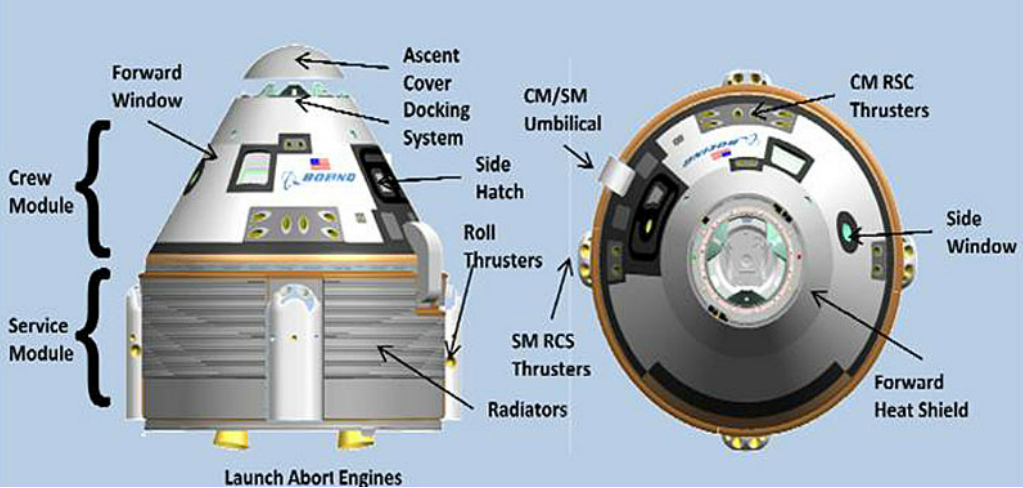
The CST-100 Starliner system. Credit: Boeing

Since then, NASA and Boeing have been investigating the root cause of the ACS timing misfiring. The results of these investigations identified both technical and organisational issues within Boeing’s management of the CST-100 programme. At the same time, a NASA internal review identified several areas where the agency could make improvements with regard to its participation in the production and testing of Orion capsules.

In all, some 61 corrective actions have been identified by NASA that Boeing need to make to both the processing of Orion vehicles and in their flight management organisation. These include gaps in processes that prevented ground-based mission controllers identifying what had gone wrong with OFT-1 in order to initiate corrective action that might have allowed the vehicle to go forward with its rendezvous with the ISS.

Boeing has accepted all 61 recommendations from NASA, and has started to implement them. At the same time, it has indicated it is to overhaul all of its testing, review, and approval processes for CST-100 hardware and software, and institute changes with its engineering board authority. NASA also plans to perform an Organisation Safety Assessment (OSA) of the workplace culture at Boeing prior to any future CST-100 flights.

The OFT-1 Starliner following its successful return to Earth, December 22nd, 2019

While there was no crew aboard the test vehicle, NASA has nevertheless designated the flight a “high visibility close call” in accordance with their own procedural requirements. This means that while it is unlikely they would have threatened a crew had they been aboard (in fact, a crew would likely have been able to immediately respond to the ACS issue and correct it) the anomalies during the flight were simply too big to ignore, and could have led to serious consequences under different circumstances.

No date has yet been confirmed for the second orbital flight for a Starliner vehicle. This is due to deliver a crew of three NASA astronauts (Nicole Mann, Mike Fincke and Christopher Ferguson) to what might yet be an extended stay at the ISS in what is regarded as the final test flight for the CST-100.

The first “operational” flight for Orion will comprise NASA personnel: mission commander Sunita Williams and Josh Cassada, ESA astronaut Thomas Pesquet and cosmonaut Andrei Borisenko. This flight will see the vehicle used in OFT-1 re-used as part of NASA’s plans to fly each CST-100 a number of times. Commander Williams was on hand to witness the vehicle’s return to Earth at the end of OFT-1, and she named the vehicle Calypso.