Sundry thoughts on regions, revenue, tier and platforms

A quiet afternoon at Hollywood Airport

The year-end brought with it a round-up of Second Life in terms of region numbers, courtesy of Tyche Shepherd and her excellent Grid Survey. 2014 continued to see the downward count in the number of private regions in SL, with some 673 regions vanishing through the course of the year (from 19,273 at the start of the year to 18,600 at the end of the year).

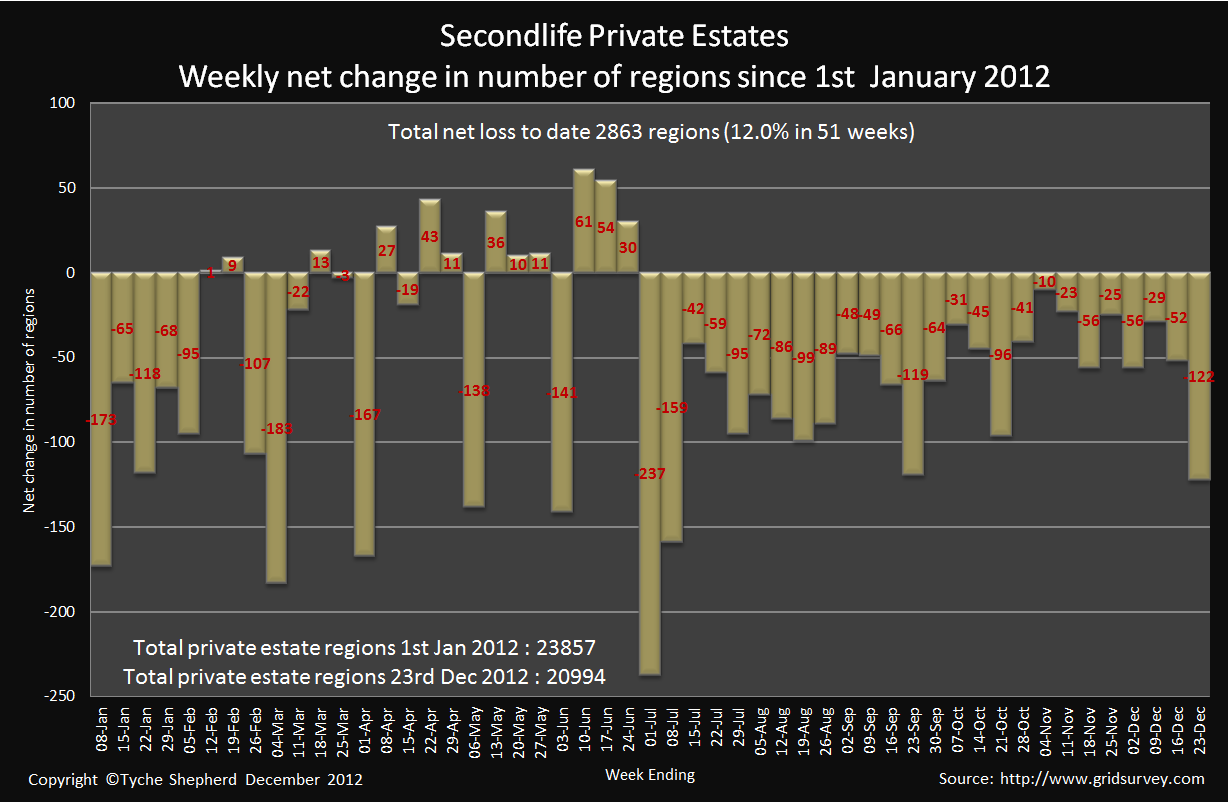
Expressed as a percentage, this means that the main grid has shrunk by 3.5%. That compares to an 8.2% shrinkage in 2013 (from 20,992 to 19,273 regions, a loss of 1719) and a 12% reduction in 2012 (23,857 to 20,992, a loss of 2865 regions).

There are likely to be a number of reasons for the slow down in losses, all interacting with one another. While  one ideologue opted to pooh-pooh it, in September 2011 I pointed to one contributing factor to the then increasing rate of decline in region numbers as likely being due to physical world economic issues. With their disposable income diminishing, people were finding an outlay of $125 a month for virtual land increasingly hard to justify, and so were divesting themselves of it; something which likely continued through 2012 and early 2013.

Private regions numbers through 2014 (source: Tyche Shepherd, SLU forums)
Private region numbers decline through 2014 (source: Tyche Shepherd, SLU forums)

While I’m not about to say we’ve turned the corner where the physical world economic situation is concerned, it is probable that by late 2013 we’d reached a point where those still with a residential homestead of their own were more willing to grit their teeth and pay for the land they hold, thus contributing to the slowing of shrinkage.

So what does that mean for the year ahead? While nothing is guaranteed, I tend to sway towards the view that the decline in region numbers will continue to slow, but at less than the rate we’ve seen in from late 2013 through 2014. I’m also inclined to think we won’t see any significant rise in region numbers through 2015 (unless some kind of external factor comes into play or the Lab does opt to do something quite unexpected to cause people to suddenly want lots of land).

One thing the slow-down will hopefully do is decrease future calls for tier cuts. As I explained back in January 2013, unless the Lab have a substantive means of compensating for the revenue loss resulting from any “reasonable” tier, any such cut will likely hurt the company (and SL) more than help. Nor is the Lab’s profit margin anywhere near the levels sometimes mentioned (e.g. the 200% recently claimed in this blog), such that they could simply “absorb” any tier cut without feeling the impact.

The decline in private regions, January 2012 through December 2013 (source: Tyche Shepherd, SLU forums)

In 2008, estimates put the Lab’s earnings at around $90-95 million, and their possible profit margin at between $40-$50 million (48-50%) – see the articles here and here. I assume these estimates are for gross profits, as neither makes allowances for tax.

More to the point, there seems to be a slight flaw in both estimates: they only appear to reference the costs involved in running simulator servers. No mention is made of the various back-end services such as group chat, group management, asset management, login, transaction management and payment, (and today, the avatar baking service), the various web services (Marketplace), and so on. While the costs associated with all of these are obviously going to be a lot lower than those for the simulator hosts, they shouldn’t be entirely discounted. There’s also third-party support costs (in 2008-2010, for example, the Lab was paying Rivers Run Red and 80/20 Studio; today there’s the costs involved in using the Highwinds CDN service).

Continue reading “Sundry thoughts on regions, revenue, tier and platforms”

Tier cuts: looking from the Lab’s perspective

Apologies to those who may have received notification of an early version of this post being published at the weekend. Slight error on my part hitting the wrong button when trying to clear-up some old drafts.

Tier has long been an issue within Second Life, one which has been exacerbated over the last 24 months by the ongoing decline in private region numbers, which form the greater proportion of LL’s revenue. The decline has been tracked across the weeks and months by Tyche Shepherd via her invaluable Grid Surveys. In 2012 alone, the grid has suffered a loss of around 12% in private regions. Such is the concern over tier that it gets raised following articles which may not be related to the subject – such as LL moving to promote SL through Amazon.

This decline has been subject to many calls for the Lab to reduce tier, with some recently advocating it should be cut by one-third. However, as both I and Tateru Nino attempted to explain in June 2012, while cutting tier may appear the obvious thing to do, it may not actually be the easiest or most comfortable thing for the Lab to do.

Crunching Some Numbers – the Lab’s Perspective

While I have covered some of this ground before, I thought it interesting to look at some numbers purely from the Lab’s perspective, using Tyche’s Grid Survey and survey summaries as reference.

Private regions losses through 2012 (click to enlarge)
  • As of December 31st, 2011, monthly private region revenue for LL was approximately $5,006,000, with a margin of error of +/-$60,000
  • As of December 31st 2012, monthly private region revenue for LL was approximately $4,244,000 per month, with a margin of error of +/- $53,000
  • While acknowledging we have yet to see Tyche’s 2012 end-of-year survey, that amounts to a drop of $762,000 through the year, or an average of $63,500 per month

If there is no reduction in tier, it is probable that the current decline in private region revenue will continue at or near the 2012 monthly average of $63,500. However, were the Lab to cut tier by one-third, they immediately slash monthly private region revenue by $1,400,520. That’s equivalent to 4,747 full private regions vanishing from the grid – 1.6 times more that the total number of private regions (full, Homestead and OpenSpace) lost in 2012.

Even allowing for the tier cut stimulating the demand from new land (and there are problems with that, as discussed later in this article), and assuming set-up fees remain unchanged, it means the Lab would need to see the equivalent of 1,337 full private regions added to the grid in the first month following the cut just to match the revenue loss suffered had they not cut tier (i.e. the difference between $1,400,520 and $63,500).

Continue reading “Tier cuts: looking from the Lab’s perspective”

The tracts of our tiers

The continuing decline in the number of private regions in Second Life, as documented by Tyche Shepherd, is giving rise to no small amount of concern, some of which is taking the form of calls for Linden Lab to reduce tier.

Region losses: uncomfortable reading

Certainly, Tyche’s figures – a loss of 1138 regions in the first 22 weeks of 2012  – are sobering; but is cutting tier really the solution at this point in time? Is it actually possible? If not, what are the alternative?

On the surface, reducing tier might seem to be a logical option. We’re all aware that tier in SL is high – but just how practical would it be for Linden Lab to lower it? If truth be told, the answer is actually, “Not very” – and for a number of reasons which may not be entirely palatable to some, but which are nevertheless unavoidable. First and foremost is the fact that, like it or not, tier accounts for 80% of Linden Lab’s revenue, so any reduction is going to hit them very hard – and will do so for some time to come.

As it stands, the current decline in private sims amounts to around an average monthly drop in tier revenue of 0.8% per month to date through 2012 – a figure which includes the fact that tier revenue did in fact increase in March by some 1.1%. While this may sound a lot, the fact remains that overall, it is a gradual downward swing. A cut in tier is not; it is an immediate and lasting loss of revenue. Drop tier by 20% and that’s 20% of your revenue gone in a blink – and with absolutely no guarantee you can compensate for it.

Of course, it will be argued that any drop in tier will lead to an uptake in land sales which will compensate for the initial loss. However, the reality is that this is very far from guaranteed. Just because tier is lowered does not automatically equate to a sudden growth in land sales. Let’s face it, private estates are already struggling to fill their available land (and the fact that they are is also likely to be a factor fuelling the number of regions being returned to Linden Lab) – so why would they rush out to obtain even more sims on the strength of a tier reduction when the population currently isn’t there to warrant them doing so?

The one possible exception to this might be with Homestead sims. These might well enjoy an initial boom period as people opt to take advantage of the lower tier and migrate to them. However, this would be somewhat tempered by an increase in the number of surplus full regions being returned to LL that would also result from such a migration. Thus, while land may appear to grow as a result of the increased number of Homesteads, any corresponding growth in revenue for LL is liable to be much smaller, and unlikely to compensate for the tier cut itself.

The same goes for commercial enterprises: any cut in tier is an immediate increase in revenue for them – but it doesn’t mean they will rush out and set up even more stores across the grid. Why should they when the teleport can instantly bring people to their existing store? Additional stores don’t automatically translate into increased revenue – but they do incur increased costs, thus undercutting and gain made through a tier reduction. And while some might opt to take the plunge and expand – or even open new product lines in new stores – it is unlikely, overall, that a tier reduction is unlikely to bring about the renaissance of the mall in SL, for example, much less a quantifiable boost to the economy as a whole.

The cold hard truth is that however much a reduction in tier might individually benefit those of us who hold land within SL, it’s actually not going to do that much to stimulate the economy – and it will stand to benefit Linden Lab even less.

Nor is being “radical” the answer. While it is true that the one way of stimulating growth in SL is to grow the user base through increased user retention, etc., this has to be tempered with the fact that the infrastructure itself can only support so much. So while Second Life does need more users and a sustainable upswing in user retention, calls for LL to try to pull-in “millions” of users are misguided and will remain so until such time as the platform can handle large volumes of avatars in close proximity to one another on an ongoing basis. Bold and radical are only useful if they are actions taken with clear intent and realizable goals.

Which is not to say something shouldn’t be done to safeguard the future. The question is what that something should be.

And it is a question Linden Research has already taken steps to address – although not in the way many have guessed. Because the answer isn’t in the company trying to reduce tier – not yet, at least – or in doing anything else with Second Life itself. Rather, they are seeking to address it through their drive to diversify.

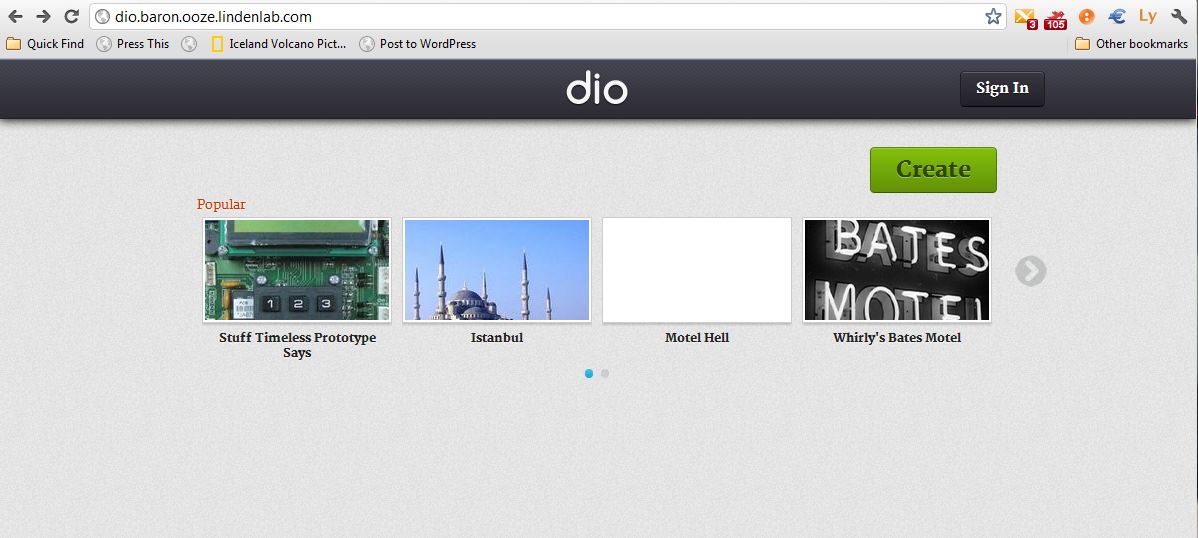
As has been reported far and wide across SL and other blogs, Linden Research is in the process of developing a portfolio of non-SL products, at least one of which, called Dio, is nearing readiness for closed beta testing. These products that are important for two key reasons:

  • They will open up new revenue streams to the company, thus reducing the strain on SL as the company’s single source of revenue, potentially allowing the company to be far more flexible in how it handles the platform fiscally;
  • They make Linden Research a far more attractive proposition for investors.
Dio: Linden Research closed beta almost ready?

Of course, it will take time for the revenue streams from the new non-SL products to mature. But as it stands, Linden Research perhaps has that time at their disposal, despite the current sim losses. In March, during a discussion on her blog, Tateru Nino estimated that the break point for LL in terms of private regions losses would be around 6,000 fewer sims than were on the grid at that time. Assuming the rate of decline in regions continues at its present rate, then LL will reach that break point about 24-30 month from now – which is potentially more than enough time for the revenues from these new products to make their presence felt.

Not that the company actually needs to wait that long. As mentioned above, the new products have the potential to benefit the company more immediately through inward investment through them. This is unlikely something that has been lost on either the management team or the board, especially given the mounting interest in, and speculation around, a new era of narrative games.

This may be of scant comfort to those of us feeling the pinch in Second Life right now – but the fact is that when it comes to tier and LL’s revenue, there is no easy answer, and any solution that is offered up is unlikely yield the anticipated benefits. Nor can the SL revenue model be easily or radically shifted. As such, the move to diversify into new product lines is perhaps the one means by which Linden Research can remodel its revenue streams without harming itself, and bring about the means by which it can take a more flexible approach to the management and operation of Second Life. If this is the case, then the company has perhaps shown itself to be far shrewder than people are prepared to credit.

Don’t much care for the prognosis? Would you like a second opinion? Would you like to read more on the subject of tier economics in SL? Well, I invite you to have a read of Tateru’s Nino’s thoughts on the matter..

Land sale in fact sees 689 private regions added to SL

Tyche Shepherd has issued a revision to her initial findings following last weekend’s land sale by the Lab.

When first surveyed, some 30 minutes after the sale had finished, it appeared that some 322 private regions were added to the grid, leading to a net gain of some 311 regions.

However, a later survey revealed that in fact a staggering total 689 regions were added to the grid as a result of the sale and sims returned to use, leading to a net gain of some 508 private regions after accounting for losses.

Of the total number of sims added to the grid:

  • 464 were open to public access, and so could be surveyed with:
    • 343 being full regions
    • 117 being homestead regions
    • 4 being OpenSpace regions
  • 225 remain closed to public access and have yet to be surveyed as to type

The 464 accessible regions were purchased by a total of 381 individual estates with 252 purchasers having no other holdings. Only five of those purchasing multiple regions brought more that 3.

The revised totals are liable to be the focus of further debate around the “new” and “used” land markets – and those seeking to offload sims to other users may well feel every harder done-by on seeing these revised figures. Those who have paid the set-up fee, and who that have to recoup that on top of the cost of tier might also be aggrieved by these results as well, particularly if the new sims coming into the grid as a result of this sale are used within the commercial / residential markets.

It will be interesting to see what the overall impact of the sale turns out to be in terms of LL’s thinking. 689 regions does make even more of a powerful case for the set-up fees to be reduced (if possible) to something reasonably sensible, as I ruminated on when reporting the original figures released by Tyche.

Of course, the precedent for lowering set-up fees has already been set. Leave us not forget the fee for a full region was once $1675, so on the surface at least it’s not unheard of for LL to adjust this figure in line with costs. As such, it is something the company may opt to do again, and it is certainly more palatable to them than lowering tier, as some are calling for within the community.

Tier is something that will have to be reviewed; the case for reductions being needed in the future is growing. but for now, given the outcome of last weekend’s sale and that it is a) it is easily reproducible as a promotion and b) will likely achieve the same level of success if repeated in a few months time should a boost in revenue be required, one rather suspects LL may well sit on their laurels for a while longer and not hurry into any moves as regards tier or set-up fees just yet.

LL’s Land sale: 322 sims in 48 hours

Note: there is now further information available on the total number of sims leased as a result of the sale.

I had doubts that the weekend’s Land Sale would prove popular among independent users and smaller estate owners. Rather, I thought that if it had any appeal at all, it would be with the larger estates.

I was completely and utterly wrong on both counts.

As Tyche Shepherd reveals, during the offer period, some 322 private regions were leased. Overall, this resulted in a net growth in private regions of some 311 – around 300 more, Tyche estimates, than might otherwise have been the case.

The 322 regions added to the grid currently comprise:

  • 152 full regions
  • 43 Homesteads
  • 127 currently closed to public access (could be either full or Homestead)

In terms of purchasers, in the 195 regions open to public access:

  • 177 are owned by different purchasers, with no single individual buying more than 3 regions
  • 111 of the new owners have no other active land holdings
  • Some purchases were made by larger estates, but again, none exceed 3 purchases during the period of the sale

So, what does this mean? Certainly, it is a braking (I wouldn’t go so far to say “reversal”) of the recent private region losses. Whether this remains so will only be seen in the release of figures over the weeks.

In terms of stemming LL’s revenue losses resulting from the fall-off in private regions, it tends to demonstrate that far from having to take “drastic” action as some have been demanding, LL actually need to do very little. Just imagine how many more sims might have been leased had the offer run for a week, or how well another such sale would be received if run, say, some time early in the New Year. Of course, whether such promotions have benefit beyond the balance sheet is quite another matter.

Certainly, the sale has generated a lot of debate around abolishing the set-up fee altogether. Some were actually making the call even before the sale was over, and the success of the sale would seem to support them. But abolishing set-up fees is not without risk; many have been reporting for a good while now that they are finding it increasingly difficult to “offload” sims due to the $100 transfer fee. Abolish the front-end set-up fee for new sims on a long-term basis, and this situation could get very much worse.

Perhaps the middle ground would be for LL to restructure (i.e. reduce) the front-end set-up fee while at the same time abolishing the sim transfer fee for “used” sims. Assuming contractual obligations with their co-location hosting company would allow this to happen, one might suggest that dropping set-up to the cost of tier might be a happy medium (so a full sim would cost $295 set-up + $295 tier, for example), alongside of transfer fees being dropped altogether.

When looking at the set-up fees, one has to say there does appear to be a gross imbalance, which suggests there might be some room for manoeuvre here. What is it about a full sim that makes the cost of setting it up some 2.5 times greater than the fee for setting-up a Homestead? At the end of the day, surely, both are more-or-less the same in terms of software, and both have to go through the same load, configuration and test processes prior to being released to the customer. As such, one would have thought that actual costs involved for both would be more-or-less comparable.

At the end of the day, however, what this sale has demonstrated (besides being very good for LL’s balance sheet) is that when given the right incentive, there is still a healthy market willing to invest in new sims. As such, it’s far to call the promotion a success. Nevertheless, whether it has itself been beneficial to the SL land market as a whole is another matter entirely. That is only likely to be known in another two or three months time via Tyche’s on-going grid surveys.

Just how bad is a 650-region loss?

Last week an article appeared in New World Notes (NWN) which seemed intent on giving the impression that Second Life is in a state of terminal decline. The headline proclaimed: “Second Life Has Lost Over 650 Sims & $1 Million in Yearly Revenue in 2011; This is Why SL Can’t Survive as a Niche”, followed by a comment that, “The only future for Second Life is several millions of users, or none at all”.

Provocative reading perhaps; but how reasonable is it to make such assertions?

Well, first and foremost, I don’t dispute the figures in terms of region losses or potential revenue drop. They’ve been taken from Tyche Shepherd’s excellent Grid Surveys, which week-by-week look at the overall status of the grid in terms of regions, private and mainland. Rather, I tend to find the conclusions the author draws from Tyche’s figures to be somewhat questionable.

The Ebb and Flow of the Statistical Tide

Let’s try to put things in a little perspective, starting with two points in particular:

  • 650 regions is around 2.6% of the total land mass
  • Linden Lab has an inward flow of revenue of some $75 million a year. As such, $1 million amounts to a 1.3% drop in that revenue. All things considered (economic climate, etc.), that’s not an horrendous drop.

Now let’s take a look back at private regions in SL over the last three years (a not unreasonable time-frame in business terms).

  • 2009:
    • Jan-May SL suffered a loss of 1095 private estates during the first 5 months (from 22406 to 21311); no doubt fuelled in part by the OpenSpace fiasco
    • June-December: SL grew to 24033 private estates, an increase of 1627 regions over the start-of-year
  • In 2010:
    • SL grew by 6% overall in terms of regions
    • 44% of this growth lay in private regions, representing an overall growth of  3% for private regions
  • In 2011:
    • Jan-Aug: 2.6% loss of private estates
    • A potential 3.9% loss by year-end.

In other words, in 2009, private regions on the Grid grew by some 7.26% over the start-of-year figure, despite an initial loss of some 4.88%. In 2010 it grew by a further 3% in private regions.

So while a current 2.6% drop is cause for some concern – it’s not yet drastic. Even if the shrinkage continues through to the year-end (as seems likely, given Tyche’s latest figures), and yields a potential 3.9% drop in private regions, the situation still would not be terminal.

Recession does Nasty Things

There is another factor to consider here. Right now, we’re in the midst of a prolonged global economic downturn. The longer it goes on, the deeper it bites into people’s disposable income. A prudent observer of the current decline in private regions in SL would consider it possible – likely, even – that the recession is responsible for at least some of the shrinkage we are currently seeing. One sees little sign of this in the NWN article.

But downturns don’t last forever (or if this one does, we’ll all have a lot more to worry about than Second Life). Therefore (and while past performance may not always be indicative of future growth), it is no unreasonable to suggest that once the economy does start to improve, people will again have more disposable income they can put towards Second Life, and this is likely to result in an improved demand for land as a result and at least slow – if not reverse – the current trend in private region losses.

Alternatives

Nor do Linden Lab need to convert anywhere near 400,000 users to Premium membership in order to recoup falling land tier income (even should this be necessary), as the NWN article also dramatically suggests.

Right now, Linden Lab generates some 20% of its income – $15 million – through non-land related activities. As such, it only needs to increase that $15 million revenue by some 10% to help offset the losses experienced to date – a not impossible figure.

There have already been a couple of small moves in this direction; we’ve seen the introduction of upload fees charged for mesh imports and a push to generate more Premium memberships. While the former might not have a significant impact in the scheme of things, the same is not necessarily true of the latter. Were Linden Lab to offer a Premium membership package that gave clear and significant benefits to those already engaged in Second Life (rather than just new users, as seems to be the case with the current offering), then the potential uptake could be significant – and relatively rapid.

Beyond this is the fact that Linden Lab doesn’t necessarily have to look at Second Life to recoup “lost” revenue. The company is shortly to launch new products into the marketplace. While details have yet to be released, it is unlikely Linden Lab will do so without the means to leverage them into revenue.

True, the results may not be immediate (depending on how these new products are to be monetized and how they are received by the world at large). However, that the company is launching new products means that it will be less dependent solely on Second Life for revenue. An optimist might even speculate that as a result, Linden Lab might have a greater degree of freedom to better restructure / improve the Second Life platform.

Nor should these products be classified (/dismissed?) as some form of “SL Light”, again as New World Notes suggested.* To quote Rod Humble himself in reference to this idea: “I never said a lite version. I said and I mean new products which are in the area of shared creative spaces. or social creative tools or user-created virtual worlds/places if you prefer”.

Where is Everybody?

Truth be told, there is one figure that gives continued cause for concern for many within Second Life – and it is not region counts; it’s user concurrency. This has been in a steady state of decline for the last three years. In her end-of-year summary in 2010, Tyche Shepherd estimated that SL’s average concurrency levels equated to just 1.57 avatars per region. That’s an awful lot of empty space.

Now to be fair, the New World Notes article I refer to at the top of this piece does indicate that Linden Lab needs to do more to get people involved in Second Life – even if it does over-egg things by putting the figure in the “millions”. And keeping on the side of fairness, Linden Lab have themselves indicated that they are working on the means to get people directly involved in in-world activities (i.e. content creation, engaging in the economy as consumers, etc.) a lot sooner than is currently the case. However, one has to admit that it would be nice to see some practical outworking of these ideas before the year’s end. Even a gentle increase in user concurrency that can be sustained for more than a few months would be good news for just about everyone involved in SL.

Niche isn’t Bad

Finally, and in turning to the claim that SL cannot survive as a niche, one has to ask, “Why not?”. The fact is that Second Life has survived for some 10 years as niche product, and has managed to generate a tidy revenue stream for Linden Lab that has made them “Very profitable”, to use Rod Humble’s words, in the process. Get the flow of people into SL right and the mechanisms of engagement in place, and there is no reason why it cannot continue to do so and enjoy practical growth.

This is not to say that things won’t have to change in time; the reality is that Second Life and Linden Lab will be facing challenges in the coming years that may yet force significant changes to aspects of how things are run (such as, ironically, land tier). However, these needn’t necessarily be negative – although they will need to be planned for and carefully executed.

And what is so bad about being niche anyway? Many a company and product have enjoyed long and fiscally healthy times being precisely that.

—–

*Hamlet has pointed out that his article drew the distinction between any new products and SL; as such, I’ve amended this piece and apologise for any upset caused.