It’s been a while since we’ve had news on the mesh parametric deformer project. So it was good to hear Karl Stiefvater (Qarl Fizz, formerly Qarl Linden), the man behind the code, to provide a brief update on matters in this week’s Metareality podcast:
[27:58] Sorry guys; so here’s an update on the deformer. I have been obscenely busy in the last three months work-wise, and I have not had the chance to work on it much. That said, I did start working on it again on Monday [the 16th April] and I should have a release this weekend … The deformer’s going to happen, you don’t need to worry about that. Linden Lab has committed to getting it working; if they reject it for dumb reasons, I think that would – while they’ve done dumb things in the past, I don’t think that will happen; that would surprise me.
Given that there have been unfounded rumours circulating that Linden Lab are trying to “kill” the deformer – which seem largely based on the premise that the project doesn’t appear to be progressing as fast as some people believe it should – hopefully, Karl’s update will set matters to rights, and see an end to such rumours.
For my part, I’ll be keeping an eye on Karl’s website at qarl.com, and will relay any news that is forthcoming.
In the meantime, there has been an interesting discussion going on within the SL official forums relating to standard sizes in SL and mesh. It’s worth a read and gives pause for thought – particularly Max Graf’s very considered input to the discussion.
Linden Lab have issued a call to help with SL9B celebrations, which reads in part:
Second Life’s 9th Birthday is coming up in June! This year it’s all about you — the denizens of the grid, the sultans of Second Life and connoisseurs of creativity— and we want to highlight the many unique and innovative ways the community has made Second Life their own.
This year we will focus the spotlight on community events. No one throws a better event or party than the Second Life community! If you’re having an event to celebrate Second Life turning nine, we want to know about it!
On the surface, this sounds great – until one realises that what is in fact being announced here is effectively the end of an era.
In previous years, Second life’s birthday has been marked through a coming-together of the community as a whole on a set of regions supplied by Linden Lab, to create a glorious theme park of builds and ideas created around a central theme, and in and around which parties and celebrations can be held. While not always free from controversy and acrimony, this approach provided a focal point for events and activities marking SL’s birthday, and helped to bring together residents from across the grid.
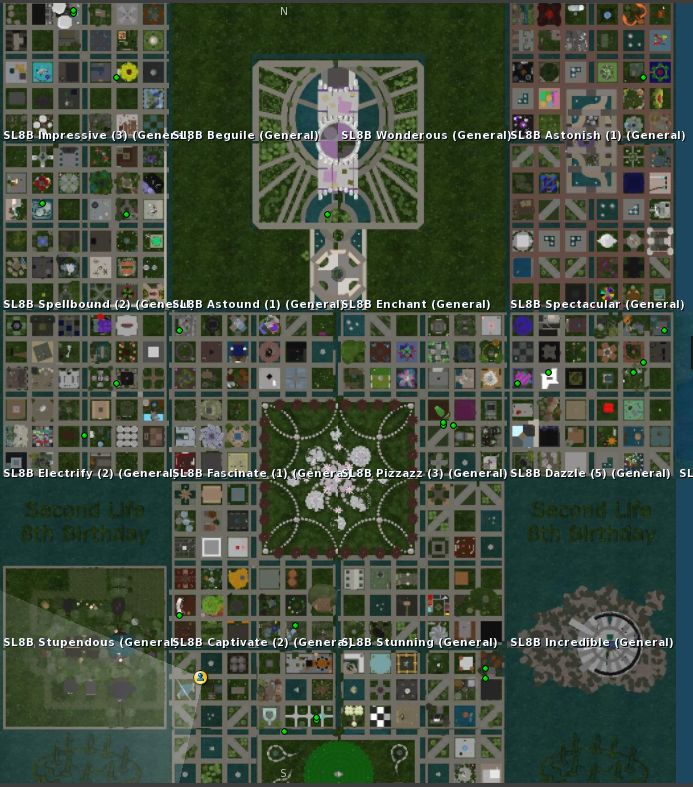
SL8B sims – not this year
Well, not any more.
Hidden within this announcement is the fact that this year there will be no large-scale provisioning of regions by LL; no central place to explore (lag and all) and see builds great and small and enjoy the thrill of celebration and discovery.
And this is a shame.
The SL8B events have traditionally been a marvellous way for the many talents and groups across SL to showcase their work, their talent and their vision. It’s hard to see how such an infinite diversity of ideas and vision can be replicated through a process of complete de-centralisation; one cannot imagine sim / estate owners / groups developing large-scale builds specifically for SL9B, especially with so broad a theme as has been offered.
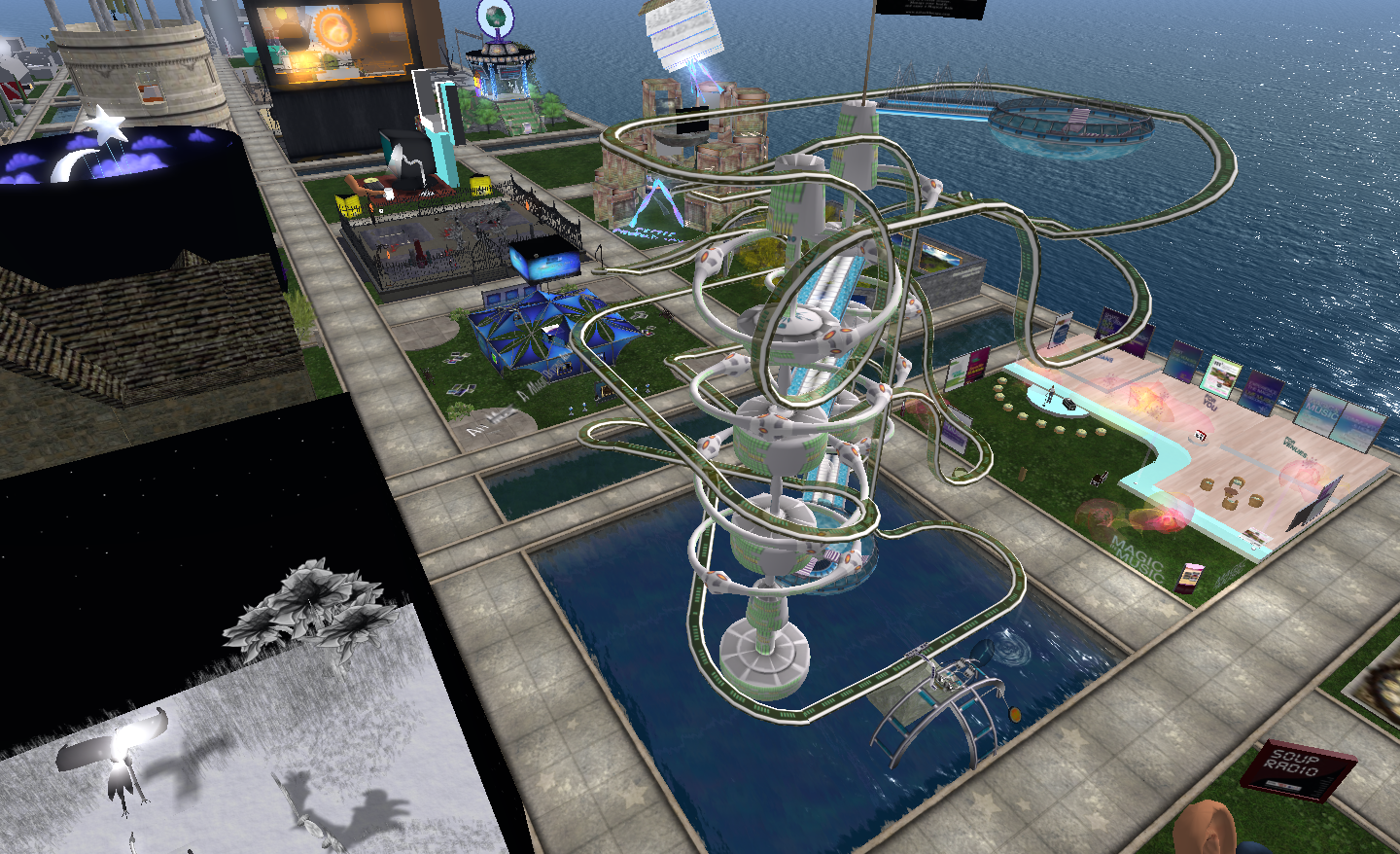
NY HealthScape roller coaster, SL8B – just one of the amazing and informative builds
I’ll personally miss the great gatherings like SL8B and its predecessors. I’ll miss the ability to wander through sim after sim of incredible builds, meeting talented content creators and designers and learning about the unique work of groups such as NY HealthScape.
Why LL have chosen to go this route is hard to fathom. Certainly, as mentioned above, previous SLB events haven’t been entirely free from controversy or headaches – but such upsets have rarely intruded into people’s overall enjoyment of the events themselves, and it is fair to say that where drama has occurred, it’s been somewhat confined to those involved, going largely unnoticed among those from across the grid who have attended events within the SLB sims and spent time exploring the exhibits.
As it stands, this announcement in some way reads less like a call for celebration and more like a renouncement of involvement in a key event in SL’s annual calendar.
And at the risk of repeating myself, that’s a shame.
We’ve all dreamed about running “full” SL on mobile devices; while there are some great text-based clients available for both Android devices and the iPhone which offer a lot of functionality, it’s fair to say that SL doesn’t always feel like SL when the graphical element is removed. Whether we will eventually see SL accessible via mobile devices and tablets on a regular basis is open to debate – although with the likes of Unity, it’s hard not to believe there will be a time when graphical access to SL via such devices will be available.
In fact, where the iPhone is concerned, it wasn’t that long ago that it looked as if graphical access to SL might not be that far away, as the video below shows.
This concept demo was developed by Comverse back in 2008. It made SL on the iPhone possible by using a server sitting between SL and the iPhone to handle all the hard number-crunching, with the results being streamed to the iPhone’s web browser, with inputs from the interface being sent back to the server for processing, prior to being sent to the SL servers. The go-between server clearly has an impact on response times, but as Tech Digest said at the time, it wasn’t bad for a proof-of-concept at the time.
Sadly, the project never seemed to go beyond this demo phase, and there is now no mention of it on the Converse website. Still, it’s interesting to contemplate where the idea might have gone, and whether it might yet simply prove to be an idea a little ahead of its time, technology-wise.
Back in the mists of time, I wrote several pieces centred on Linden Lab, one of which in particular, Business, Collaboration and Creative Growth, focused on the Lab’s relationship with the pool of talent it has at its fingertips: the user base.
In that piece, I bullet-pointed a number of ways in which engagement with the community could directly help market and promote Second Life as a whole, noting in closing:
“In short, Linden Lab needs to start collaborating with the user community once more and thinking more holistically about their product. Doing so isn’t going to solve all of SL’s woes (would it were that easy); but it will represent a major step in the right direction.”
Well, it appears that at least some of the holistic thinking is taking hold at the Lab, as the SL website log-in / splash page has been quietly undergoing an overhaul of late.
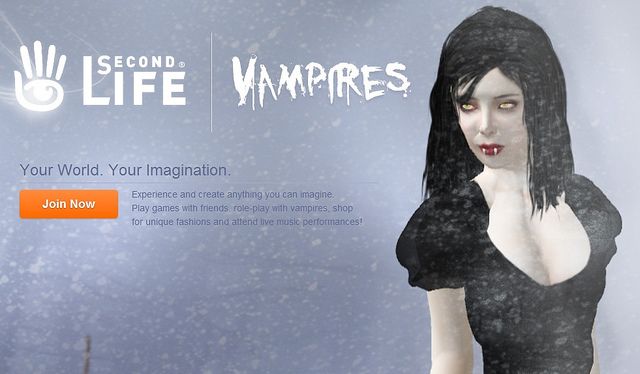
For a good while, the screen comprised a series of images that fell somewhat short of enticing – if not outright ugly. Perhaps the most famous of these was the “vampire in a snowstorm” image.
Camp-ire: the vampire-in-a-snowstorm log-in page image
Several commentators took LL to task over the images selection – which could at the time best be described as “vapid” – and earlier this year things started improving, with crisper images of avatars appearing, together with picture credits.
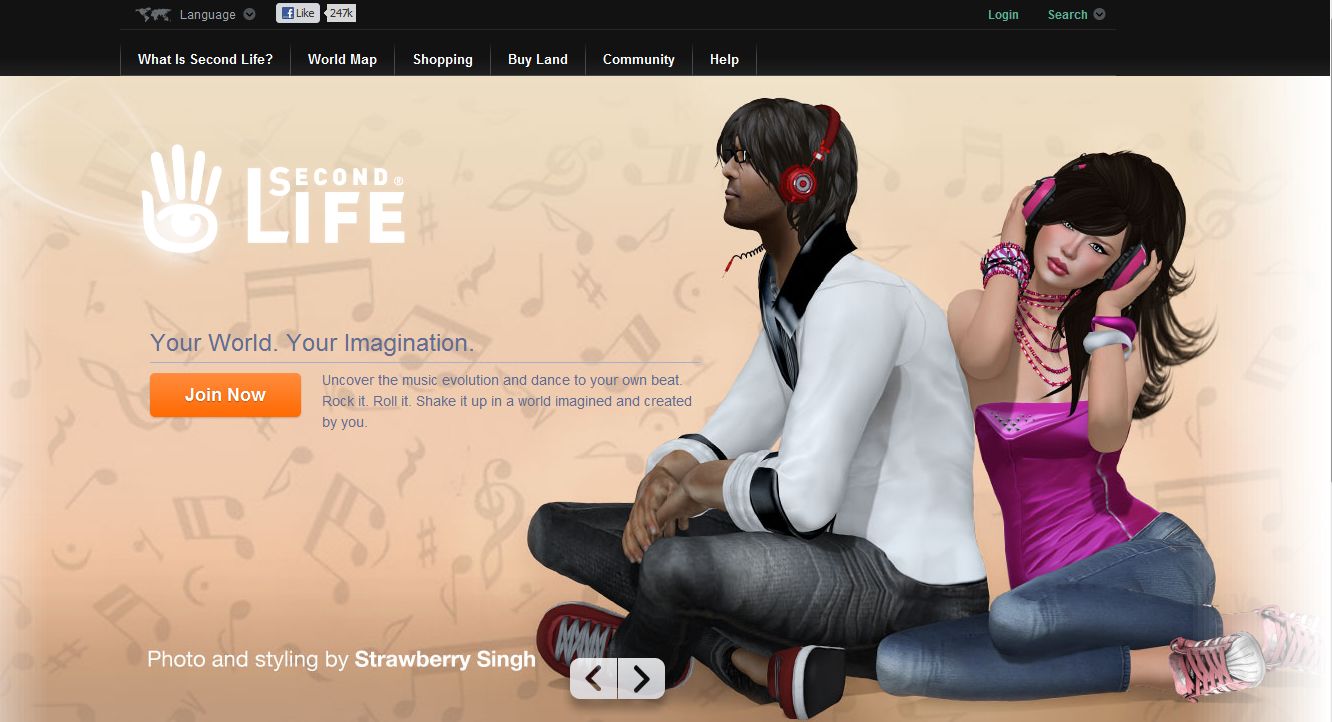
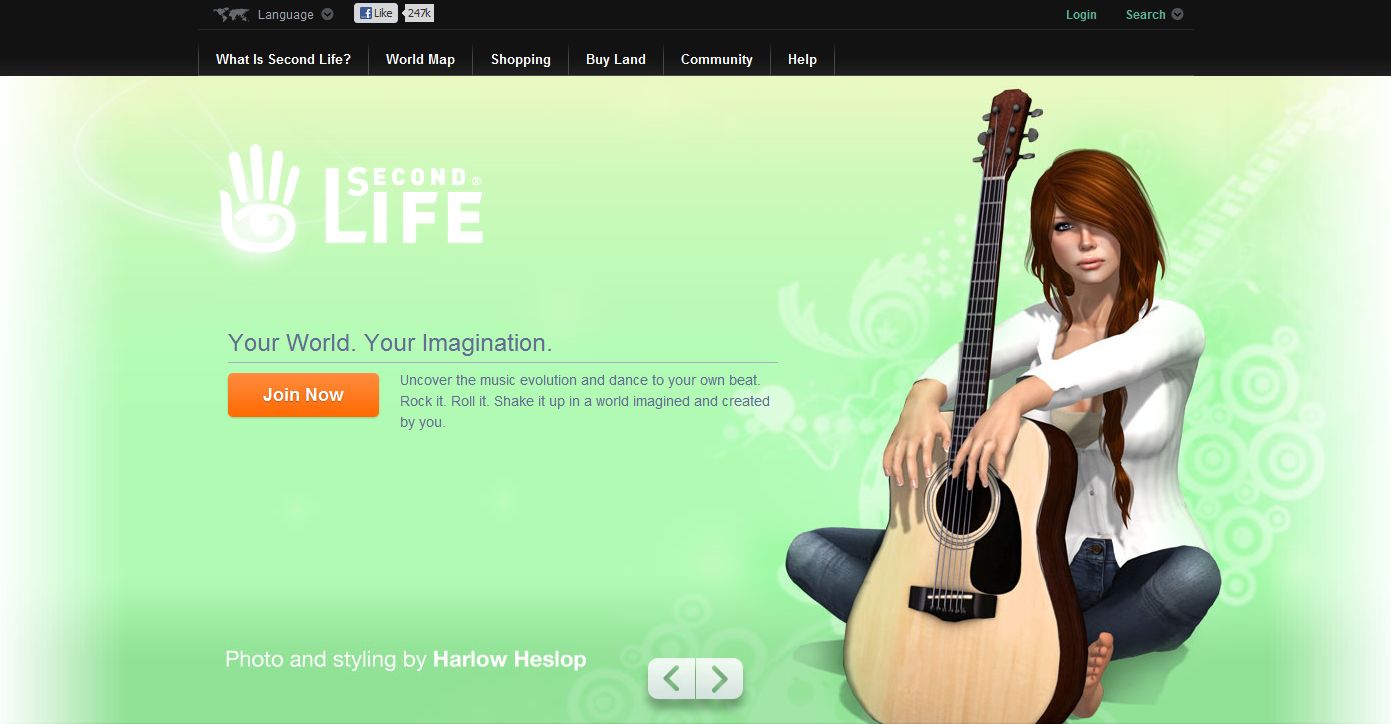
Now LL have gone the extra mile and not only engaged with some of best photographers and artists in SL to produce some really outstanding images for the log-in screen, they would appear to have started working on a theme-based approach to advertising SL through the splash page – the current theme being music. I caught sight of the new pages while browsing Strawberry Singh’s blog, but got sidetracked away from the new art by things like Havok sub-licencing and Marketplace updates, which became the focus of recent blog posts.
Strawberry is one of a number of SL artists who were asked by LL to produce music-themed images a few weeks ago, the other being Harlow Heslop, Miaa Rebane, siXX Yangtz and Harper Beresford, and Ivoni Miles. The results are simply spectacular.
All of the images capture the heart of music entertainment in SL in all its diverse forms, with Strawberry’s in particular hinting at more – friendship and relationships. This is a fresh move from Linden Lab in combining user-generated images on a thematic basis to help promote SL and it is one to be applauded – and one I hope we’ll see more of – for how better to capture the rich diversity of Second Life other than by working with those intimately involved with it?
With efforts like this, it would be nice to see some kind of Destination Guide tie-in as well: perhaps with a special sub-category of “What’s Hot” appearing on the log-in screen carrying information on locations directly related to the image theme: in this case, a list of the currently hot live music venues in SL.
Harlow Heslop’s evocative image
After all, if music is being used to promote SL – then it makes sense for LL to provide the follow-through and help those drawn to SL as a result of the theme to actually connect with the in-world music scene – or whatever the chosen promotional theme is.
Of course, this isn’t the first time LL have sought to work with members of the community, and it would be unfair to cast it as such. But given the way in which LL has been perceived to be retreating from direct engagement with the community over the last few years – a perception they have contributed in no small part themselves – this move is to be commended. Hopefully, it’ll be the first step along the way to the Lab working more directly with members of the user community to better promote SL and reach out to potential users. Certainly, there are many powerful tools that can be used in this regard – such as machinima, something I’ve again discussed elsewhere – and the talent to leverage those tools is rich within SL itself. I’ve little doubt that were this talent to be harnessed, the results would be beyond anything LL have themselves been able to produce using this incredible medium.
In the meantime, credit and thanks must go to Strawberry, Harlow and the other contributors to the artwork for their time and effort. So why not take a look at their work for yourself? (Remember you’ll have to log-out of the SL website in order to display the log-in / splash page and see the images.)
Linden Lab has recently acquired the right to sub-licence the Havok physics engine technology used within their Viewer. This has resulted in the Lab issuing new guidelines to third-party Viewer developers wishing to incorporate advanced Viewer capabilities developed using the Havok technology within their offerings.
The guidelines read in part:
The technology is provided in the form of an autobuild package ‘llphysicsextensions’ containing header files and the required library. This does not directly expose the Havok APIs, but a set of higher level interfaces specific to the viewer. Sources for the wrapper itself will not be open source. The llphysicsextensions package includes all features that use Havok (currently convex decomposition and features related to navigation mesh for pathfinding).
This move is already a subject of debate among TPV developers and the OpenSim community, because the sub-licence associated with the guidelines appears to place clear restrictions on TPV developers, notably in clause (b) of the Conditions to Grant, which reads:
(b) Sublicensee must require the Third Party Viewer to connect only to servers owned or operated by the Company; [i.e. Linden Lab]
So if a TPV developer wishes to work on both Second Life and OpenSim, they’ll have to look at options very carefully, as Maria Korolov points out in Hypergrid Business.
Within Second Life, there is concern as to what this may mean for some TPVs – specifically those utilising GPL rather than LGPL. Such Viewers appear to be effectively excluded from applying for a sub-licence. While this will not prevent such Viewers from accessing Second Life, it does mean that they’ll be excluded from using code that implements the Havok capabilities. The requirement for TPVs wishing to obtain a sub-licence being required to be publicly listed on the Third-Party Viewer Directory may also have a negative impact in some quarters.
The flip side to this, however, is that it means Havok physics will effectively be in the Viewer itself, which could pave the way to many new enhancements and capabilities within Second Life. As such, it is far to say that the move to sub-licence the Havok engine is less about LL attempting to restrict Viewer development per se (the apparent attempt to push out V1-based Viewers not withstanding), but rather to provide a means by which they can integrated what is effectively a closed-source, licenced product (Havok) into what is essentially an open-source project (the Viewer) without breaking the terms of their agreement with Havok.
The program itself is not available as yet, and discussions within the community are ongoing, with TPV developers aiming to seek further clarification from Linden Lab on possible impacts on their work – again, specifically where OpenSim support is concerned.
SL has tended to have its share of scams over the years, running from the misuse of Account Debiting scripts (wherein an unknown object sends you a request asking to be allowed to take money from your account), through to quite involved and complicated data-scraping efforts as most clearly exemplified by the infamous RedZone affair of 2010/2011.
Recently, we’ve had two attempts at what amounts to phishing for SL user’s log-in credentials (and possibly other information). These attempts are focused on trying to take advantage of the Second Life name and the widespread popularity of the Phoenix and Firestorm TPVs.
SL Log-in Scam
This problem first appeared in March which people began receiving seemingly genuine information directing them to what appears to be the SL web log-in page, with a request to log-in to SL The site was actually a false page, geared solely towards gain people’s user name and password.
Over the Easter weekend, a new scam appeared using the lure of a L$ reward to tempt people. It comprises a message the can be received either in-world or relayed to e-mail (if you are offline), encouraging you to visit a website and “confirm your details” in return for a L$1000 reward. The following is a typical example of such a message (as I received today, relayed via e-mail):
The object ‘Second Life’ has sent you a message from Second Life:Happy Holidays Everyone! Get 1000L just for signing up here and confirming your email –http://bit.ly/????
Second Life is owned by FirestormRelease Resident
(Note that I have redacted a part of the URL short link to avoid any accidents with people copy/pasting it out of curiosity.)
This is a particularly insidious scam because it is using the names of SL’s two most widely used TPVs in order to gain a veneer of authenticity – notice the name of the avatar responsible for sending the message. This has prompted the Phoenix / Firestorm team to issue a cautionary Message of the Day warning, seen when logging in to either of their Viewers:
Multiple accounts are being used to circulate such messages – “FirestormRelease Resident”, the attribution for the message I received being just one. Indeed, when I contacted Jessica Lyon about this account name and location she replied, “I just got a bunch of those accounts shut down, however, if more show up please send me the SLurls to the objects and account names.”
How to Deal with a Scam Message
The important thing here is that if you are in receipt of such a message / e-mail either asking you to log-in to the SL website or which gives the impression it is associated with a valid group or organisation within SL (such as the Phoenix / Firestorm team as seen here), do not click on any link it contains or provide any information to the website you’re taken to if you do.
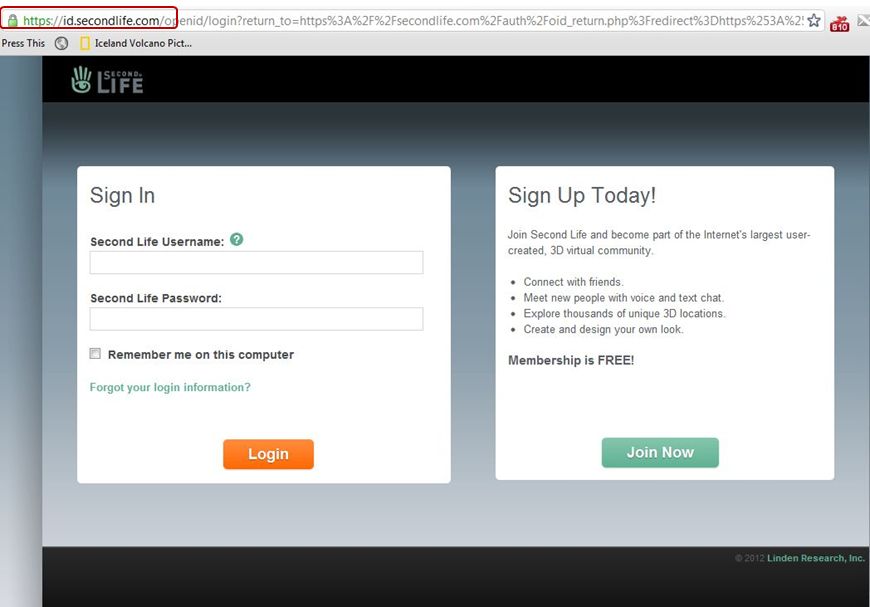
In respect of the SL log-in page, you can always test the validity of the page you are displaying prior to logging-in simply by looking at the URL. The genuine SL website log-in page will always commence with: https://id.secondlife.com/, regardless of whether you are trying to log into your Dashboard or the Marketplace or your web Profile.
SL log-in page: the real McCoy (click to enlarge)
If the URL for the page contains any other information than this, regardless of how “real” the rest of the page may look, then the URL is bogus; do not follow it. An example of such a bogus URL which was circulated last month commenced: “http://marketplacesi.altavista…..”.
False prophet – note the (made up) URL (click to enlarge)
Where messages appearing to come from established in-world groups or organisations are concerned, check the message carefully and if you have any doubts at all, contact a representative of the group / organisation to verify whether the message is genuine or not.
If you have followed any such link and supplied information to a website / possibly had something download from the website, then you should:
At the very least, change your account password immediately
If you believe the account has already been tampered with, contact Linden Lab and inform them of the situation. They may lock the account while they investigate. Note that you’ll have to supply RL information in order for them to release it back to you
Raise an Abuse Report if you have sufficient information on the perpetrator. Contrary to popular myth, LL do take Abuse Reports seriously and will investigate
Run an anti-virus / malware sweep of your computer.
In the case of scam messages relating to Phoenix / Firestorm, you may wish to inform Jessica or a member of the team, so they can continue to work with LL to get bogus accounts shut down en masse.
Linden Lab are working pro-actively on matters as well – not long after I’d informed Jessica about “FirestormRelease Resident”, a representative from the Lab was on-hand investigating the location being used.