Second Life land and users in 2020, via Tyche Shepherd

Sunset at home in Second Life

The last few months of 2020 saw Tyche Shepherd release some brief summaries related to Second Life that – as always – make for interesting reading for those interested in the general state of the platform.

In the first, a tweet Tyche issued in October, we were offered insight into general use of the platform in terms of sign-up and concurrency. It came as a the last in a brief series of tweets from Tyche on the subject that started after the Lab indicated that with the spread of the SARS-CoV-2 pandemic, they were seeing an increase in general usage of the platform, particularly among returning users.

Following-on from Tweets in June -, Tyche confirmed that overall, median concurrency on the platform saw clear growth in March through mid-May (when the first ’bout of lockdowns hit a fair portion of the world  due to the pandemic, before gradually falling through until mid-August, when a further “bump” occurred that lasted through until October (when Tyche made her Tweet). She also showed that overall, median concurrency remained well above that seen in 2019.
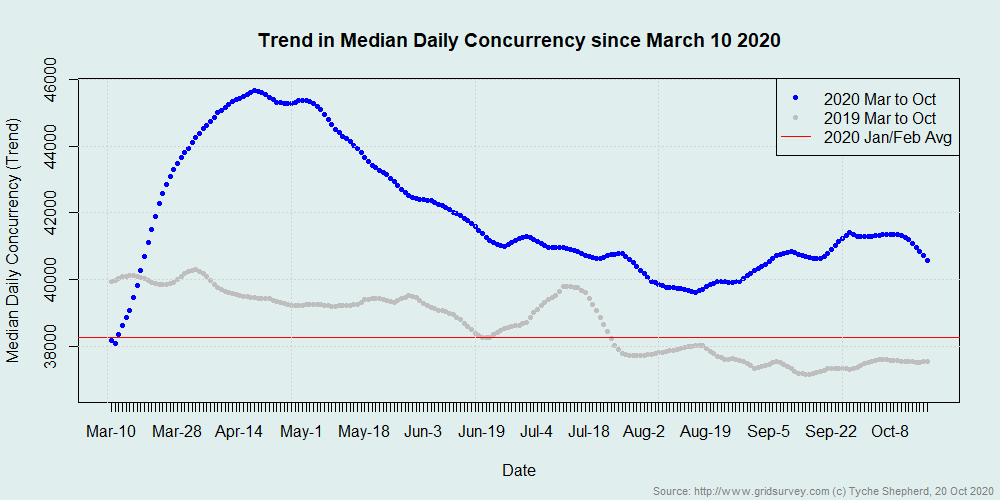
SL concurrency, March-October 2020. Credit: Tyche Shepherd

That concurrency is up can be taken as a good sign; it means that more people are engaging in the platform at any given period, allowing greater opportunities for interactions  – which can be particularly important for incoming new users looking for things to do and people to meet. However, it is with regards to the latter that Tyche’s observations have been more mixed.

On the one hand, the second graphic included in her tweet appears to in part confirm commentary from the Lab itself: that 2020 has seen an upswing in the number of users returning to the platform, whilst also suggesting that – again, understandably, given the pandemic – that existing users were spending longer in-world in 2020 that had been the case in recent years. All of which is also to the good (particularly if returning users find reasons to maintain their engagement in the platform once more).
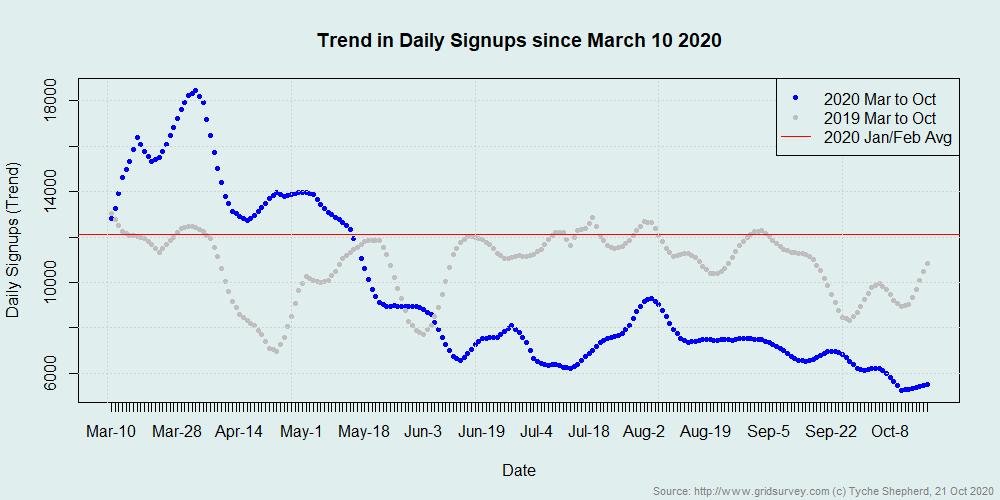
Second Life new user sign-ups 2020. Credit: Tyche Shepherd

However, on the other, the graphic reveals a niggling concern: whilst sign-up have remained relatively stable for a number of years, with occasional peaks and crevasses, 2020 saw a distinct decline in sign-ups from the end of March through until early October, despite an initial spike in sign-ups in the March-April period, again potentially fuelled by the pandemic. In particular, the drop-off not only saw sign-ups fall below the average set in the first two months of 2020, but also fall and remain below average sign-ups seen throughout 2019.

As such, Tyche’s figures tend to suggest that, while the Lab is determined to grow SL’s user base through the attraction of new users – a programme it has, to varying degrees,  indicated it has been focused on since around mid-2019 – there is still a lot to be done in this area, if the hoped-for growth is to be realised. However, this is somewhat tempered by the fact that given the rise in median concurrency is in part fueled by returning users, it demonstrates that the Lab is correct in focusing a portion of its marketing efforts towards former users who have drifted away for one reason or another.

Land use – or more correctly, grid size – is another metric Tyche tracks, providing as she does regular reports on the overall size of the main grid and the comings and goings of both private and “Linden owned” regions. While the relative size of the grid, if looked at in and of itself only, can be a false or misleading indicator of the overall state of SL, tracking the number of private regions does help in building a picture of LL’s core revenue flow – region tier.

On January 3rd, 2021, Tyche tweeted her year-end analysis on private region numbers, revealing that 2020 saw an overall net growth of some 919 private regions (Full and Homestead) through the year, representing a 5.7% increase.
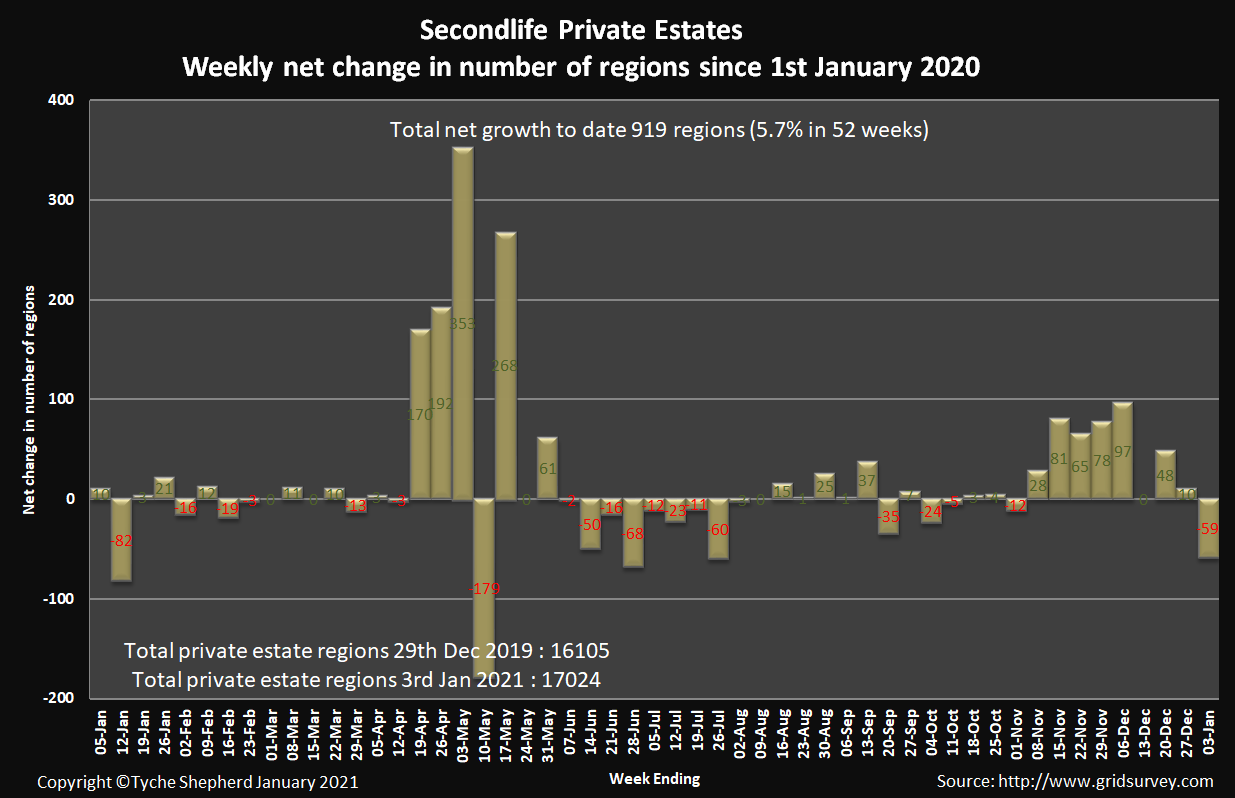
Second Life private regions in 2020. Credit: Tyche Shepherd

The majority of this growth came in two bursts: mid-April through to the end of May (with one significant period of shrinkage during the week to Sunday, May 10th, 2020), and then November-December 2020, immediately following the period of unavailability of new regions through the mid-months of the year resulting from the work transitioning SL to AWS services.

While the increase in the size of the grid is not exceptional when compared to increases seen prior to 2011/2012, it is still positive, indicating that there is a general willingness among users to invest in land, helping the Lab’s bottom line. The uptick in 2020 has meant that when the general reduction of Linden-held regions through the year is taken into account, the total number of regions in the grid grew by 3.3%.

Given the difficulties of 2020, Tyche’s figures tend to show Second Life held its own through what has been what might be termed a less-than-optimal year. With the Lab looking to further ramp-up advertising in 2021 (and perhaps further tweaking of the on-boarding process), it’ll be interesting to see how the overall level of users / size of the grid fares through the year.

Related Links

Lab introduces Second Life public events calendar

Earlier in November, a little discussion round robin kicked-off on the subject of helping to keep SL users informed of events. It was kicked off by John Westra, after I posted an article  concerning the (then upcoming) Lab Gab session with Oz and Mazidox Linden discussing the Cloud Uplift project, who tweeted:

His voice was amplified by J.M. Hardin, who in turned tweeted a request for some form  of calendar functionality users could turn to to help stay abreast of what’s going on within Second Life:

J.M. Hardin’s response

I thought this was an excellent idea, so thought I’d add my voice to the call – which someone at Linden Lab (/me waves to Strawberry / Tara) – appeared to like:

My own thoughts on the calendar idea, as “liked” by the official Second Life Twitter account

Roll forward a couple of weeks, and it is revealed that not only was the discussion read and liked, it prompted so action as well, as on Thursday, November 19th, Linden Lab announced the launch of the Second Life public calendar  – not that no log-in is required to view the calendar, just click the link and then bookmark the page.

The calendar is already packed within a range of events  – including things like the weekly / monthly user group meetings – with each item neatly annotated with further information: just click on an item to expand it (see below). In addition, the blog post includes an ICAL feed link you can use to add the SL calendar to you personal calendar, and you can of course select individual events and add them individually to your own calendar, marked this as a very flexible response to the requests.

The SL public calendar provides a list of all official SL events that are occurring in-world, complete with details and the ability to add events to your own calendar (arrowed in red), or you can use an ICAL feed link to add the entire calendar to your own.

So, thanks to John and J.M. for the idea – and thank you, Linden Lab (particularly the folks on the Marketing team) for following-up on the idea and implementing it.


Lab resumes offering private regions in Second Life

via Linden Lab

In May, as the Lab started gearing-up to move Second Life regions to being hosted on AWS cloud services, an announcement was made that private regions would be subject to limited availability (see Limited Availability of New Second Life Region), prior to further sales of private regions being effectively frozen. 

However, the work in migrating regions from the Lab’s co-lo facility to AWS services progressing well (up to approximately 30% of all main grid regions should be migrated by the end of week #45), so much so that on Tuesday, November 3rd, the Lab announced that private regions are to be made available once more, initially on a limited quantity (per order) basis.

The blog post making the announcement reads in part:

As Oz recently discussed in a post, we are hard at work on uplifting Second Life to the cloud. It’s an incredibly exciting time, and we’re already seeing some significant improvements to Second Life as a service from this process. 
Additionally, many regions on the grid are now running on AWS simulators, with more being added every day!
In light of more regions being moved to the cloud, we are pleased to announce that we are ready to begin offering new private region purchases in limited quantities. As we continue to uplift more of the grid, more regions will become available over time, eventually leading to the Land Store being reopened. 
If you wish to purchase a private region, please submit a support ticket through our Support Portal. The ticket can be submitted under the Land & Region > Order Private Region category. Please include the region name, which must conform to region naming guidelines. Following your ticket submission, we will either process the region purchase, or add your request to a wait list, which will be handled in the order the submission is received. In the event that your request is put on the waiting list, we will not charge your account until the point when the region is delivered.

– Linden lab blog post

Current pricing and requirements for obtaining private regions can be found here, with further information on private regions is available via available here.

Lab expanding number of regions on AWS

Logos ©, ™ and ® Linden Lab and Amazon Inc

On Friday, October 16th, Oz Linden posted about the work in migrating Second Life services to running on Amazon AWS cloud servers and infrastructure – see: Uplift Update, which I expanded upon in Oz Linden posts on Second Life cloud uplift status.

At the time of that update, it was indicated that about 100 regions on Agni, the main grid, had been transitioned to running on AWS, comprising a mix of Linden-held, Mainland and private regions.

Commencing on Tuesday, October 20th, the Lab will be expanding on the number by “a few hundred” regions during week #43. The announcement came via a forum post by Bugsly Linden, which reads in full (re-formatted for ease of reading):

This week marks the beginning of medium-scale migration of production regions to the cloud (AWS). We will be transferring a few hundred regions from all existing channels of Second Life based on the Engineering team’s need for additional data and performance metrics. Bulk region migration will take place this week between 6:00 AM and 12:00 PM (Noon) Pacific Daylight Time.
If you are interested in having a region you own (or are the alternate payer for) migrated to the cloud, please submit a Support Ticket. Regions that are migrated to the cloud may experience degraded performance or behave incorrectly; if you are in a cloud based region (you can check by clicking Help->About, and if you see the URL on line 3 end in “amazonaws.com” you’re in the cloud) and observe behaviour you believe is newly incorrect, please file a BUG at jira.secondlife.com.
Due to the rapid speed of our Uplift efforts, we are unable to guarantee that regions in the cloud that are behaving incorrectly will be moved immediately back to our existing hosts.

Bugsly Linden

Spotting a region hosted in the cloud via Help About. Top: a region hosted at the Lab’s co-location facility (note the agni.lindenlab.com in the address). Bottom: and a region running on a simulator in the cloud

There have been concerns about aspects of performance with regions operating in the AWS environment – particularly with regards to communications with the KVP database associated with experiences, which has yet to be migrated), and there are on-going teleport issues that might be related to the Uplift work, although as Oz indicated in his blog post, this has yet to be confirmed.

Elsewhere, some of those with regions already uplifted – such as London City (see London City Uplifted) – have reported generally good performance, if with a one or two caveats such as legacy profiles being slow to load in viewers that support them (which again may or may not be Uplift related). Similarly,those testing region crossings between those based in the AWS environment and those still within the Lab’s co-lo facility have reported them to be generally “smooth”.

However, as Bugsly’s forum post implies, there could be a period of degraded performance within regions that are transitioned to AWS, so keep an eye on where you are in SL.

Byeline

The Fourmilab Cloud Halo detecting an AWS region. Credit: Fourmilab

For those who are curious about whether or not they are in a region that has been uplifted to the cloud or not, and who don’t like opening menus and panels to find out, Fourmilab may have the answer: a freebie full permission halo that attaches to your avatar.

By default, it is invisible, but should you move from a region hosted by the Lab in their co-lo facility to one running on AWS, it will sparkle briefly into life to the faint accompaniment of harps being played (well, you’re in the cloud, after all) before vanishing.

Similarly, when you leave a region running in the cloud and return to one still based in the Lab’s co-lo facility, the halo will again briefly appear, this time a dull grey and without the golden sparkles, while a trombone plays a couple of sad notes.

Note that it will only play when moving between regions hosted in the two facilities, not when moving between regions in the same facility (so you won’t repeatedly get the trombone when moving between regions that are all hosted at the Lab’s co-lo for example).

You can grab the halo here.


Oz Linden posts on Second Life cloud uplift status

Logos ©, ™ and ® Linden Lab and Amazon Inc

On Friday,  October 16th, Oz Linden posted on the status of the cloud uplift work – see: Uplift Update -, the article coming as regions on the main (Agini) grid are gradually starting to be migrated to AWS services. For those possibly unaware of this project, Oz provides an opening explanation:

We’ve been working hard on the Uplift of Second Life. If you have not been following this project, that’s what we’re calling the migration of our Second Life simulators, services, and websites from a private data centre to hosting in The Cloud (Amazon Web Services). It’s a massive, complicated project that I’ve previously compared to converting a steam-driven railroad to a maglev monorail — without ever stopping the train. This undertaking has at times been smooth sailing, at other times a very bumpy ride. We wanted to share some more of the story with you.

The uplift project was first announced in August 2017, and formed a part of the Lab’s presentation at the AWS Reinvent conference that same year – which if nothing else points to the amount of planning and testing that has been going on both before and during the gradual migration of services, which has been going on for somewhere between 12 and 18 months, recently reaching the point were the aforementioned main grid region migrations could commence.

As Oz notes, the work has been very incremental in nature, and always with a the aim of transitioning services in such a way that users generally have not been aware of which services have moved and when. This has certainly been true for many of the back-end services (no-one noticed when the log-in services and the inventory  / asset services moved to AWS, for example). However, as Oz notes in his post, there have been a few bumps on the road.

Some of these problems were initially manifested on Aditi, the Bet grid, which saw batches of regions cloned from the main grid and transitioned to the cloud. Region crossings were one such problem which, thanks to extensive testing by users on Aditi, allowed the Lab to make changes to region crossing that have generally improved things even sans the uplift – although as the Lab readily notes, there is still future work to be done on region crossings once the uplift work has been completed.

Work related to the uplift project allowed the lab to make improvements to region crossings that have benefited Second Life even before regions on Agni (the main grid) commenced a slow migration to AWS

However,  some problems unfortunately only manifested once some back-end services had been uplifted and were so bedded-in to running on AWS, reverting to running them out of the Lab’s co-lo is no longer an option. Again, as Oz notes, the recent group service issues being a case in point. Other issues – such as the recent bout of avatar bake (appearance) failures – have been the result not of moving that service to the cloud (the Bake Service has also been AWS based for a while without most users noticing), but in making subsequent changes to a related service – again pointing to the complexities involved in moving multiple systems and services from an established operating environment to an entirely new operating environment.

Elsewhere, there has been a need to revert the Marketplace to running via the lab’s co-lo (albeit it temporarily), whilst some known issues  – such as teleport failures – may or may not be linked to migration issues, with the Lab engaged in trying to get to the bottom of things. So if you do see a problem, don’t automatically assume it is uplift related; even without the current migration work, SL can be temperamental!

Currently, around 100 regions on the main grid have been uplifted, and Oz confirms that, barring the unforeseen, the end-of-2020 for uplift completion is still very much the goal.

For more information, please take a read of his post.

Second place for STÖMOL at digital film festival

From STÖMOL

STÖMOL, the feature-length science-fiction move produced entire in Second Life, has been awarded second place in the 2020 SUPERNOVA Digital Film Festival.

The film, written, directed, produced and starring Huckleberry Hax, together with Caitlin Tobias, Ylva, Boudicca Amat, Anthony Wesburn and Mich Michabo in leading roles, was one of a number of entries to the festival that were wholly filmed in Second Life and which were open to viewing on-line throughout the festival’s almost month-long run.

The film gained numerous plaudits from those at the festival for its style, content, story arc and composition, including founder and Creative Director Ivar Zeile. It was runner-up to #21XOXO, “a stylized window into the zeitgeist of youth and pop culture,” by Sine Ozblige, and earned a prize of US $750 for Huckleberry and his team.

I was stunned when I watched STÖMOL for the first time. I’ve seen some Second Life animations – we’ve really supported artists that are working in that platform over the years – and I didn’t believe I was going to be taken by a feature length film made in Second Life, but Huckleberry absolutely delivered the goods.

Ivar Zeile, Supernova founder and Creative Director

Very special and deserved congratulations to Huckleberry and his team for STÖMOL’s runner-up status at the festival, it was well deserved. I hope that – as nerve racking as entering this festival was to him – this award will spur Huckleberry to continue filming, and we will get to see the sequel and the answers to the question posed by the film’s end credits (nope, not going  to spoil it for those who haven’t seen it! – but if you are interested, my own review of the film can be found in Second Life’s STÖMOL: a review).

Other pieces filmed in Second Life and featured in the festival were machinima by Erik Mondrian, and a piece by Tizzy Canncci.

Erik had a total of three pieces accepted by the festival, comprising his CalArts Master of  Fine Arts thesis For the Light of Other Shores, a marvellous 10-part series, selected for the Director’s Choice programme of the festival; together with Tripping through Skyscrapers, his video journey through Gem Preiz’s Skycrapers installation ,and Cetatea Poenari, recording a visit to the region of the same name, and both of which featured in the festival’s Everything Abstract-Sonic programme.

For her entry, Tizzy submitted Out of Isolation Came Forth Light, a recording of a performance by artist SaveMe Oh that took place in CapCat Ragu’s installation entitled Isolation, displayed at Ribong Gallery’s Artspace 1789.

I’d also like to offer my congratulations to Tizzy and Erik for entering their work for the festival. I know that Erik had a certain amount of trepidation in making his submissions, but his work  – which I have the privilege to be able to discuss with him and write about (see Erik Mondrian: master of fine arts in and beyond Second Life) as well as follow via You Tube – full deserves recognition through a wider audience.

Film Links