Sarawak by Loverdag on Flickr, one of the images used in my rebuttal to Marlon McDonald’s article on SL
On Friday, November 14th, erstwhile contributor to Moviepilot,com Marlon McDonald wrote an article about Second Life which, is to say the least, predictably one-dimensional.
The item in question, entitled These Strange Stories Prove Second Life Isn’t The Dreamworld You Believed… takes as its rather predictable focus, the subject of pornography in Second Life. It’s lead to a fair level of upset among SL users – and rightly so; Mr. McDonald goes to considerable lengths to make his case by apparently passing on the opportunity to try the platform for himself, and instead dig through Google searches for articles that are anything up to seven years old (and none more recently written than three years ago).
Marlon McDonald: one-dimensional article
There is much that is wrong with the piece; not only does it present a one-side view of SL, it’s clearly intended as clickbait – if not for Moviepilot.com directly (although it doesn’t hurt them!), then certainly for Mr. McDonald himself, a regular contributor there, Most of what is wrong is easy to spot and cane be said through a comment on the piece. However, I opted to present a more direct rebuttal to the article through Moviepilot’s own pages, in the hopes of also reaching Mr. McDonald’s intended audience and perhaps persuading them to look on SL differently.
I don’t usually ask for page views – but in this case, I am. Not for myself, but to help the article get right up there alongside Mr. McDonald’s piece and truly give Moviepilot users an alternative point of view on SL. So please, if you wouldn’t mind, follow the link and have a read, Or if you’re tired of my writing – just follow the link and go make yourself a cup of tea / coffee!
In the run-up to the festive season, the Lab are using social media (though not, it seems their own forum) to ask residents a question.
In the Tell Us What You Want campaign, the Lab is enquiring:
We’re working on a holiday gift item for everyone and want to know: What item would be on your Second Life wishlist?
The question is being asked via Facebook and Twitter, Second Life enjoying a high level of visibility on both (although I’ve little doubt the use of Facebook will draw some humbugging grumbles!).
In terms of the responses so far, I’m actually not sure people are perhaps giving the kind of response the Lab has in mind. Requests range from from a couple of thousand Linden dollars a head through 24-hour day cycles on regions, volumetric Linden water, functional search, to lower tier (inevitably, even though not currently possible) and the return of gambling to the grid (not possible) – as well as a whole lot more in between, including, in so cases, what appear to be entire wish lists!
At the time of writing, only one person appears to have entered into the spirit of the direction the Lab would probably like the conversation to take:
Yes, it is a tad lightweight, has a ridiculous title which has no bearing on the content, and gives every indication of being written in a hurry. It also gets a couple of things wrong: sex has always been a part of SL, rather than something that filled the void left by big business; and it isn’t actually as easy to see adult themed items in search as is suggested (not without setting the right Maturity ratings first).
But “negative”? Not really. Sure, it quotes William Reed Seal-Foss saying that SL stagnated (a view actually shared by many in SL); however Ms Levy counters this herself, pointing out the platform is pretty much still as popular among its users as it ever was. She also references the fact that it is embracing new technology like the Oculus Rift and she references Chris Stokel-Walker’s excellent 2013 article on SL for The Verge (which I reviewed when it first appeared).
Nor is any failure to mention the likes of the LEA or live performances or any of the hundreds of photogenic regions in SL evidence of a lack of research on Ms. Levy’s part. The reason such places aren’t mentioned is simple: they’re not the focus of the article.
The bottom line is that the article isn’t supposed to be any kind of analysis or examination of Second Life; nor is it an exploration of the creative opportunities within the platform. It is simply this: a “dear diary” account of one person’s venture back into Second Life and her experiences in doing so, and to judge it as anything else is to entirely miss the point.
As it is, and given the way the piece demonstrates just how shoddy the new user experience is, with its sink-or-swim approach to new users, I’d suggest Ms. Levy is to be commended for not sitting down and dashing-off an article along the lines of “after ignoring it for X years, I tried SL again. It still sucks”.
Let’s face it, she comes in-world, apparently negotiates the Learning and Social Islands (both of which are anything but), and gets herself to a role-play region only to find herself summarily ignored. As experiences go, it’s hardly great, and I suspect there are more than a few who can attest to having a similar experience when coming into SL for the first time.
Fortunately, rather than running off never to be seen again, Ms. Levy uses the assistance of an acquaintance – Judy – to help her on her way. How and where Ms. Levy may have contacted Judy isn’t that important given the nature of the piece; the fact that she at least had someone willing to help her is.
Ms. Levy met-up with Judy at the Caledon Oxbridge new user orientation centre, where she was able to acquaint herself with the rudiments of Viewer 3.x
Nor does it particularly matter whether or not Judy took Ms. Levy to the “right” places in SL or that her personal view of SL seems oddly slanted. What matters is that she was able to provide help, and enabled her to have a little fun whilst in-world.
That last part is actually quite important, hence the emphasis. Having fun is what is likely to bring newcomers back to Second Life. Probably more so than bashing them for writing something which fails to measure up to some preconception of what their article “should” be about.
At the end of the day, there is nothing intrinsically negative about the Business Insider. It doesn’t malign the platform, or cast judgement on the initial experience the writer had when in-world. It doesn’t poke an accusatory finger at anyone or mock Judy’s SL / RL relationship. The most that can really be said about it is that it overplays the adult / sex element; but that’s not bad research, that’s unfortunate titillation.
Would I have preferred something with more meat on it? Yes; I’m not about to deny that. But by the same standard, I’m also not about to start clubbing Ms. Levy about the head with a rolled-up version of her article because it doesn’t meet my expectations. As strategies go, that’s probably going to be a lot less successful in getting her to write something more considered in the future than, say, inviting her back in-world and showing her the things she might enjoy writing about.
The Verge has an article out about Second Life. Second Life’s Strange Second Life may not sound the most promising of titles, and the opening paragraph may not make for the most inspiring of reading material:
Do you remember Second Life? Set up by developer Linden Lab in 2003, it was the faithful replication of our modern world where whoring, drinking, and fighting were acceptable. It was the place where big brands moved in as neighbours and hawked you their wares online. For many, it was the future — our lives were going to be lived online, as avatars represented us in nightclubs, bedrooms, and banks made of pixels and code.
However, never judge a book – or in this case, an article – by its title (or its opening paragraph!). What follows is actually an astute look at the platform, as seen through the eyes of a newcomer, Chris Stokel-Walker, a freelance writer in the UK, and through those of long-time resident Fee Berry, as well as a few others.
Fee, who lives in Middlesex, England, is actually none other than Caliandris Pendragon, also once known as Misty Mole. She’s been involved in Second Life since 2004, having migrated from the worlds of games such as Riven and Myst. She’s been both a resident of SL and she’s been employed – until June of this year, at least – by Linden Lab. As such, she is eminently qualified to talk about SL from all sides.
The attraction which brought Fee to Second Life is more than likely the very same attraction which brought each of us here in the first place and caused us to “stick”, as Stokel-Walker relates:
“It’s like every toy you ever had, all rolled into one,” she tells me in awed tones, recalling the power of the game to keep her playing nearly a decade on. It’s also liberating, she explains, allowing her to forget about the kids, the responsibilities, and the extra few inches she’d rather not have. It lets her cut free.
Fee provides a very clear and concise view of Second Life, one we can all perhaps identify with: the wonders that it presents to us; the opportunities for discovering new friends, learning new things; the initial shaping of the world by Linden Lab – and the fact that, when all is said and done, it’s entirely possible that not everyone at the Lab really gets the in-world culture the company gave birth to simply by allowing Second Life to be so open-ended.
It is this examination of the cultural and historical aspects of Second Life, unburdened by bias, that helps to set this piece apart from the more usual offerings the media serve-up when talking about the platform. Not only do we get Fee’s perspective, we also get to hear from Hunter Walker. One of the original Lab employees working on Second Life from before the launch, but since departed, Hunter also provides insight into the early days, again as Stokel-Walker relates:
It was conceived as a space that gave you a set of choices that were missing from reality. “In your first life you don’t necessarily get to fly. Here you can fly. In your first life you can’t choose what you look like. Here you can choose what you look like — and it’s malleable.”
Nor does it end there. This is a piece which has not been written as a late-coming feature built from SL’s tenth anniversary infographic. Rather, it is a piece that has come about through experimentation and research, with Stokel-Walker spending time in-world, going through all the pangs, trials and tribulations of a newcomer to Second Life. He is clearly someone who is attracted to the platform without – at least initially understanding why. And this brings an added element to the article, because his story will be so familiar with many of us:
For the longest time I didn’t get it. I’d spent several weeks pottering about, teleporting from one place to another. I stood on a dock of a bay, overlooking an azure sea and hearing the whistle of the wind. I walked through a cold, gun-metal gray futuristic world full of walkways that reminded me of any number of first-person shooters. I’d chased a woman, inexplicably sprinting, arms flailing, through the palazzos of Milan, looking at the fashion boutiques. I’d visited London — in reality a tired collection of worn clichés, a cardboard cut-out of the Beatles crossing the street down from a roundabout with a red telephone box on one corner. It was kind of cool, but it was also corny.
We’re all probably familiar with the story of Fran Swenson, now 86, a Parkinson’s sufferer who has seen something of an overall improvement in her condition which she attributes to Second Life.
It’s a remarkable story, initially broken by Hamlet Au in February 2013, which has again demonstrated the therapeutic impact of Second Life which is not always obvious to many of us, and which can itself become the subject of wider study.
Now Fran, who is known in-world as Fran Seranade, and her story are again being picked-up by mainstream media as the San Diego Union-Tribune (Fran is a San Diego resident, rl) provides more insight into Fran’s life and that of her family, together with thoughts and feedback from Tom Boellstorff, an anthropology professor at UC Irvine, who took interest in Fran’s situation back at the start of the year, and Donna Davis, a strategic communications professor at the University of Oregon.
Fran Swenson with her avatar (in the blue gown) Fran Seranade, and her daughter’s avatar, Barbi Alchemi – image courtesy of San Diego Union-Tribune / Bill Wechter
Pam Kragen, author of the piece, provides a very focused and heart-warming article which not only encompasses Fran’s life and her family, it also does much to overturn the “accepted” view of Second Life so often adopted by those outside of SL.
Some of the benefits offered by the platform may appear obvious even to those uninitiated into Second Life, as Fran explains in the article, “It’s a place that gives me great satisfaction. I’m dancing now and I can run, hop, jump and have fun. I’m not just in my apartment, I have the whole world now. It’s thrilling.”
But it’s the underlying benefits which make the real story here, and which have drawn Fran to the attention of Boellstorff and Davis, and now the San Diego U-T. In real life, Fran has reported she feels mentally better as a result of the time she spends engaged in SL; she has seen her physical capabilities and freedom of movement improve, and has felt a corresponding uplift in her overall quality of life.
Having lost her husband to Parkinson’s in 2003, Fran found herself diagnosed with the illness the following year. As a result, her son Ken, living on the other side of the country in Florida, proposed the idea of using Second Life as a means of bringing the family together more easily, offering to build a home for them in-world.
Fran Swenson (Fran Seranade) and her daughter Barbara Richard (Barbi Alchemi) – image courtesy of San Diego Union-Tribune / Bill Wechter
Ever since LL announced they were actively working on integrating Oculus Rift into Second Life, there has been a lot of upbeat blogging and speculation as to what it will do / mean for the platform. Reading some of the more enthusiastic posts on the subject, it’s hard not to escape the feeling that we’re apparently standing on the edge of a new age in virtual worlds interaction, and that Oculus Rift is going to bring new depth, new meaning (and new users) to Second Life.
Not all agree with the upbeat messages surrounding the headset and SL. Coinciding with the appearance of a photo showing the Lab’s CEO trying-out the headset, Mona Eberhardt and Will Burns each blogged on the Oculus Rift and some of the factors which could limit its wider use with SL. Both of them raise some valid points, and while I don’t agree with all their arguments, they do present food for thought.
Rod Humble tries out Oculus Rift in a photo released on July 18th, 2013
Oculus Rift is a first-person experience, and this could immediately limit its appeal. The problem here is not so much interacting with the UI or in-world objects – the UI can be updated to handle such shortfalls; some TPVs already allow far greater access to the UI view and to in-world objects than the official viewer when using the first-person (aka Mouselook). Firestorm, for example, presents users with the toolbar buttons in Mouselook which can then be used to display and interact with various UI elements, and it also allows right-click/menu interactions with in-world objects. Ergo, it’s not exactly that hard to re-work things to make them more accessible when using something like Oculus Rift. Similarly, the upcoming updated / new experience tools could also provide the means for better interactions with in-world objects such as teleport portals.
Rather, the problem is that most people seem to intrinsically prefer the third-person view, with the greater freedom (e.g. camera movement, etc.) it presents for the vast majority of their in-world interactions and experiences. Coupled with the price tag for the headset (something I’ll return to in a moment), this could possibly count against the Oculus Rift in terms of general use.
Then, as Mona and Will point out, there is the problem that the headset isolates the wearer from the primary means they have of interacting with other people: the keyboard. While the conversations floater can easily be displayed (CTRL-H), it still leaves the problem of actually being able to see the keyboard in order to type accurately. This leaves those wanting to use Oculus Rift either needing to become very proficient touch-typists, or they’re going to have to settle for using voice.
SL is inherently keyboard-focused for the vast majority of users (image courtesy of Prad Prathivi)
Will Burns points to issues of headsets and open microphones as being a problem when it comes to voice. but I tend to disagree with him. For one thing, it’s not as if a headset / microphone combination can’t be worn with the Oculus Rift. More particularly, and from the in-world meetings held in voice I routinely attend, people actually do leave their microphones open, as the barking dogs, ringing ‘phones and the clicks of lighters being flicked in the background tend to demonstrate. No, the problem is actually more basic than that.
It’s this: since its introduction in 2007, voice tends to have been avoided by what seems to be the vast majority of SL users. Many simply will not use it, period. So if voice is seen as the means for person/person interactions when using Oculus Rift, then it is quite likely to further marginalize take-up with the headset, no matter what the promise of Exciting New Things it might bring.
In his piece, Will also points to the limitation of the headset when trying to perform tasks such as building. Such critiques might appear to be unjustly harsh and leave people saying, “Well yes, but Oculus Rift isn’t designed to be used for everything!“. However, while such a reply is true, it actually underlines Will’s central point: that the headset is liable have niche applications in Second Life which could further limit its appeal among the wider user base.
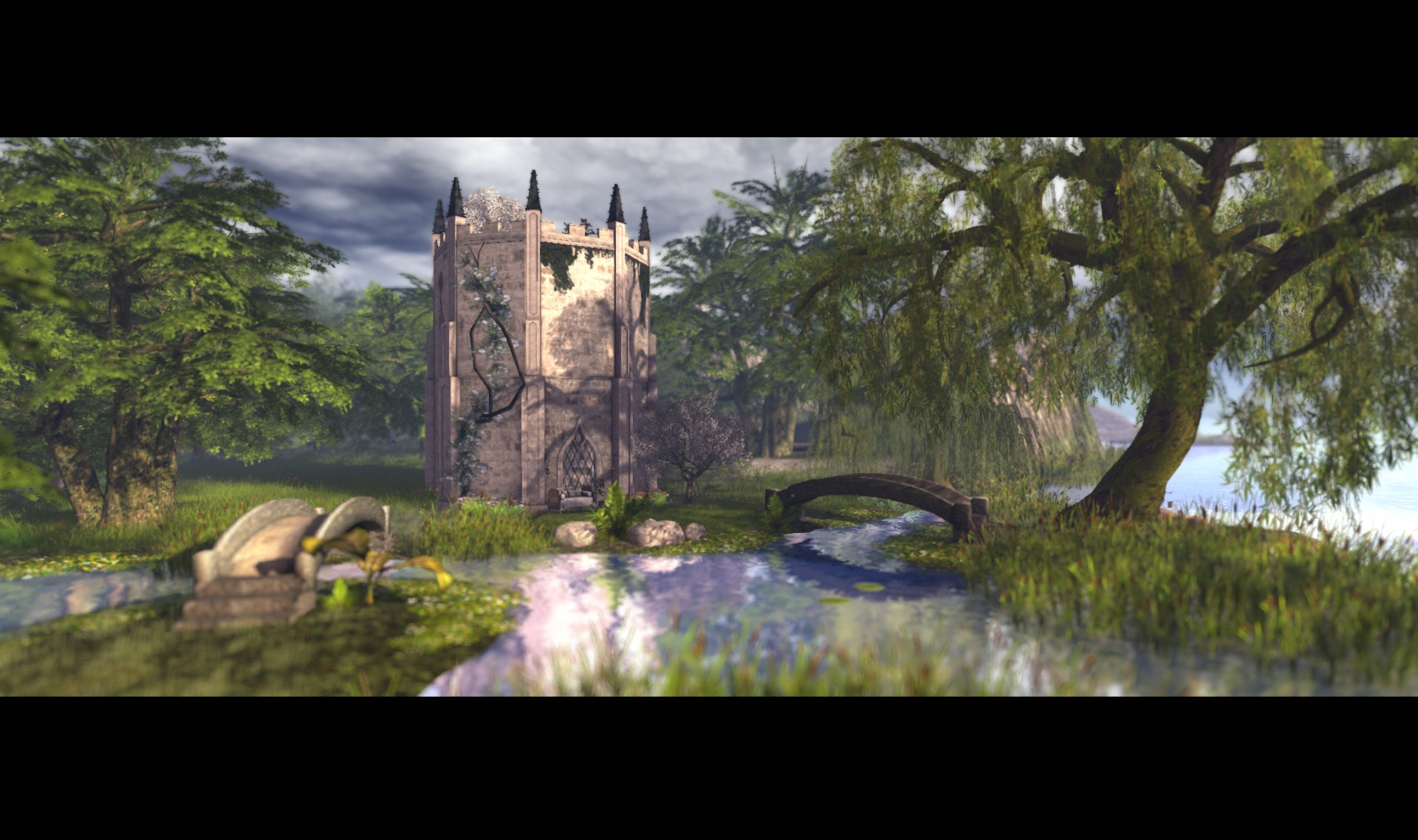 Sarawak by Loverdag on Flickr, one of the images used in my rebuttal to Marlon McDonald’s article on SL


 Inara Pey: Living in a Modemworld