The little lander that could – and did

Rosetta,
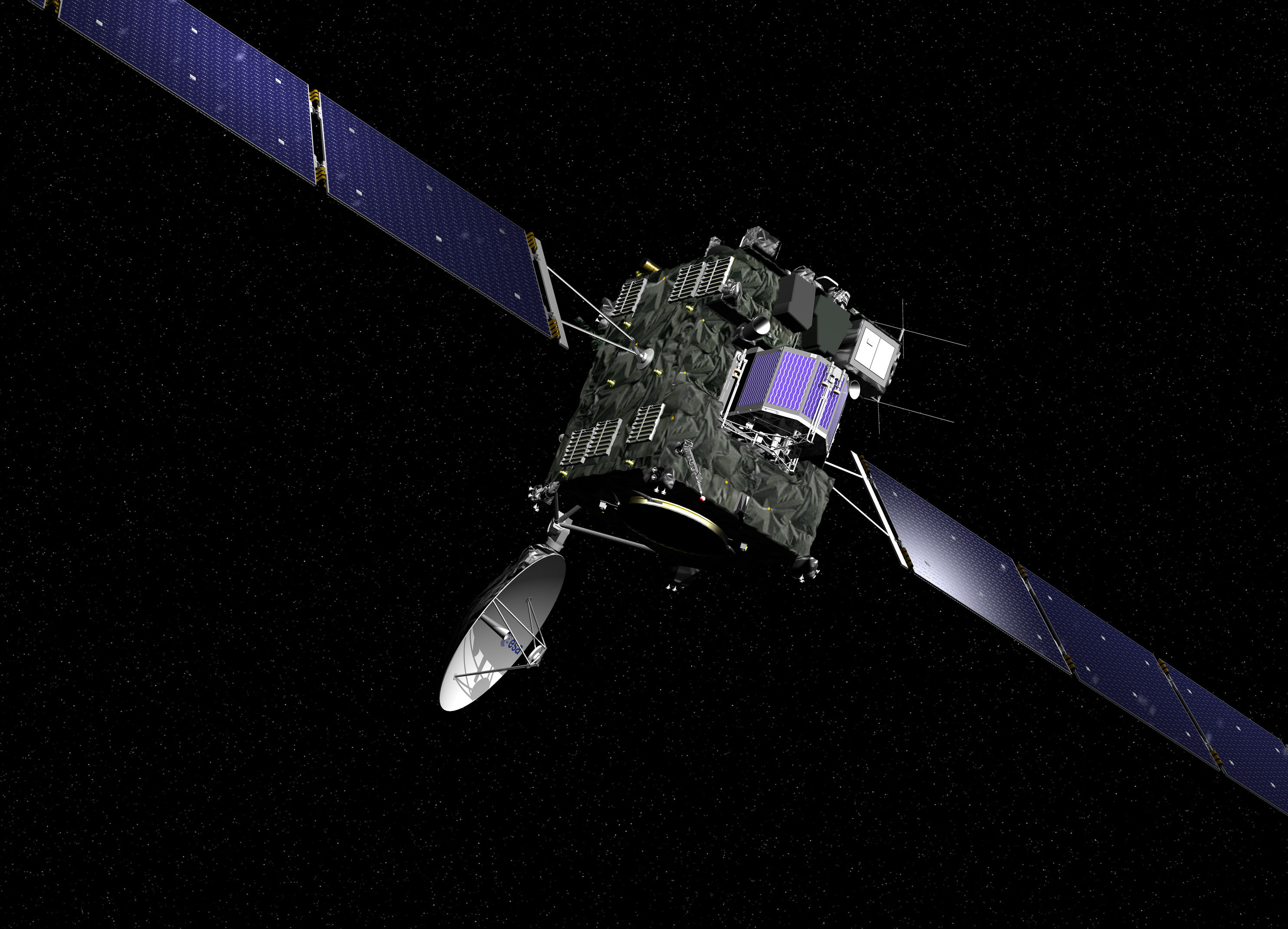
Rosetta,Philae and, behind them, comet 67P/Churyumov–Gerasimenko seen in an artist’s impression of the mission

It’s been a hectic 48 hours. On Wednesday, November 12th, after 10 years in space, travelling aboard its parent vehicle, Rosetta, the little lander Philae touched down on the surface of comet 67P/C-G/Churyumov–Gerasimenko (67P/C-G). It was the climax of an amazing space mission spanning two decades – and yet was to be just the beginning. Packed with instruments, it was hoped that Philae would immediately commence around 60 hours of intense scientific investigation, prior to its batteries discharging, causing it to switch to a solar-powered battery system.

Unfortunately, things haven’t quite worked out that way. As I’ve previously reported, the is very little in the way of gravity on the comet, so in order for Philae to avoid bouncing off of it when landing, several things had to happen the moment it touched the comet’s surface. As it turned out, two of these things didn’t happen, with the result that the lander did bounce – twice.

Where Philae may be (ESA image via BBC News) – Rosetta has yet to positively locate the lander beyond a rough estimate based on communications and signals received from the CONSERT instrument on the lander

The first time it rose to around 1 kilometre above the comet before descending once more in a bounce lasting and hour and fifty minutes, the second time it bounced for just seven minutes. Even so, both of these bounces meant the lander eventually came to rest about a kilometre away from its intended landing zone. What’s worse, rather than touching down in an area where it would received around 6-7 hours of sunlight a “day” as the comet tumbles through space, it arrived in an area where it was only receiving around 80-90 minutes of sunlight – meaning that it would be almost impossible to charge the solar-powered battery system.

As noted above, the mission was designed so that most of the core science could be carried out in the first 60 hours of the mission, just in case something like this occurred. Even so, in order to prolong the life of the vehicle, it would have been nice to move it into a greater area of sunlight. A means of doing this had also been built-in to Philae: the three landing legs can be flexed, allowing it to “hop”. But as images were returned to Earth by the Lander, it became apparent that one of the legs is not in contact with the ground, making such a hop problematic. After discussion, it was decided not to attempt to move the lander, but focus on trying to achieve the planned science objectives.

In this image released by ESA, a model of the Philae lander has been superimposed on images of the vehicle's shadowy surroundings as captured by the panoramic cameras mounted around the lander (image: Image: Sipa USA/Rex)
In this image released by ESA, a model of the Philae lander has been superimposed on images of the vehicle’s shadowy surroundings as captured by the panoramic cameras mounted around the lander (image: Image: Sipa USA/Rex)

As it turned out, the initial contact between the lander and the comet confused several of Philae’s instruments into “thinking” it had in fact landed, causing them to activate. These included the ROMAP magnetic field analyser, the MUPUS thermal mapper, the CONSERT radio sounding experiment and the SESAME sensors in the landing gear. Data received from these instruments, arriving on Earth some 30 minutes after initial contact with the comet, and the information which followed, help alert mission staff that something had gone wrong, and enabled them to subsequently piece together the events that occurred during the landing sequence, while the instruments continued to gather data and transmit it back to Earth via Rosetta.

On Friday, November 14th, the decision was taken to activate Philae’s sample-gathering drill, officially referred to as SD2. This had been postponed from the previous day, as the drill uses a lot of power. However, obtaining and analysing samples from inside the comet is a central part of the mission, the decision was made to push ahead with drilling operations.

Continue reading “The little lander that could – and did”

Philae: “I’m here, not there!”

The first image from the surface of a comet, returned to Earth by the Rosetta lander Philae, November 13th, 2014. image: ESA/Rosetta/Philae/CIVA
The first image from the surface of a comet, returned to Earth by the Rosetta lander Philae, November 12th, 2014. image: ESA/Rosetta/Philae/CIVA

Wednesday, November 12th saw a remarkable feat take place over 515,000,000 kilometres from Earth as a small robotic vehicle called Philae, and a part of the European Space Agency’s Rosetta mission, landed on the surface of a comet, marking the very first time this has ever been achieved.

As I reported, immediately following the landing, getting a vehicle to rendezvous with a comet, enter orbit around it and deploy a lander to its surface isn’t easy – Rosetta is a mission 21 years old, with the spacecraft spending a decade of that time flying through space.

Mission control personnel react to the first telemetry received from Philae on it's initial contact with the surface of comet 67P/C-G
Mission control personnel react to the first telemetry received from Philae on its initial contact with the surface of comet 67P/C-G

Immediately following the landing, telemetry revealed things hadn’t gone to plan, although the lander itself was unharmed. Essentially, part of the landing system – a pair of harpoons designed to tether the lander to the comet’s surface as a direct result of the very weak gravity there – failed to operate as expected. Telemetry has shown that the tensioning mechanism and the harpoon activation process started, but the harpoons themselves did not fire. As a result, the vehicle actually “bounced” after its initial touch-down.

The initial touch-down was at 15:33 UT – precisely on schedule and on target. However, as the harpoons failed, the lander rose back up – possibly by as much as a kilometre – above the comet, before finally striking the surface again, two hours later. This means that even while celebrations over the initial landing were going on here on Earth (the initial signal confirming touchdown taking some 30 minutes to reach Earth), Philae had yet to make its second contact with the comet.

Philae (circled in red) en route to its landing site on 67P/C-G (visible top right)

This eventually happened at 17:26 UT, and was followed by another bounce, this one of a much lesser force, before the lander came to rest at 17:33 UT.

One of the consequences of this bouncing is that the lander is not actually in its designated landing zone – the comet is tumbling through space, and thus turning under the lander as it bounced. This means that while Rosetta and Philae are communicating with one another, the spacecraft’s orbital position around the comet is not optimal for the lander’s position, and is being refined to better suit Philae’s new location. An initial adjustment was made overnight on the 12th/13th November, and further adjust is likely to be made on Friday, November 14th. Currently, communications can occur between the two vehicles for just under 4 hours out of every 13.

Philae mission manager Stephan Ulamec explains where it is belived the lander resides, represented by the blue triangle (ESA press conference, Thursday, November 14th)
Philae mission manager Stephan Ulamec explains where it is believed the lander resides, represented by the blue triangle (ESA press conference, Thursday, November 14th)

This bouncing may explain why there was an initial problem with communications between the lander and the Rosetta spacecraft, as reported immediately after the initial landing telemetry was received: Rosetta was expecting Philae to be at a certain fixed position on the comet, whereas the lander was still in motion, and “moving away” from the landing site as the comet rotated. The task now is for Rosetta to visually locate the lander – which given the current orbital positioning, may take a little time; the next passage of the spacecraft over the region of the landing site will not start until 19:27 UT this evening. Mission planners hope the sunlight reflected by the lander’s solar panels might help in identifying Philae’s exact position.

A core worry for the mission team is that Philae has in fact come down in an area of shadow, possibly in a depression and close to one or two rocky “walls”, and it appears to only be receiving direct sunlight for around 90-120 mins as the comet tumbles, rather than the 6-7 hours planned with the target landing point. This potentially has serious implications for the lander’s power and science regime, although it is hoped that Philae might be able to adjust its position somewhat – the craft actually has the capability of “hopping” around by flexing its landing legs.

Continue reading “Philae: “I’m here, not there!””

To touch the origins of the solar system

Brave new world: the surface of comet 67P/C-G, upon which the European space Agency successfully landed a the robot vehicle Philae on Wednesday, November 12th, 2014 as a part of the Rosetta mission

“The biggest problem with success is that it looks easy, especially for those of us who have nothing to do.” Thus spoke Jean-Jacques Dordain on Wednesday, November 12th, just moments after it had been confirmed that a tiny robot vehicle called Philae had safely landed on the surface of a comet half a billion kilometres away from Earth.

That simple statement offers a subtle message on the huge achievement this landing represents. The Rosetta / Philae mission is the story of a 6 billion kilometre journey across space which has taken a decade to achieve, and which has involved some 20 countries. Yet the adventure is in many ways only now starting.

The Rosetta mission actually started 21 years ago, in 1993 when it was approved as the European Space Agency’s first long-term science programme. The aim of the mission being to reach back in time to the very foundations of the solar system by rendezvousing with, and landing on, a comet as it travel through the solar system.

An artist’s impression of Rosetta in space. It has already achieved a remarkable set of “firsts”, including the first solar-powered space probe to operate beyond the orbit of Mars. Philae, the lander, is the purple house shape on the front of the vehicle

Comets hold enormous scientific interest because they are, as far as can be determined, the oldest, most primitive bodies in the Solar System, preserving the earliest record of material from the nebula out of which our Sun and planets were formed. While the planets have gone through chemical and (in the cases of places like Earth), environmental and geological change, comets have remained almost unchanged through the millennia. What’s more, they likely played an important role in the evolution of at least some of the planets. There is already substantial evidence that comets probably brought much of the water in today’s oceans – and they may even have provided the complex organic molecules that may have played a crucial role in the evolution of life here.

The target for ESA’s attention is comet 67P/Churyumov–Gerasimenko (aka 67P/C-G), an odd-shaped body comprising two “lobes” joined together one  in what some in the media have at times referred to as the “rubber duck”. The larger of the two lobes measures some 4.1×3.2×1.3 kilometres in size (2.55×1.99×0.8 miles) and the smaller some 2.5×2.5×2 kilometres (1.6×1.6×1.2 miles). It is a “short period” comet, orbiting the Sun once every 6.4 years and most likely originating in the Kuiper belt, a disk of material from the early history of the solar system, orbiting the Sun at a distance of around 30-50 AU

The primary spacecraft in the mission, Rosetta, arrived in the vicinity of 67P/C-G on August 6th, 2014 becoming the first vehicle in history to successfully enter orbit around a comet. The major reason the mission took so long to reach the comet, having been launched in 2004, is that despite having a relatively short orbital period, 67P/C-G is travelling very fast and accelerating as is falls deeper into the Sun’s gravity well heading for perihelion (it is currently travelling at 18 kilometres (11.25 miles) a second and can reach velocities of 34 kilometres a second as it swings around the Sun). As it is impossible to launch a space vehicle is these velocities, Rosetta was launched on a trajectory which allowed it to fly by Earth twice (2005 and the end of 2007) and Mars once (early 2007), using the gravity of both planets to accelerate it and (in the case of the 2nd Earth fly by), swinging it onto an orbit where it would “chase” and eventually catch the comet.

It’s a long way from here to there: Rosetta’s flight from Earth to 67P/C-G (image via extremetech.com) – click for full size

Following its safe arrival, Rosetta settled into an orbit of some 30 kilometres around the comet in September, and began looking for a suitable place where Philae might land – because until the craft actually arrived in orbit around 67P/C-G, no-one had any idea of what it’s surface might look like. On 15 September 2014, ESA announced a region on the “head” of the “duck” had been selected for the landing, christening it Agilkia in keeping with a contest to name the landing site.

Further observations of the comet were carried out throughout September and October as an overall part of Rosetta’s mission and to gain as much information on the landing site itself. At the same time the spacecraft started manoeuvring itself in closer to the comet, dropping its orbit to just 10 km, ready for Philae’s delivery.

This image, captured by Rosetta on Wednesday, November 12th, shows the Philae lander as it starts its descent towards the comet

The landing operations commenced around 09:05 UT on Wednesday, November 12th, when Philae detached from Rosetta and started on its long gentle descent. Immediately following the separation, and due to Rosetta’s orbit around the comet, contact was almost immediately lost with the lander, leading to a tense 2 hour wait before communications could be re-established. This happened on cue, with the lander reporting all was OK.

Landing on a comet is no easy task. The gravity is almost non-existent, and there was a very real risk that Philae could, if it struck the surface of 67P/C-G too fast, simply bounce off. Hence the lander’s long, slow drop from the Rosetta spacecraft which the ESA mission scientists dubbed “the seven hours of terror” in recognition of the famous “seven minutes of terror” which marked the arrival of NASA’s Mars Science Laboratory Curiosity on Mars.

Continue reading “To touch the origins of the solar system”