Project Bento User Group update 28 with audio

Bento: extending the avatar skeleton

The following notes and audio were taken from the weekly Bento User Group meeting, held on Thursday, September 29th at 13:00 SLT at the the Hippotropolis Campfire Circle. and chaired by Vir Linden. For details on the meeting agenda, please refer to the Bento User Group wiki page.

Note that this update is not intended to offer a full transcript of the meeting, nor does it present the discussion points in chronological order. Rather, it represents the core points of discussion, grouped together by subject matter were relevant / possible, whilst maintaining the overall context of the meeting.

RC Viewer and Scale Locking

The next release of the Bento RC viewer should be appearing soon. When it does, it will have a couple of updates:

Slider Scale Locking

At the last meeting, Vir requested feedback on the proposed ability to effectively make joints in a mesh “slider proof” by overriding the scale as well as position in uploaded mesh models, as seen in the proof of concept viewer put out at the start of September.

The option has now received positive feedback, and will included in the next RC update. It will comprise a check box which, if checked will lock joints against scale changes, and thus the sliders affecting the joint will no longer influence it. Leaving the box unchecked for the joint will allow scale changes.

Performance optimisations

There has been one noticeable “hot spot” of viewer performance degradation as a result of all the new Bento joints. This has been sufficient for the Lab to make some changes which should help improve FPS for users when in a region with a lot of rigged mesh.

Going to Release

The question on when Bento will reach a release status tends to come up at every meeting, and the answer remains the same. Bento’s promotion to release status is dependent on a number of factors, including:

  • The viewer’s crash rate compared with the current release viewer and other RC viewer in the release channel
  • Whether exposure to a wider audience of users uncovers non-bento bugs or regressions which require additional fixing
  • Relative priorities between Bento and other projects.

However, there have been few Bento-specific bugs raised against the RC viewer, and while it still requires time as an RC as changes are still being made, Vir’s hope is that it will be weeks rather than months until the viewer is promoted to release status (bugs and other priorities allowing, as noted.

Joint Position Locking

A joint’s position can be locked from slider influence by setting a custom position for it. However, the slider’s influence isn’t completely disabled, as a change to scale can still have influence. For example, if the scale of a parent join is changed, it can influence where a child joint appears, even if the child has a custom position set (hence one reason for the scale locking. However, there has been a suggestion that joint position locking may not be working smoothly, so Vir is interested in hearing about situations where this might be the case.

The question was asked in joints could be locked from within Second Life – that is, after upload. the short answer to this is no, as it would require a significant amount of reworking which falls well outside of the scope for Bento.

My company of wolves: wearing the "Morgan" avatar, my Alt attends the Bento meeting, under the protection of two Bento wolves (designed by Medhue Simoni) - that's Whirly on the left, and Medhue on the right)
My company of wolves: wearing the “Morgan” avatar, my Alt attends the Bento meeting, under the protection of two Bento wolves (designed by Medhue Simoni) – that’s Whirly on the left, and Medhue on the right) – see the addendum below for more info on the wolves.

Animation Priorities And Formats

As all SL animators know, the platform supports two animation types: .BVH and .ANIM. The differences between them, in essence, is that .BVH is a format which pre-dates Second Life. During the upload process, an attempt is made to process the .BVH file to make it more efficient. The .ANIM format is more of an internal format for Second Life, and bypasses all the processing common to .BVH files; all the settings are already baked in, including the priority.

Generally speaking, the priority in which animations play is based on their priority; those animations with a high priority than other will take precedence in playback. If to animations with the same priority are called, it can be indeterminate as to which may play first. There have been some proposals to make this more deterministic, but it is a non-Bento effort, if it is being actively pursued.

However, if using the .ANIM format in Blender, it is possible to set the animation priority on a per joint basis, prior to exporting for upload to Second Life – although it is not clear if the Second Life .ANIM format supports a per-joint field for prioritising animations. Also, all of the options available in the .BVH uploader for Second Life are available for .ANIM files from within Blender / Avastar, and can be set from there prior to export.

Maya also has a native .ANIM format, but it is important to note that this is not the same format as the Second Life .ANIM file, and it is not  compatible with Second Life.

Other Items

Mixing and Matching Bento Parts

One of the aims with Bento is to allow users to mix and match Bento parts. So, for example, if you have a Bento elephant, you might in theory be able to get a set of Bento wings and add them to become a flying elephant. To achieve this, a Bento mesh no longer has to define positions for all the joints in the skeleton – only those it actually uses need to be defined.

However, this still means customers must be aware of the joints being used by different mesh models to avoid potential conflicts. Again, if the elephant mentioned above uses the wing bones to animate its ears, that’s going to conflict with the use of wings using the same bones  – and yes, I’m avoiding Dumbo and his ear-flapping flying for the purposes of this example! 🙂 ).

One way to avoid this might be for creator to document the joints they’re using in their mesh models when selling them (e.g. in the Marketplace listings, on their vendor boards, etc). But quite how this might work in practice remains to be seen – and will largely rely on the community to consider matters.

MayaStar Update

Cathy Foil has reached a point of getting all the sliders working with the all of the bones, although some are not yet working properly. She hopes that MayaStar will be updating a in the next couple of weeks. She also reminded people that Aura Linden is, in her own time and unpaid, writing an exporter for MayaStar for .ANIM files. This will be provided as an open-source project.

Bento Follow-up?

After the main meeting had finished, Cathy Foil indicated that she and Matrice had discussed a possible follow-up for Bento with Vir, which he was positive about. This would be to add a further appearance slider which would allow an avatar to be correctly / proportionally scaled larger or smaller.

This would apparently be a relatively simple addition, although work would also have to be put into correctly scaling walks, runs and flying to avoid things like Mach 5 tinies roaring across a region because the scale of their steps remains unchanged (the upper and lower limits of avatar size would also need to be defined). Given the potential benefits of such a slider – more efficient land use as avatars could be more easily scaled down to make use of smaller spaces, etc. -, it could also be a useful task for one of the few remaining slider slots which are available.

The discussion included the idea of using animations or even a file (/script) to define avatar scale, with Cathy indicating that animation scaling was ruled out early in the project on the grounds of cost, and that Vir was unsure of a way to easily allow file-based avatar scaling.

Next Meeting

Due to the Lab’s monthly internal meeting, which conflicts with the Bento meeting, the next Bento User Group meeting will be on Thursday, October 13th.

Addendum

Those interested in the Bento mega-wolves by Medhue can now obtain them through the Marketplace, and read about them on Medhue’s blog. You will require a Bento-enabled viewer to render them correctly. With thanks to Whirly for the pointer.

Additional Links

Project Bento User Group update 27 with audio

Bento: extending the avatar skeleton

The following notes and audio were taken from the weekly Bento User Group meeting, held on Thursday, September 22nd at 13:00 SLT at the the Hippotropolis Campfire Circle. and chaired by Vir Linden. For details on the meeting agenda, please refer to the Bento User Group wiki page.

Note that this update is not intended to offer a full transcript of the meeting, nor does it present the discussion points in chronological order. Rather, it represents the core points of discussion, grouped together by subject matter were relevant / possible, whilst maintaining the overall context of the meeting.

RC Viewer

The Project Bento RC viewer updated to version 5.0.0.319893 on Thursday, September 22nd, 2016. This update contained no functional changes to Bento, but merged it with the current release viewer code (e.g. the addition of the visual Outfit Browser code).

The Lab’s focus on the viewer at the moment is seeing how more widespread testing goes (in general use terms, rather than Bento-specific, although this is still of interest), whether issues or regressions arise in the viewer as a whole and watching the crash rate.  The latter has been high, but it is hoped the merge with the current release viewer will reduce these. If not, it may be that there are some Bento-specific issues still requiring deeper investigation.

A further preview demonstration of the Catwa mesh head rigged for Bento

Sliders and Bones / Joints

Avatar Sliders Wiki Page

Matrice Laville has put together documentation on which bones in the avatar skeleton are affected by the various appearance sliders when editing your shape. This can be found on the Avatar Sliders wiki page. The tables list the affected bones per slider, and how they are affected (translate / scale / both).  The eyebrow slider is also included, although this is actually a part of the hair wearable.

The was a general discussion on sliders and joint positions, which I’ve attempted to break down by topic point for ease of reference.

Locking Scale with Sliders – Proof of Concept Viewer

At the start of September, Vir produced a proof of concept viewer adding the ability to override the scale as well as position for joints in uploaded mesh models. A joint with both position and scale overrides would be effectively “slider-proof” – no sliders that affect the joint would have any effect on the model. This might be useful for those wishing to produce (non-human?) avatars where it might be preferable to have certain parts of the body locked from slider-driven changes to prevent distortions / conflicts arising, without necessarily locking in the entire mesh against slider changes (e.g. the face could be “frozen” to prevent distortion, but body height or tail length, etc).

There’s been little feedback on the option to date,so anyone who is interested in the option or has views on how it works / should work, to try this version of the viewer and provide their feedback through the forum ASAP, otherwise the option won’t be included in the Bento RC.

Sliders and Custom Joint Positions

At one time it had been possible to use sliders with custom joint positions. This is not longer the case, due to inconsistencies in how avatars would appear to themselves and one another (and changes would revert following a re-log). As the option wasn’t an intended feature for Bento, and given it can lead to inconsistencies (some of which can be fixed using Reset Skeleton, although this doesn’t work in all cases), the decision has been made not to allow sliders to operate on custom joints.

Locking Sliders / “Partial Shapes”

The above discussions flowed into questions on whether it might be possible to just lock individual sliders at upload, rather than disabling their impact on a joint basis. This is viewed as not being possible, as it would require a more extensive overhaul of the avatar system and permission system.

Paralleling this idea was a question on “partial shapes” for Bento heads, raised by Elizabeth Jarvinen (polysail). The idea here is that many shape creators sell their shape as No Modify, but if such a shape is used with a Bento head, it defeats the idea that the Bento head can be modified via slider.

Again, there is no real means to achieve this without an extensive overhaul of the avatar system. There are also the points that if people are buying No modify shapes as they are unsure of using the sliders, they are unlikely to want to fiddle with the sliders with a Bento head, and those wishing to modify their body will likely use their own shape anyway, removing the problem of No Modify shapes (although re-creating a No Mod shape by approximation or XML export / import – via Develop > Avatar > Character tests > Appearance to xml – might be a hassle, with the latter requiring a suitable TPV for re-import). A further side to this is that a number of shape creators are already supplying body shapes intended for use with the various mesh bodies already on sale, as which are supplied Modify, which could be used with Bento heads.

Gestures and Outfits

As I noted last week, gestures – such as for speech – can be stored as a part of an avatar’s outfit in the Outfits folder, allowing them to be automatically activated / de-activated. However, this has to be done by copying a link to the gesture into the required folder, as the Save Outfit function currently ignores gestures. Replacing outfits should then trigger gesture activation  of those being added, and de-activate those gestures associated with the outfit being removed.

This is not an optimal solution, but changes to have gestures made a part of the Save Outfit function are outside the scope of Bento, and Medhue Simoni has indicated he’ll raise a feature request on the idea for future consideration.

Other Items

Avastar Version Numbers

Those using the development versions of Avastar 2.0 may have noticed a recent change in version numbering. This is because people were getting confused between the technical release number and the public incremental “Alpha” version numbering.

Project Bento User Group update 26 with audio + hints’n’tips

Bento: extending the avatar skeleton

The following notes and audio were taken from the weekly Bento User Group meeting, held on Thursday, September 15th at 13:00 SLT at the the Hippotropolis Campfire Circle. and chaired by Vir Linden. For details on the meeting agenda, please refer to the Bento User Group wiki page.

Note that this update is not intended to offer a full transcript of the meeting, nor does it present the discussion points in chronological order. Rather, it represents the core points of discussion, grouped together by subject matter were relevant / possible, whilst maintaining the overall context of the meeting.

RC Viewer Release

As indicated in an official blog post, and in this blog, the Bento viewer is now at release candidate status with the release of version 5.0.0.319688 – which can be obtained through the Alternate Viewers wiki page. This means that TPVs can now officially adopt the Bento code and release it in their own viewers. Cool VL Viewer already has Bento merged into its experimental branch, for example, and Firestorm has the code merged ready for their next scheduled release.

There are a number of small updates in the RC version of the viewer, chiefly typos in the sliders which were preventing them from having symmetrical effects. These affected the lip thickness slider, the square head slider, and the body thickness slider, together with a slight tail bone issue.

The RC Viewer and “Distorted Avatars”

If you opt to experiment with the Bento RC viewer and Beno demons etc., keep in mind that any Bento-enabled items to you wear will only appear as intended when viewed from another Bento capable viewer. Anyone using a non-Bento viewer see you is at best going to see things incorrectly positioned on your avatar, and at worse, see whatever you are wearing utterly deformed.

Bento creations will only appear correctly when viewed in a Bento-enabled viewer, as shown in these two pairs of images. On the left: a Bento head seen in a Bento viewer, then in a non-Bento viewer; On the right, a Bento avatar seen respectively in a Bento and a non-Bento viewer (click for full size)
Bento creations will only appear correctly when viewed in a Bento-enabled viewer, as shown in these two pairs of images. On the left: a Bento head seen in a Bento viewer (note; the jewellery is out-of-position on the first image as I didn’t bother repositioning it to fit the head for the photo) and then on a non-Bento viewer – note the head is now located in the small of my back (arrowed). On the right, a Bento avatar seen respectively in a Bento and a non-Bento viewer (click for full size)

Obviously, as the Bento code is more widely adopted and reaches release status, these issues will decline – but for now, if you’re using the Bento RC viewer (or other viewer with Bento support), do keep this in mind when venturing out in public.

In extreme cases, older viewer versions may crash if a Bento avatar / Bento content is encountered; but these cases should be rare. The Lab added code to the viewer some time ago to specifically prevent Bento updates from crashing the viewer, so as long as a viewer has these updates – as should be the case with all currently maintained viewers – it should not crash.

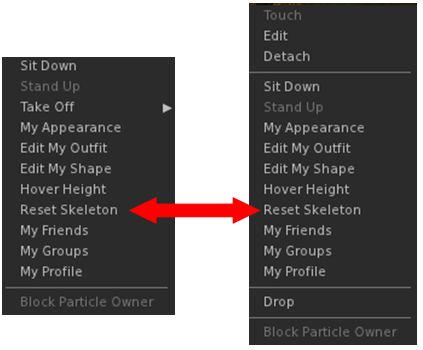
Reset Skeleton

reset-skele
The Reset Sketon option is available from the right-click context menus for both avatar name tags (l) and avatars (r)

There are occasions (when changing between avatars, for example) when those who are on a Bento viewer may see themselves or another Bento avatar distorted. This is due to variances in how appearance updates are received / handled (and even with non-Bento avatar models has in the past required a re-log to fix).

To overcome this in the Bento viewer, there is a Reset Skeleton option, which can be used on either yourself or other deformed avatars in your view. This can be found in the avatar name tag context menu, or the avatar context menu, either of which can be access by right-clicking on the name tag or avatar respectively.

Vir notes the solution is not ideal, but the only other way to fix such issues would be extensive re-working of the viewer code – and at least this approach avoids the need for a re-log to correct matters.

Time Frames for Release

Questions were asked on when the viewer might go to release. this is actually dependent on a number of factors, including:

  • The viewer’s crash rate compared with the current release viewer and other RC viewer in the release channel
  • Whether exposure to a wider audience of users uncovers non-bento bugs or regressions which require additional fixing
  • Relative priorities between Bento and other projects.

Avatar Vertical Position (height above ground) Calculation

This has been a running topic for some time. In short, a n avatar’s vertical position relative to the ground is determined by a complex calculation which involves using a number of joints running up through the body from the left foot to the skull. The idea is to present a consistent view of an avatar standing on the ground, rather than in the ground or over the ground. However, if any of the joints used in the calculation are changing position unintentionally when the calculation is made, it can result in the avatar seeming to bounce up-and-down (see here for more).

To help overcome these kinds of issues, Vir has now documented the body height calculation bones, and the details can be found here: Avatar body size

Joint Position and Volume Bones

collision-bones
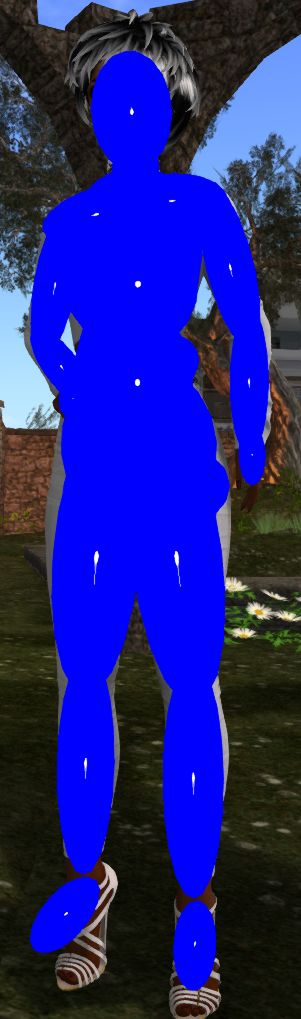
Visualising volume bones

It’s been noted that zooming in on a Bento avatar or attempting to click on a part of the avatar can be difficult. This is generally because the collision bones are not set-up correctly. The positions of the volume bones can be seen using Advanced Menu > Avatar > Show Collision Skeleton.

This will overlay the avatar with a series of oval shapes (official viewer – other viewers may render the collision skeleton slightly differently) which show the position of the volume bones. The closer these match the shape an avatar (something which may not always be possible, depending on the avatar type / size), the easier it will be to zoom in on the avatar and / or click on it.

Tapple Gao’s avatar testing and visualisation kit of meshes and animations can also be used to show the collision skeleton.

Setting volume bone positions can either be done within the mesh model or via animation, although there was some confusion whether collision volumes now get included in joint offsets.

Continue reading “Project Bento User Group update 26 with audio + hints’n’tips”

Bento project reaches RC status in Second Life

Bento: extending the avatar skeleton

OK, I admit I wasn’t expect this until next week, but on Wednesday, September 14th, the Lab  announced that Project Bento is now officially available as a release candidate viewer – version 5.0.0.319688 – which can be obtained through the Alternate Viewers wiki page.

And just in case anyone has missed all the Project Bento news, the best way is to catch-up through the official video. In short, Bento adds a wealth of new bones to the basic avatar skeleton (30+ to heads / faces and to hands alone!), making a wealth of new avatars (humans and non-human) and mesh wearables possible.

The reason I wasn’t expecting the viewer to get promoted just year is that the Lab also has a proof-of-concept viewer being tested, so I assumed any push to RC would come after a decision had been made on incorporating those changes (if they are to be adopted). So, not for the first time, I’m been wrong 🙂 .

The move to release candidate status doesn’t mean the project is at an end. There is still further work to be done as remaining bugs are fixed, etc  (so updates such as the slider locking in the proof-of-concept might yet arrive in the viewer). What it does do is three things:

  • Makes the viewer available to a wider audience through the Lab’s RC distribution mechanism, thus allowing any unforeseen issues in merging the Bento code into the current release viewer code (and which may be outside of direct Bento testing) to be identified and fixed
  • Potentially makes the viewer more widely available to content creators who may not have so far tried the viewer
  • Means that TPVs can now officially start incorporating the Bento code into their viewers (in fact, Cool VL Viewer has had Bento in its Experimental branch from some time, and Firestorm have also been working to merge the Bento code as well – but this shouldn’t be taken to mean there will be a new release of the latter in  the near future).

In keeping with the status of the Bento code, the Lab do ask people – particularly avatar content creators – to give the viewer a go,  and to file a JIRA against any issues found.

As noted above, Bento offers a range of opportunities for mesh wearable and avatar creators – you can see a couple of video exploring the AK and Catwa preview Bento mesh heads in my SL project update. Also, back in August, Vista Animations produced a video illustrating the potential of finger animations:

Then, of course, there is a huge range of non-human avatars: centaurs, “rideables”, winged creatures – all of which can be achieved a lot more efficiently through Bento than has previously been the case.

Teager's Bento Raptor using Bento bones
Teager’s Bento Raptor using Bento bones

So – get ready for the Bento Revolution!

Additional Links

2016 SL project updates 37 (1): server, Bento preview head videos

Vintage Romance; Inara Pey, September 2016, on Flickr Vintage Romanceblog post

Server Deployment: Week 37

On Tuesday, September 13th, the Main (SLS) channel received the same server maintenance package previously deployed on the RC channel in week #36. This comprises “minor internal logging changes” which may help with some of the problems occasionally seen with estate bans; at a minimum the Lab will be able to gather more information on them.

There iss no planned deployment or restart set for the three RC channels during the week. RC deployments will resume in week #38. This may involve further serve-side updates to reduce certain griefing vectors.

SL Viewer

The VLC Media Plugin viewer updated in September 13th to version 4.1.1.319583. This viewer replaces the QuickTime media plugin for the Windows viewer with one based on LibVLC.

In addition, and as indicated in my TPVD meeting notes, this version should include changes for exception handling in the viewer intended to ensure exceptions are better handled and recorded. These may not prevent crashes occurring, but should provide the Lab with better data on the exception throws and catches. Overall, they are describes as “fairly small, widespread changes” to the viewer code.

The remaining viewers in the various pipelines remain as per the end of week #36:

  • Current Release version: 4.0.7.318301 (dated August 8), promoted August 11 – formerly the Maintenance RC viewer download page, release notes
  • Release channel cohorts (please see my notes on manually installing RC viewer versions if you wish to install any release candidate(s) yourself):
    • Visual Outfit Browser viewer,  version 4.0.8.319143, dated August 30 – ability to preview images of outfits in the Appearance floater
  • Project viewers:
    • Project Bento (avatar skeleton extensions), version 5.0.0.318969, dated August 25 – avatar vertical position update; SLM files are by default not created or used; show bones display uses colours differently; animation of collision volumes fixed
  • Obsolete platform viewer version 3.7.28.300847 dated May 8, 2015 – provided for users on Windows XP and OS X versions below 10.7.

Project Bento

Following my last Bento update, Matrice and Gaia have been working on Avastar 2, which has now reached Alpha 10, supporting the current version of the project viewer (5.0.0.318969).

Demo Heads

In that update, I also blogged about the AK Bento preview head. On September 13th, Catwa offered some bloggers a preview look at an upcoming Catwa head, as  well as a preview video. – Doubtless, more heads will be appearing in the near future.

An important point to note with Bento heads is that while they will offer considerably more options for customising your look that “conventional” mesh head, it won’t simply be a case of buying Bento head, wearing it, and having it conform to your existing facial features – you will obviously need to adjust many of the head / facial sliders to get a close / approximate look, and even then, just how close a look you can achieve will depend a lot upon the base mesh of the head itself. So careful testing of Bento heads to find one which bears some initial resemblance to your desired look is likely to be required, and it may be that multiple heads are still required to achieve all of your desired looks.

Strawberry Singh has produced a video based on the AK Bento preview head, demonstrating how it currently works with the sliders.

As Whirly Fizzle pointed out to me, on the day Catwa issued preview copies of her Bento head work, fashion blogger Daeberethwen Arbenlow also put a video together running through the capabilities on that head as well

A further point of note with Bento mesh heads is that the degree of customisation available will depend on which bones of the face and head a model is rigged to, and the weighting assigned to it. An example of this is the nose division, mentioned in both videos. This can potentially be  more prominent, providing the head is rigged to the mFaceNoseBase bone and has a suitable weighting applied.

As Cathy Foil, developer of MayaStar, and one of the core members of the Bento development team points out:

Each mesh head designer will have to decide what sliders they want and will have to experiment with different weighting. It will be very exciting to see how face weights will evolve over the next few months and years.

Which again underline the need for careful comparisons when selected Bento heads as they become more and more available once Bento moves past RC status, and more Bento products start to appear.

SL Wiki

The Wiki remains locked to the majority of users for editing, no news on when it may be unlocked, or what might be done to address the current issues.

Project Bento User Group update 25 with audio

Bento: extending the avatar skeleton

The following notes and audio were taken from the weekly Bento User Group meeting, held on Thursday, September 8th at 13:00 SLT at the the Hippotropolis Campfire Circle. For details on the meeting agenda, please refer to the Bento User Group wiki page.

Note that this update is not intended to offer a full transcript of the meeting, nor does it present the discussion points in chronological order. Rather, it represents the core points of discussion, grouped together by subject matter were relevant / possible, whilst maintaining the overall context of the meeting.

RC Viewer Release

It is still hoped the Bento viewer will move to RC status soon. The main reluctance with pushing it further is to give people enough time for final testing with the majority of Avastar issues now hopefully resolved (see below). There are currently no major changes to the viewer being planned by the Lab, with the possible exception of the proof-of-concept idea for locking a mesh against slider changes.

Proof of Concept: Locking a Mesh Against Slider Changes

There have been discussions about possibly adding the ability to override the scale as well as position for joints in uploaded mesh models. A joint with both position and scale overrides would be effectively “slider-proof” – no sliders that affect the joint would have any effect on the model. This may be useful for content creators who want to control their avatar mesh shape exactly, without being affected by the standard customization options.

The Lab has now issued a proof-of-concept version of the Bento viewer for testing.  Depending on feedback it may or may not make it into the final version of the viewer. In releasing the proof-of-concept. there are also some notes on the forum from Vir on using this version of the viewer.

Note that this option doesn’t include the ability to enable / disable things on a per joint basis, which is unlikely to happen within the remaining Bento time frame. The idea is to try to provide something that s useful, but doesn’t involve a lot of changes to the UI. The Lab is interested in any feedback on this approach (via the Bento forum thread).

Collision Volumes

Vir presented a forum post on collision volumes and the operations supported for them (contrary to the name, collision volumes are not related to the physics of avatars – all such calculations are carried out on the back-end using a simplified representation of the avatar and do not include the avatar skeleton). Vir indicates that support for animating collision volumes is available on all versions of the viewer, including Bento, but whether or not it is a good idea to do so depends on what is trying to be achieved, noting the following use-cases:

  • Raycasting: collision volumes are used to detect an avatar under the mouse pointer. You can see this in drag-and-drop – try dragging a folder of clothing onto yourself. The drag will succeed if the spot you drag to is occupied by a collision volume
  • Animations with constraints: animations can include constraint information that causes the animation to respond to the location of body parts (hands on hips, resting hand on legs when sitting, etc). The collision volumes are used to determine these constraint locations.
  • Fitted mesh: suitably rigged meshes can use the collision volumes to scale with the avatar shape.

He also offered some guidelines for using collision volumes both in the post and during the meeting, including using them in the creating animations with constraints. Matrice requested anyone doing the latter if they could pass information to him on how they are doing this, as documentation is lacking.

Avastar 2 Updates

Avastar 2 Alpha 7 is available, which should resolve major issues with joint positions. The core updates in this version are:

  • All the related Appearance sliders, for human characters as well as for non human characters. Avastar now behaves just like any Second Life viewer, giving true “what you see is what you get character editing in Blender
  • Mesh eyes now behave exactly in the same way as the system eyes, including scaling with the eye size slider.

Medhue Simoni has produced an instructional video on updating from the “old” Bento rig version to the new rig version in Avastar.

Matrice Laville offered some feedback on the video, concerning some upcoming changes to Avastar.

Matrice also noted that there are a couple of issues which either have a fix awaiting release, or being investigated, which are related to jaw issues and scaling (below).

Jaw Issues And Scaling

Teager reports continued problems with her horse avatar, specifically with the teeth showing as a result of the lower lip not aligning correctly with the upper lip. Testing had led her to believe the problem might be related to scale on one of the bones. Matrice confirmed that there is a scaling issue, together with a peculiarity  in the way Blender works and applying scale within Avastar and issues of parenting / unparenting meshes which can lead to problems. He therefore recommends the best option at present is to ensuring the scaling on a bone in a mesh is always 1 while the problem is investigated.

In addition, Matrice indicated that he has added an option to Avastar to allow the export of all parent bones of each weighted bone, rather than just relying on the Avastar optimising which exported only weighted bones and ignoring any intervening bones. This option will be appearing in the next release of Avastar 2.

Continue reading “Project Bento User Group update 25 with audio”