Space Sunday: In memory of James A. Lovell

Jim Lovell in a cropped version of his 1969 official NASA portrait

On Friday, August 8th, NASA confirmed the passing of James A. Lovell, who alongside the crew of Apollo 11, could well be the most famous of the Apollo astronauts. During his career at NASA he flew into space fours times and to the Moon twice – although he was destined to never set foot on the latter, despite being a mission commander.

Born in Cleveland, Ohio on March 25th, 1928, James Arthur Lovell Jr., was the only child of James Lovell Snr., a Canadian expatriate, and Blanche Lovell (née Masek), who was of Czech descent. Following the death of his father in a car accident in 1933, James and his mother moved to Milwaukee, Wisconsin, where he developed an interest in aircraft and rocketry as a teenager. After graduating high school, Lovell enrolled in the US Navy’s “Flying Midshipman” programme, which enabled him to attend the University of Wisconsin and study engineering – something he could not otherwise have been able to afford. As his Navy stipend was fairly meagre, he supplemented his income working a local restaurant as a busboy and wishing dishes.

In 1948, Lovell’s hoped-for career as a potential naval aviator almost came to an end when the Navy announced it was cutting back on the number of students being accepted through the “Flying Midshipman” programme. However, with the aid of local Congressman John C. Brophy, Lovell was able to turn this downturn in his career into a positive, by being accepted into the United States Naval Academy, Annapolis, where he was able to both continue his studies and secure himself a US Navy commission upon his graduation.

This happened in 1952, with Lovell gaining a Bachelor of Science degree and a US Navy commission as an ensign. He was then selected for aviation training. However, prior to commencing flight training, he married his long-term sweetheart, Marilyn Lillie Gerlach, who had transferred to George Washington University in Washington, D.C., so she could be near him while he was at Annapolis.

Jim and Marilyn Lovell, circa 1965. Credit: unknown

In February 1954, Lovell completed his flight training and was assigned as a night fighter pilot operating out of Virginia, prior to being moved to the aircraft carrier USS Shangri-La during her third commissioning as US Navy fleet carrier. Sailing in the western Pacific and completing 107 carrier sorties, Lovell was again reassigned in 1956, this time to provide transition training for pilots moving over to the new generation of Navy jets entering service.

This work qualified Lovell for selection as a trainee test pilot in 1958, and he joined a class with included future fellow astronauts Walter “Wally” Schirra Jr and Charles “Pete” Conrad Jr. After six months of training, Lovell graduated at the top of the class – which should have assured him a role as a test pilot. Instead, he found himself pushed into Electronics Testing, and assigned to work on airborne radar systems.

This prompted him to join Schirra and Conrad in applying to join NASA’s first astronaut intake, the three being part of a batch of 110 test pilots initially selected for consideration as potential astronauts. Ultimately, Schirra was the only one of the three to be selected to become one of the Group One Mercury Seven astronauts; Conrad blew his chances by rebelling against a number of the psychological tests, finding them objectionable, whilst Lovell missed out when a temporarily high bilirubin count stopped his selection.

Returning to naval duties, Lovell became the Navy’s McDonnell Douglas F-4 Phantom II programme manager, followed by a stint as a flight instructor and a safety engineering officer. Then in 1962, NASA started the selection process for the Group Two astronaut intake (the so-called “New Nine”, as the media would eventually dub the nine selected by NASA). Both Lovell and Conrad re-applied, the latter a lot more contrite this time around, together with John Young, who had served under Lovell on the F-4 Phantom 2 programme.

Lovell was informed he has been selected as one of the “New Nine” in September 1962. The following month, he and his family moved to the Clear Lake City area near Houston, Texas, where the new Manned Spaceflight Centre was being built.

NASA’s “New Nine” (officially the Group Two astronaut intake) in 1962, with Jim Lovell in the centre of the standing row. Flanking Lovell to the left and right respectively (and from the left) are: Elliott M. See, James A. McDivitt, Edward H. White II and Thomas P. Stafford. In the front row (left to right) are: Charles Conrad, Jr, Frank Borman, Neil Armstrong and John Young. Credit: NASA

Following initial training, carried out alongside the original Mercury Seven, Lovell was selected as backup pilot for the Gemini 4 mission, with Frank Borman, another of the “New Nine” selected as backup commander. This placed Borman and Lovell in line to fly the Gemini 7 mission as the prime crew.

Gemini 7 launched on December 4th, 1965, and would become the longest space mission undertaken until Soyuz 9 in 1970. In all, Gemini 7 lasted 14 days and completed 206 orbits of Earth. It was primarily intended to solve some of the problems of long-duration space flight, such as stowage of waste and testing a new lightweight spacesuit which might be used for both Gemini and Apollo, but which both men found to be impractical.

One significant “late change” to the mission came in the last two months prior to launch. Gemini 6, with “Wally” Schirra and Thomas Stafford, had been planned to take place in October 1965. The goal of that mission was to perform a series of dockings with an Agena target vehicle. However the mission was scrubbed when the Agena for the mission suffered a catastrophic failure following separation from its launch booster, destroying itself. As a result, Gemini 6 was initially cancelled.

Gemini 7, with Lovell and Borman aboard, as seen from Gemini 6A, and the later closes to a distance of some 7 metres. Credit: NASA (digitally enhanced to remove light reflection from the cockpit window of Gemini 6A)

However, such was the importance of on-orbit rendezvous and docking to the Apollo programme, the decision was made to re-designate Gemini 6 as Gemini 6A, and launch it eight days after Gemini 7. This allowed Schirra and Stafford to perform an on-orbit rendezvous (but no docking) with Gemini 7, that latter remaining a passive target for Gemini 6A whilst Schirra and Stafford manoeuvred their vehicle.

Following their launch, Borman Lovell performed their own rendezvous manoeuvre: following separation from their Titan II launch vehicle, Borman turned their craft around and flew in formation with the expended Titan II for fifteen minutes before moving away to start their mission proper. This included each man having the opportunity to doff his spacesuit and test working in shirt sleeves in the vehicle, and then donning it in a space little bigger than the front seat of a car. These tests greatly contributed to Apollo crews being able to fly to the Moon and back in their shirt sleeves, only wearing their pressure suits during critical phases of the mission, Lovell and Borman finding the revised Gemini spacesuit cumbersome, and long-term work inside a spacecraft whilst wearing a pressure suit too restrictive and uncomfortable.

Another view of Gemini 7 from Gemini 6A, at a distance of around four metres, as the two craft perform a station-keeping exercise. Credit: NASA

The rendezvous with Gemini 6A took place on December 15th, 1965, same day as Gemini 6A launched. At the time, Gemini 7 was “parked” in a circular 300 km orbit, allowing Gemini 6A to “chase” it, with Schirra allowing his vehicle’s autopilot to carry out some of the manoeuvring before taking over and bringing Gemini 6A to some 40 metres separation from Gemini 7. For the next 270 minutes Gemini 6A performed a series of rendezvous manoeuvres with Borman and Lovell, sometimes coming as close as 30 centimetres (1 foot) of Gemini 7. Station keeping between the two craft was so good that during one such manoeuvre, Gemini 6A was able to remain in place alongside  Gemini 7 for 20 minutes with any need for control inputs.

Following completion of these tests, Gemini 6A returned to Earth the day after its launch. Gemini 7, meanwhile, continued on what Borman and Lovell would later describe as the “boring” part of the mission, prior to re-entry, splashdown and recovery on December 18th.

Gemini 7 set Lovell up to command the final Gemini mission in the programme, Gemini 12, with one Edwin E “Buzz” Aldrin Jr., as his pilot. Lovell would later describe the mission as being a means to “catch all those items that were not caught on previous flights.”  One of these was to need to carry out a series of EVA tests – with Aldrin, as pilot, selected to leave the confines of the vehicle’s cramped cabin and carry them out.

Similar EVAs had been attempted in other Gemini flights, but none had really succeeded for a variety of reasons. For Gemini 12, equipment – notably tethering restraints on the Gemini vehicle – had been greatly improved, and a new underwater training capability had been introduced, allowing Aldrin to gain familiarity with being weightless through neutral buoyancy ahead of the mission – something which would go on to be a staple of human spaceflight training at NASA.

A shorter 4-day duration mission, Gemini 12 lifted-off on November 11th, 1966. The following day Lovell and Aldrin completed a rendezvous and docking with the Agena target vehicle, launched just 1 hour and 39 minutes ahead of them. Aldrin completed a 2 hour 20 minute EVA whilst the Gemini spacecraft was docked with its Agena target vehicle, successfully meeting all of his objectives, and the two men carried out a series 14 scientific experiments prior to returning to Earth on November 16th, 1966.

“Buzz” Aldrin (left, with cap) and Jim Lovell celebrate the end of their Gemini 12 mission aboard the recovery vessel, USS Wasp. Credit: unknown

Following the tragedy of the Apollo 1 fire, the Apollo Command Module went through a significant re-design, including the hatch mechanism which had effectively trapped the Apollo 1 crew in their burning vehicle, leading to their deaths. As a result, the updated vehicle had to go through a series of ground-based qualification tests. One of these tests formed Lovell’s next “mission” – spending 48 hours bobbing around the Gulf of Mexico in Command Module test article CM-007A along with Stuart Roosa and Charles Duke Jr , testing its seaworthiness, the efficiency of its floatation devices and dealing with any potential small leaks of seawater entering the vehicle.

With the Apollo programme attempting to get back on track after Apollo 1, Lovell was assigned as back-up Command Module Pilot (CMP) for Apollo 9. He was then promoted to the prime crew when Michael Collins had to be removed as prime CMP so he could receive surgery for a spinal bone spur. This move reunited Lovell with Frank Borman, Apollo 9’s commander.

Apollo 9 was intended to be the second half of a pair of missions designed the test the the Apollo Lunar Module (LM), Apollo 8 doing so in a low Earth orbit, and Apollo 9 in a high-perigee orbit. However, with work on the Lunar Module running well behind schedule, the decision was made to scrap the high-perigee test mission, and instead carry out one low orbit test flight of the Lunar Module. To achieve this, the Apollo 8 and Apollo 9 crews were swapped. The Apollo 9 crew would now fly the LM tests, delayed to allow time for the Lunar Module to be completed;  Borman and his crew, as Apollo 8, would fly a mission to and around the Moon as a part of a final check-out of the Command and Service modules on long duration flights.
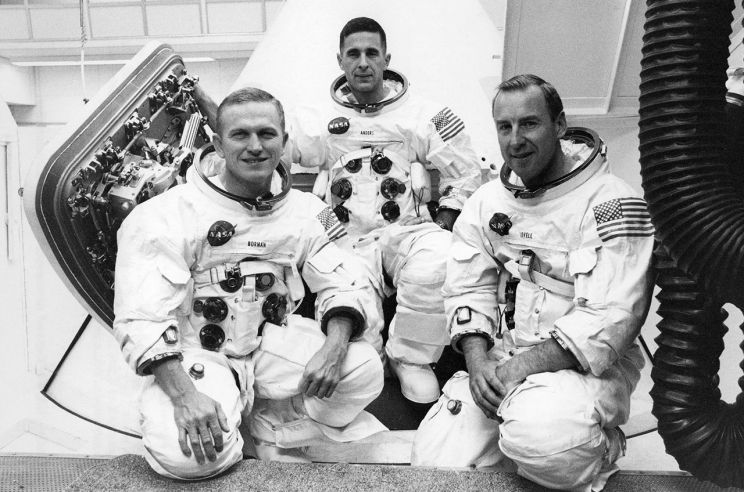
Lovell (right) poses with Frank Borman (left) and William Anders at the hatch  of their Apollo 8 Command Module, ahead of that mission. Credit: NASA

Launched on December 21st, 1968, Apollo 8 was a landmark mission in a number of respects:

  • The first crewed flight of the Saturn V launch system.
  • The first crewed mission to ever leave low Earth orbit and enter he gravitational sphere of influence of another celestial body.
  • The first crewed mission to enter lunar orbit.
  • The first humans to be entirely cut off from Earth as their vehicle passed around the Moon.
  • The first humans ever to witness “earthrise” – the Earth rising over the limb of the Moon, something almost impossible to see from the surface of the Moon where the Earth is either above or below the horizon.

The “earthrise” phenomenon was first witnessed as Apollo 8 came around from behind the Moon at the end of its fourth orbit. All three men were busy with various observations, with Anders taking black and white photos of the lunar surface when he happened to look up, and gasp in surprise.

Oh my God, look at that picture over there! There’s the Earth coming up. Wow, is that pretty! … You got a colour film, Jim? Hand me a roll of colour, quick, would you?

– William Anders, Apollo 8, on witnessing “Earthrise” for the first time

Taking a colour film cassette from Lovell, Ander loaded it into his camera and took the picture destined to become famous the world over, later selected by Life magazine as one of its hundred photos of the 20th century.

Earthrise: the shot that enraptured the world. Credit: William Anders / NASA

Entering lunar orbit, and after checking the status of the spacecraft following the orbital insertion burn of the Service Module’s main engine, Lovell provided the very first close-up description of the lunar surface as seen with unaided human eyes.

The Moon is essentially grey, no colour; looks like plaster of Paris or sort of a greyish beach sand. We can see quite a bit of detail. The Sea of Fertility doesn’t stand out as well here as it does back on Earth. There’s not as much contrast between that and the surrounding craters. The craters are all rounded off. There’s quite a few of them, some of them are newer. Many of them look like—especially the round ones—look like hit by meteorites or projectiles of some sort. Langrenus is quite a huge crater; it’s got a central cone to it. The walls of the crater are terraced, about six or seven different terraces on the way down.

–  Jim Lovell, Apollo 8, offering the first close-up description of the Moon

As they rounded the Moon for the ninth of ten times, on Christmas Day 1968, the crew of Apollo 8 made a second television broadcast to Earth. It concluded with each of the three men reading verses from the Book of Genesis describing the creation of the Earth; given what they had witnessed with “earthrise” the passages seemed particularly fitting.

During their trip home, the crew were informed they had presents hidden aware in their vehicle, courtesy of Chief of the Astronaut Office, Donald “Deke” Slayton: a Christmas dinner with all the trimmings, all specially packed together with a miniature bottle of brandy for each man. Borman ordered the bottles to remain sealed until after splashdown to avoid any risk of alcoholic impairment during re-entry and splashdown – all of which occurred without incident on December 27th, 1968. However, no warning was required: all three men kept the bottles unopened as keepsakes for years.

As prime crew for Apollo 8, Lovell was automatically selected as commander on the back-up crew for Apollo 11. Under the crew rotation rules established by “Deke” Slayton, this assignment in turn meant Lovell would command Apollo 14.

However, fate again intervened, as it had in so many ways during Lovell’s career. Apollo 13 was to have been commanded by Alan Shepard, marking his return to flight status after being grounded for several years. However, Slayton’s boss, George Mueller, Director of Manned Space Flight, refused to sign-off on Shepard’s selection for the mission, believing Shepard had not had sufficient training. Because of this, Slayton asked Lovell if he and his crew of Thomas Kenneth “Ken” Mattingly (who would later be replaced by John “Jack” L. Swigert Jr.) and Fred Haise Jr., would be willing to swap seats with Shepard and his crew, to give the latter more training time.

Lovell’s response to the request was to become one of the greatest unintentional understatements of the 20th Century: “Sure, why not? What could possibly be the difference between Apollo 13 and Apollo 14?”

As well all know now, Apollo 13 was to have quite a lot of difference between it and Apollo 14 – and any other Apollo mission NASA flew, becoming as it did potentially the most famous Apollo lunar mission alongside that of Apollo 11, but for very different reasons.

“We have a problem here.” – CMP  Jack Swigert.
“This is Houston, say again please,” – CapCom Jack Lousma.
“Houston, we’ve had a problem,”- CDR Jim  Lovell.

– From the communications between the Apollo 13 command module and Mission Control, immediately following the explosion within the oxygen tanks of Apollo 13’s Service Module

The wreck of the service module after it had been jettisoned. The blown-out panel and extensive damage to the fuel cell rack and oxygen tank shelf below then can be seen. Credit: NASA

The safe recovery of the Apollo 13 crew following an explosion within the Service Module’s oxygen tank 2 is the stuff of legend so much so, that rather than dwelling on it here, I’ll refer readers to my article on the occasion of its 50th anniversary –Space Sunday: Apollo 13, 50 years on.

Apollo 13’s flight trajectory would result in Lovell, Haise, and Swigert gaining the record for the farthest distance that humans have ever travelled from Earth to date. It also made Lovell one of only three Apollo astronauts, along with John Young and Eugene Cernan, to fly to the Moon twice – although unlike Cernan and Young, he was never destined to set foot on its surface. In all, he accrued 715 hours and 5 minutes in space flights on his Gemini and Apollo flights, a personal record that stood until the Skylab 3 mission in 1973.
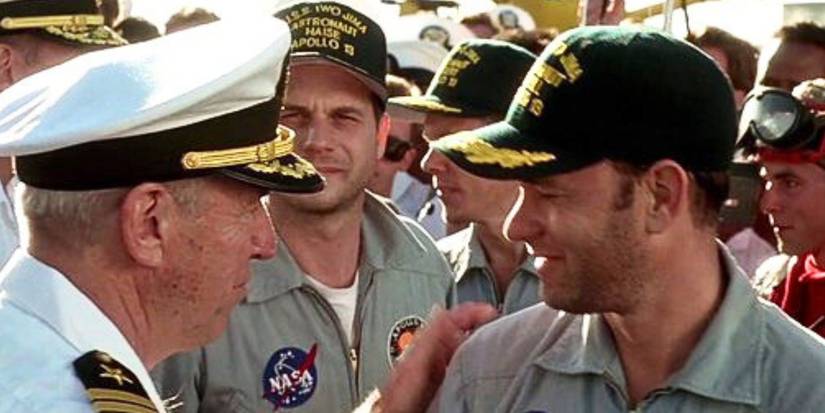
Jim Lovell, in a cameo role and US Navy whites, greets “himself” (in the form of Tom Hanks) after the recovery of the Apollo 13 crew by the USS Yorktown in Ron Howards 1995 film, Apollo 13. Credit: Universal Studios

Following his retirement from NASA in 1973, Lovell had a successful business career, taking on both CEO and President positions for a number  of corporations, and serving on the board of directors of several more. In 1999, he and his family opened Lovell’s of Lake Forest, a restaurant in Lake Forest, Illinois, where the family settled. The head chef was James “Jay” Lovell, his oldest son, who took over the business in 2006, and ran it through until in closed in 2014.

Lovell and his wife Marilyn remained married through until her passing in August 2023 at the age of 93. Mount Marilyn in the Montes Secchi  was named in her honour by Lovell in during the Apollo 8 mission, with the name later officially adopted. Lovell has a small crater on the lunar farside named for him.

Lovell passed away at the age of 97 at his home in Lake Forest, Illinois. He is survived by his four children, Barbara, “Jay”, Susan, and Jeffrey.

Space Sunday: Frank Borman – first to the Moon

Fank Borman during Suiting-up for the Apollo 8 mission, December 1968. Visible but blurred in the background is his crewmate, Jim Lovell. Credit: NASA (via You Tube)

Just a week after the passing of Apollo astronaut Ken Mattingly (see: Space Sunday: Remembering Ken Mattingly), came the news that another pioneering hero of spaceflight, Frank Borman, had passed away at the age of 95.

Born in Gary, Indiana on March 14, 1928 as the only child of Edwin Otto and Marjorie Borman, Frank Frederick Borman II considered Tucson, Arizona to be his home town after his family moved there whilst he was very young in order to ease the numerous sinus and mastoid problems he suffered in the colder, damper environment of Indiana.

By the age of 15 and in the mid-1940s, he was playing football for the high school team and, thanks to local flight instructor Bobbie Kroll, who took a shine to his enthusiasm for aviation, he has his student’s flying certificate and was a member of a local flying club. His aim was to levering his football playing into a scholarship so he might attend an out-of-state university offering a good course in aeronautical engineering.

Unfortunately, this did not work out and with graduation approaching and his family unable to afford to send him to a suitable university, he determined he’s have to enlist in the Army and later use his right to a college tuition under the GI Bill. However, a family friend persuaded local congressman Richard F. Harless to add Borman’s name to a list of nominees he was going to put forward for a slot at the US Military Academy, West Point.

Borman’s official 1950 West Point yearbook photo. Via Wikipedia

Despite having little chance of being offered the slot – his was the fourth and last name on the list, after all – Borman took the entrance exam, and passed. Shortly afterwards, hostilities in the Pacific ended, and astoundingly, those on the list ahead of him opted to forego military service, gifting the slot to him.

Graduating West Point in June 1950, Borman returned home to Tucson on leave prior to commencing his formal basic training. Whilst there, he arranged to meet Susan Bugbee, whom he had dated in high school. She had recently graduated from the University of Pennsylvania with a degree in dental hygiene. Rekindling their relationship, they were married on July 20th, 1950.

Achieving his goal of training as a fighter pilot, Borman attended combat flight school throughout most of 1951, based at Nellis Air Force Base, Nevada. Whilst there, Susan gave birth to their first son, Frederick Pearce Borman, in October of that year. Two months later, Borman found his flying career potentially shattered after he suffered a perforated eardrum whilst on a dive bombing training flight and doctors grounded him indefinitely as a result.

It took him a year to convince his seniors his ear had healed without any danger of further ruptures,  and he was capable of flying. During that time, he was assigned to ground duties at Clark Air Base in Philippines, where Susan gave birth to their second son, Edwin Sloan.

By 1960 and with a Masters degree under his belt – which he obtained in just a year rather than the usual 3 – Borman had been back in the pilot’s seat for eight years, clocking up some impressive experience, all of which resulted in his selection for training USAF Experimental Flight Test School. Graduating from it April 1961, he was immediately selected as one of five Air Force students to attend the first class at the Aerospace Research Pilot School. However, NASA also announced they were seeking nine candidates for their second astronaut intake, so Borman, along with fellow student James McDivitt and instructor Thomas Stafford obtained permission to apply, and all three were formally accepted as a members of the “Next Nine” (Group 2) NASA astronaut candidates in April 1962.

At NASA, Borman became known for his focus and tenacity – and for have something of an ego. He was initially selected to fly with Mercury veteran Virgil “Gus” Grissom on the first long-duration flight of Gemini. However, their pairing as the back-up crew for Gemini 3, the first Gemini Project crewed mission, led to tensions such that when astronaut chief Donald “Deke” Slayton wanted to promote both men to the prime crew slots on the mission after original mission commander Alan Shepard was diagnosed with Ménière’s disease, Grissom stated he would only fly the mission if Borman were replaced as his pilot.

Complying with the request, Slayton replaced Borman with John Young. This scored two goals: it ended the friction between Grissom and Borman and it allowed him to appoint Borman as commander of the long-duration Gemini flight – now designated Gemini 7 – with Jim Lovell as his pilot, the two getting on well together. Plans changed just two months ahead of Gemini 7’s December 1965 launch, when Gemini 6 was cancelled while the crew of Walter Schirra and Thomas Stafford were actually in their capsule preparing for launch.

The reason for this was Gemini 6 has been due to perform rendezvous and docking tests with a uncrewed Agena Target Vehicle launch just ahead of it. However, the Agena had exploded shortly after launch, leaving Gemini 6 without a docking target. However, rather than drop the mission entirely, mission planners decided Gemini 6 – re-designated as Gemini 6A – could launch a few days after Gemini 7, with Schirra and Stafford using it as their rendezvous and docking target.

Borman agreed to this change, but drew the line at any idea of the two craft physically docking; he and Lovell didn’t have the time they’d need to learn the required procedures, even if their vehicle were to be the passive element of any docking. He also mixed the idea that Lovell and Stafford should perform and joint EVA and swap vehicles, pointing out this would require Lovell to wear a Gemini EVA suit for several days, something for which it was not designed. Conceding these points, mission planners settled on the basic rendezvous idea, and Gemini 7 lifted off on December 4th, 1965, with Gemini 6A following on December 15th – three days later than planned.

Gemini 7 with Borman and Lovell aboard, as seen from Gemini 6A, shortly after their initial rendezvous, December 15/16, 1965, when the two craft are approximately 10 metres apart. Credit: NASA

During the intervening period, Borman and Lovell completed all the major aspects of their mission – which were related to matter of crew hygiene, nutrition, fitness, diet, etc., during a lunar mission – and were keen to see Gemini 6A arrive. This it did some 13 hours after launch, with Schirra initially bringing the craft alongside Gemini 7 at a distance of 40 metres before spend the next 4.5 hours performing a series of rendezvous manoeuvres, at times coming as close as 30 cm (1 ft) to Gemini 7 as he practiced docking manoeuvres and assessed flight control precision. After this, he moved Gemini 6A some 16 km away to allow both crews to get some rest without any worry their vehicles might collide.

After just over 24 hours in orbit, Gemini 6A fired its retro-rockets and re-entered the atmosphere, splashing down in the North Atlantic to be recovered by the USS Wasp. Meanwhile Borman and Lovell continued in orbit, becoming concerned as their craft started experiencing a mounting series of niggling issues and malfunctions as it started to reach the limits of its operational endurance. Despite this, both men remained in good spirits, even joking with their recovery crew – their December 18th splashdown was close enough to that of Gemini 6A that the USS Wasp was also assigned to their recovery – that they’d been together so long, the Wasp’s Captain might as well marry them!

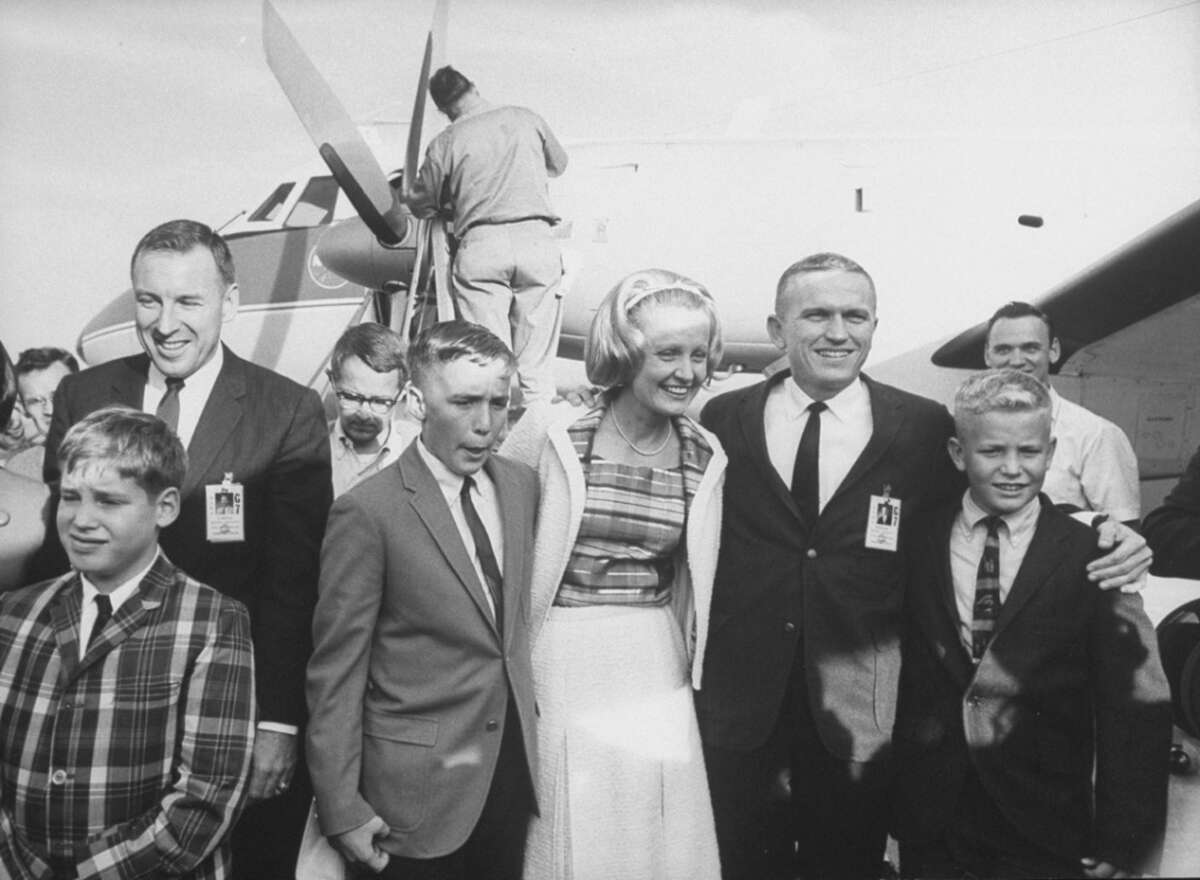
James Lovell (left, with son Jay) and Frank Borman (right, with wife Susan and sons Frederick and Edwin), following the successful flight of Gemini 7

Continue reading “Space Sunday: Frank Borman – first to the Moon”

Serene Footman: one of the great hearts of Second life

Isle of May, October 2022

On October 2nd, 2022 Jade Koltai informed us that Serene Footman, her long-time creative partner in bringing together some of the most outstanding region builds witnessed in Second Life, passed away from cancer in August 2022.

To my regret, Serene and I were not closely acquainted in Second Life; although we did exchange IMs at times, and chatted on a few topics. However, I didn’t actually need to converse with him to hear his voice or appreciate his heart: both could be seen and felt through every single region build he and Jade presented to Second Life for the enjoyment of everyone who visited them.

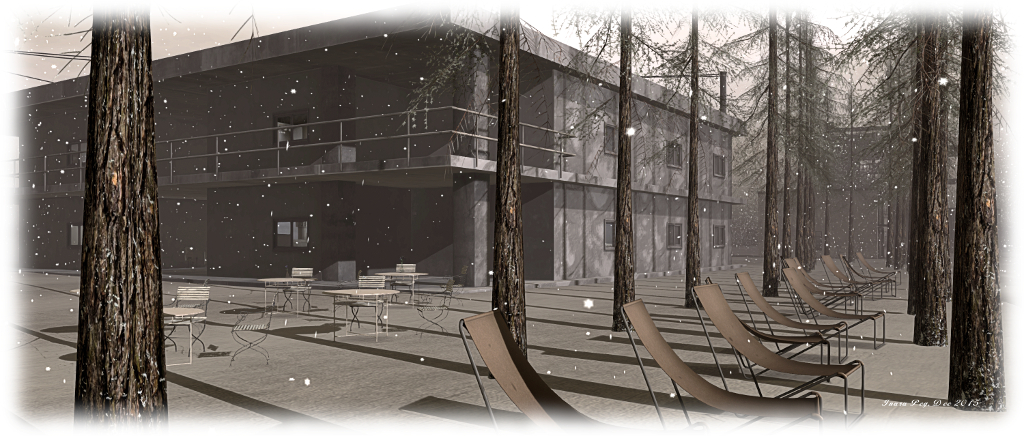
I first became familiar with Serene and Jade’s work back in 2015, when they opened Furillen, a Homestead region modelled on a small isle of that name and itself laying off the coast of Gotland, Sweden’s largest island. By turn a quarry, then a military installation and more recently a conference centre, Furillen’s history was richly and evocatively caught in Serene and Jade’s build  –  and build that set the tone for almost all of their subsequent designs, as well as loaning its name to Serene’s blog.

Furillen; Inara Pey, December 2015, on FlickrFurillen, 2015 – blog post

I say “almost”, because the next design the pair produced was very different to any physical world location (although it did include a reproduction of London’s Battersea power Station), as it offered an engaging and unique homage to English rock band Pink Floyd with Pink Floyd Ate My Sim.

But it was with the representation of physical world locations that Serene and Jade’s partnership became most well-known, with designs encompassing La Digue du Braek (found in France), Khodovarikha (Russia), Isle of May (Scotland), Louisiana’s Black Bayou Lake, Rummu quarry in Estonia, Chesapeake Bay, Ukivok in Alaska, North Brother Island, New York, to name just some – with both Serene and Jade also producing individual region designs also based on physical world locations as well.

Ojuela, May 2022 – blog post

The major points of all of these designs, alongside them being modelled on places people would likely otherwise have little or not opportunity to visit in the physical world, was the fact they were richly detailed and offered superbly imaginative interpretations of the places on which they were based, given the limitations (notably physical space) found within SL Homestead (and even Full) regions.

A further aspect of these builds which helped distinguish them from other region builds lay in the amount of additional information Serene would provide on them and their physical world namesakes through his Furillen blog which remains (for the time being at least), an excellent reference work in its own right.

Serene was also a gifted photographer, and his images were subject to exhibitions in Second Life, as with 2019 Retrospective, which I reviewed here, and which demonstrated Serene’s wonderfully understated and eye-caching technique.

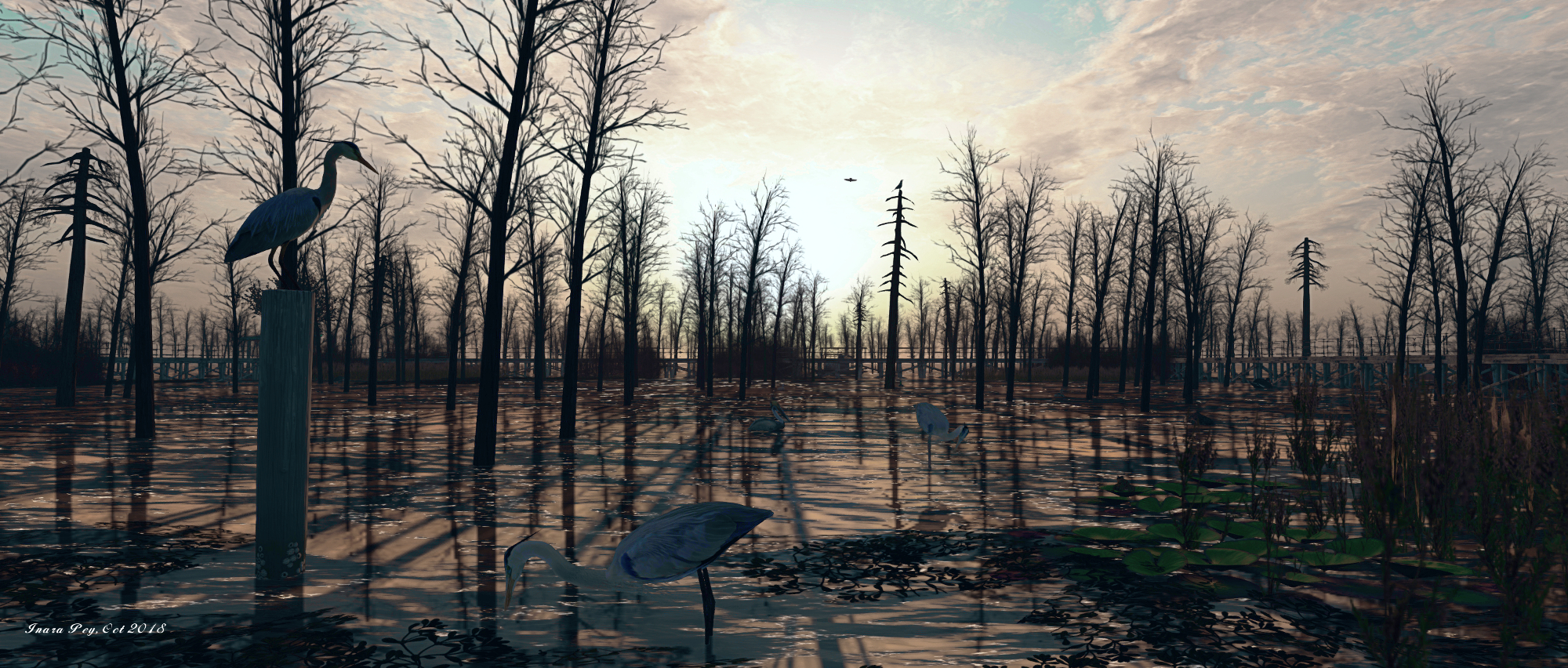
Black Bayou Lake; Inara Pey, October 2018, on Flickr
Black Bayou Lake, 2018 – blog post

To give people the opportunity to remember Serene, his work, and her partnership with him, Jade has returned Isle of May – one of Serene’s favourite builds – to Second Life, and visitors are encouraged to drop in and recall Serene’s presence in Second Life, the beauty of his work and the joy he brought to all of us in visiting these wonderful creations.

My condolences to Jade and to Serene’s family and friends.

Related Links

Space Sunday special: Nichelle Nichols, First Lady of Space

via NASA / Paramount +

While I have written about the passing of noted individuals involved in astronomy and space exploration in previous Space Sunday articles, this obituary – coming a little later than intended – focuses on the life of a woman who never actually flew in space or worked directly on any space programme, but who nevertheless has a profound impact on the shape of the US space programme from the late 1970s through mid-1980s. who who served as an inspiration for woman and those from diverse ethnic backgrounds to seek careers with NASA, and who sadly passed away on July 30th, 2022

Her name is Nichelle Nichols, known the world over as Lt. Uhura from the original Star Trek TV series and the first six of the franchise’s big screen outings, and this is her story.

Born Grace Dell Nichols on December 28th, 1932 to Samuel Earl Nichols, a factory worker who Lishia (Parks) Nichols, in Robbins, Illinois (a suburb of Chicago), where Samuel Nichols served as both the local mayor (1929) and its chief magistrate. From the start, she was determined in her aims: as a youngster, she informed her parents she did not like her given first name and asked them to change it, any they suggested “Nichelle”, which she adopted.

By the age of 16, Nichelle Nichols was singing professionally for Duke Ellington. Credit: Unknown

Studying ballet, dance, music and singing at High School and the Chicago School of Ballet, Nichols landed her first professional gig when just 16, singing in a revue at The College Inn, a well-known Chicago night spot.

It was there that jazz legend Duke Ellington witnessed her performance and he invited her to join his big band as a singer / dancer. This was followed by time with Lionel Hampton’s band, which she joined as a lead singer and dancer.

Nichols’ acting break came in 1959, when she appeared in Porgy and Bess, Starring Sammy Davis Jr., Sidney Poitier, Dorothy Danridge and Pearl Bailey. While she was uncredited in the film, her appearance led to a series of small stage roles, then in 1961 she was cast opposite Burgess Meredith in Oscar Brown’s Kicks and Co, a musical satire poking fun at Hugh Hefner’s Playboy.

The show wasn’t a success, closing not long after it opened, but it ran for long enough for a curious Hefner to attend a performance. He was so impressed by Nichol’s stage presence and singing voice, he immediately offered her the chance to sing at his original Playboy Club, which has opened to great success as a nightspot in 1960.

Three years later, Nichols gained her first TV part, a small role in The Lieutenant starring Gary Lockwood (2001 a Space Odyssey) and created by a certain Eugene “Gene” Roddenberry. The episode, entitled To Set It Right, guest-starred Don Marshall (Land of the Giants) and the legendary Dennis Hopper, and dealt with the controversial subject of racism – so controversial in fact that NBC initially refused to air it, a decision that Roddenberry later said helped spur him in his desire to create Star Trek and use the science-fiction format by which to tell morality tales and socially-aware stories without upsetting the network censors.

Nichol’s role in The Lieutenant was small but memorable (and actually led to a short-lived affair with Roddenberry). More particularly, in appearing in the show, she joined a distinguished list of actors who would go on to have an impact on Star Trek, including cast members Majel Barrett (with whom Roddenberry also had an affair before eventually marrying her) Leonard Nimoy, William Shatner and Walter Koeing, and guest stars Ricardo Montalban (Khan Noonian Singh from Space Seed and later, Star Trek II: The Wrath of Khan) Paul Comi (Lt. Styles, Balance of Terror), and Lockwood himself (Lt. Commander Gary Mitchell from Where No Man Has Gone Before).

As Lieutenant Uhura in Star Trek, Nichols became an icon for women and people of colour the world over, and particularly in the Untied States. Her position as a female officer serving on the bridge of a quasi-military vessel (part of an organisation clearly modelled on the US Navy), was unprecedented, while the role itself was one of the first times an African American actress was portrayed a non-stereotypical role on television.

However, thanks to the core focus on the series leads – Shatner and Nimoy – by the end of the first season, Nichols was dissatisfied in having little to do, and on the final day of shooting, Wednesday, February 22nd, 1967, she handed her resignation to creator-producer Roddenberry, stating her intention to take an offer to appear on Broadway. Rather than accept, Roddenberry requested she take time to think about leaving the show some more before making her decision final.

Nichelle Nichols in her iconic and inspirational role of Lt. Uhura in Star Trek. Credit: Paramount – CBS

The following Saturday, February 25th, 1967, Nichols attended an event at the Beverley Hills Hilton in connection with the Nation Institute (although later attributed as an NAACP banquet) at which Dr. Martin Luther King Jr, was to speak. It was an event to go down in history as the first time Dr. King publicly condemned the war in Vietnam. However, for Nichelle Nichols it was memorable for another reason entirely. Ahead of King’s address, she was informed her “greatest fan” wanted to meet her.

I said, ‘Sure.’ I looked across the room and thought whoever the fan was had to wait because there was Dr. Martin Luther King walking towards me with this big grin on his face. He reached out to me and said, ‘Yes, Ms. Nichols, I am your greatest fan.’ He said that Star Trek was the only show that he, and his wife Coretta, would allow their three children to stay up and watch. When I told he I was leaving the series, he said, ‘you cannot, you cannot! For the first time on television, we will be seen as we should be seen every day, as intelligent, quality, beautiful, people who can sing dance, and can go to space, who are professors, lawyers … If you leave, that door can be closed because your role is not a black role, and is not a female role; he can fill it with anybody even an alien.

– Nichelle Nichols, recalling her 1967 meeting with Dr. Martin Luther King Jr.

So deeply affected by King’s words, Nichols didn’t only return to Start Trek and stay with it through the Star Trek VI: The Undiscovered Country, the last outing for the entire original series cast, she sought to do more for the people of whom King spoke.

Most notably, she helped found and run Women in Motion, a company that initially produced educational materials using music as a teaching tool and which focused on young women and girls. However, during a visit to a NASA facility, she commented about the lack of apparent diversity among the staff. NASA responded by asking her to help them broaden their recruiting activities, providing a grant to Women in Motion to help with the work.

Nichelle Nichols one one of the two Apollo Mission Operations Control Rooms (MOCR, popularly referred to as “Mission Control”) in 1977. Credit: NASA

Continue reading “Space Sunday special: Nichelle Nichols, First Lady of Space”

Space Sunday special: Michael Collins

Michael Collins in his official NASA Apollo 11 photo. Credit: NASA

On Wednesday, April 28th, 2021. the news came that Michael Collins, the Command and Service Module pilot on Apollo 11 had passed away at the age of 90.

Collins was the unsung hero of Apollo 11. While Armstrong and Aldrin held the world’s attention, he quietly circled the Moon in the CSM on his own. A natural loner, he stated he never really felt lonely, and in the 48 minutes of each orbit when he was out of radio contact with the Earth as Columbia passed round the far side of the Moon, has was not afraid. Rather, he felt “awareness, anticipation, satisfaction, confidence, almost exultation”.

Born on October 31st, 1930 in Rome, Italy, Collins, was the second son and forth child of James Lawton Collins and Virginia Collins ( née Stewart). The Collins family was steeped in military service, a fact that helped shaped Michael’s life.

Rising to the rank of of major-general, his father served in the 8th Cavalry during the Philippine–American War, and also saw deployments in both World Wars; he was also an aide-de-camp to General of the Armies John Joseph (Black Jack” Pershing. His brother – Michael’s uncle – was General J. Lawton Collins, the Army Chief of Staff during the Korean War. Collins’ elder brother, James Lawton Collins Jr., also served in US Army in World War II and rose to the rank of brigadier general, and served as the U.S. Army Chief of Military History from 1970 to 1982.

Given his father’s career, Collins spent the first 17 years of his life following his father to his various US and overseas posting. During this time – and possibly fuelled by his father’s tale of flying on a Wright Brother’s biplane in 1911 – he jumped at the chance to take the controls of a US Army Air Corp Widgeon being flown by a family friend, awakening a nascent talent for flying.

Graduating from college in 1948 Collins briefly toyed with the idea of entering the US diplomatic service,  but opted to follow in the footsteps of his father and older brother, entering the United States Military Academy at West Point, sharing his class with future fellow astronaut Ed White. Graduating from West Point in 1952 with a BSc in military science, Collins had the choice of pursuing an Army or Air Force career and decided on the latter in part because of his love of flying and the rate at which aeronautics were developing, and in part because given the careers of his father, uncle and brother, he was worried about accusations of nepotism should he enter the Army.

Collins aboard Apollo 11. Credit: NASA

It  turned out that Collins was a “natural” pilot who easily took to flying jets. After training, he was selected for advanced day fighter training – a highly dangerous activity at the time, with 11 of his classmates killed during the 22 weeks of the training course. He also trained with fighter-bombers and gained qualifications in nuclear weapons delivery as well as maintaining his edge as a fighter pilot, winning first prize in a 1956 gunnery competition.

During the late 1950s, Collins was awarded command of a Mobile Training Detachment allowing him to accumulate over 1,500 hours flying time, which in turn gained him admittance to the USAF Experimental Flight Test Pilot School. From 1960 through 1962, he flew numerous jet aircraft – although the test pilot’s life of hard flying and occasional ’bouts of hard drinking in celebration / commiseration encouraged him to quit smoking, with a four-hour flight as co-pilot of a B52 Stratofortress bomber getting him through the initial stages of nicotine withdrawal.

In 1962, like millions of others, Collins witnessed the flight of John Glenn, the first American to orbit the Earth. As s result, he applied to be a part of the second NASA astronaut intake, but his application was unsuccessful. However, as the Air Force was trying to enter space research via its own means, Collins applied for a new postgraduate course offered on the basics of space flight. He was accepted into the third class, studying alongside future astronauts: Charles Bassett, Edward Givens and Joe Engle.

In mid-1963 NASA started recruitment for their third astronaut intake – and Deke Slayton, the Chief of the Astronaut Office at NASA, personally called both Collins and Bassett and offered them places in the astronaut training programme after reviewing their applications.

After completing his basic training, Collins opted to take pressure suits and extravehicular activities (EVAs, also known as spacewalks) as his specialised area of study. In writing his autobiography, he admitted that he was concerned at being excluded from the planning for the first American space walk – undertaken by Ed White in June 1965 – despite have the greatest expertise in the practical operation of space suits and in EVA protocols.

He was the first Group 3 astronaut to receive a crew assignment – back-up pilot for Gemini 7, which assigned him a flight seat on Gemini 10, alongside mission commander John “Jim” Young, who would go on to become NASA’s most experienced astronaut, flying Gemini, Apollo and the space shuttle.

Collins (right) with John Young ahead of their Gemini 10 flight. Credit: NASA

Gemini 10 was one of the most ambitious of the Gemini programme. It carried fifteen scientific experiments – more than any other Gemini mission outside of Gemini 7; it also called for two EVAs, and multiple rendezvous and docking with two Agena target vehicles. The EVAs meant that Collins became the first person to complete two spacewalks in the same mission.

Following the success of the 3-day Gemini 10 mission, Collins was assigned to the backup crew for the second crewed Apollo flight (Apollo 2), serving as the lunar Module Pilot, with Frank Borman as Commander and Thomas P. Stafford the Command Module Pilot. The training exposed Collins to both piloting the lunar module and the command module, and allowed him to receive training as a helicopter pilot – helicopters being believed to be the best way to simulate the descent of the lunar module.

With the ending of the Gemini programme, NASA opted to reshuffle the Apollo mission line up, axing Apollo 2 as it was seen as largely a re-run of Apollo 1. This and alterations to the crew rosters resulted in Collins – with the benefit of his experience and vehicle exposure – being transferred from lunar module pilot to command module pilot. In his role, he was promoted to the prime crew for Apollo 8.

Tragedy and health then intervened: the first in the form of the Apollo 1 fired that killed Gus Grissom, Ed White and Roger Chaffee, and which prompted a redesign of the Apollo Command Module and a reorganisation of the planned Apollo flights. The second came as a result of Collins suffering a cervical disc herniation in early 1968 that required surgery. As a result, Collins was initially moved from Apollo 8 to Apollo 9, and then removed from that mission to allow time to recuperate from his surgery.

As a result of all of this, Collins was selected with fellow Group 3 astronaut Edwin “Buzz” Aldrin and the exceptional Group 2 astronaut Neil Armstrong for the crew of Apollo 11, now earmarked to make the first crewed landing on the Moon – providing Apollo 9 and Apollo 10 missions completed successfully.

Collins (left) with Edwin Aldrin and Neil Armstrong in an engaging black and white portrait (later colourised). Credit: NASA

Given his role as Command Module Pilot, Collins often trained separately to Armstrong and Aldrin – and given they would be the two who would be the first humans to land on the Moon, they often took the lion’s share of media interest . Yet it was his role in the mission that perhaps carried the heaviest burden: if anything went wrong with the lunar module that left his colleagues stranded, Collins would be the one who would have to abandon them to their deaths and return to Earth alone.

Apollo 11 lifted-off from Kennedy Space Centre on July 16th, 1969. The mission has been documented to such a degree (including in these pages), that little need be said about the major elements. While Armstrong and Aldrin were on the lunar surface, Collins – who was also responsible for design the mission’s patch – kept himself busy with a range of tasks aboard the command and service module, which he came to regard as his personal space to the extent he wrote a dedication to the vehicle in the equipment bay:

Spacecraft 107 — alias Apollo 11 — alias Columbia. The best ship to come down the line. God Bless Her. Michael Collins, CMP

He also dealt with a potential malfunction in the vehicle’s coolant system which, if unchecked, might have resulted in parts of Columbia freezing.

Mission Control advised him to follow a complicated procedure for taking manual control of the system as he passed out of radio range around the far side of the Moon. When he regained radio contact, he reported the issue dealt with – although he did so by the simple expedient of ignoring Mission Control entirely and simply switching the system to manual control and then back to automatic!

I am alone now, truly alone, and absolutely isolated from any known life. I am it. If a count were taken, the score would be three billion plus two over on the other side of the moon, and one plus God knows what on this side.

– Michael Collins, recounting how he felt after Armstrong and Aldrin had departed for the lunar
surface, and he was passing around the Moon’s far side
Carrying the Fire: An Astronaut’s Journeys, 1974)

Continue reading “Space Sunday special: Michael Collins”

Space Sunday: Al Worden remembered

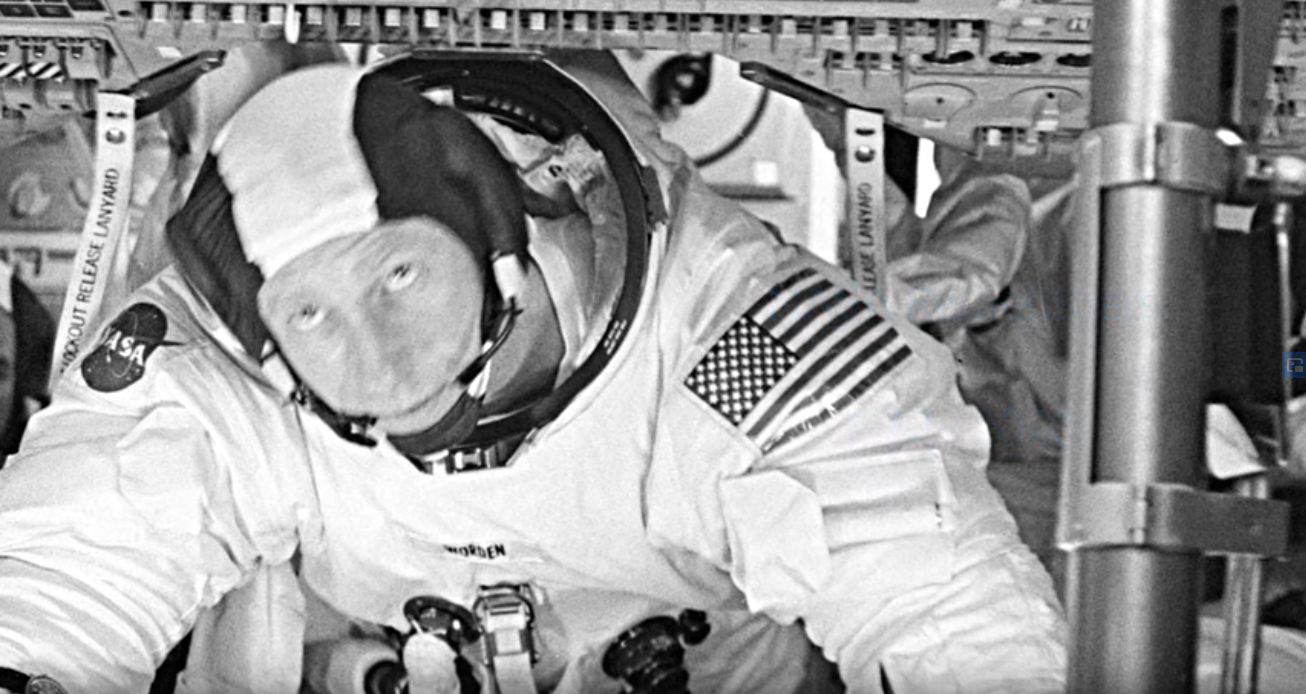
Al Worden, Apollo 15, July 1971. Credit: NASA

The years 2019 through 2022 mark the 50th anniversaries of the Apollo lunar landings of the 1960s. At a time when those ambitious, pioneering mission, undertaken at what was still the early dawn of human space flight, serve as a background against the current US Artemis endeavour, it is sad to report on the passing of another of one of the 24 men who flew to the Moon as a part of those trailblazing missions has passed away.

Alfred Merrill “Al” Worden was one of those Apollo pioneers who is perhaps less well-known than others, as he was one of Command Module Pilots. These were the mean who remained in lunar orbit piloting the Apollo Command and Service Module (CSM) whilst their fellow crew members made the actual descent and landing on the Moon, and so – with perhaps the exceptions of Michael Collins (Apollo 11) and John Leonard (“Jack”) Swigert Jr. (Apollo13) – did not garner the same degree of media attention during their missions and their surface exploring crew mates.

Worden’s lunar flight aboard Apollo 15 (July 26th, 1971 through August 7th, 1971) was his only flight into space, thanks to actions he and his fellow crew, David R. Scott and James Irwin, took before, during and after the mission which saw all three removed from active flight status for the remainder of their careers at NASA.

Born in 1932, in Jackson, Michigan, Worden was the second of six children and the oldest of the four boys born into a low-income farming family. A keen learner, he opted to try to continue his education beyond high school by obtaining an scholarship, initially to the University of Michigan. But unable to secure funding for more than a year, he turned his attention to the military in order to continue his learning. Applying to both United States Military Academy at West Point (US Army) and the United States Naval Academy at Annapolis, he found himself accepted by both, and after some deliberation, opted to go to West Point, enrolling there in 1951.

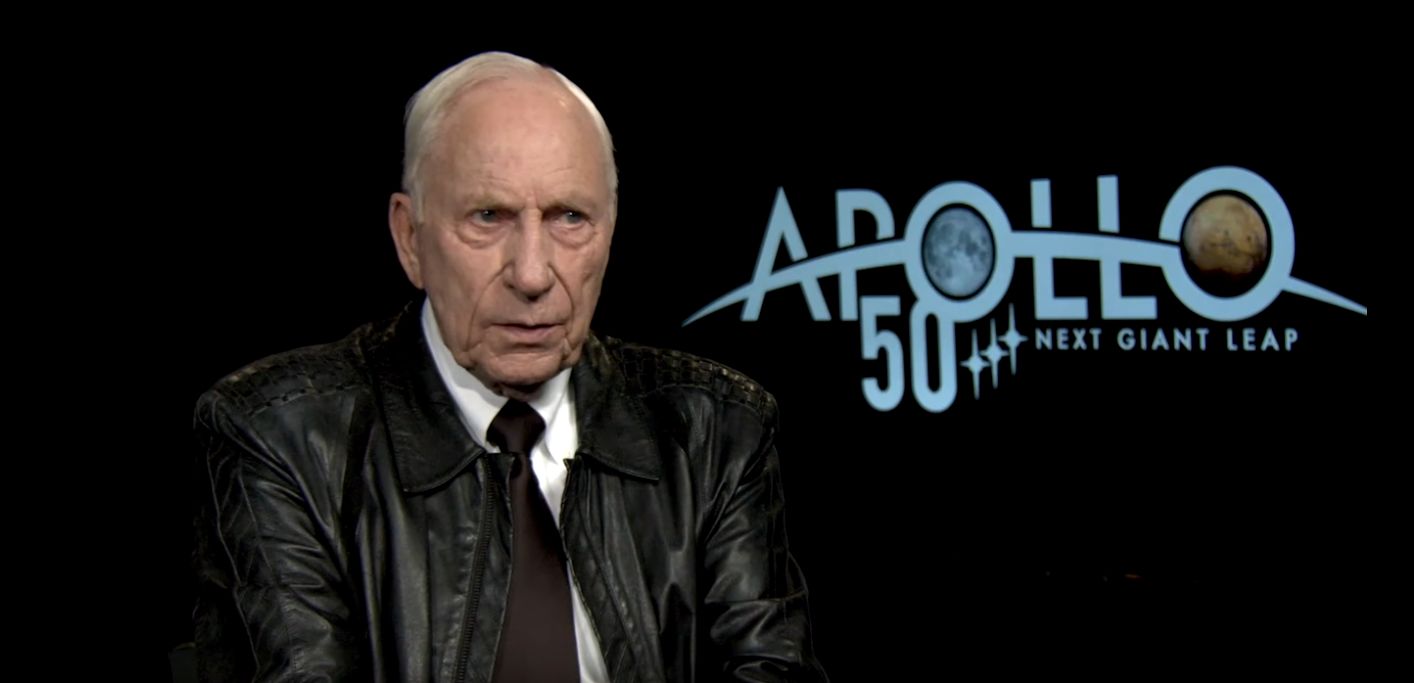
Al Worden at an Apollo 11 50th anniversary event. Credit: NASA

Whilst he enjoyed the army discipline at West Point, Worden found himself being encouraged by instructors to pursue a career in the nascent United States Air Force (formed out of the United States Army Air Force in 1947). At that time, the USAF was so young as an independent branch of the US military, it did not have its own training academy, so Worden was able to take advantage of an arrangement that allowed West Point and Annapolis graduates to transfer to the USAF for training, regardless of any possible lack of experience in flying.

As it turned out, Worden proved to be a natural flyer, moving swiftly from the propeller-driven T34 trainer to the jet-powered Lockheed T33. On completing his Air Defense Command training, he was posted to the 95th Fighter Interceptor Squadron, based at  Andrews Air Force Base near Washington D.C. , where he mostly flew the USAF’s first supersonic, swept-wing fighter, the F-102 Delta Dagger. Staying with the squadron as a pilot and armaments officer through until May 1961, Worden applied for, and received, permission to study aerospace engineering at the University of Michigan, graduating in 1963 with Master of Science degrees in astronautical/aeronautical engineering and instrumentation engineering.

Returning to flight service, Worden increased his logged flying time to over 4,000 hours, 2,500 of which was flying jets. During this time he graduated from both the Instrument Pilots Instructor School in the US, and the Empire Test Pilots’ School, UK, one of the most high-regarded test pilots schools in the world. He then served as an instructor at the Aerospace Research Pilots School, then attended the USAF’s advanced flight training school for experimental aircraft, as both a pilot and as an instructor.

In 1966, he joined NASA as a part of the 19-strong Group 5 astronaut intake, alongside of his eventual crew mate, (“Jim”) Irwin. In 1968, they were selected to be the Apollo 12 back-up under the command of veteran astronaut David R. Scott, one of the most experienced Apollo astronauts, whoo had already flown on Gemini 8 and, more particularly, Apollo 9, the proving flight for all of the Apollo hardware – Saturn V rocket, Apollo Command and Service Modules, and the Lunar Module.

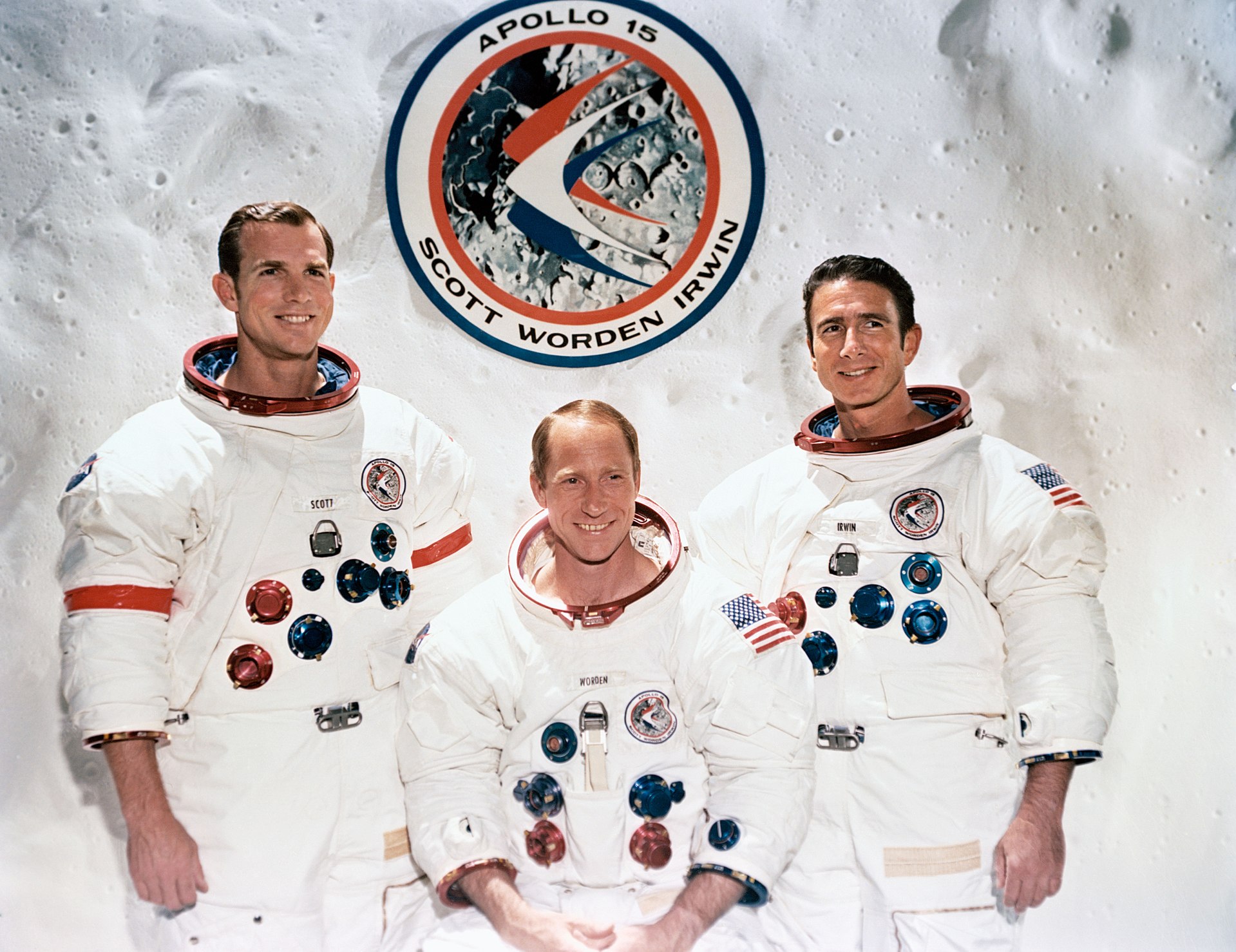
Apollo 15 crew: David Scott (l), James Irwin (r) and Al Worden (c). Credit: NASA

The crew were appointed as the prime crew for Apollo 15 at the start of 1970. From the start, Scott, as the mission commander, was determined that they would by the crew that gathered the most scientific data on and about the Moon – spurred in on part back the Apollo 15 back-up crew included Harrison Schmitt, the only actual scientist to participate in a lunar flight (Apollo 17). A first reason for wanting to be the best science crew on Apollo was that thanks to NASA cancelling two of the planned missions, Apollo 15 was raised to a “J-mission”, becoming the first such mission to feature an enhanced Lunar Module, capable of carrying more to the surface of the Moon, including the now famous lunar rover vehicle.

The J mission status of the flight also meant that Worden would have far more to do in lunar orbit than previous CM pilots, as the service module for the mission was the first to include a dedicated Scientific Instrument Module (SIM) bay. This was an equipment bay shielded by a protective panel during launch (and jettisoned once en route to the Moon), and carrying a range of science equipment – a high-resolution contained a panoramic camera, a gamma ray spectrometer, a mapping camera, a laser altimeter and mass spectrometer, all of which Worden had to manage and monitor. In addition, the bay contained a sub-satellite he was tasked with deploying before Apollo 15 left lunar orbit to return to Earth, and designed to study the plasma, particle, and magnetic field environment of the Moon and map the lunar gravity field.

A shot of the Apollo 15 Command Module Endeavour and its Service Module, as seen by from the Lunar Module Falcon, showing the exposed SIM bay and instruments, the cover having been jettisoned en route to the Moon. Credit: NASA

Worden’s sojourn about the Command Module Endeavour began after the Lunar Module carrying Scott and Irwin detached from his vehicle on July 30th, 1971 at an attitude of just 10.7 km above the lunar surface. Following separation, Worden fired the main engine on the Service Module to raise his orbit to 120.8 km x 101.5 km in order to commence his science work.

Over the next 4 days, he worked steadily on his assigned science duties, actually exceeding in some of them. Among his activities, he used the spy satellite quality camera system in the SIM bay to capture 1,529 usable high-resolution images of the lunar surface, and also carried out a regime of exercises using a bungee cord for research into muscle behaviour in micro-gravity environments. These exercises were supposed to mirror similar exercises performed by Scott and Irwin under the greater influence of lunar gravity, so that comparative data could be obtained between them. However, Worden was so enthusiastic about his work, he completed twice the amount of exercise he was required to do!

During those days on his own, Worden gained a citation from Guinness World Records as “the most isolated human being”, because as times during his flights around the Moon he would by up to 3,597 km away from the Lunar Module Falcon and Scott and Irwin – further than any human being had been from anyone else up until that point in time.

After the mission and when asked if he ever felt alone during this time, he would always reply in the negative, saying it suited his jet fighter pilot mentality, and he particularly enjoyed his times on the far side of the Moon when he’d be totally out of contact with any living soul, and would have something special to look forward to.

Every time I came around the Moon I went to a window and watched the Earth rise and that was pretty unique.

The thing that was most interesting to me was taking photographs of very faint objects with a special camera that I had on board. These objects reflect sunlight, but it’s very, very weak and you can’t see it from [Earth]. There are several places between the Earth and the moon that are stable equilibrium points. And if that’s the case, there has to be a dust cloud there. I got pictures of that.

– Al Worden discussing his time alone as the Apollo 15 Command Module Pilot

Following the rendezvous with, and recovery of, the Lunar Module ascent stage, Worden had another record-setting duty to complete: whilst en-route back to Earth, he had to perform an EVA – extra-vehiclular activity -, leaving the Apollo Command Module to make his way back to the SIM bay of the service module to collect the 25 kg cassette of images he’d captured during his time orbiting the Moon.

Worden during his historic deep space EVA, the round drum of the film cassette hanging from his harness. Credit: NASA

The space walk was completed with Jim Irwin standing in the Command Module’s hatch ready to provide assistance if needed, a camera watching over his shoulder. At the time, Apollo 15 was approximately 317,000 km from Earth, marking Worden’s space walk has the first “deep space” EVA in history. As of 2020, it remains one of only three such EVAs, all performed during  the last three Apollo lunar missions.

Despite the overwhelming success of Apollo 15 and the achievements made – first J-class mission, first use of the SIM bay, first use of the lunar rover vehicle, etc., – following the astronaut’s return to Earth, the mission would become the subject of the controversy that would see Scott, Irwin and Worden grounded by NASA for the rest of their careers.

Prior to the flight – and against NASA policy – all three men entered into a financial arrangement with a West German stamp dealer to fly 400 postal covers to the surface of the Moon and back.

Postmarked on the day of the launch at the Kennedy Space Centre post office and smuggled onto the Command Module, the covers flew to the Moon and then to the lunar surface with Scott and Irwin. On their return to Earth, the three men managed to get 398 of the covers – two were accidentally destroyed – cancelled and date-stamped on the day of their splash down at the post office aboard the recovery ship, USS Okinawa. Once back in the USA, the astronauts annotated and signed them, before sending 100 to the dealer, Hermann Sieger, whilst splitting the rest between themselves. The arrangement was for Sieger to pay the three men $7,000 each (approximately US $45,196 in today’s terms), and then give them a percentage each of the 100 in his possession, which he sold to dealers at $1,500 a cover.