One of the most common issues raised by virtual teachers in Second Life (SL) is how to get new students up to speed with the fundamentals. You know – walk, talk, navigate – that stuff. For those with little or no experience in 3D environments it’s not easy to pick up SL’s basics, however these are the skills that underpin everything we do in world. Needless to say a solid set of foundation competencies is vital to the success of any learning endeavour. The problem is that eradicating SL newbie–ness takes time – many would argue lots of time.
So opens a UWA blog post by Carmsie Melodie about a web-based resource she has put together which, while primarily aimed at the education sector, potentially has a broader reach when it comes to assisting those new to Second Life.
The SLeducate site, hosted by the University of Western Australia, essentially comprises three main parts:
The SL Basics Series section, which provides a set of resources designed to help newcomers get to grips with Second Life
The Virtual Educators section, which provides a central resource (documents, tools, videos) designed to help educators and teachers understand the benefits and potential of using Second Life as a medium for teaching and education
The SLictionary, a searchable glossary of Second Life terms, words, abbreviations, etc.
It is the SL Basics modules which are the focal-point for Carmsie’s blog post. In it, she covers the aims of the series, outlines the structure of the modules and their relationship with one another, etc, and provides notes and thoughts on how the series can be delivered (e.g. as a series of self-teach modules, as a classroom-lead activity, or as a combination of the two).
While primarily aimed at educators and instructors, the introduction to the series notes it can be used by anyone new to SL, or who is interested in trying-out Second Life.
The 6 elements (including the introduction) of the SL Basics course provided as a part of the SLeducate website
There are six modules in total – an introductory unit and five learning modules which take someone wishing to get started with Second Life from signing-up for an account, through downloading the viewer (Firestorm being the viewer of choice in the course), and on to the essentials of getting about in SL, and understanding camera controls, clothing, inventory, etc.
Each module comprises one or more interactive Adobe Captivate sessions, complete with embedded video and demonstrations, with supporting information such as PDF format “cheat sheets” and other handy documents, useful URLS and SLurls, additional optional videos and demonstrations, etc. Each of the Adobe Captivate sessions in turn covers a specific aspect of using Second Life, and can be allowed to run at its own pace, or users can step forward / back through it as needed, with an estimated maximum duration for any session of around 15 minutes.
To assist with using the modules for self-teaching or asynchronously, and to provide and in-world community around the SL Basics Series, Carmsie has created the SLeducate group in-world. This can be used by those following the modules to seek assistance, ask questions, exchange ideas, and so on.
A part of one of the new user experience social islands
While at the TPV meeting on June 20th, 2014, Ebbe Altberg didn’t only address questions on the new virtual world platform the Lab is developing. The session actually kicked-off with a discussion of user retention in Second Life and the new user experience.
Some eight minutes were devoted to the discussion, of which around five and a half were taken-up by Ebbe talking through ideas, and the remaining time either with questions or with reminiscences about mentors and the old mentor programme. The audio presented here represents all of Ebbe’s comments on the subject, together with a transcription for those who prefer to read his comments.
The first question was whether the Lab had any further ideas for trying to improve user retention.
Well, there are lots of different types of users, and I think we can make it easier for some users without losing the power for other users. But yeah, that is a tremendous challenge, allowing for this incredible flexibility, openness, freedom, and at the same time make it simple.
I am convinced there’s a lot of things we can do, not necessarily in the short-term, but in the medium-to-long term that going to make things a lot easier.
Ebbe Linden (LL CEO Ebbe Altberg) Talked about user retention at the June 20th TPV Developer meeting (image: Strawberry Singh from the VWBPE conference, April 2014)
I mean, just coming in and getting dressed is a major undertaking, and it shouldn’t have to be. There’s a lot of stuff that is geekier than it need to be; what the hell does it mean to “detach” something from your avatar and stuff like that?
So I think the user interface can improve a lot. and obviously, a lot of the work that you guys have just discussed here [Experience Tools, etc] will make retention improve. When the quality improves, performance improves, that will do a lot as well. It’ll just take users a while to notice and appreciate, and therefore get sticker. It seems to me, the metric seems to indicate, you know, some potential extra stickiness is going on. We’ll have to see; we’ll have to wait a little longer to be sure about that.
But when I talk about making in “simpler”, I’m not suggesting I’m trying to make it dumber or less powerful. So it’s going to take some smart people quite some time to solve for, but we have to try really hard to continuously make it easier.
Hopefully we can have something with the power of Second Life, but appealing to hundreds of millions, and not just a million; we have to figure out how to get there.
The next question was whether Ebbe was aware of the official mentor programme, and whether he would consider bringing that back.
[1:57] I was actually in-world yesterday [Thursday June 19th, 2014] with a group of people, many of whom have been part of that, and so we started conversations. There’s a lot of sub-groups participating in that conversation, of helpers.
I think the difficulty is, for our perspective, or why it might have been discontinued, is how do you manage it at scale? Who do you trust? Who’s behaving? Who’s not behaving? I think that might have been a part of it.
But I think that also a lot of those efforts were unfortunately discontinued as a part of the big layoff back in the day, when a lot of things were thrown out of the window whether it made completely sense to stop those types of things or not.
[2:43] Personally, I’m in big favour of a – what was at the beginning, what was it called? Community Portal? … Community Gateway programme – to enable creators to attract their own audience into their experiences. I think ultimately, if we’re going to scale way beyond a million users but tens of millions or hundreds of millions, we have to allow creators to be able to attract an audience from the outside world directly into their experiences.
There we have to think about what does that mean? Does it become some kind of co-shared, co-branded on-boarding experience for people? Because there are too many unique communities and verticals and experiences, that we can’t correctly advertise and drive traffic to those experiences, and it would be much more powerful if the creators could sort-of attract their own audience, and that’s much more scalable. That’s the way I think about it, but how long it will take to get there, I’m not sure.
[3:43] So we’re actually experimenting right now, where we’re doing A/B tests with a welcome island as we know it, and a second welcome island with a live helper so we can A/B test the conversion rates and the stickiness of the product. Obviously, one person is not going to do it, but we’re starting with one person as a very consistent way of treating people coming in. and then we can see what the actual performance differences [are] between those two experiences. We’ve also tried with audio on and audio off.
So we’re doing these little A/B tests to see what works, and if we find that having a live greeter there has a meaningful conversion rate improvement , then we just have to figure out how we can scale that, so we can have people able to meet everybody.
I haven’t seen statistics come out of that yet. I saw some stats of audio versus no audio, and it was like a tiny, tiny, plus for no audio, so we’re now trying with no audio, or no speech, so that … but other things we can do is maybe only certain people can get to the welcome island … and [not] having cuckoo folk show up there … Having a way to … we can technically potentially solve it so that we don’t have to have people kicking people out, but you could be sort of, only new users or … and if you’re a brand-new user, it’s a little harder to grief than if you’re and existing user.
Anyway, it’s stuff we’re actively playing with. I’ll try to figure out when we’ll have statistically relevant numbers from the tests we’re doing, and then we’ll go from there.
[At this point the discussion moves to PR as a means of reaching out to new users, and then moves into the discussion of the Lab’s next generation platform.]
Community Gateways offer perhaps the most flexible means to meet the needs of incoming users (image: The Snow Lion, Oceanside dAlliez (Flickr))
Comments
The first interesting point of note here – and with the benefit of hindsight – is the first clue is given that the Lab is looking towards another platform for mass adoption:
“Hopefully we can have something with the power of Second Life, but appealing to hundreds of millions…” [my emphasis]
The idea of enabling established users to be able to build tailored on-boarding experiences which not only get newcomers involved in their activities, but also provide them with sufficient guidance to be able enjoy the rest of what a platform has to offer, could be a powerful move in the right direction. Not only does it resolve issues of scalability, it is also something that delivers the on-boarding process more squarely to users within a platform, something many in SL want to see.
It will be interesting to see if the Lab actively pursue such an approach with SL, or whether it is something they’ll look more towards implementing in-depth on the new platform. Perhaps we’ll see a little bit of both; the Lab initially “trialing” such an approach on SL, prior to enhancing / expanding it with their new platform.
The further A/B testing with the current on-boarding process is interesting. Even if one discounts 90% of the current 350,000 (ish) monthly sign-ups as alt creation or spambots*, that’s still potentially 35,000 new users month who are coming into SL, of whom around 80% have apparently evaporated within a month. So any attempts to increase on this are to be welcomed.
That said, whether user retention can be signficantly increased by tweaking at the edges of the current on-boarding process is debatable. I tend to still be of a mind that without finding the means to connect incoming new users on a more “social” level with others within SL, attempts at increasing user retention will be limited in success. Nevertheless, it will be interesting to see what comes out of the current A/B testing – and in seeing just where else the Lab is willing to invest time and effort in order to try to increase SL’s retention levels.
*Footnote: some claim that 99% of this number is the result of spambots which never actually go on to download the viewer, much less log-in. While I agree that the potential number of sign-up hits by bots is likely to be high, placing it that high is perhaps a stretch, and points toward’s Marcello Truzzi’s statement that such an extraordinary claim requires extraordinary proof.
In June Rod Humble indicated that the Lab would be evaluating a “new” new user experience in an A/B test against the current Destination Islands. During a conversation I was able to have with him a little more recently*, I asked whether the new experience would include anything of the “personal touch” – getting new users more easily get to the things which interest them. He replied:
We definitely want to make it easy for Second Life users (especially new ones) to connect with the things in-world that match their interests. What we’re testing at the moment is more geared at getting new users familiar with basic controls, so it comes even before the point where they’re ready to connect with relevant content.
Given this, I’ve been curious as to what form the “new” new user experience might take – and today I had my answer.
The sign-up process itself remains unchanged, so far as I can tell. as does the first-time installation of the viewer, which I looked at back in March 2012 – although this does differ significantly to the installation process established users may be familiar with.
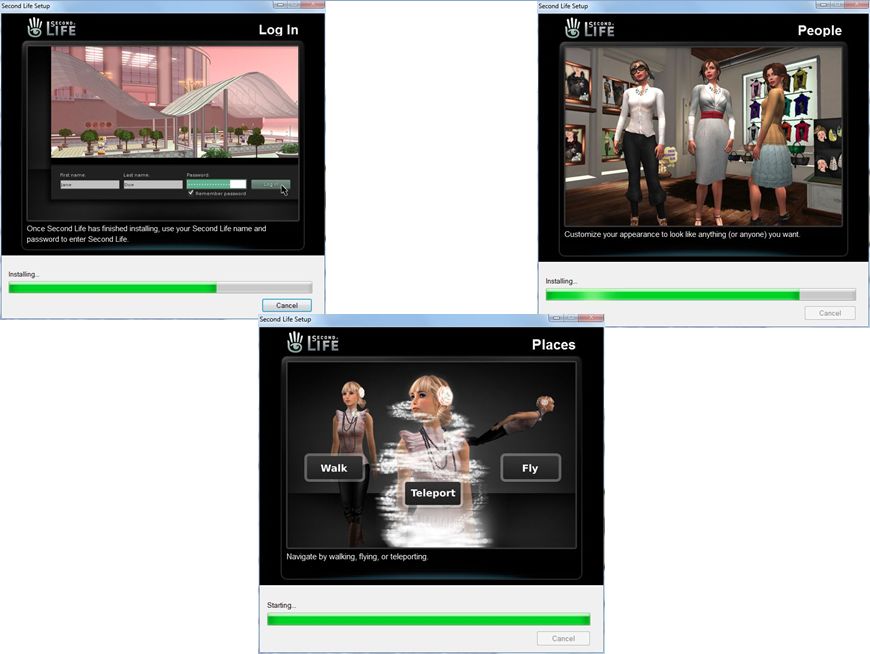
As I reported in 2012, when installing from the sign-up process, the viewer includes a series of panels which give various hints as to what SL is and how to get a start in it, such as the use of text and voice chat – although admittedly, the fact that these panels still feature viewer 2.x did raise a couple of eyebrows. Nothing like staying up-to-date, eh?
One of the explanatory text panels displayed during the viewer installation process. note the viewer 2.0 UI, complete with sidebar!
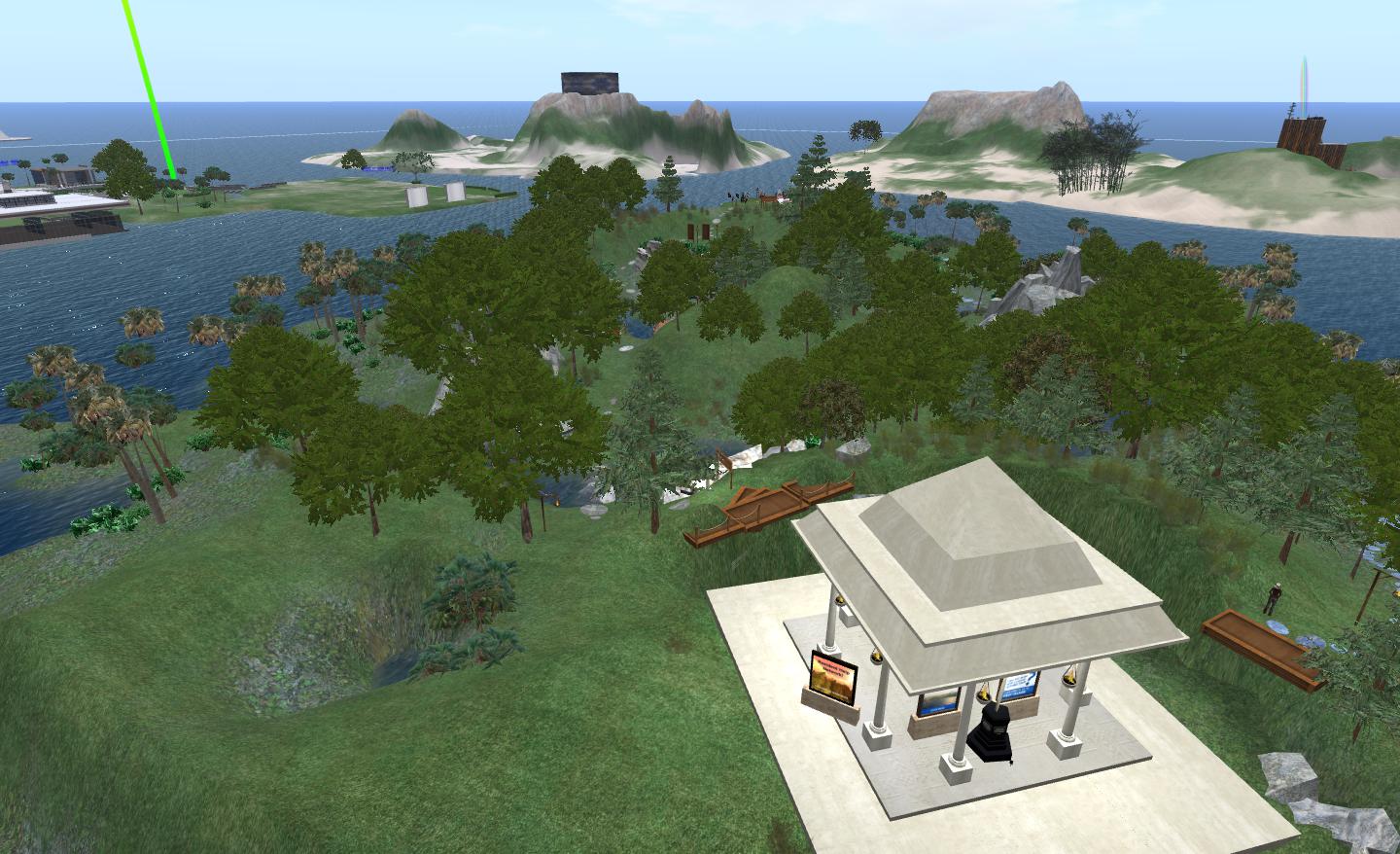
Once logged-in to Second Life, things are now noticeably different. New users are initially delivered to one of several versions of “Social Island”, arriving on a beach. The landscaping here is somewhat more pleasing to the eye than the older Destination Islands, However – and bearing in mind, I have no idea just how “preview” or “work-in-progress” this approach is – it tends to start to unravel from here. Just what do you do? Where do you go? What the heck is going on? There is currently no indication at all.
Well, actually, there are clues. They’re just not terribly obvious clues.
“Where am I? What am I supposed to do?” A plaintive question from a newcomer on the beach at Social Island
Up in the navigation bar, alongside the region name is the parcel description “Find the path”. The clue refers to one of two paths off of the beach. The first refers to on which leads up from the eastern end of the beach, under a stone arch, and the other goes through a tunnel to the island’s interior. Taking either results in the parcel description changing to “cross the bridges”. And indeed, there are wooden bridges to cross; although if you went through the tunnel, you’ll need to master climbing the rock face first (up a set of pretty obvious “steps”.
“Social Island” is perhaps well-named. There was a lot of chatting going-on when I arrived. Admittedly it was of the “Help!” variety of conversation – which included comments like, “What am I supposed to be doing?”, “Can anyone tell me what this is?”, and, “Does anyone else here use IMVU? Why isn’t this like it?” (yes, honestly, that is exactly what was being asked) – but at least people were communicating and socialising. Sort-of.
Perhaps the most disheartening thing was – again, my direct experience – trying to help a newcomer, only to have her respond, “I hate this,” before she vanished, presumably logging-off into the ether, never to return.
The Social Islands appeared geared towards getting people walking around and perhaps talking – although much of the conversation might be pleas for help from genuine newcomers…
The path leads newcomers to a single teleport portal which uses the experience tools teleport capability to deliver them to one of the Learning Islands. Here things are, if anything, slightly more confusing – again with the caveat that it may be a work-in-progress.
In June 2012, I reviewed MetaHarpers’ The Inspiring Orientation, an installation intended to be part gallery, part orientation course, with various interactive elements intended to teach new users the basics of getting around in Second Life – walking, flying, chatting, using the camera, sitting, etc.
The original Inspiring Orientation – from the outside
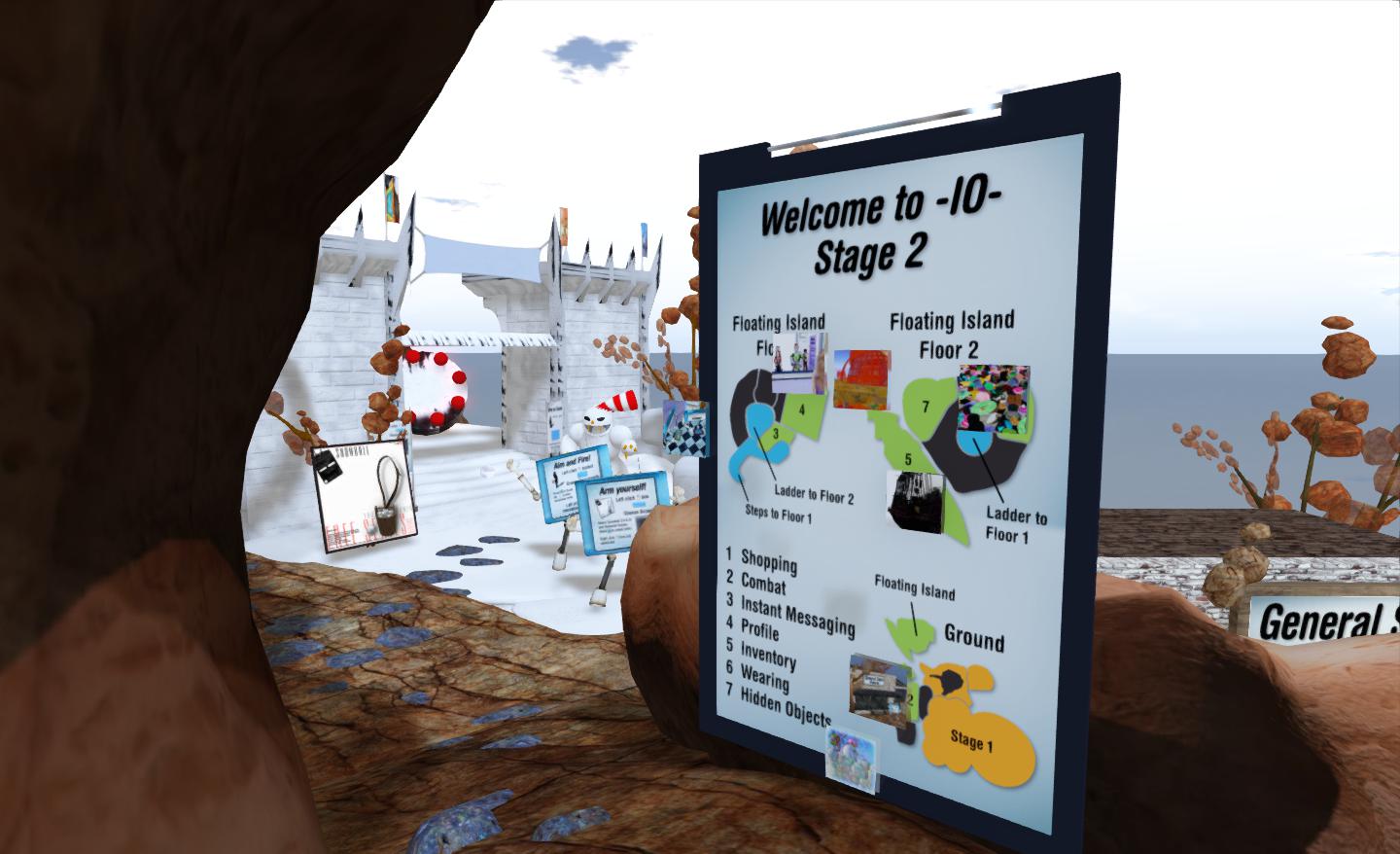
Opened to the public on February 5th, The Inspiring Orientation, Stage 2 now takes the concept a step further by providing additional interactive lessons covering such diverse subjects as in-world shopping, instant messaging, inventory management, profile creation, in-world combat and games, and exploration. At the same time, it revamps the original installation, and incorporates features such as media-on-a-prim. So what is it like?
On arrival, the installation appears familiar – the welcome area is the same as its first iteration, and the familiar tablet-like guides are still there. However, on stepping inside, it is clear things have been changed. Basic movement – walking and jumping – is quickly dealt with before moving onto the basics of camera control, which used to come somewhat later in the piece, and which is dealt with in a more compact manner. The rest of the initial elements of the piece remain largely unchanged until one arrives at the teleport portals, which in the original more-or-less marked the end of the process. While people can still teleport away at this point, a sign points the way to the new additions waiting to be explored.
Here people can learn about shopping, instant messaging, profiles, inventory (including attachments, clothing layers, etc), dealing with “hidden objects” and combat, all in discrete units linked by footpaths, chair lifts and ladders.
There are several routes around this part of the installation, which can lead to a degree of repetition in instructions (accessing inventory, for example). However, this is no bad thing in that it allows for easy re-caps on lessons and pointers.
The inclusion of combat options might at first glance seem a little odd, but it actually does make sense given that, while “Second Life is not a game”, many people actually do join SL in anticipation of engaging in roleplay (which can include combat elements) and engaging in combat-related activities (the dreaded zombie hunting beloved of the official SL promo videos, etc). Ergo, getting people started on how weapons, HUDs, mouselook, etc., all work within the realms of combat isn’t necessarily a bad thing.
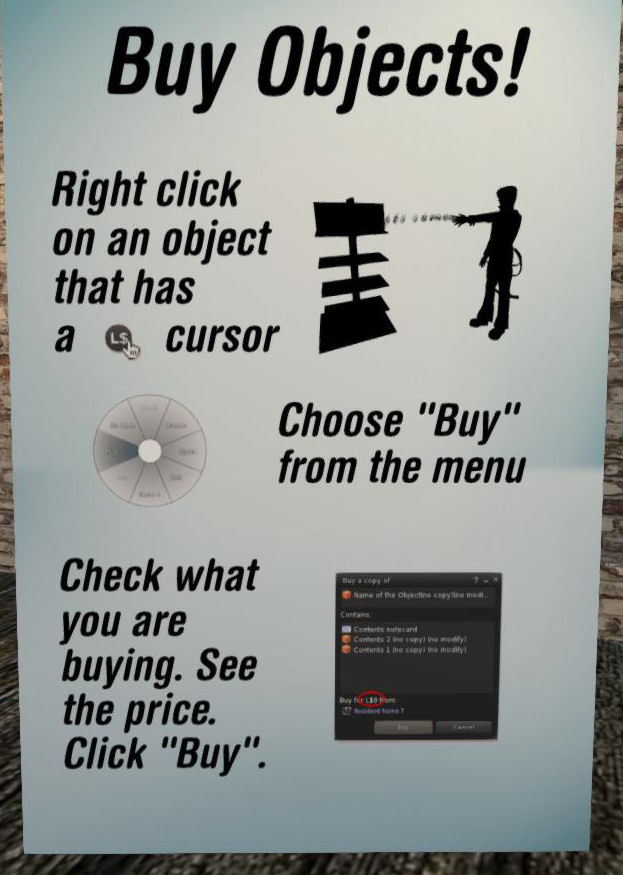
Whither the context menu?
The use of media-on-a-prim in the portal area, is both new and subtle. Drawing on the Destination Guide to provide a click-through list of destinations and descriptions related to the selected portal, it does much to present users with far more choice on where they go next, and on seeing where they are likely to meet other users.
That said, there are a few niggles with the update. Given this is an exhibition intended to demonstrate a new user orientation, the almost exclusive use of screen shots of a popular TPV is surprising. Yes, it may weel be the most popular viewer in use in SL, but given this is a new user experience, and presumably something the creators would hope users would encounter early-on in their explorations of Second Life, I can’t help but feel that there should perhaps be more emphasis on the official viewer – particularly as this is the viewer the majority of new users will initially be using when they log-into SL.
It could also be argued that other essentials are missed or given scant explanation as well – such as the Marketplace, the use of the world map, search and the concept of teleports (although teleports is touched upon throughout the exhibit, if not fully explained). However, the piece is a work-in-progress (the team behind it plan to move it to a location of its own at the conclusion of its time at the LEA), so these are matters which may still be addressed.
One thing that does still disappoint me with the update, though, is that it still fails to reference the viewer’s own means of providing help to users. The How To guide still goes unmentioned, as does the Help options in the menu. The How To guide is certainly worth a reference, given it forms an easy aide-mémoire to some of the lessons given during the orientation tour.
Some might argue that The Inspiring Orientation fails to offer any significant advantages over a more straightforward approach to user orientation such as that provided by the Phoenix Firestorm Support Region. In some respects, I’m inclined to agree; the latter has the beauty of keeping to a KISS approach which make progress perhaps seemingly less time-intensive. However, The Inspiring Orientation perhaps offers greater visual and aural stimulation, and thus may better hold a new user’s attention than a more traditional “walk-and-read” approach.
Whether it is viewed as a prototype / alternative approach to engaging new users and unlocking some of the mysteries of the viewer or whether it is seen purely in terms of an art installation which encompasses learning experiences, The Inspiring Orientation remains an interesting insight into how an engaging and interactive user experience might be built. As such, it has always made for an interesting visit, and the Stage 2 updates provide plenty of additional food for thought, particularly for those interested in the new user experience ethos.
Note: This article has been taken to mean I was unaware of the Community Gateway programme. Not so; rather I wanted to focus on the Destination Islands in this piece. As it is, and subsequent to this being published, a comment was passed elsewhere indicating the new Destination Islands are in fact something of a collaborative effort between the Lab and residents.
“Shared” is a word that has gained increasing prominence where Second Life is concerned over the last year. We’ve had Rod Humble talking about “shared creativity” and more recently, Oz raising the issue of the “shared experience”. Now there would appear to be an opportunity available for LL to come together with members of the user community to share creativity in order to develop a shared experience that can be of great potential benefit.
As I reported recently, LL have – at some point – launched a new range of “Destination Islands” to which new users are delivered. Currently, it’s hard to see what these regions actually achieve; they provide no introduction to SL, they don’t build on information given to the new user through the Viewer installation process, etc. As some have commented, they could even result in people thinking they’ve entered little more than a cartoon-based game with no obvious goal or function.
However, they are evidence that LL are still trying to address the issue of the “new user experience” by at least providing a means to direct newcomers to experiences they might be interested in. The problem is, the entire process is very hit-and-miss, and actually leaves much that is attractive about SL completely hidden – such as building and content creation.
New destination islands: low-key
It’s Not Easy
In fairness to the Lab, providing a means of supporting new users is no easy task. As we all tend to point out, SL cannot be taught in a day, and when one goes from talking about the “first hour experience” to the “first five hours experience” – as Mark Kingdon famously did – then something, somewhere is going more than a little pear-shaped when considering new users. At the same time LL have been presented with ample evidence that help centres that rely on direct user / user interaction don’t always work.
However, there is also a risk in going too far in the other direction as well and simply providing too little help and support – and this is the issue one tends to have with the new Destination Islands; they are minimalist in approach, both in terms of appearance and information, to the point of being mere way-stations that direct people elsewhere in SL without doing anything to help them understand where they are or what they might be doing.
How much better might it be if, rather than trying to deal with the “new user experience” without actually addressing it, LL were to seek to collaborate with the user community to provide a means by which new users entering Second Life for the first time are faced with an immersive, engaging experience that helps them understand the basic mechanisms in using the Viewer and the nuances of performing basic tasks SL before passing on elsewhere.
The Competitive Edge
This could be run as a form of a competition or a request for proposals (RFP) process, with Linden Lab providing a set of guidelines as to what is required, together with access to capabilities such as the new advanced creation tools, allowing those in the community to offer potential solutions / responses that meet the requirements /criteria in imaginative and innovative ways, with people free to work either individually or as a collaborative group.
Obviously, not every eventuality for user interaction in SL needs to be covered – just enough to get users reasonably acquainted with getting on with things in SL – and the experience could finish be delivering users to the style of portals currently positioned on the Destination Islands, allowing them to continue their adventures elsewhere. As such, potential criteria for the competition / proposal might be:
Provide users with sufficient information on using key aspects of the official Viewer 3.x UI – HOW TO, setting-up buttons, key menu options, etc.
How to walk, talk, IM perhaps leveraging HOW TO)
Provide an overview of inventory, including the basics of wearing clothing
Show how basic interaction with in-world objects work: opening doors, selecting and opening objects with contents
Use the advanced tools to demonstrate more advance interactions with in-world objects, such as opening an item and wearing the contents
Provide an introduction to building in SL, perhaps with some explanation of what sandboxes are
These criteria could be met through anything from simple read-and-do style notices, to practical demonstrations and / or by the user exploring an immersive build, where they walk a path of their choosing and encounter objects and information boards along the way and are encouraged to apply what they are learning along the way (an example of this might start with a simple door into a building / in a room with the words “click me” written on it to encourage someone to click & open it).
Linden Lab would then be free to select the entry / proposal that most closely fulfils their requirements and proceed to work with those responsible for the entry / proposal to develop and enhance the current Destination Islands.
Portals to more directed experiences might even be provided along the way; for example: those particularly drawn to in-world content creation might be offered a portal taking them to the Ivory Tower of Prims or on reaching the end of the experience, be offered a portal connected to various sandboxes across the grid.
In order to simplify understanding things like the UI, portals could perhaps be included to the gated Orientation Island regions (assuming these are to be continued, given there only appears to be one left & they could be made somewhat more relevant) or to platforms over the Destination Islands, where those who need it can obtain more in-depth guidance. In turn, portals from them could allow new users to find their way back to specific elements of the Destination Islands experience.
Gated Orientation Islands: fold them into the mix?
Such an approach potentially achieves three goals:
Relieve LL of the burden of having the physically devote a large amount of time and effort to the development of a “new user experience” while allowing them to retain control over how such an experience should be framed
Leverage the core experience and familiarity with SL that the user community has
Promote a collaborative, shared experience between the Lab and the user community that can be used to benefit new users, the community and the platform as a whole.
Add to that the capability to “regionalise” the experience by sign-up language (so that those whose primary language is, say, Portuguese, arrive in a Portuguese Destination Island for example), then so much the better. (This may already be the case for the current system, hence the number of Destination Islands already on the grid; I’ve simply no idea.)
Working in this manner isn’t entirely new to Linden Lab – they’ve recently taken a similar approach elsewhere in terms of issuing an RFP. Admittedly, this approach might require a little more structure from LL to avoid cried of “foul!” from elsewhere – but providing the process is as transparent as possible, there is no reason why it shouldn’t result in a positive outcome. Were the approach to be run as a competition, involvement from users needn’t be limited to those presenting entries: there is no reason why selected users shouldn’t sit on the “judging panel”.
Some would inevitably find fault were LL to take the opportunity to generate a project this way, but overall, given the potential benefit it could bring, it’s hard to find a show-stopping fault with the idea.
In a low-key move, Linden Lab has rolled-out what appears to be a “new” new user experience and which seems to utilise some of the new game controls LL are shortly to be rolling-out to the community as a whole. However, what it is precisely aimed at doing is unclear.
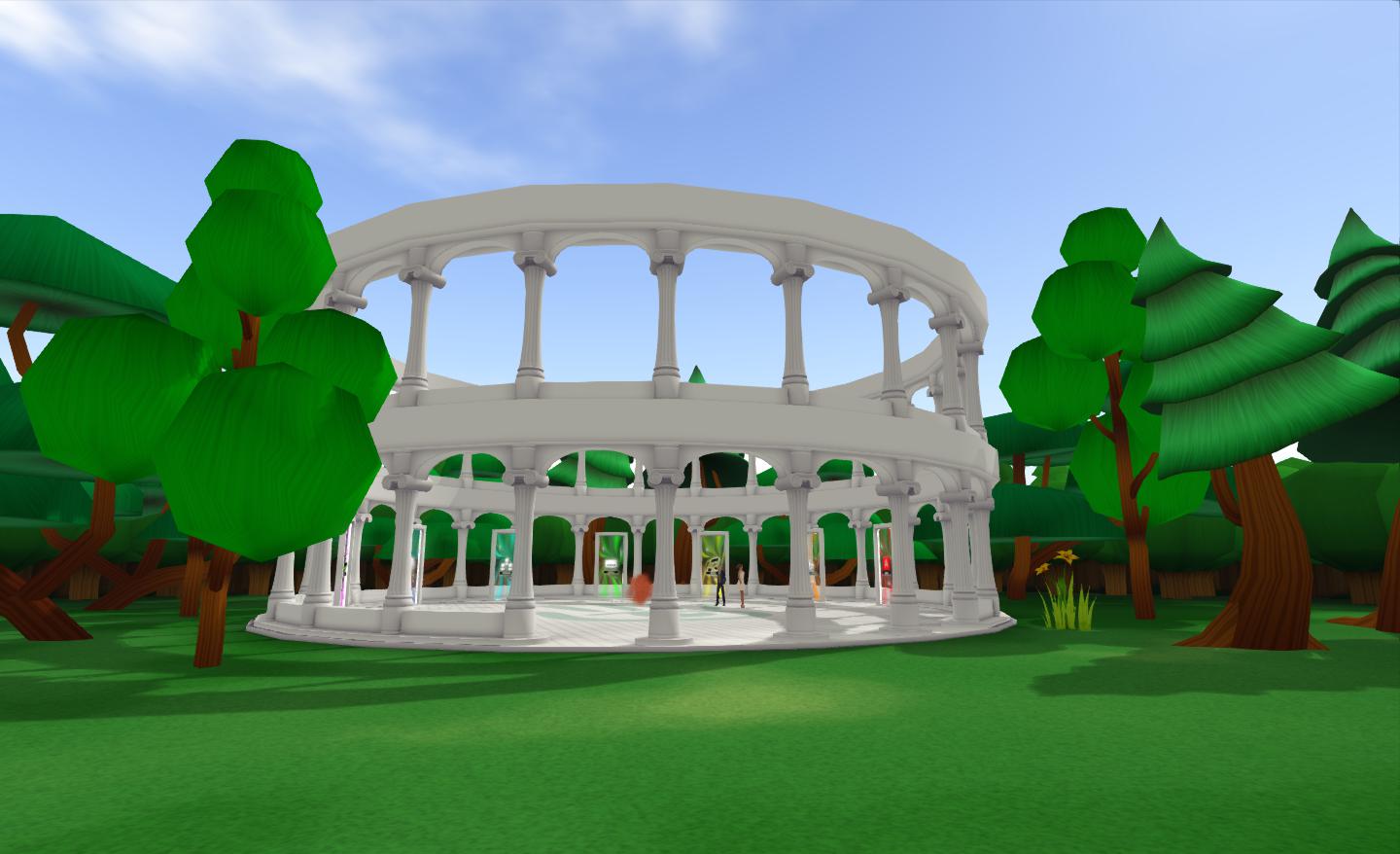
On signing-up to Second Life, new users (or those with a new avatar account) are now delivered to one of 24 Destination Islands. Like Linden Realms, these are a group of identical regions, each containing mesh trees from the game, with a central coliseum-like structure towards the centre which forms the arrival-point for new users.
Once of the new Destination Islands
No real explanation is provided as to what the place represents or how to use it. Arrivals are instead presented with a series of glass-like doorways with arrows and footprints leading to them, and each with is own label.
Information slides for those installing the SL Viewer for the very first time following sign-up
True, as a part of installing the Viewer for the first time (the download being a part of the sign-up process), new users are treated to a series of slides that provide a little more detail on using SL (see selected screen captures above), and they’ll have the Destination Guide open once they’ve logged-in to SL – but that’s it. Within the Destination Island areas there are no hints, tips or tutorials available to help the new user – there are just the seven doors (Art, Role-playing, Popular, Social, Music, Editor’s Picks and Adult), arrows and footprints.
Magical mystery tour
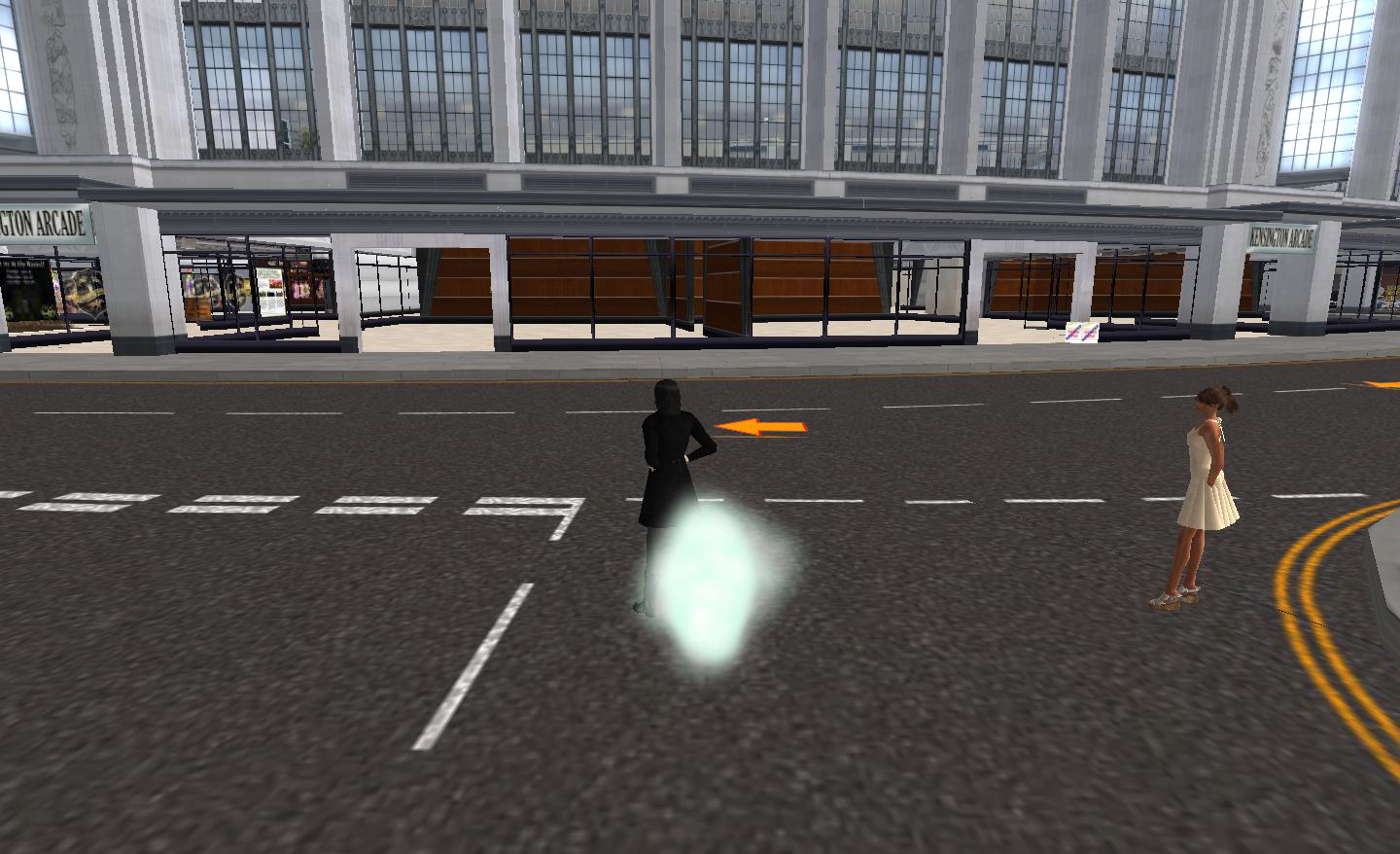
Walking through a portal will do two things: open the world-map at a potential destination and auto-teleport your avatar to a destination. Unless you’re using an unverified adult account and try the Adult portal. In this case you’ll simply get a flat nose and no explanation as to why. While an e-mail on this subject of adult verification is sent out to users as a part of the sign-up process, it would be nice if walking-into the door with an unverified account popped-up some kind of explanation rather than leaving people bouncing off the portal for no readily apparent reason.
Passing though other doors drops you into a destination based on the portal’s category. These appear to be selected at random from the Destination Guide. The process doesn’t seem entirely smooth: the world map opens during teleport (or it did for me. Twice), only to close on arrival. This is something that doesn’t happen in Linden Realms, so if the system i use at the Destination Islands is the same as the auto-teleport function used within LR, I assume this is a glitch that will be fixed, rather than a “feature” of the auto-teleport function.
Once you’ve left the Destination Islands there is no way back. Any attempt to teleport directly to them (assuming a new user understand the concept of teleporting) is met “Teleport Failed. You cannot teleport back to Help Island. Go to ‘Help Island Public’ to repeat the tutorial” and an OK button. Hence why you’ll have to create a new account if you want to test the system yourself.
OK, where next? What next?
This isn’t the solution you’re looking for?
Much – perhaps too much – has been made of the new user experience over the past few years. We’ve had talk of the “first hour”, the “first five hours” and, at the opposite end of the spectrum, “the first five minutes”. From comments he’s passed, it’s clear that Rod Humble is swayed towards the latter – that if you don’t capture the heart and mind of a new user in the first five minutes, then you’ve potentially lost them forever.
I’m not about to debate his wisdom on that one – but I will say that it’s hard to see how this approach actually improves matters. While one doesn’t necessarily need to have masses of information on display at the Destination Islands, having at least some guidance provided would, I’d have thought, be beneficial. Of course, this may be coming – in which case LL have rather put cart before horse in hooking-up the new islands to the sign-up process ahead of the information arriving.
This is where I think LL missed a step in merging-up the Basic and Advanced modes of the Viewer. In the former, we had a very good introductory series of tutorials in the form of the HOW TO pages. At the time I felt these could be enhanced, but overall they provided a good starting-point. While HOW TO is still evidenced in the Viewer in the form of a button – it would be useful if the installation process at least drew attention to it. Much better would be for HOW TO to be open by default until the first time it is manually closed (as with the Destination Guide). It wouldn’t solve all the issues in getting new users semi-oriented to SL, but it would at least help them feel comfortable with the Viewer UI – not everyone is happy with randomly pushing on-screen buttons and seeing what happens.
My experience demonstrated that people arriving at the same destination as myself were very confused as to what was happening and what they were supposed to be doing. The flow of people into the region I arrived in was fairly steady, but all of those stating they had just joined SL (and the number was around one or two arriving every few minutes) all pretty much had the same three questions:
What just happened?
Where am I?
What am I supposed to be doing?
Few had actually appreciated there was a HOW TO button (more-or-less the first thing I directed them to), and I found that doing so, and pointing them to functions such as Search, was greeted with verbal facepalming, e.g.: “Well, it would help to be told that from the start!”
It’s hard to see how this system relates to the Public Help Islands, which are still active. There are no links between the two (other than the message displayed when trying to teleport directly to a Destination Island, as described above). Whether information from PHI will be incorporated into the Destination Islands is an unknown and remains to be seen.
Right now, I’m curious as to where this idea is going. Is it offered-up as delivered, or will there be enhancements based on feedback or observation (and if based on feedback, where do people give it?). As it stands, it’s hard to see how this system helps new users – although LL are doubtless in a far better position to make a call on this than my casual observations. I can’t help feel the approach, as currently presented is potentially as much a hindrance as anything else, and getting to grips with SL is still a matter of dogged determination on the part of those signing-up.
But then, this isn’t the easiest of issues to address, as we’ve seen over the years.
I’d like to keep an eye on if / how the new regions develop. As such I’ve held back with a new account on one of the islands to see if anything changes. If it does, I’ll be following-up here.







 Inara Pey: Living in a Modemworld