In the Lavender Fields of MMe Loutre in Second Life

Nathhimmel: Lavender Fields of Madame Loutre, June 2024 – click any image for full size

From the east and south the land rises in a gentle slope, climbing gently to the west and north to meet with the upward sweep of land for the north side of the region so that all three slopes slopes form the low hump of a hill before falling back towards the western edge of the region. Across this landscape and broken by precious few trees, is spread a blanket of lavender, running from the water’s edge on all sides and drawn into regimented lines and blocks by avenues of grass in places topped by short lines of paving stones.

This is a tranquil place, the eastern shoreline interrupted by two bays pushing into it, the smaller of which looks like a giant thumb has been pressed into the ground to leave an indentation for the surrounding waters to claim as theirs. Such is the lie of the setting, were the wind to come from the east and passing over these bays, it is not hard to imagine it driving waves to where the shore breaks their progress so they transfer their momentum to the lavender, causing it to ripple inland and up the slope to wash around the house atop that single low hill.

Nathhimmel: Lavender Fields of Madame Loutre, June 2024

Boxy and long, the house presents a tiled roof to the sky which extends out over a north-facing veranda, affording it some protection against the likes of sunshine and rain. It is counterbalanced by the rising second floor of the house rising from the southern end of the house to provide sufficient space for a cosy bedroom. Aside from broken ruins a short walk down slope, the house is the only human-made structure on the island – and the only place still occupied.

With its low-walled garden lushly overgrown with flowers allowed to grow wild on one side and the other planted with cobbles, the house exudes the tranquillity that seems to flow outwards over the surrounding lavender and to the very edges of the region. Alone and at peace, this is the home of Madame Loutre, the last inhabitant of this restful setting, and the spread of aromatic plants growing around it are known as the Lavender Fields of Madame Loutre.

Nathhimmel: Lavender Fields of Madame Loutre, June 2024

But who is she? I hear you ask, and where might this place be found? Well (and to ignore the surrounding waters, I’ll let Konrad (Kaiju Kohime) and Saskia Rieko explain, for they are the people who have made our journeys to this place possible:

In the secluded one-house village, nestled deep within the enchanting region of Provence, resides the mysterious Madame Loutre, an ethereal otter spirit … Madame Loutre is both a guardian and a secret keeper of the village, known for her wisdom and the enchanting, calming presence she bestows upon visitors. The villagers from nearby towns speak in hushed tones about her magical abilities and the tranquillity her lavender brings. This idyllic haven remains untouched by time, a place of quiet wonder and mystical charm.

– From the Nathhimmel website

Nathhimmel: Lavender Fields of Madame Loutre, June 2024

Saskia and Konrad are, of course, the designers of Nathhimmel region settings in Second Life and which have appeared in these pages several times since the couple started offering their work as places for Second Life users to visit and photograph;  and the Lavender Fields of Madame Loutre is the latest iteration of their work, having opened at the start of June 2024.

This is a design which – quite genuinely – does not require description or explanation; it speaks beautifully and clearly for itself. The house offers a focal point around which endless stories might be woven about the mysterious MMe. Loutre – who she might by, why the locals think she has magical powers, what has given her a love of lavender – and more. The landscape offers subtle opportunities for photography, whilst dotted around three sides of the region places to sit / rest are awaiting those who seek them. Should props be required for photography, then joining the local group (no charge) will provide rezzing rights – but do please remember to pick your thing up afterwards!

Nathhimmel: Lavender Fields of Madame Loutre, June 2024

The landing point, located in the south-east corner of the region includes a link for obtaining additional information on the region (although the supplied notecard does give details on a previous Natthimmel design), and a teleport link to the region’s gallery – although this was without art at the time of my visit, so possibly awaiting a new exhibition. Neither of these latter points detract from the setting, which offers a relaxing and gentle visit for all who choose to drop in.

SLurl Details

A visit to an exoplanet in Second Life

Natthimmel, July 2023 – click any image for full size

It was back to the Homestead region of Natthimmel, held by Saskia Rieko to witness the latest design by her SL partner Konrad (Kaiju Kohime) after seeing a tweet by Laskya Claren (who also assisted with the notecard introduction to the build). To be honest, it’s a setting that would have attracted my interest, but Laskya’s tweet helped me to note it sooner rather than later, given it is by Konrad and Saskia – who are establishing a solid reputation for region designs representative of physical world locations (for example, see: A Night Sky with a touch of history in Second Life) – and the fact that for this particular build they mix three of my non-SL interests: astronomy, theoretical space science and science-fiction as the springboard for the imagination. However, Laskya’s tweet was timely in that it pushed me towards visiting sooner rather than later.

The astronomy comes from the use of the Gliese 581 system as a inspiration for the build and its associated story. This is a dwarf star (M spectral type) located some 20.5 light-years from our own solar system, and which in 2005 was discovered to have one of the smallest extrasolar planets ever found orbiting it. Called Gliese 581b (the “b” indicating it to be the first planet known to be orbiting the star, whilst “Gliese” referencing the 1957 catalogue in which the star was record – even though it has been observed well before that year). It is actually one of three planets currently known to be orbiting the tiny star, with three other potential planets – Gliese 581d, Gliese 581f and Gliese 581g – thought to have been discovered later proving to be the result of stellar upsets within the star affecting the instruments on Earth attempting to locate exoplanets around it.

Natthimmel, July 2023

From these fact, the region spins off a story of the future discovery of artefacts on the outermost of the three Gliese 581 planets, Gliese 581e (as all the planets in the system are tidally locked with their parent star, always keep the same face towards it, the observed artefacts could not be surface features moving as a result of Gliese 581e’s axial rotation). This discovery leads to a crewed mission to the system aboard the UESS Rocinante, thus bringing in the first sci-fi reference, the Rocinante being the hero ship from The Expanse series of novels and stories by “James S. A. Corey” and the associated TV series (as well as also being a classic literary reference to adventures, Rocinante also being the name of Don Quixote’s horse).

A second sci-fi reference also lies in the text with the reference to ansible communications – a term first coined (and subsequently built upon) by Ursula le Guin, and used by many sci-fi authors, including Orson Scott Card. It is also in the notecard that the reference to theoretical space science appears, the Rocinante using an Alcubierre Drive for interstellar propulsion.

Natthimmel, July 2023

This introductory notecard actually serves as a mini short story in is own right, rather than just and introduction to the setting. In doing so, it sets up the imagination, offering a framework by which we might – if we so choose – explore the setting: what actually happened aboard the Rocinante? Were the note affects on the crew the result of the indicated damage to the drive system or something else? What caused the vessel to crash on the planet? Systems failure? Human error? Deliberate malfeasance by a member of the crew? Were the logged reports of alien creatures the result of genuine sightings or further hallucinations?

Thus, visitors can opt to put themselves in the role of the recommended salvage / rescue mission; or, if preferred, as members of the Rocinante’s crew encountering this strange world on which they have been cast – be it Gliese 581e or somewhere deep within a rip in the fabric of space/time brought about by the failure in their drive system. Or, if preferred, visitors can simply use the eerie, other-worldly environment for photography; there are no rules here in that respect. However, one thing I would recommend is to visit using the local environment settings (World → Environment → Use Shared Environment) and with the viewer’s Advanced Lighting Model enabled (Preferences → Graphics → make sure Advanced Lighting Model is checked – no need to enable shadows).

Natthimmel, July 2023

A different but engaging location which, whilst entirely imaginary, nevertheless folds into it some nice touches of science fact and theory wrapped into an engaging visit.

SLurl Details

A Night Sky with a touch of history in Second Life

Natthimmel – Göbekli Tepe. May 2023; click any image for full size

Potbelly Hill – otherwise known as Göbekli Tepe in Turkish or Girê Mirazan or Xirabreşkê in Kurdish – is home to the world’s oldest known megaliths, dating back to approximately 9500 and 8000 BCE and the Pre-Pottery Neolithic era of the Fertile Crescent. This was the period, commencing at the end of the last Ice Age, which marked the switch from the more nomadic forms of life in within the region towards the establishment of village life, producing some of the earliest evidence for permanent human settlements in the world.

Occupying some 8 hectares of land, Göbekli Tepe is one of the earliest examples of this move to settlement living, occupying as it does a tell, an artificial hill created from the accumulation of the debris from successive generations of people living in the same location, their detritus mixed with natural sedimentation.

Natthimmel – Göbekli Tepe. May 2023

Sitting in the foothills of the Taurus Mountains, many of the megaliths at Göbekli Tepe are richly decorated with figurative anthropomorphic details, clothing, and reliefs of wild animals, providing archaeologists rare insights into prehistoric religion and the particular iconography of the period. The tell also includes many smaller buildings, quarries, and stone-cut cisterns from the Neolithic, as well as some traces of activity from later periods.

First noted as site of historical significance in the 1960s, the tell has been subject to continued study since then, and in 2018 it  was awarded UNESCO World Heritage Status in recognition of its universal value as “one of the first manifestations of human-made monumental architecture”. Yet despite almost 60 years of continuous study and excavation, it is estimated that only around some 5% of the site as been exposed for investigation.

Natthimmel – Göbekli Tepe. May 2023

However, you don’t have to travel to the Anatolia region of Turkey in order to witness Göbekli Tepe; it has been brought – at least in spirit and part – to Second Life by Konrad (Kaiju Kohime). It is located within the Homestead region of Natthimmel, held by Konrad’s SL partner, Saskia Rieko, a region with its own little story: Natthimmel being Swedish for Night Sky (Saskia herself being Nordic) as a creative open space and photogenic spot for people to enjoy.

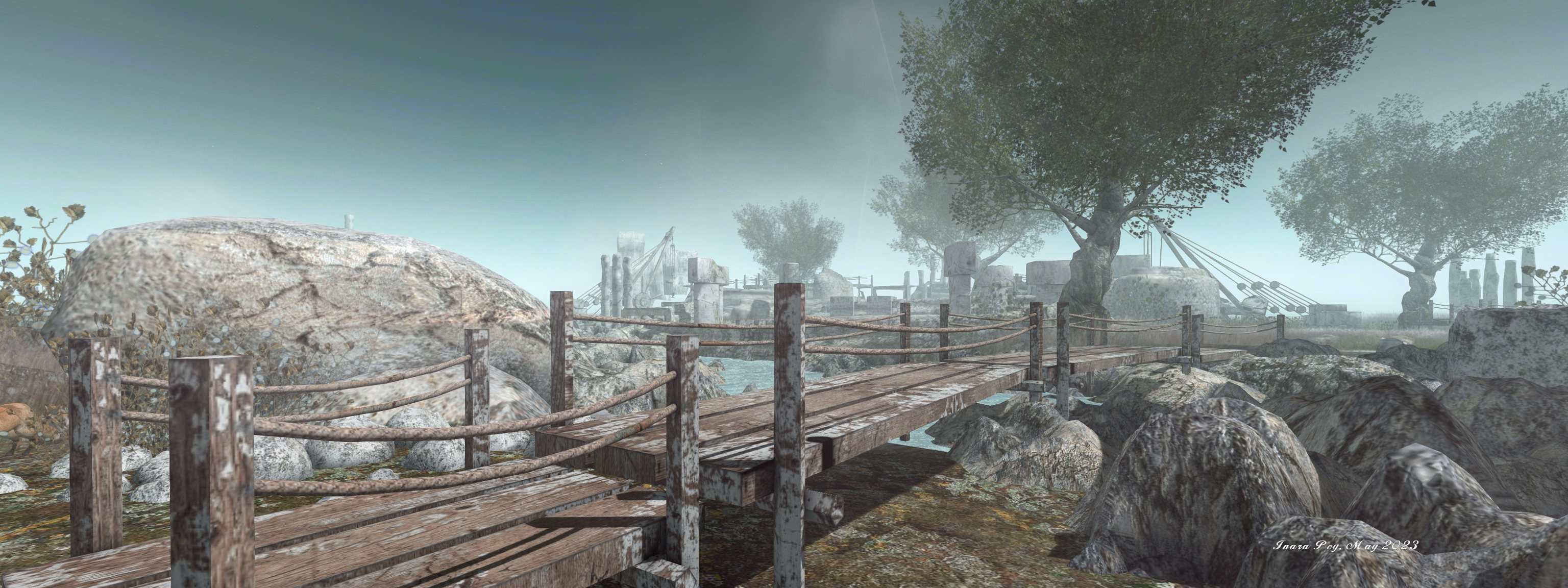
In bringing Göbekli Tepe to Second Life, Konrad has shown extraordinary dedication, having built many of the elements used within the setting himself, whilst he and Saskia have shown further creativity in using the natural presence of Linden Water in-world within their interpretation rather than trying to hide or ignore it, given the inland nature of the physical Göbekli Tepe. This gives the setting a unique appearance, the stones of the ancient monument mixing equally with natural rock formations as both dip their toes into the waters meandering across the setting.

Natthimmel – Göbekli Tepe. May 2023

As with the original, the landscape here is crossed by boardwalks which prevent unwary feet from damaging the exposed stonework and former structures as they have been exposed through excavation, whilst a further element of individuality is offered by in the way the megaliths have been made to look like they have naturally extruded from the ground and grown naturally, rather than being the result of the hands of ancient humans.

A further echo of the original comes in the form of the carved reliefs of animals on the ground, which are in turn nicely balanced by the presence of foxes wandering through the site, whilst cormorants and heron again help link the landscape the surrounding waters, again linking the two together into a single whole.

Natthimmel – Göbekli Tepe. May 2023

Carrying with it a slight sense of the alien in its broader appearance – something itself not unbecoming of an interpretation of a site of antiquity, for would not our own world appear alien were it to be seen through the eyes of those who once lived at Göbekli Tepe? –  the build offered by Konrad and Saskia is both highly picturesque and engaging. It awakens the curiosity about its physical world namesake – a curiosity which might be fed / further prodded by the inclusion of some historical notes at the landing point (which make a recommended read).

I’ve no idea if this is to be the first of a series of region designs at Natthhimmel, or whether it is intended to remain as-is; what I will say is if – like me – you are interested in seeing locations from the physical world in a manner that is more immersive than relying on images and film, I strongly recommend a visit to the region to se Göbekli Tepe, just in case it is to be replaced by another idea springing from the imaginations of Saskia and Konrad.

Natthimmel – Göbekli Tepe. May 2023

SLurl Details