A peaceful Zephyr in Second Life

Zephyr, May 2021 – click any image for full size

Talia (Natalia Corvale) has an eye for creating region designs that are wonderfully attractive, rich in natural detail, and evocative of places that one might find tucked away whilst on global travels. Her designs are places I always enjoyed visiting and writing about (as evidenced by the articles in this blog), as they are always so beautifully bucolic in presentation, places guaranteed to put the eye and heart at rest.

For Zephyr, her latest setting in her homestead region of Porter Island, Talia presents a a place I confess to immediately falling in love with for its fusion of ideas.

Zephyr, May 2021

Surrounded by off-region hills coated by fir trees that suggest a northern latitude, Zephyr sits as a trio of islands, two of which are linked by a causeway. Together, they individually contain suggestions of China, Japan, and Africa that are most marvellously brought together, whilst collectively their appearance also brings to mind parts of the coastline of IndoChina to mind.

The landing point sits atop a flat-topped mesa that rises vertically from one of the region’s two larger islands. This sits to the north-east and curls away eastwards around the region’s outer limits.

Zephyr, May 2021

Watched over by a seated Buddha and sleepy pandas, its steep flanks fall away to grasslands that wash around it, and which could easily look right at home on the African plains – especially given the Africa tusker of a bull elephant standing upon them. Even the presence of a great monkeypod tree raising its head alongside the plateau doesn’t break with the African vibe that echoes here, as from a distance, it might equally be a great Umbrella Thorn.

But the fact it is a monkeypod tree reminds visitors that the core influence for the region is Asian in nature, as does the curving arm of this island as it turns to the east, its razor back line home to a Japanese styled structure. However, quite how you reach both it and the grasslands below the landing point is a little open to interpretation, preference.

Zephyr, May 2021

This is because while there is a zipline connecting the landing point to one of the highlands of  the central island, the only path from there leads either up to a bridge sling across the gap between the two plateaus or down to where the causeway connects middle and northern islands. Save jumping down from the ziplines end-point or wading through water at the foot of the downslope path, there is no clear route to get to the lowland that sit under the flanks of the two plateaus (well, you can fly of course, but that’s cheating! 🙂 ).

like those of the landing point island, the lowlands of the middle isle are dominated by a monkeypod tree. however, there is also a small bridge that spans the waters back to the north island, allowing visitors the opportunity to return to it and then make their way eastwards around its raised back.

Zephyr, May 2021

However, for those who prefer, the taller of the two rocky tables on the middle island is home to a wooden platform where comfortable seating a a good vantage point out over the islands are to be found, while the caused offers a dry route to the other northern island isle, and which sweeps around the west side of the region.

This is the largest of the three islands by area, and has much to offer that again gives hints of Africa (the elephant and the suggestion of broad savanna, the thatched hut by the water suggestive of a hide from which to observe wildlife). But then, with the sakura, the bamboo, the very Japanese styling of the little cabin across the grass from the hideaway, the sampans and monkeypods, visions of Asia also abound here.

Zephyr, May 2021

To the north, this part of the land rises to a ridgeline that is home to waterfalls that drop into the waters between the islands and another hideaway that offers a comfortable retreat as it overlooks the causeway visitors must cross from the middle isle.

Of course, the African lean to Zephyr can be excused by the fact there are precious few Asian elephants in SL – and the two featured in the region certainly look as if they are semi-domesticated and awaiting mahouts, despite clearly being African in origin – but I love the way they add that sense of fusion to the region. Elsewhere, the wildlife does lean more towards Asia with cranes, tigers, panda, parrots, etc., all of which enrich the setting, together with the lanterns that in places drift overhead, even as orca swim in the waters.

Zephyr, May 2021

And even with all this, I’ve barely scratched the surface of all the delights Talia has brought to this most idyllic of settings. So,rather than sit here reading, get your boots on and go see for yourselves! And be sure to take your cameras!

SLurl Details

  • Zephyr (Porter Island, rated Moderate)

Talia’s Still Waters in Second Life

Still Waters, September 2020 – click any image for full size

I’ve long appreciated the region design work of Talia (Natalia Corvale),  having written about her designs for Broken several times. So it was with a sense of anticipation that I hopped over to Still Waters, a further homestead region she recently opened to the public at large. And as someone who appreciates open spaces and rural settings that can have some subtle quirks, I  found myself instantly at home and appreciative.

Still Waters is a prime example of sensible region design, one in which consideration of layout, theme, and thoughtful selection of items give rise to a setting that is self-consistent and rich in detail but doesn’t unnecessarily tax the computer running the viewer. Multiple use of landscape elements helps reduce the use of unique high-res textures, whilst considered placement ensures the viewer is not burdened at any point by a mass assault of mesh demanding to be rendered.

Still Waters, September 2020

The region sits as an island sitting within an almost entirely land-locked lake occupying a bowl formed by three-covered hills. I say lake rather than coastal inlet, as the ducks and swans swimming the waters would indicate they are freshwater, rather than of the salted variety. This water sweeps into the island to form a broad bay, the land reduced to a curved ribbon of green and autumnal hues, backed to the west by a ridge of uplands that broaden to the north to become a broad terrace of rock overlooking the bay, whilst dropping down to the south to become a low-ling headland.

The landing point sits at the mid-point in the curve of the bay’s shore, a wide deck built out over the water, a wooden lodge standing behind it waiting to greet visitors. The deck offers numerous places to sit, including in the rowing boat tied-up alongside, together with a small summer house sitting to one side between deck and lodge. The lodge is cosily furnished – as are all the buildings presented in the region – and visitors can wander through it to the back door, or around it from the deck, according to their preference.

Still Waters, September 2020

South from the lodge, a wooden bridge passes over a narrow channel of water. This flows under an arched canopy formed by two lines of four plane trees apiece, standing on either bank of the channel. They serve to shade the channel and hide a small, comfortably furnished gazebo sitting over the water, warmed by its own fireplace.

The bridge leads to way to a meadow of long grass, the home of a wagon, horses and a tractor. Check the horses carefully, and you’ll find one is a Water Horse that’s available for a visitor to ride (if you have a wearable Water Horse or Teagle, you can also wear and ride that for exploration). Beyond the meadow, the grass shortens and two quirky tree houses await discovery and exploration, a winding path linking them.

Still Waters, September 2020

West and north of the landing point, the land remains open and grassy before climbing up to the northern headland and its table of rock. Gabled gates mark the patch up to the top of these uplands, watched over by another open-sided pavilion offering seating before a stone fireplace, and a little garden chair sitting on the lip of the promontory above the path.

At the top of the path sits another wooden house, this one raised about the grass on stout legs, reached by steep steps.  The interior of the house offers another warm welcome with places to sit and bric-a-brac to admire. Young pygmy goats frolic in the field next to the house, their presence an interesting contrast to the general autumnal feel to the region, suggesting as it does a time earlier in the year and the lambing season; something that adds an interesting twist to the setting.

Still Waters, September 2020

Still Waters is a genuinely peaceful, gentle setting, rich in outdoor spaces (something sorely needed as many of us are once again feeling the pinch of 2020’s lock downs), and with multiple places to sit and appreciate the view and share it with others.

Completely photogenic and rounded-out by a perfect sound scape, this is not a destination to miss.

Still Waters, September 2020

SLurl Details

A return to Broken in Second Life

Broken, August 2020 – click any image for full size

Shawn Shakespeare recently indirectly reminded me that it has been a year since I last wrote about Natalia Corvale’s Broken, the homestead region she has long dedicated to anyone who has lost someone they loved, offering setting that are rich in natural beauty and offering places to escape the madness of the world.

For the current iteration, Natalia offers strands of previous themes to the region design, as well as offering something entirely new with a touch of south of the border, down Mexico way.

Broken, August 2020

Surrounded by the high sandstone mesas of an off-region surround, and ringed at it edge by a slightly broken circle of rocks and plateaus that, from ground level appear to blend with the surround, the majority of the region sits as flat grasslands, dried and risking a turn towards yellow under the Sun. Joshua and Junipers with a mix of cacti give a further sense that the region sits on the edge of an arid region – one perhaps just beyond the surrounding rocks and mesas – although it is kept from drying out completely courtesy of the rive that sluggishly cuts though it.

The landing point sits offset somewhat from its centre, sitting close to a little adobe village built around a fountained-topped plaza. painted in different colours from yellow to a dour brown.

Broken, August 2020

The little houses may only be shells, but this is intentional, as they are really there to provide places to sit – and such places are one of the familiar elements found within Natalia’s designs. The majority of this seating in on the roofs, although a courtyard between three of the houses offers ground-level seating, while tables and chairs on the stone slabs of the little square are set with tables and chairs, an a outdoor tequila bar to one side offers refreshments.

Just beyond the incomplete wall of the village and across the other side of the landing point, sits a little church. Flat-topped, it may still have a row of bells strung from a metal frame, but this chapel is unlikely to be a place of worship now. The pews have all long gone, and the old upright piano that may have once accompanied hymns is now left with only a rusting lamp and crates of empty, ageing beer bottles for company.

Broken, August 2020

Horses are another motif from past Broken designs, and they can again be found here, out on the grasslands, brazen drinking from the village fountain and even keeping watch from up on a high peak, a couple of chairs close by for those wishing to do the same.

Indeed, such is the lie of the land that those who have a wearable horse might be tempted to slip it on and take to the hoof to explore. This is something this iteration of Broken has in common with the the August 2019 version, and is a manner of exploration that I can again recommend this time around, offering as it does a way of discovering all the various seating points in the region in a manner entirely in keeping with the setting – although admittedly, there are a couple of seating areas not well suited to horseback access!

Broken, August 2020

As is always the case with Broken, this is another engaging design from Natalia, one worth spending time exploring and enjoying, although for photography, you might want to experiment with environment settings.

SLurl Details

  • Broken (Farron, rated: Moderate)

Broken’s summer beauty in Second Life

Broken, August 2019 – click on any image to enlarge

We first visited Broken, the homestead region designed and held by Natalia Corvale, at the start of 2019. At that time, it offered a winter’s setting: a place lightly dusted in snow (see The beauty of Broken in Second Life for more). Now, eight months later, things have moved on and in keeping with the northern hemisphere seasons, Broken presents a landscape caught in the bloom of summer and caught under twilight’s full gleaming.

The land lies split into a number of islands, some connected by bridges, others perhaps best visited by the little swan boats that can be found a short walk to the north from the landing point. The latter sits within the largest island in the group, a low-lying, grassy location marked by the presence of a barn and several horses that stand idly around.

Broken, August 2019

Examination of the horses will reveal they are in fact Water Horse Animesh animals available for visitors to ride; just click a horse to mount it (you’ll be offered a riding HUD – not a vital requirement – and removable stirrups). Use the Arrow or WASD keys for movement, with a double tap of W or Up to cycle through the walk, trot, canter and gallop options (and a quick tap on the D or Down arrow to cycle back down).

The HUD, for those who want to try it offers an option to dismount and lead the horse around, whilst standing from it de-rez the horse – don’t forget to remove the stirrups from your feet! (you can also find out more about the horses in my review The Animesh Water Horse in Second Life). I should also note using the horses can make it easier to cross to those islands in the group that are not linked by bridges to their neighbours.

Broken, August 2019

When writing about Broken in January, I noted that the region has the feel of being a personal design for Natalia. This still feels the case now; the dedication offered in the About Land description  – “for anyone who’s ever lost someone” – remains the same, and it continues to resonate with aspects of Natalia’s profile information. Further the very setting, with the twilight sky under its painter’s clouds, invites a mood of remembrance and / or contemplation.

Also as I noted in January, “lost” doesn’t necessarily refer to having suffered the passing of someone close. Rather, it encompasses the separation born of a relationship – be it as lovers or friends – that has run its course and which now lies behind us. Thus Broken perhaps offers a place where memories can be recalled, although this doesn’t necessarily make it a place purely for the melancholy of heart. Far from it; there are plenty of places where couples can spend time to be found scattered across the island, both indoors and out.

Broken, August 2019

These, and the very nature and placement of the islands one to the next, mean Broken ripe for exploration and photography. Some of the locations to be enjoyed are easy to find – such as the Hideaway cabin  tucked away to the south and west of the region and that offers a cosy little place to share and o perhaps ruminate. Others are a little harder to find, and often pop out at you unexpectedly, presenting a smile of delight on being discovered.

Large among the latter is the hilltop open-air theatre; more subtle are the swings beneath stout boughs or the raft floating quietly in the shadow of shoreline bushes.  Travel east and you might unexpectedly come across a little fish’n’chips bar; go north beyond the camper trailer visible from the landing point, and over the low hills beyond it, and you’ll come across another cabin, this one squatting above the open sea, its exterior careworn by the elements, its interior a cosy little retreat.

Broken, August 2019

All of this is just scratching the surface of Broken’s delight, much of which extends into the very landscaping of the region, particularly in the use of grasses and flowers across the ground. There is a natural beauty that shines throughout the region from grass to flowers to trees and buildings and individual locations, that make it instantly attractive, and that encourages the visitor to stay.

With thanks to all who suggested a re-visit to Broken: Max, Miro, Morgana and Shawn!

Broken, August 2019

SLurl Details

  • Broken (Farron, rated: Moderate)

The beauty of Broken in Second Life

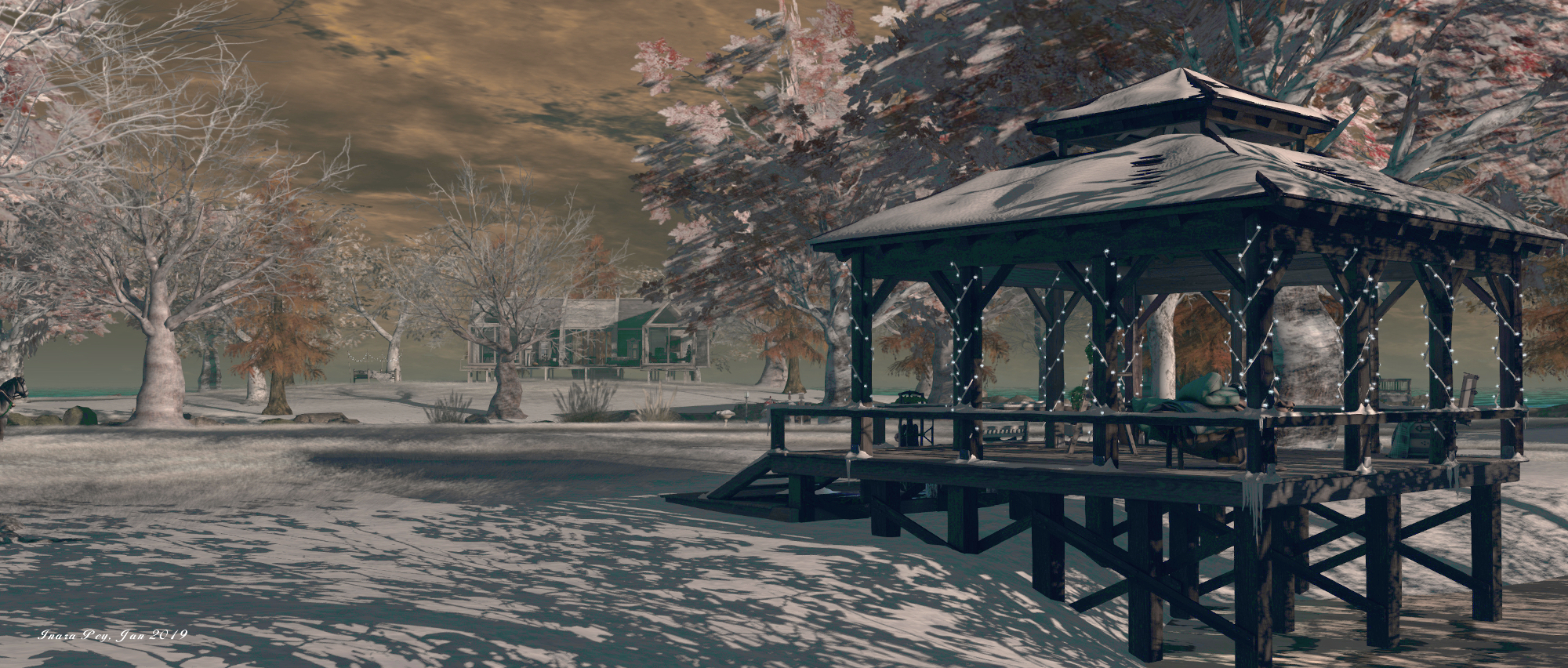
Broken; Inara Pey, January 2019, on FlickrBroken – click any image for full size

Broken is the name Talia (Natalia Corvale) has given to her Homestead region, to which we were led over the weekend by Shakespeare and Max.

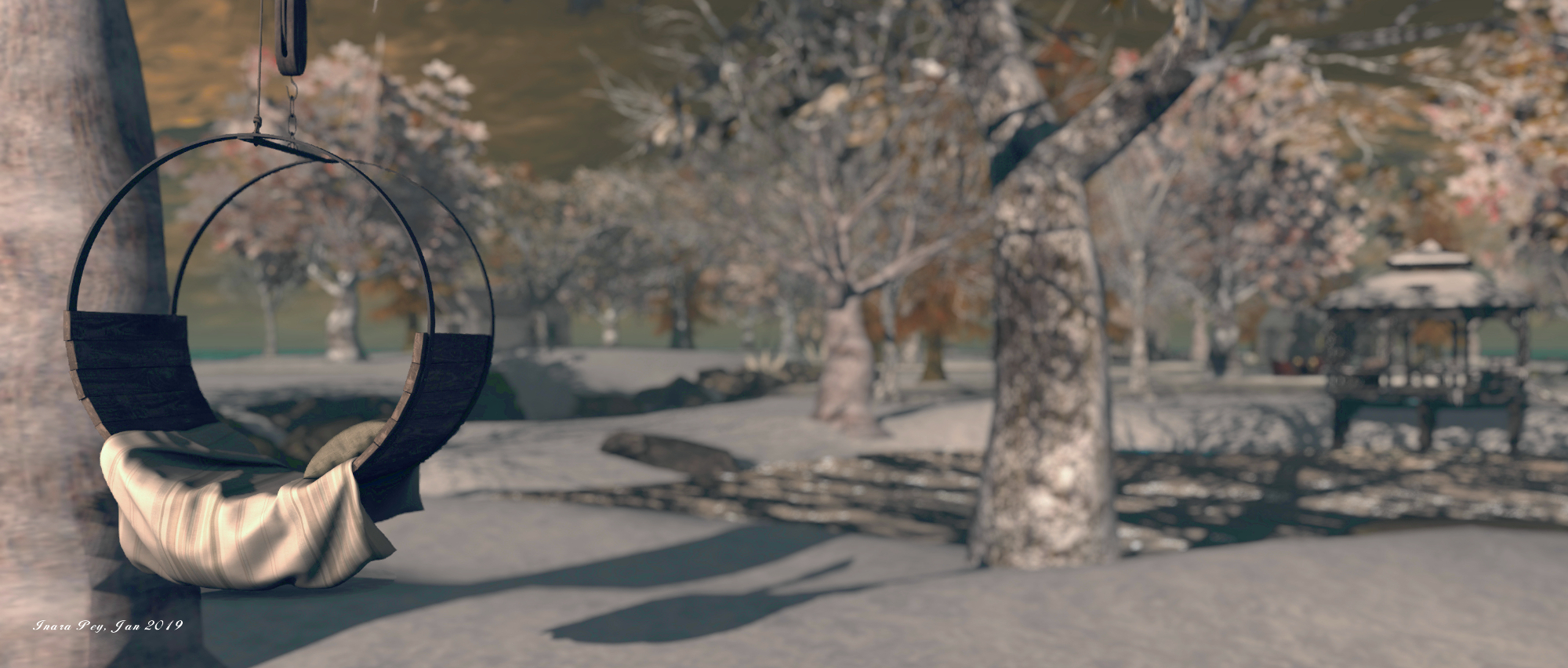
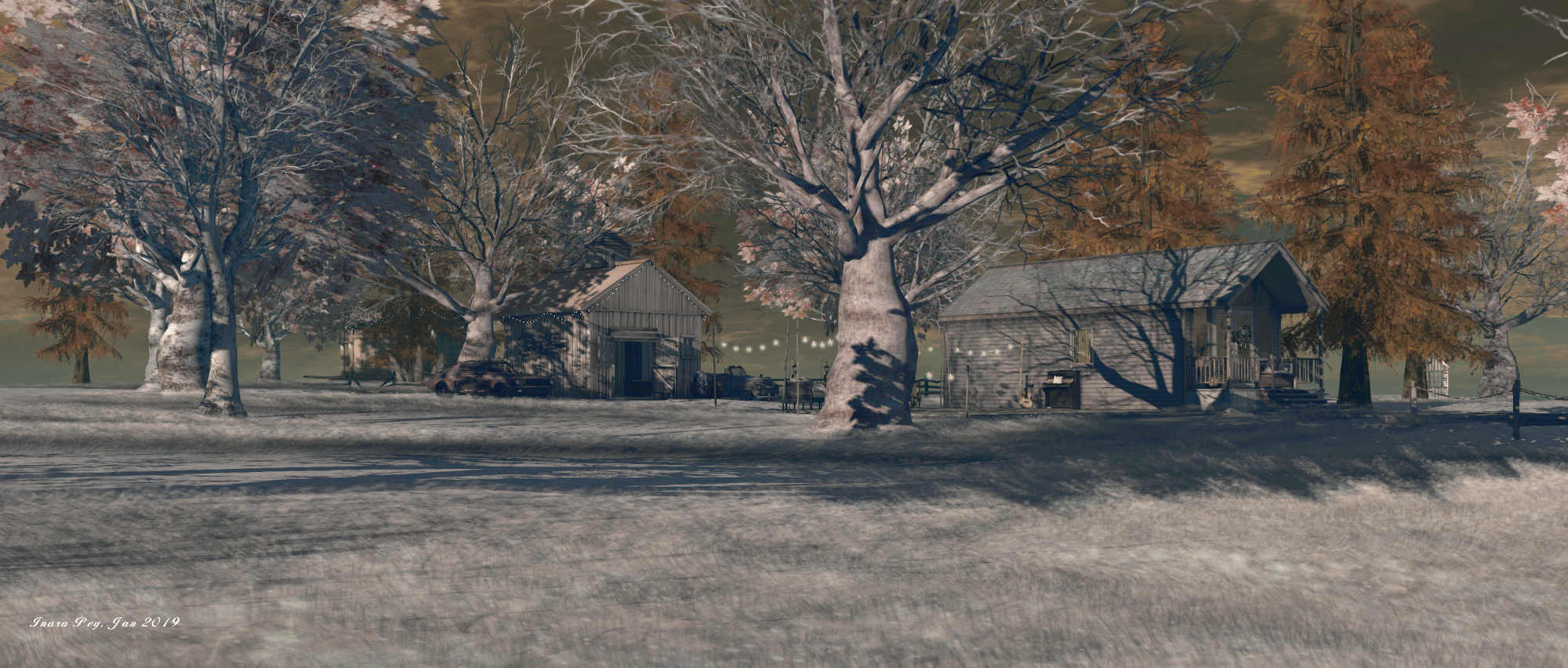
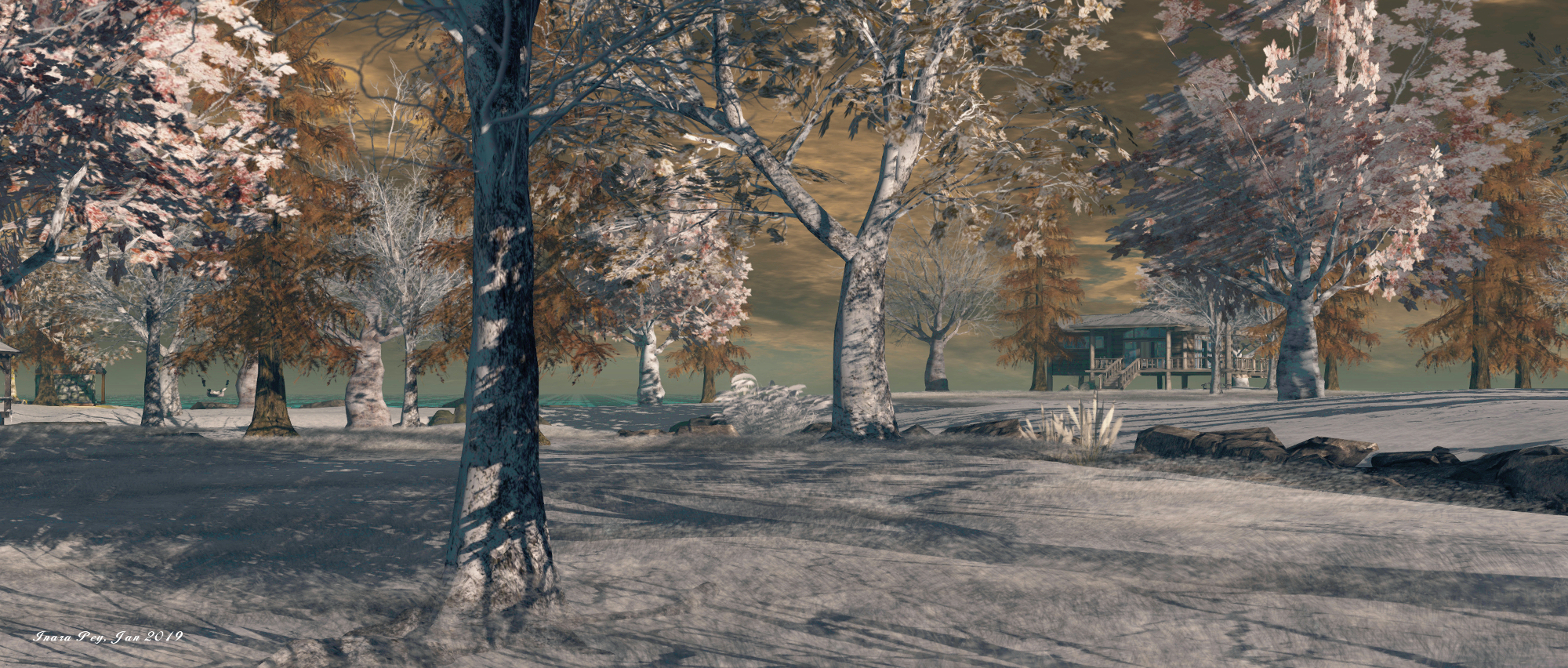
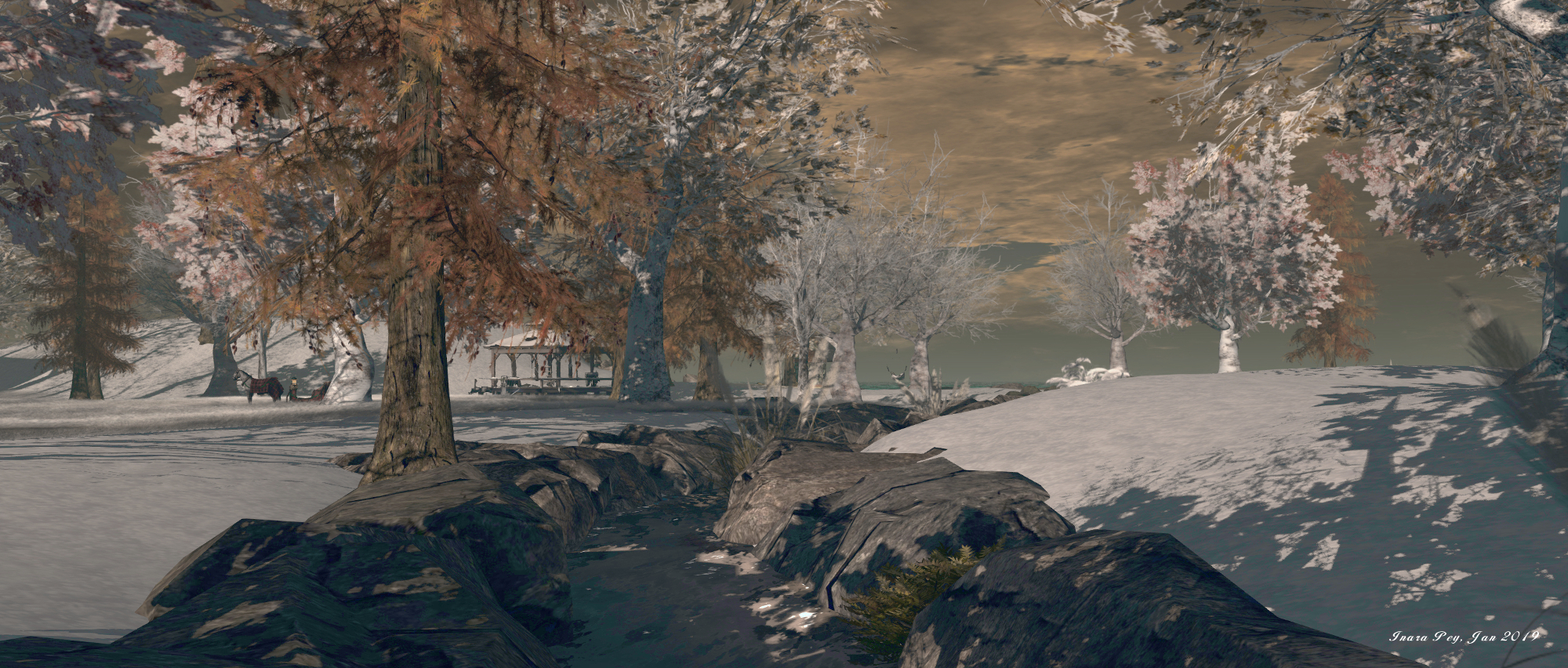
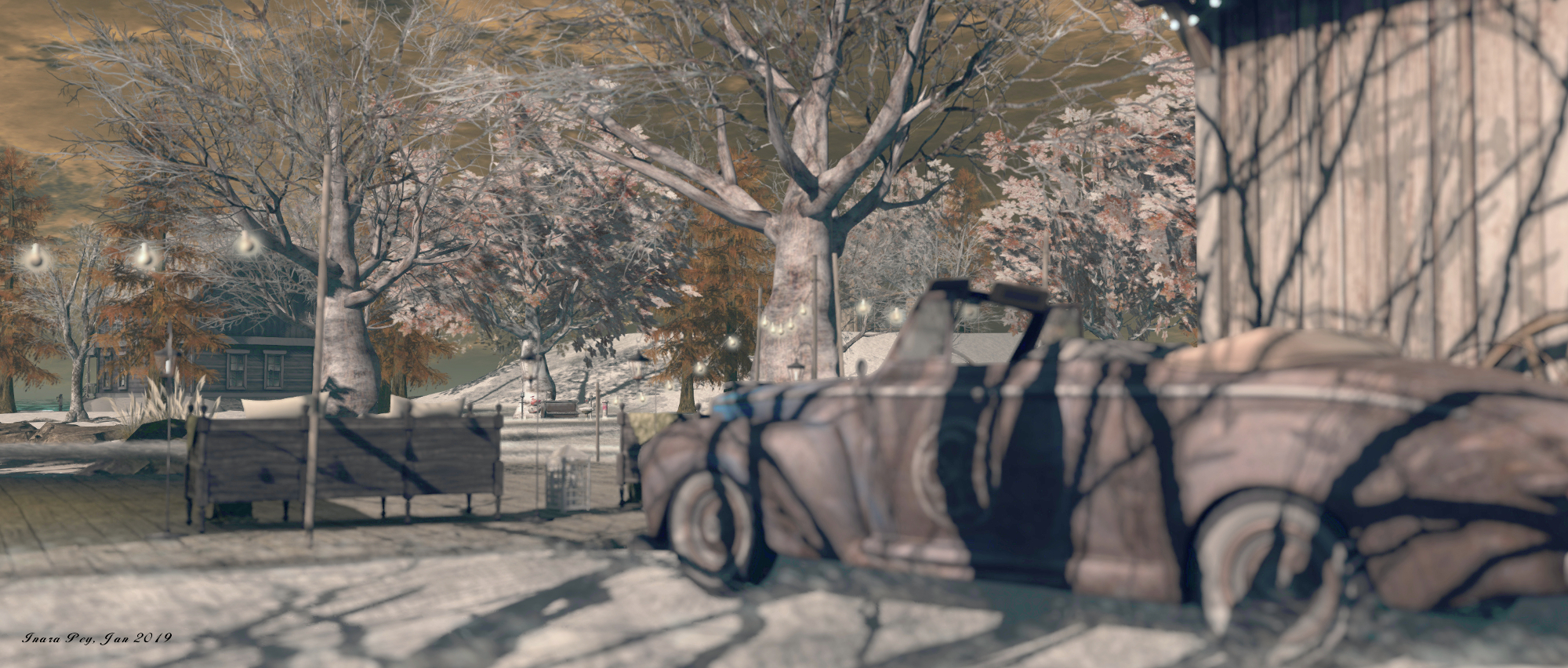
On the surface, this is an elegantly simple design, a place – at the time of our visit – dusted with a light fall of snow through which the grass raises fields of weary heads under an ochre sky held aloft by the trees scattered across the landscape.

Broken; Inara Pey, January 2019, on FlickrBroken

Cut by a stone-banked stream running outwards from a small pool and by the long finger of an inlet, this is a predominantly low-laying region, a single hill rising from its otherwise gentle undulations. It’s a place which at first glance might be mistaken for a residential location: sharing  the region with its trees, grass and water is a series of houses and cabins. However, each and every one of them is open to the public and offers a place of rest. More spots to sit, either on your own or with company, can be found outdoors as well, from a horse-drawn sleigh, through swings suspended under stout boughs or on verandahs to waterside benches and benches on wooden decks.

Devoid of any sound scape, the land here is quiet. As one who always appreciates the added depth given to a region through the use of ambient sounds, I have to say the lack of any here does detract from the setting in any way; if anything it adds to it. Not only does the silence (there is no audio stream either) give the impression this is a place where the snow lies as a blanket absorbing everything, it also sits perfectly with the intent of the region.

Broken; Inara Pey, January 2019, on FlickrBroken

This is because while Broken undoubtedly a place lovers and friends can enjoy – numerous couples poses abound in seats, beds and benches – it is also very much a place of solitude and introspection, as Talia herself notes in describing the region: “for anyone who’s ever lost someone”.

“Lost” in this sense doesn’t necessarily refer to having suffered the passing of someone close; rather it encompasses the separation born of a relationship – be it as lovers or friends – that has run its course and which now lies behind us. It is a place we can come to and give memories and thoughts – happy or sad; with freedom or regret – release. Thus, this is a place that can be both new to visitors and yet personal.

Broken; Inara Pey, January 2019, on FlickrBroken

This is clearly a personal design for Talia as well – as indicated by the dedication she gives with the region’s Pick in her profile. There is also a certain subtle aspect to the way things are placed in the region that perhaps reveals something of her own personality – which is also hinted at in her profile notes.

Take the positioning of the houses and cabins, for example. Their placement makes them both a part of the landscape – but the spaces between them set them apart from one another, allowing each to maintain a distance and individuality within the whole. This  – to me at least – seems to reflect the sense given by Talia’s profile notes that she is (somewhat like me) someone who enjoys company, buy tends to keep slightly apart, even when in that company. Or perhaps I’m just projecting!

Broken; Inara Pey, January 2019, on FlickrBroken

Broken also has something else about it. As well as projecting beauty and peace, there is also an air of strength about it; of endurance captured in the wintry setting and the hard lines of the wooden buildings. Thus, the region offers an appeal on multiple levels, its design touching us whether we visit whilst feeling lost, or in the company of those closest to us or simply out of that desire to explore and discover in Second Life.

I would perhaps like to see scripts enabled within the region, simply because any need to relog during a visit then requires a jump elsewhere and back to re-enable any worn animations such as scripted AOs, but this really is a very, very minor point. The beauty and peace of Broken speak for themselves, making any visit more than worthwhile, no matter what our mood.

Broken; Inara Pey, January 2019, on FlickrBroken

SLurl Details

  • Broken (Farron, rated: Moderate)