Cherished Melody: the waterside walk and Featured Artist gallery beyond, with one of the new studios just visible to the left
A week ago I wrote about one of the things that is keeping be busy – the consolidation work to unify the Phoenix Artists Collaboration (PAC) into a single location.
Well, a week is a long time in Second Life 🙂 , and it finally looks as if the major work is over and I’ll be getting back to more regularly scheduled blogging. The core of the building / landscaping is now done, and the work of transitioning artists from Holly Kai Park to Cherished Melody can shortly begin.
The view from the events space outside the PAC Gallery
It’s been an interesting project; with some 31 artists at Holly Kai Park, and 22 at Cherished Melody within an established setting, it was important we try to bring things together in a way the maintained the look and feel of what Audie had already established, whilst acknowledging we would also need to find space for at least one gallery for group exhibitions, and provide an events space for openings, etc.
Overall, and if I say so myself – and allowing for the fact a little bit of squeezing had to be carried out – thing seem to have turned out pretty well.
In all, Cherished Melody now has 52 indoor studios and two outdoor display areas for our 3D artists. In addition, we’ve actually managed to fit not one, but two gallery spaces into the location. One of these will be the PAC group gallery for exhibitions featuring group members, the second a Featured Artist / special exhibitions gallery (although the space can potentially be re-purposed to provide additional indoor / outdoor studio space, if that becomes a requirement). I’ve also bee able to work in a garden area for pop-up art displays by group members and their friends – although again, the current layout of this area is subject to revision, as it needs a little more brainstorming!
The revised Cherished Melody layout from the air
Most importantly, the work has allowed the water aspects of the setting to be maintained, particularly to the west, but also on the east side as well, with the two bodies of water connected through the water around the landing point that I hope adds to the sense of space within the setting. Admittedly, some of the new studios had to be places somewhat closer together – such is the nature of things – and this can be seen on the south side, where I took a courtyard design Audie used as my lead, but even in these spaces, incoming artists from Holly Kai Park should have a greater sense of space than their former home.
If you are a PAC member at Holly Kai Park, you’re welcome to hop over an take a look – but please, not we’re not quite ready for artists to start claiming spaces, so don’t lay down prims or anyone or start setting up just yet: we’ll let all of you know once we’re ready. Those who are curious about what’s been going on at Cherished Melody are also welcome to come have a look around.
The PAC Gallery, which has an open-air event space before it
I recently mentioned that things have been a little hectic (both in the physical world and SL) such that my blogging frequency has been a little down this last week-ish.
One of the reasons for the slow-down as the decision to say farewell to Isla Pey after some 6 years of using it as an in-world home. Six years is a long time in SL, and while moving elsewhere hadn’t actually been something we’d mulled over in depth, circumstances aligned in such a way that an opportunity to relocate to somewhere slightly larger with the same LI and at a lower cost came up that combined with other changes so as to make a move advantageous.
Isla Ciatinara, August 2020
While living at Isla Pey had been fun – access to Blake Sea, sitting on the very edge of the grid, and so on., there were some disadvantages, and while these didn’t weigh heavily on the decision to move, they have been overcome by making it. In particular, the increased space means the house, gardens and grounds to be properly integrated without feeling cramped and being split into what was effectively three separate parts: north island and gardens, house, and south island, due to the shape of the parcel.
The new location, sitting in a corner of the renewed Second Norway estate – which I’ve had the pleasure of being completely revitalised by Vanity and her team – offers the same benefits as Isla Pey, while allowing house and gardens to be more properly integrated in a parcel that – like all those in Second Norway are offered with (optional) landscaping – a stream, a rocky backdrop in one corners, etc.
Isla Caitinara, August 2020
This supplied landscaping presented the opportunity to take the “skytower” house design we’ve been using, and move it more it overland and without having to put the various landscaping elements in beforehand. the cliffs also mean that the house – raised as it is above the ground – is also somewhat screened from view so as not to overpower the neighbours.
Positioning the house in a corner like this, a stream bubbling below it, means I could spread the main garden with its pond and zen elements, together with the old chapel ruins, out on the land directly below and in front of it, giving that sense of integration between house and grounds, whiles allowing the pond to be enlarged, and is now nicely overlooked by the infinity pool at the front of the house.
Isla Caitinara, August 2020
Of course the vehicle rezzing system came along in the move as well, so we can still easily change which boats aircraft as available for us without having to devote a huge amount of LI to keeping them rezzed or the annoyance of pulling the from inventory. If you haven’t read about using such systems, why not check out Adding a little vehicle space with a rezzing system.
Doubtless I’ll be making minor tweaks for a while, but for now it is – farewell Isla Pey, hello Isla Caitinara!
The Shippe and Saille Harbor Master (Bimini and fishing rods deployed)
As a rule of thumb, I tend not to seek copies of items for review in these pages; those I do produce tend towards items I have purchased. The reason for this is because I feel I can give a fairer review if I’m writing about something I’ve purchased. That said, there are a couple of of exceptions to the rule, and I’m about to make a third in this case.
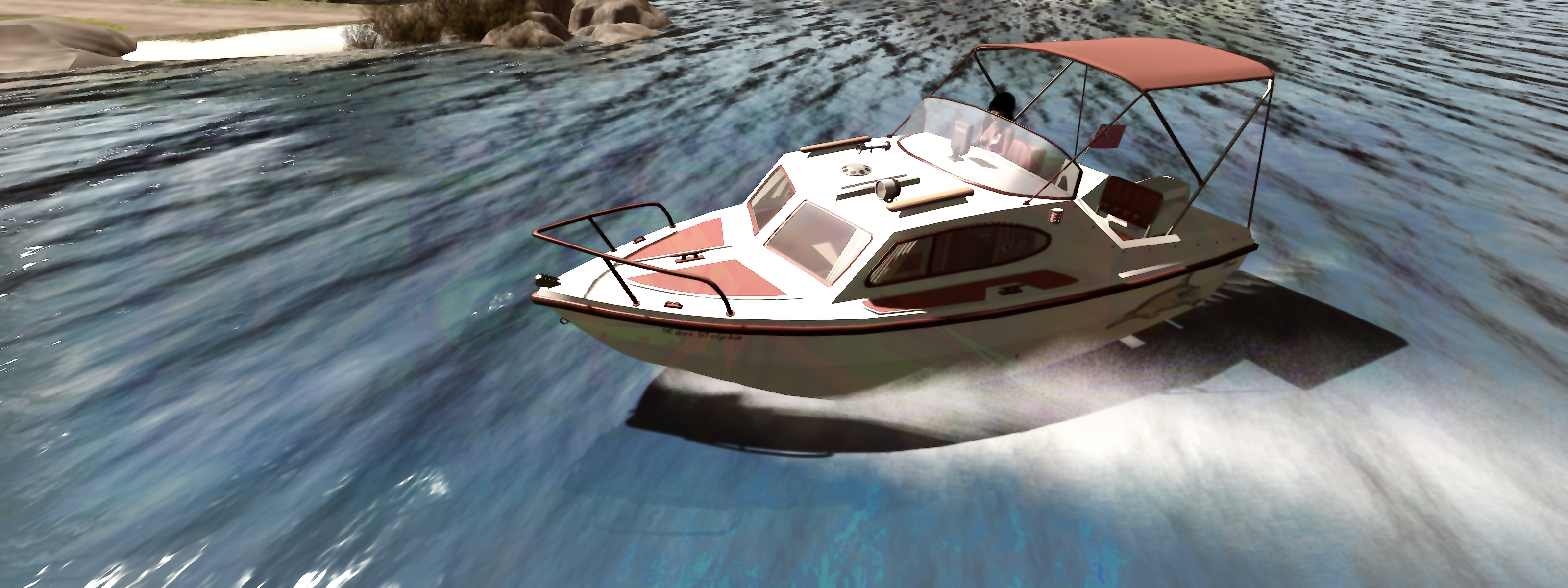
LadyJane Shippe sent me the latest from her Shippe and Saille brand, the Harbor Master, a slightly rescaled model of the Harbor Master 19, a dory style hulled cruiser with a forward cabin space, and itself based on the classic open Outboard Dory 18. It’s a small, fairly nimble craft driven (in the case of this version) by a 50 horse power outboard motor.
The Shippe and Saille (r) moored alongside the Bandit 170 at home, with the Bandit 580 behind them both
The S&S Harbor Master is reportedly 15% larger that its physical world equivalent, so as to present enough space for all sizes of human avatars within the cabin and the covered pilot house. It is not, at first glance, a particularly elegant boat when compared to other cabin cruisers; the snub bow, forward placement of the cabin and high roof to the pilot house tend to give it something of an ungainly look. But looks, as the hoary old saying goes, can be deceptive.
Outside of the increase in size – which given it is proportional, isn’t that noticeable – this is a faithful reproduction of the Harbor Master 19, fully capturing the shape of the dory hull, the cabin and pilot house. The latter offers bench seating for two, and the cabin basic sleeping space for two – although the boat will carry up to three. Behind the benches, the open cockpit offers room for equipment stowage, etc. A cooler box sits at the back of the cockpit, which might be considered at keeping drinks on ice or used to hold any fish caught when out and about.
Fishing aboard the Shippe & Saille Harbor Master
Fishing, because the boat is compatible with a number of Second Life fishing systems – WZW fishing, 7 Seas, and Goldtokens rod. Two rods can be rezzed in the holders towards the stern of the hull, and the pose system also include fishing poses that will auto-rez (temp) fishing rods. In addition, the user manual provides instructions on swapping the latter out for any preferred rods an owner might have.
Rezzing the two rods on the boat increases the LI from 31 to 34, which still leaves the boat a modest count in terms of LI. Other options that are included with it are a cockpit Bimini “raised” and “lowered” by the pilot’s chat command of “Bimini”, an opening /closing cabin skylight or door, and an anchor that can be raised / lowered, as can the outboard motor (the latter of which is raised by default on a fresh rezzing of the boat)., and the boat’s fenders. All of these, bar the cabin skylight and door, are activated via chat commands (the skylight by touch).
If rezzed out of Linden Water, the boat will raise itself and rez a 6 LI trailer underneath to support it
Handling-wise the boat follows the usual lines: the majority of commands are chat based, although some – such as the lights – use the switches in the pilot house. the arrow / WASD keys handle steering and the throttle. The latter has four forward and four reverse settings (dead slow, slow, half, and full) sitting either side of the idle setting. Additionally, the Page keys can be used to rapidly toggled between idle and half speed (forward or reverse). In terms of driving, the boat is extremely responsive and the chat command for the camera can be used to help recover the camera position should things go sideways on a region crossing (including the “cc” command for any passenger – a nice touch).
Painting the boat can be handled in one of two ways. Those wishing to just change their Harbor Master’s name can use the hull texture included in the user guide. Those wishing to make more extensive changes can find a link to download a comprehensive set of texture and UV maps. As a copy / mod vehicle, this boat is also open to a degree of physical customisation – general guidelines are provided in the user guide for those wishing to do so.
The Shippe & Saille Harbor Master
Those who enjoy Get The Freight Out will find a GTFO option in the the Habor Master package. Once unpacked, simply add the script and GTFO item it contains to the boat’s contents, and your ready to use it with the game.
I’ve not used the Harbor Master extensively, having made fewer than a dozen runs in it – although three have been reasonably long distance across and around Blake Sea and along the coast of Nautilus. Throughout, I found the boat to be responsive, made good recoveries on region crossings and generally presented no real handling problems. At L$1,900, it’s very well priced, and just the job for those looking for a modestly-priced, small-sized motor cruiser for open water or river cruising.
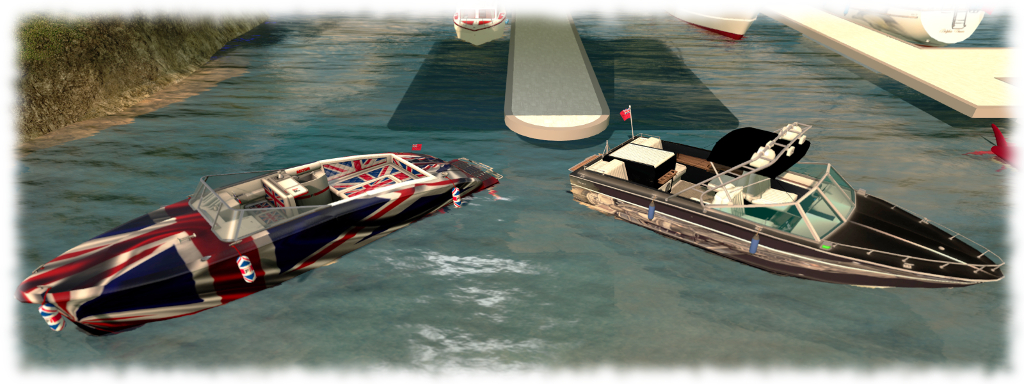
The Piaggio Little Bee (l) and the Bandit SRV 210 (r) in custom finishes
As regulars to these pages know, I enjoy sailing, motor boating, cruising and flying in SL, and I sometimes review the vehicles I obtain. As a result, I often get asked for a recommendation from people curious about vehicles in SL.
Answering such questions isn’t easy, in part because we all like different things, but mostly because – in all honesty – my experience is not that wide-ranging; I don’t have a huge stockpile of craft, and I tend to restrict myself to just a handful of creators on a regular basis, so there is potentially a lot out there that I’m missing.
However, my preview of the Bandit 170, which will be on general release soon, has resulted in people asking me about what I would recommend as a versatile, fun boat motor boat that looks good and doesn’t take up a huge amount of space. There are potentially hundreds of such craft to be had in Second Life – and the Bandit 170 is definitely a good place to start, in my opinion, allowing for the final details (including cost) on it to be settled.
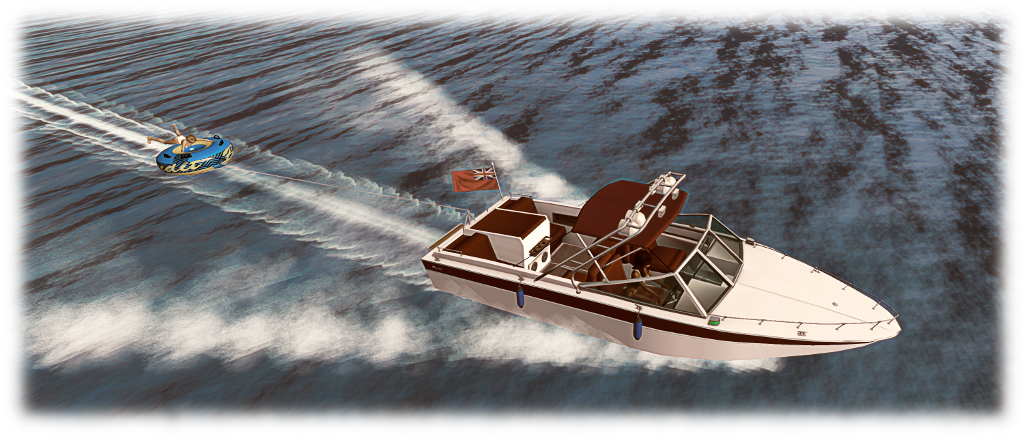
The Bandit includes a towable float tube
That said, the two boats that I find simply cannot be beaten – and indeed, have actually stopped me from buying boats I’ve tried elsewhere, simply because they are so much fun – are the Bandit SRV 210 and the Piaggio Little Bee. Both of these boats offer so much, they are genuinely hard to beat in terms of use and value for money.
The Little Bee is the oldest of the two in terms of its time on the market, having been around since August 2015. It is based on a classic tender style speedboat design, giving it classic, clean lines. The cockpit offers plenty of space and seating, with three forward seats (including the driver) and a large rear seating area behind, with floor section that can be raised to form a bed. Two novel items with the main cockpit are the hand basin and the espresso machine with hotplate – which will deliver a brew!
The Little Bee with a custom paint finish
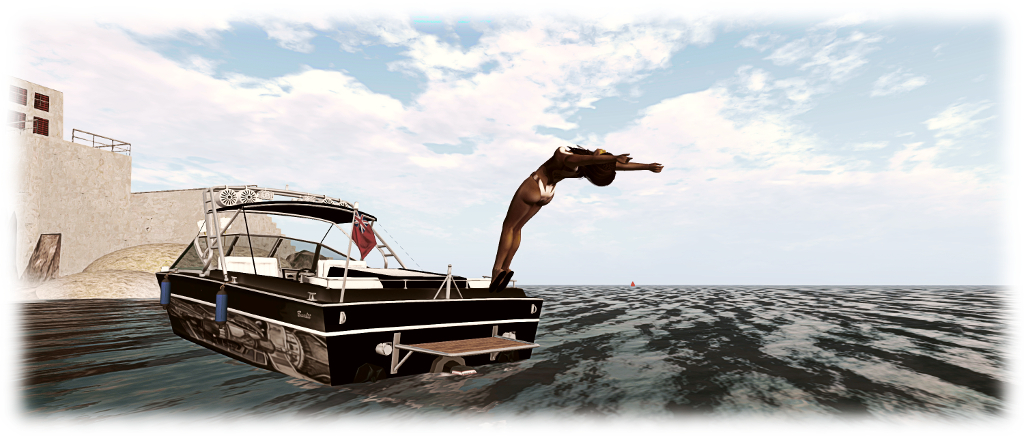
The SRV-210 has been around since 2018, and is built along the lines of the deep v-hulled fibreglass sports boats of the 1970s / 80s. The cockpit is smaller but broader than the Little Bee, and provides seating for up to 6, including the driver. The boat is equipped with a Bimini sun screen and a full tent, both of which are chat-enabled (as are many of the commands with the boat, and some of the commands with the Little Bee). Two versions are offered – one with an enclosed forward cabin, and the other with an open forward cockpit (and which may have additional poses as a result – as I don’t have that version, I’m not familiar with its capabilities).
The two boats handle remarkably well and similarly, providing a good ride experience, although the SRV 210’s ride is a little more physical, in that the boat (and camera smoothness) respond to speed and wave force, which adds to the realism of driving it. The overall controls are pretty much the same, within the exception that the Little Bee has a hydrofoil capability; this is both novel for a speedboat and makes it exceptionally fast with the foils deployed.
The SRV includes both diving and swimming animations, as well as on-board poses / animations
Each boat comes with a range of options some of which are common to both – paint files, media system, towing trailer, etc. The SRV 210 is supplied with a full paint finish and a set of textures for the flag. The Little Bee is supplied with a basic paint finish, but comes with far more options, including a car to tow the boat and trailer (called the TugBee and resembling a VW Beetle), a wakeboard and a parasail (a wakeboard for the SRV 210 can be purchased separately), while paint options can either be applied manually or via scripted means. Rez it on land, and it will automatically rez a cradle under it that it will sit on.
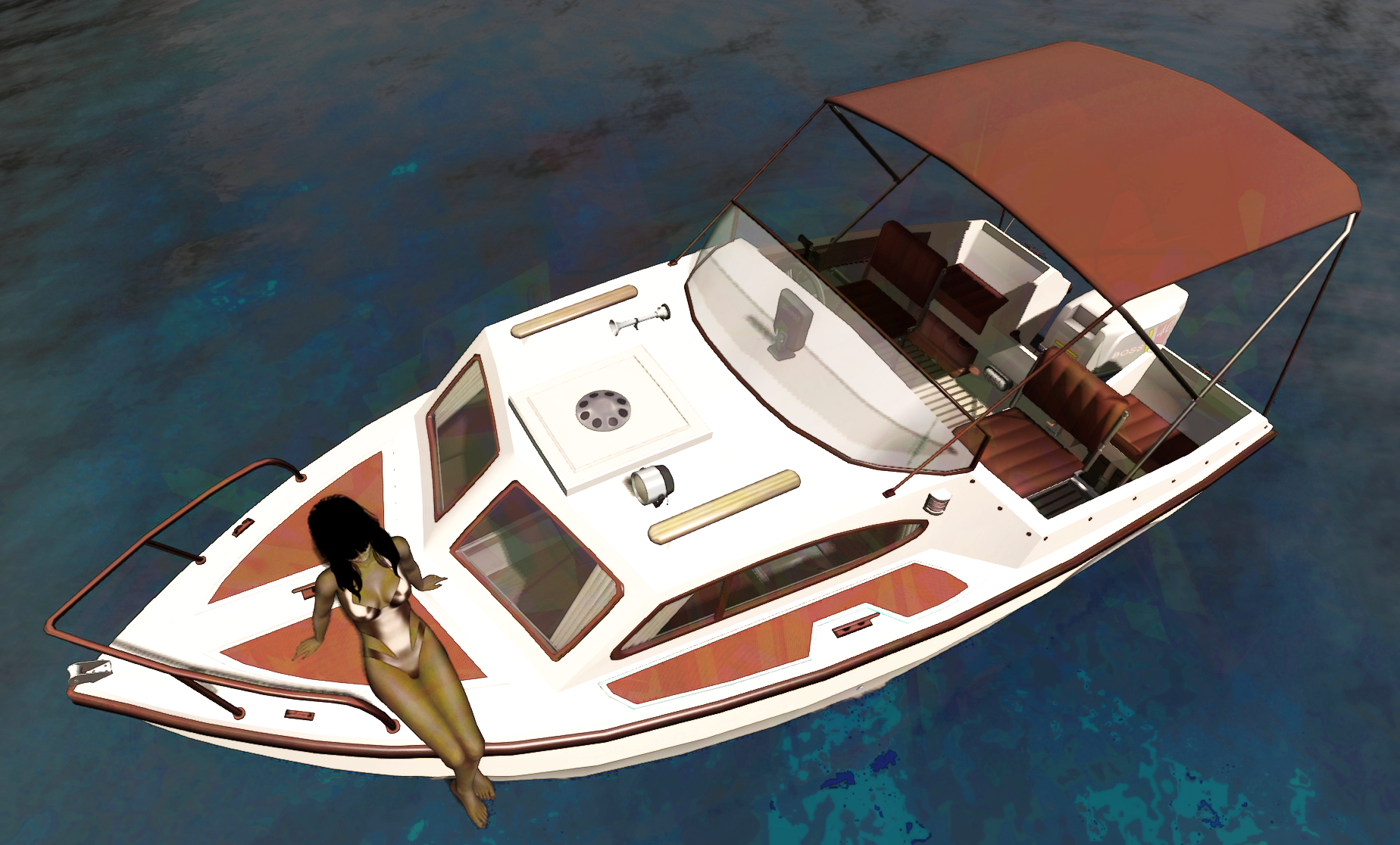
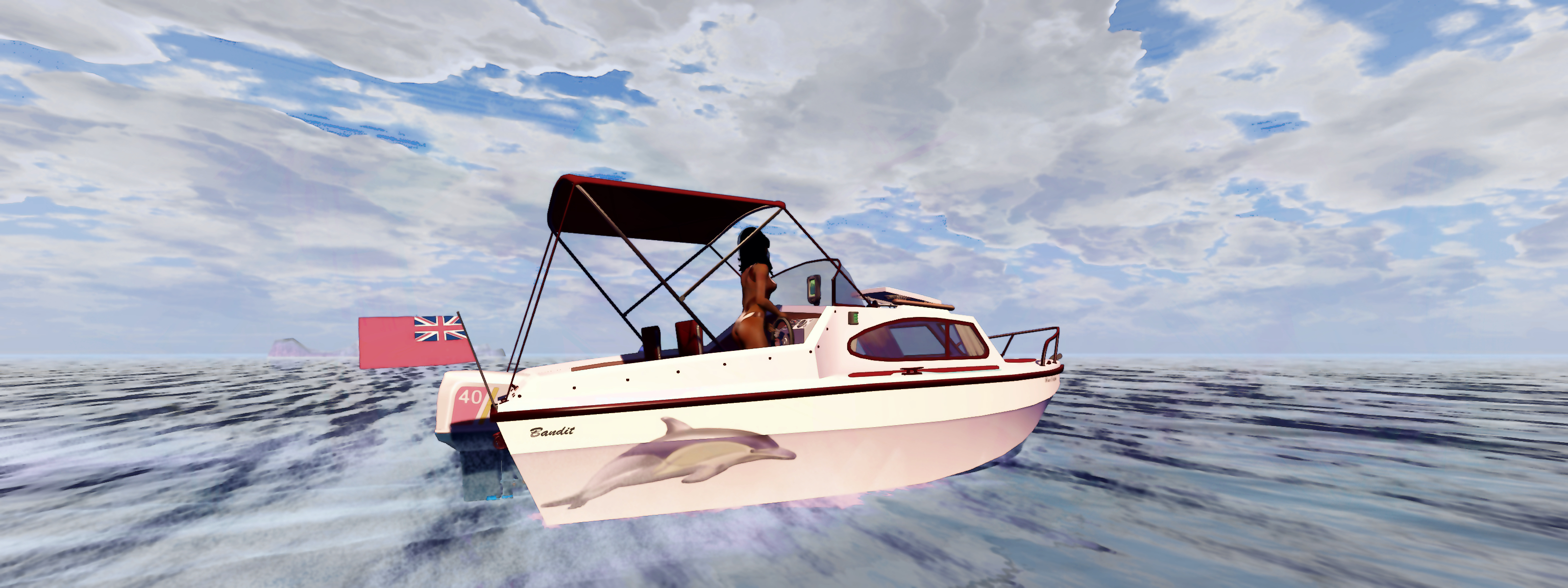
I logged in to Second Life to find I had an unexpected gift waiting for me: a preview version of the Bandit 170, the latest motor boat by Analyse Dean. It’s a cute little craft modelled, as Ana’s boats are, after a physical world boat, as is noted in the 170’s user guide.
The Bandit 170 DeLuxe is modelled after the small recreational pocket cruisers of the 1970’s, like the Inter 500 and the Marina M17, they were popular then, and are still popular now.
Due to the small size they are easily stored, can be pulled on a trailer behind a compact car, they are fuel efficient when puttering around, but fast and fun to drive when you open up the throttle, and you can camp out in the cosy cabin for a weekend fishing trip.
At 6.6 metres in overall deck length, this really is a small boat – smaller than the Bandit SRV-210 speedboat, which I reviewed two years ago, when it was first released. Nevertheless, it come packed with details: a range of cabin and deck sits, the ability to tow a passenger carrying tube or and optional wakeboard (the 170 is compatible with Ape Piaggio’s wakeboards, which can be purchased at Ape’s store at Dutch Harbor).
Bandit 170
The 170 is very much a faithful reproduction of the Inter 500 / Marina M17 (Ana provides a pair of photos of the Inter 500 so you can see for yourself). The stern well provides room for four, while the compact cabin offers sleeping / sitting space for in reasonable comfort. It is powered by 40 hp outboard motor that may not have a huge turn of speed in the physical world when compared to speed boats and larger cruisers, but which is for Second Life more than adequate, and at the upper end of its speed scale, makes this a manoeuvrable, nippy little craft.
The controls for the boat follow the usual layout: when seated, the pilot types “start” (no quotes) to start the engine and “stop” to turn it off, while the Left / Right keys will turn the boat in the appropriate direction, and the Up / Down keys increase / decrease the throttle. From start, a tap on Page Up will fully open the throttle while tapping the Down Key when in motion will drop the throttle back to idle. If Page Down is tapped when the throttle is idling, it will drop the boat into full reverse, and Page Up will bring the throttle back up to idle.
A range of chat commands unlock other features, including deploying the Bimini (Sun shade over the open boat well) or the tent (completely encloses the boat well), setting the camera position, turning the hover text HUD on / off, dropping / raise the anchor, deploy the fenders – and more, as detailed in the the user guide. Touching the boat can either access the range of sit / pose options (of which there are a fair few, singles, couples and fun) or activate various controls / options – such the the ventilation hatch in the cabin roof, boil the kettle, (and give you a mug of a hot beverage), toggle the control panel switches for the boat’s lights, stow / unstow the forward seats in the boat’s well or the table in the cabin, put out a larger bed, etc.
Bandit 170
Like many of Ana’s boats, the Bandit 170 is a very physical craft: it really will bounce through waves when at speed; as a consequence, you can suffer a fair amount of camera juddering. This can be lessened by using the mouse scroll wheel to push your camera back a little from the boat. And talking of the camera, for those times when it skews and locks at a weird position on a region crossing, the pilot can generally recover by toggling between the two camera modes (cam 1 and cam 2). It may not always work – but such is the nature of SL.
For those who like first-person driving, the Bandit 170 is a capable craft, the dashboard has a single instrument – the speedometer. When driving in third-person mode, a little practice will show there’s no need for the hover text HUD.
The boat’s package includes a range of extras: a dock with scripted auto-mooring, a trailer for towing the boat, a complete texture pack for producing custom paint finishes (and which includes a couple of pre set paint options; textures are applied by right-clicking the boat and selecting the required face – just refer to the texture currently in place on the boat to confirm which texture goes where). A pack of flag textures are also included, together with the aforementioned towable tube – see the user manual for details on this.
The Bandit 170 on its trailer
An interesting twist with the Bandit 170 is that it comes ready for a new game Ana is working on with Ape Piaggio, Rez Grey (the originator of Get The Freight out) and Dutch Mainsail. Called OMFG (that’s One More Fishing Game before you jump other conclusions!), it is a grid-wide fishing game that Ana describes thus:
It’s 100% database driven, so all the water in SL is mapped out, meaning you’d really have to go out with your boat, look at the fish finder to see if there is fish, and then stop and cast a line, what you catch depends on what gear/bait you use, and where you are (also, how much you had to drink, if that’s a lot, you start catching really weird things…
The game has yet to be finalised, which means the eventual retail price of the Bandit 170 is still TBC. However, those who would like early access to the boat (without the game option) can obtain it from the Bandit stall at Uber. Those buying the boat from there will receive a free game update once the latter is available.
Bandit 170 o the rivers of Bellisseria
One of the things I like about this little cruiser is that its small size, shallow draft and low speeds make it ideal for navigating inland waterways around SL – I had a lot of fun (low bridges allowing) pootling around the rivers of Bellisseria.
All told, a great addition to the Bandit ranged of power boats, one that could well be a popular item among boating enthusiasts, bringing with it a land impact of 35. If you don’t fancy trying to fight your way into Uber to grab one, you can hop to Dutch Harbor and at least take the demo version for a run.
While visiting JimGarand’s Grauland in January 2020 (see: Grauland’s touch of Japanese Zen in Second Life), I was struck by the zen garden included within the region design. An examination of the core elements in the design revealed them to be from the Zen Garden Building Set by Alex Bader, sold under his Studio Skye brand.
Alex has a reputation for producing excellent landscape building kits – and I’ve used several in constructing places like Holy Kai, although there are admittedly some that while mouth-watering in terms of my desire to put them to good use, such as his stream building sets, I simply haven’t (thus far) had the space in which to do them real justice. However, the Zen Garden kit was one that I immediately had a familiar “me want!” itch about, so that after a couple of days of pondering how it might work within Isla Pey, I snagged a copy from the Marketplace. And I have to say, it is simply superb.
The zen garden at Isla Pey viewed from the house balcony
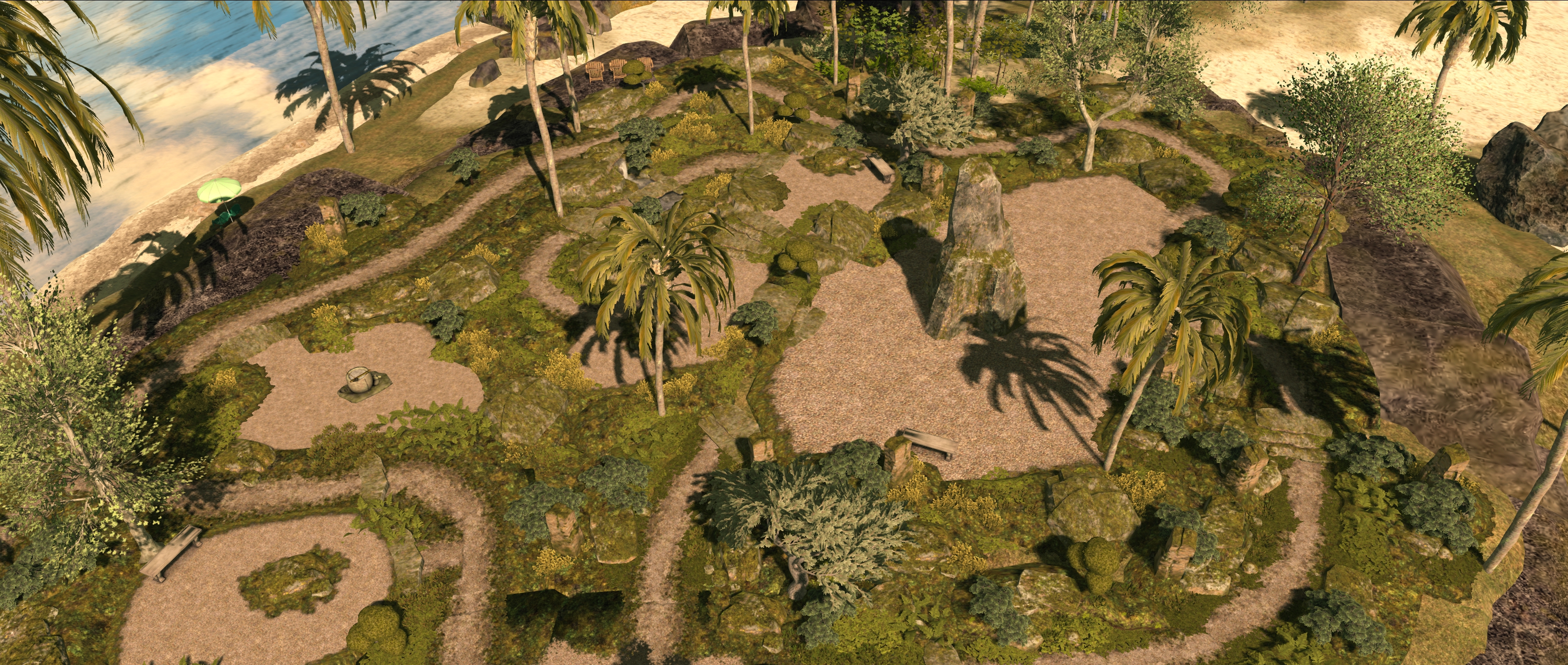
At L$899, the kit includes some 24 individual elements: rocks, gravel surfaces, gravel path sections, plants, shrubs, ground cover, ground pieces, stone steps, edging pieces (combinations of rocks and plants), and so on. All of this offers a comprehensive means to build a garden network of paths, plants and open spaces, which can both be used to provide places to sit or include additional features as well as being easily integrated into a broader landscape.
In addition, for those who might be daunted at the thought of trying to glue everything together themselves, Alex provides two “pre-built” and rezzer based examples of gardens: one 32m on a side (96 LI when rezzed) and the other 26x18m (46 LI). Also, a couple of textures are also provided for the purposes of blending any additional items – fillers and the like – that might be required to ensure a good pairing of garden to surrounding landscape elements.
Given they are “ready to go”, so to speak, the two example gardens are a good place to start with a design. As they are supplied in rezzers, also that’s required is a couple of clicks with the rezzers, and they can be put together in moments and the rezzer then used to position them as required. Just click the Finish option once placed, remove the rez box and then modify or extend the garden or blend it with a broader landscape using both the additional components in the kit and whatever else you have that you feel might work with it.
I opted to take this approach myself, using the 32mx32m garden as my starting point. To this I added some of the base, path and edge pieces to provide a basic design (one which currently uses the garden’s featured rock monolith seen in the photos here, although I’m debating swapping that out and creating a “formal” element common to zen gardens: an area of sand raked to resemble ripples on water). To this I added our selection of sculptures by Ciottolina Xue and Silas Merlin, plus trees by AzaleaBluebell originally offered as a Fantasy Faire hunt gift, together with a selection of shrubs to provide more of a garden feel.
The more extensive zen garden at Grauland
There are some additional nice touches with the set, together with a couple of “does” and “don’ts”. For example, the water elements include a volume control for adjusting / changing the sound being generated by their little falls. The edges of the individual paths are nicely “feathered” so that path sections can be more easily placed together and blended. Also, the kit is compatible with the Studio Skye 4-Seasons bolt on – although this is where the “don’t” comes into play. If you do plan to use season changing bolt-on, don’t link elements of the garden together, as doing so will adversely affect how textures get applied when changing the seasons.
Also, do take care should you vertically resize elements (e.g. so the base better connects with whatever is under it): many of the pieces have horizontal faces painted as edge cover, and resizing can leave these “floating” above the rocks / pathway section on which they are supposed to be growing, or no longer aligning with edges they are supposed to be draped over.
The zen garden at Isla Pey with the house behind
But, as noted at the top of this piece, this is a minor niggle. For those looking for a different look to their garden – one that can be unique to them whilst leveraging other plants and garden items they have, the Studio Skye Zen Garden Building Kit makes for a excellent purchase.
Note: the statuary, trees, large bushes and benches seen in the images here do not form a part of the Zen Garden Building Kit, but have been purchased separately.