Curiosity: Sol 3 and Sol 4

Curiosity continues to operate well on Mars, with the MSL mission’s characterisation activity phase proceeding precisely as planned.

The last two Sols have been the focus of some intense work, including preparing the rover for what NASA has dubbed its “brain transplant”.

Like all computers, Curiosity’s computers have finite storage capacity, and to cram all the code required for the mission aboard the rover would be impossible. So the software in broken-down in sections that equate to various phases of the mission. The software is then uploaded to the rover and committed to its on-board computers as it becomes required, over-writing the previous mission phase software.

Prior to its arrival on Mars, Curiosity’s software was concerned with three things: the cruise phase of the mission (keeping the vehicle on-course for Mars and the planned landing site and correctly oriented for both this and communications with Earth); carrying out experiments to monitor radiation in interplanetary space and how it penetrates the vehicle (part of planning for a manned mission to Mars); and the EDL (Entry Descent, Landing) phase of the mission itself. Now the rover has landed, that software package (called the R9 Flight Software Package) has done its job, and so needs to be replaced with the software (called the R10 Flight Software Package) required for Curiosity to operate on Mars.

Sol 3

The day began with the upload of R10 files to Curiosity. Installation did not immediately take place – it is planned to commence on Sol 5 – but the rover’s back-up computer was powered-up and checked-out ready for the upcoming software upgrade. The transition will be handled on a per computer basis, in case anything unforeseen occurs. The software will, among other things, allow the robot arm and  Curiosity’s “hand” of instruments to be activated and checked out. The software also contains software related to Curiosity’s ability to drive on Mars and self-navigate.

Curiosity in action: the “hand” deployed on the end of the 2-metre robot arm with the MAHLI camera visible on the top of the hand and in the foreground

The hand is crucial to the mission, containing a range of instruments capable of a range of tasks including: viewing surface features in extreme close-up (the MAHLI camera); gathering soil and dust samples from the surface; scraping the surface of rocks and drilling into them to obtain samples, and so on, all of which can be returned to the rover’s onboard analysis lab.

The Mastcam completed final calibration and then undertook a 360-degree look at Gale Crater around the rover with 130 images, each compressed into a 144×144 pixel format, returned to Earth and used to create the first colour panoramic view of the rover’s location.

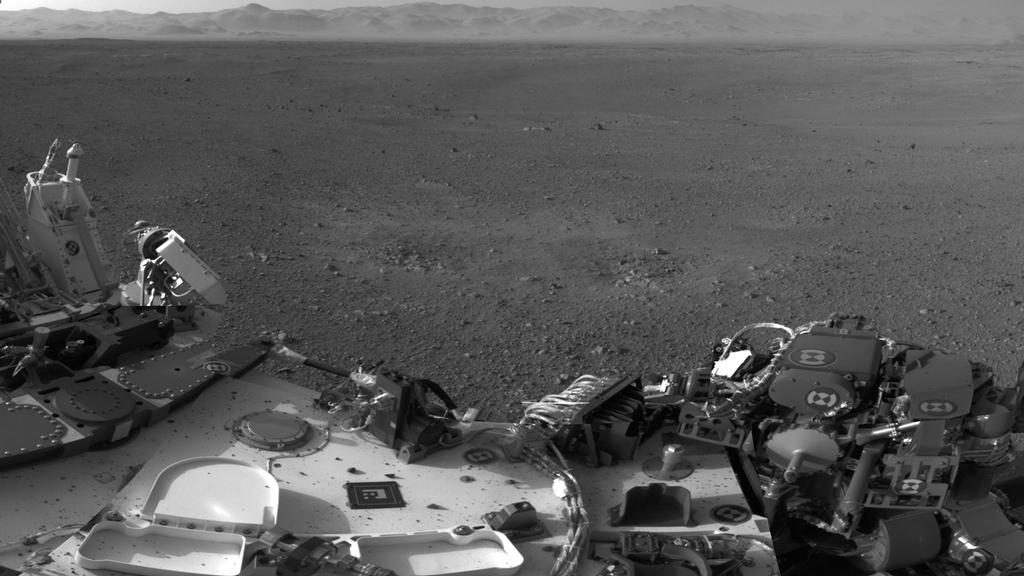
The Navcams were used to take high resolution images of the rover’s deck, taking a number of shots which revealed the vehicle to have some small debris scattered on the deck as a result of jet-wash from the descent stage motors, but nothing serious. These images were returned together with the low-res colour images during the scheduled overhead passes of Mars Odyssey and the Mars Reconnaissance Orbiter (MRO).

Hi-res Navcam image of Curiosity’s rear deck – see description in the main text

Image above: Curiosity’s rear deck. One the extreme left of the image, angling away from the deck is the RTG housing at the back of the rover. Immediately to the right of this, sitting on top of the raised structure is the arrow-like low-gain antenna (LGA). In front of this and side-on to the camera is the high-gain antenna (HGA). The rim of Gale Crater is the line of sun-brightened hills on the horizon.

Sol 3 also saw initial check-outs completed on a range of other instruments on the rover: the Alpha Particle X-ray Spectrometer (APXS), Chemistry & Mineralogy Analyzer (CheMin), Sample Analysis at Mars (SAM), and Dynamic Albedo Neutrons (DAN), all of which were successful.  instruments were all successful. Issues with the Remote Environmental Monitoring Station (REMS) were resolved, allowing both REMS and RAD (Radiation Assessment Detector) to return further data on the environmental and climatic conditions in Gale Crater to Earth.
Another hi-res image of the rover’s deck

Image above: a further image of Curiosity’s deck taken as the Navcam rotates more towards the front of the rover in relation to the previous image. The LGA, HGA and drive system arm can still be seen to the left. In the right foreground is the rover’s “hand”, still in its stowed position against the front of the vehicle. Pebbles and dirt can clearly been seen on the rover’s deck, thrown-up by the jet-wash from the descent stage motors. Blast marks from the motors can themselves be seen a short distance from the rover.

Sol 4

Sol 4 was a relatively quiet day for the mission. Work continued on preparing the rover to transition to the R10 Flight Software. Key capabilities in the R10 package, as mentioned above, enable full use of Curiosity’s robotic arm and hand, and includes advanced image processing to check for obstacles while driving. This software will enable Curiosity far more autonomous than is the case with Opportunity, allowing it to make much longer drives along routes it identifies for itself and to avoid potential hazards along the way.

During the period of the transition, science and check-out operations have been deferred, and while the rover did return some images and additional data to Earth, the focus was on readying the on-board systems for the new software. The transition itself is expected to run through the weekend, with an end-time targeted for August 13th (PDT) Earth time. While this work is ongoing, the mission scientists have been putting together a geological map of a rough 390 square kilometre (150 square mile) region of Gale Crater, including the landing zone.

Elsewhere in JPL, and following the successful MSL landing, a unique video was cut together mixing footage from the “seven minutes of terror” simulation of Curiosity’s arrival on Mars with scenes from mission control at JPL during the actual sequence of events from EDL. The result is a unique film that puts a new perspective on the mission and the landing sequence.

Mission Trivia

Curiosity’s Sol 3 wake-up call came in the form of Good Mornin’ from Singin’ in the Rain. 

MSL coverage in this blog

All images: credit NASA / JPL

Curiosity: Sol 3: first colour panoramic image

Jut after I pressed my most recent update on the Mars Science Laboratory mission, NASA JPL release the first low-resolution colour panoramic view of Gale Crater captures by Curiosity’s Mastcam.

The images were captured by the Mastcam system’s 34 mm fixed focal length camera mounted towards the top of the rover’s remote sensing mast (it is the Mastcam camera on the left of this image).

First colour panoramic view of Gale Crater from Curiosity’s Mastcam

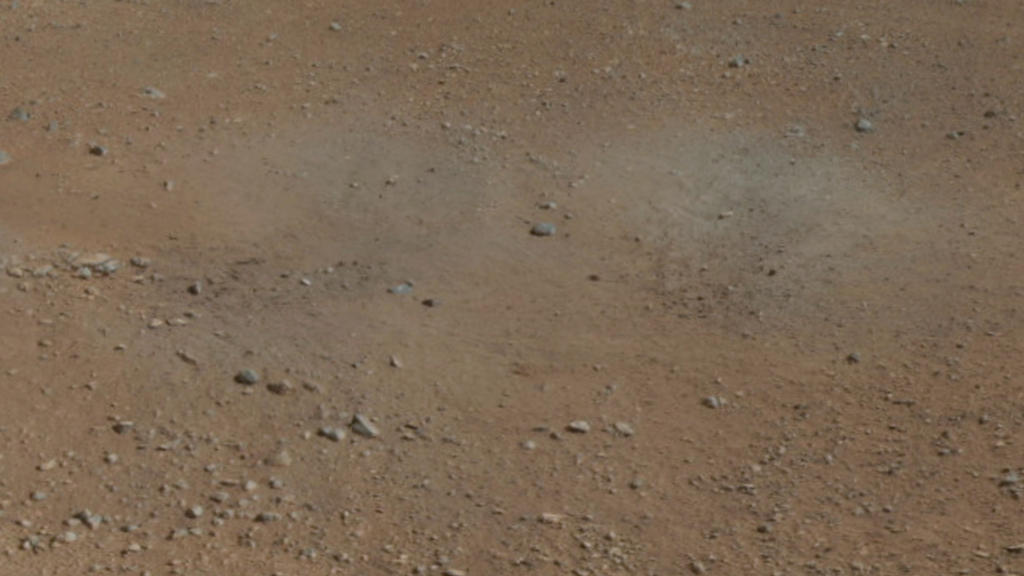
The mosaic is made up of 130 images each compressed into a 144×144 pixel format for transmission to Earth. The complete set of images has been brightened in the processing as Mars only receives half the sunlight Earth does, and these images were captured in the late Martian afternoon. The black areas denote areas outside the view of the Mastcam. The grey patches on the ground to the left and right of the rover are the result of the blast from the descent stage’s radial motors striking the ground and blowing away the topsoil, and these are already the subject of study by the science team on the mission.

A closer view of one of the blast areas resulting from the MSL’s descent stage motor thrust

The dunes on the horizon are also visible in the black-and-white panoramic view captured by Curiosity’s Navcam on Sol 2, but in this image they reveal some interesting hues that suggest they are comprised of different materials or textures.

Selected high-resolution (1200×1200 pixel) images from the panorama are expected to be returned to Earth later.

Image credit: NASA / Caltech / Malin Space Science Systems (MSSS)

MSL coverage in this blog

Curiosity: Sol 0 to Sol 2

It’s been an amazing few days since Curiosity landed on Mars. The rover is off to a good start in what is called the “characterisation activity phase” of the mission, which is scheduled to last around a month.

The rover landed on Mars at 15:00 “Mars time”, equating to 06:14 BST on August 6th, or  22:14 PDT August 5th, at NASA’s Jet Propulsion Laboratory in Pasadena, with confirmation being received on Earth at 06:32 / 22:32 respectively .

This marked the start of the rover’s first day on Mars, officially designated Sol 0. Activities during Sol 0 comprised releasing various instruments and protective covers, such as those over the Hazcams at the front and rear of the rover, checking-out the UHF telecommunications system and the rover motor controller, confirming its orientation (facing a heading of 112.7 degrees (+/- 5 degrees) and with a slight tilt) and relaying some 5 Mb of data back to Earth via Mars Odyssey.

Sol 1

Sol 1 saw the rover gather data from the Radiation Assessment Detector and Rover Environmental Monitoring Station instruments and further tests on the high-gain antenna (HGA), located towards the back of the vehicle. This is important, as the HGA enables the rover to communicate directly with Earth when it is above the rover’s horizon, rather than signals having to be relaid via Mars Odyssey and Mars Reconnaissance Orbiter (MRO) – although both of these will continue to be used when direct rover-Earth lines of communications are unavailable.

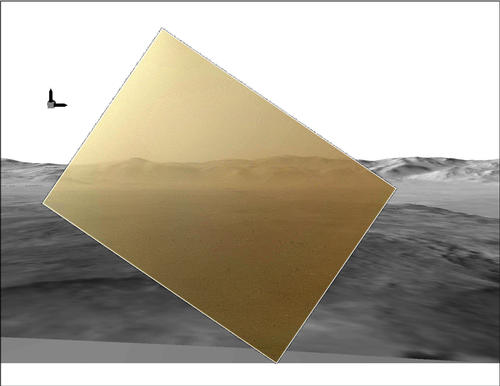
Curiosity took its first colour image of Mars using the Mars Hand Lens Imager, or MAHLI, located on the robot arm. This image appeared oddly rotated due to the arm being in its stowed position, MAHLI pointing outwards on the front left side of the rover.

First MAHLI image, taken with the camera in its stowed position, looking over the side of the rover. In the distance is the rim of the crater

The image appears cloudy as it was taken before MAHLI’s protective cover was still in place, coated by a film of dust thrown-up by the descent stage motors during landing.  The image is facing north, and the visible ridge is the rim of Gale Crater, with the peak to the left being some 1,150m (3,775 ft) high and 24 km (15 miles) from the rover

Sol 1 also saw the rover complete an initial deployment of the forward remote sensing mast to enable calibration of the navigation cameras (Navcams) to commence. Calibration was expected to take around a Sol to complete, as test images of targets on the rear section of the vehicle had to be returned to Earth in order for any “manual” adjustments yo the camera systems to be calculated and then transmitted back to the rover.

MAHLI’s image (above) given context is a computer simulation of Gale Crater developed from hi-resolution images returned by MRO’s HiRISE and the High Resolution Stereo Camera on Europe’s Mars Express.

During Sol 1, MRO also captured a fabulous image of the landing zone from some 300 km above the surface of Mars, using it’s HiRISE camera system. The image clearly shows the shadow cast by Curiosity, together with parachute and aeroshell to the left and slightly below it (approx. 615m away) and the impact points for the heat shield (some 1.5 km (1 mile) from the rover) and descent stage. The latter, having flown clear of the rover’s landing-zone, impacted on the surface around 650 metres from the rover, leaving a classic oblique impact mark (common to asteroids striking a planet), which forms an arrow pointing back towards the rover. This image was later combined with images of Mars to create a short movie called Zooming in on the scene of Curiosity’s Landing.

Sol 2

Curiosity’s remote sensing mast, seen fully deployed prior to launch in 2011

On Sol 2, Curiosity completed calibration testing on the Navcams, and raised the remote sensing mast to its fully deployed position. An initial high-resolution image was then captured by the Navcam, looking out over the front of the rover (part of an exercise to help confirm the rover’s alignment relative to the sun).

The first image taken by the Navcams following full deployment of the remote sensing mast. The cameras are looking forward and down over the front of the rover, away from the sun (what JPL calls the “anti-sun” image)

Following this, the mast was rotated, allowing the Navcams to be used to capture images of the rover’s immediate surroundings, including a 360-degree panoramic collage of Gale Crater and Aeolis Mons (referred to as “Mount Sharp” by NASA, the unofficial name given to the mound prior to its naming by the IAU). The panoramic view was initially returned to Earth as a collage of thumbnail images.

The first 360-degree panoramic view of the landing site and Gale Crater returned as thumbnails by Curiosity

As it is currently only available at thumbnail resolution, the panoramic view was somewhat overshadowed by high-resolution images also returned by the Navcams, which stand as promise of things to come once the Mastcams start operations.

The Navcams were also used to image elements of the rover itself in order to gain a further indication of the vehicle’s overall condition, and these revealed no nasty surprises, and were later strung together to give and overhead “fish-eye” view of  Curiosity (see the image towards the end of this article).

Use the page numbers below left to continue reading

Curiosity: two remarkable photos

Earlier today I commented on the fact that NASA hoped that the Mars Reconnaissance Orbiter would be able to capture an image of Curiosity as it descended through the Martian atmosphere. 

Well – take a look at these pictures!

MRO captures MSL / Curiosity, still within its aeroshell and suspended beneath its parachute (credit: NASA)
And a closer view (credit: NASA)

And this is just the start!

Curiosity: arrival

Shadow on the ground, Curiosity on Mars – one of the first images to be sent to Earth from the newly arrived rover (credit: JPL)

At 06:14  BST (05:14 UTC), Curiosity, NASA’s latest and largest rover vehicle, officially arrived on the surface of Mars at the end of a 570-million-km journey, and the start of what promises to be a truly remarkable international mission (the science package that forms the heart of the mission – the Mars Science Laboratory itself – includes instruments from Canada, France, Spain, Russia, Germany, the UK and Finland as well as the United States, while scientists from around the world will be directly involved in analysing data and images returned by the rover).

The entire landing sequence – referred to as the EDL, for Entry, Descent and Landing – proceeded flawlessly, with telemetry confirmed the rover was on the surface of Mars arriving at mission control 06:32, after being relayed to Earth via an orbiting space craft above Mars and the Canberra Deep Space Communications Complex, Australia.

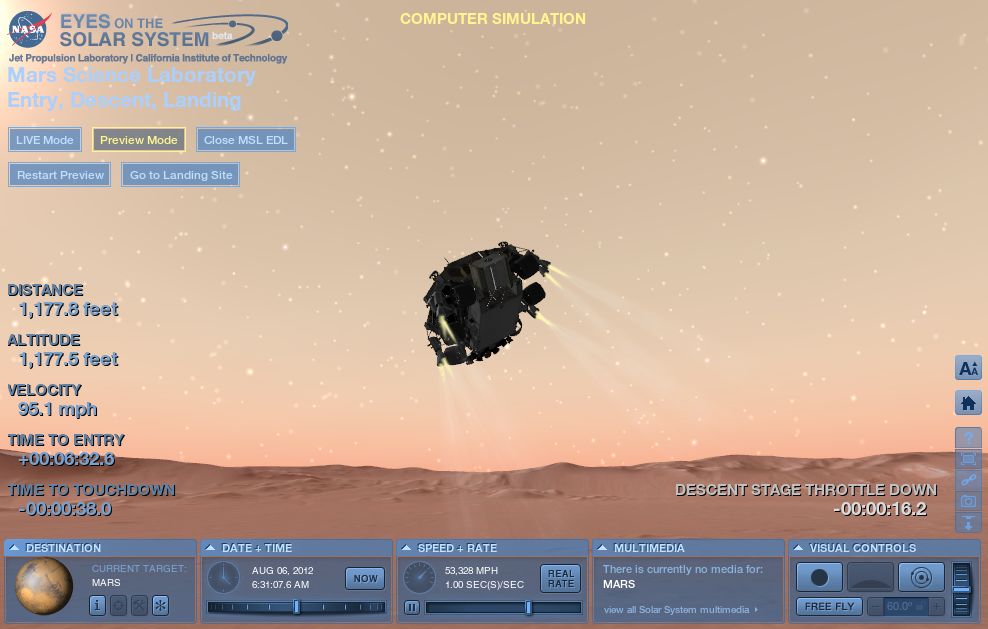
The landing was followed around the world, via NASA TV web feeds, Twitter and through the unique perspective of NASA’s Eyes on the Solar System, which presented a simulation of the entire EDL phase of the mission which could be played in real-time as events unfolded 246 million kilometres (154 million miles) away.

The descent stage simulated by Eyes on the Solar System (NASA)

The excitement of the event was genuinely palpable; not only was there the massive question as to whether the vehicle survive the “seven minutes of terror”, as the EDL had been dubbed by the mission team, there was concern whether NASA’s Mars Odyssey orbiter – the only vehicle in Mars orbit capable of relaying data received from Curiosity directly to Earth – would in fact be able to do so.

The 11-year-old orbiter has been struck by a series of problems over the last year, the most recent of which occurred immediately prior to an orbital manoeuvre designed to put the vehicle on the correct track in order to be overhead as Curiosity landed on Mars. While that problem have been successfully overcome, there was concern that the orbiter might fail to complete a final orientation manoeuvre designed to correctly align its antennae so it could act as a relay – and the manoeuvre itself could not be carried out until just 15 minutes prior to Curiosity arriving on Mars.

While NASA’s Mars Reconnaissance Orbiter (MRO) and Europe’s Mars Express were also on-hand to capture data transmissions from Curiosity, neither one has the ability to simultaneously receive data from the surface of Mars and transmit it directly back to Earth. Instead, telemetry from Curiosity would have to be recorded and then relayed to Earth many hours after then landing period. Thus, without Mars Odyssey, mission control – and the world at large – would have no idea as to Curiosity’s fate for a considerable period of time after the event.

As it was, everything worked flawlessly. Not only were the Odyssey team able to ensure the vehicle was on the right track ahead of EDL, the entire landing process ran to almost precisely to the projected schedule, key events occurring a matter of seconds behind the times being played-out on the Eyes on the Solar System EDL simulation.

For those used to the button-down shirt formality of NASA so beloved of Hollywood and familiar from achieve footage of the Apollo missions, the informality at JPL may have come as something of a surprise. As EDL progressed, team members passed jars of peanuts around, taking handfuls and munching on them in a long-standing tradition dating back to Ranger 7, the first US probe to successfully transmit close images of the lunar surface in 1964. Then, as Allen Chen, the EDL’s Flight Dynamics and Operations Lead announced, “Touchdown confirmed, we’re safe on Mars!” the room erupted into scenes of heartfelt jubilation with shouts, cheers, hugs and even one or two little dances.

Adam Steltzner (right), the man who lead the team responsible for the Curiosity’s descent and landing systems, reaction to the first images received from Curiosity on Mars (credit: Brian van der Brug/Los Angeles Times-POOL)

Even with Odyssey on track and correctly oriented, there was still some doubt as to how much data would be relayed before Mars Odyssey dropped below the horizon relative to Curiosity and direct contact from the rover was lost. As well as transmitting confirmation it was down and relatively safe, the rover had been pre-programmed to record a number of rapid-fire images using the front and rear hazard avoidance cameras (Hazcams) in order to give some visual indication of the vehicle’s general condition / possible orientation. However, the window for data transmission was so tight, there was doubt that any of the images would be captured, compressed and transmitted prior to Odyssey moving out of range.

Use the page numbers below left to continue reading

2012: a Martian Curiosity

Update, Monday August 6th: Curiosity arrived on Mars, on time and on target, the start of what promises to be a remarkable mission of exploration. Mars was good, and allowed the rover to pass images over to Mars Odyssey for transmission to Earth. Read my report.

Later today – or in the early hours of the morning of Monday 6th August if you live on the East Coast of the USA or in Europe, something very, very remarkable will take place above the magnificent vistas of Mars: NASA’s latest mission to the Red Planet will arrive in a quite spectacular manner.

The Mars Science Laboratory (MSL) mission is the biggest single payload yet sent to Mars. It comprises a rover vehicle called Curiosity, weighing-in at almost a tonne, carrying  a sophisticated science laboratory that gives the mission its name. The latter is designed to study the Martian climate and to analyse soil and rock samples to assess what the Martian environment was like in the past in terms of its potential to have been the abode of life. To contribute to thee goals, MSL has six primary mission objectives:

  1. Determine the mineralogical composition of the Martian surface and near-surface geological materials.
  2. Attempt to detect chemical building blocks of life (biosignatures).
  3. Interpret the processes that have formed and modified rocks and soils.
  4. Assess long-timescale (i.e., 4-billion-year) Martian atmospheric evolution processes.
  5. Determine present state, distribution, and cycling of water and carbon dioxide.
  6. Characterize the broad spectrum of surface radiation, including galactic radiation, cosmic radiation, solar proton events and secondary neutrons.

In addition, and while en-route to Mars, the mission has been measuring the radiation exposure experienced by the interior of the vehicle while in interplanetary space in order to better understand that medium in preparation for manned deep-space missions into the solar system.

The Rover

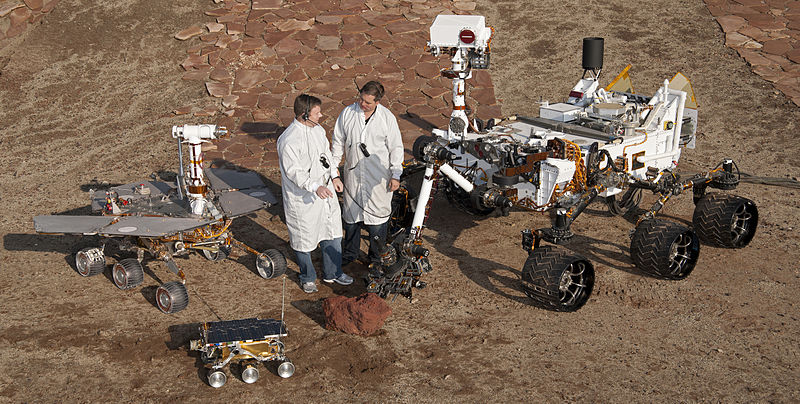
While some to the media descriptions have been prone to exaggeration where Curiosity is concerned (comments like “the size of an SUV” leading people to visualise something the size of a Range Rover or Jeep Cherokee), one should not doubt that, comparatively speaking, the rover is big. At around 3 metres (approx 10ft) in length, Curiosity is almost twice the length of the Mars Exploration Rovers (MER) Opportunity and Spirit already on Mars, while at 900kg (1984 pounds), it is almost two-and-a-half times heavier than their combined weight.

Comparative rover sizes. Foreground: Mars Pathfinder (1997); left: Mars Exploration Rover (2003-present); right: MSL (credit: NASA)

The MERs, which arrived on Mars in 2003, were both solar-powered, as was NASA’s first mission to put a rover on Mars – the tiny Sojourner, which formed a part of the Mars Pathfinder mission of 1997. As such, the MERs were expected to only operate for some 90 days apiece – even though Opportunity is still functioning today (over 3,100 days into the mission). One of the reasons for the 90-day limit placed on the MER missions was the expectation that the rovers solar arrays would become less and less effective as the mission progressed due to the accumulation of Martian dust on their flat surfaces, reducing the amount of sunlight they could convert into power for the rovers’ battery systems. This actually did occur, but so did a series of (initially unexpected) “cleaning events”, which saw the Martian wind periodically remove dust from the arrays, restoring some of their ability to harness sunlight.

MSL is expected to operate for far longer than the MERs – a full Martian year (just under 687 days) being the planned initial mission period. It also carries far more science and other equipment on-board. As such, solar power for the vehicle is impractical. Instead, it will be powered by a radioisotope thermoelectric generator (RTG), which utilises heat from the radioactive decay of plutonium-238. This produces around 110 watts of electrical power, generating around 2.5 kilowatt hours per day (compared to the 0.6 kilowatt hours per day generated by the MERs). In addition, the heat generated by the radioactive decay is used to warm fluids which are circulated through the rover keep electronics and other systems at acceptable operating temperatures during the harsher periods of the Martian / seasons.

MSL is not the first time RTGs have been flown to Mars by the United States; both of the Viking Landers of the 1970s were RTG-powered, and both of them, like Spirit and Opportunity, functioned well beyond their original mission times, with Viking Lander 1 operating for over six years and Viking Lander 2 for just over three-and-a-half years.

The late Carl Sagan and a full-size model of the Viking Lander from the 1970s (the Lander was similar in size and mass to the MSL)

Once on the surface, Curiosity will be able to traverse the terrain at a maximum speed of some 90 metres (300ft)  per hour, with average traverse speeds of around 30m (100ft) per hour. This compares to the MERs traversing around 100 metres per day, and means that over the course of the initial mission period, the rover should cover a minimum of some 19 kilometres (12 miles) during the initial mission period (Opportunity has, to date, travelled some 34.6 kilometres (21.5 miles). The rover will be able to calculate the distance it has travelled by means of the unique pattern the wheel treads will leave in the Martian sand; included in the thread pattern is the Morse code pattern for JPL (·— ·–· ·-··), which will be imprinted on the Martian soil once every revolution (JPL standing for “Jet Propulsion Laboratory, MSL’s “home”).  In addition, Curiosity will be able to roll over obstacles approaching 75 cm (30 in) in height.

Curiosity’s wheel treads include the Morse code pattern for JPL (·— ·–· ·-··) to help the rover calculate the distance it has travelled (credit: JPL)

Science Instruments

Some 80 Kg of Curiosty’s mass comprises the camera systems, scientific instruments, experiments and operating systems themselves. These include two on-board computer systems responsible for managing all of the rover’s operations. Both of these are radiation-hardened, with one forming the back-up to the other in case of unexpected failure. Each computer has just over 2Gb of memory and a RAD750 CPU.  For navigation, the computers are supported by an Inertial Measurement Unit (IMU) that provides 3-axis information on its position.

MSL includes a suite of camera systems, which will be used for a range of functions, including autonomous navigation, hazard avoidance cameras (using pairs of black-and-white cameras mounted at each corner of the rover), a “Mars Hand” camera mounted on the rover’s robotic arm (which has a reach of some 2 metres) capable of taking microscopic images of rock and soil, a “ChemCam” which uses an infra-red laser to vaporise rock and soil samples and then collecting a spectrum of the light emitted.

MSL science instruments and cameras (credit: JPL)

From a public perspective, however, the two most interesting camera systems aboard the rover are liable to be the Mars Descent Imager (MARDI) and the MastCam. MARDI will be used during the final moments of MSL’s Martian arrival (dubbed, with good reason, the “seven minutes of terror” – see below). This is designed to start operating when the MSL and its decent unit are some 3.7 km above the surface of Mars and continue through until the vehicle is some 5 metres above the surface. It will take images at 1600×1200 pixel resolution with a 1.3 millisecond exposure time and at a rate of some 5 frame per second.

The MastCam sits (as the name suggests) atop the rover’s mast, some 1.97m above the bottom of the rover’s wheels. This system provides multiple spectra and true color imaging with two cameras. The cameras can take true color images at 1600×1200 pixels and up to 10 frames per second hardware-compressed, high-definition video at 720p (1280×720). As such, it is liable to be images and film from this camera that will capture the imagination of people from around the globe, with the two cameras in the system given between 1.25 and 3.67 higher spatial resolution than the panoramic cameras carried by the MERs when operating at its highest (black and white) resolution of 1024×1024 pixels.

NASA JPL provides a comprehensive overview of the complete science package for those who are interested.

Use the page numbers below left to continue reading