Moni’s Discolouration Disrupted in Second Life

IMAGOLand Art Galleries: Moni Beebe – Discolouration Disrupted

Having been caught up with things in the physical world for much of March (and still trying to clear up the last few issues as April 2024 starts its merry dance to becoming at part of the year’s history!), I’m caught in something of a game of catch-up with events, exhibitions and what have you. In terms of some exhibitions, there are some I simply won’t get to, as their days are numbered and they’ll have likely ended before I can get to them.

However, there is one exhibition I really wanted to try to cover before it vanishes into the ether (it having opened nigh-on a month ago at the time of writing, on March 6th, 2024). It is Monique Beebe’s Discolouration Disrupted, which (again at the time of writing this piece) is still available at Mareea Farrasco’s IMAGO Art Galleries.

IMAGOLand Art Galleries: Moni Beebe – Discolouration Disrupted

I’ve been an admirer of Moni’s work ever since her first exhibition in Second Life in 2017. Her work, which has until relatively recently focused on avatar studies, is always marvellously expressive and rich on both narrative and, frequently, a degree of subtext as well. Her exhibitions tend to be thematically driven and often highly sensual in nature, and the former is certainly true of Discolouration Disrupted, as evidenced by its subtitle Unveiling the Beauty in Imperfection, which itself might also be seen as a subtextual comment on modern society’s obsession with perfection when it comes to the human body.

No liner notes appear to be provided for the exhibition, allowing viewers to plumb the depths of the pieces and discern their relationship to the central theme for themselves. The pieces are a mixture of still life and animated works – be sure to enable the media option in your viewer (click the movie camera icon towards the top right corner of the viewer window) to see the latter in motion – and all appear (and forgive me if I’m wrong here, Moni) to be digitally generated.

IMAGOLand Art Galleries: Moni Beebe – Discolouration Disrupted
The still life images perhaps offer the clearest link to the theme of beauty in imperfection in the manner they juxtapose clearly beautiful / handsome figures (aka society’s “perfection”) with styles and colour mixes that whilst not undermining the stated beauty of the figure(s) within them offer a degree of discordance with their beauty, drawing the eye from them and imbuing a sense of mismatch or an unfinished feel to them – thus presenting the idea of the imperfect. Yet at the same time it is these very clashes of style and / or the sense of the unfinished which actually provides each piece with a depth of beauty that reaches well beyond what might have been had they been presented as “unblemished” works. The animated images share this to a degree, but also offer additional dimensions to the core theme – the blurring of images, the use of a mask and veils, etc.

And while it may just be my personal interpretation, some of the pieces perhaps present subtextual commentary on society in other ways as well. The likes of Break Away, Hiding, Undisclosed, Empowerment, and even Fish in the Sea, all appear to offer a degree of commentary on current reactionary moves in (particularly) patriarchal / pseudo-religious circles towards matters of a woman’s bodily autonomy, the dismissing of female equality / empowerment, the right to gender identification and self-identification and choice in general.

IMAGOLand Art Galleries: Moni Beebe – Discolouration Disrupted

But again, this is an interpretation informed purely by matters that impact my own thinking, and not necessarily those intended by the artist. You might well – in fact most likely will – find the images within Discolouration Disrupted speaking to you very differently. As such I do urge you to visit this exhibition, and to do so before it does vanish from IMAGO altogether, possibly in the next few days.

SLurl  Details

Artistic digital fusions in motion in Second Life

Kondor Arts Centre, November 2023: Monique Beebe – On the Move

I confess that I find myself caught in a dichotomy of viewpoints when it comes to AI art; on the one hand, there is a huge potential for using AI tools to enhance the creative process and allow the artist to produce some truly stunning and innovative art. Countering this are the twin concerns of the potential for AI tools to be terribly degenerative towards genuine artistic skills under the guise of “democratising art for all”, and the fact that very often – as with Midjourney, the current darling of art AI proponents – those behind such tools are content to raise a large middle finger towards concerns of copyright & artists’ rights as they pull “source” material from wherever they deem fit.

As a result, I’ve tended to exercise caution in reviewing exhibitions of AI art in Second Life. Not that I deem it unworthy or have doubt towards the artists concerned; rather, it is the fact that it is not always easy to identify the broader provenance for such art in terms of a potential for it to incorporate elements which might be regarded as violating the copyright of others. Fortunately, there are artists and exhibitions with SL utilising AI where the provenance for the pieces lays so clearly with the artist’s imagination and skill, they can be seen and enjoyed entirely in their own right and without the broader questions surrounding the use of AI intruding.

Kondor Arts Centre, November 2023: Monique Beebe – On the Move

Such is the case – once again – with the work of Monique Beebe, who recently opened On the Move at the recently relocated Kondor Art Centre, operated and curated by Hermes Kondor.

On the Move is not just an exhibition; it’s a leap into a new era of artistic expression. Whether you’re a connoisseur of art and technology, a futurist, or simply an admirer of the creative process, this exhibition promises to leave you spellbound and questioning the limits of human and AI collaboration. … An exhibition that pushes the boundaries of creativity through the fusion of MidJourney AI, cutting-edge Gen2 MP4 technology.

This might sound a grandiose statement as the official introduction to On the Move, but I guarantee you it is not. I’ll also guarantee that the still images provided here do not come close to the beauty and creativity found within each of the collection’s images, every one of which is imbued with a richness of motion and life founded on Monique’s own creative eye and ability to capture thought, emotion and humanity.

Kondor Arts Centre, November 2023: Monique Beebe – On the Move

As I’ve frequently noted in covering her work, Monique – or Moni to her friends – is one of the most gifted individuals to enter the Second Life art world; an artist whose expressiveness is utterly captivating and who is herself wholly captivated with the creative process. She had been active in Second Life for nigh-on a decade prior to her first public exhibition in February 2017 – an exhibition which came about thanks to the gentle and considered encouragement from Dido Haas, taking place at her Nitroglobus Roof Gallery. Avatar-centric, it was an exhibition which immediately captivated me (see: Hidden Faces in Second Life), and led me to becoming a keen follower of Moni’s work over the intervening years.

Indeed, following Moni’s evolving expressiveness, her ability to challenge herself by constantly evolving her technique and style, the manner in which she has driven headlong into a variety of creative processes – photography, art, digital recording – all the while refining her abilities and extending her craft, has for me been an utter delight. Her desire to learn, to grow her art and cultivate new skills towards that end has led to a series of exhibitions startling in their beauty and emotional content, and which just under a year ago saw her present her first exhibition utilising AI tools, also at the Kondor Art Centre (see: Monsters, Demons and Chess in Second Life).

Kondor Arts Centre, November 2023: Monique Beebe – On the Move

As per its own introduction, On the Move once again utilises AI (MidJourney), with Moni combining its algorithmic power with still images, video and animations to produce 14 looping images-in-motion; a veritable tour de force in a mastery of digital techniques and incredible expressions of beauty and artistry which transports us instantly into the worlds of Moni’s imagination and creative expressiveness.

From the simple turn of a (Tilda Swinton-esque) head and slow blink of eyes (Eyes are mirror of the soul) to the utterly enthralling Where the magic begins, these are pieces which honestly sit well above the ability of mere words to encompass. Each is a visual essay in its own right – but more to the point, it is in their motion that their emotional depth resides, each one pulling us towards its narrative and passional core; as such, they really should be seen first-hand. Further, they collectively stand as a triumphal validation of the multiple hours of learning, trial, error and perfection of technique that have enabled Moni to offer art which is both truly representative of the positive potential of AI and digital capabilities as the tools (rather than the subsummation) of genuine artistic expression and creativity.

SLurl Details

Monsters, Demons and Chess in Second Life

Kondor Art Centre: Monique Beeb – Monsters, Demons and Chess

Monique Beebe – Moni to her friends – is one of the most expressive digital artists I know in Second Life. I’ve had the good fortune to follow the growth of her photographic and digital art skills since her first exhibition, hosted at Nitroglobus Roof Gallery back in early 2017 (see: Hidden Faces in Second Life), and have always utterly enjoyed exploring her work as it enfolds the sensual, the sublime, the emotive and more – always with a story to tell, a question to ask, or a subtle means of engaging her audience’s minds.

Through the years since that first exhibition, Moni has continued to enthral, engage and challenge through evolving styles and approaches, as is the case with Monsters, Demons and Chess, which opened at the Kondor Art Centre, curated by Hermes Kondor, on November 8th, 2022.

Kondor Art Centre: Monique Beeb – Monsters, Demons and Chess

To be honest, this is an exhibition I would have embraced even without having an admiration of Moni’s work which has only grown over the last five years, because it encompasses a form of art that is gaining increasing traction among artists engaged in Second Life: that of hybrid art, and specifically the use of AI processes – in this case the Midjourney AI art generator. I’ve outlined this open-source software previously in these pages, but I’ll let Moni – who has been using it for around six months at the time of writing this article – describe it:

It is software used to generate realistic images, based on Artificial Intelligence. It is used with text we can write down, and it creates some indications; it is not a random image taken on Internet, which corresponds to your text, your words really create something with a deep learning algorithm, giving birth to a new image.
[It presented] A complete new experience for me! In the beginning I was doubtful about it, and I did read a lot of discussions around this subject. It ended becoming a curiosity in my mind, and turned out to be a complete addiction. It [has] allowed me to search more about AI, to discuss it with users and artists, in what way they manipulate it to come to something they wanted at first or appreciate something they did not know about previously.

– Monique Beeb

Kondor Art Centre: Monique Beeb – Monsters, Demons and Chess

Offered across the two floors of the striking gallery building are some of the fruits of Moni’s labours with Midjourney: a striking series of 25 images that allow us to see into Moni’s journey with the software tool, a journey involving chess, monsters and demons, as she explains in her liner notes accompanying the exhibition:

My first use of this software was rather random, I was mostly discovering it. I took simple shapes, balls, and it ended in chess pieces. I made many of them, arranging the background, the lights, the perspectives … When I tried to make faces, I often saw irregularities in the way they were created. Distortions on the eyes or lips, strange shapes. Then I worked more, trying to identify why it came that way. I was at some point left with a gallery of “monsters” on my computer. Their unusual odd curves made me like them … I eventually edited them on Photoshop, and make them: beautiful monsters and quiet demons!

Monique Beeb

I don’t propose to delve into the pieces in depth – each and every one of them speaks clearly and beautifully for itself. The lower floor of the gallery focuses on the works featuring chess, and like that game, there a marvellous strategy at work within them as Moni takes the nuances of MidJourney’s algorithm and combines it with her own innate ability to frame a single-frame story which born of the aforementioned sensuality, subtleness and expressiveness.

The latter is also present in the images around the upper level, where Moni’s “monsters” and “demons” reside.  These may not be sensual in the conventional sense like those on the gallery’s lower floor, but there is a richness of expression, beauty and look that makes them as equally attractive and as rich in their own narratives.

Kondor Art Centre: Monique Beeb – Monsters, Demons and Chess

As a part of this exhibition, Moni asks a question that is not uncommon with the subject of hybrid art: are images generated through, or collated and manipulated by, AI (and other) means really art? She also enquires whether such images have a place in Second Life. My personal response to both questions is an unequivocal “yes”; traditional artists manipulate brushes, paints and inject their own eye and imagination in their work in order to create a piece of art; similarly, Second Life (and digital) artists also manipulate images with tools like  PhotoShop and GIMP and paint with digital tools to produce an end result.

The fact that tools like Midjourney rely on descriptive text elements or the manipulation of algorithms or alterations to their baseline parameters does not lessen the fact it is the artist’s eye and imagination, often assisted by additional tools that allow for editing and / or compositing – just as with other digital art forms, as noted above – guiding the entire creative process.

Kondor Art Centre: Monique Beeb – Monsters, Demons and Chess

More than that – I’d defy anyone to visit Monsters, Demons and Chess and not see the images presented as a richly artistic expression.

SLurl Details

Traci and Moni: of self through others in Second Life

Art Korner, April 2022: Traci Ultsch and Monique Beebe

Update, June 27th, 2022: Art Korner has Closed.

Opening on Wednesday, April 13th is a further joint exhibition at the main gallery within Frank Atisso’s Art Korner – one that again features the work of Traci Ultsch, who this time partners with Monique Beebe. Between them they offer two distinct exhibitions that share some common threads.

With Hell is Other People, Traci presents a series of pieces that are in part spiritually connected to her March exhibition at Art Korner – and not just because they share the same space on the upper level (see: Danni and Traci: portraits and colour in Second Life). This is a series of images that share much of a common root with that exhibition, challenging us to consider the individual in each of them, but to do by using them as a lens through which we might consider the question who am I?

Art Korner, April 2022: Traci Ultsch and Monique Beebe

In this respect, Hell Is Other People tackles some heady concepts – Satre, solipsism, phenomenology – who we really are when we see ourselves through the eyes of others. Hence the title of the piece, which is perhaps one of Satre’s most famous lines. It first appeared in his 1943 play, Huis Clos (“No Exit”), in which three men find themselves in hell – and come to realise their everlasting punishment is to see themselves through the eyes of others.

All those eyes intent on me. Devouring me. What? Only two of you? I thought there were more; many more. So this is hell. I’d never have believed it. You remember all we were told about the torture-chambers, the fire and brimstone, the “burning marl.” Old wives’ tales! There’s no need for red-hot pokers. HELL IS OTHER PEOPLE!

– “Joseph Garcin” in Huis Clos, Jean-Paul Satre 1943

To explore this, Traci introduces the pieces in the exhibition via text from philosophy.com, while the pieces themselves offer unique perspectives of avatars. Portraits, yes (like those of the March exhibition), but from unusual angles and / or cut through with lines of colour or blackness, each one communicating a view, a perspective that might be seen as analogous to the idea of seeing oneself differently – through the eyes of others, one might say.

Art Korner, April 2022: Traci Ultsch and Monique Beebe

For Still Waters run Deep, located on the lower floor of the gallery, Monique Beebe also offers a series of images – self-portraits – that also have an introspective nature – and more. As the introduction to the selection notes:

Art is not created with the viewer in mind. It flies from the soul. The pictures on Moni each has their own story, their emotion. They resemble loneliness, waiting, hope and a little spark of hope.

The first part of this statement is an unattributed quote that has been used in various contexts, but here helps to provide that common thread that links Moni’s work with Traci’s: that her art is a reflection of herself. Each piece, as the introduction notes, is intended to convey an emotion, a story, we are invited to explore and consider. And perhaps, through viewing them and reflecting further of what drew us to the stories we feel they say, come to a better understanding of ourselves.

Art Korner, April 2022: Traci Ultsch and Monique Beebe

SLurl Details

Plastic People and Dead Cities: reflections on Second Life

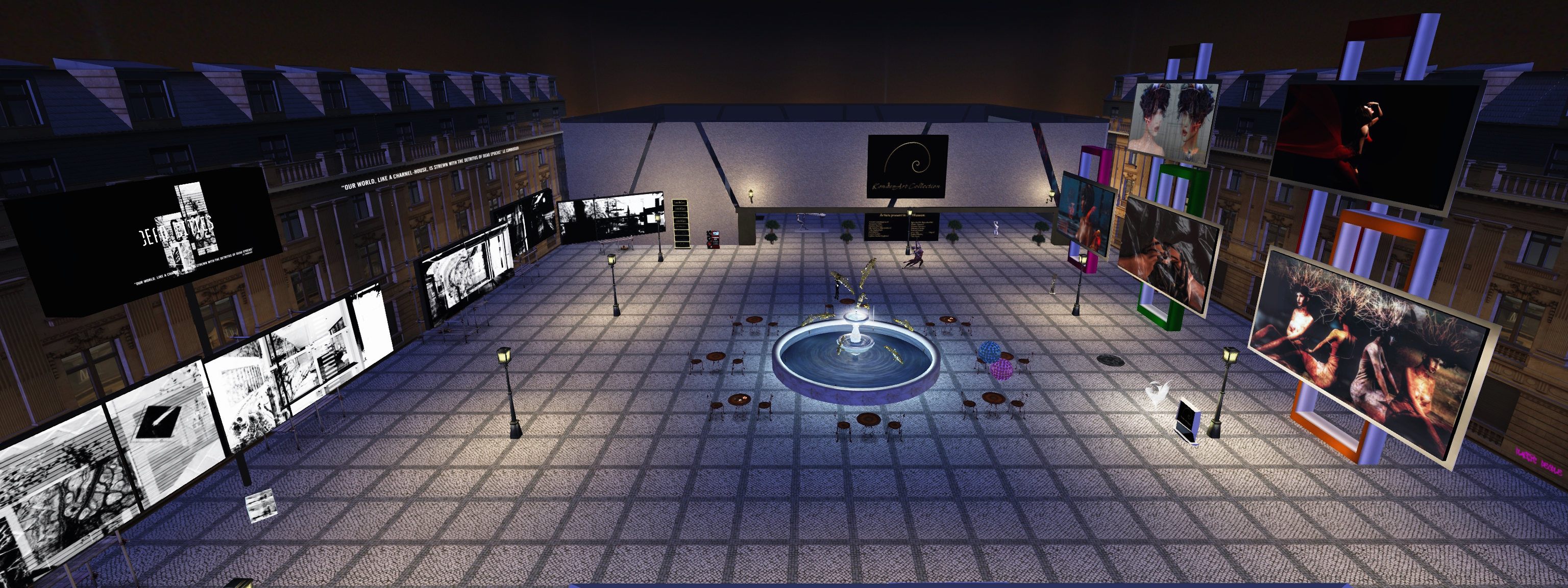
Kondor Art Square, Jul 2021: Dead Cities (l) and Plastic People (r)

Monique “Moni” Beebe and Traci Ultsch are among a group of artists whose work I find immediately engaging, and which I always appreciate being able to see and appreciate. So any new exhibition by either of them is going to get me hopping with interest –  and when they are exhibiting together, then I’m not so much hopping as I am leaping – which has very much been the case with Plastic People / Dead Cities, which opened at the Kondor Art Centre’s Art Square, curated by Hermes Kondor, on July 8th.

Now to be clear – this is not a joint exhibition in the sense of being a collaborative project between the two artists. Rather, and like their joint exhibition at Midgard Gallery in February 2021 (see: Moni and Traci at Midgard Gallery in Second Life), Plastic People and Dead Cities stand as two individual exhibition linked by theme and reflection, allowing them to be appreciated both individually and jointly, with certain truths to be found within them that may well be discomfiting to some.

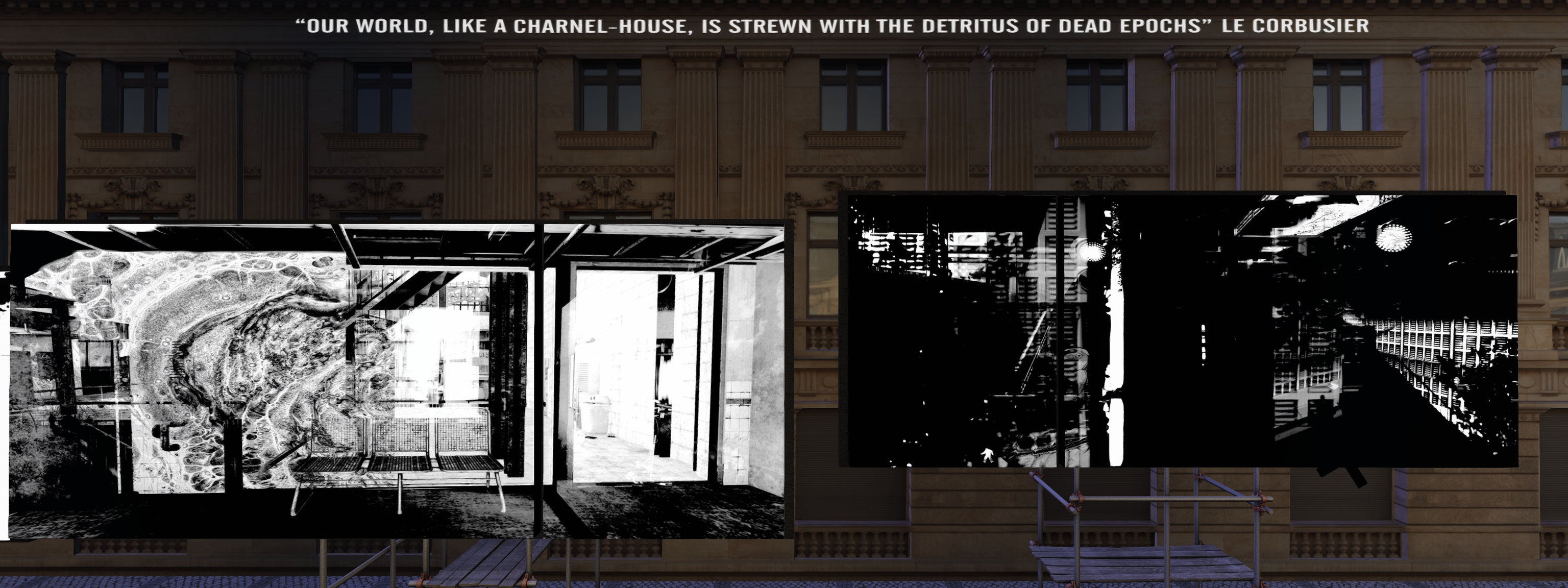
With Dead Cities, Traci explores the impermanence of Second Life through the dual medium of exploring the cityscapes that can be found throughout the grid and the medium of reflections on the ideas of so-called occultist Psychogeography as it relates to the city of London and as espoused through the work of Iain Sinclair and Peter Ackroyd.

Kondor Art Square, July 2021: Traci Ultsch – Dead Cities

In short, the latter might be said to be explorations of the myths and legends that claim much of “modern” London (e.g. from the 1660s onwards) was built on occultist practices, and the idea the “spirit” of all who have dwelt in the city combine to inform its nature down the centuries, and that “spirit” in turn informs the nature of those dwelling in it today.

Thus we are presented with a series of bold monochrome images that, rather than presenting “traditional” views of buildings, streets, and so on, are multi-faceted in the way they have been layered to present us with glimpses of buildings and structure together with the ghostly outlines of something more – that spiritual element to their nature, so to speak. Similarly, the use of scaffolding to mount the images, some of which also has skulls sitting on it, encapsulates the idea of the present being informed by the past.

In taking this route, Traci also underscores her theme of emptiness / impermanence: by presenting facets of structures in this way, with the dark and light obscuring as much as revealing, Traci points to the fact that, like it or not – and contrary to SL myth) – nothing in this virtual realm is in any way permanent; it survives and is constantly rebuilt – like a city as great as London itself – only so long as there are people to populate it. When empty, it might as well not exist – and when the novelty of the platform does finally wane, Second Life and its cities and places will won’t exist.

Kondor Art Square, July 2021: Traci Ultsch – Dead Cities

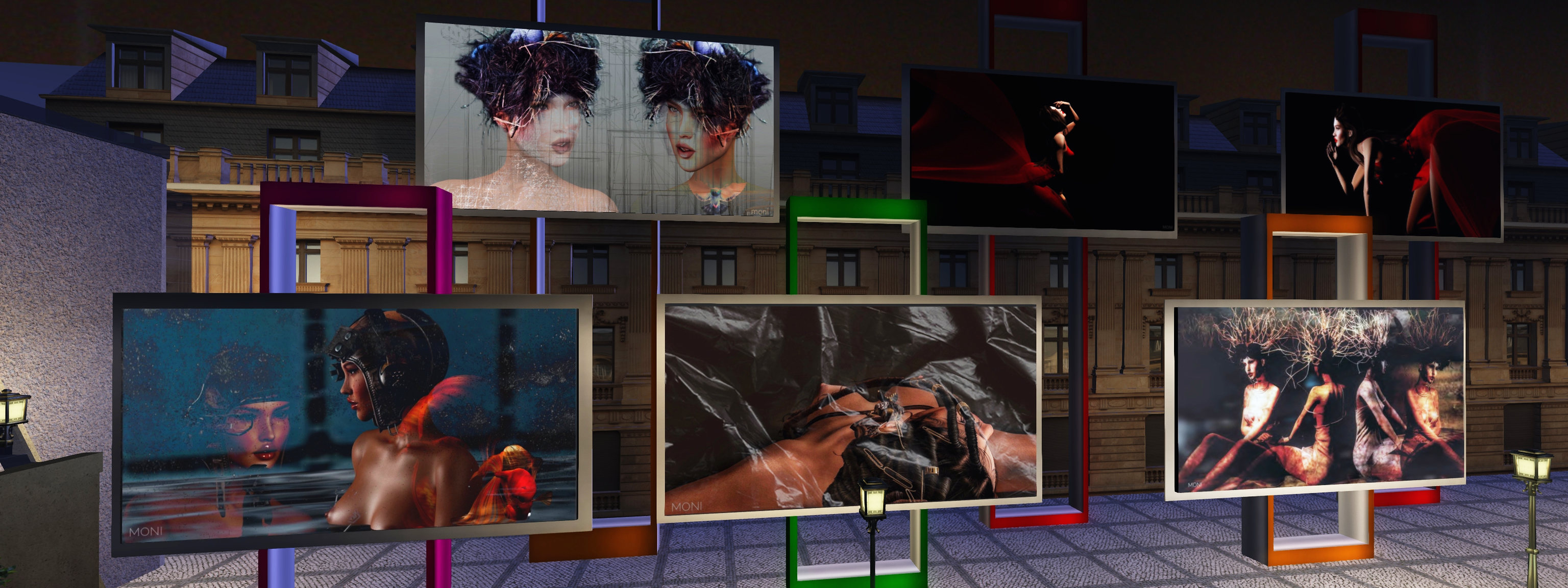
By comparison, Moni’s Plastic People appears to be an altogether lighter, brighter presentation, both in terms of being a series of images that do utilise colour, and in their general theme.

In short, this is the idea that Second Life is a plastic – perhaps malleable might be a more appropriate term – world which we can all bend and shape into whatever we wish, and in which we can express ourselves howsoever we wish, in keeping with the old SL tenet, Your World, Your Imagination. Thus Moni presents us with a series of avatar studies that when first viewed, appear to reflect this in their presentation of “classically” posed images, touches of sci-fi, fantasy and the platform’s more adult elements.

Kondor Art Square, July 2021: Monique Beebe – Plastic People

However, I say “appears”, because – to me at least – there would seem to be a further layer to Moni’s images, evidenced through her use of a stanza from Frank Zappa’s 1967 song, Plastic People within her liner notes for the exhibition:

A fine little girl / She waits for me / She’s as plastic / As she can be / She paints her face / With plastic goo / And wrecks her hair / With some shampoo.

That song was written as a manifesto against conformity and materialistic culture. So is its inclusion in Moni’s liner notes for the exhibition simply a reflection of the malleably of our avatars, or is it a comment on the fact that whilst founded on the ideal of individual expression, SL is increasingly becoming a place of homogenised, materialistic conformity for many? Just look at the way a certain avatar body dominate the platform, or the manner in which “creativity” now seems to be more about looking good and buying the latest fashion.

If this interpretation might be seen as accurate, then it begs the further question: just who are the “plastic people”, the avatars within Second Life, or those who operate them? I’ll leave that to you to ponder.

Kondor Art Square, July 2021: Monique Beebe – Plastic People

Through these two exhibits, Moni and Traci offer collections of images that are in and of themselves captivating, whether or not one wishes to look deeper into them. At the same time, they each hold up a mirror, one of which encourages us to reflect on Second Life is a whole as it relates to us, and the other asking that will look directly on  ourselves, and how we relate to the platform.

What we might discover in looking into either might not be comfortable to consider – but that does negate either exhibition. Indeed, I’d strongly recommend that anyone who likes to ponder on this virtual world in which we invest so much of ourselves, whatever the reason, pay a visit to Plastic People / Dead Cities, and spend time with the art and the artists’ own words.

SLURL DETAILS

Moni and Traci at Midgard Gallery in Second Life

Midgard Gallery: Monique Beebe, February 2021

Midgard Gallery is – for me at least – a new arts venue I was delighted to be pointed towards by Traci Ultsch by way of a personal invitation to witness the new joint exhibition she has there.

Occupying an underground cavern within the Land of Thor – a place I’ll be discussing in greater detail in an upcoming article -, the Gallery is one of three within the region, and is currently featuring Crash Traci and Portraits and Other Things Monique Beebe. these are two very different in focus, but which share certain aspects and elements in the manner in which they challenge the viewer to look into them and consider what they are seeing, that mark them as complimentary to one another.

Midgard Gallery: Traci Ultsch, February 2021

Crash, located on the mezzanine floor of the gallery, takes as its inspiration English author J.G. Ballard’s 1973 novel Crash, later made into a 1996 film by the same title, written and directed by David Cronenberg. Both novel and film gained notoriety for their depictions of symphorophilia – the experience of intense sexual arousal as a result of stage-managing and watching a disaster – in their case, the focus being that of car crashes.

Given the nature of the subject matter, it might be tempting to dismiss Traci’s Crash as a further excuse for voyeuristic gratification; however, this would be a complete mistake. Whilst sexual undertones are apparent within the images (take, for example the placement of the lock to a car’s glove compartment in Bodies: framed within the outline of a female body, it clearly serve the purpose of a nipple), this is no mere excuse to revel, as it were, in the subject matter of the novel.

Midgard Gallery: Traci Ultsch, February 2021

Rather, these are pieces, each one carefully constructed and presented, that use the theme of the novel to explore the basic concepts of art: how we define it; whether something that is intrinsically repelling as symphorophilia or some other socially unacceptable outlook, contain within it a thread from which some form of more positive expression be drawn. At the same time, there is a personal dimension added to the piece, with Traci noting that in producing these pieces, she sought to address a situation from her own life.

Each image is presented as a layered, almost abstract collage, taking images captured from within Second Life, editing and transforming them in tone and look, then combining them one with another and / or with images of wrecked vehicles from the physical world. The result is a set of tableau pieces that can be looked upon purely as abstracted art and / or through the prism of the exhibitions theme, each one daring us to look again and again; their concept and content shifting, challenging our overall perception of each of them.

Midgard Gallery: Traci Ultsch, February 2021

On the ground floor of the gallery, Monique presents Portraits and Other Things, a baker’s dozen of utterly engaging avatar studies that in places mirror Traci’s work by offering us collage-like pieces to appreciate and perhaps decipher, whilst elsewhere presenting narrative and / or pieces linked by theme, such as the “rabbit” series along the back wall of the gallery.

Moni is an artist I’ve long admired for her ability to capture an entire story within a single frame, whilst often also challenging us to look beyond the surface of her art, be it erotic in nature or a seemingly straightforward facial portrait, or which at first glance appears to tell a simple story, and see what lies within. She has an innate ability to layer emotions and feelings with her work that I find utterly captivating.

Midgard Gallery: Monique Beebe, February 2021

A  good deal of this is to be found in the pieces within Portraits and Other Things. With Chaos for example, we start with a collage featuring a human face that draws us to it simply as a piece to be appreciate for its sue of image, line, and colour. But it also contains hints of commentary on the chaotic nature of thought and mood, both of which can swirl and shift within us, such that the face we show the world around us is ever-changing; also within it stand the ideas of the chaotic bustle and churn of life around us, with all of these elements perhaps calling into question just who we are – as signified by the eyes of the central faces, the sockets becoming emptier as we scan from left-to-right.

Across the hall, Sadness offer a subtle layering of expression and condition to evoke the desired mood: that the subject is unhappy might appear to be evident from the forward tilt of her head and downcast eyes – although equally, this could be the prelude to a flick of the eyelids to provide an altogether different image, such as a coy glance into the camera lens. What actually gives this piece its emotional frame are the water droplets scattered across the subject’s face and their trails along her cheeks; they are as effective – if not more so – at conveying mood than had she been shown to be crying.

Midgard Gallery: Monique Beebe, February 2021

With two evocative displays of art from two of Second life’s most engaging artists, Midgard Gallery is well worth a February visit – and as noted, I’ll have more on the region as whole in an upcoming article.

SLurl Details