2011: a Humble year

Second Life’s New Leader: Rod Humble Becomes CEO of Linden Lab

MMO and Gaming Industry Visionary to Bring New Life to Second Life

SAN FRANCISCO — December 23, 2010Linden Lab®, creator of 3D virtual world Second Life®, today announced that Rod Humble has become the company’s Chief Executive Officer. Humble joins Linden Lab from Electronic Arts, where he was Executive Vice President for its EA Play label.

Humble’s 20-year career in the game development industry has included work on more than 200 games. In his most recent position at Electronic Arts, Humble headed the EA Play label, which includes the best-selling PC game franchise of all time, The Sims. In 2009, he was ranked #2 on the annual list of the Hot 100 Game Developers from gaming publication Edge. Prior to his work at Electronic Arts, Humble served as Vice President of Product Development at Sony Online Entertainment for the massively multiplayer online game (MMOG), EverQuest.
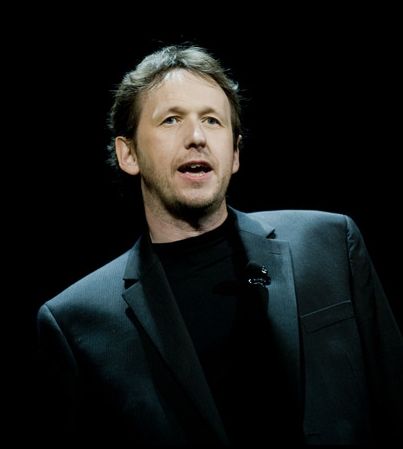
LL CEO Rod Humble

Thus broke the news, on December 23rd 2010, that Linden Lab had a new CEO. Now, I’ll admit, and with all due respect to Mr. Humble – Rodvik, as we all now know him – but I’m not a games player (or wasn’t, until my retired father got himself a Wii, which has become the centrepiece of get-togethers at his place…but I digress). No, I had no more familiarity with The Sims than I had with George Clooney; sure, both were / are big names in their respective worlds, but the closest I’d been to either was passing a DVD box on a store shelf…

So the name “Rod Humble”, to me, meant little when the announcement was made, and I really had no idea how to respond to the news, so decided to wait. Some were a tad impatient for him to say something (although he wasn’t actually due to officially start at LL until mid-January), and some even commented that his silence didn’t bode well. I didn’t share this view and saw a number of reasons why Rod Humble was taking the right course in keeping quiet – as did Tateru Nino, in a thought-provoking piece.

When he did finally blog (just under a week after starting), his first post was a combination of the uplifting and the cautious – which again, I personally felt was the right way to go, and boded well for the future.

Since then, we’ve seen highs and we’ve seen lows – but I’ll nail my colours to the mast and say I believe the former outweigh the latter. On the whole, a lot of confidence has been restored in the user community – one only has to look at the overall favourable reaction to Rodvik’s appointment the more people heard him talk about SL, and to the reaction of SLCC attendees and those who watched the streams from the convention. Yes, there is still a long way to go, and cock-ups do happen, as we saw both with the code breakages around the middle of the year and the Marketplace mess-ups. But – the Viewer has been improved, mesh has arrived after years of waiting and hoping for many; we have Linden staff spending time in-world, re-discovering the complexities of the platform and developing new tool sets that will be released to the community, and so on.

It would be easy to nit-pick over the issues and downsides that remain, but I’m not going to that. One year ago today, it was announced that Rod Humble was appointed as CEO on Linden Lab, and since then, it’s been an interesting ride – and was we can see from his very appropriate post today, we’re in for more interesting times in 2012, which are bound to bring their own share of rewards and grumbles.

All I am going to say at this point – while aware that he didn’t officially occupy the hot seat at Battery Street until mid-January 2011 – is this: happy anniversary, Rodvik, and here’s to the next 12 months. Looking forward to further engagement between Lab and users, and experiencing the tools and pathfinding elements on which you blog…

…Just one question for you, if you please: at SLCC 2012. You said your goal for your first year at LL as being to be able to give every family member within Linden Lab a Second Life account, for them to be able to send the account to any “intelligent or above average intelligence computer user” for them to be able to use it to get into Second Life, use it and be grateful.

How has that worked out? Goal met? Very curious to know! :).
The myth of a mendacious, malicious Lab

Linden Lab are not without their share of problems when it comes to their relationship with the user community as a whole. I’ve banged on rather a lot over time about issues originating at their end. However, it is unfair to blame Linden Lab alone for the problem. As Tateru points out, it’s hard to carry on a dialogue when the user is part of the problem.

Over the last few years, I’ve noticed that there is an oft-voiced perception that Linden Lab’s actions and words are somehow either malicious or mendacious – or both. This was again brought home to me last week during a group conversation wherein the claim was forcefully made that the only reason mesh has been implemented in the way it has is (quote) “Linden greed”.

The conversation in question wasn’t the first time I’ve heard this view voiced; I’ve come across it in blog posts and forum comments in a number of places. The argument,  focused on the matter of Land Impact (previously known has Prim Equivalency), goes like this: Linden Lab have deliberately swayed the costings of mesh so as to give inflated Land Impact values in order to force people to move to larger land holdings, thus generating greater tier revenues for the company.

In other words, LL have maliciously crippled mesh in order to line their pockets. However you look at it, that’s a pretty harsh claim to make.

The idea that Linden Lab operates either maliciously or mendacious in its actions is not restricted to the matter of mesh. It’s a view that has been doing the rounds in a variety of forms for quite some time now. In fact, I first commented on it more than 18 months ago.

I didn’t believe it to be right then, and I certainly don’t think it is any more correct now. Linden Lab may well be guilty of many things: inept communications, an inability to actually comprehend their own product, a track record demonstrating their failure to learn from previous errors of judgement, and so on. But none of this actually makes them deliberately malicious. As I said back in April 2010:

“I don’t buy the ‘simply malicious’ argument because, at the end of the day, Linden Lab isn’t likely to profit or grow from it in a sustainable manner. Grabbing the profits today and saying to hell with the customer and to hell with tomorrow is an exceptionally myopic and ultimately stupid way to run a company.”

Yes, there is much that LL does err on at times (although equally, there is much that they get right but which often receives little or no acknowledgement). As such, when things are perceived as going wrong, or potentially damaging the platform / community, then it is absolutely right that we speak out, challenge and constructively critique in order to try to get LL to revise its view / policy / actions.

But to dismiss the company’s actions as being those of a malicious, greedy mindset is, I would venture to say, both shooting far wide of the mark and somewhat counter-productive.

Loyalty, adoption, inspirational leadership … and SL

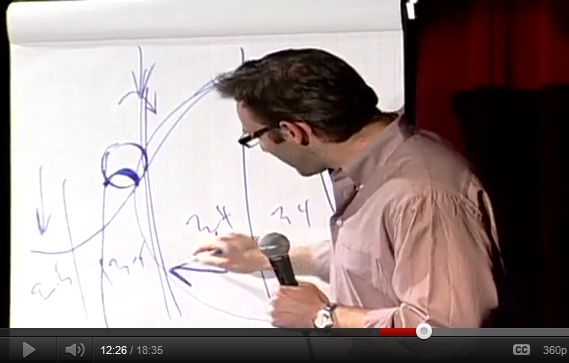
Simon Sinek probably isn’t a new name to a lot of people who may read this; nor, potentially, is his “Golden Circle” popularising the concept of “why”. But ever since Spikeheel Starr pointed me towards his TED presentation made last year (and now apparently the 19th most-viewed video on TED.com), I’ve found the ideas he expresses fascinating.

For one thing, I cannot help but agree with his example of Apple. This is a company that people like or loathe. Customers are intensely loyal and remain so, no matter what happens to dent the company’s reputation. Apple continue to top the charts with their products, despite the fact that – really – there is nothing that is that technically innovative about them. Why?

Well, as Sinek points out, Apple developed and has retained, the ability to inspire aspirational desire with its products. Take the famous Apple “1984” ad: it presents a clear message of that aspirational desire through a positive vision of non-conformity.

That approach has continued through to Apple’s messaging today, where the “what” might be more prominently placed – but it is still wrapped in the aspirational subtext of their messaging, “We’ve done this and it feels good, wouldn’t you like to have the ability to do it to?”

The Law of Diffusion

Further into his talk, Sinek touches on the law of diffusion of innovations, which caused me to think about Second Life.

In 2008, Mitch Kapor gave an address at SL5B in which he referred to the same law, and particularly the matter of what Geoffrey Moore refers to as crossing the chasm – moving a product from the status of early adoption to its use by an early majority (or “pragmatists”, as Mr. Kapor preferred to call them).

However, in his presentation, Mr. Kapor appeared to turn the issue of crossing the chasm entirely on its head. To him, it would appear that the early adopters – the “pioneers”, as Mr. Kapor called them – were anathema to SL’s future growth.

The early majority is gained through the early adopters

Yet, as Mr. Sinek points out – and Moore understood – the fact is that without the early adopters, the majority will not actually follow to adopt the product.

In short, by suggesting the early adopters might need to stand aside, Mitch Kapor appeared to completely miss an opportunity – as LL itself did, as I’ve previously noted.

And it is here, while watching Simon Sinek, that I again feel a renewed hope for Second Life – and more particularly, Linden Lab. Why?

Because everything that appears to be coming out of Linden Lab does now appears to be geared towards crossing their chasm in a manner Moore recommends and Sinek indicates: by leveraging their existing user-base.

Anyone attending the Lab’s presentations at SLCC this year cannot fail to have noticed this; all of them were, in one way or another, focused on the user community as a whole. Both Mark Viale (Viale Linden) and Brett Attwood (Brett Linden) in particular gave insight into LL’s change in philosophy that stands to benefit the user community and the company equally well.

In this respect, something has changed within Linden Lab over the course of this year; and it’s pretty obvious that – and I say this without any desire to sound like a fangirl – the “something” in question might at this point be Rod Humble.

Rod Humble embodies much of what Simon Sinek discusses about good leadership. Hearing him speak at SLCC and elsewhere and when reading interviews he’s given, Rod Humble unabashedly talks about his personal beliefs. It doesn’t matter whether the subject under discussion is Second Life or on matter of virtual identity; he strikes that emotive chord that resonates within us.

In short: he inspires trust.

It’s why we like Rod Humble. More than that – it’s why we need him right where he is.

Note: updated in 2019 due to video links to Apple ads being broken and forcing an alternative version of the “1984” ad to be embedded and reference to the AirPlay ad removed. 

LL diversifying? What does that mean?

LL CEO Rod Humble

Potentially the most interesting comments to come out of Rod Humble’s presentation at SLCC 2011 were related to the fact that Linden Lab may be diversifying. These started early on when he announced:

“You are going to see Linden Lab working on new products as well as Second Life”.

While he refused to delve into specifics, it has led to speculation that he may be referring to what Hamlet Au refers to as a new “SL Light experience” that will utilise “the web and tablets”.

Hamlet was certainly in a position to ask Rod questions on the matter after the presentation, given he’s at SLCC; and so may have a greater insight than I; certainly, there is no denying Rod indicated that Linden Lab is eyeing-up the tablet marker where Second Life is concerned. However, I cannot help but speculate that Linden Lab is going after something a lot broader than just introducing a “light” version of SL when Rod refers to the growing tablet / mobile market.

Look at his comment, quoted above, for example. It clearly differentiates between Second Life and a product and whatever else Linden Lab has planned. This seems an odd statement to make if whatever is coming down the line is simply aimed at enhancing Second Life’s reach. It’s also a differentiation that came up again during the extensive Q&A session. Here’s what he said:

“The other massive opportunity and massive threat to on-line games and everyone in this room is the rise of tablet and mobile devices; and right now we don’t participate on those devices. So you will see us address for Second Life, but also for at least one new product, the area of tablets in particular and some mobile stuff as well.[my emphasis]

Again, if Linden Lab are simply looking towards opportunities to extend Second Life’s reach, it seems odd that he clearly differentiates between Second Life and the “new products” in this comment.

So what else could he be referring to? Here’s where the speculation begins.

A recurring theme during the 45 minutes Rod was on stage was what I’m going to refer to “social involvement”, so much so that it is hard not to link them with his comments relating “new products”.To bullet-point some of the references:

  • He was at pains to emphasis the importance of people being able to define their own persona on-line and to be able to set their own barriers as to how much they reveal about themselves and how they establish divides or barriers between what the reveal / how they interact with others according to the environment / situation they are in
  • He also emphasised twice that Linden Lab believes that customer privacy is paramount, and that they will not do anything that betrays this
  • A number of his comments were around LL’s perception that people’s habits are changing with regards to Second Life, people are spending less time engaged in-world, but more time engaging socially about Second Life through various mediums – the new web profiles, Twitter, etc.

In this last point, he specifically points out, “By the way, I mentioned that Second Life was growing earlier…there’s a really interesting dynamic as well, is that many of the new users of Second Life are a very, er, very younger demographic…sort-of a mid-twenties, college age. And they also…they are generally spending less time in-world but more time socialising within Second Life social circles…and I think that’s really interesting.” He goes on to note that this is common in other on-line games and suggests that the onus for LL is to enhance this capability, “for our customers”.

Wen profiles: precursor to LL’s move towards wider on-line social involvement?

This would all seem to point towards Linden Lab moving more into the realm on on-line social involvement. It’s something they’ve tried, albeit on a very limited basis through the acquisition of Avatars United a couple of years back, which was ultimately discarded – which is not to say they ever gave up on the idea.

In many respects, it makes sense for the company to move into social involvement in a more premeditated manner, as a) this is clearly a growing market; b) through Second Life, they have been developing capabilities and knowledge ideally suited to the environment (i.e. through my.secondlife.com). What’s more, they are willing to step away from the likes of Facebook and Google+ and uphold the principles of pseudonymity and privacy, which could make such a move attractive to a broad audience.

Of course, it would be ridiculous to suggest that Linden Lab could in any way take-on the likes of Google or Facebook in the broadest sense; and I’m certainly not suggesting that.

But then, they don’t have to. By providing a set of social media tools that enable gamers, Second Life users and others to remain connected, to “meet” and discuss their interests, passions, plans, swap ideas, link-up with others and so on, they could potentially tap into a huge market, and offer them the ability to leverage technology and capability already developed that would not necessarily impact on their focus of “fixing” core issues and services within the Second Life platform itself.

There’s also the matter of diversification and revenue. Hamlet himself (rightly or wrongly, depending upon one’s standpoint) makes much of the current revenue stream enjoyed by Linden Lab (the “sale” of SL “land”) as being somewhat unsustainable – and over time, he may well be right. Ergo, it would make sense for LL to look at other opportunities and markets in which to generate new income. Although precisely how this might be achieved is harder to define, and worthy of a separate debated in and of itself.

It’s going to be interesting to see what is announced in the coming months and, equally, how Second Life users respond to whatever comes out of the Lab – particularly if it is seen as “taking effort away” from supporting Second Life. In this latter regard, assuming the new products are divorced from Second Life, LL will doubtless have a fine balancing act to perform where user happiness is concerned.

Rodvik: Virtual Goods and LL’s Profitability

Rod Humble discusses virtual goods and virtual worlds in a brief Bloomberg interview. What are most interesting to note are the comments towards the end of the piece, regarding Linden Lab’s current profitability:

Emily Chang: The Tech IPO bandwagon is filling up. Is that something that you guys would consider or [are] considering?

Rod Humble:  We’re not looking for any further investment right now. We’re profitable, we’ve got [a] very good cash balance… So from our perspective, if we were to be able to deliver a large and measurable long-term return on new investment, then we’d certainly look at it. We’ve got a long runway of features that I want to put in place with our current very healthy cash and profitable business first, though.

Should this story be picked up, it is these words that are probably going to be the focus of attention – particularly among those who seem anxious to sink the Second Life boat, who will probably interpret Humble’s words as, “We’re not really attractive enough for IPO, and we’ve got to blow money to get there, ‘cos we have to make ourselves attractive somehow.”

Personally, I see his statement in a more positive light: LL are reasonably cash stable and are profitable, something I’ve commented on previously. Furthermore, there is a continuing upswing in sign-ups (still running at around 16K per day), which appears to be translating into a rise in user concurrency, which would indicate that new users are actually sticking around for longer and potentially getting more involved. Both of which are healthy signs.

What is key about Humble’s words, however, is the sheer pragmatism they carry, even in such a relatively lightweight interview. He recognises that while Second Life indeed “has legs”, and can, on current form, continue pretty much as is as a private company generating sufficient profits to demonstrate (presumably) a return reasonable enough to keep the original investors happy, it also has the potential to go much further in time. Thus, while IPO is definitely not on the cards right now, this may not be the case in the future, should things develop in that direction.

This is pragmatic on two counts. Firstly, it is allowing the company a degree of freedom in tackling the issues it currently faces – technical and otherwise – and solidifying its position without any ulterior needs or requirements overshadowing things. Given the company has undergone significant pain when ulterior motives have been the driving force behind matters in the past (e.g. the drive to convert SL into some form of “real world” business and applications platform), this is a wise move. Secondly, as Emily Chang states – the technology IPO bandwagon is fast filling up, but if we’re all absolutely honest, we’ve no idea where it is going. As such, not leaping onto it with everyone else is also something of a potentially wise move; especially if the wheels do come off the wagon, as LL get to avoid the resultant crash. However, if the bandwagon proves it can roll and roll, then LL could ideally be well-placed to pick-up on all those investors who might otherwise be kicking themselves from not being “in” on things from the start.

Taking this perspective and being willing to acknowledge both sides of the coin, so to speak, again demonstrates to me that Rod Humble is very much the right man in the right place at Linden Lab – and he’s hopefully carrying the board with him on this.

“Great company, but….”

We’ve all had our views on Linden Lab. Some have been favourable, some haven’t. Some have blamed specific people, some have blamed the culture. Most have felt the company was suffering bumhand syndrome (that’s where you can find your bum with one hand but never with the other).

But… have you ever wondered what Linden employees, past and present, felt about the company? Well – here’s your chance.

(With thanks to Daniel Voyager for raising awareness.)