These questions were actually the focus of some thought on my part back in 2011, when – having been prompted by a tweet from Crap Mariner, I mused on advertising SL: the machinima effect, and it seems worthwhile both revisiting those thoughts and updating them with a few further ideas and thoughts.
The video that prompted my original post on the subject may not be focused on Second Life, but it is ample proof of how machinima can be used to promote a product. What’s more it is fun.
Back in 2011, it prompted Crap to tweet: Linden Lab needs to make some ads like this for Second Life – something which caused me to reply: Or #LL should work with the machinima folk for suitable ads: say a competition; top 3 promoted on YT, SL.com, etc., which inturn prompted my original post on this idea,
Today, as Ciaran points out, and as I’ve covered for the last few years in this blog (albeit haphazardly), the University of Western Australia holds an annual MachinimUWA Challenge, which this year sees a prize pool of L$1.1 million for machinima makers submitting entries on the theme of “Reflections”.
MachinimUWA VI: showing the potential for machinima as a promotional tool
What makes MachinimUWA particularly relevant to this discussion is that not only does it showcase machinima as an art form, it actually promotes the University of Western Australia. The promotion may actually be very low-key, and a somewhat secondary consideration in terms of storytelling for those entering the competition, but it is there. This year, for example, entrants are required to film in “At least one of the 3 major spaces of Reflection at UWA … (The Reflection Pond, The Sunken Gardens, The Somerville Auditorium).” With the rules going on to note that entrants “may choose to film in any other area of the campus … or … include all 3 locations.” Thus, the UWA’s in-world facilities form the nucleus of the competition in terms of providing the backdrop for whatever stories entrants opt to tell.
It’s been interesting to watch reactions toLinden Lab’s recent announcement on the forthcoming launch of two of their new products – Creatorverse and Patterns.
While many have responded positively to the announcement, it is fair to say that some have not, categorising LL’s diversification as a sign that either the company given up on Second Life, or that the company can now only develop products or continue to develop SL rather than doing both. I find both attitudes completely unfathomable, although in the case of the latter, not entirely new. When it comes to even trivial, easy-to-make changes that are essentially crowd pleasers, there can often be a response from commentators who feel that company is only doing so at the expense of working on more serious matters – as if LL can only do one or the other.
Patterns: some see LL’s move to diversify as a sign the company has “given up” on SL (image courtesy of Linden Research Inc.)
They’re Still Working On It
The view that LL are developing new products because they’ve “given up” on Second life is one I find curious because in the 13 months following Rod Humble announcing the company would be diversifying, Linden Lab has clearly shown that it actually is continuing to develop and enhance SL – and what’s more, the work is taking place alongside the development of their new products. Since the beginning of 2012 alone we’ve seen LL:
Making what they refer to as being one of the largest investments in hardware and infrastructure for SL to date (which came on top of a major hardware investment in 2011)
Investing heavily in manpower, time and effort to bring greater and broader capabilities to Second Life, including:
Materials processing – which should revolutionise how SL looks compared to modern games
A new HTTP library capability aimed at eliminating many of the major issues we’ve long complained about, with texture load times and large group loading / management fixes being the first two to rolling-off the development line
Advanced creation tools which will (permissions allowing) help enhance SL in a wide variety of ways
Re-working interest lists and object rezzing to develop a faster, more logical way in which objects are rezzed around us when we teleport in-world
Providing a new avatar baking process to eliminate bake fail
Developing multi-threading region crossing to help eliminate sim boundary issues
Purchasing a Havok sub-licence arrangement which, despite worries over TPVs and connectivity, could in the future yield significant improvements to SL through the provisioning of dedicated Havok libraries accessed by the viewer
Pro-actively working to find a new audience for SL through the forthcoming link-up with Steam
Working to nail down long-standing issues within the viewer – memory leaks and so on – in order to make the whole SL experience less prone to bumps, thumps and outright crashes
Seeking to improve their customer support, and working towards providing better assistance for TPV users where it is logical for them to do so.
Materials processing: enhancing Second Life
True, we may not necessarily like the way the company is developing the platform (pathfinding being the current bug-a-boo). There are also decisions the company has made and is making which may confound us or seem counter-intuitive; I’m still very much frustrated at their willingness to even engage in an ongoing one way dialogue towards users, for example. While such moves and decisions may well cause us concern and / or regret, they don’t actually point to the company as having “given up” on SL; and we shouldn’t confuse the two issues.
It’s Not Time Taken from SL
When it comes to the actual development of the new products themselves, there appears to be a misconception among some that LL has only been able to do so by taking time and resources away from Second Life. Yet, outside of senior management, this would hardly appear to be the case. For a start, and since mid-2011, Linden Lab has been recruiting very specialist skills aimed specifically at developing new products separate from SL itself. Secondly, we need to remember that in the case of at least two of the three new products we know about, the creative resources have (at least in part) come from outside of SL. Dio is being developed by Richard Evans and Emily Short, both formerly LittleTextPeople, a company acquired by LL and who have had little if anything to do with SL; while Patterns is being produced in partnership with games developers Free Range Software.
There’s been something of an ongoing discussion over the ever-excellent Metareality concerning the viability / attractiveness of a “new” Second Life – that is, a platform wherein Linden Lab starts over to present something new and overcomes the shortcomings of the SL grid as we know it today.
It’s an interesting – and entirely hypothetical – discussion point. Just how viable would a new Second Life be (if we assume the money was there to develop such a beast), both in terms of Linden Lab’s development of the platform and in people’s acceptance and use of it?
Well, some of the benefits that might come from such a product would be technical; doubtless things like the creaking mass of the asset server infrastructure could be addressed and made a lot more robust / scalable. Potentially the region / sim code could be completely overhauled to both improve stability and remove much of the “band aid” code that has, due to the nature of the platform, had to be applied to deal with various issues and bugs over the years rather than LL being able to dig deep and resolve them at source.
A new Second Life grid could also, I assume, be better geared towards handling the likes of mesh and other capabilities. Similarly, the Viewer could be revamped – and while this may draw boos and hisses – be kept closed, or perhaps licensed, to better control the growth of features and to ensure Viewer and server code remain better integrated.
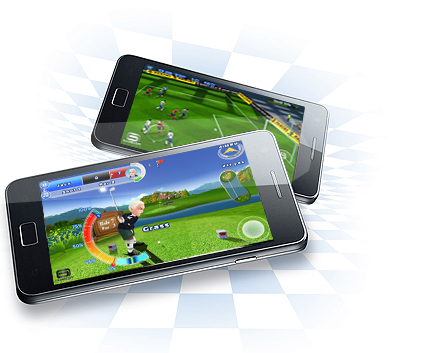
There might also be the opportunity to directly address issues of accessibility through other means – tablets, web pages and mobile devices.
Would an “SL 2.0” allow the mobile / tablet markets to be better leveraged? (image: Lumiya for Second Life running on a Samsung Galaxy S2)
Social aspects might also be better integrated into the platform as well, for those who wish to use them. These are no to everyone’s cup-of tea, but that’s no reason to exclude such extensions / capabilities.
All of this could be massively to the good; but what about those of us already engaged in Second Life? Are we likely to leap onto the bandwagon of a “new” Second Life? Some undoubtedly would; but many of us probably wouldn’t for much the same reason as we don’t take a deep plunge into existing SL alternatives: we have an awful lot of what amounts to personal investment in our inventories, and if we can’t take it with us, the likelihood is, we aren’t going to go – not unless forced out of SL itself (which might easily see us giving LL the one-fingered salute and disappearing somewhere else entirely).
Of course, losing the current user base (or a good proportion thereof) might be seen as part and parcel of the risks involved in developing an updated platform – after all, with 16K-a-day sign-ups for the current platform, there is opportunity for LL to address initial retention head-on and harness a good percentage of that 16K and so not actually miss those of us who stay behind.
On the other hand, offering a migratory path from “SL 1.0” to “SL 2.0” would obviously be one way of alleviating issues around existing users, allowing LL to retain them and their loyalty while also avoiding initial issues of growing a new user base.
SL 2.0: The potential for better avatars?
However, offering such a path might itself create issues. One of the biggest potential benefits in an “SL 2.0” would be the ability to incorporate the infamous “avatar 2.0”, which has been the subject of speculation on-and-off since around mid-2007. This is something that is unlikely to happen within Second Life as it is because of a myriad of dependencies means a dramatic overhaul of the avatar could break things. As such, developing a new avatar form for “SL 2.0” could end up breaking compatibility with “SL 1.0” and render migration either problematic or (worse case) pointless.
Perhaps the biggest issue with any “SL 2.0” though, is not technical, but physical (so to speak). At the end of the day – and as Qarl comments in a recent Metareality podcast – a lot of issues relating to SL are actually centred on the relationship between users and Linden Lab itself. These take a variety of forms, some are justified (such as people feeling the company could be more forthcoming within consistent and more open communications and dialogue with the user base), others are completely unjustified (such as claims that LL are out to “kill” aspects of Second Life or that they act “maliciously” towards users).
Regardless of how justified or otherwise claims and arguments about LL are, the fact is that whatever the platform LL provides, the issues and arguments will likely continue. As such, there is a risk that any “new” SL could be taken to be “same s***, different shovel” by both sides of the relationship; users will continue to bemoan LL and LL will continue to feel they are in an uphill battle facing the same criticisms and complaints they face at the moment. This in turn could lead to both sides asking the question, “Why even bother?”
Over all of this, however, lies the biggest question of all: what, exactly, would LL achieve by taking such a route? It’s unlikely that “SL 2.0” would achieve any grater success than the current Second Life has achieved or has the potential to achieve, allowing for all the new capabilities being developed. Thus, any new variant of the platform is liable to end up occupying precisely the same niche as the current product, with more-or-less the same attractiveness to users and possibly the same grumbles and gripes – and this renders any idea of an SL 2.0 developed by LL pretty much moot. Far better that they focus efforts on improving and enhancing the current platform and in maintaining / increasing its relevancy.
Nevertheless, the idea is still an interesting discussion-point – well, for me, at least!
Linden Lab have issued a call to help with SL9B celebrations, which reads in part:
Second Life’s 9th Birthday is coming up in June! This year it’s all about you — the denizens of the grid, the sultans of Second Life and connoisseurs of creativity— and we want to highlight the many unique and innovative ways the community has made Second Life their own.
This year we will focus the spotlight on community events. No one throws a better event or party than the Second Life community! If you’re having an event to celebrate Second Life turning nine, we want to know about it!
On the surface, this sounds great – until one realises that what is in fact being announced here is effectively the end of an era.
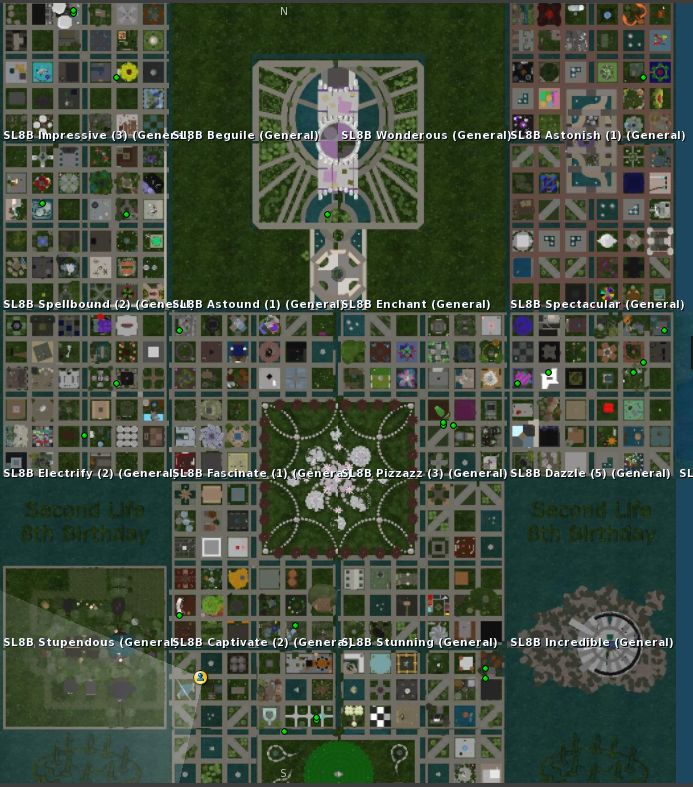
In previous years, Second life’s birthday has been marked through a coming-together of the community as a whole on a set of regions supplied by Linden Lab, to create a glorious theme park of builds and ideas created around a central theme, and in and around which parties and celebrations can be held. While not always free from controversy and acrimony, this approach provided a focal point for events and activities marking SL’s birthday, and helped to bring together residents from across the grid.
SL8B sims – not this year
Well, not any more.
Hidden within this announcement is the fact that this year there will be no large-scale provisioning of regions by LL; no central place to explore (lag and all) and see builds great and small and enjoy the thrill of celebration and discovery.
And this is a shame.
The SL8B events have traditionally been a marvellous way for the many talents and groups across SL to showcase their work, their talent and their vision. It’s hard to see how such an infinite diversity of ideas and vision can be replicated through a process of complete de-centralisation; one cannot imagine sim / estate owners / groups developing large-scale builds specifically for SL9B, especially with so broad a theme as has been offered.
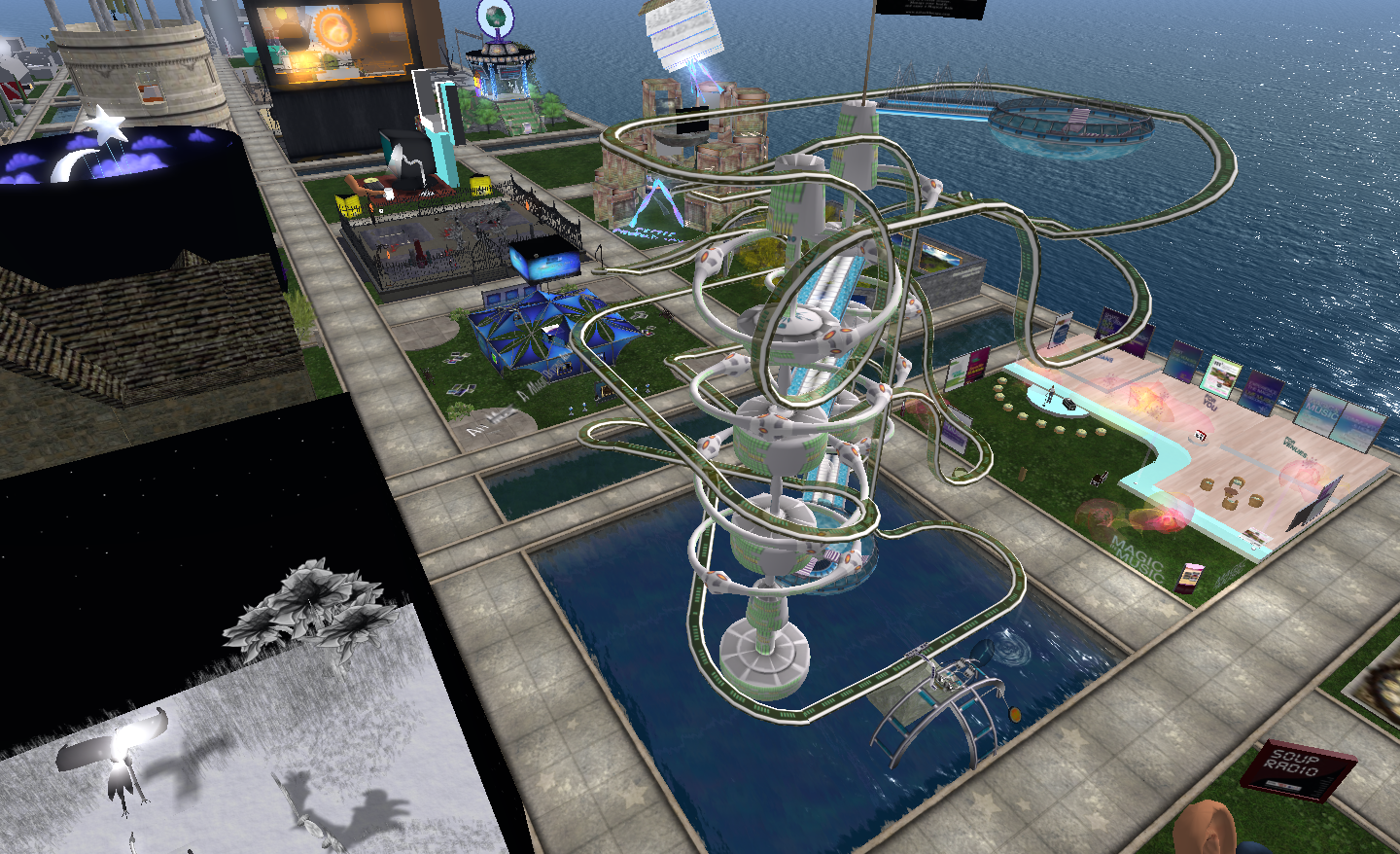
NY HealthScape roller coaster, SL8B – just one of the amazing and informative builds
I’ll personally miss the great gatherings like SL8B and its predecessors. I’ll miss the ability to wander through sim after sim of incredible builds, meeting talented content creators and designers and learning about the unique work of groups such as NY HealthScape.
Why LL have chosen to go this route is hard to fathom. Certainly, as mentioned above, previous SLB events haven’t been entirely free from controversy or headaches – but such upsets have rarely intruded into people’s overall enjoyment of the events themselves, and it is fair to say that where drama has occurred, it’s been somewhat confined to those involved, going largely unnoticed among those from across the grid who have attended events within the SLB sims and spent time exploring the exhibits.
As it stands, this announcement in some way reads less like a call for celebration and more like a renouncement of involvement in a key event in SL’s annual calendar.
And at the risk of repeating myself, that’s a shame.
The recent Marketplace issues are not precisely news any more. LL are working to resolve matters, but in the meantime are coming under increasing backlash from users as in response to the overall management of the situation, both in terms of the manner in which the company has handled open communications with merchants on the matter and in the way the Marketplace as a whole has been handled over the years – which frankly, has been far from stellar.
My thoughts on LL’s handling of communications on the core issues is a matter of record here. Others feel the same way, so much so that a vexed comment from Sera Lok on Twitter lead to a response from Rodvik:
On the one hand, the honesty in Rodvik’s response is to be applauded. Free from BS, it speaks to the heart of the matter in many respects. However, it has to be said that one apology via Twitter isn’t actually enough.
Not One-off
The problem here is that the current Marketplace issues are not a one-off situation; the fact is that the Marketplace as a whole has effectively lurched from controversy to controversy ever since XStreet, its progenitor (so to speak), was purchased by Linden Lab back in January 2009. Indeed, some of the problems being experienced today are as a result of issues relating to the re-coding / relaunch of XStreet as the SL Marketplace back in 2010, as LL themselves note in updates to their forum posts on problems. As such, it has caused merchants and SL commentators to give voice to the widespread sense of frustration many feel towards LL and their management of updates and changes:
And herein lies the rub: one can well understand the managing, maintaining and updating a beast such as Second Life, which has had an organic growth over its 10-plus years of life, to be nothing short of a major headache. It’s a difficult and complicated monster to control without sometimes breaking things; but the same cannot be said of SLM. This is a product that was originally purchased as XStreet in a reasonably robust and working form, thus LL had no reason to rush through its redevelopment and implementation – yet that appears to have been precisely what happened in the drive to replace XStreet with SLM.
There can be no excuse here: the entire process appears to have been mishandled from start to finish, frequently with deadlines seeming to come ahead of consideration as to whether code was ready and often missing critical functions. Even the recent roll-out of Direct Delivery trod this all-too-familiar route; while merchants openly pleaded with the Commerce Team not to roll out DD without ANS (Automated Notification of Sale) with some even posting precisely why ANS is vital to many merchants. Yet, when launched, DD brought with it the statement that ANS would be enabled in “next couple of weeks” (a time frame which itself, unsurprisingly, has slipped given the ongoing problems).
“Putting the Lab back into Linden Lab”
In a recent interview with Games Industry, Rod Humble indicated that one of his goals from the start of his tenure as CEO was to “put the ‘lab’ back into Linden Lab”. Well, the mark of a good lab is its ability to rigorously apply robust and consistent processes and procedures to the work it carries out. At the moment, particularly with reference to the company’s management of the Marketplace, it would appear that much more needs to be done before the “Lab” is anywhere near being back in “Linden Lab”.
While it is very good to know the team is “crunching hard” to resolve issues, one very much hopes that the outcome will be more than a simple “fix it and move on”, leaving the door for the same mistakes to again be made in handling future Marketplace updates. Rather, one hopes that a long, objective look will be taken as to how things are being managed and the necessary checks and balances implemented to ensure that product roll-outs are no longer subject to the poor level of quality that – as Tateru points out in her Tweet – users have been forced to expect and accept over the years.
It’s an interesting read, which is bound to draw wide-ranging feedback, positive and negative. Leaving aside the look back over the Viewer, mesh (which I’ve already commented upon) and 2011 in general, here are some thoughts on Rodvik’s outline for 2012.
The tools developed in the creation of Linden Realms roll-out to the community
Linden Realms: game tools to roll-out in 2012
Undoubtedly a good move – there are a lot of content creators who have been fairly bouncing up and down at the thought of being able to use these tools, and their potential to revolutionise aspects of the SL experience in very dynamic ways is huge. Obviously, there are also certain risks that have to be managed as well – a auto-teleport feature and an auto-attaching HUD capability could easily be put to the wrong use if not properly safeguarded.
Tiggs Linden, one of the major brains behind Linden Realms was well aware of the issues even before Linden Realms was launched, and commented that he’d been working to lock-down the teleport aspect pretty tight. So Linden Lab certainly aren’t walking into this blind. Even so, its welcoming to hear Rodvik also raise this issue, as he states, “To prevent abuse of these tools, we will introduce a “creators” program in which verified members will be given access to these very powerful capabilities.” Precisely what form the program will take is unclear. Certainly, one expects it to be somewhat more robust than the mesh upload status process.
“Pathfinding” to be a major focus of 2012
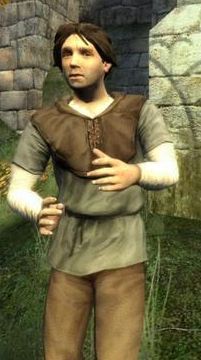
“Mr Grimsdale!” – NPCs for SL
Keeping to the creativity front, Rodvik also confirmed that 2012 will se the roll-out of advanced tools that will incorporate the updated AI capabilities he spoke about earlier in the year. Again, some may see this as window-dressing, but the fact is, it is a capability that many in SL have been requesting for a very long time – so it could be said that the provision of such tools (some of which may be based on capabilities already within the SL software, as Tateru speculated a while back).
As a part of this process, Q1 has been earmarked from the roll-out of “pathfinding” tools “That will allow objects to intelligently navigate around the world while avoiding obstacles,” as Rodvik describes them. Again, given the unfortunate situation that occurred earlier this year wherein automated vehicles started running amok across the Mainland, these capabilities are also likely to find beneficial use among creators and coders.
Server-side performance a priority
There is also the promise that server-side performance and bug-fixing will remain a high priority in Q1 of 2012. We’ve already seen massive effort to install critical OS updates across the grid, and moves to improve overall stability and performance. Some of these have, ironically, caused SL to get rather bumpity while work has been carried out, and caused angst and annoyance at times. However, if all goes according to plan, then as Rodvik says, things should be much improved as time goes on.
One hopes that the longer-term work into things like region crossings forms a part of the overall push on performance. As Ciaran Laval points out, this is a big task, but hopefully we’ll see more information appear in the blogs as progress is made.
No tier increases in 2012
Tucked away in the middle of the piece is this nugget, which is going to please many. Particularly as Rodvik outright refused to comment on tier at SLCC 2011, despite several questions on the subject being asked during his presentation, gave rise to concerns that increases may well be on the way.
The flipside to this of course is that many will argue that tier actually needs to be coming down. In the longer term, this may well prove to be the case. However, there is a fine balance to be struck, at least as far as Linden Lab is concerned simply because so much of their revenue is currently linked to tier. However, if the promised tools Rodvik mentions in passing do result in increase traffic flow to in-world stores and destinations, and landowners do in fact see an increase in their own revenues as a result, it’s entirely possible than the calls for a lowering of tier may actually be reduced.
New Premium features and content
This, like the comment on tools for landowners and store owners is a little nebulous, but it suggests that LL are possibly looking beyond the idea of periodic gifts for Premium members and towards something more substantial. Certainly the terms “features” and “content” are interesting. The provision of additional capabilities for Premium members that moves away from the concept of gifts and towards things that clearly and obviously enhance their SL experience (and I’m not just talking sandboxes here) would be a welcome move and one that is liable to increase the overall value of Premium membership in a more positive and beneficial manner than is currently the case – and I’m speaking as a premium member. As such, I’m looking forward with interest as to what LL has planned in this area.
New products on the way
New products – mobile devices?
The final paragraph of the blog is the one that is liable to create some of the strongest reaction, good and bad.
That LL were to work on and launch new products beyond Second Life was first announced by Rodvik himself at SLCC-2011. I gave some speculation on this after the convention, which while not particularly deep, did draw comment back from Rodvik.
Details still aren’t clear on what the products will be – although there has been a lot of speculation as to what these might be, some of which met with some chortles coming out of Battery Street, as those who spend time on the SLU forums are aware!
Some are bound to see this as a good thing, others bad. Indeed, Hamlet Au has already gained a very mixed bag of feedback at the news. Like I did a few months back, Hamlet sees the development of these tools as helping offset LL’s reliance on tier for its revenue – although that’s not to say I agree with the rest of his analysis. As such, diversification could be very good for the company and for Second Life, provided things are properly ring-fenced within the company as a whole (i.e., so that SL doesn’t become a means of subsidising new revenue streams at the cost of its own growth).
Second Life isn’t a game!
Alongside the comments on new products hitting the market and users, the other aspect of Rodvik’s post that I can’t help feel will have some shivering in horror, is all the talk of gaming mechanisms, tools and even Rodvik’s comment that they, “Will make the polished creation of full MMORPG’s or people/animal simulators within Second Life easier and of high quality.”
In fact I can almost hear the oft-repeated cry of “But Second Life ISN’T a game!” from afar…
Well, true, Second life isn’t a game; it’s a platform that is capable of being put to a multitude of uses – one of which is gaming. As such, it is right and proper that LL should take the gaming environment into their consideration, particularly if it can be done in a way that a) doesn’t impact on the many other ways in which the platform is used; b) it drives more traffic into the platform, encourages growth and opens new in-world economic options. Indeed, in this respect, I find myself in agreement with much of Ciaran Laval’s thoughts on gaming opportunities.
At the end of the day, it doesn’t have to be one or the other – which is sometimes how I feel things are painted when I hear the “it isn’t a game” complaints. Second Life is a broad canvas. Linden Lab are right to use as many colours as they have on their palette with which to paint it.
All-in-all, the blog post makes interesting and overall positive reading. One would like to hear more on the practical details – but hopefully these will come in detailed blog posts as things like roll-out dates draw closer and ideas and more fully thrashed out at LL. Again, it leaves me feeling, on the whole, pretty positive towards the next twelve months. Obviously, there are still issues that go unmentioned I’d personally like to see addressed (such as more communications such as this blog post) – but for now I’ll leave it as Rodvik does, and wish him and everyone else at the Lab a very Merry Christmas and Happy New Year!





 Inara Pey: Living in a Modemworld